Día de los Muertos en Mazatlán/Day of the Dead in Mazatlán

Several of you have asked me to post information about Day of the Dead (Día de los Muertos) celebrations here in Mazatlán. This holiday is one of our favorites, and we’d love for you to enjoy it as much as we do!

Day of the Dead in Mazatlán is a happy, festive celebration that takes place November 1 and 2 — All Saints’ and All Souls’ Days in the Christian (particularly Roman Catholic) religious calendar.

The tradition goes back prior to the import (or imposition) of Christianity to the New World. As in other indigenous belief systems around the world from Asia to Africa to Latin America, Mazatlecos believe that once a year departed family members and friends come back to this world to visit their family and friends. And who wouldn’t want to take advantage of a once a year opportunity to party again with departed loved ones?!


Bakeries, Candy Stores and Artesanía Shops

One of the first signs that Day of the Dead is approaching is that you begin to see pan de muerto, bread of the dead, in the bakeries. These loaves of bread are often put on a family’s altar and then eaten after the ancestors have had their fill. You will also see calaveras or skulls made of sugar and amaranth, decorated with brightly colored frosting, for sale in the bakeries and candy stores. If you are visiting Mazatlán during the end of October or first days of November, be sure to stop in a bakery or two, and definitely visit a traditional candy store.
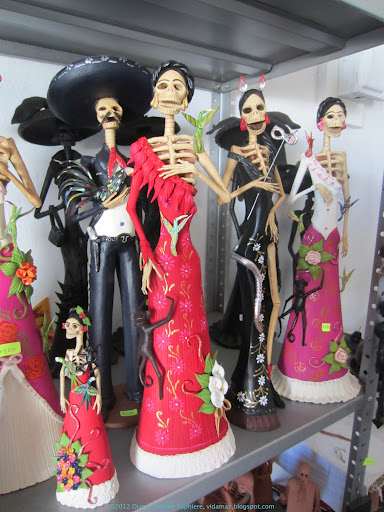
Also be sure to visit one of the many handicraft shops around town, as you will find wonderful Day of the Dead souvenirs, including traditional ceramic Katrinas and calaveras, skeletons representing people working in all sorts of different professions and engaging in sports and other hobbies. You’ll find lots of souvenirs to take home. Between the bakeries, candy stores, handicraft shops and even the fabric stores, you will find loads of wonderful gifts to take home.


Altars
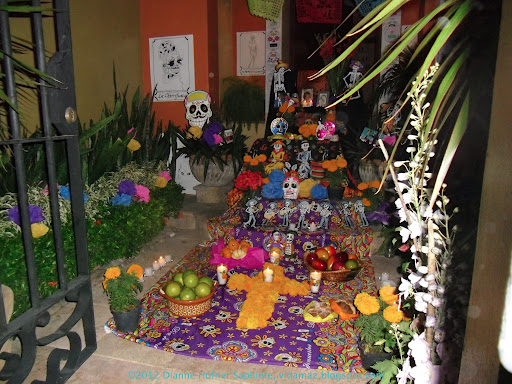
Next you will begin to see altares or family altars. Many families put together an altar to welcome back their departed loved ones.

On a table or a multi-tiered piling of crates, they put out photos of loved ones along with articles that belonged to them, cempasúchitl (marigold) flowers, tissue paper flowers, salt, candles, and water. Ofrendas or offerings of favorite foods or drink and items from favorite pastimes are also set out to entice the dead to stop in and stay a while.

There is an art to making an altar, and here in Mazatlán you will see everything from charmingly simple to very elaborate altars. Some years the Mayor’s Office or Secretary of Tourism have put out a map of the altars available for public viewing (usually the ones that will be visited during the callejoneada, below), so it’s worthwhile to check if a map’s available. If not, walking around the streets of historic downtown is definitely worth an afternoon or evening.

If you are in the Golden Zone, you will find that many hotels and other businesses set up altars, often for famous people that have passed on (i.e. Michael Jackson, Marilyn Monroe). Many of the altars are really heartwarming, showing incredible love and attention to detail.


The Callejoneada Parade, Evening of November 1st

Unlike celebrations with lengthier histories and more solemnic processions such as those in Michoacán or Oaxaca, Mazatlán’s Day of the Dead celebrations involve donkeys that pull gigantic kegs of free beer through the streets of downtown.

This callejoneada, a parade through the narrow streets of the Centro Histórico, takes place from about 6:30 pm on the evening of November 1st. It begins and ends in the Plazuela Machado, and afterwards families tend to hang out for cena or late night supper. Before the callejoneada there is frequently a performance event in the Angela Peralta theater. Many years there have also been public performances in the Plazuela Machado after the parade. Check schedulesor ask around to be sure what’s on when you’re here.
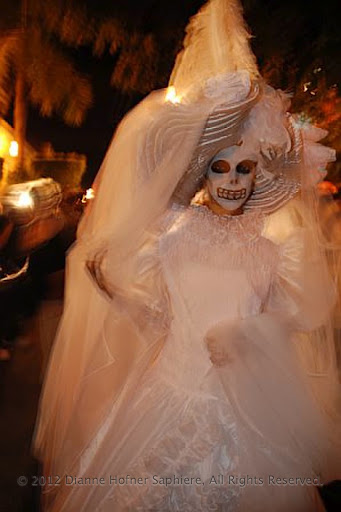
The white Katrina accompanies
children to the afterlife.
The black Katrina accompanies
adults to the afterlife.

The callejoneada is, for us, a not-to-be-missed event. Our very talented young dancers and actors from the Centro Municipal de Artedress in costumes.

Live bands join in.

Many in the crowd also wear skull masks or skeleton costumes, and a group of hundreds if not more than a thousand dances and sings its way through the streets of downtown, visiting the various altars to help the white and black Katrinas accompany the souls of those who have left this life during the year safely to the afterlife. Do not miss the callejoneada!

Wear comfortable shoes, do not hesitate to push your way up to the donkey cart for some free beer (wear clothes that you won’t mind having beer spilled on), have your camera set to night action mode, and be prepared to enjoy!

Perhaps you’d like to see a short video clip of the Day of the Dead parade?


Cemeteries

Be sure to visit the municipal cemetery or another, smaller one during Day of the Dead.

Most families will visit the graves of their ancestors to clean the gravesite, to set out fresh flowers, and, often, they take along a picnic, hire a band, and party a bit, right there in the cemetery!

While the children play, grandparents, uncles and aunties, Mom and Dad share a beer, eat some lunch, and reminisce about the dearly departed. I trust someone does this on my behalf some day!

As you approach the cemetery you will see flower shops and impromptu vendors selling all sorts of gorgeous flowers and decorations. Entering the cemetery, you will often see bands wandering around, hoping to be hired. Also, many workers are available to help tend to a tombstone, or simply carry water. It’s well worth a couple of hours. Most years we have been invited by friends to join their celebrations, though the first year we were here strangers invited us to join them.


“Roasting” the Living: Newspapers and School Fairs
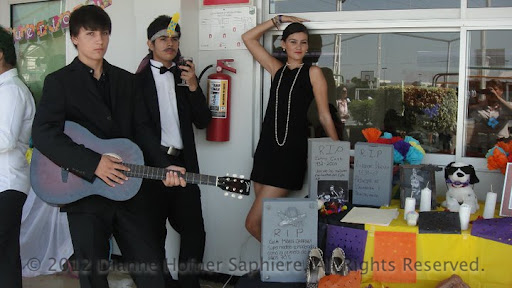
Another tradition this time of year is to celebrate the living as if they were dead. I believe this somehow reminds us all that we are on a one-way path through life.

The first time I witnessed this was at my son’s school. We walked in to find fake gravestones lining the walkways, with the names of (living!) teachers on the headstones! Each headstone contained a calavera or funny poem about the teacher. You will see many of these calavera poems in the newspaper, written about major politicians or celebrities in the news.

Friends will have the names of their (living) friends put on one of the sugar skulls, so that the friends can “eat their own death.” To someone not familiar with these practices it can seem a bit eerie, but it’s all done in good humor and filled with affection. One year at our son’s school they did “living altars,” where the kids acted out famous dead people.


Halloween

391770_372728722804454_1129221583_nThe Catholic diocese here tends to encourage people to celebrate Day of the Dead and very much discourages any celebration of Halloween, often referring to it as a witch’s or devil’s holiday. In Mazatlán, however, you will see children dress up in costumes and go trick or treating at the Gran Plaza or within El Cid residential development, usually on the evening of October 31.

Young adults, from junior high school on up, hold costume parties for Halloween.

Most of the dance clubs also hold Halloween parties. You’ll also see a lot of very sexily costumed young people waiting in line outside the clubs to celebrate a version of Halloween that, in my day, had not yet been invented 😉

We do hope you’ll enjoy Day of the Dead (and Halloween), Mazatlán style!

Primera CicloNoche Mazatlán/First Mazatlán Bicycle Night

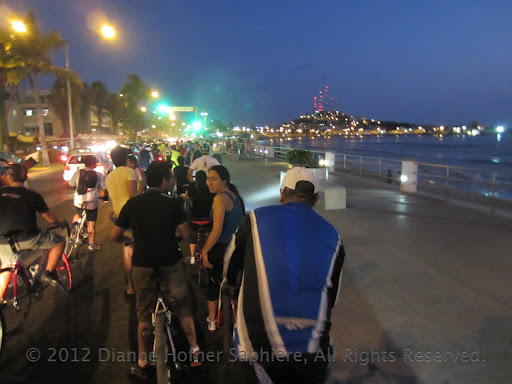
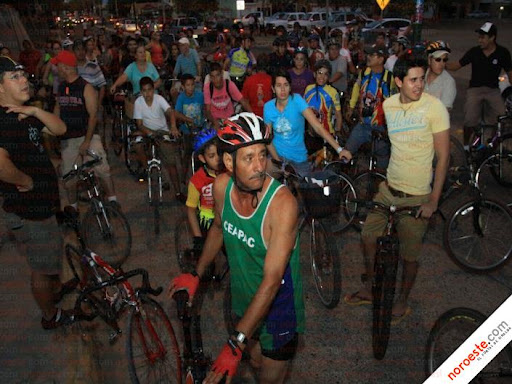
180 bicyclists showed up this evening at 8:00 pm for the very first CicloNoche Mazatlán!

We pedaled only about seven kilometers, but oh was it gorgeous!

The event was organized by SEMARNAT—Secretaria de Medio Ambiente y Recursos Naturales (Brenda Garcia) and CiclosUrbanos, who have been coordinating Cycle Nights in Culiacán since 2009.

Starting at the Aquarium, we pedaled south on Avenida del Mar to Belisario Dominguez, then turned up the road, around the block, and back down to Avenida del Mar. We were escorted by Mazatlán’s finest tránsitos, and we were instructed to stay in the right lane so that traffic could pass us easily.

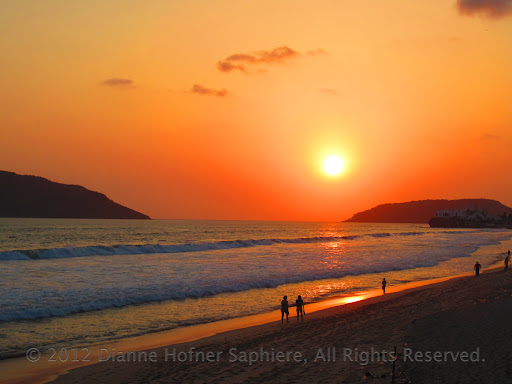
Our route started with the sunset, and ended with the starlight. Along the way we were cheered on and joined by ever-more cyclists.

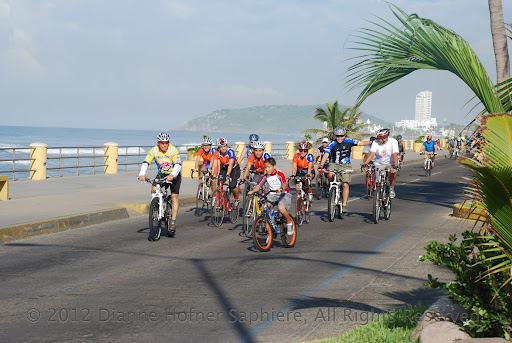
You’ll remember that a couple of years ago a group of active citizens organized a couple of months’ worth of Sunday morning closures of Avenida del Mar for bicycle riding.

The “United for Health” group was led by the very kind and energetic Dr. Angel Eduardo Olivera Sandoval, a local homeopath. Sunday morning street closures to traffic, so that families can walk and ride bikes, are common throughout Mexico and most of Latin America.

Here in Mazatlán we had good crowds turn out, but unfortunately the municipal government didn’t seem to support continuation of the activity.

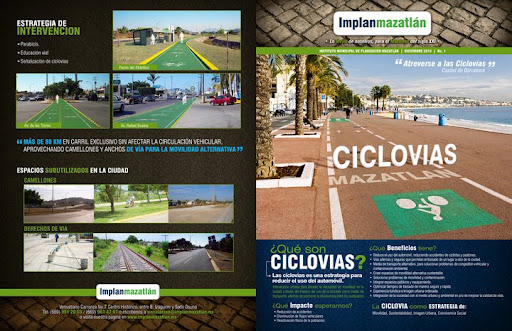
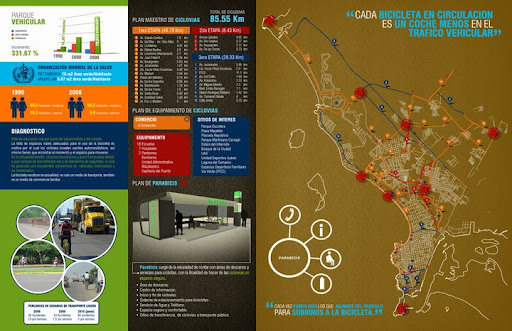
Nor have we thus far seen positive outcomes from citizen-led efforts to build bike lanes here in our port, despite having extensive ciclovías planning for some time now.

The event this evening was held in conjunction with the International and National Congresses of Environmental Science, which has had events at the Mazatlán International Center and the Aquarium.

We were told that the first CicloNoche Culiacán only had 90 bicyclists show up (compared to the 180 who showed up here tonight), so there is obviously a passion for it here in Mazatlán. These days in Culiacán about 1600 people show up for the once-a-month CicloNoches.

It is our sincere hope that this terrific activity can take hold and gain a place in the hearts of Mazatlecos.

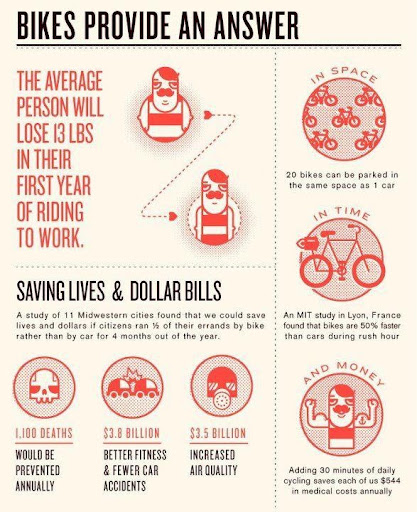
Bicycling promotes a cleaner environment, healthier bodies, enjoyment of the outdoors, time together with friends and family. It’s good for locals and out-of-town visitors.

Thank you to CiclosUrbanos, SEMARNAT, and all the organizers of bicycling events and programs in Mazatlán past, present and future!
Lets all turn out and show our support for bicycling! For our health and the health of our city!


Getting a Mexican Driver’s License in Mazatlán

For many of us, obtaining our first driver’s license was a treasured rite of passage. When it comes to our kids getting their licenses, however, like many parents the thought scares me. And the scariness factor is amplified because our son is learning to drive in what, for us, is a foreign land, and one in which the driving, at times, can seem a bit crazy. Guardian angels please protect him and those near him!

Greg and I obtained our Sinaloa driver’s licenses shortly after we arrived. We took the required class, submitted our documents, drove around the block, had our photos taken, and oilá. Others pay a “fee” and have it all done for them, but we did it above-boards and it was easy-peasy. In fact, the class was downright enjoyable — the teacher is a very good storyteller!

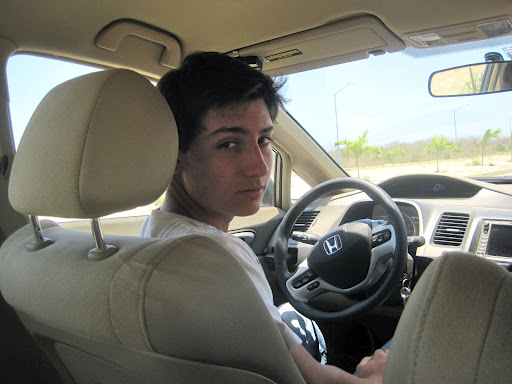
Now Danny’s just gotten his license, so I thought telling you about it might prove helpful for someone.

In his case, he’s a new driver, and we’ve been teaching him whenever we get a chance for about a year and a half. He started out slow, as does everyone, but these days he’s become quite competent.

He wants to work this summer to save money to buy a used car, and he will probably end up buying one with a stick shift. But, our car, the one on which he’s learned, is automatic. So, we enrolled him in a driving school so that he could learn how to use a clutch. The series of classes cost 1450 pesos, and included four rounds of driving of two hours each time, or eight hours total. In addition, there was a three hour classroom session during which they studied rules of the road. He seems to have taken to the standard transmission like a charm.

On Saturday he went to the tránsito, which is located just in front of the Aquarium here in Mazatlán. From the malecón, turn on the street towards the Aquarium. Go past the statue of Don Cruz Lizarraga, and turn right on the street on the far side of the vacant lot. The DMV office (tránsito) is at the end of the street, last building on your left, on the corner. There are two doors. The door on the right is where you file your paperwork.

The door on the left is where you take a class.

First-time drivers under the age of 18 have to take a five-hour class. They tell us the class is offered twice/month on Saturdays from 8:00 to 1:00. The classes seem to be pretty full, and the kids get a certificate upon completion which entitles them to be able to submit paperwork for a license. They do not take a written test.

When we got our Sinaloa licenses we already had U.S. driver’s licenses, so we only had to take a one hour class. At the conclusion of the class, they gave out a written test. There was an English language version of the test that they give out here in town, which seems much much easier than the Spanish language version (it’s multiple choice).

After the class and after you pass the written test, they give you paperwork so that you can go next door and get your license.

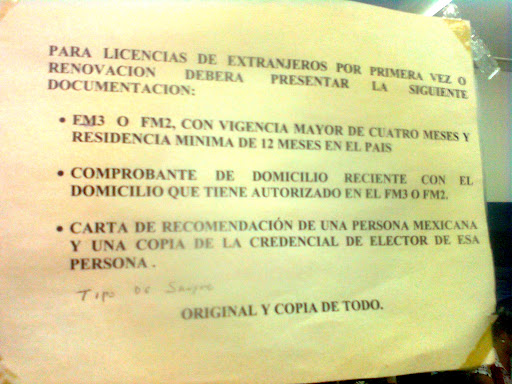
The documents a foreigner will need include (original and one copy of everything):

  1. Your Mexican visa or residency document
  2. Proof of residence/domicilio (water or electric bill with your name on it and your address)
  3. Letter of recommendation from a Mexican national, vouching that the person knows you and you are an upstanding person. This needs to be signed and accompanied by a copy of the signor’s voter registration card.
  4. You need to know your blood type (no proof required; just know it). If you don’t know, supposedly there is a lab about a block away where you can get tested. We know our blood types, so we didn’t experience this part of the process.
  5. The correct fee (see the photo at right for the chart of fees). Foreigners with FM3s are limited to 2-year licenses. First-time licensees pay for “Aprendiz.”


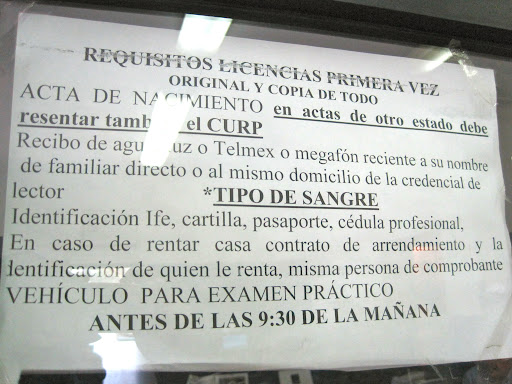
For first-time drivers like our son, you also need to bring:

  1. Birth certificate (to prove age)
  2. CURP
  3. Passport
  4. Parent needs to be present to sign

When you present your paperwork, they will usually ask you to do a driving test. So, you will need a car. They just asked us to drive around the block, nothing too challenging. We’ve been told that they want to be sure you buckle your seat belt and instruct the examiner to buckle his; this didn’t happen for us. Danny was also told that they ask you to pop the hood of your vehicle and show the examiner where you insert water, oil, coolant, etc., though he was not asked to do this.

Be careful as the street beyond the DMV office is one-way to the left; you don’t want to turn the wrong way. Also there are quite a few topes on the road leading up to the DMV office, as well as a stop sign conveniently hidden behind a tree.

After you drive with the officer, you pay your fee at a booth on the right side. Currently that fee is 344 pesos for a two-year period.

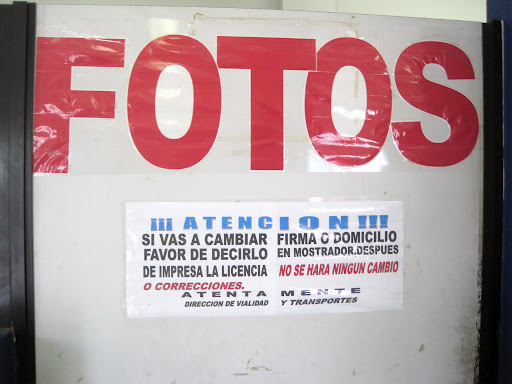
Next they take your photo and produce the license while you wait.

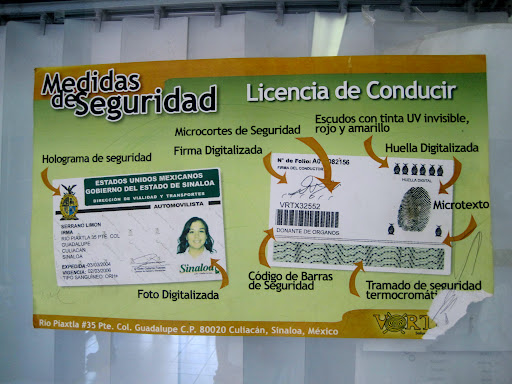
Each license contains a fingerprint of the license holder, so that’ll be the last step in the process. For us we filed the paperwork, did the drive around the block and got our licenses in under 90 minutes.

Licenses are issued Monday through Friday 8 am to 2:30 pm.

Renewals (as well as license plates, titles) can be done at this same office. However, we have had much better luck renewing our licenses at the DMV office in the Gran Plaza — it’s less of a crowd and seems to go quicker.

Good luck and drive safely!

NOTE: Our son said he learned a lot more in the driving school than he learned in the tránsito class, although he enjoyed both, and that he highly recommends the school for new drivers.

Opening of the Hotel Jonathon

We’ve been watching it being built. Have gone in a couple of times to check out the progress. Was supposed to have opened in time for Carnavál last February.

But, hey, the Jonathan Hotelis now open, it’s been open for five days, and it’s beautiful!

Facing the Angela Peralta Theater, it has a view of our city that we haven’t yet been privy to; unless of course you own a 3-story home right in front of the opera house!

On this Thursday evening during graduation and end-of-the-school-year season, it was quite the exciting place to be!

The Hotel Jonathan, built with Korean-San Diego money from what I hear, is really gorgeous.

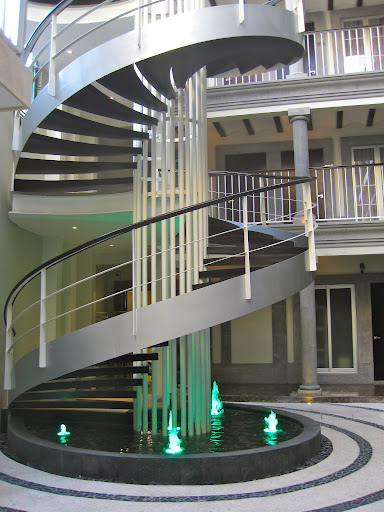
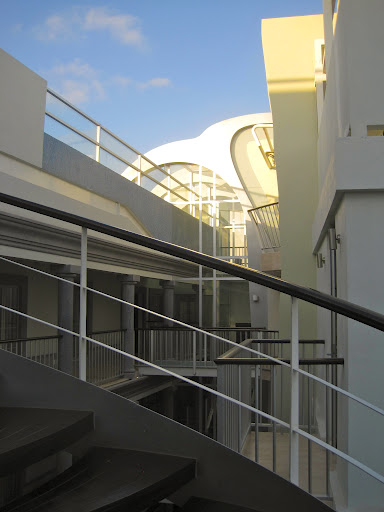
Very modern, though they kept the historic façade per Centro Histórico regulations.

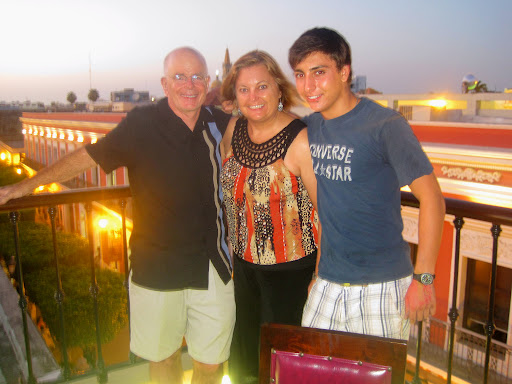
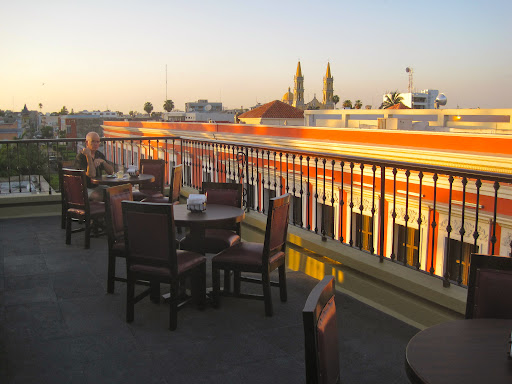
We went at sunset this evening, and had a drink up on the rooftop bar as we waited for Danny to finish his painting classes at the Municipal Center for the Arts.

The setting is gorgeous, although you see the reality of our fair city right next door.

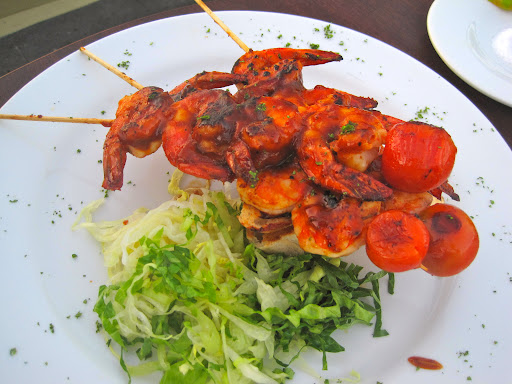
The food was good but not outstanding. That may of course improve as staff get accustomed to their roles. We ordered barbecued shrimp and crab-stuffed mushrooms. Danny later had clam chowder.

All our dishes were fine, just not remarkable. Presentation was nice.

The Jonathan Hotel would seem to be a beautiful addition to our local boutique hotel scene: well located, old-world yet modern, romantic yet sleek. The restaurant is on the ground floor and is gorgeous, with some nice Asian ink-brush paintings and floor-to-ceiling-windows onto the central courtyard.

A great place to wait for our kids to finish their classes. A great place for before or after the theater. A wonderful place to hear the Plazuela music without the crowds. Tonight the rooftop bar was ours and ours alone.

Let’s hope this venture endures! Good luck and god speed!

Update in July: The Hotel seems to have liked our photos. Check out the header on their web page. Would have been courteous to acknowledge this post and request use, but, glad it’s of use….

Children’s Day at Deportivas Juarez

The other really terrific Children’s Day event in which we participated last weekend was a huge festival for local kids from the more marginalized neighborhoods of town. It was held at the Canchas Juarez on Sunday. (I already posted about the terrific opening of the Marco Polo Park last Monday, which was Children’s Day here in Mexico.)

The festival at the Deportivas Juarez was very well organized: well-publicized, a published schedule, lots of organizers wearing colored shirts, Scouts present to help out. There were people at the park collecting donations of toys and gifts all week leading up to the event. They had a clown as a Master of Ceremonies who was just terrific, and the mayor and his wife and the full Cabildo Infantil 2012 showed up. The whole Juarez complex, by the way, is amazingly state-of-the-art: green grass on the fields, covered bleachers, large clean toilet facilities. Kudos to the city and the local business sponsors for building this new park for our kids!

The children on Sunday had so many terrific activities in which they could participate! There were sports events such as running races on the track, baseball games, soccer and American football games. There were carnaval-type games and face painting. There was music and dancing. There were gifts and prizes, from new bicycles and soccer balls to dolls and toys and books. We made a human fish and a helicopter arrived to take photos, to the delight of the kids. But the biggest hit of this party, hands-down, were the half dozen or so swimming pools that they had brought in and filled on-site. Some of the kids didn’t want to get out of those pools even to run and wave at the helicopter (though the helicopter was a HUGE hit)!

The event was organized by a long list of local grassroots organizations, and sponsored by a large number of local businesses. About 1500 kids had a really terrific time; an amazing turnout for a first-time-ever event, I thought. I was so proud to be involved. There were so many giggles and delighted faces.

Take a look and enjoy the slideshow above! If you’d rather see larger photos, click through to SmugMug. Some videos I took of the event have also been posted to YouTube, if you are curious. I’m sure they’ll be edited together in time; right now they are just raw footage. First one is here, and you can see there are about a dozen more if you’re trying to find something in particular. Enjoy!