 The Wild Goose
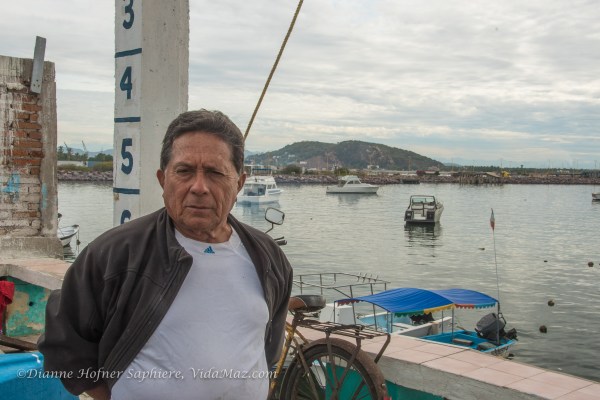
Imagine yourself at twenty years old, a poor fisherman hauling in 400 kilos of lobster—there were loads of lobster in our waters back then—in your panga in the bay of Mazatlán. Suddenly a 136-foot yacht pulls up and none other than John Wayne himself shouts out to you, inviting you aboard for coffee. This is what local boat charter operator Manuel Valdéz tells me happened to him.
Wayne spoke Spanish fluently, having been married to three different Latina women and having spent considerable time filming and vacationing in México. Of course, Manuel boarded the large vessel, counting his lucky stars. The Duke asked him about his catch and offered to trade bottles from his extensive wine cellar for some of the lobster. “No,” Manuel said, “I don’t want to trade for wine. Thank you.” “I know what you want!” Wayne apparently responded with a twinkle in his eye. “You want a magazine, one with some nice chicas.” Handing Manuel a girlie magazine, they shared their first belly laugh.
He had to deny John Wayne for the third time.
“No, I can’t trade. I am going to take the lobsters to my rancho in Mesillas,” Manuel told the actor. Upon hearing the word “rancho” Wayne got excited and asked if he could accompany Manuel to his ranch. Manuel believed that Wayne was imagining a ranch with a big house and lots of cattle, when in fact the fisherman was the son of a poor family with a simple home that didn’t own any livestock. He had to deny John Wayne for the third time. “Not today,” he said with embarrassment. “Maybe some other time.”
Then the Duke returned to the topic of the lobsters. “If you don’t want to trade, I’ll buy them from you.” Proving that he was a very clever young man, instead of selling the lobster Manuel gifted the star two large sacks of lobster. When Wayne insisted on paying him, Manuel asked that instead of money he be invited for dinner. Would you have been able to think that quickly? I don’t know that I would have. Happy to oblige, Wayne invited Manuel for dinner at 8 pm. Manuel says that he arrived on the boat at 7:00, excited to be able to socialize with the Hollywood star and eager to taste what Wayne’s private chef would serve!
Wayne took a liking to the young Sinaloan.
Wayne took a liking to the young Sinaloan, offering Manuel a job as deckhand on the Wild Goose, his remodeled Navy minesweeper. Manuel explained that he had neither a passport nor a visa and had not yet completed his military service. “You do your military service and get your credential. I’ll take care of the passport and visa,” Wayne told him. True to his word, a few months later Manuel was working on the Wild Goose full time: six months in California, six months in México. That job would last twelve years, until Wayne’s death.
That job would last twelve years, until Wayne’s death.
Manuel says he got to know the Wayne family well. The actor was then married to his third wife, Pilar, a Peruvian beauty, and was almost always accompanied by her and their children, Aissa, John Ethan and Marisa. Manuel has many memories of the giant family man laughing, playing cards, horsing around, jumping into the water and swimming with his children. He says that Wayne had a heart of gold and absolutely loved children. He would work the boat with the crew, loved piloting it and especially loved the 3 am watch.
When I first met Manuel, he showed me several photos of him and the Duke and him and the crew on the boat. Sadly, his cell phone was stolen, as was the printed photo in his office, and now he has no photos left from this period of his life.
The Duke also enjoyed hosting his friends from Hollywood; the boat, according to Manuel, had four bars, was made of Douglas fir, and would sleep 25 guests plus eight staff. Dean Martin was a frequent visitor aboard the Wild Goose, and Manuel told me that Martin’s drinking wasn’t just part of his act; in real life he loved Russian vodka, too. Wayne once told Manuel, “Don’t waste time watching the boat tonight; I’ve got a more important job for you. Watch Dino so he doesn’t fall overboard!”
The way John Wayne greeted Manuel on their first meeting was a pattern he frequently followed. The Wild Goose had a huge tank to store live seafood, and in Manuel’s memory it was always full because, whenever they sailed past a fisherman, Wayne would insist they stop and see what the guy had caught. He’d offer the man some coffee, engage him in conversation, and end up trading for his day’s catch. “We never bought fish or seafood. Mr. Wayne would always trade for it. He loved to meet people and to barter.”
The first trip Manuel made with John Wayne was to Acapulco: 600 miles from Mazatlán at 12 mph with their 1000 horsepower turbine engine, one of only two in the world, according to Manuel. They pulled into Acapulco right next to Frank Sinatra’s boat, Pussycat. “I was really lucky as a young man,” Manuel told me. “Our very first day of fishing we caught two marlins. Wayne told me I brought him luck.”
Every year they would visit Vallarta, and head over to Acapulco prior to heading north to Newport Beach, where they’d anchor at Lido Isle. “One time when we were in Acapulco Wayne received a huge check. He had sold one of his prize steers from his 26 Bar Ranch in Eagar, Arizona. He took us out to a hotel for dinner and drinks. He hosted us to the best of everything, saying, ‘Let’s see if we can spend this money tonight!’ I had so many great experiences and met so many incredible people,” Manuel reminisced. “Mr. Wayne was a really good guy, very patient. I remember one time when we got five or six miles out of Acapulco, and I realized that I’d forgotten the fuel back on the dock. I told Mr. Wayne, fearful of what he would say. But, fortunately we just turned around, got the fuel, and went on our way.”
In Newport Beach Manuel had a room in Wayne’s home or, if he returned home late from a party, he might sleep on the boat. He remembers the very first time he arrived at Wayne’s mansion, which seemed to him an entire city block in size. “If you were on one end of the house you couldn’t tell if anyone was home in the other end.” That first night Wayne’s staff, all from Guadalajara, cooked carne asada and fresh tortillas. Manuel was in heaven. He says that after his twelve years working for Wayne he would never again eat so well.
Manuel was the only Mexican crewmember on the Wild Goose. The captain he sailed with most was named Jack Curley. The first mate was Bert (Albert) Minshall, and Bert’s brother Ken was the engineer; they were English. The chef, Bill or “Memo,” was German. Manuel was especially impressed with how Bill would cook the duck that Wayne would hunt. “Duck tastes gamey. It’s tough. But Bill would cook it so we’d all lick our fingers and want seconds.”
Manuel remembers that they would always stop at Isla del Cedro, south of Ensenada, to go duck hunting. They’d stay there about fifteen days. “We’d get a lot of abalone and lobster there,” he told me. “It was the only place that sold diesel fuel.” Manuel talks about the guide there—a big fat guy—with some envy, because Wayne would always leave him a month’s worth of food provisions, including lobster, snapper, abalone and scallops; “I wanted some of that food,” Manuel told me. “In those days there were so many fish. We could stand on rocks at the edge of the Mar de Cortés and shoot snapper with harpoon pistols, as many as we could. It was heaven.”
According to Manuel there was usually a photographer on board, a man named Joffrey. One day over in Baja, Joffrey had a cold and asked Manuel to take pictures for him while he rested. He showed Manuel the basic operation of the camera. When Wayne and Manuel later took the zodiac to shore they noticed a huge, maybe three-meter-long shark on the dock. “Mr. Wayne got so excited. ‘Take my picture! Take my picture,’ he shouted. I did, and he shared that photo with all his friends, and it appeared in newspapers and magazines. Joffrey was so mad at me,” Manuel recalled. Joffrey was jealous that he missed such a great photo opportunity. To thank Manuel for the great photo, Wayne bought him a pair of new shoes. Manuel continued to wear his worn-out pair, but Wayne noticed. “Where are your new shoes, buddy?” “I’m keeping them for special occasions, for Sundays,” Manuel responded, but the Duke forced him to start using them.
Manuel says they got new uniform shirts, khaki slacks, grey sweaters and topsider shoes at least once every six months. When they were up in California they would cruise over to Catalina Island most weekends.
Manuel told me about the time he tried to cross the border heading north, in order to get back to work, and the US border agents detained him. “I called Mr. Wayne, and he called the State Department. Then he actually showed up at the border. He put his arm around my neck, looked straight into the border official’s eyes, and said, ‘He’s coming with me.’ No one stopped us then!”
Manuel made his last cruise with John Wayne in April of 1979; he was on the boat the day the Duke died of cancer. “He was happy and strong right up to the end,” Manuel tells me. “The service was private, a family affair. After that, when I came home, a big Texan at the Tijuana/San Ysidro border crossing told me, ‘Your patron is gone now. This visa is history.’ I had a lot of time left on that visa, but he took it from me. And that was that. I returned to reality.”

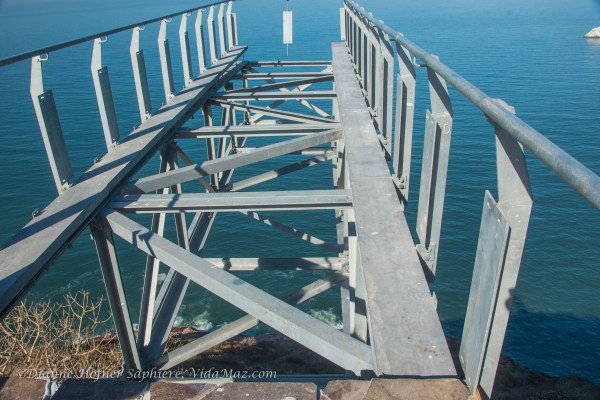 The glass walkway atop the lighthouse is, indeed, a reality. The glass for the walls is there and ready for install; the glass floor is scheduled to arrive and be installed next week. I walked to the edge of the solid surface and looked down, and it is truly a thrill! Long, long, long drop down! Click on any photo to enlarge it or view a slideshow.


 French Canadian artist Manon Côte has an exhibition of some very unique visual art pieces on display right now in the Galería Carlos Bueno at the art museum. I very much enjoyed meeting her and viewing both her artwork and that of her students.


 Many thanks to all of you, the opening of my photo exhibition in the Galería Peralta on Thursday night broke the record for most people attending. It also signaled the opening of the Temporada Primavera, or Cultura Mazatlán’s Spring Season; my exhibit was the first event, a very nice honor!


 ¡VidaMaz!