Cultural Appropriation of Day of the Dead?

As locals, expats and immigrants gear up for Day of the Dead festivities here in Mazatlán, I wonder how many of us realize that there has been quite a backlash to cultural appropriation and commercialization of Day of the Dead by non-Latinos.

I first realized how “hot” Day of the Dead was on my recent visit to a US liquor store. There, I was astounded by the quantity of Day of the Dead- or calaca-themed beer and liquor! To be honest, skeletons and skulls in and of themselves seem to be popular, and anything Mexican (amigos, lucha libre….), Spanish (Don Quixote) or mystical (voodoo) as well. The commercialization is, indeed, real. Click on any photo to enlarge it or view a slideshow.

Living here in Mexico, where we are privileged to be steeped in the traditions as well as the festivities, I hadn’t realized the concerns about appropriation of Day of the Dead until I read a post by one of the bloggers I follow, Aya de Leon, entitled, “Dear White People/Queridos Gringos: You Want Our Culture But You Don’t Want Us — Stop Colonizing The Day Of The Dead.”

In reading her excellent article and researching the matter a bit more, it seems that most Latinos are proud of this holiday. They understand that recognizing the dearly departed is a universal desire. Most are happy to share and ready to welcome us into the Día de los Muertos traditions, which have existed since Aztec times. But they most definitely and understandably resent our taking on the traditions as our own and transforming them into something they’re not — emptying the traditions of their soul. She writes:

And the urge to colonization is born when your own land and resources have been taken over by the greedy and your cultures have been bankrupted. Halloween has a rich history as an indigenous European holiday that celebrated many of the same themes as Day of the Dead, but you have let it be taken over by Wal-Mart… You have abandoned Halloween, left it laying in the street like a trampled fright wig from the dollar store. Take back your holiday. Take back your own indigenous culture. Fight to reclaim your own spirituality.

Please. Stop colonizing ours.

Aya gives examples of Day of the Dead festivals organized by non-Latinos in which Latino voices and faces are not even present! She talks of a sort of Cinco-de-Mayo-ization (my words) of Day of the Dead, in which white hipsters wear calaca face paint, stand amongst broken marigolds listening to white bands, and drink gentrified, holiday-themed micro-brews, without so much as a thought to what the true tradition is or means. She explains, and rightly complains, that we love Mexican culture when it’s convenient and fun, but not when it involves advocating to solve undocumented immigration, illegal gun exports, or rampant femicide.

So where, exactly, is the line between participating in and honoring Day of the Dead and appropriating or colonizing it?

Cultural appropriation is often used as an accusation, implying theft. But cultures, their traditions and artifacts, often aren’t clearly distinguishable. Throughout history people have intermingled, shared, and been inspired by one another.  As an interculturalist, I’m all about diversity, integration, collaboration, creativity. There is nothing inherently wrong in us learning from and building on one another; that is actually, rather, a really good thing!

The problem, Aya tells us, is many who are welcomed to the Day of the Dead table are poor guests. We don’t sit at the table; we take the table over. We don’t pay our respects, acknowledge our hosts, or say thank you. We need to be conscious that if we organize themed events, we should use them as opportunities to showcase Latino artists and musicians, and we should hold the tradition with reverence, respect, and a desire to learn and honor.

In an insightful piece in Quartz, Noah Berlatsky tells us that the problem with cultural appropriation is racism:

“There’s nothing wrong with Elvis loving and imitating Jackie Wilson. But there is something wrong with the fact that Elvis is hailed as the King of Rock n’ Roll, while most people barely know who Jackie Wilson is… White performers, like Taylor Swift or Miley Cyrus, use twerking in their videos on the way to becoming more successful and awarded than the black women who developed the style in the first place. When the white borrower, predictably, earns more accolades than the borrowee, artistic freedom and admiration is transformed into something much more problematic… While country music loves black music, it mostly excludes black artists, in the sense that those artists are not considered central, and their contributions aren’t recognized.”

Therefore, all of us need to be vigilant to extend power and privilege, credit and honor, to the origins and originators, not just to those who adapt. However, our modern-day systems are skewed against us. Those who write a book are credited with ideas expressed by others; individuals and corporations can copyright and trademark something that has a long tradition and belongs to a group of people.

Did you know that Disney even attempted to trademark Day of the Dead? They were making a movie called, Day of the Dead, and wanted to trademark the title. Thanks to huge response to a petition on Change.org, Disney rather quickly pulled its trademark application. According to an article in the Los Angeles Times, here’s what some of those opposing Disney’s trademark application had to say:

“Our spiritual traditions are for everyone, not for companies like Walt Disney to trademark and exploit,” wrote Grace Sesma, the petition’s creator. “I am deeply offended and dismayed that a family-oriented company like Walt Disney would seek to own the rights to something that is the rightful heritage of the people of Mexico. This is a sacred tradition. It’s NOT FOR SALE,” wrote Consuelo Alba, of Watsonville, Calif.

The trademark application was “odd” to Evonne Gallardo, executive director of the Boyle Heights art center Self Help Graphics. The center puts on one of the largest Day of the Dead celebrations in Los Angeles and has been sponsored by the Walt Disney Co. “The right thing to do is not to attempt to trademark a cultural and spiritual celebration,” Gallardo said. “I have yet to see a trademark on Christmas or Hanukkah.”

The movie was re-titled to “Coco,” no doubt so that Disney could trademark the title and create a website. One of the most spirited activists to oppose the trademark application was cartoonist Lalo Alcaraz, creator of that incredibly powerful graphic at the top of this post. In a great act of corporate listening and learning, he was recently hired on by Disney to work on the film about which he protested! Our speaking up to defend our heritage can have positive results! The movie is being made, showcasing a beautiful tradition, and it now includes more representation from the very culture it portrays.

Today as I started to write this post, I read an interesting article in The Atlantic: “The Dos and Don’ts of Cultural Appropriation.” In it, Jenni Avins provides six recommendations to prevent appropriation, including involvement of and engagement with members of the culture. She points out that cultures are fluid and constantly changing, so we can’t ask that they stay frozen in time. On the other hand, foreign passion has often helped preserve native traditions, arts, handicrafts, music, dance, literature and even languages. Like Aya, she highlights the importance of acknowledging and honoring the source, the origin, of cultural arts and traditions. Jenni also provides two “don’ts”: never wear blackface, and never use sacred artifacts as accessories.

As we all gear up to paint our faces and create our altars, let us participate in and enjoy the festivities, and use this time to truly remember those who have preceded us in death. Day of the Dead provides a perfect time for us to learn from our neighbors and hosts in this country, and to share with them a human universal: remembrance and longing for those we’ve loved and lost.

When have you felt the tug between honoring and participating in the local culture, and appropriating it?

Day of the Dead Makeup Class

©03.IMG_0542

My cousins Lori and Mary, and yours truly. I asked my friend Lilzy, who did my makeup, to put a rose on my forehead in honor of my Aunt Rose, my cousins’ wonderful Mom.

Do you love Day of the Dead? We all know Mazatlán has one of the BEST DODs in all of Mexico, what with the callejoneada parade, the incredible show inside the Angela Peralta Theater, the numerous gorgeous altars all over town, and events at the cemetery. Do you love joining in the traditional festivities? Would you like to be able to do your own or your friends’ makeup?

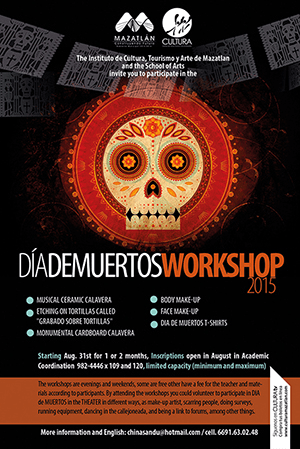
DODThis September and October, our beloved Centro Municipal de Arte/CMA/Municipal School of the Arts has been conducting free workshops in preparation for these big events, coordinated by the gorgeous, energetic and enthusiastic Cecilia Sanchez Duarte (nicknamed China). The latest was yesterday’s class in calaca (skeleton) or catrina makeup, conducted by Delfos dancer and makeup artist, Johnny Millán, with interpretation into English by China herself. It rocked!

The class was held from 5-7 pm in the air-conditioned comfort of the Jonathan Hotel, just across from the CMA, and was attended by about 40 people. China arranged the class in hopes that more and more of the city’s residents will dress up and volunteer to participate in the main events, including the parade and the performance in the theater.

The timing of this workshop was perfect for me, as my two beloved sister-cousins were visiting from Minnesota and Indiana. We get together for a girls’ vacation every October, and we always do a craft. What better “craft” than a Day of the Dead makeup class with a professional makeup artist—for free?!

©05.P1280960

Cecilia Sanchez Duarte, director of Fine Arts at the CMA, in charge of Day of the Dead in the theater

Supplies for the Basic Makeup

Prior to the class, China had sent those of us who pre-registered a list of supplies to bring:

  • White concealer (corrector blanco),
  • Black eyeliner pencil (lapiz negro),
  • Black and white powders or eyeshadows (sombras),
  • Eyeshadows of different colors, and
  • Shiny things (e.g., sequins—lentejuelas, or crystals/gemstones). We also brought
  • Fake eyelashes (which we didn’t have time to apply) and
  • Eyelash glue, a couple of
  • Hand mirrors, a box of
  • Kleenex, and some
  • Props—a catrina hat and a couple of feather boas. I rarely put on makeup, so what we forgot to bring were
  • Brushes, Q-tips, applicators and blending sponges, also highly recommended.
©04.P1280958

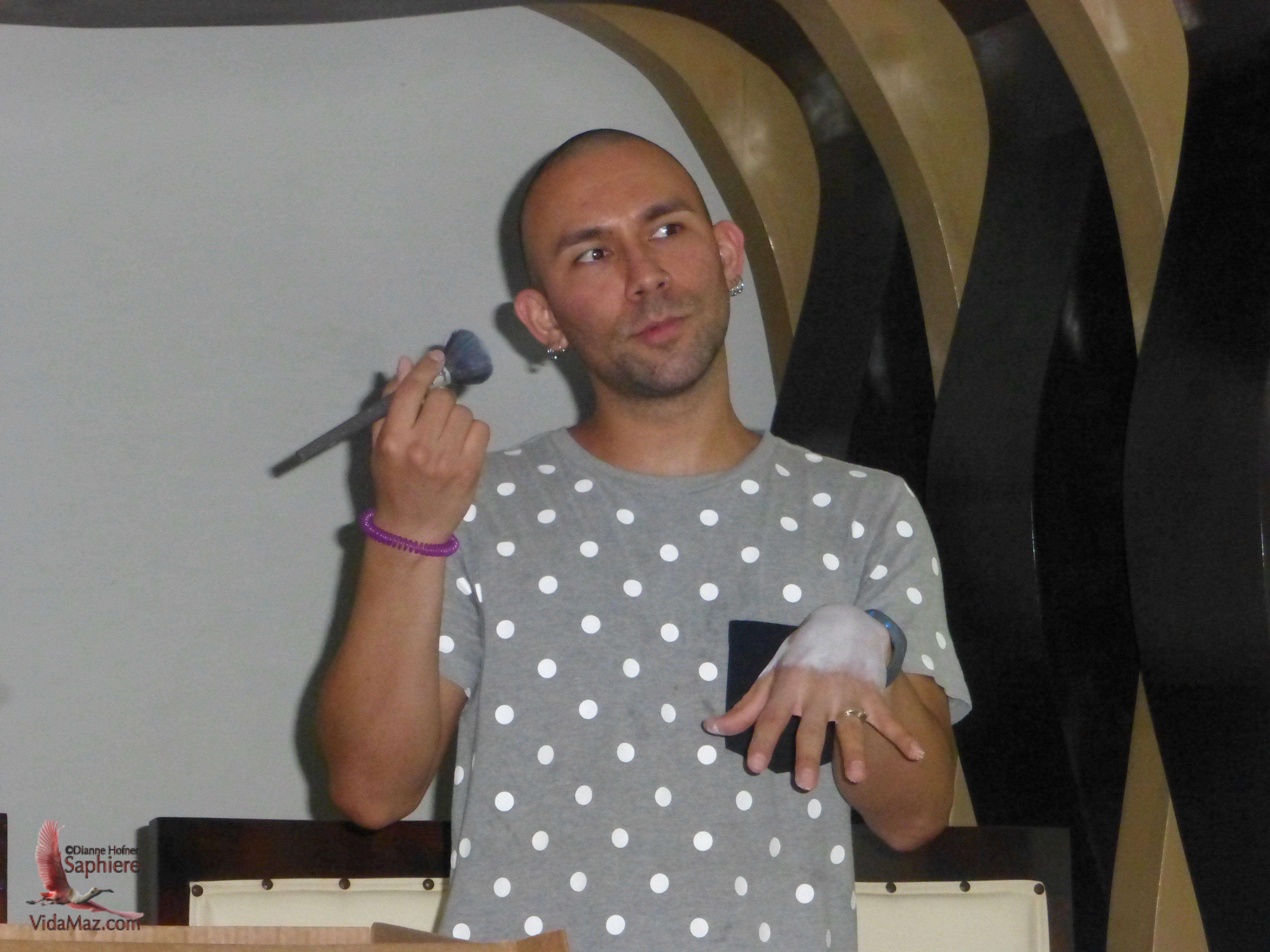
Johnny Millán, Delfos dancer, professional makeup artist, and our teacher for the day

Maestro Millán first talked to us all as we sat theater-style, explaining the different types of makeup, brushes and blending pads he likes to use. He told us that while we can’t get professional-quality white pancake theater makeup here in Mazatlán (he brings his from DF), the concealer works well. We’d just need to break off pieces and mix it into a paste (which we could do on the backs of our hands) till it was smooth and free of clumps.

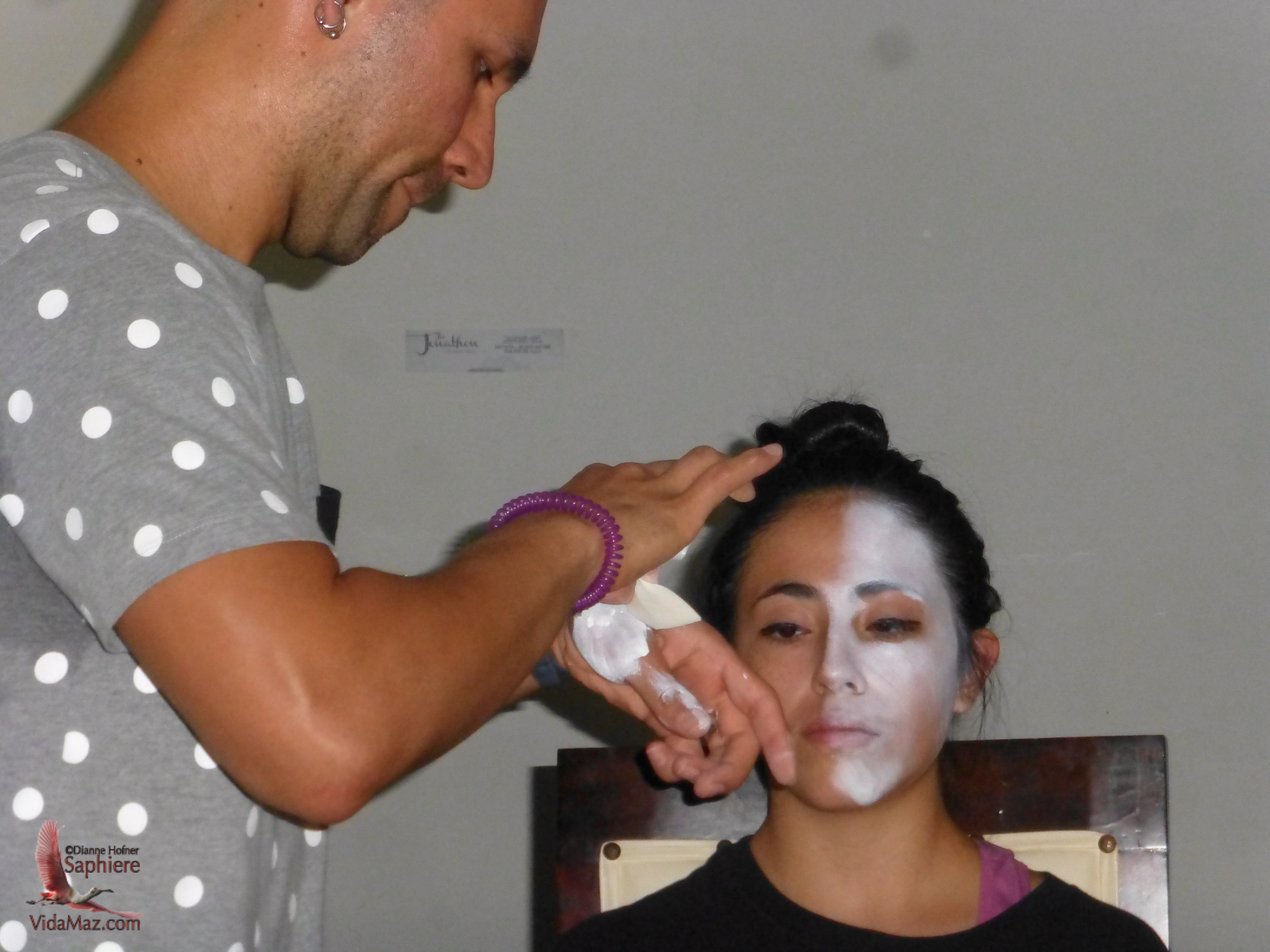
He demonstrated the steps to a basic catrina makeup on a model, doing just half her face in order to save time on his explanation. After his demonstration, those of us attending got to either apply makeup to one another or to ourselves. We were all so excited to get started! He had some supplies to sell us, and was happy to share Q-tips and other applicators.

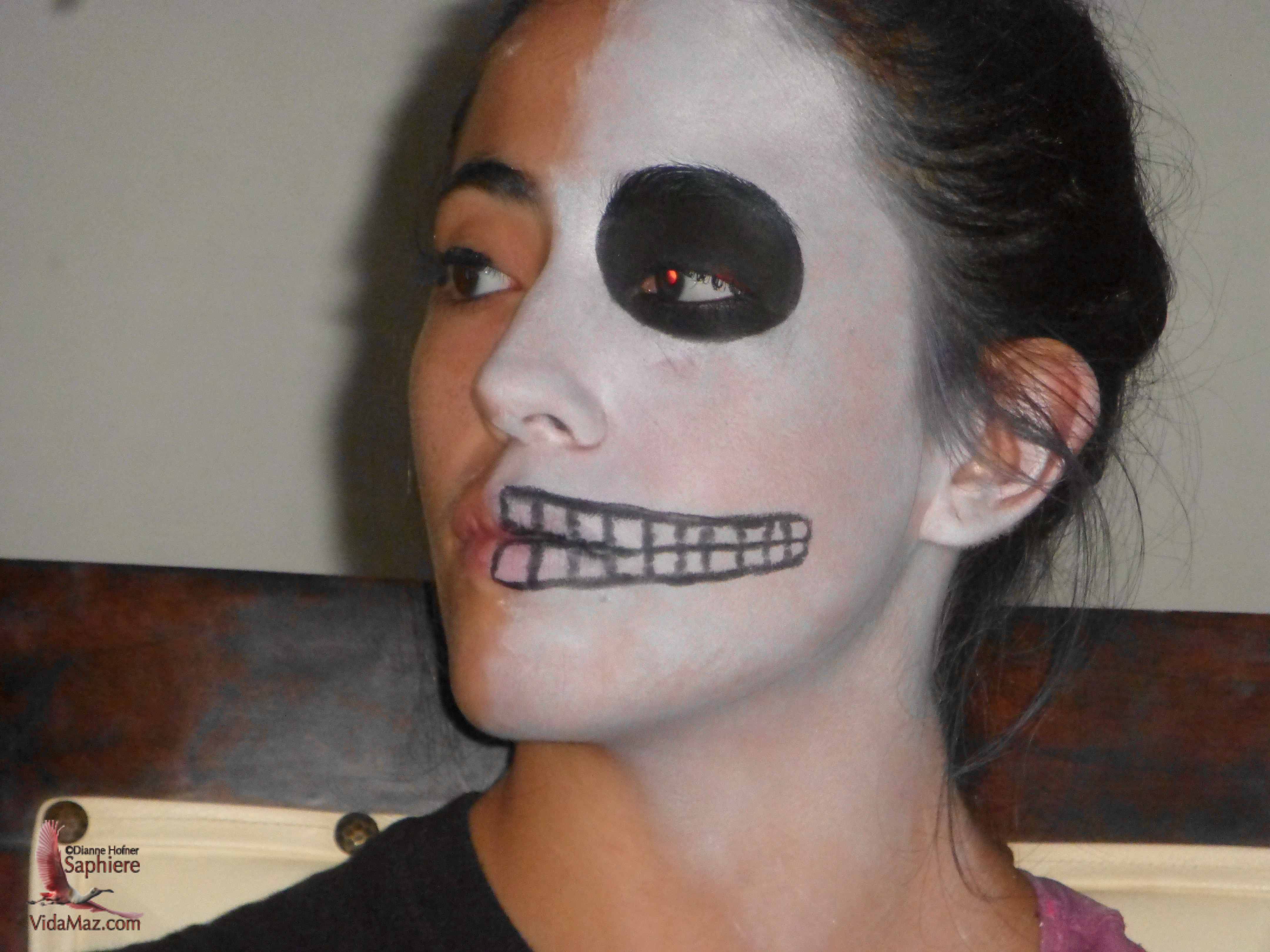
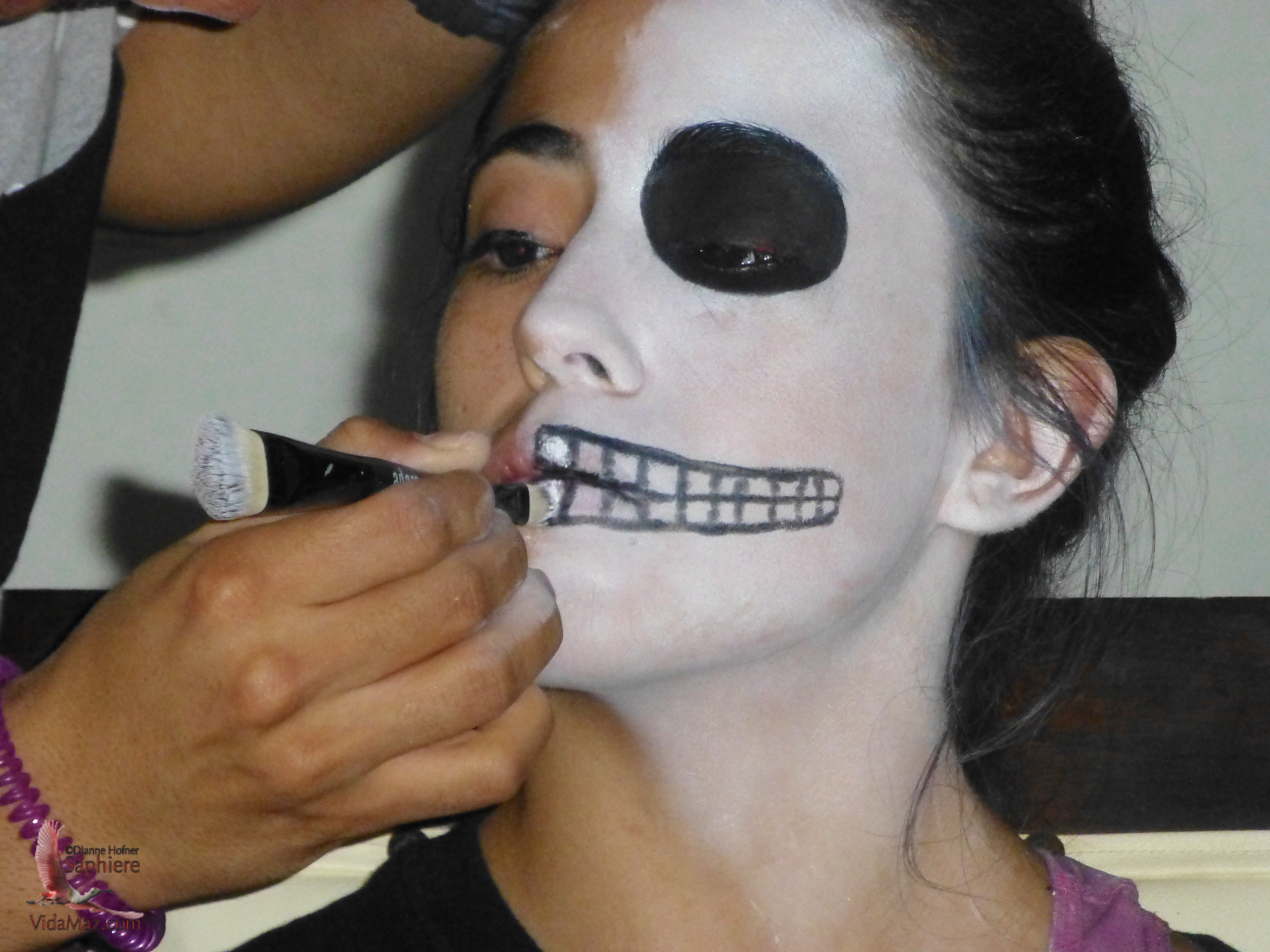
In the 90 minutes or so that we had available to do one another’s makeup, the most any of us were able to achieve was the basic makeup, with a teeny bit of customization. While we were working on the basic steps explained below, Maestro Millán finished up the makeup on the model. You can see what she looked like in the final photo in this post. Needless to say, the Maestro was fast, made it look so easy, and had really great results. That’s why he’s the professional, right?

Steps to the Basic Makeup

  1. Johnny showed us that the first step to creating a catrina makeup is to apply a thin white base coat. For this we used the concealer that we’d made into a smooth paste. He told us to apply this with our fingers or with a sponge, and that we don’t need to blend the white to cover the face perfectly; later when we apply white powder or eyeshadow over the concealer to fix it, the coverage will become much more perfect. He told us to be sure to avoid applying white to the area around the eyes, as we’d later paint them black or in colors, and to think about the costume we are going to be wearing: if our hair will be up, we should paint our ears; if we’ll have a plunging neckline, we’ll need to paint our chest, etc. Be sure not to put the white on too thickly; you can see in the photo that the base coat is very thin.

    ©01.P1280962-1

    Step 1: White base coat

  2. Next we took a brush and set the base coat with a dusting of white powder or white eye shadow. This step was incredible. It really made the base coat look well blended, and it made the color pop! Not being a makeup queen myself, the power of the powder over the makeup really astounded me.

    ©02.P1280963-2

    Step 2: White powder to seal the base coat

  3. Once we had our white face on, we proceeded to the eyes. Johnny told us to use the black eyeliner pencil and, in the direction of the growth of hairs on our eyebrows, to trace the brow line and then around the cavity of the eye, following the bone of the eye socket. Once we had the outline, we were to fill the area in with the black eyeliner pencil. Again, we didn’t need to worry about perfectly blending, as we’d next cover this area with black powder or eyeshadow. If you want to put colors on the eye area, you can apply glitter or shadow over the black, or you do it directly to the skin, depending on your creativity.

    ©03.P1280965-3

    Step 3: The eye sockets

  4. We now needed to seal the black eyes with shadow or powder. Again, our rough-looking black eyes suddenly became velvety smooth and perfectly blended. It was amazing.
  5. From here Johnny told us to work on the mouth. This was by far the most difficult part of the basic makeup for most of us in the class.  He told us to follow the upper and lower lip lines, and extend the line out to where the teeth actually end in the back of the mouth, squaring off the outside. We then needed to make a center line, right where the lips meet, painting inside the lips a bit so the pink didn’t show. After that we made vertical lines to create teeth. One trick here is to round the roots of the teeth a bit with the eyeliner pencil, so they are not square but more natural looking.

    ©04.P1280973-4

    Steps 4 and 5: Sealing the eye sockets and outlining the teeth

  6. It was important for the teeth to be bright white, so at this point we took an applicator and applied another dot of white concealer to each of the pearly teeth. This really made the teeth look real.

    ©05.P1280974-5

    Step 6: Making the pearly whites pop

  7. The final main feature was the nose. We drew triangles over the nostril area, to look like the holes in a skull.

    ©07.P1280977-7

    Step 7: The nasal cavity

  8. To finish the basic makeup, we needed to use the pencil to draw the jawline, and then seal that with black powder. We also dabbed black powder around the hairline, and used it to hollow under the cheekbone.

    ©08.P1280985-9

    Step 8: Shadowing and contouring the facial outline and bone structure

  9. From here, Johnny told us our creativity could take free rein. We could put sequins around the eyes (he said we could use eyelash glue or even normal white Resistol water-soluble glue), liquid eyeliner to paint some cracks or decorative detail (sealing those details with powder), adding colored eyeshadow or glitter to the eyelids, or detailing the neck and chest. Click on any photo to enlarge or view a slideshow.

Fortunately most of us attending felt that the makeup was pretty easy to do, and it was really fun! While 45 minutes for each face (our group painted one another) isn’t much, we were pretty psyched with the results.

12115980_943243912409327_3970495844696971161_nDay of the Dead Parade and Theater Event in Mazatlán 2015

While having a professional do your makeup here can be very affordable, now that I know how to do it, I’m so looking forward to opening a bottle of bubbly and sitting down with a few friends in front of the mirror on October 31.

That’s right! The callejoneada is on Halloween this year. Cecilia told us that’s because we normally do the parade on November 1st. This year, that date falls on a Sunday. CULTURAL didn’t feel they could ask all the volunteers to work on Sunday, and they’d have to pay overtime to those who are paid, so instead they’ve switched it to Saturday this once. Next year, she tells me, it’ll be back to the regular November 1st.

The theme of the Dia de los Muertos events this year is Mictlán, a tribute to pre-hispanic culture. The events in the Angela Peralta Theater will start at 7 pm, with aerial dance, concept art, poetry readings, singing, ballet—it’s an event not to be missed. Free tickets will be handed out in the Plaza Machado starting at 10 am Friday, though the official announcements say Saturday. Be sure to be there early or on time, as the free tickets run out quickly and are limited to two per person. The parade itself starts about 8:00 pm from the Plaza Machado; route map is above.

Please Share!

Many of you have made yourselves up for years, so you are experienced. Not sure if any of the above will give you a few pro tips or not. I would love to hear your favorite makeup techniques and tips; please also share a photo of yourself in your favorite catrina outfit. For our group, it was all new. Now we know to buy some good brushes, blending sponges, and sequins. So, watch out Mazatlán! Here come the catrinas!

Thank you, China!!!! Thank you, Johnny! We so appreciate your generosity and talent!

Día de los Muertos, Mazatlán 2014

La Pareja: Together in life and death

La Pareja: Together in life and death

What a welcome home! The callejoneada (alley parade) this year for Day of the Dead in Mazatlán was the best ever, if I dare say so! It was a perfect evening weather-wise: clear skies highlighted by a gorgeous crescent moon, and warm weather that was cool enough for comfort. More people and especially more complete families participated, more dressed up, the beer flowed more freely and was better organized, and the main costumed characters were spectacular!

This year’s event was a tribute to Maestro Rigo Lewis, the long-time creator of our unbelievably gorgeous Carnavál carrozas/floats, so the callejoneada for Day of the Dead had a Carnavalesque air to it this year; it was a beautiful fusion of two local traditions for which Mazatlán has international fame. Kudos and thanks to CULTURA and to the Centro Municipal de Arte staff and students! By the way, I’ve been told we will STILL this year AND next year in the Carnavál parade will have carrozas designed by Maestro Rigo! His legacy lives on, thanks to his hard work and passion.

Click on any of the images below to see it larger or to view a slideshow.

I am sorry to have been so long away from this page, but after seven years it was wonderful to reconnect this summer with family and friends north of the border in a lengthier, more meaningful way. We were able to celebrate my aunt’s 80th birthday, be with my sister-cousin through surgery, and settle Danny into his dorm room and college life. For that I am ever grateful! Plus I had a month of work in Europe, where I met incredible people and thoroughly enjoyed myself. Of course we missed home, and our friends and family here, terribly.

Saturday night felt like our personal welcome home party, as we hugged loved ones everywhere we went. Funniest, to me, was how often I had to ask, “Who are you?” as the costumes were so excellent that they disguised identities quite effectively!

I can’t imagine not dancing in the parade with the live music, if one is able to do so, as it is just so much fun! There are, however, many people who line the route to watch and enjoy, as well as those who camp out at front-row-seats in bars and restaurants to watch the parade pass by.

Life in the Plaza Machado after the callejoneada was a sight to behold as well. I unfortunately can’t tell you anything about the event inside the theater, as though we waited in line at the Machado for about 90 minutes to get tickets, they ran out long before it was our turn.
We met one woman who was here in town to celebrate her 50th birthday, all the way from Washington DC with two of her best girlfriends. They obviously brought complete Day of the Dead costumes with them for their holiday! We saw store-bought costumes, handmade costumes, traditional and modern versions, and fortunately there were many of us who were still alive and un-costumed to enjoy the rest!
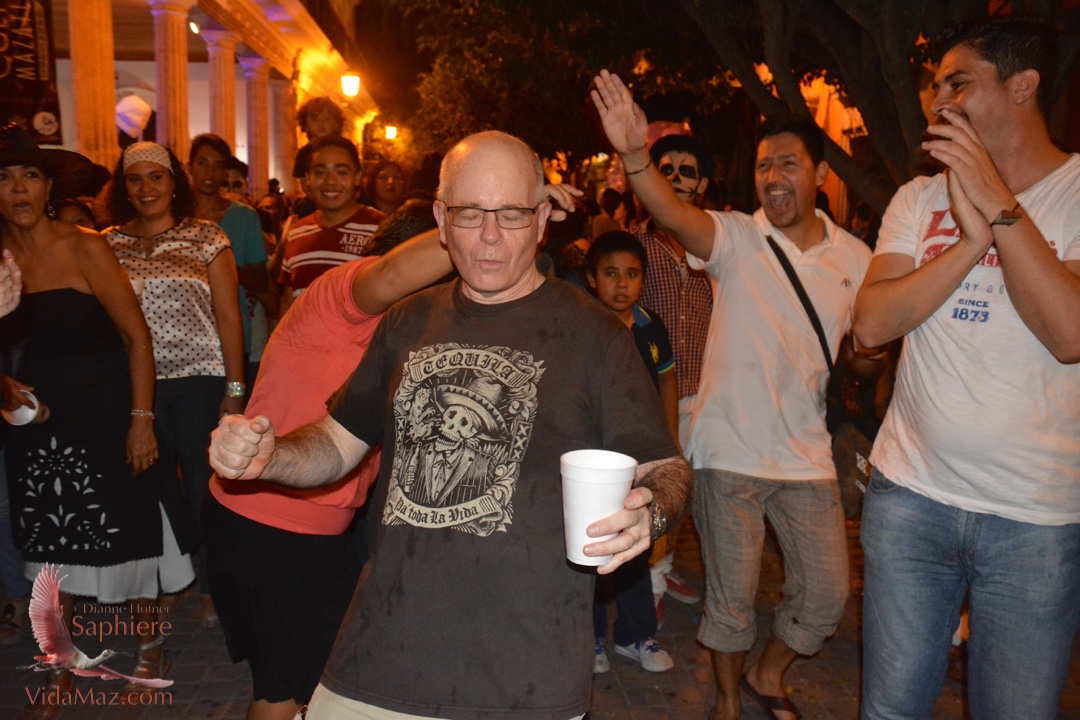
My absolute favorite moment of the evening, and there were so many awesome ones to choose from, was as the callejoneada entered the plazuela. Just in front of the theater, a group of young men started cheering loudly, dancing and jumping around. “Güero! “Güero!” they were shouting. As I turned around to see what all the happy commotion was about, I realized they were cheering on my partner, Greg. He was dancing happily, having been soaked with beer head to toe earlier in the evening.
31.DSC_0378Guero!
CULTURA TV is going to stream it’s video of the callejoneada this Wednesday, November 5, at 5:00 pm local time. Be sure to check it out! There are many more aspects of Day of the Dead in Mazatlán; the callenjoneada is just one activity. This blog post can give you a broader idea for your trip. I know my favorites include making an altar to remember my departed family members and friends, as well as remembering them in Mass each year. We hope you’ll join us so we can dance with you all next year!

5th Anniversary and 200 Posts

5 yearsOur first entry on the VidaMaz blog was June 14, 2008. At that point, I had been a lover of and frequent traveler to Mazatlán since 1982; Greg since 1993. We had been married here (at the Hotel Camino Real in its heyday), and we had already owned our home here for a few years. In 2007, we had made the decision to change our lives, and the country in which we lived. In June of 2008 we loaded our just-out-of-sixth-grade son into a car, drove south by southwest, and enrolled him into junior high school here in our adopted hometown.

And oh how we’ve loved it! Danny did not want to come. He didn’t want to leave his friends. He didn’t want to learn Spanish. When we woke him up for school on the one-year anniversary of our move here, he proclaimed, “One year since we made the best decision of our lives!” We have made so many dear friends, we have learned so many new things, we have experienced events and realities that have stirred our souls. Our son has become bilingual, bicultural, the children of immigrant parents. He celebrated his 13th birthday in our pool, and just two weeks ago he celebrated his 18th. Every parent says it, but where has the time gone?

We started this blog in order to let our family and friends back home, and worldwide, see a bit of our new lives here. What I really treasure about this blog is the way it has helped us keep a record of our journeys, of some of what we have learned, and most importantly, of the people we have met along the way. Mazatlán absolutely has some of the world’s friendliest, happiest, and most open-hearted people on the planet! Thank you all for allowing us to live here in this beautiful port city with you!

In looking at the blog’s statistics, I realize that the blog has become a source of information for many of our fellow expats. We didn’t plan it that way, but we are very happy to be able to be of some service to others. We have thousands of readers who come here to learn how to enjoy Mazatlán with kids and how to choose a school and live here with kids (onetwothree, and many more). Two of our most popular posts include last year’s Immigration Forum (not a topic we’d normally write about, but the changes in immigration rules were hugely important for all expats, and no one else at the time, at least in Mazatlán, was really writing about it), and Getting a Driver’s License in Mazatlán (information that has of course changed since it was first published, but our readers have kindly kept it updated).

Most of our posts, as you our readers know, are about events and people here in town. We definitely enjoy life here, despite or because we work more than full-time. Other popular posts have included:

HOLIDAYS

  1. Quite a few on Carnavál (one, two, three, and our “eternal calendar” of Carnavál events)
  2. Day of the Dead
  3. Spring Equinox at Las Labradas and the Deer Dances (one, two)
  4. Celebrations for Independence Day here in town
  5. Religious tourism in and around Mazatlán for Holy Week

EVENTS

  1. Happily for us, posts about our favorite event all year—Desayuno de los Pollos, a charity event conducted by my good friend Yoly (one, two), are popular. We have participated in this event from the time we came down as tourists. Danny was maybe eight the first time we had the privilege of participating.
  2. The extremely cool annual swim to Deer Island, the Travesía Anual

PROFILES

  1. Eating breakfast with oyster divers
  2. Interview with a cancer survivor who opened a meat shop and deli (and the story of a historic restaurant we enjoyed decades ago)
  3. Shrimp fishermen (one, two)
  4. Lots of excitement around Ice Skating at Christmas last year

OTHERS

  1. Travel nearby (weekend trips): Mezcaltitán, Bird watching in Singayta
  2. Definitely take longer to fully enjoy Copper Canyon

There are hundreds more posts—our observations and experiences of the culture here, dozens of other holidays, events and people. Please check them out.

Everyone, thank you for joining us! We work full-time, we have a son still at home, we enjoy nature, like to exercise, are always ready for a good time, and we enjoy the opportunity to record some of our pleasures here in this space. We are most grateful that you have found this blog interesting or useful. What has been your favorite post?

La Callejoneada for Day of the Dead

Greg absolutely hates Halloween, but Day of the Dead is his favorite holiday here. Go figure! He loves it even more than Carnavál, and that’s saying a lot. His favorite part of Día de los Muertos festivities is the callejoneada, the parade that winds through the narrow streets of the Centro Histórico. This year I had fun putting together a “scary movie trailer”-type video (above) to commemorate the event. I hope you enjoy it!

I’ve written a few posts about Día de los Muertos here in Mazatlán. This year there were a few things different, of course. One was the gorgeous, colorful katrina costumes in the callejoneada. They were breathtaking! You can see them in the video above. Many of them actually lit up, which was extra cool!

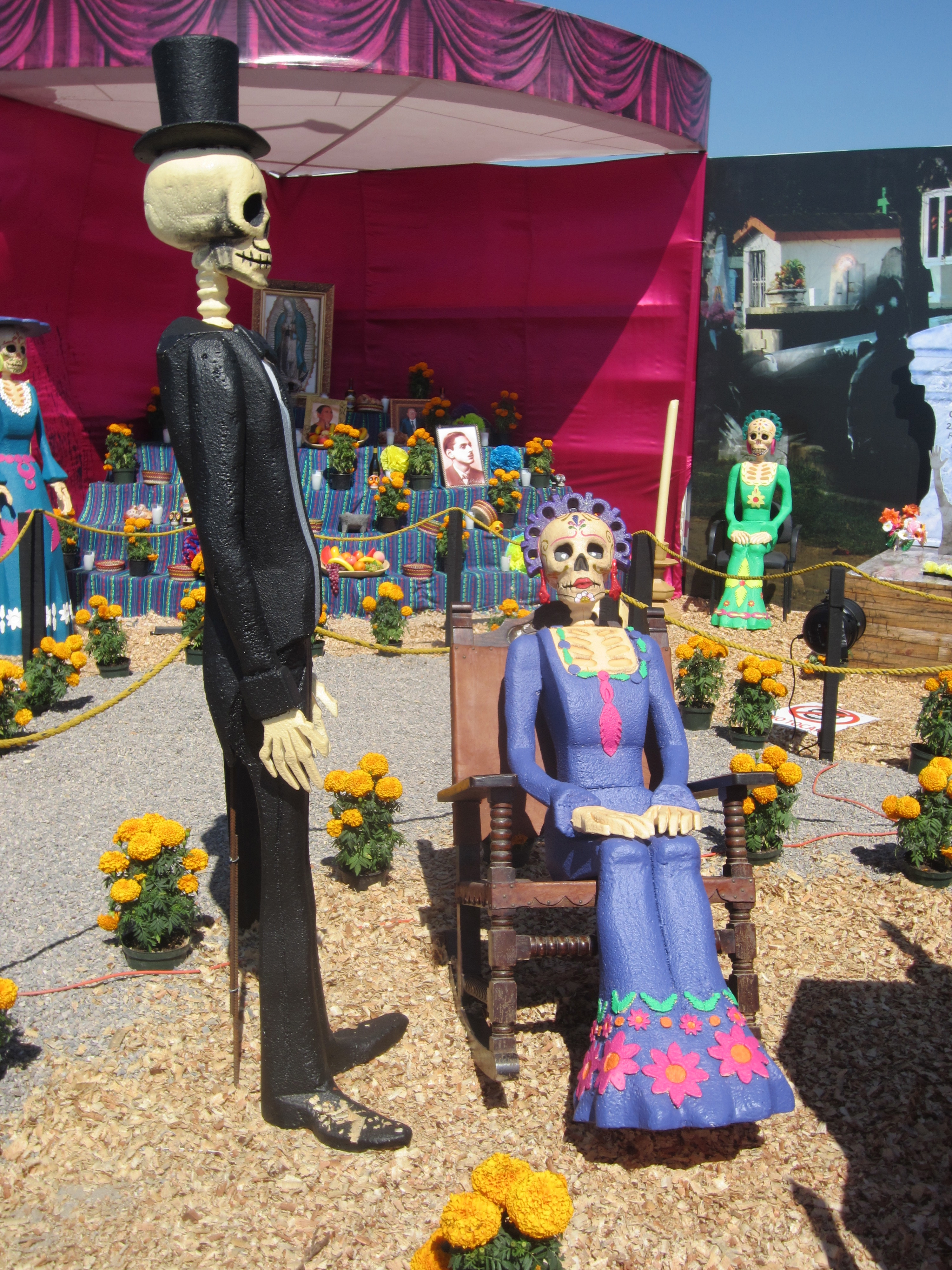
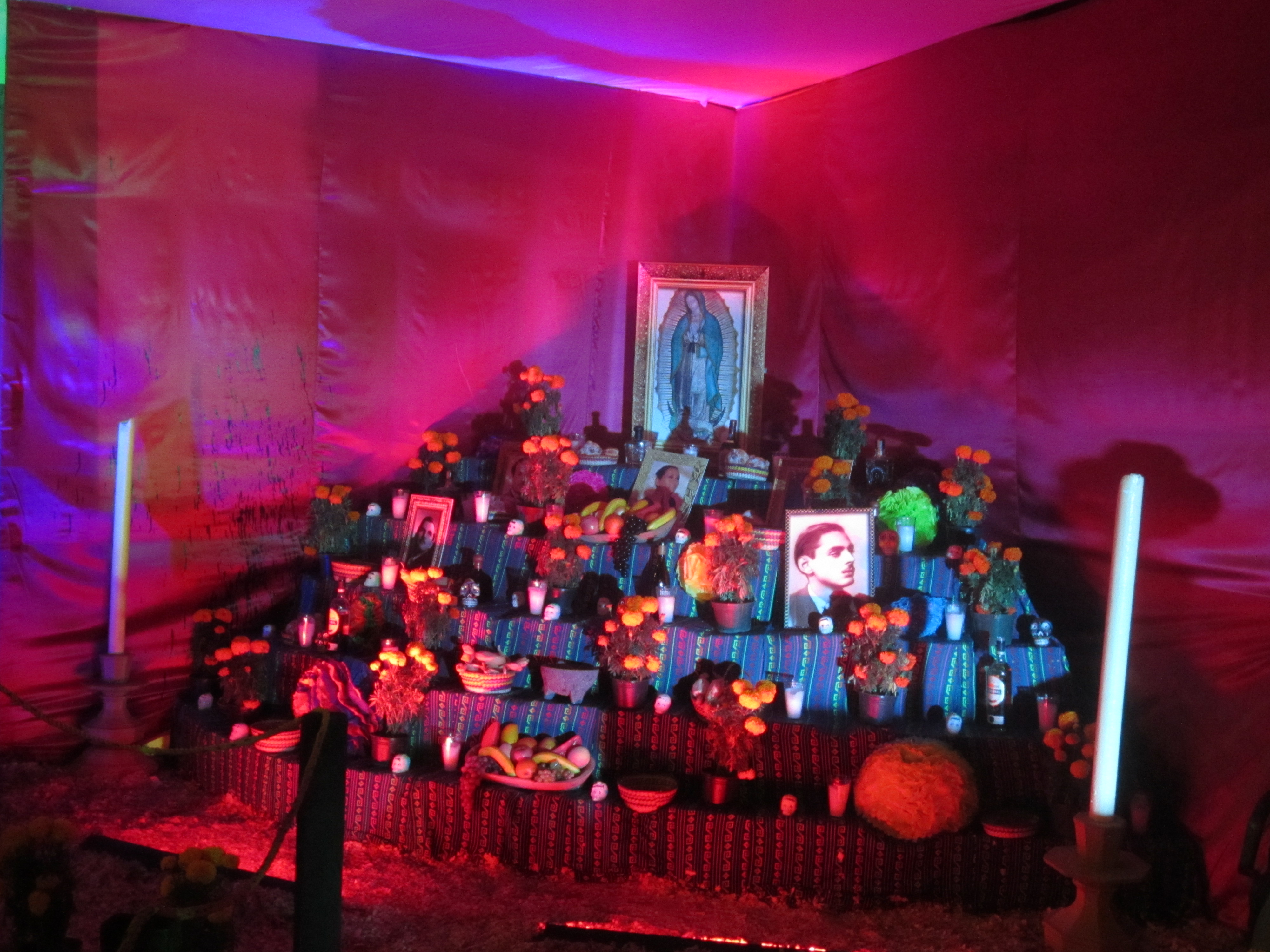
Another new development we noticed is that the print shop just down from us put up a big outdoor walk-through Day of the Dead display, complete with life-size katrina statues and a large altar, all lit at night.

At the bottom is the map of this year’s “official” altars that the Katrina visited last night during the callejoneada in order to accompany the dead to the other world.