
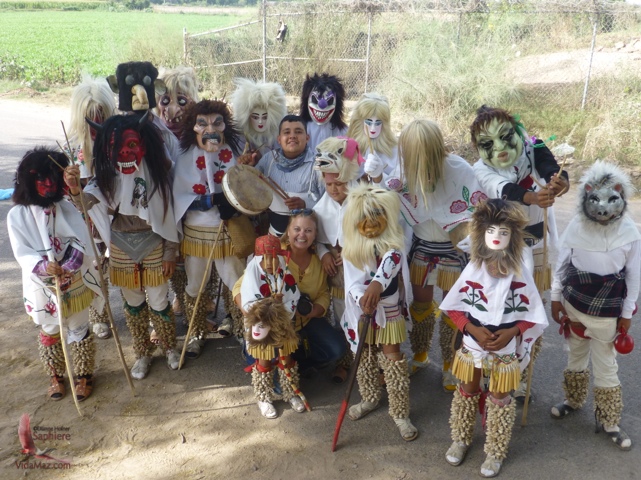
Some of the Judíos en route to Mochicahui, with yours truly in the center.
I am passionate about culture. My friends, family and professional colleagues know that. I hate to see a language or a cultural tradition die out. I feel sure in my bones that when we lose such a treasure, we lose some of the answer—some of the solution—to living together in a sustainable and harmonious way on our planet.
That being said, this weekend we witnessed one of the most wonderful rescues of cultural tradition that I have seen in a looooong time—the return of EL KONTI to the corrida of Las Higueras in the small Yoreme town of Mochicahui!
Traditionally, every Friday during Lent, in each of the Yoreme communities along the Rio Fuerte, the Stations of the Cross are performed by men dressed as Judíos or Fariseos. They dance in honor of God and their families. They dance as a promise to their fathers or their wives—to bring God’s blessings to their families and communities. They dance from nine in the morning till seven in the evening, from house to house, dancing in circles around the cross at each station, covering long distances, with all routes or corridas leading to the central church.
The trouble is, two leaders of the Las Higueras route have died, and many of the 30 or so remaining Judíos have gotten older and are no longer up to the physically taxing role of dancing all day long. Over the past fifteen years the KONTI tradition died out here. Community members were disappointed—they missed their Fariseos, they wanted their homes blessed, they wanted to participate, but there was no clear leader, no one to make it happen for them. The younger people didn’t know the details or subtleties of the tradition. This year a few community leaders got together and made the effort to revive the tradition along the Las Higueras corrida.
We were fortunate enough to meet Omar Castro, a 27-year old leader of EL KONTI in Mochicahui. He is a handsome and well-spoken young man, newly married with his first child on the way. We accompanied him and his group, led by the local Mandón or Chicotero, Toño Mocho, on the Las Higueras route.

Dianne, Omar and Greg, in the church as we were cleaning it up
Omar told us that on the first Friday of Lent this year, it was only him, his brother, and a young boy dressed as Judíos. They felt so alone and overwhelmed at the challenge facing them: to revive this centuries-old custom on the Higueras corrida. The three of them danced the entire five kilometers, visiting every house with an official cross in the yard, dancing around the cross and blessing the families inside and nearby. As is tradition, most every family shares food or drink as well as limosna (a donation to support the Easter Week festivities) with the Fariseos when they visit. The trouble is, the Judíos must eat or carry with them all the food and drink they are given; it’s a sign of respect and gratitude. But, how could two men and a boy eat and drink, or carry, all that was offered to them at 80 houses? Omar tells us he was so over-full, had such a stomachache, that he had to call his wife and ask her to bring him stomach medicine en route!
Fast-forward from the first to the fourth Friday of Lent, March 28th, when we joined the KONTI celebrations, and Omar’s group of three Judíos had grown considerably! He and the community were obviously up to the challenge! Just take a look:
Omar has taught the new young Judíos on his route, instructing them while doing, leading by example. Greg and I felt that his was one of the best-behaved of the five routes we witnessed gathering in the plaza. And, it is now the newest!
SO WHAT IS EL KONTI?
KONTI is the traditional procession and dancing of the Stations of the Cross that occurs on Fridays during Lent in the Yoreme communities. We knew that the men of the village dress up as Judíos (Jews), Fariseos (Pharisees) or yuris, “white people,” representing those who crucified Jesus. What we did not expect was the huge number of people in the procession, the amazing crescendo to which it builds, the remarkable diversity of the masks, the sacredness and intensity of this celebration amidst all the merriment, and, most especially, that so many children participate, from as young as two years of age! (Click on any photo to enlarge it or view a slideshow.)


The Yoreme pueblos in Sinaloa where EL KONTI is practiced include: Choix, San Javier, Baymena, Baca, Tehueca, Sibirijoa, Charay, Mochicahui, San Miguel Zapotitlán, and La Florida. EL KONTI in each of the pueblos is supposedly remarkably the same, and also, of course, slightly different. Bernardo, the Yoreme elder and maestro we got to know this weekend, told us that when he travels up to Sonora, to Tucson with the Yaqui, and even as far as the Hopi lands east of Flagstaff, EL KONTI is very much the same. He says the Mayo language (Yoreme) communicates with the Rarámuri (Tarahumara), Yaqui, and Hopi. Mayo is a Uto-Aztecan language, one of Mexico’s 63 national languages.
In Mochicahui pueblo, there are five routes or corridas. Here is Omar explaining to us what they are, how the limosnas work, and other details of the EL KONTI procession:
So how does it all work? The mandón receives requests from Yoreme families who want to place a cross on their patio. If a family wants to be on the KONTI route, they must have the mandón’s approval. The mandón’s job is then to guide the Judíos from house to house, cross to cross. At each station, the Fariseos dance in circles around the cross. In one place they entered a small chapel to dance as well. After the dance, they receive any food, drink or limosna the local families have to offer, and then they run to the next station.
This was our favorite part of EL KONTI. The houses in Cruz Pinta where we joined the route were very basic, the yards and patios were dusty—bare dirt—and the people were reverent and happy to see the procession. Most of the families were sitting outside near the crosses in chairs or on benches, ready for the procession to arrive. Most of them had made food to share with the Judíos. Most of them also donated some money, into a can, to support the Holy Week festivities. There was a solemn joy at each station. At each house, more Judíos and other participants joined in the procession, so that by the time we approached the town, we were quite a large group. (Mouse over a photo to view a caption; click to enlarge or view a slideshow.)


Over the course of the afternoon, more and more corridas or routes make their way into town, entering the plaza and then the church. The procession gets increasingly crowded, chaotic and festive. We were amazed how many people turned out from this small town of 5000 people, either to participate in EL KONTI or to watch the festivities.
The Fariseos are supposed to complete their route and arrive at the church in Mochicahui by about 4:00 in the afternoon. Once there they first enter the church. Pews have been moved to form two rows lining the walls, and they are filled to capacity. In front of the altar, facing the congregation, a large statue of Jesus is on display. Jesus is attended to by a group of young girls, the Marías, looking pure in white lace dresses. The Marías care for Jesus during his time of trial, wiping his brow, caressing his cheek, kissing his hands and feet. The Judíos dance around the statue, and then retreat from the church to await the arrival of their colleagues from the other routes.


While they wait, crosses are set up around the perimeter of the church. As more corridas arrive, the plaza, and the church, become increasingly crowded. While they wait for all the corridas to arrive, the Judíos play music and dance around.


Once the Judíos from all the routes have arrived in the plaza, they process into the very crowded church, and the statue of Jesus is raised and carried outside. Once outside the church, four men hold a cloth roof, reminiscent to me of a chuppah or Jewish wedding canopy, over the statue of Jesus as it is processed. The procession leaves the church, turns to the left, and proceeds around the church, stopping at each cross or station.
The procession is lead by a maestro, in this case Bernardo, who played flute, as well as by a local man who leads the prayers at each of the Stations of the Cross. This gentleman would kneel down with Bernardo in front of the cross, exhibiting incredible focus despite the chaos going on around him. He and a small group of church members would recite the prayer for that Station after walking around the cross and the statue several times. The Marías follow and surround the Jesus statue, accompanied by some key members of the parish with their prayer books, people holding flags representing major church events such as Guadalupe Day, and church elders carrying other holy relics. The Marías remove the thorned crown on Jesus’ head, wipe his brow, and replace it. Other Marías throw flower petals (representing divinity and life) at the statue at each station, while the main María cleans the petals off. The by now hundreds of dancing Judíos surround all of this, dancing and creating mayhem on the perimeter. This is all in turn surrounded by hundreds of spectators, sitting or standing along the church walls and the KONTI route.


As a climax, the procession re-enters the church. By now there is a cacophony of sound: drums, tambourines, maracas, percussive skirts and leg-ware. Christ is carried into the church, to resume his previous position in front of the altar. The Marías clean him up. The Judíos dance around him, filling and over-filling the small church. The pews are filled, and have been filled, for a couple of hours, and those spectators watch the proceedings. Most come up to kiss the Jesus statue, and to genuflect before him.
After everyone takes their turn and things calm down inside the church, Omar and his two fellow leaders, along with a few others and Greg and myself, clean up the church a bit and return the pews to their normal position. They also count the money that they have taken in for Holy Week festivities—money that will pay for food and fireworks, among other things.
In hindsight, it’s interesting to us that it was all percussive music for KONTI; there were no violins, or harps, and only the one main flute. There were a few toy horns, but our guess is these were items brought by those who don’t know the tradition, who embrace it more as a party.
As we left the church about 7:30 pm, there was a huge party happening in the central plaza. Kids were spraying shaving cream, people were drinking beer, food stalls were set up, balloons and toys were being sold, and the gigantic inflatable bouncy house was going gangbusters. A couple of cars had music blaring.
Omar and his extended family most generously invited us to accompany them home for cena. There, Maestro Bernardo played the 16th century harp, and Omar played the fiddle, holding it to his chest despite the chin rest on the instrument. We very much enjoyed the company and the explanations of what we had witnessed during this terrific afternoon and evening. On this fourth Friday of Lent, we ate escabeche de marlin, bean burritos, two kinds of rice, and capirotada for dessert. We drank water or Nescafe, and sat under the stars on their patio, enjoying the evening. With so many children surrounding us, and aunts, uncles, parents and grandparents who are stewarding their community and their families, it was truly a night to remember and treasure.


HOW THE TRADITION WAS REVIVED
The Yoreme know that it is key to instill a sense of community in their children, including a strong set of values and responsibility. They know that if the children learn these things while they are young, and if they can have fun learning and living this way, they will do so—building strong, responsible, and joyous families and communities.
The Yoreme live near us, in Mexico, a country that has sadly become infamous for violence and drug trafficking. We are located just south of the world’s biggest drug consumers, who have the money to pay for them, and who happen to also have loads of guns for sale. We live in territory that is suited for harvesting marijuana, and we are on the route through which the South American cocaine passes heading north. Amidst this reality, the Yoreme are even more motivated to instill ethics and morals in their children and build strong communities.
The KONTI festival has three leaders, who each serve three-year terms. For Mochicahui, the Pilato Mayor (head Pilate, as in Pontius Pilate) is Jesus Castro Valdéz, who carried a long colorful spear. The Segundo Pilato is Miguel Castro, and the Tercer Pilato is Omar. This is their first year serving in these positions. They were elected to serve because they are young, they know the tradition, and they were willing to take time away from work and their families to coordinate EL KONTI. Omar, for example, has danced in KONTI since he was four years old. He has studied the traditions, plays traditional Yoreme music, and is enthused to currently be one of the leaders. This year they decided to charge Omar with reviving the Las Higueras corrida. He enlisted the help of Toño Mocho, an elderly, one-armed resident of the route, as mandón.


That first Friday this year, on the Las Higueras route, when there were only three Judíos, the able-bodied men, the young people, and the children, watched them dance. They saw them sweat. They witnessed them overeat. They saw their passion. They could also see the tears in their grandmothers’ eyes—how happy they were that the Judíos were once again, after such a long lapse, visiting their homes. They saw their mothers’ pride—that they were able to make tamales, burritos or quesadillas and share them with the Judíos. They thought the dancing looked fun, that the costumes were cool. Perhaps they wanted to share in the food. But, as is most definitely evidenced by the number of Judíos dancing the route by the fourth Friday of Lent, they wanted to participate! They’d ask Omar, or the mandón, if they could join in, and they were told how to do so. The first thing they were told is that they’d need the proper costume.
COSTUMES
- Máscara or mask: Traditional Judío masks tend to have exaggeratedly large noses—the way the Spanish probably appeared back in the day to the native Mexicans. The typical mask in Mochicahui is a white, Spanish lady—a yuri. To me it almost looks like a Japanese Noh mask. Masks are usually hand-carved from wood (usually cottonwood or elephant wood/torote), and often covered with animal skin. The masks maintain the anonymity of the Judío. We asked several people how they got their masks. There are people in the community who carve them. Some carve their own, others buy one,someare handed down in the family. There were a huge variety of masks, and some were very modern, including Smurfs and movie characters.


- White manta shorts and shirt
- Carrilleras, a “skirt,” commonly made of bamboo pieces or reeds which click together like wind chimes as the Judío dances. The carrilleras are often embroidered, and are worn around the waist, over the shorts. I fell in love with the carrilleras; the sound they make is magical, and they look wonderful while people are dancing. We bought a small child’s carrillera for 300 pesos from a gentleman selling them.
- Huaraches, typical and traditional, very simple cowhide sandals. These sandals were mostly white, of the typical variety we see here in Sinaloa.
- Tenabaris, long strings of butterfly cocoons, dried by cooking them on hot rocks. Into each cocoon a small stone has been placed to make a sound when the cocoon is shaken. Each tenabari is about four meters long, and is wrapped around the Judío’s calves, usually on top of a cloth wrapping so that it doesn’t chafe the skin. We saw a few more modern versions, some made from recycled aluminum cans, and others from sewn or stapled thin pieces of rubber. Obviously these latter versions make a different sound. I have been in love with the tenabaris since I first saw them a few years ago. What a beautiful idea: butterfly cocoons wrapped around one’s leg that produce music! I was too cheap to buy a pair, however, at 1200 pesos. Next time maybe I’ll ask if they have a shorter, child-size strand.


- A capa or white cape, usually embroidered with an image of Jesus, the Virgin Mary, or another religious symbol. Sometimes the capas are handpainted instead of embroidered. In Mochicahui these capastendedto be very colorful, some with glitter or sparkles. They were gorgeous.


- Many of the Judíos beat drums or tambores, made of leather and usually adorned with religious symbols. They may also shake rectangular wooden tambourines and maracas or gourds.
 A rectangular wooden tambourine
 A wood and leather drum, hand painted
 - A lanza or spear, a long stick carried by many of the Judíos. Some also carry wooden swords or daggers. Spears, swords and daggers are often hand painted in bright colors.
- A bag, usually woven from straw or twine, like a flexible basket, though also often made from animal fur. The bag is usually decorated or adorned in some way. It’s function is to hold the food and limosna that the JudíosreceivefromtheYoreme families they visit.
 Closeup of a carrillera, one of the musical skirts
 Closeup of a bag
 Closeup of a sword/dagger


Here is a video of a few of the teenagers teaching me the names of the costume parts:
RULES
Next, the new Judíos were instructed that they would need to participate in EL KONTI for good reasons: to honor God or their families. They were told that KONTI is not Carnavál, but rather a celebration commemorating the crucifixion of Lord Jesus and his stations of the cross en route to Calvary. KONTI leads up to the big Easter Week ceremonies.
Judíos should not smoke or drink alcohol. You can see in some of the photos and video that we took that this rule is not followed by all who participate. Judíos should not talk; only pantomime. They are supposed to walk, run and dance to town; they should not ride in a car or truck while performing the ceremony. Some of them are scary, as were the soldiers who arrested Jesus and accompanied him to his death. Some of the Judíos are funny, giving members of the crowd a hard time, joking with them, much as the soldiers did to Jesus and his followers. We had Judíos blow horns in our ears, poke us in the ribs with their drum sticks, and share their long hair with my handsomely balding hubby.


WHAT WE ESPECIALLY ENJOYED
- We loved walking and driving around the area, seeing people getting dressed for KONTI, watching them walk, dance and run on their routes to town. It was truly a family-friendly, community-wide festival. We were very fortunate to have Omar leading the way for us and showing us the ropes. There is a ceremonial center on the edge of Mochicahui, on the way to Cruz Pinta. If you travel here during one of the Fridays of Lent, that would be an excellent place to photograph people getting ready, as there were dozens of Judíos gathering there before making their way into town.
- We were fascinated by the incredible mix of pre-Colombian, indigenous ritual (the masks, costumes, method of dancing—KONTI originated in Tasaria, a pre-Hispanic spring ritual), Spanish and Jesuit Catholicism (the Stations of the Cross, prayers, relics), with a bit of modernity thrown in for good measure (masks included Smurfs, movie characters, Japanese tengu and devils) were a joy to behold. I’d suggest you arrive just after noon and plan to start outside of Mochicahuí, on one of the five corridas or routes. To us, seeing people’s homes, witnessing how important KONTI was to the local families, was the best part of the day.
- We were rather blown away by the crescendo of KONTI in the plaza during the actual procession—it was organized chaos of a whole lot of people. The sound, the cacophony, was unreal. If you enjoy indigenous cultures and traditional events, KONTI is most definitely one to add to your list.
- Finally, the children! I was infatuated with the young children, dressed up, standing amongst the men—toddlers who already knew the dance steps: they knew to bend over, crouch down, stomp their feet so that the tenabaris on their legs and the carrilleras at their waist would rattle. They seemed thrilled to be part of the community. The older children and teenagers were also great to observe, hanging out in groups, yet led by their Pilato. They would drift off on their own, and then their Pilato would herd them back, coach them into how they should behave. It was a beautiful mix of community, discipline, joy and sacredness. Just what more of our communities today would seem to need.


YOU ARE INVITED FOR HOLY WEEK
There are still two more Fridays of Lent this year, prior to Holy Week, if you’d like to drive up and enjoy EL KONTI. Mochicahui also hosts a major celebration during Holy Week, from the night of Holy Thursday through Good Friday and Easter Sunday. Here is one of the ladies from Pinta Cruz, inviting all of you:
DIRECTIONS AND DETAILS
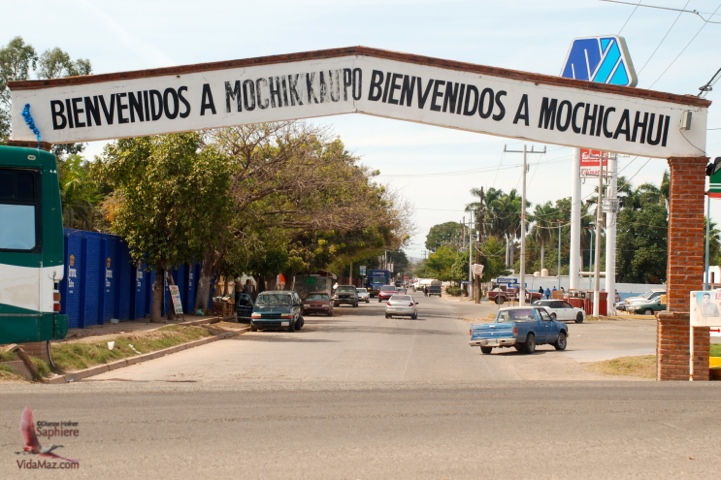
Mochicahui is a town of 5144 people, located just north of Los Mochis on the way to El Fuerte. It is located about 12 km north of Los Mochis—five hours north of Mazatlán on Highway 15. Just past Los Mochis, take a right on Highway 32 towards El Fuerte. The entrance to Mochicahui will be on your left.
The Rio Fuerte winds along the city, at about 500 meters from the central plaza. Mochicahui has been a Yoreme ceremonial center since prehispanic, even pre-Colombian times. It was officially founded in 1606 by the Jesuit missionary Andrés Pérez de Rivas, who arrived with the Spanish conquistadors. “Mochicahui” means “turtle hill”: “cahui” means cerro or “hill,“ and “mochi” means “turtle.” Indeed, the hills near the town church look like turtles.
During the festivities it is very dusty; I recommend taking closed-toed shoes and wearing socks. Many of the dancers wore a bandanna around their nose and mouth, so they wouldn’t inhale all the dust. It’s also hot and sunny, so take your hat, sunglasses, and sunscreen. You can buy water and soft drinks in the plaza, but public toilets were a rare commodity. The ladies of the church were selling food and drink, trying to raise money to build some.
We spent the night at a hotel in Los Mochis, which was very comfortable, clean and convenient: El Doux. We paid about 500 pesos for the night.
We met several locals in Mochicahui who spoke fluent English, having lived much of their lives north of the border. We would recommend, however, that if you attend KONTI you speak Spanish or go with Spanish-speaking friends. If you happen to speak Mayo, you may of course be ok. A connection with a local family or business would also be very worthwhile. We were the only foreigners we saw over the two days. While there were hundreds of spectators, everyone we met was from the immediate area; there were not a lot of tourists.
Of the pueblos listed above that celebrate KONTI, those closest to Los Mochis (and therefore closest to Mazatlán, other than Mochicahui which is both close and perhaps the most traditional) are:
- La Florida (15 km from Mochis on the way to El Colorado),
- San Miguel Zapotitlán (16 km north on Highway 15), and
- Charay (22 km towards El Fuerte).
Many, many thanks to both Luís Hernández Ayala (ITOM YOLEM JIAWI page on Facebook) and Silverio Zambrano López, for helping us learn enough about EL KONTI so that we were willing to make the five-hour drive from Mazatlán. It was Luís who introduced us to Omar. Most especially a big thanks to Omar Castro and his family for their excellent hospitality and teaching. Also our appreciation to Maestro Bernardo, who seems to be an endless source of oral tradition, knowledge and wisdom. We first met him two years ago during the Spring Equinox at Las Labradas.
A group of Yoreme Mayo youth, seeking to preserve their culture and heritage, made this terrific short video about El KONTI:
—




 ¡VidaMaz!