Nikkei Convention—Japanese in Mexico

P1130638

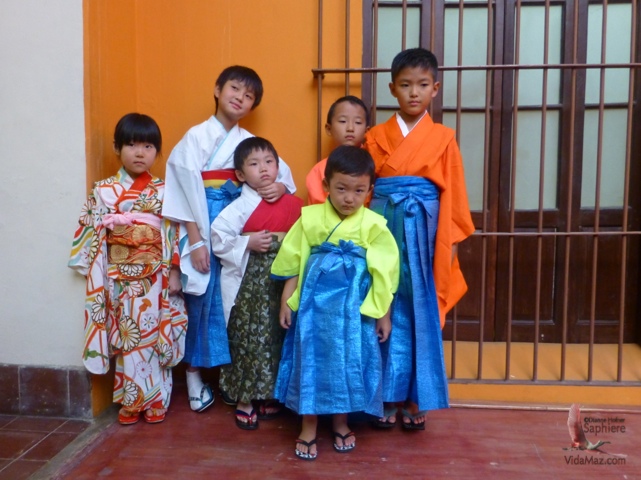
Some of our gorgeous Mazatleco Japanese kids, including my friend Chika’s children,
wearing hakama and kimono for the occasion.

Well, the 12th National Nikkei/Japanese-Mexican Convention is coming to a close. Events included the election of “Miss Nikkei,” a dozen or so incredible conferences, an early morning dance on the beach combining traditional Japanese buyo and Aztec dancing—to symbolize the Mexican-Japanese mix. We had kimono, happi and hakama, t-shirts with the Mazatlán deer sketched in kanji characters, origami paper folding and shoudo calligraphy, and a terrific, quite large ikebana/flower arranging display. Kudos to the unbelievable Esperanza Kasuga and all the convention organizers, staff, and volunteers!!!! お疲れさまです!!!!Over 400 people registered for the full convention, and thousands of people attended the events this week, commemorating 400 years of Mexico-Japan relations.

It was wonderful to meet so many people who were so thrilled to meet others with whom they share so much in common, and great to learn more of the history of Japanese people in Sinaloa and in Mexico. I met Mrs. Nakamichi, for example, who was joyfully proud to tell me about her grandfather (speaking in the video below, in front of a photo of her grandfather):

I was especially psyched to learn that kamaboko, traditional Japanese fish cake, is made right here in Mazatlán! How could I have lived here six years and not known that?! I am told I can buy it at Ricamar, which is on the right side as you head to the airport, just past Café Marino. Yippeee!!!

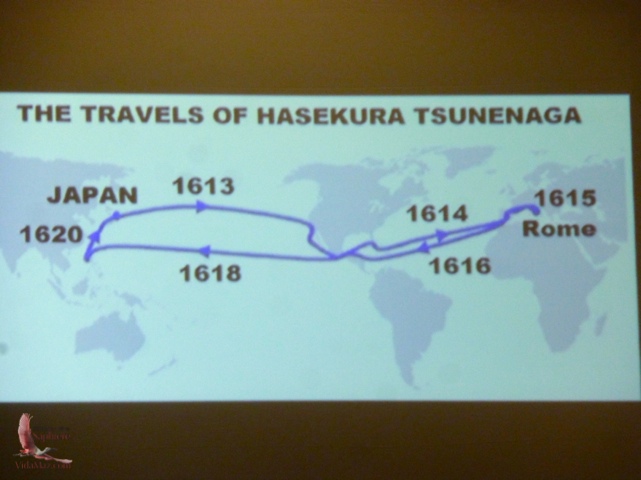
I loved the simple graphic below, outlining the first voyage of Japanese people to Mexico, then to Europe, and back again. Hasekura sure had perseverance and an adventurous spirit, as did Japan’s first immigrants to Mexico.

P1130606

I was privileged to meet Hirofumi Nakasone, the Japanese Senator from Gumma Prefecture and former Minister of Foreign Affairs as well as Minister of Education (I met his father, the Prime Minister, years ago and immediately noted the family resemblance), along with Shuichiro Megata, Japanese Ambassador to Mexico, in Casa Haas at the opening of the historical photo exhibit on Friday.

P1130701

Mr. Megata, myself, and Mr. Nakasone

My friend Joaquin Hernández showed us a few volumes from his astounding book collection, and I absolutely fell in love with this wood block print of Mazatlán. We are blessed with so many incredible intellectuals and all-around terrific people here, I am consistently amazed.

The photo exhibit at Casa Haas will be open for two or three more weeks, I am told, so do not miss it. In the rear room is a film made by a Japanese-Mexican woman from El Rosario, Sachiko Uzeta Amano, entitled, Del Otro Lado del Mar. The film was made in 1997 to commemorate the 100th anniversary of the arrival of Japan’s first immigrants to Mexico, and discusses their descendants cultural integration into Mexico and preservation of their Japanese heritage. I’ll have to go back in order to watch the whole thing. Seeing traditional Japanese festival accoutrements alongside the Virgen de Guadalupe sort of blew my mind!

Below is a highlight reel of Friday night’s Nikkei Convention concert in the Angela Peralta Theater, with interview from baritone Adán Pérez.

Japanese Movies and Convention in Mazatlán


10153000_675952005805187_7374108031705079814_n-1

I announced to you back in January that this year we celebrate 400 years of Japanese-Mexico relations. We had the “black ship” float and two Japanese dance troupes in Carnavál, and this weekend the Mexico-Japan Association will hold its Nikkei convention in Mazatlán; I can’t wait for that!

In preparation, CULTURA got in on the action this week with a series of three Japanese movies, subtitled in Spanish. While the free tickets were given out within just an hour or two, and those of us living outside Centro Histórico, as usual, were not privileged to get any, we have been able to get a seat the past two nights. The last movie in the series will show tonight, Wednesday, at 7:00 in Casa Haas. Oh how I have enjoyed them! Greg has generously accompanied me to each of the two so far; hopefully he will again tonight, despite what he’d prefer to be doing.

Then on Friday night, also at Casa Haas but beginning at 6:00 pm, will be an exposition on the history and impact of Japanese immigration in Sinaloa state. Yes, I am so excited!!!! I hope to see you there.

Below is a short recap of the three movies in the series.

Monday’s Movie: 生きる、Vivir, the award-winning 1952 Kurosawa classic

I’ve seen “Ikiru” several times. It’s the only Kurosawa movie of that period that does not feature Mifune, and it was required viewing in the 1970s when I first studied Japanese. This was my first time to view it in Mexico, however, and the similarities I noted between my two oh-so-different adopted cultures were really striking. The protagonist, who’s dying of cancer, goes out on the town at one point, and despite the kimono and tatami you’d swear he visited Mazatlán—from La Botana to trumpets in a banda surprising you from behind and poorly sung karaoke, it was puro Mazatleco. The main character (Watanabe-san) is a city official who works in a dysfunctional bureaucracy in which very little gets done and nearly no one thinks about community needs, and at one point he has to navigate the Yakuza (mafia) visiting the vice-Mayor’s office. Sound familiar? I thoroughly enjoyed this re-viewing.

Tuesday’s Movie: 歩いても歩いても、Caminando, Still Walking, the 2008 movie by Director Hirokazu Koreeda

I had not previously seen this movie, nor am I familiar with this director, and I thoroughly enjoyed it. The film so well captured everyday Japanese life—the love of nature, cooking and eating (it sure made me hungry!), respect for elders and ancestors, the pace of conversation, the communalism of family life. The people in this movie were bitterer than most Japanese I know, but it is, after all, a movie, and a movie needs tension.

Tonight’s Movie: そして父になる、 Like Father Like Son, last year’s movie by the same director, Koreeda

This is the story of a businessman who learns that his six-year old son is not his biologically, but that two boys were switched in the hospital at birth. Now he must choose between the son he has raised and his blood kin. Sounds pretty interesting but, for me, the real joy is hearing the Japanese language, the sounds of my other adopted home, and feeling as if I’ve visited this other land I am so very fond of. なんて懐かしい!!!

On Keeping Traditions Traditional


10009854_10151968950151246_1414383763_n

Photo of Omar Castro around taken 1992 in Mochicahui, Sinaloa, Mexico

¡Feliz Día del Niño! Happy Children’s Day! April 30, 2014, Children’s Day here in Mexico.

The photo above is of a new friend of ours whom I greatly admire, Omar Castro. In this photo he looks to be about five years old. It was one of the first times he danced with his father in El KONTI, and the photo is taken in the central plaza of Mochicahui, in front of the church.

If you follow this blog, you know we had the pleasure of fulfilling my dream and attending KONTI this year. A week or so after that, I spent some time with a nationally renowned photographer and a well-known international journalist. As Greg and I were talking to them about our recent trip to Mochicahui for these Yoreme Mayo festivities, they were both bemoaning that EL KONTI had become too modernized, too watered down. They lamented the misfortune that some Fariseos now wear masks representing Disney characters, or metal leggings rather than traditional leggings made of  dried cocoons. They advocated that ceremonial leaders should be stricter: insist that participants only wear traditional dress, and that they follow the Catholic-native rituals more closely.

Normally, I would strongly agree with this point of view. I am an interculturalist; I am strongly in favor of preserving cultural traditions. So, my initial response to these two gentlemen was to explain that Omar and other Yoreme leaders are  doing their very best to educate their communities about these centuries-old traditions—explaining many of the points that are in my KONTI blog post. I so admire Omar and the other community leaders for their efforts to preserve the traditions.

But, I was torn. I also reminded my two meal-mates that the real tradition of KONTI is, of course, pre-Hispanic—and thus, pre-Catholicism. If we were to preserve traditions without change, there would surely be no crucifixes, no stations of the cross, no Spanish language prayers, no churches, and no Bible references in the celebration of KONTI. I explained to my esteemed colleagues that while I strongly feel traditions need to be preserved, that they belong to the people. To thrive as vital components of society, traditions need to be living, dynamic customs—and that perhaps requires change and “modernization.”

I believe Omar and other leaders of the Yoreme traditions see this. They teach community members the old ways, through their example, their coaching, and via the school system. They have a young artist from Europe living in the pueblos right now, contributing drawings to a book they are writing on the Yoreme traditions. They value tradition so much that they also permit the use of non-traditional masks or leggings. I believe this is because they know that the people need to make the traditions their own. The tradition needs to speak to individual members, to resonate with them, to have meaning and purpose for them.

I met several young men in Mochicahui who would not have been able to dance in KONTI if not for their tenabaris made by hand out of recycled tin cans, because the butterfly cocoons were far too expensive for them to afford, or they didn’t have access to the cocoons they needed. Thus, keeping the traditional open to some modernity and flexibility enables more people to get involved, to learn the tradition, to breathe continued life into it. I am confident that those young men will save their money or make a trade so that they have traditional tenabaris next year or the following; it’s a process.

Same with the Disney-esque masks. Personally, I loved them. To me it was proof that people want to participate in KONTI, that they find joy in the communal aspects of the worship and desire to join in. Again, I know community leaders prefer them to wear traditional, hand-carved wooden masks (almost every Disney-esque mask I saw was hand-carved from wood, by the way). I know leaders teach that, and promote that. But I also salute community leaders for the fact that they do no prohibit non-traditional masks. To me, it keeps the tradition vital.

It’s a delicate balance, preserving tradition and maintaining its vital place in community. It’s a process, with a tension between change and status quo. It requires us to remember a tradition’s purpose, what is at its core. The photo up top is of Omar as a child. He and his wife are now expecting their first child. The tradition continues. And adapts.

My admiration goes out to the Yoreme Mayo leaders who so well demonstrate that. I learned so much from them on that one day I spent in Mochicahui!

10150609_10151968918821246_1521236448_n

Historic photo of the church in Mochicahui.
Today the building on the left is in ruins; the chapel at far right stands proudly.


Desfile de Semana de la Moto 2014

It was wonderful to have our friends over for the motorcycle parade this afternoon, the culmination of Moto Week 2014. Here are a few highlights.

This slideshow requires JavaScript.


Governor Malova led the parade on his bike, as usual, and Mayor Felton and First Lady Sylvia accompanied him. They all looked like they were having a great time. Short clip below.

Unfortunately at the very end of the parade there was a crash: two bikes crashed, and one jumped the curb up to the malecón. The rider flew off, and Greg was collateral damage. He’s ok but very bruised, swollen and sore. One other young woman—who had been walking by—was bleeding, and she and the poor man who flew off the bike left in ambulances.

It could have been much worse; our prayers are with all the riders. For the record, all those affected were immediately and very kindly attended to by Cruz Roja, Protección Civíl, Tránsito, and bilingual officials from MotoWeek.

Talented Kids Doing Great Things: UTE Conference

Image

In June it will be six years since we started this blog, and this past week we were afforded an excellent opportunity to reflect on our experience with it. You see, Greg and I were invited to present at a tourism conference at the Universidad Tecnológica de Escuinapa. It was a wonderful experience—the students were amazing, we met some incredible people, and I also really enjoyed how it motivated me to reflect on where we’ve been and what we’ve learned.

We started VidaMaz.com in order to stay in touch with family and friends after our move. We wanted to be able to share a bit of our new lives with them. What we quickly learned, however, was that the most avid readers of our blog were people who loved Mazatlán, who fantasized about living here, or who already enjoyed living here. We started without any sort of a plan; we were just going to publish posts about our experiences, our daily lives.

And we did.

Then came the swine flu. It had such a huge impact on our daily lives. Movie theaters closed. Concerts were cancelled. Everyone wore masks over their mouths, and used antibacterial gel everywhere. In researching it, the flu seemed to originate on a pig farm in Wisconsin, of all places. But the way Mexico reacted to it caused all sorts of fallout, huge decreases in tourism, and a horrible economic ding on our adopted home.

Next the narco violence rose to the forefront of international media reporting. Wherever I travelled for work, from Istanbul to Bogotá, people looked at me horrified when I told them where I lived. “Why in the world would you choose to live somewhere so unsafe?” So our little blog took on a new passion for us. It was our small way to let people know that we were living peaceful, enjoyable, healthy lives, despite what the media might portray. That Mazatlán was beautiful, was populated by a whole lot of cool and caring people, and that life here was sweet. It was our way to combat the anger we felt that international media insisted on selling only one very negative story of my beloved and wonder-filled adopted country.

A few of the hotels started using our posts, as did some of the realtors and condo associations. They seemed to take our stories about “normal life” as proof to the outside world that living here was, indeed, great. That was fine with us; we just asked for credit. Then we were asked to be interviewed for a few videos, about how it was to live here in Mazatlán as a family, to raise a son here. It wasn’t too long before we were honored to receive an award from the Hotel Association and the State Secretary of Tourism, commending us for our work in tourism. We sure had never planned to be a tourist blog, but such, it seemed, was how we were perceived.

So, six years later, when Dr. Arturo Santamaría Gómez asked us to present at a university conference on using blogs in tourism, we were eager to share our experience and learning. I didn’t realize it would cause me to reflect back, but indeed it did. What had we learned? Where had we journeyed? What stood out most for me was how many incredible people we have had the true pleasure of meeting over the past six years. Even without the blog, we would have met many of them—we are curious, outgoing, we love to learn. But, because of the blog, we’ve met so many more, and have interviewed people in more depth, than we would have normally. This was the true gift of starting a blog—the community it created. The people who are now friends who began as readers, who perhaps wrote us with a question, and now teach us.

So, that very long introduction is to tell you that this past Thursday and Friday we had the distinct honor of presenting at the Congreso Internacional de Creadores de Imagen Turistica, alongside a very interesting Brazilian engineer (Dr. Thiago Duarte Pimental), a Los Angeles Times columnist I’ve long admired (Sam Quiñones), the very talented head chef of Pueblo Bonito (Marino Maganda Pacheco), a charming gentleman from the Nayarit Secretary of Tourism (Raúl Rodrigo Pérez Hernández), and a very talented woman who has changed the face of our fair city in several major ways (Janet Blaser).

This slideshow requires JavaScript.

Students attended the conference from several universities in Mazatlán, from throughout southern Sinaloa and northern Nayarit. And were they enthusiastic! I told them their clapping and hollering made me feel like I was an Olympic star! In addition to the main talk, Greg and I gave a 2 1/2 hour workshop on blogs and videos. We were blown away by the students’ commitment to encouraging tourism in a sustainable way—environmentally, socially, and in a way that builds an equitable, respectful relationship between the visitor and host. It was such a joy to be able to work with them!

In addition to the students, we of course met some awesome faculty, tour providers, city tourism professionals, and regional business people. We honestly do live in a place where people rock! We met one young lady who wrote her master’s thesis on a mango tour in Escuinapa. Rather than keep it to herself and make money off it, she has given it to the people, where it belongs, and they are launching it as a public project. Stay tuned and don’t miss out on this cool glimpse into a local farming tradition!

We are truly blessed to have found such a beautiful home and community here. We are very grateful to have been welcomed to a place within it. It is not often we get to teach young people, so this experience was truly splendid.

Please, take a moment to let us know the kind of stories that you most enjoy here on VidaMaz.com. We’d love to hear from you.