5th Anniversary and 200 Posts

5 yearsOur first entry on the VidaMaz blog was June 14, 2008. At that point, I had been a lover of and frequent traveler to Mazatlán since 1982; Greg since 1993. We had been married here (at the Hotel Camino Real in its heyday), and we had already owned our home here for a few years. In 2007, we had made the decision to change our lives, and the country in which we lived. In June of 2008 we loaded our just-out-of-sixth-grade son into a car, drove south by southwest, and enrolled him into junior high school here in our adopted hometown.

And oh how we’ve loved it! Danny did not want to come. He didn’t want to leave his friends. He didn’t want to learn Spanish. When we woke him up for school on the one-year anniversary of our move here, he proclaimed, “One year since we made the best decision of our lives!” We have made so many dear friends, we have learned so many new things, we have experienced events and realities that have stirred our souls. Our son has become bilingual, bicultural, the children of immigrant parents. He celebrated his 13th birthday in our pool, and just two weeks ago he celebrated his 18th. Every parent says it, but where has the time gone?

We started this blog in order to let our family and friends back home, and worldwide, see a bit of our new lives here. What I really treasure about this blog is the way it has helped us keep a record of our journeys, of some of what we have learned, and most importantly, of the people we have met along the way. Mazatlán absolutely has some of the world’s friendliest, happiest, and most open-hearted people on the planet! Thank you all for allowing us to live here in this beautiful port city with you!

In looking at the blog’s statistics, I realize that the blog has become a source of information for many of our fellow expats. We didn’t plan it that way, but we are very happy to be able to be of some service to others. We have thousands of readers who come here to learn how to enjoy Mazatlán with kids and how to choose a school and live here with kids (onetwothree, and many more). Two of our most popular posts include last year’s Immigration Forum (not a topic we’d normally write about, but the changes in immigration rules were hugely important for all expats, and no one else at the time, at least in Mazatlán, was really writing about it), and Getting a Driver’s License in Mazatlán (information that has of course changed since it was first published, but our readers have kindly kept it updated).

Most of our posts, as you our readers know, are about events and people here in town. We definitely enjoy life here, despite or because we work more than full-time. Other popular posts have included:

HOLIDAYS

  1. Quite a few on Carnavál (one, two, three, and our “eternal calendar” of Carnavál events)
  2. Day of the Dead
  3. Spring Equinox at Las Labradas and the Deer Dances (one, two)
  4. Celebrations for Independence Day here in town
  5. Religious tourism in and around Mazatlán for Holy Week

EVENTS

  1. Happily for us, posts about our favorite event all year—Desayuno de los Pollos, a charity event conducted by my good friend Yoly (one, two), are popular. We have participated in this event from the time we came down as tourists. Danny was maybe eight the first time we had the privilege of participating.
  2. The extremely cool annual swim to Deer Island, the Travesía Anual

PROFILES

  1. Eating breakfast with oyster divers
  2. Interview with a cancer survivor who opened a meat shop and deli (and the story of a historic restaurant we enjoyed decades ago)
  3. Shrimp fishermen (one, two)
  4. Lots of excitement around Ice Skating at Christmas last year

OTHERS

  1. Travel nearby (weekend trips): Mezcaltitán, Bird watching in Singayta
  2. Definitely take longer to fully enjoy Copper Canyon

There are hundreds more posts—our observations and experiences of the culture here, dozens of other holidays, events and people. Please check them out.

Everyone, thank you for joining us! We work full-time, we have a son still at home, we enjoy nature, like to exercise, are always ready for a good time, and we enjoy the opportunity to record some of our pleasures here in this space. We are most grateful that you have found this blog interesting or useful. What has been your favorite post?

Porqué Me Gusta Tanto El Amanecer? Why Do I Love Sunrise So Much?

Sunrise over the Sierras

Sunrise over the Sierras

Why do I love sunrise so much? Acompáñenme, por favor. Pull up a chair and join me, won’t you? Here’s the walk I took just after sunrise this morning. Get why I like it? There was quite a bit of fog over the city, as you can see. Vamos a comenzar el camino un poco después del amanecer. Caminaremos hasta arriba del faro. ¿Ven porque me gusta tanto? Hoy había bastante niebla sobre la ciudad, como pueden ver.

This slideshow requires JavaScript.

¿Y desde arriba? ¿Como se ve? Aquí arriba no había nada de niebla hoy por la mañana. How did it look up top this morning, looking out over the city, and down on the boats? There wasn’t a bit of fog up here this morning.

This slideshow requires JavaScript.

After a short break up top, I start the walk back down. Now I don’t have to turn around to see the view—it’s in all its glory right in front of me! Después de un pequeño descanso por arriba, comienzo la bajada. Ahora no tengo que voltearme para apreciar la vista—todo está esplendidamente enfrente de mí.

This slideshow requires JavaScript.

Al fin, tengo que volver a casa, para comenzar el día de trabajo. Pero me quedan unas vistas más. Qué difíciles las mañanas aquí en el puerto, ¿verdad? Finally, I have to make my way home so I can get to work. But I still have a few things left to see; it’s such a difficult challenge living here in our fair port. 😉

This slideshow requires JavaScript.

Thank you for joining me! ¡Gracias por acompañarme!

An "Aha!" into Mexican Culture

Agreeing on a time to meet and then having the other person show up late. Very late, at least by the clock. Or perhaps they don’t show up at all. You call the person. “Oops; plans changed. Can’t meet.”

Every expatriate living in Mexico knows that locals and expats often have very different orientations to time. It’s Mexican Culture 101. But knowing the difference, expecting the difference, doesn’t necessarily make it less frustrating when you’re living it on a daily basis.

Live and learn. That’s, hopefully, the story of life and most definitely the story of living abroad—a new adventure every day. We have sure learned a lot about Mexican and Mazatleco culture in the past four years of living here.

One of the learnings we’ve had that has really stood out for me this week is something I call “auto-protectivos” or “self-protectiveness.” In my day job I run a collaborative project in which we publish materials and a method for collaborating across cultures. I remember talking at length with my good friend, Rossana, co-author of Cultural Detective Mexico, after we first moved here. I told her that in my experience with Mexicans I didn’t really “get” the value she writes about called auto-protectivos. At the time she gave me lots of examples and talked me through it. It made sense. But I can’t recall what she taught me. I suppose I was not yet ready for it. I kept thinking, “but most Mexicans are very inclusive and welcoming. They’re not self-protective,” which I somehow saw as exclusionary.

On a very separate train of thought, I have repeatedly marveled at how Mexicans (or at least Mazatlecos) lack consideration for others. Please remember that I lived for years in Japan, the land of consideration for others. Any culture seems lacking in consideration compared to that. I’ve never felt locals here in Mexico lack consideration in a deep sense, as they are very loving people by and large. But in a superficial sense, more like: do they scoot down on a bench to make room for you to sit down or do you need to ask them? Or do they serve themselves food at a buffet without thinking about leaving some for those following them in line, that sort of thing.

Well, it turns out these two very different things — self-protection and my perception of lack of consideration — are actually very interrelated. I’ve finally developed my own “sense” around what this value that Rossana so kindly taught me means. It is fascinating how the learning comes in waves when you live overseas.

Let me share with you a few examples, from our experience, of when local friends have behaved (or we should have behaved) in a self-protective way, and how that relates to a possible outsider perception of lack of consideration for others:

  1. Yesterday, Greg and his compadre showed up at Sergio’s (another buddy’s) house at about 5:00 in the afternoon on a Friday, unannounced. Sergio greeted them in sweat pants and an undershirt. He got them plastic chairs and a beer and set them out in the shade of the street. He told them he’d be right back, and went inside to shower. We can’t imagine this happening in the States. If friends were to show up at my house unannounced, I might take a couple of minutes to change my blouse or to freshen my hair or face, but I’d sit down with my guests right away. But here the “wait while I bathe or finish what I’m doing” happens all the time, in our experience. While in the beginning I’d feel guilty for disturbing someone (“I should have called so they could have been ready”), I am now able to see their reaction as very functional auto-protectivo behavior. Sergio needed to bathe. He was happy to see his friends. He knew he’d be more comfortable if he were clean and refreshed, and he knew they would wait. They were comfortable. He was comfortable. All was well. No stress.
  2. Example two: Also yesterday, Danny had an event with a friend. He had another meeting with a second friend scheduled after the first. He was really excited about the first meeting. He wanted to make the second meeting, but more out of a desire to help a friend in need, more out of obligation. Well, at lunch we reminded Danny, who is by now quite bicultural but very responsible about his commitments to friends, “If you are having a great time this afternoon, don’t let the clock regulate you. Just call your other friend and tell him you’re running late. Take the time to enjoy yourself with your friend in the afternoon.” Well, sure enough, Danny did have a great time in the afternoon. When he called the second friend to tell him he’d be latE, the friend told him that oh, by the way, he’d have to cancel after all, because plans had changed. All was well. Everyone was happy. No worries. Four years ago, Danny would have ended his afternoon fun, arrived at the meeting spot on time by the clock for his second friend, had his friend not show, and then feel bad that he’d been blown off. It does strike me that this “self-protection” or taking care of yourself is actually a really healthy thing that a lot of gringos can learn from.
  3. Example three: We have a very good friend who is very handy. We often hire him to fix things for us around the house. He’s a compadre, so we’ve been all over the hora mexicana or hora gringa thing over the years. We both know cultures are different, and we know we are who we are. This morning our friend was due to come to our house at 10 am to fix an air conditioning thermostat that had gone bad. Greg and I needed to run a few errands. I said, “let’s go run them. Call him and let him know you’ll be back by 10:30. That way we can get our stuff done and still be on time by the Mexican clock.” “No,” Greg said, “I want to wait for him.” We talked it over. We decided that most probably he would arrive later than the appointed time, and we needed to take care of our own needs. If he arrived while we were out, he would call us or wait for us. So, we ran our errands. Got home about 10:45. Our friend had not come while we were out. When he did arrive just prior to noon, we were not at all inconvenienced. We had gotten done in the morning what we needed to get done. We had not inconvenienced ourselves, and we were happy to see our friend.

By exercising self-protectiveness in this cultural milieu, we don’t find ourselves getting upset at having waited, and we are able to take care of ourselves. It’s a very workable way of doing things. Importing some foreign concept of time or consideration of others just doesn’t bring joy or value to life here. We all have to find our own way, and acculturation is an ongoing process. We sure are enjoying the journey!

Update on Bicycling in Mazatlán

In June I wrote a post updating everyone in English about the planning for ciclovías/bike paths in town and the CicloNoches/night bike tours in this gorgeous port of ours.

I’m very happy to report that since that post, the city has joined so many other cities in Mexico and abroad, and has begun closing the southbound lanes of Avenida del Mar on Sunday mornings. Today was the second such Sunday.

Last week, opening week, we were joined by Governor Malova and Mayor Higuera, as can be seen in the video above.

The road is closed from Insurgentes to Monos Bichis, the Fishermen’s Monument. It gets closed about 8 am (though they’ve announced it’s from 6 am), and stays closed until about 10:30 or 11 am (though, again, it’s announced to stay closed till noon). Southbound traffic is routed to one lane, as is northbound traffic, both using the inland side of the Avenue. Thus, drivers are able to continue using the Avenida, and the bikers, skaters and skateboarders are safe in the oceanside lanes.

This is a wonderful chance to get out with the whole family, or with your friends and neighbors. Please take advantage of it! We definitely want to show the city how important this privilege is to us by having a good turnout. Hopefully this practice will continue long enough for citizens to learn about it and develop the habit of Sunday morning cycling, though we weren’t that lucky last time.

Something wonderful this morning was that police were loaning out, free of charge, 80 beautiful bicycles for people to use! Those wanting to borrow a bicycle were asked to leave their credenciál or identification card, in order to ensure they’d return the bike.

Regarding CicloNoches, they are now scheduled for the first Thursday of every month. September 6 will be the third such event. Meet in front of the Aquarium at 7:30 pm, for an 8:00 pm start. The plan this time is to ride down to the Escudo/the shield down in Olas Altas and back. It is a wonderful feeling pedaling the Avenida del Mar in the dark, looking out at the lights around the bay.

As in prior events, the road will not be closed for this event, but we should have a police escort and a wonderful turnout. We will be guided by a leader, and will be asked to stay only in the rightmost lane of the Avenida. You can see the rules here in the photo at the left. This is a group event, so participants are asked not to pass each other and not to go out into the left-hand lane, in order to protect everyone’s safety and enjoyment, and ensure that drivers can get by smoothly.


Getting a Mexican Driver’s License in Mazatlán

For many of us, obtaining our first driver’s license was a treasured rite of passage. When it comes to our kids getting their licenses, however, like many parents the thought scares me. And the scariness factor is amplified because our son is learning to drive in what, for us, is a foreign land, and one in which the driving, at times, can seem a bit crazy. Guardian angels please protect him and those near him!

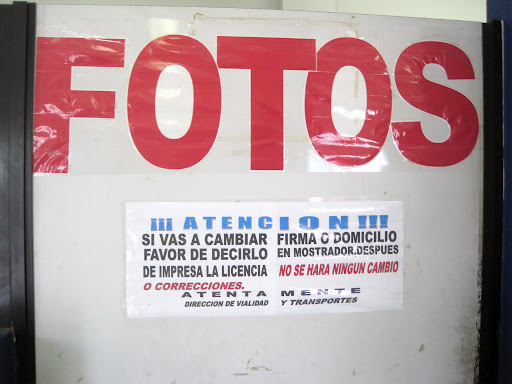
Greg and I obtained our Sinaloa driver’s licenses shortly after we arrived. We took the required class, submitted our documents, drove around the block, had our photos taken, and oilá. Others pay a “fee” and have it all done for them, but we did it above-boards and it was easy-peasy. In fact, the class was downright enjoyable — the teacher is a very good storyteller!

Now Danny’s just gotten his license, so I thought telling you about it might prove helpful for someone.

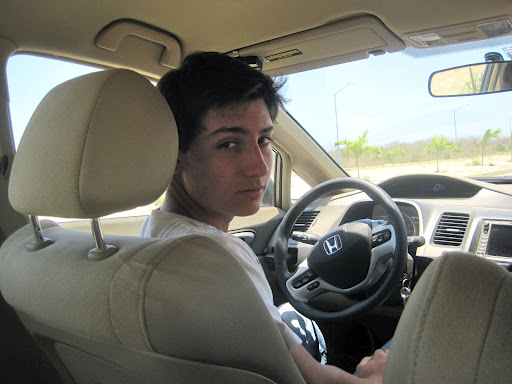
In his case, he’s a new driver, and we’ve been teaching him whenever we get a chance for about a year and a half. He started out slow, as does everyone, but these days he’s become quite competent.

He wants to work this summer to save money to buy a used car, and he will probably end up buying one with a stick shift. But, our car, the one on which he’s learned, is automatic. So, we enrolled him in a driving school so that he could learn how to use a clutch. The series of classes cost 1450 pesos, and included four rounds of driving of two hours each time, or eight hours total. In addition, there was a three hour classroom session during which they studied rules of the road. He seems to have taken to the standard transmission like a charm.

On Saturday he went to the tránsito, which is located just in front of the Aquarium here in Mazatlán. From the malecón, turn on the street towards the Aquarium. Go past the statue of Don Cruz Lizarraga, and turn right on the street on the far side of the vacant lot. The DMV office (tránsito) is at the end of the street, last building on your left, on the corner. There are two doors. The door on the right is where you file your paperwork.

The door on the left is where you take a class.

First-time drivers under the age of 18 have to take a five-hour class. They tell us the class is offered twice/month on Saturdays from 8:00 to 1:00. The classes seem to be pretty full, and the kids get a certificate upon completion which entitles them to be able to submit paperwork for a license. They do not take a written test.

When we got our Sinaloa licenses we already had U.S. driver’s licenses, so we only had to take a one hour class. At the conclusion of the class, they gave out a written test. There was an English language version of the test that they give out here in town, which seems much much easier than the Spanish language version (it’s multiple choice).

After the class and after you pass the written test, they give you paperwork so that you can go next door and get your license.

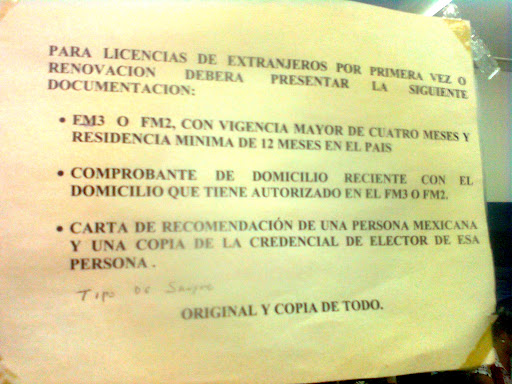
The documents a foreigner will need include (original and one copy of everything):

  1. Your Mexican visa or residency document
  2. Proof of residence/domicilio (water or electric bill with your name on it and your address)
  3. Letter of recommendation from a Mexican national, vouching that the person knows you and you are an upstanding person. This needs to be signed and accompanied by a copy of the signor’s voter registration card.
  4. You need to know your blood type (no proof required; just know it). If you don’t know, supposedly there is a lab about a block away where you can get tested. We know our blood types, so we didn’t experience this part of the process.
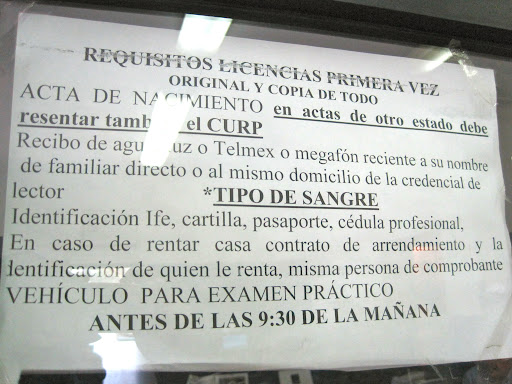
  5. The correct fee (see the photo at right for the chart of fees). Foreigners with FM3s are limited to 2-year licenses. First-time licensees pay for “Aprendiz.”


For first-time drivers like our son, you also need to bring:

  1. Birth certificate (to prove age)
  2. CURP
  3. Passport
  4. Parent needs to be present to sign

When you present your paperwork, they will usually ask you to do a driving test. So, you will need a car. They just asked us to drive around the block, nothing too challenging. We’ve been told that they want to be sure you buckle your seat belt and instruct the examiner to buckle his; this didn’t happen for us. Danny was also told that they ask you to pop the hood of your vehicle and show the examiner where you insert water, oil, coolant, etc., though he was not asked to do this.

Be careful as the street beyond the DMV office is one-way to the left; you don’t want to turn the wrong way. Also there are quite a few topes on the road leading up to the DMV office, as well as a stop sign conveniently hidden behind a tree.

After you drive with the officer, you pay your fee at a booth on the right side. Currently that fee is 344 pesos for a two-year period.

Next they take your photo and produce the license while you wait.

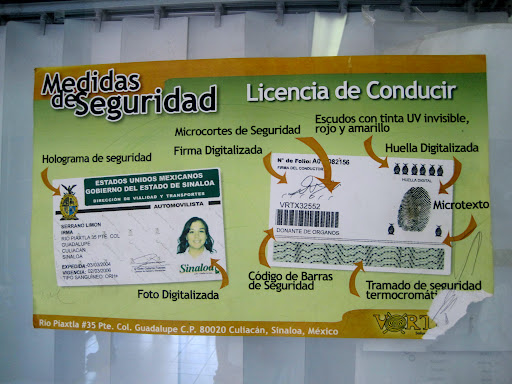
Each license contains a fingerprint of the license holder, so that’ll be the last step in the process. For us we filed the paperwork, did the drive around the block and got our licenses in under 90 minutes.

Licenses are issued Monday through Friday 8 am to 2:30 pm.

Renewals (as well as license plates, titles) can be done at this same office. However, we have had much better luck renewing our licenses at the DMV office in the Gran Plaza — it’s less of a crowd and seems to go quicker.

Good luck and drive safely!

NOTE: Our son said he learned a lot more in the driving school than he learned in the tránsito class, although he enjoyed both, and that he highly recommends the school for new drivers.