Mazatlán Photo Calendars are Out!

©2.P1290426

Photographers whose works are in the calendar: Lenny, Beverly, Dianne and John, with Dee Hulen from Sonrisas in yellow in the center. Missing is Lloyd.

Sonrisas, the small group of powerful expatriate women who give scholarships to outstanding students, has just published their third “photos of Mazatlán” calendar. I am once again proud to be included in this very worthwhile effort. Be sure to get your calendars, and those you want to give as gifts, quickly. They always run out long before Christmas!

Yesterday afternoon (Friday) was the launch party at Macaw’s downtown, just prior to ArtWalk. On hand were some of the women in the group, as well as all but one of the photographers. Photographers with works in the Sonrisas calendar this year include Beverly Kreutzer (the cover), Lenny Wollitz, Dianne Hofner Saphiere, John Kirsch, and Lloyd Goldstein. Click a photo below to enlarge it.

The Sonrisas group has been around for about ten years, though several of these ladies have lived in Mazatlán for decades. The group includes Lynn Hopkins de Hernández, Dee Hulen, Judith Wolfberg, Kathy Thompson, Marg Deane, Valerie Byrd, Lena Brown, Trish Kenison, Tish Loeppke, Claire Robertson, and Diane Hoover.

They have helped students get a good education, sponsoring academically-talented youngsters from elementary school clear through, for outstanding scholars, to university. They are even sponsoring one student who is currently studying abroad in Valparaiso, Chile!

Each lady contributes money to the scholarship fund, and they also conduct fundraising activities such as the calendar, bi-annual trips to a spa north of town or to Guadalajara/Tonalá and Tlaquepaque to go shopping; they’ve made and sold handmade greeting cards, and they used to have a large garage sale, as well.

The calendars contain 14 months (November 2015-January 2017), are bilingual, and list Mexican, Canadian and US American holidays—and this year they have a hole for hanging! They cost only 100 pesos each. Calendars are available at:

  • Twisted Mamas in the Golden Zone
  • Cafe Playa Sur downtown

Dee Hulen will be at Macaws every Friday from 4-6 pm till mid-December or till the calendars are sold out (they printed 600 this year). Group members will also be selling calendars at Rico’s and Looney Bean.

For more information please canemail Dee Hulen or Lynne Hopkins.

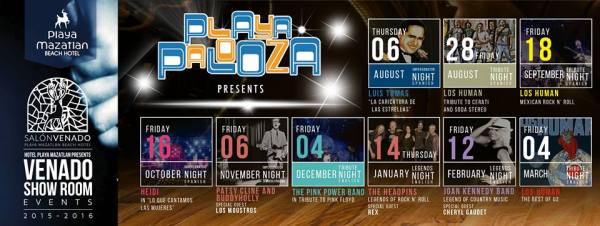
Go NOW and Get Your Tickets for Playapalooza!

11826044_1668255580056760_2044999750367621509_nWe went last night, it ROCKED, and you don’t want to miss the next one!

Lance Vient and the Hotel Playa have a new series of shows this year, and if last night is any indication, Mazatlán is indeed blessed! Called Playa Palooza, last night’s show had a nearly full house dancing till we dropped.

Headliner was a Patsy Cline impersonator, Amberley Beatty. Her voice is sultry and sweet, and her personality sassy. She most definitely charmed our audience. Below is a short clip of her opening her set with “Pearl Bailey:”

Click on any photo to enlarge it or view a slideshow.

Amberley came out into the audience several times to engage the crowd. Below is a clip of her flirting with one happy man from the audience:

Opening for Patsy was Buddy Holly impersonator, Jeff Scott. He had the energy and the moves, and included some Big Bopper, Ritchie Valens and Johnny Cash tunes in his repertoire. Here’s a short clip of him singing “That’ll Be the Day:”

And a few pics of Jeff; click to enlarge or see a slideshow:

And here’s a short video of Jeff singing “Peggy Sue:”

Both Patsy and Buddy were wonderful, and they were what drew Greg and me in, but what really made the night for all of us was the INCREDIBLE rockabilly group from Culiacán—Los Moustros del Espacio Exterior. Yes, weird name, but the group is AWESOME! Very, very tight; excellent musicians. The lead singer, “Voodoo” Sanchez, is completely bilingual, which adds so much feeling to those old favorites. Guitar, bass, sax, drums, and keyboards combined to get even this more “seasoned” crowd jumping to their feet and dancing in the wings of the Venado Showroom. I know we’ll be contacting them for our next party! Check out this short excerpt of just one song:

The group had nearly everyone on our feet, shouting like teenagers. They know how to rock! Click photos to enlarge or view a slideshow.

The Hotel Playa has long been our absolute favorite hotel in town. It’s gorgeous—the architecture, the lighting, the setting, the beach. We can rely on the Playa to have excellent dance music in the evenings, though we do miss their weekly fireworks displays (hint, hint).

For three decades before we moved to Mazatlán full time we stayed at the Hotel Playa on family trips, and we hosted our wedding party here as well. Our son Danny grew up with Paulina, who worked at the pool café. And now, keeping it in the family, Lance Vient is managing things. Below you can see a pic of him last night with his beautiful wife Brooke.

There isn’t a bad seat in the Venado Showroom, everyone, so run over to the Hotel Playa Mazatlán right now and get tickets for the remainder of the series! Mazatlán is home to some of the world’s best musicians; music runs in the blood of patasaladas. So, it’s especially encouraging to see the Hotel Playa bringing music front and center via its innovative Playapalooza!

My Favorite 2015 Day of the Dead Story!

XoloAnubisThis year’s official theme for Day of the Dead cultural activities in Mazatlán was Mictlán—the world of death in Aztec mythology. Navigating the nine levels of Mictlán towards the evening star in the heavens was said to take nearly four years and was full of challenges. The dead needed help, a guide, and they found it in a dog—Xoloitzcuintle—a carnation of Xolotl, the god of fire, lightning, sickness and deformities, twin brother of Quetzalcoatl.

Xolo effigyClay dog statues have been found ritualistically placed in the tombs of Aztecs, Mayans and Colima Indians, as have the skeletons of actual dogs. Sort of reminds you of Anubis, the Egyptian dog-god, lord of the underworld, doesn’t it? They are both black, guide the dead, and have pointy, stand-up ears!

Well, a modern-day incarnation of Xoloitzcuintle apparently lives in El Rosario, and her name is La Tigresa!

For the past year, every time Tigresa hears the funeral bells of Our Lady of Rosario ring, she walks into church and politely sits down to attend the funeral mass. When the mass is finished, she walks in the funerary procession, in front of the casket, all the way to the cemetery. There she stays with the body until the last person has gone home.

La Tigresa distinguishes between the bells of a funeral mass and those of ordinary mass, which she never attends. If there are two simultaneous funerals, Tigresa walks in between the two coffins, treating both equitably. If there’s a funeral in the morning and another in the afternoon, she attends both. If the body is taken back home after mass, that’s where she heads, too.

Photo from the Noroeste by Hugo Gómez

Photo from the Noroeste by Hugo Gómez

I want to thank my good friend Lupita, who shared this story with me from Sunday’s Noroeste. I just love it, and hope you will, too! We’ve got to meet La Tigresa!

Xoloitcuintle is, of course, a breed of dog here in Mexico, often shortened to “Xolo.” These beautiful, often black, hairless (and therefore flea-less) dogs were almost extinct, but concerted efforts to rescue it have been successful. It is believed to be one of the world’s oldest and rarest breeds, dating 3000 to 7000 years. In pre-hispanic times they were considered sacred, with healing properties both for the body and the soul.

The name is a combination of the god’s name, Xolotl, and izcuintli, which means “dog” in Nahuatl, though there are those who say the name means “he who snatches his food with teeth sharp as obsidian.” The breed has three unique features that baffle biologists:

  1. The absence of teeth between the molars and the incisors.
  2. A body temperature a few degrees higher than is normal for a dog.
  3. The dog sweats through its skin rather than by panting its tongue.

La Tigresa is obviously not a Xoloitcuintle breed, but would, indeed, appear to be an embodiment of this guardian of the underworld!

Día de Muertos in the TAP

One of the main catrinas, my friend Lilzy and me

One of the main catrinas, my friend Lilzy and me

Regular readers of this blog know that Day of the Dead in Mazatlán for us closely rivals our port’s ultimate party, Carnavál. And that is saying A LOT! So much so that, this year, I willingly woke up at TWO A.M. (!) in Seattle in order to get the earliest flight back to Mazatlán in order to attend our traditional callejoneada—CULTURA moved the event up one day to avoid the overtime hassles of having people work on Sunday. I got home just in time to welcome two of my girlfriends, Jessica and Lilzy, for a makeup party prior to the evening’s events.

Walking with the two gorgeous main catrinas to escort the dearly departed from their altars around El Centro to the ever-after was wonderful as usual! This year the donkey-drawn beer carts were replaced with motor-driven versions (two donkeys did head up the parade), at least four bandas took part, and there were hundreds of people who made the effort to paint their faces and dress the part of calacas and catrinas.

Below is footage from 2012’s alley parade, or click here to view a photo album of this year’s callejoneada.

Very exciting to me this year was that for the first time ever—I’ve stood in line for hours in previous years, to no avail—we were able to get tickets to the events in the Angela Peralta Theater. I have heard how awesome that event is, but we were never lucky enough to make it to the front of the ticket line. And, yes, many of you ask us why CULTURA doesn’t give us tickets, since we promote them so much. But, they don’t.

Even though I was out of town working, my wonderful husband Greg stood in line and scored us a pair of tickets! Then my good friend Jessica gifted us with two more, so a couple of friends could join us. After standing in line for the tickets, gentlemanly Greg didn’t even go in, but let the women have the opportunity!

The theme this year was Mictlán, honoring pre-hispanic Mexico. Entering the theater the very first act was a tribute to the Aztecs. Going on to the stage we saw two large dance performances: one looking out to the theater (in the seats) and another looking in towards the back of the stage (a wedding). All were gorgeous.

Walking through the hallways and stairways inside the theater was a bit like a spook house, but emerging out onto the upper deck some calacas were playing classical music and singing opera, and below was an aerial dancer wowing the crowd. Throughout the theater were located multiple altars honoring the dearly departed, and multiple dance and visual art installations.

Click on any photo below to enlarge it or view a slideshow.

Both Carnavál and Day of the Dead show just how strong our local arts community is. Young people practice for weeks to prepare for these big events, and hundreds of people dress up, make up, and bring their families and friends to participate in the events. We are so blessed here with every type of musician, singer and dancer, from classical to banda, as well as to artists of every form of visual and performing art. Many thanks to Cecilia Sanchez Duarte, who devotes the major part of three months to making events in the theater come to life, and to all the makeup artists, costume and set designers who contribute their skills as well! Such a terrific event, and the tickets are free! If, of course, you can get them!

The last two days have been family time, with altars at home to reflect on those we’ve loved and lost, visits to the cemetery, and raising a glass and a song to celebrate their lives. Day of the Dead is, indeed, yet one more of Mexico’s great contributions to our planet. I trust you’ve enjoyed the long weekend and used the opportunity of the holiday to connect with family and friends!

Cultural Appropriation of Day of the Dead?

As locals, expats and immigrants gear up for Day of the Dead festivities here in Mazatlán, I wonder how many of us realize that there has been quite a backlash to cultural appropriation and commercialization of Day of the Dead by non-Latinos.

I first realized how “hot” Day of the Dead was on my recent visit to a US liquor store. There, I was astounded by the quantity of Day of the Dead- or calaca-themed beer and liquor! To be honest, skeletons and skulls in and of themselves seem to be popular, and anything Mexican (amigos, lucha libre….), Spanish (Don Quixote) or mystical (voodoo) as well. The commercialization is, indeed, real. Click on any photo to enlarge it or view a slideshow.

Living here in Mexico, where we are privileged to be steeped in the traditions as well as the festivities, I hadn’t realized the concerns about appropriation of Day of the Dead until I read a post by one of the bloggers I follow, Aya de Leon, entitled, “Dear White People/Queridos Gringos: You Want Our Culture But You Don’t Want Us — Stop Colonizing The Day Of The Dead.”

In reading her excellent article and researching the matter a bit more, it seems that most Latinos are proud of this holiday. They understand that recognizing the dearly departed is a universal desire. Most are happy to share and ready to welcome us into the Día de los Muertos traditions, which have existed since Aztec times. But they most definitely and understandably resent our taking on the traditions as our own and transforming them into something they’re not — emptying the traditions of their soul. She writes:

And the urge to colonization is born when your own land and resources have been taken over by the greedy and your cultures have been bankrupted. Halloween has a rich history as an indigenous European holiday that celebrated many of the same themes as Day of the Dead, but you have let it be taken over by Wal-Mart… You have abandoned Halloween, left it laying in the street like a trampled fright wig from the dollar store. Take back your holiday. Take back your own indigenous culture. Fight to reclaim your own spirituality.

Please. Stop colonizing ours.

Aya gives examples of Day of the Dead festivals organized by non-Latinos in which Latino voices and faces are not even present! She talks of a sort of Cinco-de-Mayo-ization (my words) of Day of the Dead, in which white hipsters wear calaca face paint, stand amongst broken marigolds listening to white bands, and drink gentrified, holiday-themed micro-brews, without so much as a thought to what the true tradition is or means. She explains, and rightly complains, that we love Mexican culture when it’s convenient and fun, but not when it involves advocating to solve undocumented immigration, illegal gun exports, or rampant femicide.

So where, exactly, is the line between participating in and honoring Day of the Dead and appropriating or colonizing it?

Cultural appropriation is often used as an accusation, implying theft. But cultures, their traditions and artifacts, often aren’t clearly distinguishable. Throughout history people have intermingled, shared, and been inspired by one another.  As an interculturalist, I’m all about diversity, integration, collaboration, creativity. There is nothing inherently wrong in us learning from and building on one another; that is actually, rather, a really good thing!

The problem, Aya tells us, is many who are welcomed to the Day of the Dead table are poor guests. We don’t sit at the table; we take the table over. We don’t pay our respects, acknowledge our hosts, or say thank you. We need to be conscious that if we organize themed events, we should use them as opportunities to showcase Latino artists and musicians, and we should hold the tradition with reverence, respect, and a desire to learn and honor.

In an insightful piece in Quartz, Noah Berlatsky tells us that the problem with cultural appropriation is racism:

“There’s nothing wrong with Elvis loving and imitating Jackie Wilson. But there is something wrong with the fact that Elvis is hailed as the King of Rock n’ Roll, while most people barely know who Jackie Wilson is… White performers, like Taylor Swift or Miley Cyrus, use twerking in their videos on the way to becoming more successful and awarded than the black women who developed the style in the first place. When the white borrower, predictably, earns more accolades than the borrowee, artistic freedom and admiration is transformed into something much more problematic… While country music loves black music, it mostly excludes black artists, in the sense that those artists are not considered central, and their contributions aren’t recognized.”

Therefore, all of us need to be vigilant to extend power and privilege, credit and honor, to the origins and originators, not just to those who adapt. However, our modern-day systems are skewed against us. Those who write a book are credited with ideas expressed by others; individuals and corporations can copyright and trademark something that has a long tradition and belongs to a group of people.

Did you know that Disney even attempted to trademark Day of the Dead? They were making a movie called, Day of the Dead, and wanted to trademark the title. Thanks to huge response to a petition on Change.org, Disney rather quickly pulled its trademark application. According to an article in the Los Angeles Times, here’s what some of those opposing Disney’s trademark application had to say:

“Our spiritual traditions are for everyone, not for companies like Walt Disney to trademark and exploit,” wrote Grace Sesma, the petition’s creator. “I am deeply offended and dismayed that a family-oriented company like Walt Disney would seek to own the rights to something that is the rightful heritage of the people of Mexico. This is a sacred tradition. It’s NOT FOR SALE,” wrote Consuelo Alba, of Watsonville, Calif.

The trademark application was “odd” to Evonne Gallardo, executive director of the Boyle Heights art center Self Help Graphics. The center puts on one of the largest Day of the Dead celebrations in Los Angeles and has been sponsored by the Walt Disney Co. “The right thing to do is not to attempt to trademark a cultural and spiritual celebration,” Gallardo said. “I have yet to see a trademark on Christmas or Hanukkah.”

The movie was re-titled to “Coco,” no doubt so that Disney could trademark the title and create a website. One of the most spirited activists to oppose the trademark application was cartoonist Lalo Alcaraz, creator of that incredibly powerful graphic at the top of this post. In a great act of corporate listening and learning, he was recently hired on by Disney to work on the film about which he protested! Our speaking up to defend our heritage can have positive results! The movie is being made, showcasing a beautiful tradition, and it now includes more representation from the very culture it portrays.

Today as I started to write this post, I read an interesting article in The Atlantic: “The Dos and Don’ts of Cultural Appropriation.” In it, Jenni Avins provides six recommendations to prevent appropriation, including involvement of and engagement with members of the culture. She points out that cultures are fluid and constantly changing, so we can’t ask that they stay frozen in time. On the other hand, foreign passion has often helped preserve native traditions, arts, handicrafts, music, dance, literature and even languages. Like Aya, she highlights the importance of acknowledging and honoring the source, the origin, of cultural arts and traditions. Jenni also provides two “don’ts”: never wear blackface, and never use sacred artifacts as accessories.

As we all gear up to paint our faces and create our altars, let us participate in and enjoy the festivities, and use this time to truly remember those who have preceded us in death. Day of the Dead provides a perfect time for us to learn from our neighbors and hosts in this country, and to share with them a human universal: remembrance and longing for those we’ve loved and lost.

When have you felt the tug between honoring and participating in the local culture, and appropriating it?