I’ve Seen Carnaval Future…

Ironically, change can sometimes be the best way to honor tradition. And holding inspiration and love for tradition in your soul can bring about the most remarkable innovations and creativity. This year, CULTURA Mazatlán’s desire to bring in younger, fresher, more modern and innovative blood has been a surprising and welcome way to honor our community tradition—what the protagonist of this story calls our “religion.”

You will have heard of Ocean Rodriguez, the young mazatleco who left town 14 years ago to make it big in set design in Mexico City and who has come home to be one of three Carnaval float designers this year. The new city administration has been singing his praises so highly since coming into office that my response to meeting him was, honestly, skeptical. Were we about to meet another over-confident ego? Thankfully that was not at all the case. And, after our community disappointment with the monigotes, I know many of you are worried about the quality of the parade this year.

Touring Ocean’s workshop with him took our breath away, and I don’t say that lightly. We saw intricately detailed, lifelike sculptures, painted in vivid colors and finished in the glitter that is a requirement of a mazatlecan Carnaval parade. We saw a bit of Las Vegas, in the way lightbulbs were used to add flare to large letters. We were awed by moving parts and mechanisms, including machines and a whale spouting. A successful set designer, as Ocean told us, is part “architect, sculptor, mechanic, painter and carpenter,” a jack of all trades or a renaissance artist. I am posting photos of details, only, as CULTURA has requested the press not post photos of Carnaval floats before the parade, so that the public can be surprised and delighted. Click on any photo to enlarge it or view a slideshow.


Talking with Ocean was a delight. He treasures the uniqueness of Carnaval de Mazatlán deep in his soul, in a manner remarkably similar to that of Maestro Rigo—the designer of our parade floats for 54 years. Ocean, in fact, credits Rigo as his earliest professional inspiration—standing on the street in awe, along with the rest of Mazatlán—of those Barroque-style carros alegóricos was one of the huge joys of his childhood. His grandmother, Emilia Zatarraín, would take him and his cousins to the parade. She was “muy carnavalera,” and from December till Mardi Gras would save egg shells to make cascarones filled with confetti and serpentine, giving each of her grandchildren a “Carnaval kit” every day during the maximum fiesta of our port. Ocean is dedicating the eight floats he is building this year to her memory. And, while the city points to the Lewis family’s creations as honoring Maestro Rigo’s legacy, I believe you can add Ocean’s eight floats to that list. In Ocean’s creations we saw the details, complexities and whimsical surprises that we had been fortunate to witness every year in Maestro Rigo’s workshop, but updated, made with modern techniques, feeling familiar and yet very fresh and new. Kudos and thanks to you, Ocean!

Perhaps most surprisingly is that his workshop was relaxed, joyful. There was none of the last-minute panic, the long days and nights of endless work, that we were so used to experiencing in a Carnaval float workshop. It may have been show, but I believe it’s thanks to the wonders of 3-D printing and modern rendering, as opposed to the gorgeous yet time-consuming artistry of papier maché. Most of the pieces of all eight floats appeared to be nearly ready to assemble, calmly and ahead of schedule!

This year is a dream come true for this young mazatleco, whose most fervent desire is to make his birthplace his home. Having raised a son here who shares that most heartfelt of desires, I know how limited the options for making a living in Mazatlán can be, and sincerely hope that Ocean, who is building a house here, will make Mazatlán his base and continue his internationally renowned career from here. Ocean graduated from ICO, is divorced, and has all his family here in town. He’s designed sets for movies, television (Shark Tank Mexico and many others) and musical tours (Yuri, Enrique Iglesias, David Bisbal…), as well as commercials for some of the world’s most major brands (Pepsi, Burger King…) with the company he founded, Artefacto Sets. Below is one of their promotional videos.


Error
This video doesn’t exist

Touring a Carnaval float workshop evokes emotions similar to what I imagine touring Willy Wonka’s chocolate factory must feel like. We visited Maestro Rigo’s workshop every year and have visited Maestro González Neri’s several times as well. During the tour you feel excitement, delight, surprise, amazement, wonder… There are lathes and saws to cut wood; there are drills and torches to form metal; turbines, elevators and mechanical pieces; there is tons of Styrofoam, paint, and glitter, glitter, everywhere glitter. People talk of men coming home with lipstick on their collars. From what I can tell, in this industry, you come home with glitter in your hair and styrofoam in places you don’t even want to think about.

I so wanted to take photos of the floats to show you. Sadly, I couldn’t. But they are truly incredible! You will be delighted! As Ocean guided us around he’d say things like, “these are the birds’ wings here and they will go onto the crow there, and the crows will then be mounted to fly over the trees here, and the trees go….” Your imagination soars. The other really impressive thing, to me, is how the floats have elevators and telescoping elements. You see, they are assembled in workshops, which are a certain height. They need to drive out, or, rather, be pulled out, through the door or gate. They assemble the floats in order on Aleman street, and that is a second height. Then, the main Avenida del Mar, cleared of all low-hanging wires and street lights, is a third height. So, all the tall elements telescope out in at least three sections, like the giant drum / cake on the Banda el Recodo float: one part fits into another and those fit into a third. The push of a button enables things to move.


The theme, “Equinox: Awakening the Senses” was evident in every aspect of Ocean’s floats, albeit in creative ways. We saw:

  • A shaman in the jungle, highlighting the importance of nature and the danger of climate change.
  • The seasons of spring (a marine scene), winter (an epic struggle with an octopus) and fall (leaves, the autumn moon, and a boat).
  • Huge numerals “80” for El Recodo’s 80thanniversary float.
  • Gigantic statue of Prometheus, the Greek god who gave humans fire.

Ocean is doing the section for the King of Carnaval—renamed this year from King of Joy. We saw a delightful boat with a working paddle wheel, made entirely out of wood. Ocean began designing his floats in early October, and began producing the parts later that same month. He hired trailers to transport them here to Mazatlán a month ago, when he arrived with his team to begin work here in town. He tells us, “No one knows Carnaval like a mazatleco. I have 25 years of my life living and breathing Carnaval. It’s been a lifelong dream to design these floats. But no one is a prophet in their hometown. I had to establish myself in Miami, Bogotá, La Havana, before I finally got to come home to do what I do. I don’t regret that it took so long; I’m ready.”

While Maestro Rigo did things artisanally, with handmade papier maché, in Ocean’s workshop we see auto-cat, plotters, 3D printers, unicel, fiberglass molds, resin—a much higher tech way of creating his intricate, realistic yet fantastical designs that are so unique and yet echo the soul of a Lewis Carnaval. The pieces are still finished up artisanally—hand painted, and adding the glitter is a laborious process. He has hopes that we will see real fire spouting from one of the floats, but that will depend on Protección Civil’s permission. “The finishing with this method is finer, like sculpture. We can get details like fingernails, gestures, how the fabric moves…” Ocean didn’t know Maestro Rigo, though he did meet him once, briefly, when he was younger.


So what about this religion stuff? Why does Ocean say that Carnaval is the mazatlecan religion? “I had doubts about using glitter on my floats. Didn’t really want to. So I asked a few people. Put the question up on my Facebook page. I couldn’t believe the ferocity of the response!!! People demanded their glitter, said it wouldn’t be Carnaval without it. They had a fit, like I was breaking a religious truth. Every mazatleco is an art curator of Carnaval floats. Everyone born here can distinguish a good float from a bad one, and critique its elements, tell you what’s missing. What do you call it, if not a religion, when people stand in line over 24 hours to get free tickets for the coronations? What do you call it when they put their chairs out three days ahead of the parade, and spend 24 hours per day guarding their space, if not a religion?”

Religion or not. Carnaval de Mazatlán rocks, and the 2019 parade looks to be no exception I trust you’ll join me, dancing in the streets!

This is the first in a series on the 2019 Carnaval de Mazatlán floats. The second, on the Lewis Family taller, is here. The third and final, about Jorge Osuna’s workshop, is here.

Under the Big Top

I do love a good circus. And I especially love the aerialists: trapeze, tight rope, spinners, acrobats. Click on any image to enlarge it or view a slideshow.

Circo Atayde Hermanos is here in Mazatlán for a couple of weeks. Their performance schedule is below. A girlfriend and I went recently and enjoyed it very much—we paid 200 pesos for very good seats. It’s a simple, classic circus, with clowns, jugglers, balancing acts, a guy who’s shot out of a cannon, motorcyclists riding inside a globe, and my beloved aerialists. The show is animal-free, as animals have been outlawed in circuses in Mexico since 2014.

What I really loved about this is that those kids selling popcorn, candy apples and toys are the performers themselves! So engage them in conversation and learn a bit about what they love about their lives and their job. Itzel, the girl with the loop on her head, told me she loves the traveling. She’s been all over Mexico and the US, and has hopes to get to Europe. She told me quite a few performers get trips to Europe for special performances. She studies with a teacher that the circus provides for the kids in the troupe.

Circo Atayde Hermanos is 130 years old this year. I have been told that it was actually founded in Mazatlán back in 1888, after the two Atayde brothers, who hailed from Zacatecas, fell in love with two sisters from El Rosario, and that Francisco Madera delivered his campaign speech under their tent here.

51092681_2532829363400329_1356177434570915840_n

Photo from the Atayde HMOs Facebook event page

The internet tells me (third-hand, as their own site doesn’t have a history) that the circus was founded in Zacatecas. Desiring to figure out the real story and get some behind-the-scenes photos and interviews, I arranged an appointment with them. Their local promotions director, however, is quite a piece of work and that interview very distastefully never happened. In its absence, enjoy the pics I did get!


Bless You All!

DSC_0107padreehijaOne whole chicken costs about 70 pesos. Today in the silent auction for the Desayuno de los Pollos/Chicken Breakfast YOU all helped us raise 22,500 pesos. That equals 322 chickens that will feed as many families! And that does not include the money raised by the breakfast itself, the bazaar, bake sale, gumball guessing and your donations!!! This year, for the first time ever, we added a LIVE AUCTION.

Many of the people we serve live in homes made of black garbage bags, recycled vinyl banners, or the occasional plywood. We completely make their Christmas holiday by giving them the chicken for a Christmas dinner, foodstuff/despensas for a couple of weeks, and second-hand bedding or kitchen items.

P1120977 pink ladies

There are SOOO many individuals we want to thank for helping us sell tickets and collect auction items. Special thanks this year to Jeanette and Emery Leraand, as always, Denise Thomson, the awe-inspiring Sue Parker, and our four goddaughters, the Hernandez sisters, among MANY more! Hundreds of people enjoyed the morning, with so many smiling, winning faces.

Please join us in thanking those businesses that supported this effort, by patronizing them and letting them know you appreciate their civic-mindedness:

  1. Athina Spa
  2. Aroma Spa
  3. Banda El Recodo
  4. Banda El Limón La Arolladora
  5. Barbie Dolls—Vintage Collectibles—from Helen James and Brenda Millirons
  6. Casa Canobbio
  7. Casa Etnika
  8. Casa Lucila
  9. Diamonds and Gem in the Pacific
  10. F.I.S.H.
  11. Gaia Bistrot
  12. Gregory Webb, art by Viejo Castro
  13. Gwen Tegart, handmade quilt
  14. Johnny Gunshots
  15. Marina Mazatlán Golf
  16. La Mona del Astillero
  17. Mazatlán Comedy Club
  18. Pedro y Lola
  19. Quince Letras Wrought Iron
  20. Sonrisas Calendar and Hand-crocheted Bag from Lynne Hopkins de Hernandez
  21. Sylvia Felix Painting
  22. Thru Di’s Eyes Photography
  23. Tippy Toes
  24. Venados de Mazatlán
  25. Villa Italia
  26. Vittore Restaurant

You can still make a donation by clicking on the “donate” button on the right side of this website, or contacting us. Join us the morning of December 24th to hand out the goodies, or the 10 days prior to pack up foodstuff. See you then!

Day of the Dead Mazatlán 2018

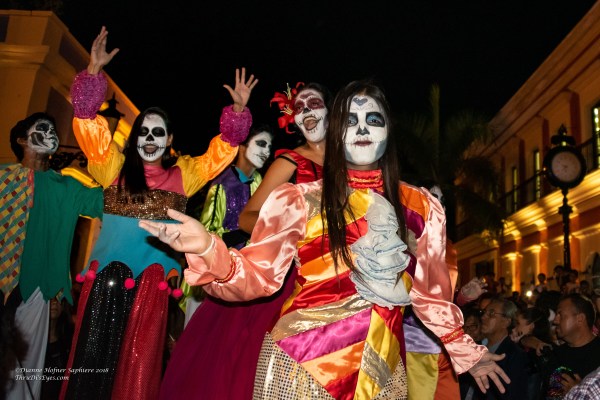
DSC_0057Mazatlán knows how to put on some of the best parties ever, and I say that with a lot of worldwide experience, not lightly. This year’s Day of the Dead alley parade or callejoneada did not disappoint. Visitors from the interior of the country, elsewhere in Latin America, north of the border and Europe all reported to me thoroughly enjoying themselves and the revelry that is Día de Muertos in our port.

The callejoneada this year was held on November 2nd instead of the traditional 1st, due to the changeover in city government. Thousands attended the annual festivities, which are some of the most exciting and participative in the country. The parade began at 8:30, and there were performances inside the Angela Peralta Theater, as there have been in other recent years.

The alley parade wound through downtown past several traditional altars, and included at least three bands, several dance groups, costumed stilt walkers, and mobile sculptures. As is traditional, families with children were in the majority. It’s my favorite part of this night: seeing multiple generational families in costume enjoying our city and one another!

The callejoneada returned to the Plazuela Machado where several stages were set up with live entertainment till the wee hours. There seemed to be a lower percentage of costumed revelers this year, but the hundreds who dressed upped the game and looked fantastic. Local makeup artists outdid themselves with creativity and color.

New this year was that the parade began at the Plaza República, winding the three blocks to the Machado and then beyond. It gave a bit more breathing room to the official participants before being bombarded with the thousands of spectators who joined in from the Plazuela.

Also new this year were official catrinas that were sponsored, namely, four or so of them sponsored by our beloved Venados baseball team. While they were gorgeous, and this was very cool, it added a commercial element to our traditional alley-winding that I found rather sad.

Sadder still was that for the first time in many years our local Pacífico brewery was apparently not a sponsor. Not only were there no kegs in sight, ruining a joyous local tradition of people handing up their cups, but Indio beer was served in cans, by gruff people lacking the usual joy! Finally, first we lost our traditional donkey cart, which was understandable, but this year we had tuk-tuks! How in the world is that traditional to this part of the world? The beer fiasco was perhaps the most epic fail of the evening, as complaints were heard far and wide over how kodo (cheap) the new administration was; the lines for Pacífico at the Kioskos went nearly around the block, with people choosing to purchase their beer.

Another disappointment was the fact that the organizers have discovered cheap Chinese imports from the likes of Waldo and Sanfri. We were treated to mass-produced skeleton Halloween costumes rather than the gorgeous handmade garments we are so used to, and numerous inflatable plastic decorations and cardboard skulls were to be seen on the stages and posts of the Plazuela, in contrast to the beautiful handmade papier maché artwork from our local art school. I pray this error will not be repeated. Mazatlán’s art scene deserves way better!

The callejoneada for Day of the Dead this year was more Carnaval-like, with dance troops performing routines that lent themselves more appropriate to Fat Tuesday than to Day of the Dead, and one of the wheeled calacas/skeletons lit with lights in a similar manner to a carroza/float in the Carnaval parade. As is usual we did have Carnavál royalty participate. I can vouch that those gorgeous women even look good dead! 😉

My favorite costume was that of my friend Linette: the death of Lady Liberty. While I hope and pray for my birth nation that it is not true, her costume rang too close to home; I appreciated its poignancy.

DSC_9917

Every year we seem to attract more people to this incredible event. It has outgrown the Plaza Machado and especially this year spillover could be seen in Olas Altas and beyond. An important recommendation for next year is to raise the stages higher. With so many people it is nearly impossible for anyone beyond the second row of standing spectators to see what’s going on on stage.

Every restaurant in the Plaza and along the parade route seemed to be sold out. Our group stayed to cenar/eat a late dinner, and when we left about 1:30 am the Plaza was still full of energy. I so enjoy watching how vociferously death sings in the late evening on the Plazuela after the callejoneada.

Day of the Dead remains one of the highlights of Mazatlán’s local cultural scene. It is a jewel in Mexico’s holiday offerings; not the traditional celebrations of Oaxaca or Janitzio, but full of spirit and reflecting our local culture. It is my true hope that some of the missteps this year are due to the fact that the new administration just took over the day before and thus had little time to prepare.

Kudos to the maestros and artists who contributed! Mazatlán is incredibly blessed with your talents and generosity! Day of the Dead in Mazatlán, as Carnavál, is truly a festival of the people!


Chicken Breakfast 2018!!!


1-p1090521

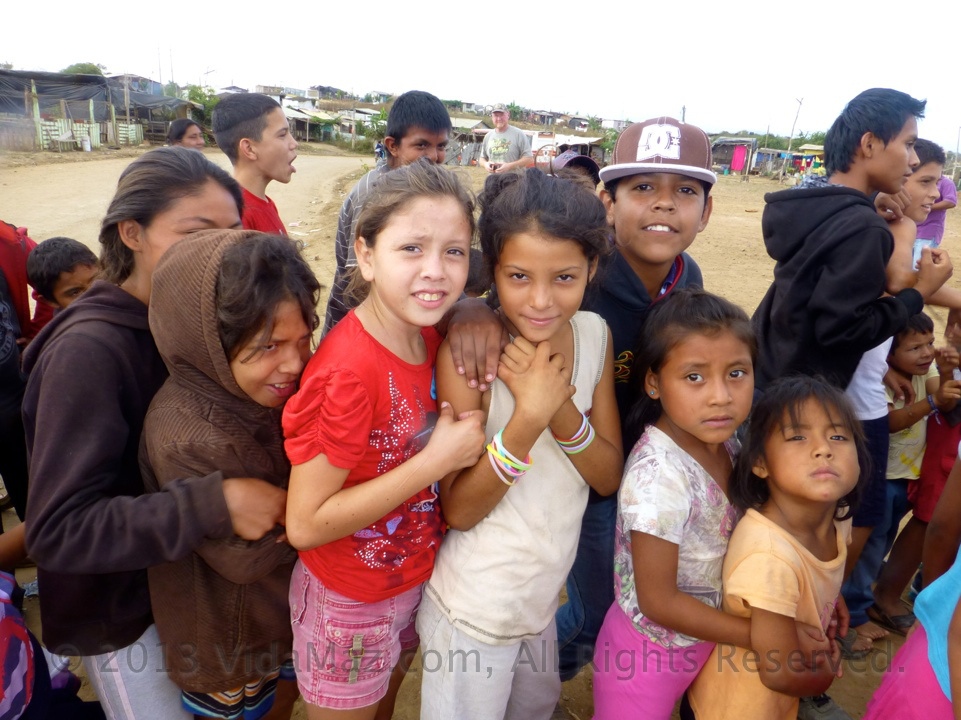
Kids charming the camera woman while they line up for candy!

I’m excited to announce the Chicken Breakfast (Desayuno de los Pollos) for 2018! Mark your calendars now for Saturday, December 8th at the API (cruise ship) dock. Help us feed 2500-300 families for two weeks during the holidays. Tickets are 200 pesos for the full breakfast, Christmas bazaar, bake sale, silent auction and raffles. We’d love it if you’d help us sell breakfast tickets! Contact Yolanda at (669) 431-4529, Jorge at (669) 110-0744, or me (dianne@vidamaz.com). We’d also love you to help collect items for the silent auction. Download a gift certificate for restaurant meals, hotel stays, airfares, or donate your artwork or cool gift item!

Also set aside the morning of December 24th to hand out the food, clothing and toys in Mazatlán’s poorest colonias! Begin collecting your items for donation now—gently used household items, sheets, towels, blankets, coats, shoes, clothes, new toys. You can also donate money, 100% of which goes to help those in need.

More details on the 29th annual event follow.

What is the “Chicken Breakfast?”
It is a two-step process to feed the neediest in our community.

First is a fundraising breakfast held in early December to raise money to buy one whole chicken and ten days’ worth of food for each family—we buy for as many families as we possibly can.

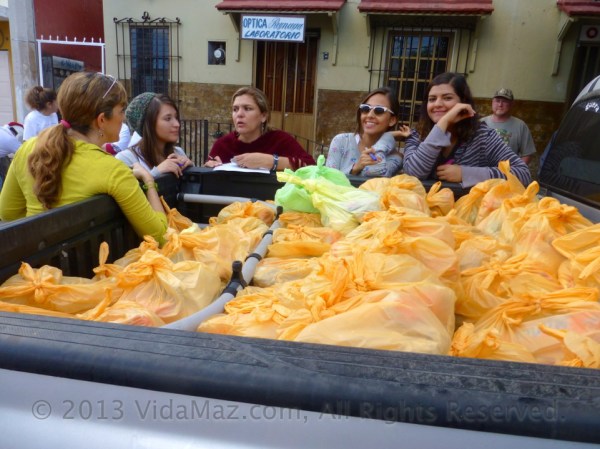
Second, on Christmas Eve morning (24 December), dozens of us gather together to load trucks and go out to the invasiones, the poorest, “squatter” areas of Mazatlán, to make people happy and hand out the goods! We give the chickens and foodstuffs, plus gently used clothing, linens, shoes, coats, and new toys and candy.

It is important to know that several of us go out to the squatter areas the week before Christmas. There we meet with area leaders and go around with them to hand out tickets, to ensure that those in need receive what they need, and that no one cheats or “double dips.” We especially want to ensure that we get food and clothes to the elderly and the disabled, so we go door to door to make sure everyone knows about the event, and to make plans to get things to those who can’t walk to the delivery site.

The history:

Yolanda Medina’s daughter, María Yolanda, was very sick. She and her husband kept vigil in the hospital, taking care of all their daughter’s needs. As Yoly’s sister-in-law Isa tells the story:

“It was Christmas Eve 1990, and María Yolanda’s days were counted. Yolanda and her late husband, Modesto, were in no mood to eat, let alone have a Christmas Dinner with all the fixings. But that night, a woman knocked on the hospital room door and peeked to see if there was someone with the patient. She came in to hand Yolanda and Modesto a box with a hot Christmas Dinner meal — and told them Merry Christmas and that God was with them. Yolanda never forgot that gesture.

After María Yolanda passed away, Yolanda got us all together and told us what had happened. So, the first couple of years, we had culinary arts students volunteer their time to prepare a Christmas Dinner meal, with donated ingredients from friends and family, and all of us volunteered to fill disposable thermal boxes with the hot dinners, load them into cars and pick-up trucks, and off we went, to hospitals, traffic intersections, parks — wherever we thought we might find people that, for one reason or another, wouldn’t be privy to a nice Christmas Dinner.

However, this was a huge effort, and very expensive, so we couldn’t cover that much ground. So we thought in terms of something more practical, something that could be cooked and prepared at home. This way, we could make sure many more families could have a Christmas Dinner. That’s when we started the Desayuno de los Pollos.”

How to help:

  1. Buy (or sell) tickets for the fundraising breakfast. Contact me at dianne@vidamaz.com, or buy them from anyone selling them around town. Post and Ship in the Golden Zone (beside Dolce Mami, across from FedEx) will have tickets also.
  2. Make crafts or baked goods to be sold at the bazaar during the breakfast.
  3. Donate (or gather) items for the silent auction (download a gift certificate, artwork, restaurant meals, hotel stays, airfares…)
  4. Help set up, cook, serve or clean up after the breakfast.
  5. Donate money (in person or click on the link), gently used clothing, diapers, lightly worn shoes, linens, blankets coats, new toys, or candy. 100% goes to those in need. Post and Ship will be happy to collect items if you drop them off there (beside Dolce Mami, across from FedEx).
  6. Help pack the food into packets—the two weeks before Christmas.
  7. Join us to go out with community leaders to deliver tickets for chickens, to ensure all receive their fair share, the weekend before Christmas.
  8. Help us load the trucks and deliver the goodies on December 24th! This is, of course, the most fun and a terrific tradition with friends and family.

When and where is the breakfast?
It’s usually the first Saturday in December, 8:30-10:30 am in the cruise ship dock/API. In 2018 the breakfast will be on Saturday December 8th. Please join us and bring all your friends! Your ticket includes a full homemade breakfast, coffee and juice, a ticket for the door prize, a ticket for the raffle, and access to the Christmas bazaar. This is a very multicultural affair, with announcements in Spanish and English and hundreds of locals and expats attending.

API dock is on Emilio Barragón nearly across from the new OXXO. Below is a map. If you can’t find it, ask any taxi driver or blue shirt/Tourism Volunteer.

API

How can I get to Quince Letras on December 24th?
Come by 6:30 am if you are driving a truck, 7:00 am if you are helping us load and deliver. We usually finish by 11:30 or noon, but some years it’s taken longer (depends how many routes you participate in).

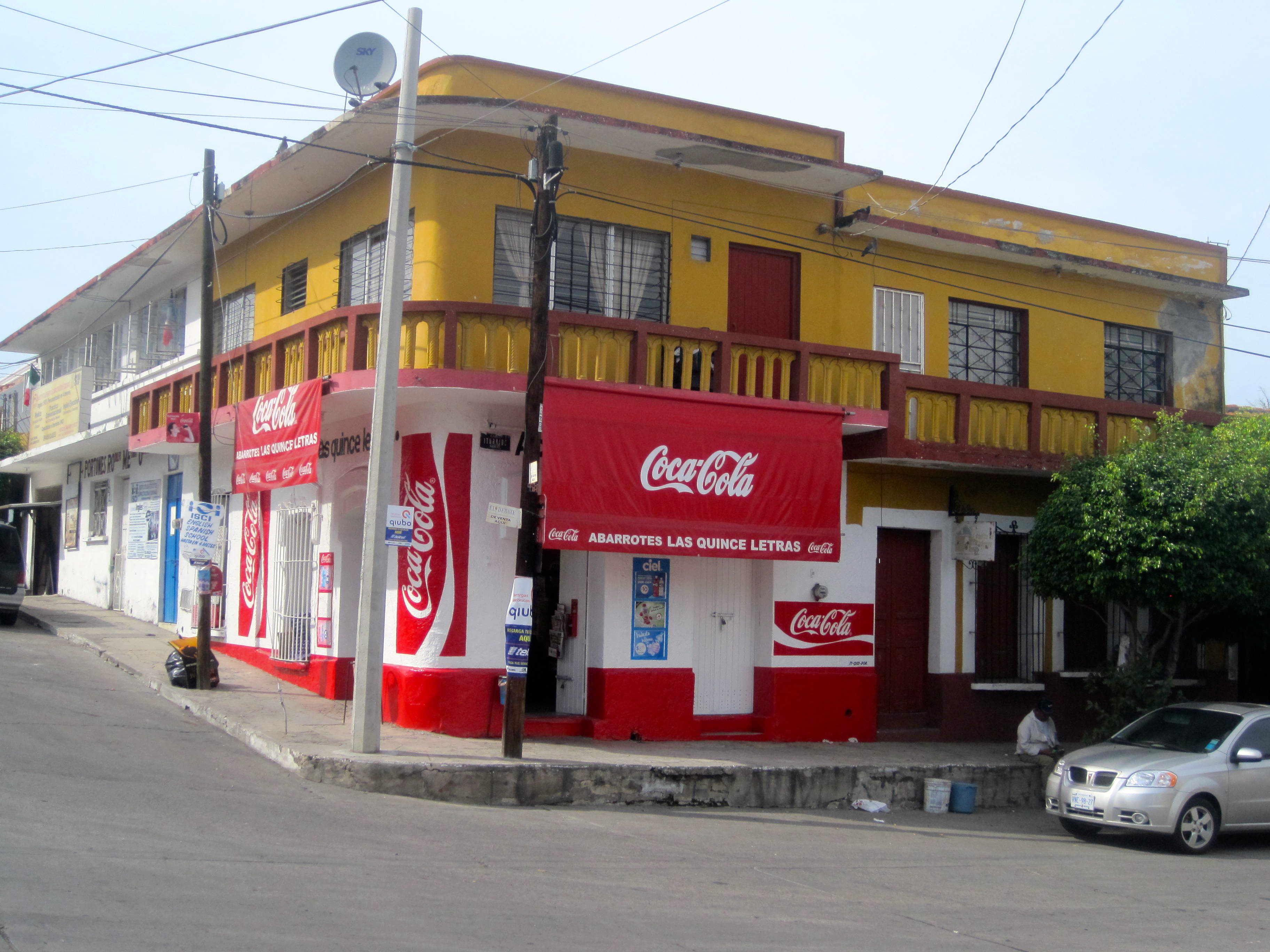
Quince Letras, corner of Tampico and Francisco Villas streets We load from either side of this

Quince Letras, corner of Tampico and Francisco Villas streets We load from either side of this “Coca Cola” store on the corner

LOCATION: 15 (QUINCE) LETRAS, corner of Francisco Villa and Tampico, just down the hill from the Church of Cristo Rey (Christ the King—photo below).

  1. From Avenida del Mar turn East at the Fisherman’s Monument.
  2. Go to the first light and turn right.
  3. Proceed one block and turn left (Francisco Villa street, just before the Pemex station).
  4. Go two blocks.
  5. If you are NOT driving a truck or transporting supplies, please park in the next block. This will give us room for loading. Once you’ve parked, walk another block down, past the iron works business called “Quince Letras.” On the corner of Francisco Villa and Tampico you will see a small store with a bright red “Coca Cola” hand painted on the outside, across from a tortillería. A door next to the Cocheras Automaticas business will be open. That’s Yolanda’s mother’s house, and it’s from there that we’ll be loading.
  6. If you are driving a truck or transporting supplies, please drive up to Tampico street (the “Coca Cola” store on your right on the corner), turn right, and park. We will be loading right there.

IMG_0669If you can’t find it, just ask someone for “Quince Letras” or “Desayuno de los Pollos/Medina family.” Everyone in the area will know.

Merry Christmas to all! And see you there!

  1. Download and view or use a PowerPoint presentation with a full explanation of the project: chicken-breakfast-presentation 
  2. Download a gift certificate to fill out, and we’ll advertise your business or service at the breakfast! Just contact us and we’ll pick it up!
  3. Download and print a poster to help advertise.

Have questions? Contact the organizers:

  • Jorge Medina (speaks English well) on his mobile, (669) 110-0744
  • Yolanda Medina (some English) at (669) 431-4529

Permanent link updated annual: https://vidamaz.com/pollos