In my next life, I want to be a manta. I’ve always said I want to be a Kobe cow, so I could drink beer and get massaged all day. But, in 2015, I hereby declare that being reincarnated as a manta ray looks oh-so-much more fun! We went out whale watching this week with Onca Explorations.
Whale watching has been our traditional Christmas gift to each other as a family since 2009. And a wonderful gift it is! The highlight of the trip this year for me were the mantas! We did, indeed, see whales; I will post pictures and write about that separately. But the mantas!
They were having so much fun! There were so very many of them—hundreds—and they kept jumping and flying and splatting and splashing, performing their high jinks all over our bay with their friends, for what seemed like forever. They just didn’t stop. What a joyful bunch they are! It reminded me of dancing sessions with my girlfriends…
The mantas’ bodies change so completely with every leap. They slap their wings against the water in a loud “thump!” That slap launches them into the air, where their wings curl up the opposite way, wrapping themselves backwards, in a rebound of sorts. They leap into the air—seemingly soaring over the skyscrapers on the beach, as you can see in the photos. They then fall back into the water with another loud “splat,” and start the process all over! And they do all of this in the company of hundreds of their joy-filled friends, frolicking about in a big band of craziness. And did I mention that mantas are HUGE? These looked to be maybe 3 or 4 feet across, and they get much bigger. Below is a short video clip of some of the manta merriment. I highly recommend you take a whale-watching excursion with Onca. Maybe, if you’re lucky, you’ll get to see some mantas!
What makes the mantas leap so? Are they mating and courting, and perhaps the manta with the biggest splash is the sexiest? Are they just having fun, partying hearty with their friends? Are they wanting some Vitamin D from the sun? Whatever the reason, I sure did enjoy them!
Click on any of the photos in the album below to view it larger or see a slideshow.
National Geographic published a video of the largest-ever-witnessed group of mobula rays in our Gulf of Cortes. It is incredible! Watch it below:
How in the world could we possibly top last year’s amazing Carnavál? The theme in 2013 was the movies. Everyone loves a good picture show, and last year’s parade most definitely made the most of that love! I figured there was no way anyone could top last year, so I was mentally prepared not to be sent over the moon by this year’s parade. NOT! Both 2014 Carnavál parades were incredible! The 34 floats, 23 dance troupes and 16 musical groups made for an absolutely fantastic nearly four hour event!
I love that we have two parades. For us, living here on the north end of the malecón, the first parade is an evening into night affair, making for a tremendous street party. The floats in the parade are all aglow, and the dancers are in party mode, grabbing us from our seats and cena on the curb to join in the merriment with them. The second parade, on Tuesday, has the floats lining up in front of our house from just after noon, ready for picture taking in the full light of day. The dancers and royalty come out about an hour before the parade, and it’s the most incredible photo opportunity of the entire year—dancers putting makeup on each other or rehearsing dance steps, bands warming up their instruments and tunes, people stretching, eating, laughing. I absolutely love both these events.
To me the very best thing about Carnavál Internacional de Mazatlán is that it’s a family affair. Nearly every family in town has a member who’s been Carnavál royalty, even if it’s a cousin or aunt, and nearly every Patasalada has danced in Carnavál at some point in his or her life. Royalty celebrate their silver and golden anniversaries, and what a joy it is to see them relive the original thrill, often accompanied by their children! Young children and grandparents dance in the parade, even though it’s such a long route. Several years ago I had a good friend from Mexico City who just hated Carnavál. She thought it was low class and tacky. What she hated most were what she called the beauty contests—that young people were taught to value superficial beauty rather than brains or talent. While I tend to agree with her about beauty contests in general, and I am very much saddened by the shadow cast over the voting for Queen of Carnavál the past few years and hopeful the process will become more transparent, the fact is that Carnavál is a festival of the people. It is much, much, MUCH more than a beauty pageant, involving literature, poetry and painting competitions, concerts galore, fireworks, a food festival, bullfight, several “manifestations” or pre-Carnavál energy-building events, the pomp and circumstance of the coronations, the parades and, of course, the huge street party in Olas Altas for six nights straight. Mazatlán has over a month’s worth of Carnavál-related events, and there’s enough variety to please everyone. Click on any photo below to enlarge it or view a slideshow.
Royal float
Young princesses
And Grandma Queens
Everyone’s royalty at Carnavál
King of Joy Adolfo Blanco
Floral Games float
DIF Queens from the different colonies of Mazatlán
Young royalty
Pretty in pink
Queen of Carnavál float
Floral Games float
Kids rule at the parade. Most of the dancers and musicians are teenagers, children or young adults, joining their friends from dance class, gymnastics, or school. They’ve worked for months to raise money for costumes and props, and have rehearsed their hearts out. They are eager to burst with joy and energy during that first parade. Then, by the second parade on Tuesday, they transform into relaxed, experienced parade marchers, more confident of themselves and the crowd around them.
Masked youth
Pierrot
Acrobats
Fairies
Growing into their bodies
Fun with friends
Hanging out
Helping with makeup
Hi!
Ready to play!
Can I get on the horse?
Vamping for the camera
REady to roll!
Eye makeup and false eyelashes
Lining up
Resting and readying
Ready to go
Smiles of joy
Clowning around
Miming
Samba man
And another samba man
Kisses!
Smiling after all that dancing!
Venetian masks
Venetian Carnavál
In Palazzo Ducale
Who are they? 😉
Hello!!!
A royal wave
Having fun
Ready for the ball
Japanese comparsa
Viva Japan-Mexico!
Africa was represented
Truck driver brings his daughter
The pre-parade sponsors
Cutie patootie
Shouts of joy
Amazon was represented
Gymnastics and hip hop dancing
Gorgeous young people
The other star of the parades is the setting—the route goes along the malecón, south to north on Sunday, then north to south on Tuesday, with a clear view out to the ocean and the islands of our bay, the glittering lights of downtown, and the changing colored lights of Valentino’s on the northern end.
Sunset over the parade route
Helicopter patroling for safety
Floats ready to go for the second parade
Sunset over the parade route
Sunset over the parade route
Sunset over the parade route
Sunset over the parade route
Monigote and the crowd
Floats ready to go for the second parade
Candy! Candy!
So, what made 2014 stand out for me? The most notable difference for me was the crowds! Usually people set out their chairs the night before the big day, but this year was unreal. There were solid chairs from one end of the parade route to the other, and it was reported that over 800,000 people—twice the population of the city—turned out to watch the first parade! We had three families that did not join our party because they couldn’t get through the crowd to get to us! It was a-m-a-z-i-n-g! The mayor tested out a bleacher system which seemed very popular with those wanting a seat at the last minute, but that met with huge pushback from those opposed to selling seats along the malecón. While I’d love to see seats and space continue to be free of charge, something obviously has to give if the crowds keep growing like they are. I’m sure we had many more spectators this year who joined us from Durango, Zacatecas and beyond, thanks to the new highway.
Last year you’ll remember that CULTURA invited a special group from Brazil to join us. They were scantily clad and a huge hit. I believe that is perhaps what influenced another change that we noticed this year: much sexier costumes, and many more scantily clad dancers. Several of the floats had hired models dancing on them, fortunately including scantily clad men as well as women, so everyone could enjoy. I noticed quite a few of the kids’ dance groups had sexier-than-usual garb, also. Perhaps that was in keeping with this year’s theme, Piel del Mar or “Skin of the Sea.”
My personal favorite float this year was the Venetian float that Francisco Igartúa made for Marcela I, Queen of the Floral Games. It transported all of us to the Palazzo Ducale, complete with a couple of gondola rides, and beautifully honored the style that Maestro Rigo Lewis established for royal carriages of Carnavál these past 50 years.
Gondolas of Venice on the malecón
Floral Games float
Floral Games float
Palazzo Ducale
Palazzo Ducale
Palazzo Ducale
Queen Lorena’s float was also incredible, representing Rio. It was begun by Maestro Rigo himself, and finished up by his family after his death. Suzset, the Child Queen’s float was also made by Maestro Rigo and the Lewis family, representing New Orleans. Maestro Jorge González Neri had a huge hit with the King of Joy, Adolfo Blanco’s, exuberant and colorful Cuban float. You can definitely see the different styles of the floats’ creators!
Royal float
Queen Lorena I
Queen of Carnavál float
Queen of Carnavál float
Queen Suzset
Queen Suzset’s float
Queen Suzset’s float
King of Joy Adolfo Blanco
King of Joy float
There were so many terrific floats, and also the LED-lit cars that we’ve grown to love these past few years. At least four continents were represented this year: the Americas, Europe, Africa and Asia. It was all definitely a feast for the senses!
Here are a few final pics of some of the dancers in this year’s parade. I hope you enjoyed it all as much as we did!
The past couple of year’s I’ve put together a video of Carnavál. This year, Mahatma Millan has already put together such a terrific one, that I figured I don’t need to bother. Let me share with you his terrific work:
Today is Ash Wednesday; Lent begins. Time to rest, reflect and recenter, after the exuberance and sleep deprival of the past week! Please, share with us your favorite part of Carnavál, in the comments below.
One of the reasons we came to live in Mazatlán is our compadres, the Valverde family. Daniel has been Greg’s best friend since they both were sixteen, working up in the SF Bay area. Daniel and his family are originally from San Ignacio, and many of his family members and dear friends have worked for Greg up north over the decades. Greg began to travel down to Mazatlán with Daniel on holidays, staying in the house Daniel built for his mother. They would often travel out to San Ignacio, to the rancho, to visit family and friends. Over the years they have become family to us. Danny dearly loves his tíos and cousins, and not so long ago we went to San Ignacio with Mariana and Rubén, Daniel’s sister and brother-in-law, to visit the dentista loco and his wife, Irma, also good friends.
The girls of the gang, at the giant statue
Hear no evil, see no evil… Yeah, right.
Pozole!
Hanging out
Cousins
At the river
Love you, tía!
San Ignacio (de Loyola) is a lovely small town about 60 miles north of Mazatlán, entered through the typical scenic gate, and with a walled church on the central square, as is so normal in the small towns of México. It was founded in 1633 by the Jesuit priest, Diego González de Cueto, and is currently home to about 4500 people. San Ignacio was originally called Piaxtla, after the indigenous people who lived there. It is a colonial mission town, with the Jesuit Misión de Santa Apolonia established there in 1748.
Like most of the small mountain towns near Mazatlán, San Ignacio was a mining town, rich in silver, gold and copper. Today, life on Constitution Square and in the streets of San Ignacio is laid-back yet vibrant. Many of the colonial French and Spanish style buildings are still standing, and the landscape is lush. The main church is called, of course, San Ignacio de Loyola, and a second church in town is Our Lady of the Nativity. There are hot springs, though our friends have never taken us to them.
“Door” into town
The municipal palace
San Ignacio de Loyola
Closeup of the clock on the church
Church through palm trees
Church taken from the other side of the square
Kiosk in the central square
An abandoned building on the square
Closeup
Closeup
A bus through town
An ice cream seller
Storefronts
Town architecture
Storefront
Ready to sell papers
View of town
Lovely buildings
Lovely buildings
Lush greenery
Storefronts
What stands out during a visit to San Ignacio is the huge statue of Jesus Christ up on the hill, hands outstretched in a similar manner to the famous statue in Rio. You can easily view this landmark from the main square, and the views out from the statue on top of the hill are truly breathtaking.
The huge statue of Jesus
Closeup of the statue
Incredible views from the statue
Incredible views from the statue
View of the main church from the statue
View of the main church from the statue
Incredible views from the statue
Incredible views from the statue
The statue’s base is surrounded by plaques of all the towns in the municipal
Incredible views from the statue
Incredible views from the statue
The handsome male members of our group
View of the statue from Plaza Constitución
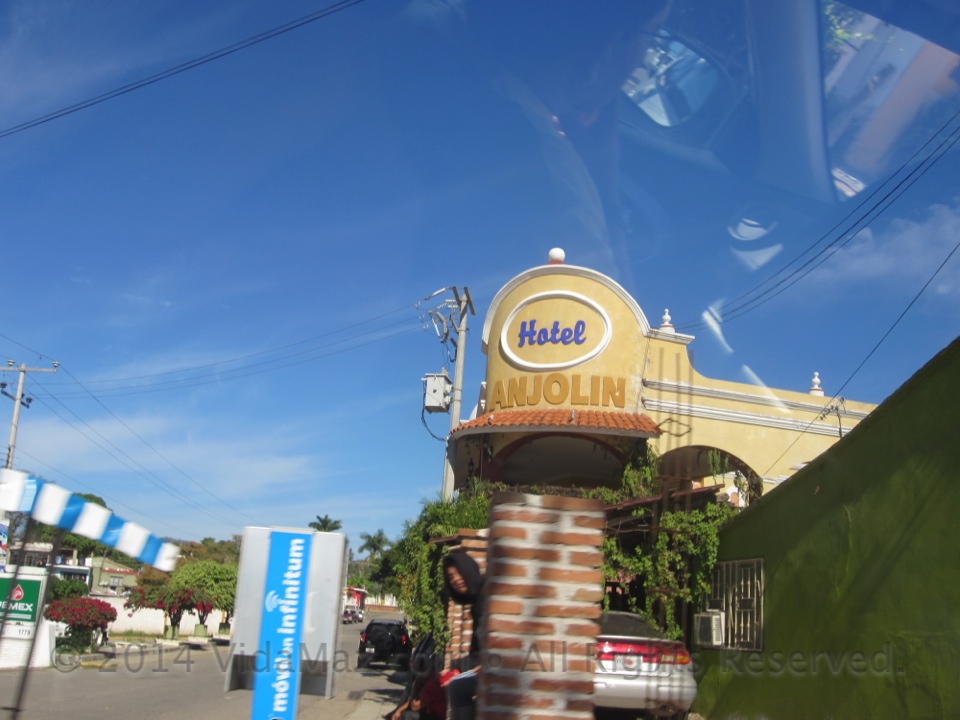
I’ve always wanted to go to San Ignacio for Good Friday. They do a remarkable, community-wide reenactment of the crucifixion. The event attracts hundreds of people, so hotel reservations need to be made far in advance. The one hotel I know of in town is the Anjolin, which is fairly new with modern amenities.
What we have done quite often is to go down to the river. It’s very pleasant, the views are open and the water is crystal clear. In summer the riverfront is one big party: trucks, horses, food carts and stalls, and of course, lots of beer.
The river
Where we hang out
Views from the river
Just drive over to the river
Mermaids at the river?
As you drive into San Ignacio, there’s a great little restaurant on the left side of the road, Cuata’s. I’ve written about this place previously, and we highly recommend it (very rustic, as you can see). We highly recommend a trip to San Ignacio for a change of pace and some beautiful scenery. Next time we are definitely checking out the hot springs!
Driving Directions
Head northwest towards Culiacan on highway 15 — the free (libre) road — for 43 miles to Coyotitán, where there is an exit for San Ignacio. You’ll turn right and proceed about 20 miles up into the lush Sierra Madre foothills to reach San Ignacio.
Over Christmas and New Year’s we had the pleasure of hosting five different sets of visitors to Mazatlán. It felt so incredibly wonderful to spend time with loved ones, and to be able to share the gorgeousness and warmth of our adopted home with them. It was fascinating to us how each group experienced Mazatlán differently. Our city has so many different faces, there is truly something for everyone—the beach bums, the farmers and ranchers, the culture mavens, those who love to eat, party or shop.
During this time we took several trips to our nearby mountain towns. We so love these trips, to a simpler life, a slower and more rural life. It struck me that we have not written that many posts on these day trip towns, so I aim to remedy that. Since we visited at least five, and that’s a whole lot of writing, I trust you’ll permit me to tell you their stories primarily in photos. Photos will give you a sense of the place, and let you know if you’d like to visit—whether for the first time or the 50th.
Let me begin with Concordia, about an hour southeast of Mazatlán, towards Durango. It’s easy to remember Concordia among the many beautiful small towns in southern Sinaloa, because the main plaza in town has that gigantic chair, representative of the solid wooden furniture crafted here. Sit in it, with the gorgeous church behind you, and you feel the joy of childhood again. Concordia is also the birthplace of the famous raspados, or shaved ice flavored with real fruit syrup. Founded as “Villa San Sebastián” in 1565 by Francisco de Ibarra, Concordia today has about 9000 residents. Its history is steeped in the gold, silver and copper mining of this region.
A window on the main square of Concordia
Main square of Concordia, Sinaloa
The Palacio Municipal/City Hall
Main square of Concordia, Sinaloa
Inside the Palacio Municipal
Side view of the Palacio Municipal
Walking the streets of Concordia
Walking the streets of Concordia
Walking the streets of Concordia
Three Kings’ Day parade remnant
The tortilla factory ladies
Walking the streets of Concordia
Walking the streets of Concordia
A second church
Walking the streets of Concordia
Walking the streets of Concordia
Loved this door
Walking the streets of Concordia
Walking the streets of Concordia
Walking the streets of Concordia
Walking the streets of Concordia
Bike awaiting its rider
Flowers along the street
An old window
Giant chair in the main square
The main church, San Sebastián, is really beautiful. Built in 1785, it has an ornate baroque facade.
Iglesia San Sebastián
The altar
The interior
Door to the church
A crucifix
Gorgeous interior doorway
Baby Jesus with some toys
I liked this saint; not sure who he is?
The Virgen
The screen at the front entrance
Detail of the facade
The belltower
View of the belltower
Rain spouts
Founding plaque
Concordia also has hot springs, which are on the left, down a dirt road, just before you get into town.
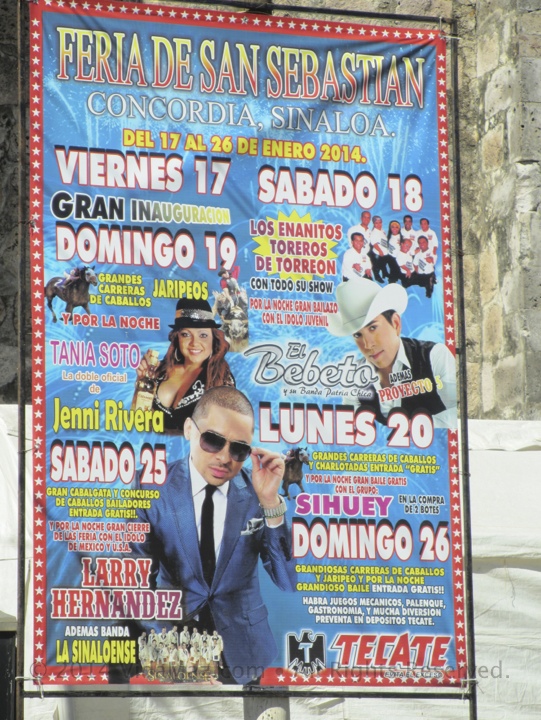
If you’re looking for something to do this weekend, the Féria de San Sebastián takes place over two weekends: from today (Friday January 17th) through Sunday the 26th. This Sunday the 19th is the seventh annual cabalgata or horse race, starting at 11 am and going from Mesillas to Concordia, concluding at the fairgrounds after a march around town. They are anticipating 450 participants in the cabalgata, and you’re sure to see some gorgeous charrería.
My friend Salvador Herrera made a video of Concordia for the “Un Mundo Mágico” project.
Driving Directions:
Concordia is one hour southeast of Mazatlán. Take highway 15 south to Villa Unión (about 13 miles from Mazatlán). Turn east on highway 40, the old free road to Durango, and continue about another 13 miles. The drive is beautiful and easy, as you pass plantations of coconuts, mangoes and bananas. Just don’t get on the new highway. For those traveling this way from Durango, Concordia is also a very convenient stopover.
You may recall that last month we went to Durango, prior to the road opening. This weekend we had to go again. Thank GOODNESS the road was open! The Baluarte Bridge is incredible, and the entire drive is unbelievably gorgeous and easy (three hours door to door). Greg will write more about that in a separate post.
We were heartbroken to miss the callejoneada for Day of the Dead here in Mazatlán, but we thought we’d share with you a glimpse of what Día de los Muertos looks like elsewhere. In Durango the cemeteries were full of people, of course—flowers, cleaning, bands, praying and partying. The city also hosted a hot air balloon festival. In the main plaza, in front of the cathedral, there was a large “Day of the Dead” display set up. It contained a dozen or more life-sized papier maché katrinas and other scenes, plus a few stages for performances.
Durango was completely different this time, primarily because last time we were there it was the height of their major annual cultural festival. Streets, plazas and restaurants were much less crowded this time around. Below are some photos we took this trip—a favorite new restaurant, some street scenes, and the plaza display. Click any photo to enlarge or view a slide show.
Best enchiladas moles since we were in Oaxaca
This is the hole-in-the-wall restaurant where we ate the enchiladas, out of this world pozole and birria. Around the corner from the Hotel Gobernador.
Not sure what happened to those enchiladas 😉
The main plaza in Durango is decked out with katrinas
The main plaza in Durango is decked out with katrinas
The balloon man…
Looking from the stage towards the cathedral
Children and adults alike here dress like cowboys. I almost felt like I was back in Arizona!
The shoe shine guys really get a workout here in Durango.
Katrina in the main plaza
Katrina in the main plaza
Katrina in the main plaza
Katrina in the main plaza
Katrina in the main plaza
Papel picado hanging over the stage
The crowd watching the stage
Mariachis ready to play along 20 de Noviembre street
Love this church
Very cool tree stump on a curb
La Virgen de Guadalupe in tilework
A great old neon down the street from Zorrita.
On Friday night Greg and I wandered back down to the plaza while Danny studied for his test, and there was a children’s folkloric dance group performing. What was out of the ordinary about this one was that the kids all dressed up as calacas—skeletons—and in glow-in-the-dark costumes. The stage was lit with black lights, so it was a pretty cool effect. We enjoyed it a lot.
Just prior to the performance, the little kids had fun posing for my camera. During the performance, shots were of course very challenging, as it was very dark and the kids were constantly moving. They danced to some songs you’d expect—Michael Jackson’s “Thriller,” for example—and they also took us on a tour around México.
I put together a short (three minute) video of the performance. I trust you’ll enjoy watching it. The kids had soooo much fun in their costumes. They knew they looked great.
On the pedestrian street to the left of the cathedral, just down from Hostal de las Monjas and across the street from our favorite little cenaduría, El Parcero Tacos Bar, is a large funeral home, Funerales Hernández. They had an altar to Jenni Rivera that was larger and more superb than ANY I have EVER laid my eyes on. They called it a “Monumental Altar de Muertos.” It contained dozens of life-sized katrinas, ceramic and sugar skulls, antique and artesenal chachkes, Jenni Rivera music playing (not too loud), a mini disco ball for effect, and gorgeous paper work. Just take a look:
Closeup of some of the painted ceramic skulls, below, and sugar skulls, above
Close-up of some of the musicians and the large central photo of Jenni
Check out the dancing katrinas, the musician katrinas…
The papel picado hanging above the Monumental Altar
The flowers are real! The candles are real! Dozens of skulls of every sort
The sign out front
The left side of the Monumental Altar. Look closely!
On our way back to the hotel, we walked by the old Palacio Municipal. It was all decorated for Day of the Dead, too. Those photos are below.
The huge central altar in the Palacio Municipal
One of Greg’s favorites, a charicature
One of the many papier maché katrinas
One of the many papier maché katrinas
Pan de muerto/”dead bread” used as candle holders
Pan de muerto/”dead bread” used as candle holders
Papel picado hanging over the altar, from the second floor ceiling

 In my next life, I want to be a manta. I’ve always said I want to be a Kobe cow, so I could drink beer and get massaged all day. But, in 2015, I hereby declare that being reincarnated as a manta ray looks oh-so-much more fun! We went out whale watching this week with Onca Explorations.
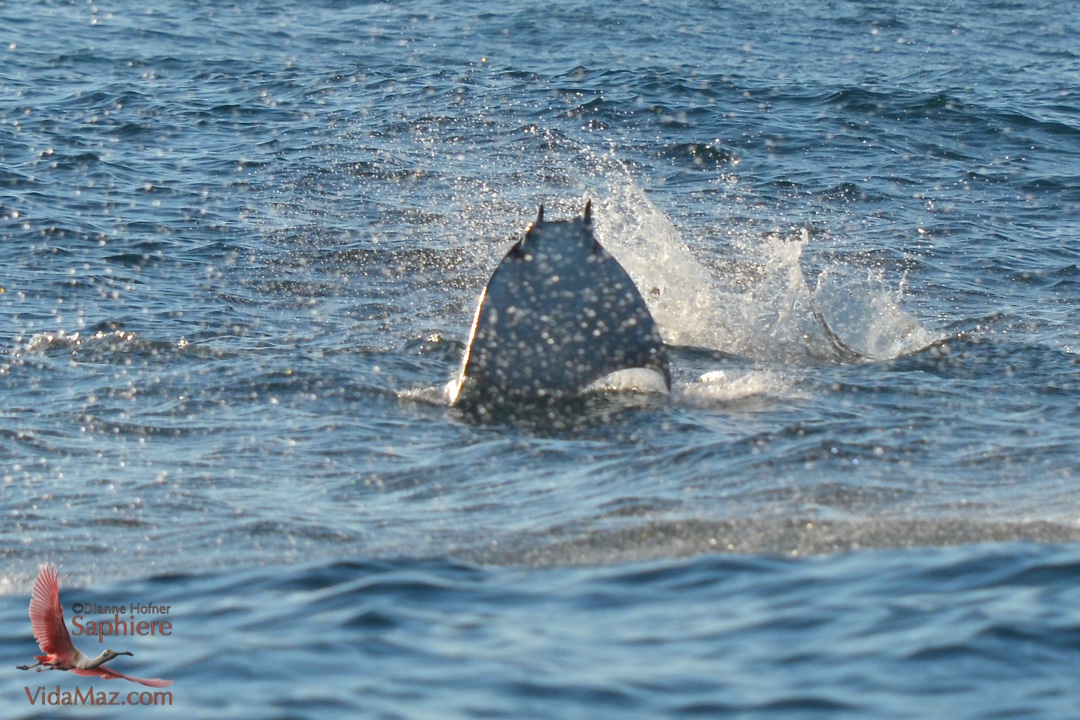 That slap launches them into the air, where their wings curl up the opposite way, wrapping themselves backwards, in a rebound of sorts.
  They leap into the air—seemingly soaring over the skyscrapers on the beach, as you can see in the photos.
  They then fall back into the water with another loud “splat,” and start the process all over!
  And they do all of this in the company of hundreds of their joy-filled friends, frolicking about in a big band of craziness.
  And did I mention that mantas are HUGE? These looked to be maybe 3 or 4 feet across, and they get much bigger. Below is a short video clip of some of the manta merriment. I highly recommend you take a whale-watching excursion with Onca. Maybe, if you’re lucky, you’ll get to see some mantas!






 ¡VidaMaz!