The Best Views in Mazatlán

1.DSC_0174

Looking back at downtown over Goat Island from the top of Deer Island

Where are the best views of Mazatlán? Atop the lighthouse? From up top of the Freeman? I believe that the views from atop Deer Island rival even those taken from the air in a helicopter. They are some of the most glorious vistas our fair city has to offer.

If you’ve taken a kayak, catamaran, or any other kind of lancha over to the islands, or if you’ve swum, you know that. The water around the islands is so crystal clear—the color of turquoise—and you can view Mazatlán in its entirety, from north to south, with the Sierras as a backdrop. Click on any photo to enlarge it, or to view a slideshow.

Then, as you climb up the island from the beach, each hill reveals new views and surprises. I have climbed up the first hill before, but I had not done a trek of three of the four hills, as we did this past Tuesday. I have not gone to the backside of the island, and looked out from different elevations. It is truly stunning!

Petroglyphs in Mazatlán. No, not Las Labradas. Here in Town.
And, on Deer Island, in a cave on the back side, there are petroglyphs. Not just those north of town, in Las Labradas. There are petroglyphs right here in Mazatlán!

When our friends saw the photos, they said the petroglyph of the footprint looks like proof that aliens were here. Right next to the foot is a petroglyph of an animal with a long tail.

Footprint petroglyph on Deer Island, Mazatlán on the right. Modern-day pedicured foot on the left. ;)
Footprint petroglyph on Deer Island, Mazatlán on the right.
Modern-day pedicured foot on the left. 😉

Our Photo Class
It’s a funny story how I discovered this. I’m taking a (wonderful!) photography class with Salvador Herrera, and loving it. Well, he invited us to Deer Island for photography practice. He advised us to wear tennis shoes, and to bring sunscreen, a lunch, and water. He also said we’d be home by 2:00 pm. Little did we know that we’d be hiking all day, in quite precarious conditions, seeing the most spectacular views imaginable, and then even rappelling down into the cave with the petroglyphs, to return home after 5:00 pm! You gotta love Mexican communication style and spontaneity! It was an incredible day!

One of the students in our class is a cheerleader. He had a friend visiting him from León, and she’s a cheerleader, too. They were kind enough to do some jumps and flips for us, so we could practice our photography skills. Take a look.

Where is the Cave?
The cave with the petroglyphs is on the back side of Deer Island, just below the crest of the third hill. You climb up from the south side of the island, on the southern end of the beach. From the top of that first hill, you’ll proceed along the crest of the island, down and up two more hills. Then, on the top of the third hill (not the fourth or northernmost, the second from the north), you turn west and hike down in altitude a bit.

The climb gets steep and is not for anyone without great balance as well as good strength and stamina. The final entrance to the cave involves a five-meter sheer drop. Agile climbers can find footholds and handholds, but we used a rappelling harness and rope for added safety.

The Three Islands/Las Tres Islas
Quick! Do you know their names? Starting from the south: Isla de Lobos/Wolf or Sea Lion Island, Isla de Venados/Deer Island, and Isla de Pájaros/Bird Island. Many people and websites erroneously call the southernmost of the three islands Isla de Chivos/Goat Island, but that is actually the island in front of the lighthouse.

The biodiversity of the islands in our bay is an incredible treasure. Four climactic zones are found within such a small area: semi-desert, tropical, coastal and mountains. Over 500 species of birds can be found here, including gorgeous waterfowl and my favorite, blue-footed boobies! 20% of the species found here are unique to this area—you can’t find them anywhere else! The islands are composed of volcanic rock, landslides and foothills. On the islands you can find cacti, agaves, lichen, and deciduous shrubs including lots of beautiful plumeria. Plus, of course, goats, lizards, a multitude of butterflies and other wildlife.

The middle island, Deer Island, is the most-visited of the three. Its attractions include its beach, with fine white sand and crystal clear water, rippling out from the beach in increasingly darker shades of turquoise. The north side is great for snorkeling, lobsters and scallops, and it makes for a terrific kayak trip. Deer Island is 2.3 kilometers off the coast, 1.8 km, long and between 250 and 700 meters wide. It’s highest point is 178 meters (and don’t my legs know it!), and it has an area of about 54 square hectares.

Bird Island, on the north, is 120 meters high and has an area of 48.5 hectares. Goat Island is pretty much inaccessible.

For Sale?!
While most anyone in town will tell you that these three islands are an ecological preserve, and I sincerely hope they are protected by legislation, there is currently an advertisement to sell these three natural treasures.I do hope it’s a joke!

Do You Know the Legend of the Three Islands?
It is said that the indigenous people of this area were suffering from a succession of horrible hurricanes and flooding. The Mazatl people were beside themselves with grief; they were exhausted and starving.

The village chief asked the curandero what he could do to put things right and bring prosperity back to his people. The curandero went into a trance, and told the chief that the only way to put things right would be to sacrifice one of his three daughters—one of the three beautiful princesses—in order to restore the welfare of the pueblo. The chief loved all his daughters dearly, and was distraught because he loved his pueblo, too. He just could not bear to sacrifice one of his daughters.

Unbeknownst to the chief, his daughters swore a secret pact. The three of them loved their home, their neighbors, and their father so much, that they would sacrifice themselves and thereby restore the prosperity of the area. One night, under a full moon, dressed in white and with the diamond their mother had given each of them when they were born, the three princesses held hands and walked into the ocean, drowning themselves for the sake of their people. One sister’s hand came free, and she was swept slightly away from her sisters, but the other two sisters hung onto each other tightly.

The morning after their sacrifice, the Mazatl people saw three gorgeous islands out in the Bay of Mazatlán! One island was located slightly to the north, on its own, while the two to the south were connected. That was when they discovered that the princesses were missing! Such an act of pure, selfless love!

Thereafter, the climate changed and the weather of Mazatlán became tranquil and pleasant. To this day the three princess islands continue to protect the people, sheltering them from winds, storms and hurricanes. It is said that in the heart of each of the three islands can be found a diamond.

Do you know the name of the annual swim out to Deer Island? Yes? The Travesía!

Even if you are not incredibly mobile, you can get out to Deer Island on a boat and enjoy the views from the beach. If you haven’t done so, I highly encourage it. Spend the day; you’ll feel like you’ve gone to a Greek Island. If you are fit, take a hike up, at least to the first hill. The views will astound you. If you want to go to the cave, I’d recommend you go with someone who knows the route; it’s pretty tricky, at least for my level of adventurism.

And, of course, we couldn’t have asked for a better day!

An update/adaptation of this post appeared in M! Magazine in October, 2015 under the title, “Three Time’s a Charm.”

Jungle Tour of a Mangrove Swamp, right here in Mazatlán

1.DSC_0476 - Version 2

Jungle Tour Mazatlán

Many people don’t play tourist in their hometowns; it’s very often the truth worldwide. For years, we’ve seen advertisements and heard about a “jungle tour” here in Mazatlán. Those tours weren’t offered, or at least we never heard of them, back when we came here as tourists. We’ve thus never been on one, but I’ve been curious.

We did a “jungle tour” last Christmas in Nayarit that was one of the most incredible birdwatching experiences of my life, and a few years ago we’d done a Marismas Nacionales tour down in Teacapán, where there are over 250 species of birds. We very much enjoyed both of these tours. But here in Mazatlán we’ve already lost so much of the gorgeous mangrove swamps and brackish water estuaries that are this city’s heritage, in which those delicious shrimp and crab thrive, attracting that great variety of water fowl. Would we be disappointed? Would there be much to see up here? We obviously have a lot of gorgeous water fowl here in Mazatlán, so maybe, just maybe, we’d enjoy such a tour.

Then, at Christmas, on the way back from Stone Island, the panga driver asked me if I’d be interested in a jungle tour. He said he could do one for us, and assured me that we’d journey through mangrove swamps, see loads of water fowl and maybe even some mammals, and that there was a farm at the end of the tour with crocodiles. He promised, over and over again, that we’d love it, and gave us a price (1500 pesos for 8 people). He gave us his cell phone number, and when we had a group of friends here with a young boy, and another group that loves the outdoors but really doesn’t enjoy climbing, we thought the jungle tour might make both groups happy. And, indeed, we were all thrilled! HIGHLY recommended!

The tour began in one of the water taxi pangas, departing from the embarcadero near the brewery. Our guide wanted to leave at 11:00 am for a 90-minute tour, but because we all wanted to spend the day eating zarandeado and lounging on Stone Island, we told him we wanted to leave at 9:00 am. I’m glad we did! LOTS of birds were out and about, and we didn’t make it to Stone Island to eat until about 1:00 pm! Our guide kindly took us wherever we wanted to go, allowed us to dally as long as we wanted, and the journey transformed into a four hour one that everybody greatly enjoyed.

As always, the tour of the port itself was fun. We saw shrimp boats coming in, a small panga decked out with a homemade sail (somehow reminiscent of southeast Asia), and loads and loads of tuneros, camaroneros, and ship repair yards. I’ll post about those later, but here are some basic photos of the port portion of our tour.

We turned right, southeast, at the end of Parque Bonfíl, and into swampland. At first the passage was fairly wide, but gradually it became narrower and narrower, shallower and shallower. Our guests, three from Italy, one from LA, and another from Nebraska, saw mangroves for the first time in their lives. They especially enjoyed seeing how the oysters grow on the roots of the mangroves, and the six-year old Italian kept his eyes peeled for wild cayman (we didn’t see any this day, sadly for him).

Bird watching was not disappointing! Everyone in the boat was shutter-happy, and Jesús was happy to cut the motor or pull the boat around in order to help us get the best photos of our subjects. As always, I wished I’d brought my bird guide, or that I knew the names of more of the birds than I do. Please feel very welcome to tell me what these birds are in the comments below, and I’ll label them properly.

After about an hour, we pulled into a small farm, that of Jesús’ brother-in-law. There they harvest palm fronds, drying, cutting and bundling them for sale to broom manufacturers, and they also make their own homemade brooms for sale. Their farm was gorgeous, with papaya, mangrove, banana and coconuts growing. During the week, Monday-Friday, the couple lives here in very minimalist quarters, and then go “home” on the weekend. I assume they have electricity and running water at home, as they sure didn’t have that here. We saw a baby iguana, and to humor our young guest, Jesús caught it so Leonardo could pet the reptile.

From this small farm, we walked across to a larger place, where the King David tours put in. Here they’ve built an open-air restaurant where we sampled some of THE BEST cocadas I’ve ever eaten. Here we also saw the cocodrílos, lots of chickens and ducks, and a huge beehive up in a tree. On this farm they were growing squash and yaka. Nothing too exciting, but a pleasant walk. From here it would have been a short walk over to the beaches of Stone Island, but we were way down south from where the palapas are. So, we got back in the panga so Jesús could take us back and drop us off for lunch.

It was a terrific day for all, and one we highly recommend. If you have access to a boat you could do this trip yourself, and I’m confident that most any panga driver would take you for a fee. I am guessing our trip was more expensive than it possibly could have been, as Jesús went through the official channels—we paid at the embarcadero ticket booth. This was just the ticket to enjoyment for three very different groups of travelers!

1.DSC_0422

Copala: One of Our Favorite Day Trips

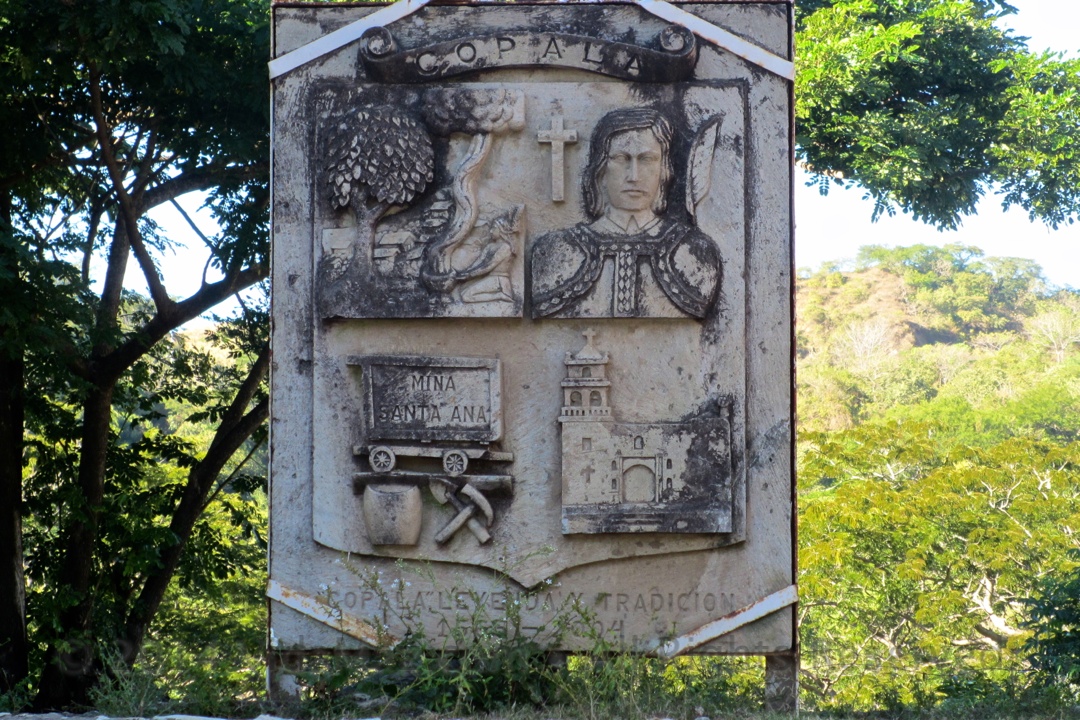
1.IMG_2414Copala (San José de Copala) is a picturesque little town southeast of Mazatlán, just past Concordia. The smallness of this village, the charm of its winding, hillside cobblestone streets, and the friendliness of its people, make it one of our favorites.

Populated by indigenous people and then “founded” by Francisco de Ibarra, veins of silver were discovered nearby Copala in 1565 and the town grew to serve the mines. It was destroyed during an uprising by the Tepehuan Indians in 1616; its church was built much later, in 1748.

You can tell by the beauty of its church and central plaza how wealthy Copala became, but it has definitely fallen on tough times now. The incredibly lovely church has plants growing from its steeple and facade, and is in desperate need of restoration—though this mix of opulence and ruin does create a thoughtful charm.

Coming into town you drive past a small cemetery. Once you are in town, children will likely approach you with hand-carved wooden replicas of the home of Copala, quite nice souvenirs. There are several restaurants in which to eat here. Years ago we always ate at Daniel’s, but that is closed since his death. Chalva’s famous banana coconut cream pie (or a replica of it) is still served in several local places. The last time we went to Copala, we ate at a new restaurant—Alejandro’s—just down the hill from the plaza. The view was outstanding, and the cook (owner’s wife) even more so.  For such a small town, it is surprising that Copala also has several places to spend the night.

There are souvenir shops and a mining museum that, despite appearances, we are assured still opens regularly. It was not open the last time we visited Copala. While there isn’t a whole lot to see here, we highly encourage a leisurely visit. It’s a very welcome respite in a busy life: a beautiful place to read a book, make some sketches, or just sit, visit, and relax a spell. Copala is also a very worthwhile stopover on the way to or from Durango.

Driving Directions:
Copala is just over one hour southeast of Mazatlán. Take highway 15 south pass the airport to Villa Unión (about 13 miles from Mazatlán). Turn east on the free (libre) version of highway 40, towards Durango. After about 15 miles, you will pass through Concordia (read here about this wonderful furniture making town) and another 15 miles later you will see the exit for Copala.The exit is clearly marked, but easy to miss if you are speeding or distracted. As soon as you exit, you will be on a cobblestone road — one of the hallmarks of this magic town. The road splits quickly and you should go to the left. You will pass by a beautiful cemetery and wind your way into town. Just stay on this main road, and you will find yourself in the plaza in front of the old church. The drive is beautiful and easy, as you pass plantations of coconuts, mangoes and bananas. Just don’t get on the new highway.

For those traveling this way from Durango on the new highway, there is a cutoff to the old highway which lands you in Concordia. From there it is a simple 15 minute drive back northeast to Copala. It is a very convenient stopover and well worth a little extra time.

San Ignacio: Lovely mountain town one hour from Mazatlán

One of the reasons we came to live in Mazatlán is our compadres, the Valverde family. Daniel has been Greg’s best friend since they both were sixteen, working up in the SF Bay area. Daniel and his family are originally from San Ignacio, and many of his family members and dear friends have worked for Greg up north over the decades. Greg began to travel down to Mazatlán with Daniel on holidays, staying in the house Daniel built for his mother. They would often travel out to San Ignacio, to the rancho, to visit family and friends. Over the years they have become family to us. Danny dearly loves his tíos and cousins, and not so long ago we went to San Ignacio with Mariana and Rubén, Daniel’s sister and brother-in-law, to visit the dentista loco and his wife, Irma, also good friends.

San Ignacio (de Loyola) is a lovely small town about 60 miles north of Mazatlán, entered through the typical scenic gate, and with a walled church on the central square, as is so normal in the small towns of México. It was founded in 1633 by the Jesuit priest, Diego González de Cueto, and is currently home to about 4500 people. San Ignacio was originally called Piaxtla, after the indigenous people who lived there. It is a colonial mission town, with the Jesuit Misión de Santa Apolonia established there in 1748.

Like most of the small mountain towns near Mazatlán, San Ignacio was a mining town, rich in silver, gold and copper. Today, life on Constitution Square and in the streets of San Ignacio is laid-back yet vibrant. Many of the colonial French and Spanish style buildings are still standing, and the landscape is lush. The main church is called, of course, San Ignacio de Loyola, and a second church in town is Our Lady of the Nativity. There are hot springs, though our friends have never taken us to them.

What stands out during a visit to San Ignacio is the huge statue of Jesus Christ up on the hill, hands outstretched in a similar manner to the famous statue in Rio. You can easily view this landmark from the main square, and the views out from the statue on top of the hill are truly breathtaking.

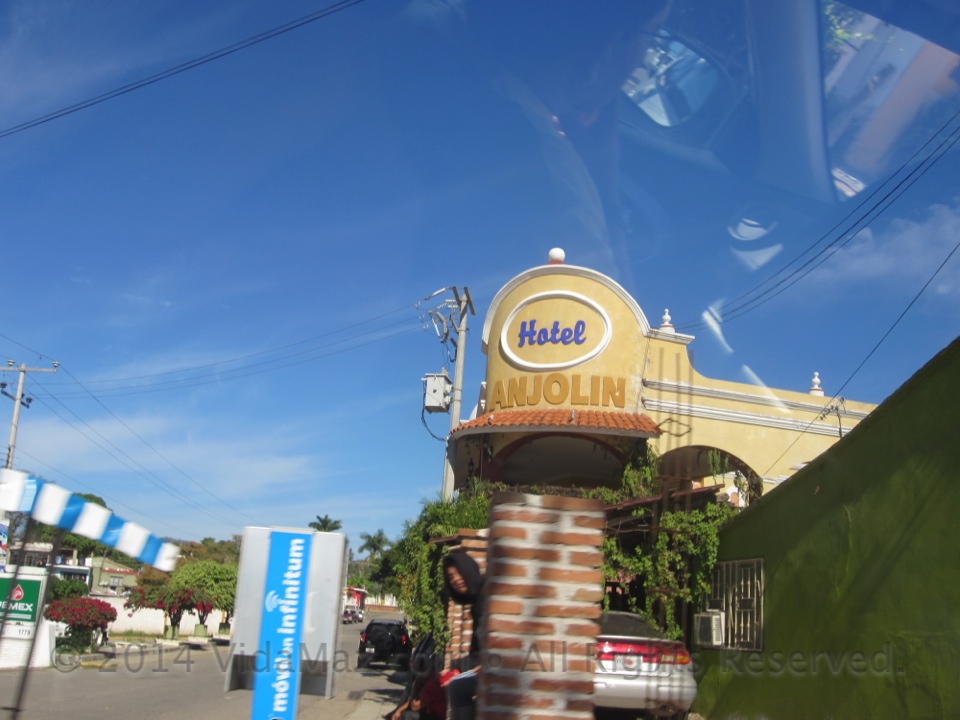
I’ve always wanted to go to San Ignacio for Good Friday. They do a remarkable, community-wide reenactment of the crucifixion. The event attracts hundreds of people, so hotel reservations need to be made far in advance. The one hotel I know of in town is the Anjolin, which is fairly new with modern amenities.

hotel

What we have done quite often is to go down to the river. It’s very pleasant, the views are open and the water is crystal clear. In summer the riverfront is one big party: trucks, horses, food carts and stalls, and of course, lots of beer.

As you drive into San Ignacio, there’s a great little restaurant on the left side of the road, Cuata’s. I’ve written about this place previously, and we highly recommend it (very rustic, as you can see). We highly recommend a trip to San Ignacio for a change of pace and some beautiful scenery. Next time we are definitely checking out the hot springs!

Driving Directions
Head northwest towards Culiacan on highway 15 — the free (libre) road — for 43 miles to Coyotitán, where there is an exit for San Ignacio. You’ll turn right and proceed about 20 miles up into the lush Sierra Madre foothills to reach San Ignacio.

Concordia: Beautiful Town One Hour Southeast of Mazatlán

Over Christmas and New Year’s we had the pleasure of hosting five different sets of visitors to Mazatlán. It felt so incredibly wonderful to spend time with loved ones, and to be able to share the gorgeousness and warmth of our adopted home with them. It was fascinating to us how each group experienced Mazatlán differently. Our city has so many different faces, there is truly something for everyone—the beach bums, the farmers and ranchers, the culture mavens, those who love to eat, party or shop.

During this time we took several trips to our nearby mountain towns. We so love these trips, to a simpler life, a slower and more rural life. It struck me that we have not written that many posts on these day trip towns, so I aim to remedy that. Since we visited at least five, and that’s a whole lot of writing, I trust you’ll permit me to tell you their stories primarily in photos. Photos will give you a sense of the place, and let you know if you’d like to visit—whether for the first time or the 50th.

Let me begin with Concordia, about an hour southeast of Mazatlán, towards Durango. It’s easy to remember Concordia among the many beautiful small towns in southern Sinaloa, because the main plaza in town has that gigantic chair, representative of the solid wooden furniture crafted here. Sit in it, with the gorgeous church behind you, and you feel the joy of childhood again. Concordia is also the birthplace of the famous raspados, or shaved ice flavored with real fruit syrup. Founded as “Villa San Sebastián” in 1565 by Francisco de Ibarra, Concordia today has about 9000 residents. Its history is steeped in the gold, silver and copper mining of this region.

The main church, San Sebastián, is really beautiful. Built in 1785, it has an ornate baroque facade.

Concordia also has hot springs, which are on the left, down a dirt road, just before you get into town.

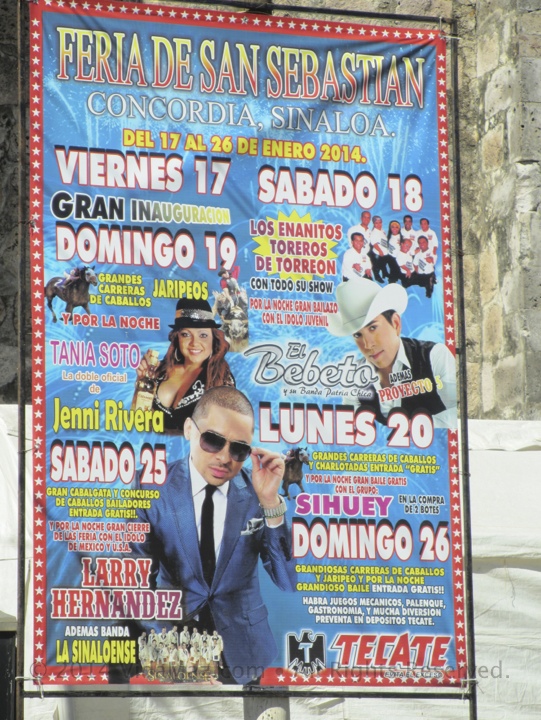
1.IMG_2229If you’re looking for something to do this weekend, the Féria de San Sebastián takes place over two weekends: from today (Friday January 17th) through Sunday the 26th. This Sunday the 19th is the seventh annual cabalgata or horse race, starting at 11 am and going from Mesillas to Concordia, concluding at the fairgrounds after a march around town. They are anticipating 450 participants in the cabalgata, and you’re sure to see some gorgeous charrería.

My friend Salvador Herrera made a video of Concordia for the “Un Mundo Mágico” project.

Driving Directions:

Concordia is one hour southeast of Mazatlán. Take highway 15 south to Villa Unión (about 13 miles from Mazatlán). Turn east on highway 40, the old free road to Durango, and continue about another 13 miles. The drive is beautiful and easy, as you pass plantations of coconuts, mangoes and bananas. Just don’t get on the new highway. For those traveling this way from Durango, Concordia is also a very convenient stopover.