Whale Watching in Mazatlán


1.DSC_0310 - Version 2

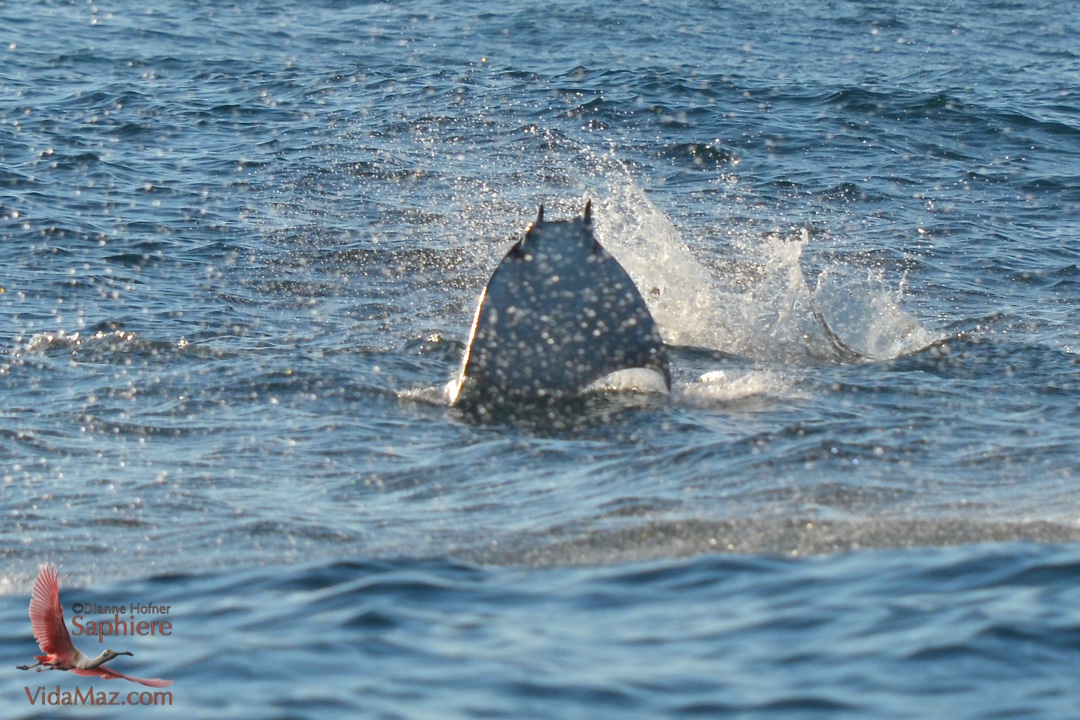
One of many happy humpback couples we saw on our excursion last week

I love how you all join in the excitement about our whale-watching trips with Onca Explorations. On our first trip in 2009 we had unbelievable good fortune; we had so many pods of whales come right up to the boat—breathing beside us and playing with us—that we lost count of how many whales we saw! The video on the link above will give you an idea. Remember, the camera is not zoomed on those shots! We felt like we could almost reach out and touch the whales, they came up so close to us.

Each year we have been blessed to see whales, though each time out has been a bit different. The humpbacks (ballenas jorobadas) that frequent our waters are the most acrobatic of the baleen whales; in fact, that’s how they got their name—the humped back motion they make when they breach out of the water. In addition to breaching, humpbacks spy-hop, lob-tail, tail-slap, and fin-slap. In our various outings we have seen humpbacks jump on top of each other and hit each other with their pectoral fins, which the males do to establish dominance and secure a mate. This time out, however, we saw a bunch of couples romancing—swimming around slowly and gently, courting and most probably mating with one another. Here, in warmer waters, is where the humpbacks mate and have their babies.

Onca’s owner, marine biologist Oscar Guzón, had to teach a class so did not go out with us this time. Saúl Herrera was our guide, and he told us that no one has ever recorded seeing humpbacks mate. Apparently it’s not uncommon to see huge gray whale penises in areas such as Baja, where they frequent. Saúl lowered a microphone so that we could hear the male humpbacks singing. They produce their haunting songs by pushing air through their nasal cavities.

Below is a short clip of one of the happy couples, swimming about romantically, with the Baja Ferry and the smaller Onca I (we were on the Onca II) in the background. First you’ll see their spouts, then the dorsal (back) fins come up, and, finally, the whale on the right dives sharply enough that the fluke comes briefly out of the water. Ah, love. You can see how coordinated their water ballet is.

The gestation period for humpback whales is 11-12 months, so calves this year were conceived in our waters last year 😉 Mature humpbacks reach 40-50 feet in length and weigh about 80,000 pounds (females are bigger than males). Their tail flukes—up to 18 feet across—are like human fingerprints: individual identifiers. No two flukes are alike.

Humpbacks live up to 50 years and are sexually mature at 6-10 years. Below you can see some of the great variety of flukes, as well as some of the spouts, that we saw during this trip. As you can see, there was a whole lot of love going on out there! Click on any photo to enlarge it or view a slideshow.

Oscar is a marine biologist, and he, Saúl and the crew of Onca have now spent nine years cataloguing and tracking the whales that frequent our waters. Their research has made huge contributions to what scientists now understand about humpback behavior at the southern tip of the Sea of Cortéz. Below is a clip of Saúl telling us a bit about cetaceans in our waters, including that they have recorded sightings of 17 species of cetaceans here in Mazatlán.

In addition to whales, this year we saw two species of dolphins (bottle nose and spotted) and, the stars of the trip, the mantas. Be sure to click on the link if you haven’t seen those photos!

Another great advantage of this whale-watching excursion with Onca is the great view of Mazatlán from the water.


Manta Merrymaking

1.DSC_0260 - Version 3 In my next life, I want to be a manta. I’ve always said I want to be a Kobe cow, so I could drink beer and get massaged all day. But, in 2015, I hereby declare that being reincarnated as a manta ray looks oh-so-much more fun! We went out whale watching this week with Onca Explorations.

Whale watching has been our traditional Christmas gift to each other as a family since 2009. And a wonderful gift it is! The highlight of the trip this year for me were the mantas! We did, indeed, see whales; I will post pictures and write about that separately. But the mantas!

They were having so much fun! There were so very many of them—hundreds—and they kept jumping and flying and splatting and splashing, performing their high jinks all over our bay with their friends, for what seemed like forever. They just didn’t stop. What a joyful bunch they are! It reminded me of dancing sessions with my girlfriends…

The mantas’ bodies change so completely with every leap. They slap their wings against the water in a loud “thump!” 1.DSC_0253 - Version 2 That slap launches them into the air, where their wings curl up the opposite way, wrapping themselves backwards, in a rebound of sorts. 1.DSC_0261 - Version 2 They leap into the air—seemingly soaring over the skyscrapers on the beach, as you can see in the photos. 1.DSC_0246 - Version 3 They then fall back into the water with another loud “splat,” and start the process all over! 1.DSC_0234 - Version 2 And they do all of this in the company of hundreds of their joy-filled friends, frolicking about in a big band of craziness. 1.DSC_0279 - Version 2 And did I mention that mantas are HUGE? These looked to be maybe 3 or 4 feet across, and they get much bigger. Below is a short video clip of some of the manta merriment. I highly recommend you take a whale-watching excursion with Onca. Maybe, if you’re lucky, you’ll get to see some mantas!

What makes the mantas leap so? Are they mating and courting, and perhaps the manta with the biggest splash is the sexiest? Are they just having fun, partying hearty with their friends? Are they wanting some Vitamin D from the sun? Whatever the reason, I sure did enjoy them!

Click on any of the photos in the album below to view it larger or see a slideshow.

National Geographic published a video of the largest-ever-witnessed group of mobula rays in our Gulf of Cortes. It is incredible! Watch it below:

Our Beloved Favorite: Stone Island

DSC_0433 - Version 2

We all love Isla de la Piedra, Stone Island. We love the:

  • Serenity—the long stretches of gorgeous beach with, normally, very few people. In fact, our family describes it to our visitors as “Gilligan’s Island.”
  • Smiling, welcoming faces who greet us in this lovely little town.
  • Number of ambulatory musicians who come by.
  • Fishermen preparing their boats to take out in the evening, working tirelessly to repair their nets for their night’s work.
  • Vendors and, especially, those who have the thighs to bicycle along the beach.

And we love the fresh seafood, caught that day and served raw or barbecued over an open flame.

Our favorite place to spend the day is Pili’s. We met Rudy, Barbara and the family of Pili’s owners when Danny was just three or four. We were introduced by our compadre, Ruben. Danny fell in love with the pretty Alhondra, who was 11 or 12 at the time, and is now married with a toddler and living in Tijuana. Pill’s makes the BEST zarandeado. Barbara sells fresh oysters and clams, and the cold coconuts are always a hit. As is a bucket of beer, or a piña colada.

Stone Island is one of our favorites, and is always one of our visitors’ favorite places, too. No, it’s not an island. It’s a peninsula. We get there from Mazatlán by water taxi. It’s part of what all of us love about going to the Isla for the day.

We love how, despite Mother Nature’s havoc, the Islanders rebuild. August’s Hurricane Marie brought waist-high flooding to the places on the beach, and the water stayed for several days. It ruined over 27 of the restaurants on the beach, and despite promises from State Secretary of Tourism, Francisco Cordova, and Mayor Carlos Felton, the islanders never saw one centavo of assistance, from either the state or the municipio. At least that’s what our friends tell us, and the Noroeste reported. Since the islanders are no longer permitted to cut down trees, they had to rescue timber from the flood waters. But they did. They have rebuilt. The restaurants, at least most of them, are again open for business. Though you can still see bulldozers cleaning up debris.

1.DSC_0542

How much longer will we have the serene beauty that is Stone Island, this idyllic paradise that is only a five- or ten-minute water taxi away from our daily lives here in Mazatlán?

Soon they will widen and pave the road from the airport. It will be much easier for tourists, who arrive via the new highway or by air, to get to Stone Island without needing to come into Mazatlán. No doubt development will follow.

And the construction of Amaitlán continues. Planned to be an eco-friendly mega-resort with lots of green space, you can see the first parts of it in the “Botanic Garden” on Stone Island. The first few rental cabañas are currently being built.

Most of our friends on the Island, the ejidatarios, are excited about Amaitlán. They believe it will bring them jobs, income, sustainability for their families and the environment on the island. I am much more skeptical. But, I have my fingers crossed. I can hope. I do know that I would love to stay in one of these little cabañas, amidst all this lush, gorgeous greenery, assuming I could afford to do so.

I guess this post is really a homage to one of our absolute favorite places on earth these past 35 years. Nostalgic, because we don’t want it to change. Hopeful, as we pray things will change in sustainable ways that support the environment and local residents.

Let me close this post with a great story that Rudy told us during our last visit. He tells us that there was a rainstorm recently during which it rained fish—un aguacero de peces! And, even though they were drinking when this event occurred, he swears it really happened.

Furthermore, Rudy told us that it wasn’t the first time it’s rained fish here in Mazatlán! According to him, El Sol reported years ago about a rain of fishes in Playa Sur ( was unable to find such a story on the internet). Our interview took place during a perfect day on the beach, but somehow the ocean breeze caught my camera’s microphone. My apologies. I’ve done all I can to minimize that windy sound… The story is great though, so, heeere’s Rudy!

The Cuauhtemoc Tall Ship in Mazatlán

DSC_0266Quick! Do you know who Cuauhtémoc was? If you are an expat in Mexico, you should. Check your answer at the end of this post. The gorgeous tall ship that anchored in our bay this afternoon is named the Cuauhtémoc. She is scheduled to put into port in an official ceremony at the docks at 10:00 am on Sunday.

The Cuauhtémoc is a training vessel of the Mexican Navy with two main purposes: to train officer cadets in seamanship, navigation, leadership, and teamwork, and to spread the message of peace and goodwill from Mexico around the world. It sails with 55 officers, 74 cadets/midshipmen, and 120 enlisted crew members. The Cuauhtémoc was built in Bilbao, Spain in 1982, in a style similar to a 1930s German design. She has sailed around the world for the past 32 years, logging over one million kilometers. She is 90 meters long by 12 meters wide, with a sail area of 25, 500 square feet.

The ship and her crew have won many awards, including the prestigious Cutty Sark Trophy, which it received twice—during the Races for Great Tall Ships in both 1998 and 2000. In 2002, the ship won the Boston Tea Pot, a trophy awarded by the International Sailing Training Association ISTA for its nonstop sail of 1,342.7 nautical miles in 124 hours, at an average speed of 10.83 knots, setting the second-best record in the history of this competition. This record is better than all other ships in Europe and America that have received the trophy in the 12 years since then. It’s tough to get clear shots of a gorgeously lit ship floating and bouncing at night in the bay! My respects to those who do, and please teach me! Here you’ll see photos of the afternoon of its arrival (Saturday), sunset that evening, Saturday night, and Sunday’s sunrise. Click on any photo to see it larger or view a slideshow.

It arrived in Mazatlán this afternoon, Saturday November 8th, and anchored itself out in the middle of the bay. Oh is it gorgeous! It is supposed to put into port tomorrow, Sunday, though I’m unsure of the time. There will be tours while it’s docked here in town, so don’t miss out! Tours are Sunday and Monday from 11 am to 10 pm, and Tuesday and Wednesday 11 am to 5 pm. The Cuauhtémoc will remain docked here until its departure on Thursday, November 13th at 10 am. It last visited Mazatlán in 2005.

Track the Cuauhtémoc’s current position

History of the Cuauhtémoc by the Secretaría de Marina

UPDATE ON SUNDAY NOV. 9th

We had the BEST time this morning! We followed the ship as it made its way to the port. It was accompanied by loads of smaller boats. As it rounded the lighthouse hill heading into the port, there were still no midshipmen up on the masts. But as they headed for the breakwater, the masts were gradually filled, and by the time the ship approached us on the outer edge of the breakwater, the masts were filled with cadets! It was a sight to behold. We were accompanied by ten or so other people looking to get good photos. I hooted and hollered and welcome them to Mazatlán, and quite a few of the cadets waved back at me. Oh so cool! As they got into the dock, we heard them singing the Marina anthem. So awesome! Because we climbed out on the breakwater, and I didn’t have the right shoes, we missed most of the opening ceremony back at the dock, but it was so worth it! Just to have them wave and know we were some of the first to welcome them in! So cool!

Cuauhtemoc-03Cuauhtémoc was the last Aztec emperor, who was executed by Hernán Cortés, Spanish conquistador, in 1525. Quite a few Mexican boys, streets and plazas are named in his honor.

Día de los Muertos, Mazatlán 2014

La Pareja: Together in life and death

La Pareja: Together in life and death

What a welcome home! The callejoneada (alley parade) this year for Day of the Dead in Mazatlán was the best ever, if I dare say so! It was a perfect evening weather-wise: clear skies highlighted by a gorgeous crescent moon, and warm weather that was cool enough for comfort. More people and especially more complete families participated, more dressed up, the beer flowed more freely and was better organized, and the main costumed characters were spectacular!

This year’s event was a tribute to Maestro Rigo Lewis, the long-time creator of our unbelievably gorgeous Carnavál carrozas/floats, so the callejoneada for Day of the Dead had a Carnavalesque air to it this year; it was a beautiful fusion of two local traditions for which Mazatlán has international fame. Kudos and thanks to CULTURA and to the Centro Municipal de Arte staff and students! By the way, I’ve been told we will STILL this year AND next year in the Carnavál parade will have carrozas designed by Maestro Rigo! His legacy lives on, thanks to his hard work and passion.

Click on any of the images below to see it larger or to view a slideshow.

I am sorry to have been so long away from this page, but after seven years it was wonderful to reconnect this summer with family and friends north of the border in a lengthier, more meaningful way. We were able to celebrate my aunt’s 80th birthday, be with my sister-cousin through surgery, and settle Danny into his dorm room and college life. For that I am ever grateful! Plus I had a month of work in Europe, where I met incredible people and thoroughly enjoyed myself. Of course we missed home, and our friends and family here, terribly.

Saturday night felt like our personal welcome home party, as we hugged loved ones everywhere we went. Funniest, to me, was how often I had to ask, “Who are you?” as the costumes were so excellent that they disguised identities quite effectively!

I can’t imagine not dancing in the parade with the live music, if one is able to do so, as it is just so much fun! There are, however, many people who line the route to watch and enjoy, as well as those who camp out at front-row-seats in bars and restaurants to watch the parade pass by.

Life in the Plaza Machado after the callejoneada was a sight to behold as well. I unfortunately can’t tell you anything about the event inside the theater, as though we waited in line at the Machado for about 90 minutes to get tickets, they ran out long before it was our turn.
We met one woman who was here in town to celebrate her 50th birthday, all the way from Washington DC with two of her best girlfriends. They obviously brought complete Day of the Dead costumes with them for their holiday! We saw store-bought costumes, handmade costumes, traditional and modern versions, and fortunately there were many of us who were still alive and un-costumed to enjoy the rest!
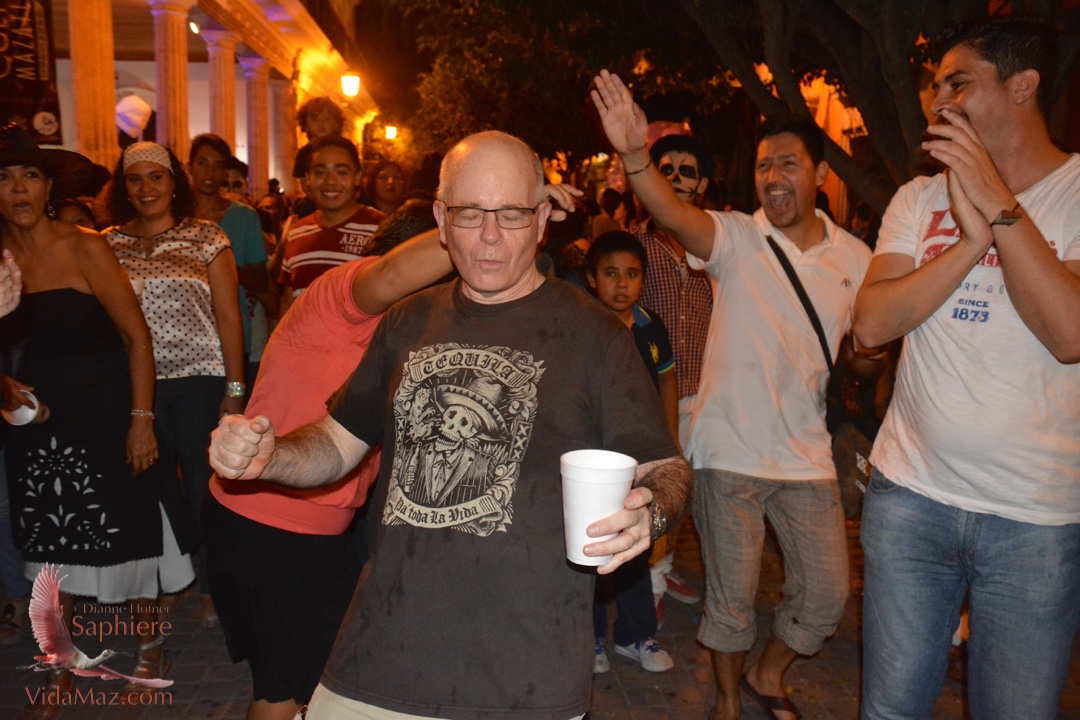
My absolute favorite moment of the evening, and there were so many awesome ones to choose from, was as the callejoneada entered the plazuela. Just in front of the theater, a group of young men started cheering loudly, dancing and jumping around. “Güero! “Güero!” they were shouting. As I turned around to see what all the happy commotion was about, I realized they were cheering on my partner, Greg. He was dancing happily, having been soaked with beer head to toe earlier in the evening.
31.DSC_0378Guero!
CULTURA TV is going to stream it’s video of the callejoneada this Wednesday, November 5, at 5:00 pm local time. Be sure to check it out! There are many more aspects of Day of the Dead in Mazatlán; the callenjoneada is just one activity. This blog post can give you a broader idea for your trip. I know my favorites include making an altar to remember my departed family members and friends, as well as remembering them in Mass each year. We hope you’ll join us so we can dance with you all next year!