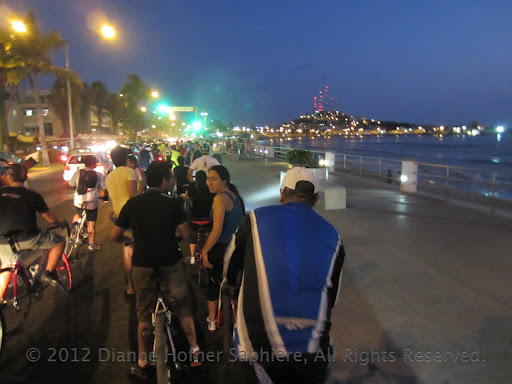
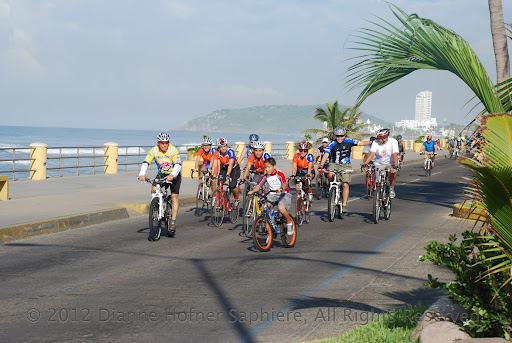
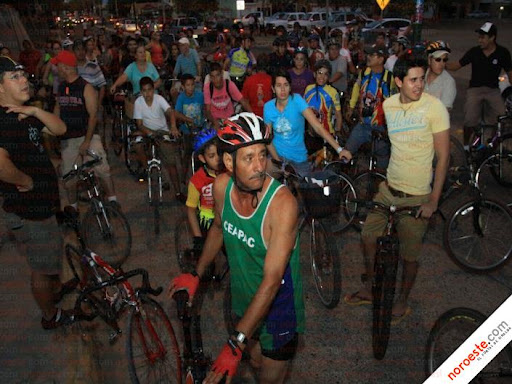
180 bicyclists showed up this evening at 8:00 pm for the very first CicloNoche Mazatlán!
We pedaled only about seven kilometers, but oh was it gorgeous!
The event was organized by SEMARNAT—Secretaria de Medio Ambiente y Recursos Naturales (Brenda Garcia) and CiclosUrbanos, who have been coordinating Cycle Nights in Culiacán since 2009.
Starting at the Aquarium, we pedaled south on Avenida del Mar to Belisario Dominguez, then turned up the road, around the block, and back down to Avenida del Mar. We were escorted by Mazatlán’s finest tránsitos, and we were instructed to stay in the right lane so that traffic could pass us easily.
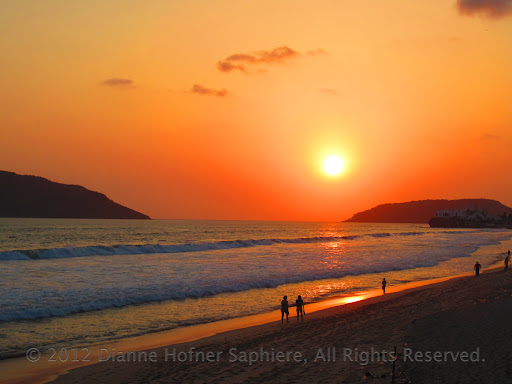
Our route started with the sunset, and ended with the starlight. Along the way we were cheered on and joined by ever-more cyclists.
You’ll remember that a couple of years ago a group of active citizens organized a couple of months’ worth of Sunday morning closures of Avenida del Mar for bicycle riding.
The “United for Health” group was led by the very kind and energetic Dr. Angel Eduardo Olivera Sandoval, a local homeopath. Sunday morning street closures to traffic, so that families can walk and ride bikes, are common throughout Mexico and most of Latin America.
Here in Mazatlán we had good crowds turn out, but unfortunately the municipal government didn’t seem to support continuation of the activity.
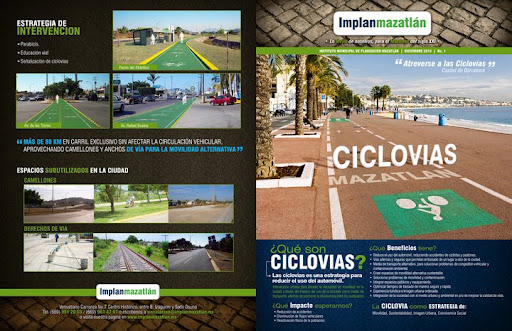
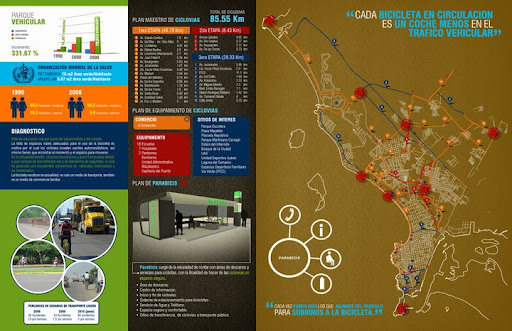
Nor have we thus far seen positive outcomes from citizen-led efforts to build bike lanes here in our port, despite having extensive ciclovías planning for some time now.
We were told that the first CicloNoche Culiacán only had 90 bicyclists show up (compared to the 180 who showed up here tonight), so there is obviously a passion for it here in Mazatlán. These days in Culiacán about 1600 people show up for the once-a-month CicloNoches.
It is our sincere hope that this terrific activity can take hold and gain a place in the hearts of Mazatlecos.
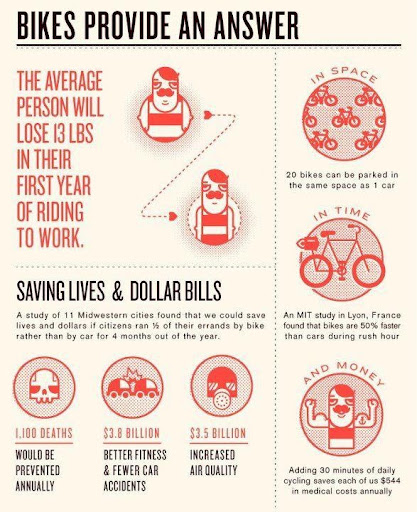
Bicycling promotes a cleaner environment, healthier bodies, enjoyment of the outdoors, time together with friends and family. It’s good for locals and out-of-town visitors.
Thank you to CiclosUrbanos, SEMARNAT, and all the organizers of bicycling events and programs in Mazatlán past, present and future!
Lets all turn out and show our support for bicycling! For our health and the health of our city!
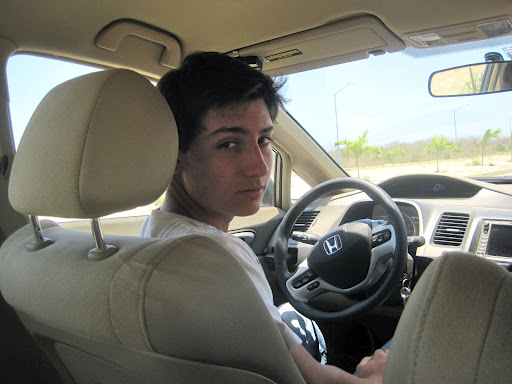
For many of us, obtaining our first driver’s license was a treasured rite of passage. When it comes to our kids getting their licenses, however, like many parents the thought scares me. And the scariness factor is amplified because our son is learning to drive in what, for us, is a foreign land, and one in which the driving, at times, can seem a bit crazy. Guardian angels please protect him and those near him!
Greg and I obtained our Sinaloa driver’s licenses shortly after we arrived. We took the required class, submitted our documents, drove around the block, had our photos taken, and oilá. Others pay a “fee” and have it all done for them, but we did it above-boards and it was easy-peasy. In fact, the class was downright enjoyable — the teacher is a very good storyteller!
Now Danny’s just gotten his license, so I thought telling you about it might prove helpful for someone.
In his case, he’s a new driver, and we’ve been teaching him whenever we get a chance for about a year and a half. He started out slow, as does everyone, but these days he’s become quite competent.
He wants to work this summer to save money to buy a used car, and he will probably end up buying one with a stick shift. But, our car, the one on which he’s learned, is automatic. So, we enrolled him in a driving school so that he could learn how to use a clutch. The series of classes cost 1450 pesos, and included four rounds of driving of two hours each time, or eight hours total. In addition, there was a three hour classroom session during which they studied rules of the road. He seems to have taken to the standard transmission like a charm.
On Saturday he went to the tránsito, which is located just in front of the Aquarium here in Mazatlán. From the malecón, turn on the street towards the Aquarium. Go past the statue of Don Cruz Lizarraga, and turn right on the street on the far side of the vacant lot. The DMV office (tránsito) is at the end of the street, last building on your left, on the corner. There are two doors. The door on the right is where you file your paperwork.
The door on the left is where you take a class.
First-time drivers under the age of 18 have to take a five-hour class. They tell us the class is offered twice/month on Saturdays from 8:00 to 1:00. The classes seem to be pretty full, and the kids get a certificate upon completion which entitles them to be able to submit paperwork for a license. They do not take a written test.
When we got our Sinaloa licenses we already had U.S. driver’s licenses, so we only had to take a one hour class. At the conclusion of the class, they gave out a written test. There was an English language version of the test that they give out here in town, which seems much much easier than the Spanish language version (it’s multiple choice).
After the class and after you pass the written test, they give you paperwork so that you can go next door and get your license.
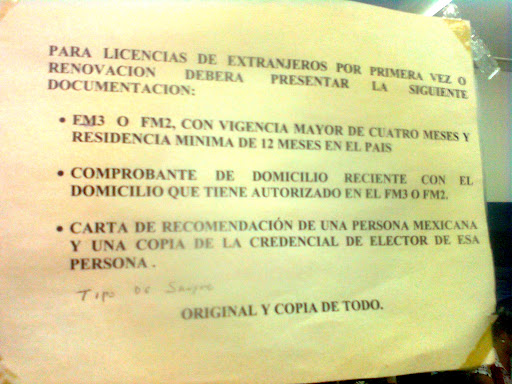
The documents a foreigner will need include (original and one copy of everything):
Your Mexican visa or residency document
Proof of residence/domicilio (water or electric bill with your name on it and your address)
Letter of recommendation from a Mexican national, vouching that the person knows you and you are an upstanding person. This needs to be signed and accompanied by a copy of the signor’s voter registration card.
You need to know your blood type (no proof required; just know it). If you don’t know, supposedly there is a lab about a block away where you can get tested. We know our blood types, so we didn’t experience this part of the process.
The correct fee (see the photo at right for the chart of fees). Foreigners with FM3s are limited to 2-year licenses. First-time licensees pay for “Aprendiz.”
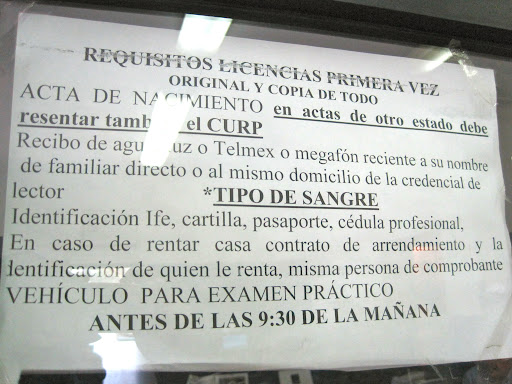
For first-time drivers like our son, you also need to bring:
Birth certificate (to prove age)
CURP
Passport
Parent needs to be present to sign
When you present your paperwork, they will usually ask you to do a driving test. So, you will need a car. They just asked us to drive around the block, nothing too challenging. We’ve been told that they want to be sure you buckle your seat belt and instruct the examiner to buckle his; this didn’t happen for us. Danny was also told that they ask you to pop the hood of your vehicle and show the examiner where you insert water, oil, coolant, etc., though he was not asked to do this.
Be careful as the street beyond the DMV office is one-way to the left; you don’t want to turn the wrong way. Also there are quite a few topes on the road leading up to the DMV office, as well as a stop sign conveniently hidden behind a tree.
After you drive with the officer, you pay your fee at a booth on the right side. Currently that fee is 344 pesos for a two-year period.
Next they take your photo and produce the license while you wait.
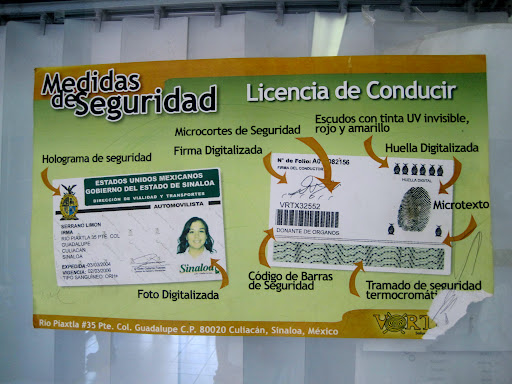
Each license contains a fingerprint of the license holder, so that’ll be the last step in the process. For us we filed the paperwork, did the drive around the block and got our licenses in under 90 minutes.
Licenses are issued Monday through Friday 8 am to 2:30 pm.
Renewals (as well as license plates, titles) can be done at this same office. However, we have had much better luck renewing our licenses at the DMV office in the Gran Plaza — it’s less of a crowd and seems to go quicker.
Good luck and drive safely!
NOTE: Our son said he learned a lot more in the driving school than he learned in the tránsito class, although he enjoyed both, and that he highly recommends the school for new drivers.
Mazatlán is privileged to have a strong and vibrant expatriate community, many of whom volunteer long hours to help make our city a better place in which to live. Many in the foreign resident community have of course grown up and lived most of our lives elsewhere. We love our adopted home, but we often lack basic “cultural literacy” about our adopted homeland. I put myself in that category, of course. Every day, many times a day, I learn something new. It’s part of why I love living here.
Last week, I noticed the below comment on one of the local expat discussion groups:
“It is located across the Malecon between two statues: the Deer, Mazatlan’s symbol; and a Sinaloa composer holding his guitar and sombrero.”
The note surprised me, because I figured everyone who lives here knows our beloved Ferrusquilla! But, of course, we don’t “all” know anything; we all have different pieces of information. I see Don Ferrusquilla once in a while, dining around town or taking a walk, and I loved his INCREDIBLE acceptance speech at the Premios Oye! last month (drag the play bar to 6:46 to skip the homage and hear the original poem he wrote just for the occasion, full of love for our fair city).
But, of course, we all hold differing pieces of knowledge, so I thought I’d share a bit of what I know about this “Sinaloa composer holding his guitar and sombrero” in the statue. Maestro José Angel Espinoza Aragón, “Ferrusquilla,” is a national cultural icon, famous throughout all of Latin America and Spain, and one of the greatest orgullos of Mazatlán. The United Nations awarded him the the Medal of Peace in 1976, the University of Sinaloa presented him with an honorary doctorate just a few years ago, in 2008, and he’s received many other distinguished awards during his career.
His “master work” is the composition “Echame a mí la culpa,” sung by most every well-known Spanish-language singer (here it’s sung by Amalia Mendoza, “La Tariacuri;” or this one sung by Javier Solís). The song inspired a Spanish movie of the same name, and decades later (in 1980) was still so popular that it won “song of the year” in Spain, as sung by Englishman Albert Hammond. Ferrusquilla has acted in 80 motion pictures alongside actors that expats will recognize such as John Wayne, Clint Eastwood, Dean Martin, Boris Karloff, Richard Burton, Anthony Quinn, Brigitte Bardot, and Robert Mitchum, and has composed, to the best of my research, 97 songs.
José Angel Espinoza Aragón was born in Choix, Sinaloa on October 2, 1919. After his mother died his father moved the family to El Guayabo and then Los Mochis, where his father remarried. In 1935, after finishing junior high, his family sent José to study in Mazatlán. In 1937 he got on a train headed to Mexico City, to study medicine, but life didn’t quite work out according to plan.
According to one interview, in 1938 the young José was working a side-job at a radio station, one that broadcasted the popular late-afternoon children’s show “Fifirafas el Valoroso.” The role of “Captain Ferrusquilla” on the show was originally played by the head technician, Carlos Contel, brother of the station manager. After Carlos’ brother told him to choose whether to be a voice actor or a technician, the show was left without a Ferrusquilla. José had the good fortune to be present in the studio when the director, panicked, asked around for a male who could read the part. Thus, by fate, the “man of a thousand voices” with the nickname “Ferrusquilla” was born.
Ferrusquilla fell in love with the female lead of the radio show, Blanca Estela (María Blanca Estela Pavón Vasconcelos). According to this same interview, the two lived in New York for a year, dubbing the voices of actors such as Ingrid Bergman, Elizabeth Taylor, and Mickey Rooney. Blanca died tragically in a plane accident in 1949. After her death Ferrusquilla decided to commit himself to music, and composed his first song in 1951.
Ferrusquilla married and had two daughters with Sonya Stransky Echeverría in the 1950s (the marriage lasted five years). He tragically lost another loved one, his daughter Vindia, in a car accident in Mexico City in 2008. His daughter Angélica is a successful actress. He has said that his daughters have been the joy of his life.
By the way, the statue of Ferrusquilla, on the malecón in Olas Altas, made by artist Carlos Espino, was unveiled in time for Ferrusquilla’s birthday, in October of 2007.
Fellow foreign residents of Mazatlán: let’s all, proudly, be sure to call this landmark the “statue of Ferrusquilla”!!!! And, Mazatlecos and fans of Ferrusquilla: please teach all of us more about this incredible gentleman, sharing your life memories of the legacy he’s given us!
—
Note/Update: Jackie Peterson wrote an article on Ferrusquilla in the Pacific Pearl last year. Somehow I missed seeing it, but you can check it out here. And one of my friends has given me the Maestro’s number and asked me to give Ferrusquilla a call, to let him know about this post, so I will do that as well.
Update #2, March 5th: I met Maestro Ferrusquilla tonight. What a great man! He told me that in his younger years, he played for a year with Banda El Recodo, in the Cruz Lizarraga days, before he went to Mexico City and did the radio show. Cool trivia! He is a really nice and VERY interesting man and his English is GREAT! It felt very good to finally get up the courage to talk to him, and to have the honor of finally meeting him.
Ok, the title of this post sounds a little too “professional” for our family blog. But it’s about dear friends, Mexican society and our beloved malecón, so I think it belongs here. It is really the story of the power of one.
Our dear friend, Guy, retired from a career as an air traffic controller in Canada and relocated to Mazatlán about five years ago. He loves the “blue:” the ocean, the sky, the outdoors, the views. He is a passionate athlete. He started out running the malecón many times a day, and has evolved to roller blading it. He is a French speaker who also speaks English, and he has actively sought to learn Spanish since living here. Guy is very outgoing, optimistic and friendly. He loves coffee, and makes a great pot of cappuccino every morning, sharing it with those friends lucky enough to be nearby when it’s ready. Guy has become a city icon. Everyone knows the bald guy dressed in black who can be seen skating along the oceanside promenade nearly any time, day or night. To see him is to be reminded to enjoy this beautiful city in which we live—not to get lost in work or daily drudgery, but to take a look around and a deep breath, and to get out and move our bodies before we lose the ability to move them.
We also love walking and biking the malecón every day; it’s one of the best things about Mazatlán. In our opinion it’s the best oceanside promenade in the world, with 4+ miles of paved, gorgeous walkway between Valentino’s and Pedro Infante. We imagine that everyone would enjoy using the malecón. Thus, we have been repeatedly surprised by friends, mostly locals, who tell us they prefer to exercise at home or in a gym. I’ve had girlfriends tell me their husbands won’t “permit” them to use the malecón if they’re not with them. Girlfriends tell me they don’t use it because they don’t want to be out in the sun; it causes wrinkles and spots on their fair skin. Others say the malecón is dangerous; that you’re looking to get robbed.
And, honestly, I know very well that many people don’t use it because it’s beneath them. That is a side of society, any society, that I very much dislike. Beach vendors, people who can’t afford gym memberships, people whose only mode of transport is a bicycle or public bus, even beggars and homeless people, use the malecón. “I have more money than them. I was born higher class than them. I need to maintain my status by not associating with them.” No one in polite society says it directly, but it’s there; it’s palpable. And this is a side of any society that I’d love to change.
There are loads of Canadians and US Americans who come here and desire to make a mark on this gorgeous city, to help make our city better. They often wreak havoc on themselves and others despite their good intentions, because they come on like gangbusters and try to “change” or “fix” something they don’t yet understand, something that is much larger than they are (a culture, a society). I know this well; I’ve seen it worldwide; it’s my profession.
Guy didn’t set out to change anything. By setting out to enjoy himself and stay in shape, he has inspired many people to get out and move: to bike, run, walk, rollerblade… People from all walks of life started coming to Guy, asking him to teach them to rollerblade, to help them get started, to give him advice. They told him they’d pay him for his lessons. “No,” he’d say. “I’ll teach you for free, but you must pay it forward and in turn do something helpful for somebody else.” Thus his “entourage” was born, including a running group and a roller blading group, as well as, now, people who hang out at the coconut stand to share good conversation and homemade ceviche.
Guy has made a wide circle of friends from all different parts of society: government, big and small business, housewives and young singles, wealthy and humble. I am sooooo so so so happy to see the gatherings of people around him. It crosses socio-economic lines. There are people roller blading now who, personally, told me the malecón was no place for them! I have had friends who previously refused to use the malecón for the reasons above ask me if they could walk with us, bicycle with us. It’s because, I believe, they see these other people, “society” people, out there, exercising. Not just with Guy, of course. Kelly and his bicycling tours and groups, other running, roller blading and bike groups…. The culture is shifting. I’ve seen a huge shift towards egalitarianism and inter-mixing of the social classes on the malecón in the four short years I’ve lived here. Bravo!!! Long live culture change! Let’s keep it up! We aren’t there yet, but… Just the other day a friend asked another friend, aghast, “You have the coco guy’s phone number in your cellular?” Well, she did. And proudly so.
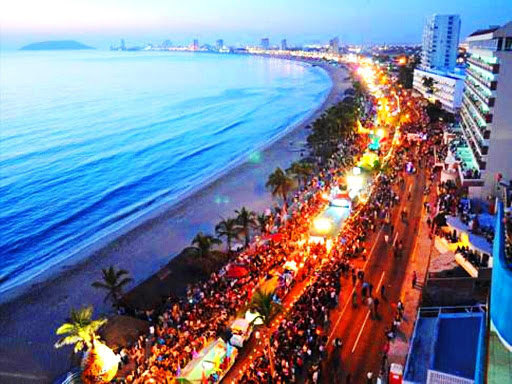
One last photo: this one of the malecón during Carnavál. Forbes Magazineranks our Carnavál/Mardi Gras one of the world’s top three. I will just add that it is VERY family-oriented. Come join us!
I ride my bike a lot in Mazatlan. It is a great town for bike riding, at least as far as I’m concerned. Some people are put off by the traffic (pedestrian and vehicular), but I think it adds to the excitement and challenge.
Most people do what I used to do and go up and down the malecon (or boardwalk) along the ocean. It is relatively flat, very scenic and overall very safe. However, it is not very challenging and if you are trying to get in some good cardio or burn a few extra calories, you either tow a bag of bricks behind you or seek a tougher ride.
I started seeking tougher rides nearly two years ago. I started going north to the far end of town, but that involved too much street time and too many crazy drivers. It was all flat other than the two bridges that are more of a workout due to the speeding traffic then the incline or distance. I also have experimented with riding downtown and do still enjoy it from time to time. It is best to go really early and realize that for a great workout, you will be going up and down the same small hills over and over.
Mazatlan has two big hills – both in the southern part of town, called Olas Altas. Mazatlan also has the second tallest natural lighthouse in the world. So, about six months ago, I decided to combine the challenge of an up and over a good sized hill with a climb to the top of the lighthouse for a good cardio workout.
If you do not know Mazatlan, you can’t imagine what a wonderful ride this is. So today I packed along my camera and took a few pictures in an attempt to show at least some of what I like about this ride. As for the hill, well, I admit it doesn’t look like much in these pictures, but it is a moderate challenge for me and of course is getting easier the more times I go. Try it and see.
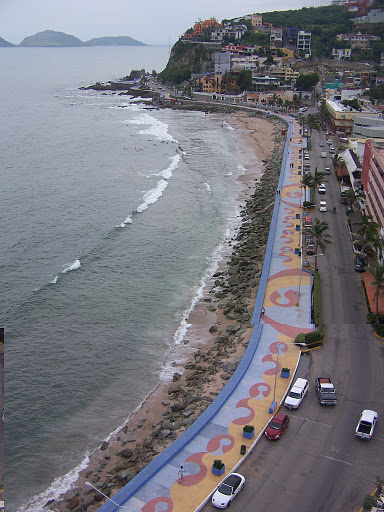
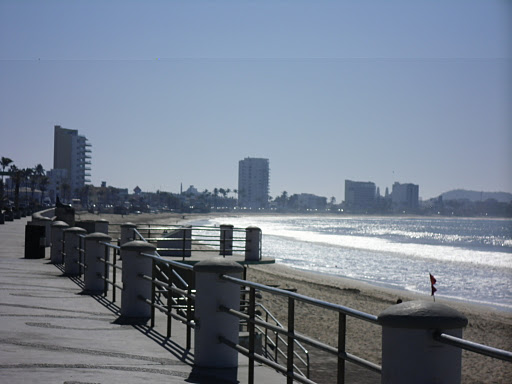
Here is the malecon looking south from in front of our house:
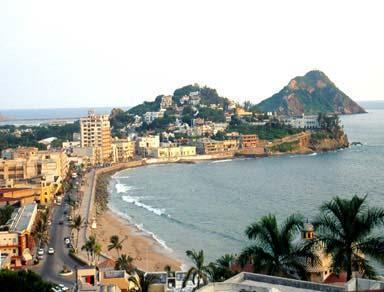
Here you can see the curve of the bay and how flat most of the malecon is:
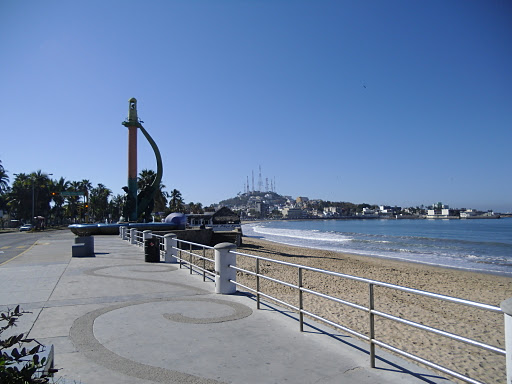
The curve and flatness continue as we go past the Fisherman’s Monument:
Once we get past the fishing boats, there is a small incline, but not much of a challenge:
Are you digging the view as much as I am? Can you see why so many people choose to just stay on the malecon? At this point we are directly across from where we live and have gone around the bay. Our building is circled:
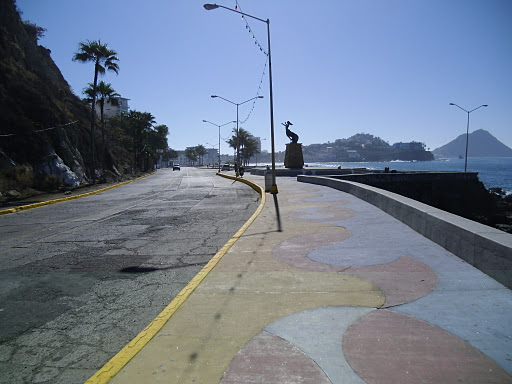
Now, there is another incline in the road to make for a little challenge:
After we round the corner and go past some vendors and the huge flagpole, we begin to see the hill to the right of the statue in the picture below and the lighthouse on the far right:
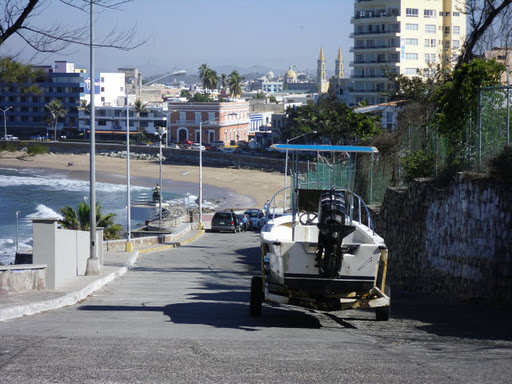
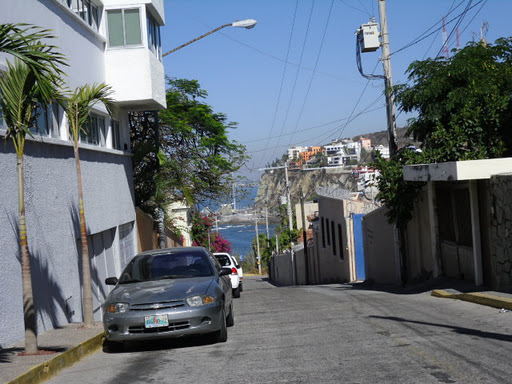
As we get a little closer, we can zoom in on the first part of the hill that we will need to climb. Today, Sunday, is the easiest day. During the week the school (blue and white building) at the elbow in the road is very busy. The turn is extremely tight and there are cars and kids everywhere. The hill is essentially three little hills in one. We will go straight up towards the school, turn left away from the ocean and then turn right and rise up above and behind the school, before eventually turning right and enjoying the downhill ride to the road to the lighthouse.
Here we are ascending the hill towards the school and a shot looking back from the school:
Next we turn left and parallel the school (hill 2):
From the next corner we pause to look behind us:
And in front of us (hill 3):
It’s at this time that my heart is usually working the hardest. With an allowed maximum heart rate of 170, I am happy to see that I have not overdone myself today:
If you look closely, you can see that we have only been at this for 28 minutes. It’s taking longer to type this than to ride it!
Looking back down hill 3:
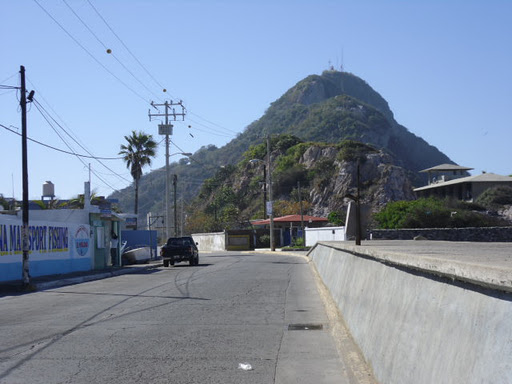
And ahead to the downhill ride the awaiting lighthouse:
The approaching lighthouse and a look back at the fun downhill ride we just had:
The road to the lighthouse – water on both sides. The lighthouse used to be an island, but a road was built over the rocks to accommodate traffic.
We have written about the lighthouse. You can read that entry here. Some people actually ride their bike up the switch back dirt path and then carry the bike up the stairs (or turn around). What I like to do is tie up my bike at the bottom. Fast walk up the path and 300+ steps, spend two minutes at the top, hurry down the stairs and then run down the path and jump back on my bike. It keeps my heart pounding and takes about 30 minutes depending on how many people I have to get around on the stairs. It is a great workout. My final picture is my bike tied up to a telephone pole waiting for me as I complete my trek down the hill. To get home, I go back the way I came. Total time is usually around 90 minutes, give or take as the wind and stopping to talk to friends often makes a difference.
A note about the picture. If you look to the right, you see three people sitting in the middle of the roundabout–one with a guitar. These three guys were sitting there when I got there and when I left just playing music and singing old Mexican ballads (quite well too). Just one of those little treats here in Mazatlan that helps me remember why we moved here.
If you ride a bike here, please be safe. It takes a little getting used to. Most of all be careful and have fun. Enjoy your ride!



























 ¡VidaMaz!


