Día de Muertos in the TAP

One of the main catrinas, my friend Lilzy and me

One of the main catrinas, my friend Lilzy and me

Regular readers of this blog know that Day of the Dead in Mazatlán for us closely rivals our port’s ultimate party, Carnavál. And that is saying A LOT! So much so that, this year, I willingly woke up at TWO A.M. (!) in Seattle in order to get the earliest flight back to Mazatlán in order to attend our traditional callejoneada—CULTURA moved the event up one day to avoid the overtime hassles of having people work on Sunday. I got home just in time to welcome two of my girlfriends, Jessica and Lilzy, for a makeup party prior to the evening’s events.

Walking with the two gorgeous main catrinas to escort the dearly departed from their altars around El Centro to the ever-after was wonderful as usual! This year the donkey-drawn beer carts were replaced with motor-driven versions (two donkeys did head up the parade), at least four bandas took part, and there were hundreds of people who made the effort to paint their faces and dress the part of calacas and catrinas.

Below is footage from 2012’s alley parade, or click here to view a photo album of this year’s callejoneada.

Very exciting to me this year was that for the first time ever—I’ve stood in line for hours in previous years, to no avail—we were able to get tickets to the events in the Angela Peralta Theater. I have heard how awesome that event is, but we were never lucky enough to make it to the front of the ticket line. And, yes, many of you ask us why CULTURA doesn’t give us tickets, since we promote them so much. But, they don’t.

Even though I was out of town working, my wonderful husband Greg stood in line and scored us a pair of tickets! Then my good friend Jessica gifted us with two more, so a couple of friends could join us. After standing in line for the tickets, gentlemanly Greg didn’t even go in, but let the women have the opportunity!

The theme this year was Mictlán, honoring pre-hispanic Mexico. Entering the theater the very first act was a tribute to the Aztecs. Going on to the stage we saw two large dance performances: one looking out to the theater (in the seats) and another looking in towards the back of the stage (a wedding). All were gorgeous.

Walking through the hallways and stairways inside the theater was a bit like a spook house, but emerging out onto the upper deck some calacas were playing classical music and singing opera, and below was an aerial dancer wowing the crowd. Throughout the theater were located multiple altars honoring the dearly departed, and multiple dance and visual art installations.

Click on any photo below to enlarge it or view a slideshow.

Both Carnavál and Day of the Dead show just how strong our local arts community is. Young people practice for weeks to prepare for these big events, and hundreds of people dress up, make up, and bring their families and friends to participate in the events. We are so blessed here with every type of musician, singer and dancer, from classical to banda, as well as to artists of every form of visual and performing art. Many thanks to Cecilia Sanchez Duarte, who devotes the major part of three months to making events in the theater come to life, and to all the makeup artists, costume and set designers who contribute their skills as well! Such a terrific event, and the tickets are free! If, of course, you can get them!

The last two days have been family time, with altars at home to reflect on those we’ve loved and lost, visits to the cemetery, and raising a glass and a song to celebrate their lives. Day of the Dead is, indeed, yet one more of Mexico’s great contributions to our planet. I trust you’ve enjoyed the long weekend and used the opportunity of the holiday to connect with family and friends!

Cultural Appropriation of Day of the Dead?

As locals, expats and immigrants gear up for Day of the Dead festivities here in Mazatlán, I wonder how many of us realize that there has been quite a backlash to cultural appropriation and commercialization of Day of the Dead by non-Latinos.

I first realized how “hot” Day of the Dead was on my recent visit to a US liquor store. There, I was astounded by the quantity of Day of the Dead- or calaca-themed beer and liquor! To be honest, skeletons and skulls in and of themselves seem to be popular, and anything Mexican (amigos, lucha libre….), Spanish (Don Quixote) or mystical (voodoo) as well. The commercialization is, indeed, real. Click on any photo to enlarge it or view a slideshow.

Living here in Mexico, where we are privileged to be steeped in the traditions as well as the festivities, I hadn’t realized the concerns about appropriation of Day of the Dead until I read a post by one of the bloggers I follow, Aya de Leon, entitled, “Dear White People/Queridos Gringos: You Want Our Culture But You Don’t Want Us — Stop Colonizing The Day Of The Dead.”

In reading her excellent article and researching the matter a bit more, it seems that most Latinos are proud of this holiday. They understand that recognizing the dearly departed is a universal desire. Most are happy to share and ready to welcome us into the Día de los Muertos traditions, which have existed since Aztec times. But they most definitely and understandably resent our taking on the traditions as our own and transforming them into something they’re not — emptying the traditions of their soul. She writes:

And the urge to colonization is born when your own land and resources have been taken over by the greedy and your cultures have been bankrupted. Halloween has a rich history as an indigenous European holiday that celebrated many of the same themes as Day of the Dead, but you have let it be taken over by Wal-Mart… You have abandoned Halloween, left it laying in the street like a trampled fright wig from the dollar store. Take back your holiday. Take back your own indigenous culture. Fight to reclaim your own spirituality.

Please. Stop colonizing ours.

Aya gives examples of Day of the Dead festivals organized by non-Latinos in which Latino voices and faces are not even present! She talks of a sort of Cinco-de-Mayo-ization (my words) of Day of the Dead, in which white hipsters wear calaca face paint, stand amongst broken marigolds listening to white bands, and drink gentrified, holiday-themed micro-brews, without so much as a thought to what the true tradition is or means. She explains, and rightly complains, that we love Mexican culture when it’s convenient and fun, but not when it involves advocating to solve undocumented immigration, illegal gun exports, or rampant femicide.

So where, exactly, is the line between participating in and honoring Day of the Dead and appropriating or colonizing it?

Cultural appropriation is often used as an accusation, implying theft. But cultures, their traditions and artifacts, often aren’t clearly distinguishable. Throughout history people have intermingled, shared, and been inspired by one another.  As an interculturalist, I’m all about diversity, integration, collaboration, creativity. There is nothing inherently wrong in us learning from and building on one another; that is actually, rather, a really good thing!

The problem, Aya tells us, is many who are welcomed to the Day of the Dead table are poor guests. We don’t sit at the table; we take the table over. We don’t pay our respects, acknowledge our hosts, or say thank you. We need to be conscious that if we organize themed events, we should use them as opportunities to showcase Latino artists and musicians, and we should hold the tradition with reverence, respect, and a desire to learn and honor.

In an insightful piece in Quartz, Noah Berlatsky tells us that the problem with cultural appropriation is racism:

“There’s nothing wrong with Elvis loving and imitating Jackie Wilson. But there is something wrong with the fact that Elvis is hailed as the King of Rock n’ Roll, while most people barely know who Jackie Wilson is… White performers, like Taylor Swift or Miley Cyrus, use twerking in their videos on the way to becoming more successful and awarded than the black women who developed the style in the first place. When the white borrower, predictably, earns more accolades than the borrowee, artistic freedom and admiration is transformed into something much more problematic… While country music loves black music, it mostly excludes black artists, in the sense that those artists are not considered central, and their contributions aren’t recognized.”

Therefore, all of us need to be vigilant to extend power and privilege, credit and honor, to the origins and originators, not just to those who adapt. However, our modern-day systems are skewed against us. Those who write a book are credited with ideas expressed by others; individuals and corporations can copyright and trademark something that has a long tradition and belongs to a group of people.

Did you know that Disney even attempted to trademark Day of the Dead? They were making a movie called, Day of the Dead, and wanted to trademark the title. Thanks to huge response to a petition on Change.org, Disney rather quickly pulled its trademark application. According to an article in the Los Angeles Times, here’s what some of those opposing Disney’s trademark application had to say:

“Our spiritual traditions are for everyone, not for companies like Walt Disney to trademark and exploit,” wrote Grace Sesma, the petition’s creator. “I am deeply offended and dismayed that a family-oriented company like Walt Disney would seek to own the rights to something that is the rightful heritage of the people of Mexico. This is a sacred tradition. It’s NOT FOR SALE,” wrote Consuelo Alba, of Watsonville, Calif.

The trademark application was “odd” to Evonne Gallardo, executive director of the Boyle Heights art center Self Help Graphics. The center puts on one of the largest Day of the Dead celebrations in Los Angeles and has been sponsored by the Walt Disney Co. “The right thing to do is not to attempt to trademark a cultural and spiritual celebration,” Gallardo said. “I have yet to see a trademark on Christmas or Hanukkah.”

The movie was re-titled to “Coco,” no doubt so that Disney could trademark the title and create a website. One of the most spirited activists to oppose the trademark application was cartoonist Lalo Alcaraz, creator of that incredibly powerful graphic at the top of this post. In a great act of corporate listening and learning, he was recently hired on by Disney to work on the film about which he protested! Our speaking up to defend our heritage can have positive results! The movie is being made, showcasing a beautiful tradition, and it now includes more representation from the very culture it portrays.

Today as I started to write this post, I read an interesting article in The Atlantic: “The Dos and Don’ts of Cultural Appropriation.” In it, Jenni Avins provides six recommendations to prevent appropriation, including involvement of and engagement with members of the culture. She points out that cultures are fluid and constantly changing, so we can’t ask that they stay frozen in time. On the other hand, foreign passion has often helped preserve native traditions, arts, handicrafts, music, dance, literature and even languages. Like Aya, she highlights the importance of acknowledging and honoring the source, the origin, of cultural arts and traditions. Jenni also provides two “don’ts”: never wear blackface, and never use sacred artifacts as accessories.

As we all gear up to paint our faces and create our altars, let us participate in and enjoy the festivities, and use this time to truly remember those who have preceded us in death. Day of the Dead provides a perfect time for us to learn from our neighbors and hosts in this country, and to share with them a human universal: remembrance and longing for those we’ve loved and lost.

When have you felt the tug between honoring and participating in the local culture, and appropriating it?

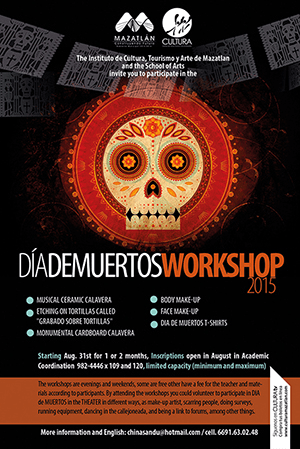
Day of the Dead Makeup Class

©03.IMG_0542

My cousins Lori and Mary, and yours truly. I asked my friend Lilzy, who did my makeup, to put a rose on my forehead in honor of my Aunt Rose, my cousins’ wonderful Mom.

Do you love Day of the Dead? We all know Mazatlán has one of the BEST DODs in all of Mexico, what with the callejoneada parade, the incredible show inside the Angela Peralta Theater, the numerous gorgeous altars all over town, and events at the cemetery. Do you love joining in the traditional festivities? Would you like to be able to do your own or your friends’ makeup?

DODThis September and October, our beloved Centro Municipal de Arte/CMA/Municipal School of the Arts has been conducting free workshops in preparation for these big events, coordinated by the gorgeous, energetic and enthusiastic Cecilia Sanchez Duarte (nicknamed China). The latest was yesterday’s class in calaca (skeleton) or catrina makeup, conducted by Delfos dancer and makeup artist, Johnny Millán, with interpretation into English by China herself. It rocked!

The class was held from 5-7 pm in the air-conditioned comfort of the Jonathan Hotel, just across from the CMA, and was attended by about 40 people. China arranged the class in hopes that more and more of the city’s residents will dress up and volunteer to participate in the main events, including the parade and the performance in the theater.

The timing of this workshop was perfect for me, as my two beloved sister-cousins were visiting from Minnesota and Indiana. We get together for a girls’ vacation every October, and we always do a craft. What better “craft” than a Day of the Dead makeup class with a professional makeup artist—for free?!

©05.P1280960

Cecilia Sanchez Duarte, director of Fine Arts at the CMA, in charge of Day of the Dead in the theater

Supplies for the Basic Makeup

Prior to the class, China had sent those of us who pre-registered a list of supplies to bring:

  • White concealer (corrector blanco),
  • Black eyeliner pencil (lapiz negro),
  • Black and white powders or eyeshadows (sombras),
  • Eyeshadows of different colors, and
  • Shiny things (e.g., sequins—lentejuelas, or crystals/gemstones). We also brought
  • Fake eyelashes (which we didn’t have time to apply) and
  • Eyelash glue, a couple of
  • Hand mirrors, a box of
  • Kleenex, and some
  • Props—a catrina hat and a couple of feather boas. I rarely put on makeup, so what we forgot to bring were
  • Brushes, Q-tips, applicators and blending sponges, also highly recommended.
©04.P1280958

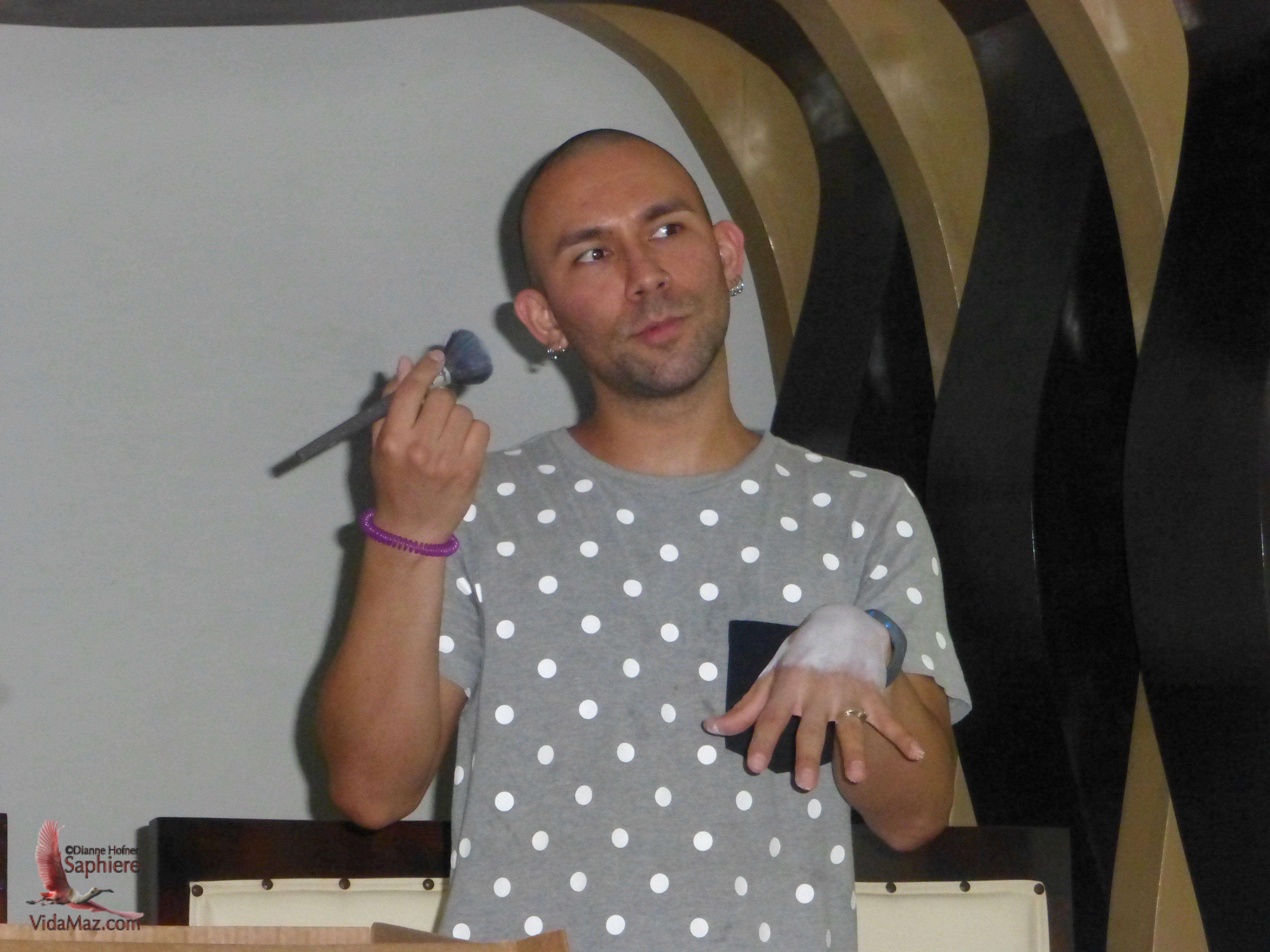
Johnny Millán, Delfos dancer, professional makeup artist, and our teacher for the day

Maestro Millán first talked to us all as we sat theater-style, explaining the different types of makeup, brushes and blending pads he likes to use. He told us that while we can’t get professional-quality white pancake theater makeup here in Mazatlán (he brings his from DF), the concealer works well. We’d just need to break off pieces and mix it into a paste (which we could do on the backs of our hands) till it was smooth and free of clumps.

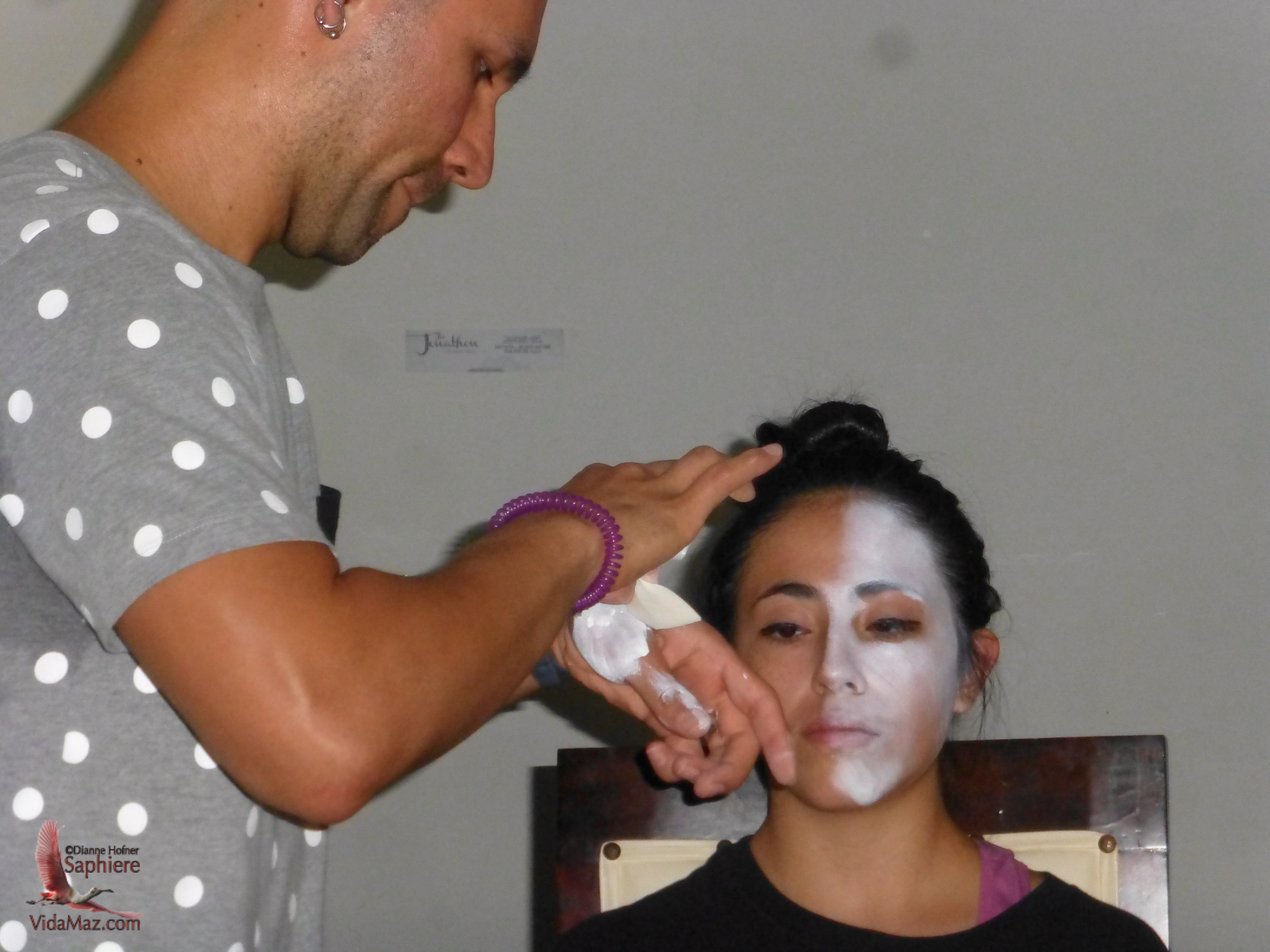
He demonstrated the steps to a basic catrina makeup on a model, doing just half her face in order to save time on his explanation. After his demonstration, those of us attending got to either apply makeup to one another or to ourselves. We were all so excited to get started! He had some supplies to sell us, and was happy to share Q-tips and other applicators.

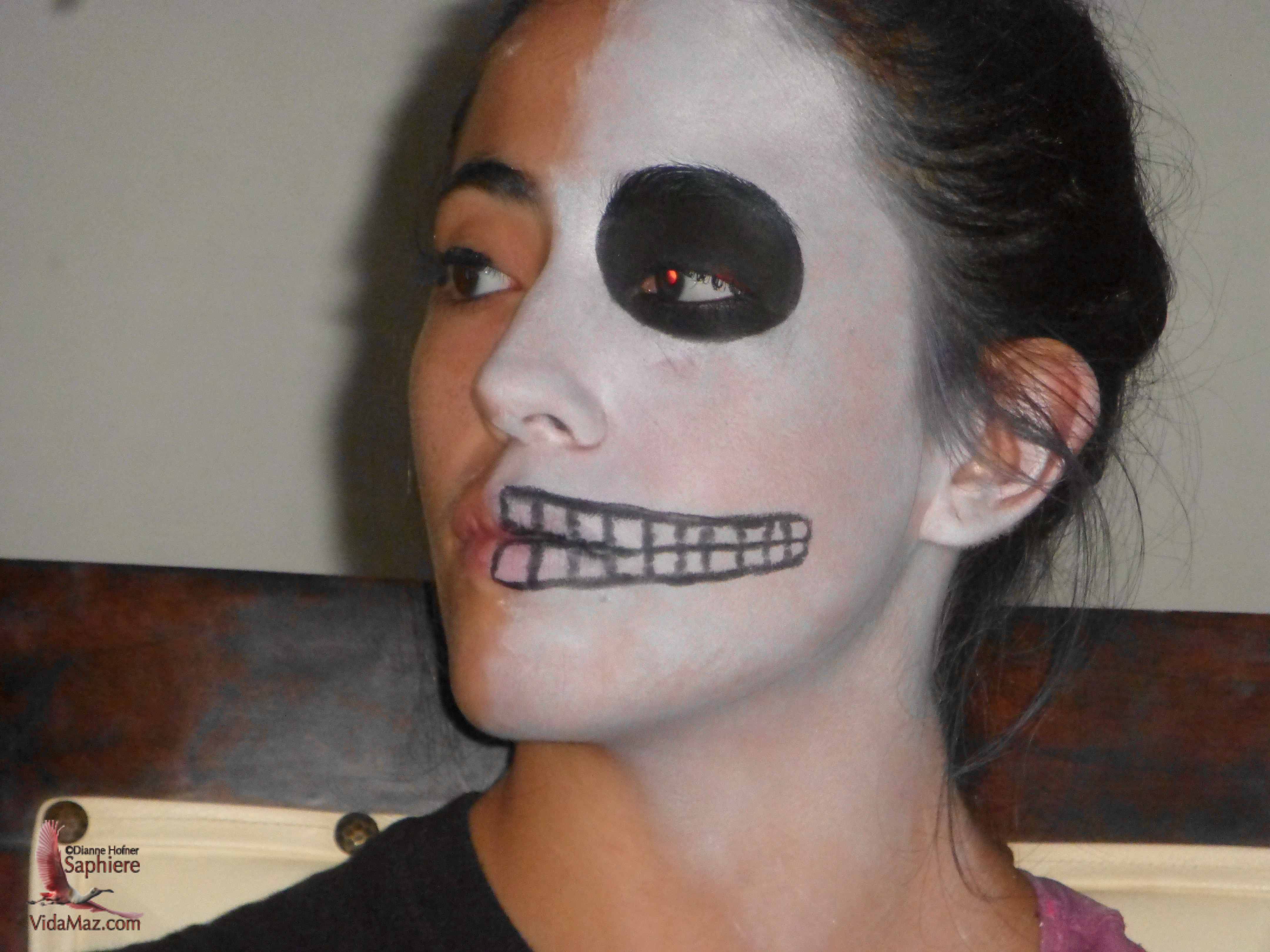
In the 90 minutes or so that we had available to do one another’s makeup, the most any of us were able to achieve was the basic makeup, with a teeny bit of customization. While we were working on the basic steps explained below, Maestro Millán finished up the makeup on the model. You can see what she looked like in the final photo in this post. Needless to say, the Maestro was fast, made it look so easy, and had really great results. That’s why he’s the professional, right?

Steps to the Basic Makeup

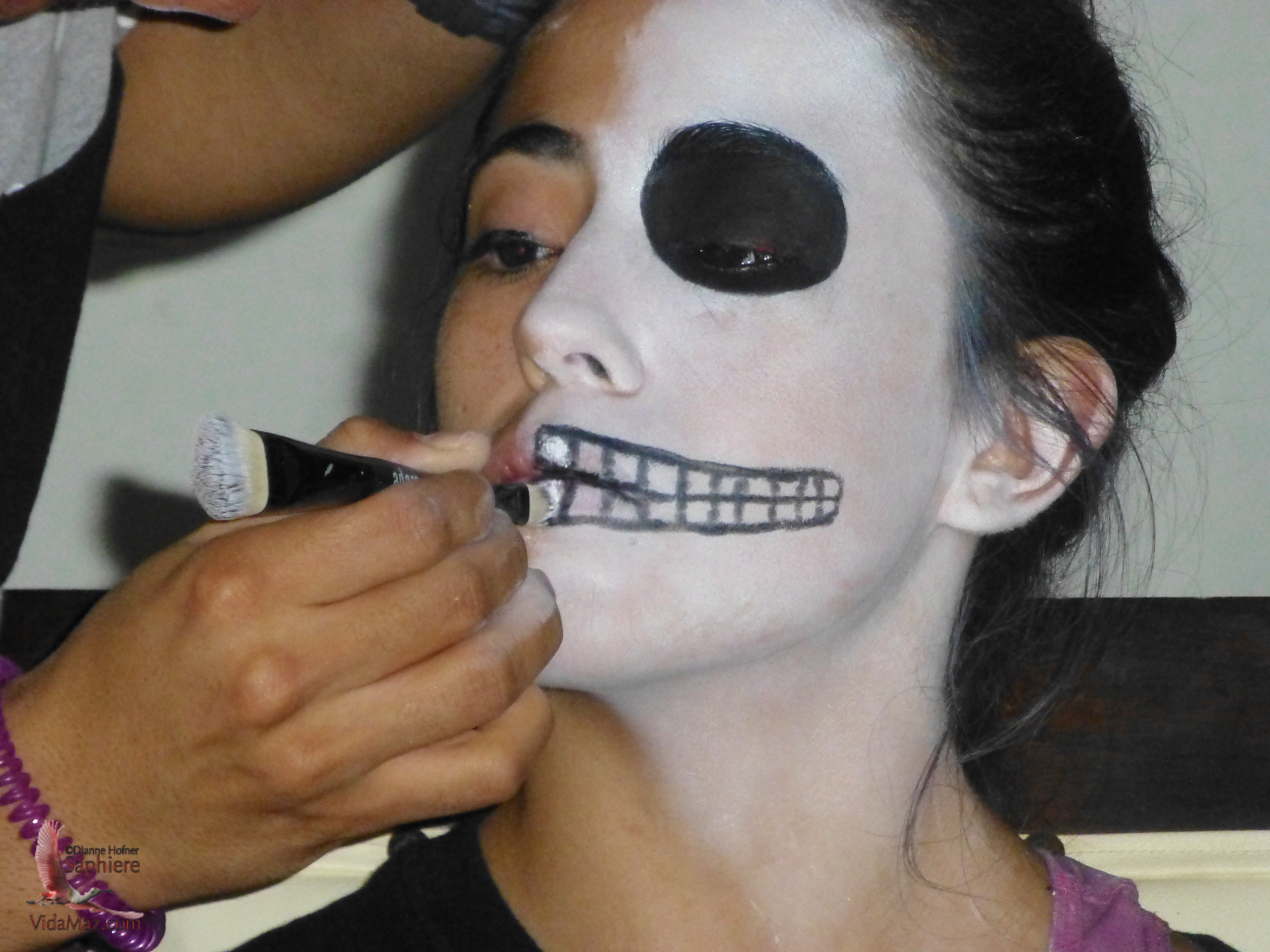
  1. Johnny showed us that the first step to creating a catrina makeup is to apply a thin white base coat. For this we used the concealer that we’d made into a smooth paste. He told us to apply this with our fingers or with a sponge, and that we don’t need to blend the white to cover the face perfectly; later when we apply white powder or eyeshadow over the concealer to fix it, the coverage will become much more perfect. He told us to be sure to avoid applying white to the area around the eyes, as we’d later paint them black or in colors, and to think about the costume we are going to be wearing: if our hair will be up, we should paint our ears; if we’ll have a plunging neckline, we’ll need to paint our chest, etc. Be sure not to put the white on too thickly; you can see in the photo that the base coat is very thin.

    ©01.P1280962-1

    Step 1: White base coat

  2. Next we took a brush and set the base coat with a dusting of white powder or white eye shadow. This step was incredible. It really made the base coat look well blended, and it made the color pop! Not being a makeup queen myself, the power of the powder over the makeup really astounded me.

    ©02.P1280963-2

    Step 2: White powder to seal the base coat

  3. Once we had our white face on, we proceeded to the eyes. Johnny told us to use the black eyeliner pencil and, in the direction of the growth of hairs on our eyebrows, to trace the brow line and then around the cavity of the eye, following the bone of the eye socket. Once we had the outline, we were to fill the area in with the black eyeliner pencil. Again, we didn’t need to worry about perfectly blending, as we’d next cover this area with black powder or eyeshadow. If you want to put colors on the eye area, you can apply glitter or shadow over the black, or you do it directly to the skin, depending on your creativity.

    ©03.P1280965-3

    Step 3: The eye sockets

  4. We now needed to seal the black eyes with shadow or powder. Again, our rough-looking black eyes suddenly became velvety smooth and perfectly blended. It was amazing.
  5. From here Johnny told us to work on the mouth. This was by far the most difficult part of the basic makeup for most of us in the class.  He told us to follow the upper and lower lip lines, and extend the line out to where the teeth actually end in the back of the mouth, squaring off the outside. We then needed to make a center line, right where the lips meet, painting inside the lips a bit so the pink didn’t show. After that we made vertical lines to create teeth. One trick here is to round the roots of the teeth a bit with the eyeliner pencil, so they are not square but more natural looking.

    ©04.P1280973-4

    Steps 4 and 5: Sealing the eye sockets and outlining the teeth

  6. It was important for the teeth to be bright white, so at this point we took an applicator and applied another dot of white concealer to each of the pearly teeth. This really made the teeth look real.

    ©05.P1280974-5

    Step 6: Making the pearly whites pop

  7. The final main feature was the nose. We drew triangles over the nostril area, to look like the holes in a skull.

    ©07.P1280977-7

    Step 7: The nasal cavity

  8. To finish the basic makeup, we needed to use the pencil to draw the jawline, and then seal that with black powder. We also dabbed black powder around the hairline, and used it to hollow under the cheekbone.

    ©08.P1280985-9

    Step 8: Shadowing and contouring the facial outline and bone structure

  9. From here, Johnny told us our creativity could take free rein. We could put sequins around the eyes (he said we could use eyelash glue or even normal white Resistol water-soluble glue), liquid eyeliner to paint some cracks or decorative detail (sealing those details with powder), adding colored eyeshadow or glitter to the eyelids, or detailing the neck and chest. Click on any photo to enlarge or view a slideshow.

Fortunately most of us attending felt that the makeup was pretty easy to do, and it was really fun! While 45 minutes for each face (our group painted one another) isn’t much, we were pretty psyched with the results.

12115980_943243912409327_3970495844696971161_nDay of the Dead Parade and Theater Event in Mazatlán 2015

While having a professional do your makeup here can be very affordable, now that I know how to do it, I’m so looking forward to opening a bottle of bubbly and sitting down with a few friends in front of the mirror on October 31.

That’s right! The callejoneada is on Halloween this year. Cecilia told us that’s because we normally do the parade on November 1st. This year, that date falls on a Sunday. CULTURAL didn’t feel they could ask all the volunteers to work on Sunday, and they’d have to pay overtime to those who are paid, so instead they’ve switched it to Saturday this once. Next year, she tells me, it’ll be back to the regular November 1st.

The theme of the Dia de los Muertos events this year is Mictlán, a tribute to pre-hispanic culture. The events in the Angela Peralta Theater will start at 7 pm, with aerial dance, concept art, poetry readings, singing, ballet—it’s an event not to be missed. Free tickets will be handed out in the Plaza Machado starting at 10 am Friday, though the official announcements say Saturday. Be sure to be there early or on time, as the free tickets run out quickly and are limited to two per person. The parade itself starts about 8:00 pm from the Plaza Machado; route map is above.

Please Share!

Many of you have made yourselves up for years, so you are experienced. Not sure if any of the above will give you a few pro tips or not. I would love to hear your favorite makeup techniques and tips; please also share a photo of yourself in your favorite catrina outfit. For our group, it was all new. Now we know to buy some good brushes, blending sponges, and sequins. So, watch out Mazatlán! Here come the catrinas!

Thank you, China!!!! Thank you, Johnny! We so appreciate your generosity and talent!

Proud to Join the M! Magazine Team!

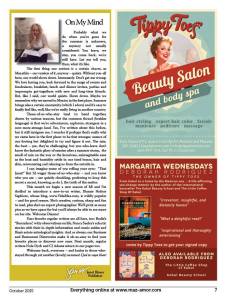
12038127_1008170239214747_3588621137447150322_nWe have loved M! Magazine pretty much since we moved to Mazatlán full-time. It’s a great publication for tourists as well as locals, snowbirds and expats, providing a broad range of stories and insights. I very much respect Janet’s professionalism and editorial skills; she’s an incredibly talented, delightful person who has done so much for our local community, including via the magazine and the Farmers’ Market. Thus, I am proud to announce that I will have a monthly column in M! Magazine. October was my first issue, and my first column—on Mazatlán’s three islands in the bay—made the cover!

12071412_10156054272460548_2034575012_n-1

You can read Janet’s first column of the new season and her introduction to my column here.

12042096_10156054273085548_1343968137_n

Please join us at M!, and be sure to have your friends join us both there and on the blog, to learn what’s new and exciting in and around our gorgeous city.

The Importance of Roots

DSC_0265GreenBay2

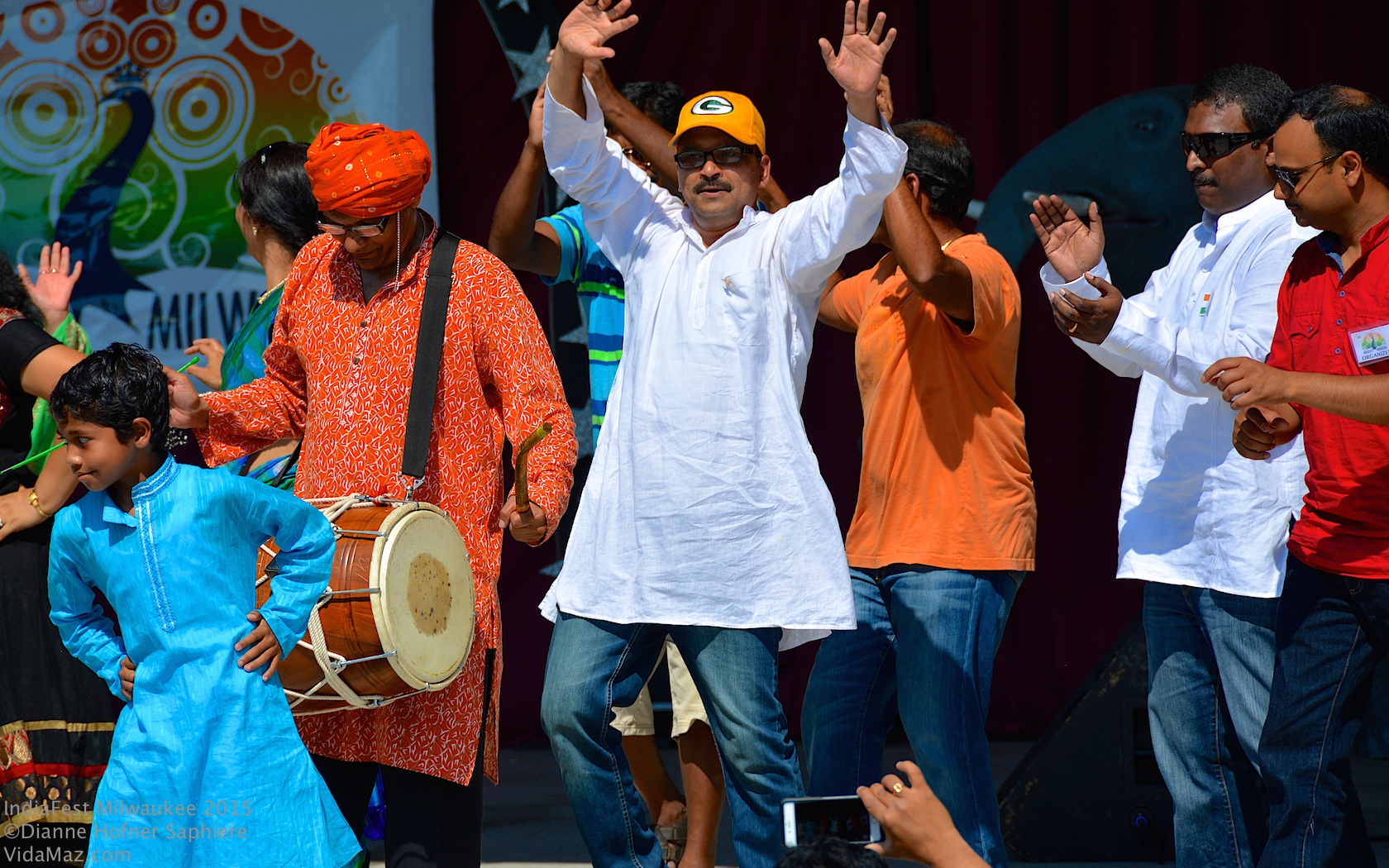
IndiaFest Milwaukee 2015

The life of an expat or immigrant involves integrating oneself and one’s family into a new home, while also maintaining ties to family and heritage. We all need roots to give us strength, help us grow lush and flexible. Thus, each summer, we do our best to return from our home in Mazatlán, México to Wisconsin, USA, where I was raised, to spend time with extended family and strengthen those root connections.

This weekend, we were looking for something to do with our nephew and his son—something that would be enjoyable for three generations of family. We read an ad on the internet that sounded too campy to be believed—in short, right up our alley: Bollywood and classical Indian dance, food, and the election of Mr/Miss/Mrs Wisconsin Indian…” Green Bay Packers and Bollywood dancers? Cheeseheads and rangoli-makers? It sounded like too good a combination to be missed! Click on any photo to enlarge it or view a slide show.

While we went to the third annual IndiaFest Milwaukee expecting to have fun, which we indeed did, the experience was so very much more than I expected. To witness these immigrants and expats maintaining their connections to their heritage, while we were doing the same, was a huge blessing. To watch my nephew dance on stage with a large portion of southeastern Wisconsin’s Indian-American community, to see the joy in my husband’s face as he wore a turban for an hour and spoke with local Sikhs about their experience, and to witness my great-nephew fall in love with chaat after having turned up his nose at it, was a privilege indeed.

I have written before on this blog about the pleasure I get learning how parents pass their traditions on to their children, and IndiaFest is no exception. We saw multigenerational families dressed in traditional garb. We ate our fill of homemade food. And we felt the swell of pride as parents and grandparents watched their youngsters sing and dance to classical and modern Indian songs.

IndiaFest was held on Saturday, August 15th—Indian Independence Day, which in 2015 happens to be the 69th anniversary of the country’s independence from Great Britain in 1947. It was held in Humboldt Park, Milwaukee.

Over 25 million Indians live abroad, according to the Ministry of Overseas Indian Affairs. In contrast, the US State Department says only three to six million US Americans live overseas. My nephew and his family don’t even have passports, and friends and family in the States frequently ask us if we are still US citizens—they are so incredulous anyone born here would willingly choose to live outside the USA. The expertise of the Indian diaspora was evident on Saturday as we experienced the local Indian-American community’s talent at involving those of us who attended the festival in their culture, motivating us to feel joy at their presence in Wisconsin.

Empathy-building was perhaps best created in the innovative yet simple turban-wearing opportunity offered by a few Sikh men who had set up a booth with a dozen or so lengths of cloth. They encouraged festival goers to let them tie a turban on their head, and then wear it for an hour. My great nephew Caleb and husband Greg participated, learning about mesh—the Sikh religious practice in which men do not cut their hair or beards, to show respect for the perfection of God’s creation. They also learned that not all Indians wear turbans, as they saw several Indian men do so for the first time in their lives.

The free blood pressure tests offered by Muslim hospital staff were another subtle empathy builder. When I was a younger interculturalist, I often would mentally poo-poo festivals like this as fun, but as not having enough depth to build real intercultural competence or empathy. However, my family members don’t know much about India or Islam, and like most US Americans are sadly taught via the media and society to distrust those who are different than them. So, to see them talking and joking with, respecting and thanking, Muslim nurses who helped them, was powerful.

My personal favorite activity was the rangoli-making, that gorgeous folk art we see created in courtyards during festivals, using colored sand, flower petals or dyed rice. Rangoli have different names in the different regions of India—kolam, mandana, muggu, alpana, among others. These decorations are welcoming areas for the Hindu gods and are thus thought to bring good luck. At IndiaFest, the rangoli were drawn on tarps with colored sand and white salt.

Saturday was my first opportunity to watch a rangoli created from start to finish. I was fascinated at the three different styles used. Rohini had hers drawn on a piece of paper. First she set down a reddish orange background, and then “painted” over it with white. She was expert at using her hands and fingers to put down fine lines. When she crowned Ganesha in a way she didn’t like, she swept the sand aside with her hand and did it over. She was the first person finished.

Rohini put a swastika in her Ganesha design. I was really proud of Caleb (a high school freshman), because he knew the history of the swastika, its importance in so many Eastern spiritual traditions (Hinduism, Buddhism, Jainism), its auspicious origins, and its appropriation and transformation into evil by the Nazis. A big shout-out for public education in Racine! Far too many westerners have no idea about this.

In contrast to Rohini’s rangoli, there were two women (sorry I failed to get their names) who worked together on theirs. They worked from a very rough, impressionistic sketch on paper, and began by using crayon and yarn like a compass, to draw concentric circles on the tarp. They then shook different colors of sand through a sieve, filling the center circle with blue, and creating a tie-dye effect in the outer circle. Once they filled the two circular areas, they drew designs in white on top of their blue and multi-hued backgrounds. They added in purple and blue circles surrounding all this at the end, and after drawing on it in white they finished their rangoli with various candles. If I were to choose a style of rangoli-making as my own, this would be it: highly spontaneous and emergent.

I was happy to see a man creating rangoli. Unlike the ladies who sketched their designs on paper, Hemendra had his design on his cell phone. He drew the design in crayon on the tarp, and then filled in background color around it. Like the ladies, he used a sieve to apply color, and also used his hands and fingers to draw fine lines of the design. Unlike the others, he used a stick and his fingers to “cut” designs into the colored sand, and he sprinkled colored sand over the top of the design as a final touch on his creation. Hemendra was very methodical, and the last to finish.

All three rangoli turned out beautifully!

No festival is complete without food, and there was plenty of it at IndiaFest! Our family ate non-stop, it seemed, from the time we got there to the time we left. Homemade Indian snacks, main dishes and drinks definitely helped us enjoy the hot afternoon.

Another activity we very much enjoyed was taking our family photo in front of a green screen. The guy charged us $10 and said he’d email us ten photos: our family in front of the Taj Mahal and in various other iconic Indian locations. How absolutely cool is that?! We haven’t yet received those photos, so I can’t share them with you here. There was also a guy selling bubble blowers to the kids, and I tried to get some photos of the bubbles, something that is always challenging. Below I share with you a couple.

We noticed so many commonalties between Indian and Mexican cultures, including the love of: family, joy, color, dance, visual arts, “bling,” makeup, food, music, and singing; respect for tradition and the embracing of modernity; the ease with which cultures, languages and religions are mixed; and the inclusive hospitality.

Words don’t suffice to extend my gratitude to the Indian-American community of southeastern Wisconsin. Thank you so very much for allowing my family this opportunity to feel “at home” in a community I grew up in, that you have helped make richer, more multicultural and inclusive. Thank you for teaching us and sharing with us as a family so generously. Happy Independence Day!

Part of the My Global Life linkup