Cúpido Motorizado/Herbie the Love Bug, Mazatleco Style

cúpido motorizadoThis morning on the way back from church we saw a “love bug.” No, not Herbie, the beetle from the 1960s and 70s Disney movies, but a modern-day love mobile.

Covered with sticky notes from top to bottom, front to back (slide show below), each note covered in kisses and expressions of amor.

The custom of covering a car with sticky notes is common among young adults here in Mazatlán. We usually see it when the car owner is being congratulated for something — a graduation, for example. When we lived in Kansas City, young people would toilet paper one another’s houses to congratulate their friends. Big change from when I was a kid; back then t-p-ing someone’s house was an insult.

I love this sticky note custom. Danny doesn’t. He told me he’d hate to have his car covered like that.

Las Luminarias: Monigotes of Carnavál Mazatlán 2013

After my last post, many of you who are not here in Mazatán have written to ask if I’d post photos of all the monigotes this year. Marilyn Monroe is still not up, and I’m not sure if she will be even though we saw her being made. (UPDATE: Marilyn is now added to the slideshow below).

This slideshow requires JavaScript.

Above you can see these eight-meter/26 foot tall statues, starting from the north at Playa Camarón (La Tongolele) and going in order to the south (Al Jolson), in the Machado.

Behind the Scenes of Carnavál: The Making of a Giant Statue

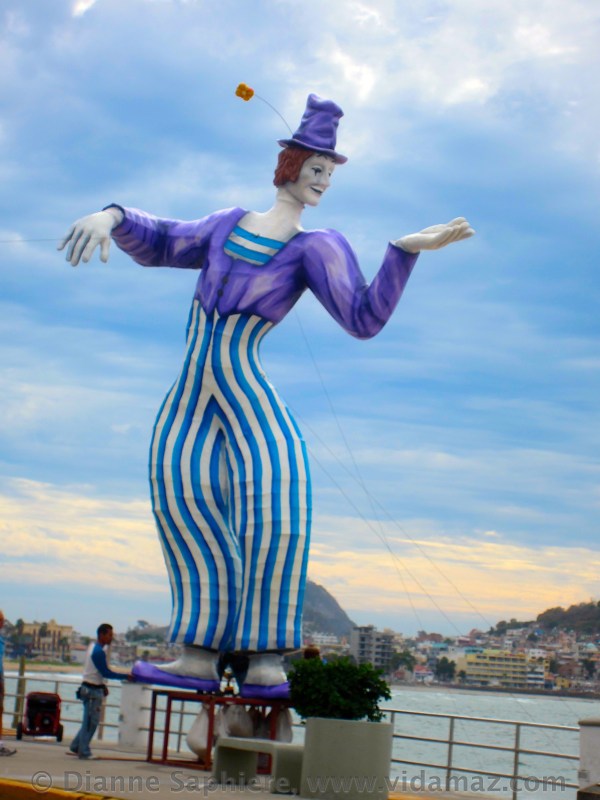
marcel

This year’s Carnavál de Mazatlán statue of Marcel Marceau

Every pata salada loves the monigotes, those super-sized statues that go up along the malecón and in the Plazuela Machado each year in the weeks prior to Carnavál. The tradition began in 2005, with Maestro Jorge González Neri’s replicas of the work of Antonio López Sáenz, Mazatlán’s illustrious painter and sculptor. Last year, for Festival de los Imperios, we had gigantic warriors from major world civilizations protecting our fair city. And we all loved it! Excited to see them go up, rather heartbroken to see them taken down, it is a terrific tradition.

Every year we wonder and guess, what will the monigotes be this year? On Saturday we were driving down Avenida del Mar and happened to see them putting up the first statue: the mime Marcel Marceau. Ah, the excitement! This year, with the theme of La Linterna Mágica, we are privileged to enjoy eight-meter tall likenesses of international film stars — Las Luminarias de Neri.

Neri

Maestro Jorge González Neri in his taller

Marlon Brando, my beloved comic actor Cantinflas, the pachuco Tin Tan, actor and luchador El SantoPedro Infante, and Al Jolson were erected over the last few days. Marlene Dietrich went up this morning at Playa Norte. Just this afternoon we watched them put Charlie Chaplin up in front of our home. Oh, the thrill! The rumbera from the Golden Age of Mexican cinema, La Tongolele (Yolanda Montez), went up late this afternoon. We watched it leave the taller after final painting and varnishing. Towards the end of the week the final monigote, of Marilyn Monroe, should make her appearance. We watched her head being carved today (see video and slideshows below), and her body being welded. Maestro Jorge González Neri himself told me that, yes, her skirt will be flying up in that iconic pose of hers.

So, how do you make one of those giant statues for Carnavál de Mazatlán? Well, the Maestro is a set designer who creates pieces for the stage as well as for public events. He is based in Monterrey, so there is a lot of sending of drawings and designs back and forth, between Monterrey and CULTURA here in Mazatlán, as they agree on what the monigotes will look like each year. It sounded to me like Neri himself is a bit astounded at how large they’ve become — the bar higher every year.

Once designs are agreed on, the staff of his taller begin working. Finished parts and parts in process are shipped to Mazatlán. A month or so prior to Carnavál, the Maestro travels here with a crew of 15 of his people from Monterrey. They hire papier maché people here locally, people who have now been doing this for years.

And, in an incredible open-air artistic assembly line, they create magic!

STEP ONE: WELD THE METAL FORM

This slideshow requires JavaScript.

STEP TWO: COVER THE FORM WITH FABRIC/MANTA

This slideshow requires JavaScript.

STEP THREE: COVER THAT WITH PAPER

This slideshow requires JavaScript.

STEP FOUR: CARVE THE HANDS AND FEET OUT OF STYROFOAM AND ATTACH TO THE BODY

This slideshow requires JavaScript.

Below is a very short video clip of one of the artists carving Marilyn’s face:

STEP FIVE: PAINT THE MONIGOTE & SEAL IT WITH VARNISH

This slideshow requires JavaScript.

Below is a very short  clip of the artists lowering La Tongolele (from vertical to horizontal) so they can paint her shoulders:

STEP SIX: WRESTLE THE STATUE ONTO A TRUCK. TAKE A CRANE, FIGHT THE OCEAN WINDS, AND PUT THE MONIGOTE ON DISPLAY

This slideshow requires JavaScript.

Below is footage of the workers loading the huge statue onto the truck for transport.

Below is a clip of the crane workers installing Charlie Chaplin in front of our building. They stake the monigote to the beach, and counterbalance the stand with sandbags.

As you can see, it’s a bit like making a piñata, or one of the papier maché projects we all did as children. But, not really. It’s nothing like that! What an incredible dream to make magic in this way, don’t you think?

Click here for a slideshow of all the 2013 Carnavál de Mazatlán statues. Thank you, Maestro and crew, as well as CULTURA and all involved! This year’s “Luminarias” rock!

Are you curious to learn more? A couple of years ago we visited Maestro Rigo Lewis in his taller, as he and his crews worked on the parade floats or carrozas for Carnavál royalty. He was born during Carnavál and the event and its magic run in his veins. Need a schedule of events? It’s posted on CULTURA’s Carnavál site. The inside scoop of what to attend and how it all works? Check that out here.

Oyster Divers in Mazatlán/Los Ostioneros

VictorToday we had breakfast with Victor. He is an oyster diver here in Mazatlán, and has been for 33 years. His brother, Javier, has been diving for oysters for 28 years. Their father before them was an oyster diver for 52 years.

There were 12 divers late this morning on Playa Camarón, just off Valentino’s/Fiesta Land, and they were all family: brothers, uncles, nephews, cousins.

Victor told us there are at least ten locations or oyster reefs around town that are good for diving. He told us they start work about 8 or 8:30 each day, diving till 10:30 or 11. Each diver makes what he makes; they are not a cooperative. A normal haul — one fill of the net in one of their inner tubes — is about 50 kg. They pack the oysters into green mesh bags that weigh about 23 kg each. Those bags wholesale for about 400 pesos locally.

For our breakfast we were charged 30 pesos (about US$2) for five oysters shucked fresh from the water as we watched. Fresh limes and bottled salsa were available, as well as plastic stools on which to sit while we ate.

Victor explained to us that they throw the shucked oyster shells back into the ocean in order to increase the harvest: that the shells have larvae on them, and they will replant and grow. He also told us about how they have a forced holiday every summer, when the veda is in place — when it’s illegal to dive for oysters. That’s why September is so often called “Septi-hambre,” the hungry month, because it comes after they’ve had three months of no oyster income.

I asked Victor how long he stays under water when he dives. He said if the water is about three meters deep, they stay down about 40 seconds, hammering on the rock to get the oysters loose. If it’s deeper water, they may stay down as few as 20 seconds at a time. Based on my observations, I’d say he underestimates.

He told us that sometimes tourists like to come out diving with them. They bring underwater cameras, and ask the guys to teach them how to oyster. He thinks it’s cool that they want to take home with them such a souvenir: a new skill, a new experience.

Below is a slideshow with a few more photos. ¡Gracias, Victor y familia!

This slideshow requires JavaScript.

UNBELIEVABLE Bird Watching in Singayta

1.DSC_0826 - Version 3

After Christmas this year we decided to head south of Mazatlán a few hours by car, to check out an area we had yet to visit — the small coastal towns of Nayarit, south of Teacapán and north of Puerto Vallarta.

SLIDESHOW OF SOME OF MY FAVORITE PHOTOS FROM OUR MORNING TOUR:

This slideshow requires JavaScript.

One of the highlights of the trip was a tour by lancha or small boat to Singayta, a bird sanctuary that is home to over 350 species. We were told that 80% of the migratory birds of the Pacific coast visit this area. We are spoiled by the daily opportunity to see loads of water birds right here in Mazatlán, so we wondered whether it would be worth waking up at 6:30 in the morning on our holiday. It was.

SLIDESHOW OF ROSEATE SPOONBILLS:

This slideshow requires JavaScript.

Our guide told us that the roseate spoonbills were nesting, and that we would have opportunity to see their nests and their babies. That’s what convinced us to take the trip. And we did see many, many roseate spoonbills.

SLIDESHOW OF PARENTS FEEDING THEIR YOUNG:

This slideshow requires JavaScript.

We especially enjoyed watching those spoonbills feed their young (slideshow above). The babies were larger than we expected, already a couple of months old, though many of them hadn’t yet gotten their pink color. Our guide said the height of the spoonbill nesting season is October through December.

SLIDESHOW OF VARIOUS BIRDS WE SAW:

This slideshow requires JavaScript.

As we boated up the river we saw so many birds of so many types. Our guide told us what all of them were, but I am no birder and it was hard to keep track. We saw eagles, storks, cranes, ibises, herons, nightjars, rails, egrets, cormorants, northern potoos and Jesus birds, among many others.

SLIDESHOW OF SOME EAGLES:

This slideshow requires JavaScript.

Our guide was keen to make sure we saw the variety of eagles that we encountered. I suppose it was much easier for us to notice the larger birds, so was glad he pointed out so much.

SLIDESHOW OF THE GORGEOUS SCENERY:

This slideshow requires JavaScript.

The area is gorgeous — full of mangrove swamps, estuaries, rivers and other wetlands, along the lines of Agua Verde or Teacapán, much as Mazatlán used to be. We saw a great variety of trees, flowers, lilies and other plant life.

SLIDESHOW OF THE FLOCKS OF BIRDS ON THE ISLANDS:

This slideshow requires JavaScript.

As we approached the actual bird sanctuary, we were amazed at what we saw in the distance. Floating islands of green that were COMPLETELY FILLED with large nests and more birds than I’ve ever seen in my life! We felt like we were in a Hitchcock movie! I can also assure you that the smell won’t be bottled for perfume anytime soon! As we approached the nesting area our guide cut the motor and paddled us closer.

SLIDESHOW OF THE NESTS:

This slideshow requires JavaScript.

In the slideshow above you can see some of the mature birds as well as their young, and you can get an idea just how many nests each little floating island contained. What a pleasure! Many of the parents were busy feeding their kids, as you can see, and many of the young birds are a different color than their parents (I assume they grow into their colors).

SLIDESHOW OF SOME CAYMAN:

This slideshow requires JavaScript.

We also saw a lot of turtles and cayman. Many of the cayman were out sunning, and several of them seemed to want to pose for my camera.

Singayta is a 90 minute boat ride north of San Blas, Nayarit. San Blas is three and a half hours south of Mazatlán, just this side of Tepic on the coast. We took the lancha that leaves from the far side of the river from San Blas — over the bridge from town. The boat and driver/guide cost us 700 pesos, and we could have taken eight passengers for that price. Our guide was very knowledgable about the birds as well as the flora and fauna of the area, as well as very attentive to our needs and desires. The area can alternatively be reached overland via driving and hiking.

We definitely encourage you to make the trip! Not a far drive at all from Mazatlán, and this would make for a terrific overnight or weekend.