Talk with State Secretary of Tourism, 18 Feb 2011

Since I do not run a business here in Mazatlán, I don’t get out and around to many business or chamber-type meetings. Yet, I am a business person, and this is my community. So occasionally, when I do get a chance to attend such a meeting, I tend to get really jazzed. Such was the case last November with the Sergio Fajardo event that I blogged about, and such was the case last Friday when I had breakfast with Oralia Rice Rodríguez, our Sinaloa State Secretary of Tourism, along with about 65 local business leaders.

It is wonderful to get a glimpse into how business and politics are conducted here. I learn a lot about conversational and discussion styles, meet some cool local movers and shakers, and improve my Spanish. And, at least this week, I got a heads-up on some major news prior to it being released publicly (at least, I hadn’t yet heard about it!). Thank you to all who attended and were gracious enough to help me feel welcome!

Please know that any errors in my reporting below are due to inadequate notes or my lack of comprehension. I continue learning about my new home and its people. I post to this blog with the intent to share information in English, not as an expert, but as a resident. I welcome your (helpful  :)) corrections.

So, what happened that was of interest? The big stuff has since the meeting been reported in the press:

  1. Our beloved Las Labradas archeological zone (petroglyphs) will be named a UNESCO World Heritage site. WONDERFUL to hear about that in a venue such as this! I was amazed there was not an outpouring of enthusiasm when Secretary Rice said it; perhaps the others present already knew? The official naming will take place next November.
  2. They are trying to organize a major concert to commemorate the above event, and have invited Andrea Bocelli. This, again, was terrific news, and came out in response to a comment from one of the participants, who suggested that Mazatlán should start hosting world-class, big-name stars on a more regular basis, to resurrect our “golden age.”

In addition to the big news, a couple of trivia pieces that I found of interest: Sec. Rice told us that “Escuinapa” means “Queen of Love” in the Chametla language, and “Teacapán” means “Where love grows.” I did not know Chametla was a language. I googled both of these, but I couldn’t find the details; eager to hear my readers’ insights!

Humberto Rice kicked off the morning by introducing his sister, and then Oralia talked for 15 minutes or so. She seemed to know the majority of the people in the room, and appeared to be very comfortable speaking informally and conversationally to us. She told us:

  • Despite the travails our port and state have been through the past couple of years, hotel room occupancy is actually up about 4%.
  • Mazatlán is in sixth place in Mexico as a tourist destination.
  • The story about the cruise ship tourist who reported her purse stolen, and the homeless man who returned it to the port when he found it sitting beside a bench in the plaza (ALL its contents including ID papers, credit cards and cash intact). We do have terrific people who live in this town! (She did not mention the collection our local foreign residents took up to help and thank the homeless man.)
  • This administration wants a very inclusive and open government; that the shield of Sinaloa belongs “to everyone.”
  • When Malova called her and asked her to be Secretary of Tourism, she asked him why. He told her, “because I want to make Sinaloa the best place in which to live.”
  • She has an open office and any of us are welcome to come to visit her without an appointment. Very surprising to me, she even gave out her cell phone number!
  • At some length about the damage that has been done to our local economy by the US travel warning issued last year that includes Sinaloa and Mazatlán. She said Governor Malova has met with the US State Department, and many state officials have had meetings at the US Embassy in Mexico City, to push for the repeal of this bulletin.
  • She would like to hear how we would like Sinaloa to be six years from now, when the governor finishes his term. That they would like the public and private sectors to work together, to be congruent. That they have or can find the resources, but what they desire are proposals from the local community about how to develop our city going forward.
  • That we have a whole lot of room for development, saying there are 44,000 hotel rooms in Cancún and only 10,000 in Mazatlán, and that she’d be meeting that afternoon at 4:00 to discuss the strategic plan.
  • About the big project in the Historic Center, a pedestrian street along Constitución leading from the cruise ship dock to the Plazuela Machado, into which 6 million pesos will be invested this year.
  • She shared a vision for Mazatlán: To make our Pearl of the Pacific the number one destination for beach and culture in Mexico. I heard several people in the audience murmur that it already is.
  • She encouraged investment into textile plants, including tablecloths and uniforms. Maybe my Spanish comprehension fell apart here, but I wasn’t quite sure how this point fit into the overall theme.
  • The affluence of Sinaloa had risen 8.8% over prior year, despite the economic crisis, and that the numbers of tourists in various categories (cruise ship, national, international) were up 20-30%. This data sure hit me by surprise; I will say that living here, I do not feel an increase in tourism or affluence around me.
  • That TV Azteca would be broadcasting the Carnavál de Mazatlán events live, and that some local hotels are already reporting 100% booking for that period.
  • She shared another vision for Mazatlán: To make our city the “Barcelona of Mexico” and the Angela Peralta “La Scala of Mexico.”
  • Though there was a lot of talk about cruise ships, she also twice to my memory mentioned the importance (very happily to me) of ecologically sound development, and mentioned the upcoming (April 7-10) Congreso de Turismo de Naturaleza (Sustainable Nature Tourism Symposium).
After Secretary Rice finished speaking, the floor was opened to proposals and recommendations, with a format in which three people would each speak, Secretary Rice would respond, and then there would be another two rounds of three in the same manner. We ran out of time before getting to round 3, so only six proposals were offered. They were:
  1. Every tourist destination seems to have a lifecycle. We in Mazatlán do not want to be like Acapulco. We had a golden age, when the world’s best entertainers came here on vacation (rather than Hawaii, Cancun or Arruba). We need to do a big event, invite someone like Placido Domingo, to put us back on the world stage. We should also do surveys of the tourists in the airport.
  2. We need to clean our city: the roads from the airport into town, the malecón, which in the morning smells like a bathroom. This will benefit everyone, visitors and residents. Let’s not take the tourists around the dirty parts, avoiding them; let’s clean them up.
  3. Leticia Alvarado from Recrea read a proposal that was by far my sentimental favorite. She said that tourists come back to visit places where they meet people and can share emotional connections with them. She said we need to work to integrate locals and visitors, by filling our parks, our plazas and our public spaces with life, by cleaning them up, making them beautiful, and holding regular public events (VERY congruent with what Sergio Fajardo told us). She told us about a program in Culiacán where they have walking tours of the city at night, designed to increase safety/decrease fear. She said we need to make people proud to play futbol at the fields in Urías.
  4. There was a question about what COPARMEX can do to support tourist development. Apparently there has been talk for quite some time about making a Tourism Commission within the group, and that will finally be happening soon.
  5. Munir Aún said that we should not limit our dreams, that we should aim high. He suggested we move parallel with FONATUR’s plan for a Teacapan-Stone Island-Mazatlán corridor. It is obviously of utmost importance for Mazatlán to be an integral part of that corridor.
  6. The final question was asked by a developer who said that cruise ship passengers are in town for only a few hours, but part-time residents, whether national or international, spend on average 15 thousand pesos per month that they are in town, and most of them come on average for four months. He encouraged the Secretary to be sure to include this type of tourist in her planning.
Secretary Rice concluded the approximately two-hour meeting by asking those business leaders in the room, “Are we ready for the highway from Durango to open?” She talked about what an incredible opportunity the highway will open for Mazatlán, how much work it’s been. If people come and are disappointed, they won’t come back. We need to be ready, to capitalize on the opportunity. She talked about a “pueblo digno,” a proud city of Mazatlecans who love our heritage and our port. She reminded us that as seafarers and mariners we know how to survive a storm. And, again, she urged everyone to submit their ideas and proposals to the Secretary of Tourism; if they don’t have the resources, they will work with the other departments to get them.

In conclusion, I was left with several things in my mind. So hear goes my personal opinion:
  1. Couldn’t we put together an online “sign this petition,” asking for people’s support to have Mazatlán removed from the US State Department’s travel advisory? I receive several such online petitions every week; they can’t be that hard to do, right? And it couldn’t hurt?
  2. I realize the cruise ships are big money. They are said to build tourism because cruise ship visitors come back for longer stays later. And, we all know how ecologically unsound these ships are. I also very much worry about the impact they have on a local community. During certain hours of the day certain places are crowded and overloaded, while others remain empty. It’s a dynamic that does not seem to me either sustainable or sound for a community. But, yes, the money and exposure are good; many local families survive on that business. So, I would LOVE to see that the Secretary of Tourism keeps the cruise ship business in perspective. I invite her to look at the two vision statements she shared with us on Friday: Mazatlán as THE beach AND culture destination of Mexico, the Barcelona of our country, with El Teatro Angela Peralta being La Scala of the new world. We can all support these visions. Overly focusing on cruise ship tourism could very easily sidetrack us away from that vision, rather than helping to fund and maintain it.
  3. Mazatlán and its environs are absolutely gorgeous. Yet, when I look at photos from decades ago, I realize how much of that beauty we have lost. The gorgeous estuaries along the coast that we used to have! The mangrove forests! The clear blue skies! Any sustainable tourism development plan, it seems to me, MUST include a plan for preserving our natural environment. Ecologically sound development must guide us. The scrubbers on the power plants will be a good start, but we need to convert our buses for clean-air energy. Neither tourists nor locals want to wake up to black clouds of inverted air pollution! There are grants available internationally for this sort of thing. Let’s go, Mazatlán! We can clean and beautify our environment while we create a better style of life for our people! Cleaner air (and water) means healthier people and fewer medical bills.
  4. I’d like to echo what Leticia Alvarado Fuentes said. By bringing life to our public spaces, and encouraging year-round cultural activities, we will overcome violence, build community, and attract tourism. Year-round cultural activities, for everyone. Let us not get stuck in an us vs them, tourist vs local, mindset of hosting cultural activities in the tourist season with nothing for the locals the rest of the year. Mazatlán has an incredibly rich cultural life, and showing it off all year long can do nothing but extend our tourist season!

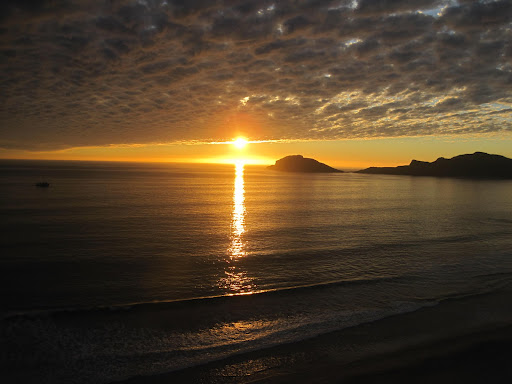
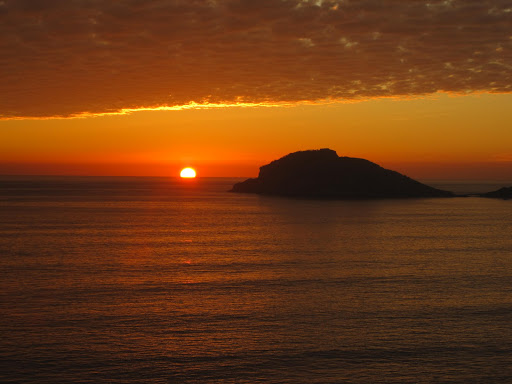
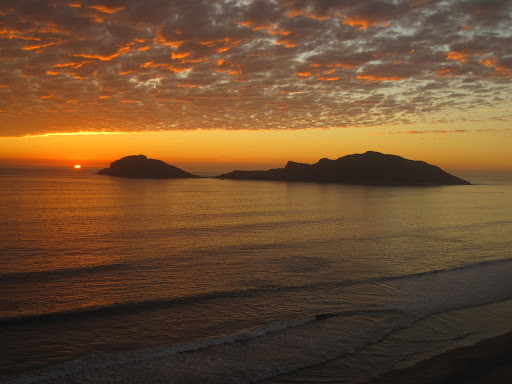
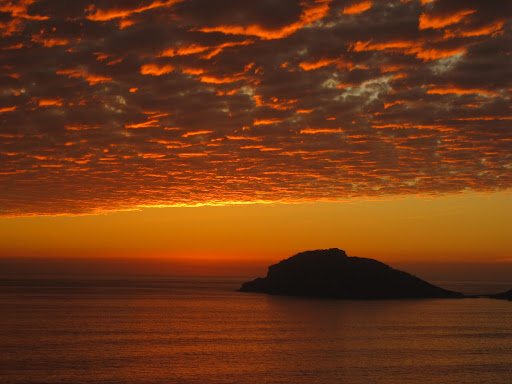
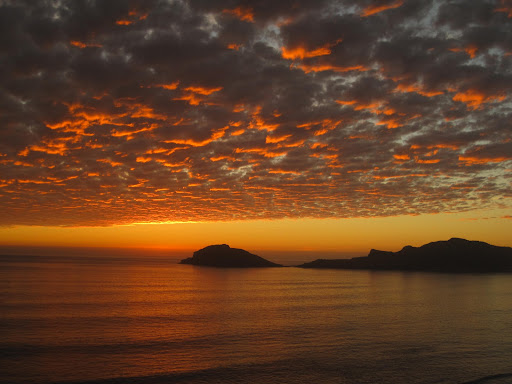
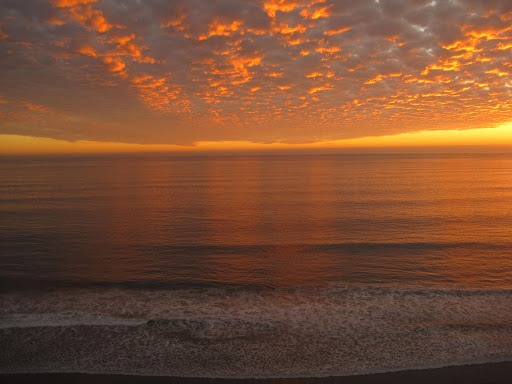
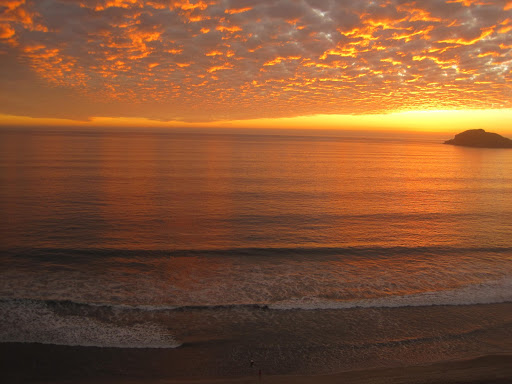
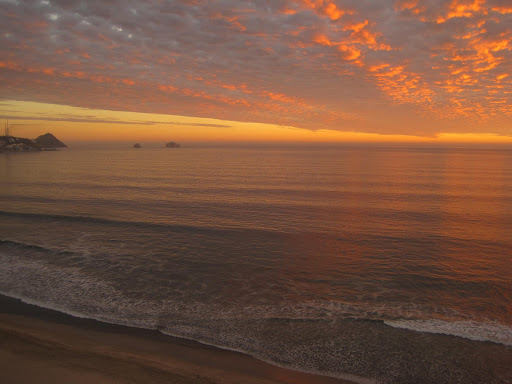
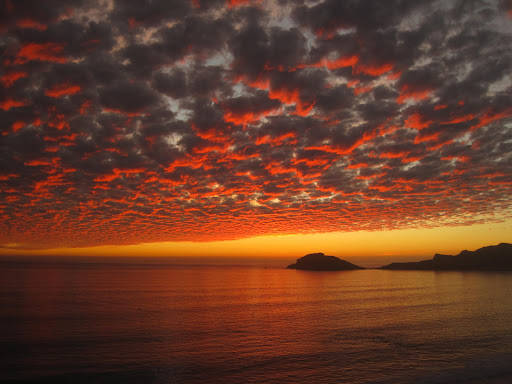
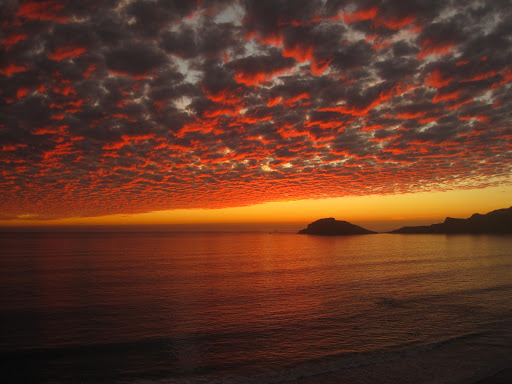
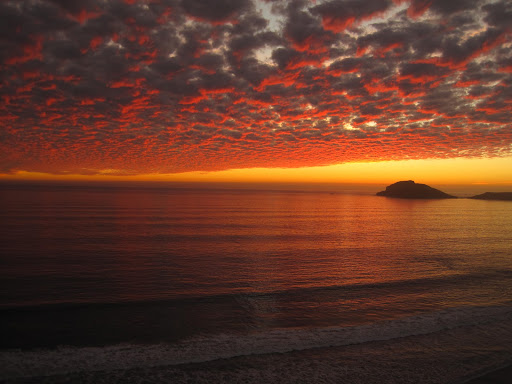
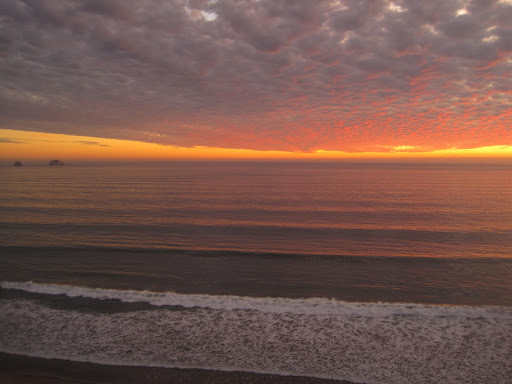
Sky on Fire – Time Lapse


29 January 2011, photos taken from our terrace

5:42:12 pm
5:42:43 pm
5:43:39 pm (note the yate fiesta/party boat)
5:44:05 pm (note the yate fiesta/party boat)
5:51:38 pm
5:53:32 pm (clouds moving quickly though there is no wind)
5:54:21 pm
5:54:51 pm
5:55:34 pm (almost set)
5:55:52 pm
5:56:07 pm
5:56:26 pm
5:56:40 pm (and set)
5:56:52 pm
5:57:45 pm
5:57:54 pm
5:58:22 pm
5:58:42 pm
5:59:40 pm (we feel the best is usually after the sunset…)
6:00:42 pm
6:02:18 pm
6:02:30 pm

6:02:48 pm

6:03:47 pm
6:04:01 pm
6:04:14 pm
6:05:06 pm


Los 2 Tesoros de Mazatlán/Pirate Treasures of Mazatlán


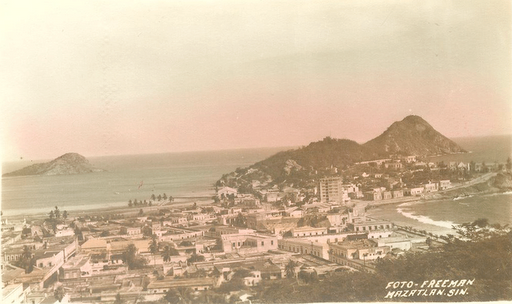
Greg has collected a lot of vintage photos, postcards, pamphlets and magazines of our adopted home. Today our friend Jorge happened to see one of the postcards, an aerial shot of El Centro when Playa Sur was still all beach, before land was reclaimed from the sea and houses built, and before Isla de Chivos was chopped off and its rock used to build the sea wall (is that what it’s called?) to protect the ship channel.

Well, he got to telling stories about his youth, which are always fun. About how Mazatlán used to be, when the area along the malecón in which we live was nothing but open space. He told a couple of stories that I had never heard before. Many of you may be familiar with them, so perhaps you can point me to a source to learn more?

The first was about the old cinema/theater downtown, where Parisina now stands. Evidently that building was roofless for years, abandoned and downtrodden. When they decided to rebuild it, to raise the building that is now the fabric store, the backhoe workers found buried treasure! According to Jorge, there was a huge pirate’s chest full of coins and jewelry. The workers started fighting amongst each other for the spoils, the police were called, the treasure chest and its bounty confiscated, apparently never to be seen again.

Which led him to a second story, about when they built the sea wall or entry to the shipping channel/port where the cruise ships now come in (or don’t, as the case may be). They evidently chopped off Isla de Chivos in two places, on the ocean side and on the inland side, to have rock to use for the sea wall. Jorge told us that the bulldozer was found still running, key in the ignition, with a few antique coins scattered around. Legend or story has it that the bulldozer driver found buried pirate treasure, and learning from the bad fortune of the Parisina workers, grabbed it and took off with it, never to be seen again.

Jorge tells us that there is still supposedly buried pirate treasure on the lighthouse rock, a story we have heard before. He also told us about the tunnels connecting so many of the houses and buildings downtown, including the cathedral. We know about those, and have seen a few. Cueva del Diablo, a tourist attraction along the malecón, supposedly went under the ocean and connected up with those tunnels. When several people went in and never came out, Jorge says the tunnel there was closed up.

Finally, Jorge told us about a now-deceased treasure hunter and historian, a man who hunted for pirate treasure and was a well-known historian here in town. He owned a business and had an antique chest on display that he’d found. He can’t remember the man’s name. Can you? Maybe that man wrote a book or some essays? Sure would be interesting reading!


Street Vendors

Part of what we love living here in Mazatlán is that you can buy almost anything you need so conveniently. “Ambulatory” street vendors walk, push carts, ride bicycles (many of them modified to carry their wares) or motorcyles around town, selling their wares. There are also many open-air stalls that make eating healthy (or not) quite convenient.

This blog post is just a collection of a few street vendors photos. Enjoy!

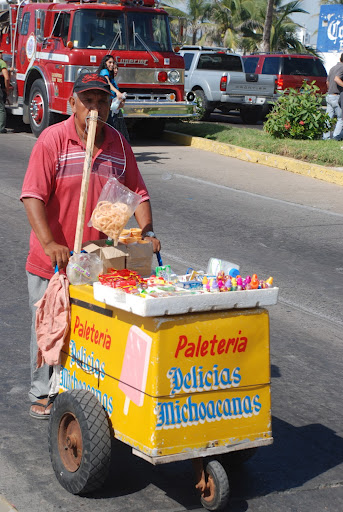
Ice cream vendor on Avenida del Mar

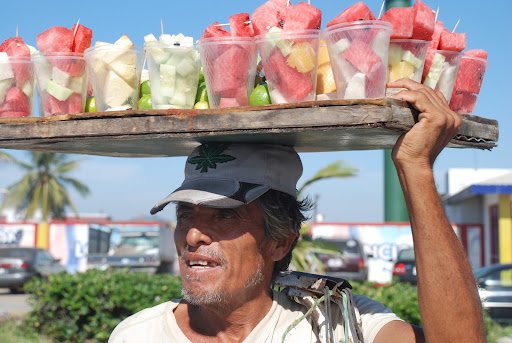
Our favorite fruit seller, who works our beach

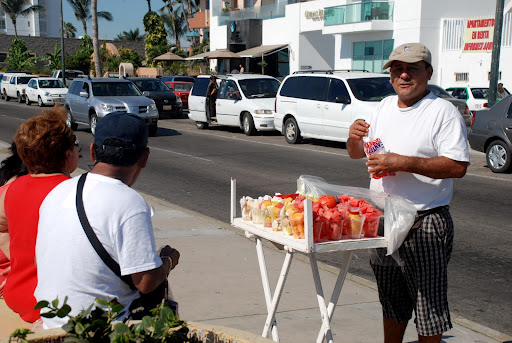
And one of his competitors

Gelatinas, or jello molds

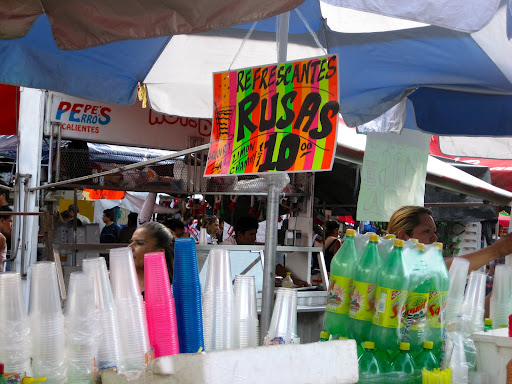
Various refreshing drinks, this photo taken in Guadalajara

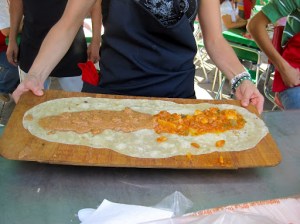
Giant burrito seller, again in Guadalajara

Vegetable seller: Nice to be able to buy healthy street food!

Another kind of fruit seller, not the ambulatory kind 🙂

Flower and plant vendor

Ceviche (fresh fish or shrimp with lime juice and some vegies) and Tostilocos (pack of tortilla chips covered with salsa and sometimes beans or cheese or meat)

Sugar cane and cane juice vendor, in a market


Broom and mop vendor


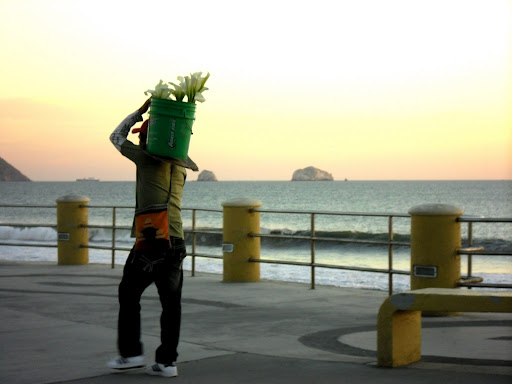
My favorite calla lily seller, at sunset on the malecón in front of our house

And this beach vendor came up to our house to measure my laptop and make me a custom-fitted computer bag out of beach trash (chip, candy and cookie wrappers)

Foro Empresarial COPARMEX Mazatlán, 26 Nov 2010 No. 2


In the first post of this seriesI told you about my excitement to meet and hear Dr. Sergio Fajardo Valderrama, former mayor of Medellín, Colombia. His talk inspired me, gave me hope, and taught me a few things. So what did I learn?1.  Some concrete ideas for dealing with violence in our society and,
2.  A model for how to lead change efforts by communicating clearly, simply, powerfully, and from the heart.

Any errors in this blog post are either due to faulty note taking or poor hearing, and are, thus, my own. Likewise, I am confident the speaker was far more eloquent and persuasive than my accounting of the speech will be.


THE PROBLEMS

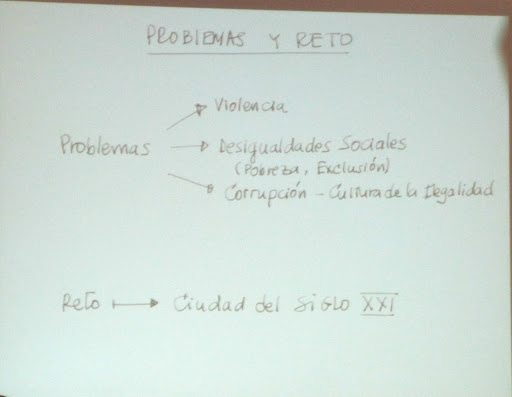
One of the first of Dr. Fajardo’s powerful, clear and simple hand-drawn PowerPoint slides was a summary of the problems:

1.  Violence,
2.  Social inequities (poverty, exclusion), and
3.  Corruption (a “culture of illegality”).

He reminded us of the saying frequently attributed to Machiavelli, that “the ends justify the means.” He made the point very strongly that for him it is just the opposite: the form, the means, achieve the ends. He explained that we couldn’t achieve good results using less than good means. We must be clear: there are no good drug dealers. When money is raised through illicit means, it is rooted in death and destruction; it cannot have a good outcome.


TRANSPARENCY AND TRUST
He urged the 14 mayor-elects and the governor-elect who were present that to combat violence and bring dignity to society government must have transparency. Dr. Fajardo explained that he grew up in Medellín. He is a math professor who would sit around with his professor friends and complain about politicians. After so much complaining he decided the responsible thing to do was to roll up his sleeves and do something about his beloved city’s problems. But he’s a math professor, what did he know about politics? Dr. Fajardo explained that one thing he feels they did right is they did not buy any votes. They gained political capital by going out and talking with the people, listening to them, gaining their trust. Voter turnout the year they were elected was the highest it has ever been.

When they took office people of course came to them, asking for positions, for favorable contracts, as people are used to doing. They refused. They wanted transparency. They were not elected in exchange for favors or gifts, and they were not about to extend favors now. Business would be conducted transparently, on the basis of merit not connection.

The people in the community developed trust in their elected leadership, because of this transparency, because of their accessibility. He explained that there was incredible value, immeasurable social capital, in trust. “Even WalMart doesn’t sell trust,” Dr. Fajardo joked.

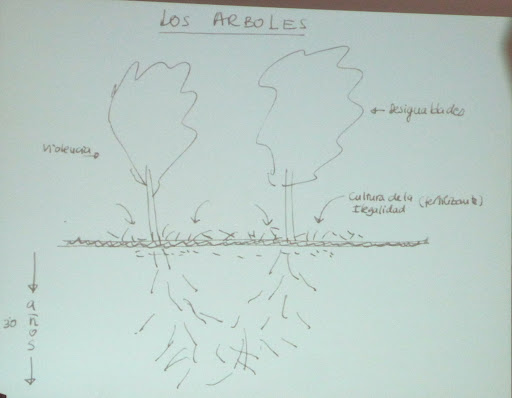
Dr. Fajardo shared another slide with us that addressed the problem using metaphor.
There are two trees: one tree represents violence, the other social inequity. The trees grow in well-fertilized soil: in a culture of illegality. The two trees have been growing close together, in such fertile soil, for so many years that their roots are completely intertwined. It is hard to distinguish, from the roots, where one tree begins and the other ends; they grow almost as if they were one tree.

The trees are tall and strong, and very deeply rooted. Even with all of society pulling together in unison—something very difficult to accomplish—we wouldn’t be able to uproot both trees in one feel swoop. Thus, the intelligent way to proceed would be step-by-step, one step at a time. But how? What would the first step be?

STEP BY STEP/POCO A POCO

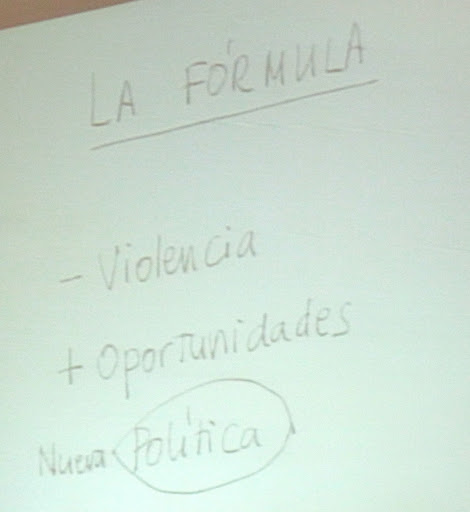
Here Dr. Fajardo relied on his mathematician background: he gave us an equation. Lowering violence and creating opportunities will bring about a new politics, a new way of life. He repeatedly cautioned that change would not happen overnight, that there would be major setbacks and backlashes along the way. But, step-by-step, we could reverse the downward spiral and begin rebuilding our societies.

In the case of Medellín, reclaiming community has taken twenty years, and it is still a daily, continuing battle. For me this was so important to hear. It is hope tempered with realism. It is not the untethered hope presented by President Obama’s campaign, but the hope we so desperately crave, anchored in the reality that the road to get where we want to go will be long and difficult.

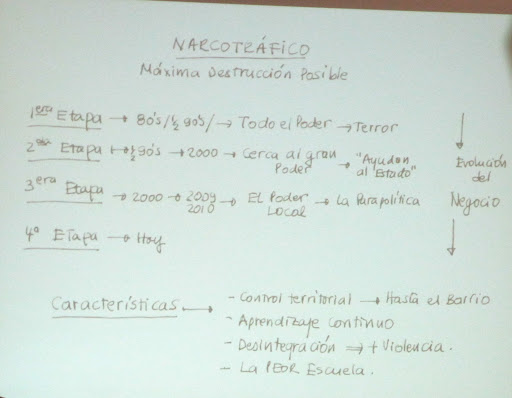
Dr. Fajardo used this slide to illustrate how one powerful man (his name was never spoken, sort of like Voldemort ☺ ) had complete control, terrorizing the people, in the 80s and the first half of the 90s. There was control of territory “hasta el barrio.” There was continuous apprenticing and tutoring of new drug dealers, a clear “management development” plan, if you will. By the latter half of the 90s, though a criminal, this man was very near power; he was “helping the state.” He wanted to be president. But from 2000 through 2009/10 the tide turned toward local power, toward participatory politics. And, today, while there remains much progress to be made, people go out in the streets again.

One of the many beauties of Dr. Fajardo’s presentation was how frequently he returned to the main point. He reminded us that there are no favorable consequences to drug trafficking. He reminded us that it is a culture that can take over; that here in Sinaloa we even have narco corridos. The narco culture is such that a common saying is “I’d rather live one day rich than a long life poor.” They live by different rules, different guiding principles. (Those of you interested in this culture may be interested to read a former blog post I wrote on Jesús Malverde, “patron saint” of narco traffickers).

TO SOLVE A PROBLEM WE MUST UNDERSTAND THE PROBLEM
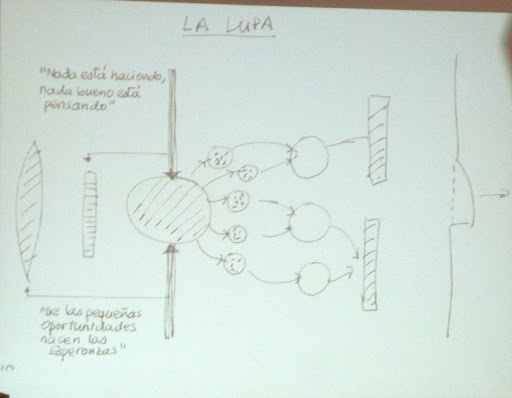
Here we were treated to another powerful slide. Such simple drawings; they created confidence that these are problems that indeed can be analyzed, can be dealt with, step by step.

The core problems are that there is a corridor, a culture, of delinquency and violence. And that corridor has two doors: an entrance and an exit. Why do people enter the corridor of delinquency and violence, and how do they exit it? If we can understand those doors and how they work, we can close the entrance and open wide the exit! Ah, so simple! So hopeful!

And what are the stages people go through once they enter the door to that corridor? According to Dr. Fajardo, it often starts with a young person thinking, “There’s nothing happening/nothing to do.”

The person then enters the door to the illegal life (the circle in the center of the drawing), by joining his friends, or the people he aspires to be (who seem to have some money, some friends, who seem to be cool), who hang out on the street corner. The young person progresses in the life until he hits a wall. That is the “are you with us or against us” wall.

According to Dr. Fajardo, the key to the process is that first door. There is a need to close that door! And how do we close that door? By opening others, by providing things for the young person to do, people for the young person to hang out with. As opportunities increase, the door to the illegal life closes, little by little.

THE SOLUTION

In Medellín their slogan became “Medellín: The Most Educated.” Their strategy to strengthen the community and its people was five-fold:

1. Politics: to create trust via transparency and participation.
2. Social urbanism: integrated urban projects, where people could go to enjoy time together.
3. Youth: Youth of the Future, adolescent pregnancy prevention, cultural networks.
4. Knowledge: education, science and technology.
5. Innovation and stimulation of culture.

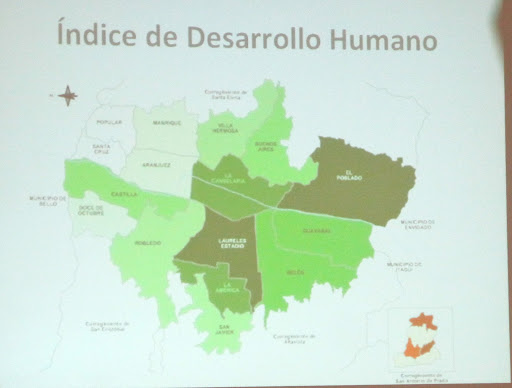
They began their efforts by getting out a map of Medellín, and looking at where the needs were highest. They strove to understand what was happening on every street corner, to know which communities were at highest risk, had the poorest living conditions. These maps show the city of Medellin, and the red arrows show where they built major “social urbanism” projects.
In 1991 Medellín was the world’s most violent city; there were 381 homicides per 100,000 people. By 2007 they had decreased that number to 26 per 100,000 people. That progress didn’t happen overnight. It happened little by little, by chipping away at the culture of illegality and persevering, via honesty and transparency. Not one peso to pay off anyone. Their strategy was to be very clear about what they represented, to be proud of the people whom they represented. They strove to close the door to the illegal life by partnering with people who did not have the power, to hear their needs and meet them. To put the best of Medellín in the worst areas of Medellín. A key message was Lo más bello para los mas humildes, “the most beautiful for the most humble/poor.”

People wanted more police, more fences. They were afraid to go out; they locked themselves in and stayed at home out of fear. No! The answer had to be to create safe public spaces, to motivate people to meet each other and enjoy one another’s company. There were no handouts; people in the poor areas could not stand around waiting with their hands out. They had to pitch in, to participate, to form, create and manage those public spaces.

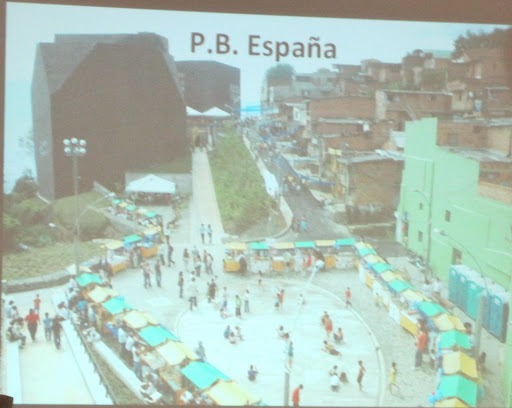
Dr. Fajardo showed us photos of quite a few Parques Biblioteca or “Library Parks,” that were built during his term as mayor. In each case, people in the local community played a key role. They were built in the poorest barrios of the city. They included play areas, learning areas, areas for creative and social development, where kids could learn about nutrition and health. Always they were designed with the finest architectural elements, so they could be the pride of the community.

We also saw photos of Colegios de Calidad, or public “Schools of Excellence.” These became places where the poorest girl in the city could go to a school as beautiful as, or even more beautiful than, the richest private school in town. In this way children and parents could feel hope, could start to feel like doors were open, that they had options for social mobility.

They built CEDEZOS, or centers for new/small/micro business development, as part of their strategy. Again, people asked them to hire them, to give their children or wives jobs. “This sort of thing happens in Colombia, but I’m sure it doesn’t in Mexico, right?” Fajardo wryly asked. They obviously refused such requests for favors. He explained that they also admonished people not to hire a bunch of secretaries to staff these centers; that they were public spaces, run by the local community, and all should be merit based.

They also built an aquarium and a botanical garden, again, in the most humble areas of the city. This served multiple purposes: attracted people to visit, attracted additional investment, gave the locals a sense of pride and provided opportunities, and it gave everyone in the community more safe public spaces in which to socialize and learn.

We saw before and after photos of a 19th century home, transformed from dilapidated to a beautiful Casa de la Lectura Infantil. There were cultural centers, including one designed by the internationally renowned architect Rogelio Salmon, now deceased. There were bridges, spanning previously murderous gulches and now linking communities together rather than separating them. We saw shantytowns transformed into multi-unit housing developments surrounded by lush green spaces.

All of the library parks, schools, business centers were gorgeous, some of the most beautiful you might see anywhere in the world. They were paid for with tax money, moneys targeted for other things (such as beauty contests) and now re-targetted to education and to public works.

I will write post #3 in this series as soon as I’m able. I trust I am communicating to you a bit of the knowledge and passion that I witnessed yesterday at the Foro.

Links to Noroeste (newspaper) articles on this talk:
Mathematics Professor Attempts to Change the World
Yes There is a Way Out of the Violence
Business is Business
Fajardo Criticizes the Absence of Convictions/Imprisonment of Narco-Politicians