Our first trip on the Durango Mazatlán Highway and the Baluarte Bridge

About one week ago, we were fortunate to drive to Durango and back on the new Durango-Mazatlán toll road. Why were we lucky? Well, first of all the road is brand new with the key part (a.k.a. the middle) only being open for less than 10 days. Second, the road contains 63 bridges and 115 tunnels – very cool. Third, the road includes the Baluarte Bridge, the highest cable-stayed bridge in the world and the longest in North America. Fourth, two days after we returned, Tropical Storm Sonia hit hard in that area of Mexico, closing the road for 36 hours and doing damage to this beautiful new highway that will be apparent for years to come (watch video in this story to see for yourself). You can read all the facts and figures here and below is a video we recorded through the sunroof.

We were door to door in three hours. By that I mean from our door on the malecón to the door of our hotel in the historic district of Durango in three hours. This includes stopping to pay tolls and one gas station stop. I did not include stopping to take pictures of the Baluarte Bridge which you can look through by clicking on any of the photos below.

The road provides an alternative to the free road, known as El Espinazo del Diablo, or the Devil’s backbone. This road took from five to eight hours for the same journey and includes countless switchbacks and hairpin turns and numerous encounters with busses, trucks, cows, burros and bicycles all on a two lane road with little or no shoulder. It was frequently closed due to accidents and mud slides and was a nightmare when the clouds were thick enough to reduce visibility to near zero. The new road is two lane most of the way, but has ample shoulders for passing or for emergencies and is about as straight as a mountainous road can get.

The tunnels range from short and sweet to awesome. Some have natural daylight “windows” while other rely on electric lights. Only four or five were long enough to lose the satellite connection to our NAV system. The longest is called El Sinaloense and is 2.8 Km long and has such cool lighting it feels like you are passing through or participating in a video game. Here is a video:

According to my passengers, the views were incredible. Passing over the bridges provides an incredible vista and the rock formations around the tunnels are truly awesome. There are no real services on the road yet, but you can see where they are being built. They should be available soon.

I highly recommend this road. It is much safer and efficient. The tolls round trip will be about 1,000 pesos which is not chump change. You will save a lot of gas compared to the old road and arrive sooner. I understand that the high price of the tolls is an issue and the governor of Sinaloa is “looking into it.” Texas is now a one day’s daylight drive thanks to this road – well, at least in summer.

***One important note about safety. The bridge is a huge attraction and many people want to stop and take pictures. Unfortunately, the topography of the land did not allow for a viewing area. So, what people are doing, us included, is simply stopping in the right lane and walking around (the bridge does have four lanes). This is perhaps a little foolish with cars coming out of a tunnel at you going well over 60 miles per hour. But, this is the system, at least for now. Word on the street is that the cruise ships are planning excursions to “see the amazing new bridge.” I can’t wait to see dozens of tourist vans taking up the right lane while tourists pose for pictures. Drive carefully everyone.

Día de los Muertos en Durango

You may recall that last month we went to Durango, prior to the road opening. This weekend we had to go again. Thank GOODNESS the road was open! The Baluarte Bridge is incredible, and the entire drive is unbelievably gorgeous and easy (three hours door to door). Greg will write more about that in a separate post.

We were heartbroken to miss the callejoneada for Day of the Dead here in Mazatlán, but we thought we’d share with you a glimpse of what Día de los Muertos looks like elsewhere. In Durango the cemeteries were full of people, of course—flowers, cleaning, bands, praying and partying. The city also hosted a hot air balloon festival. In the main plaza, in front of the cathedral, there was a large “Day of the Dead” display set up. It contained a dozen or more life-sized papier maché katrinas and other scenes, plus a few stages for performances.

Durango was completely different this time, primarily because last time we were there it was the height of their major annual cultural festival. Streets, plazas and restaurants were much less crowded this time around. Below are some photos we took this trip—a favorite new restaurant, some street scenes, and the plaza display. Click any photo to enlarge or view a slide show.

On Friday night Greg and I wandered back down to the plaza while Danny studied for his test, and there was a children’s folkloric dance group performing. What was out of the ordinary about this one was that the kids all dressed up as calacas—skeletons—and in glow-in-the-dark costumes. The stage was lit with black lights, so it was a pretty cool effect. We enjoyed it a lot.

Just prior to the performance, the little kids had fun posing for my camera. During the performance, shots were of course very challenging, as it was very dark and the kids were constantly moving. They danced to some songs you’d expect—Michael Jackson’s “Thriller,” for example—and they also took us on a tour around México.

I put together a short (three minute) video of the performance. I trust you’ll enjoy watching it. The kids had soooo much fun in their costumes. They knew they looked great.

On the pedestrian street to the left of the cathedral, just down from Hostal de las Monjas and across the street from our favorite little cenaduría, El Parcero Tacos Bar, is a large funeral home, Funerales Hernández. They had an altar to Jenni Rivera that was larger and more superb than ANY I have EVER laid my eyes on. They called it a “Monumental Altar de Muertos.” It contained dozens of life-sized katrinas, ceramic and sugar skulls, antique and artesenal chachkes, Jenni Rivera music playing (not too loud), a mini disco ball for effect, and gorgeous paper work. Just take a look:

On our way back to the hotel, we walked by the old Palacio Municipal. It was all decorated for Day of the Dead, too. Those photos are below.


This Weekend in Durango

Well, since the SATs (college entrance exam for many schools in the USA) are held in Mazatlán only in the springtime, we drove to Durango this weekend so Danny could take the test. The last two times we drove that route, it took 3 and 3 1/2 hours for us to get from Mazatlán to Durango. This time, on Friday, it took 5 1/2! Granted, it was raining and foggy, and there was a whole lot of truck traffic. But we counted only 18 tunnels and 12 bridges that we crossed. We would swear that more of the new highway was open the last times we went. Perhaps more has closed due to damage from the recent heavy rains?

Needless to say, we arrived on Friday evening much later than we would have preferred, since we had to get up at the crack of dawn to get Danny to the test. But we had a great weekend! Unbeknownst to us, Durango is celebrating its 450th birthday (since summer), and right now is the Festival Cultural Revueltas—music, literature, dancing, theater. The streets were packed and all were having a grand time. While we have seen a lot of folkloric dancing in our day, it was the first time we’d witnessed ballet folkloric danced to banda music!  (I post a short video below, if you’d care to see.)

We stayed in a beautiful hotel very near the American School, where the test was held—the Hotel Gobernador.  Click on any photo below to enlarge it or view a slideshow.

While Danny took the test, Greg and I spent a whopping 20 pesos to go round-trip on the teleférico, or gondola, one of four in Mexico. What a gorgeous day we had, and such incredible views! At the top of the route is the Santuario de Nuestra Señora de los Remedios, a beautiful, small, and very old church, dating back to the founding of the city itself (and worship at the site by native Mexicans even earlier). (Click on any photo below to view it larger or view a slideshow.)

At the top of the gondola, a group of folkloric dancers were performing. Many of them were the same dancers that we’d happen to see again that evening in the Plaza de Armas. (Click on any photo below to view it larger or view a slideshow.)

Once Danny was finished with the test, we ate lunch at an incredible restaurant, Esquilón (Hidalgo #411, tel 618-811-1632). The space was awesome, the food was very, very good, and they have loads of private party areas. We  highly recommend it. (Click on any photo below to view it larger or view a slideshow.)

As part of the festival there was a handicraft market going on. As always, I was interested in the native peoples. There was a lovely Huichol couple doing beadwork, and several Tepehuanos sewing barbasca de pino/pine needle basketry. While we weren’t able to make it this trip, there is an Artesanías Tepehuana (O’dam) at Tuxpan 227, cel. 618-151-9862 or 618-116-8849. We also learned that there is an Indigenous Art and Culture of Durango Cooperative at Isla Acerralvo 211, cel. 618-171-9661 that sounds well worth visiting. Danny was able to buy a nice birthday gift for his friend, made of animal skin, so he was also quite happy. (Click on any photo below to view it larger or view a slideshow.)

Our favorite part of Durango, always, has been the beautiful architecture. The climate there seems to be so much more forgiving than ours here in Mazatlán, and they light the buildings up so gorgeously at night! It is breathtaking.

Finally, let me share with you some various shots of children playing and other city scenes.

Once the highway and the Puente Baluarte are truly open, they are predicting that the trip to Durango will take 2 1/2 hours. Even at 4 hours, it is well worth a visit!

UNBELIEVABLE Bird Watching in Singayta

1.DSC_0826 - Version 3

After Christmas this year we decided to head south of Mazatlán a few hours by car, to check out an area we had yet to visit — the small coastal towns of Nayarit, south of Teacapán and north of Puerto Vallarta.

SLIDESHOW OF SOME OF MY FAVORITE PHOTOS FROM OUR MORNING TOUR:

This slideshow requires JavaScript.

One of the highlights of the trip was a tour by lancha or small boat to Singayta, a bird sanctuary that is home to over 350 species. We were told that 80% of the migratory birds of the Pacific coast visit this area. We are spoiled by the daily opportunity to see loads of water birds right here in Mazatlán, so we wondered whether it would be worth waking up at 6:30 in the morning on our holiday. It was.

SLIDESHOW OF ROSEATE SPOONBILLS:

This slideshow requires JavaScript.

Our guide told us that the roseate spoonbills were nesting, and that we would have opportunity to see their nests and their babies. That’s what convinced us to take the trip. And we did see many, many roseate spoonbills.

SLIDESHOW OF PARENTS FEEDING THEIR YOUNG:

This slideshow requires JavaScript.

We especially enjoyed watching those spoonbills feed their young (slideshow above). The babies were larger than we expected, already a couple of months old, though many of them hadn’t yet gotten their pink color. Our guide said the height of the spoonbill nesting season is October through December.

SLIDESHOW OF VARIOUS BIRDS WE SAW:

This slideshow requires JavaScript.

As we boated up the river we saw so many birds of so many types. Our guide told us what all of them were, but I am no birder and it was hard to keep track. We saw eagles, storks, cranes, ibises, herons, nightjars, rails, egrets, cormorants, northern potoos and Jesus birds, among many others.

SLIDESHOW OF SOME EAGLES:

This slideshow requires JavaScript.

Our guide was keen to make sure we saw the variety of eagles that we encountered. I suppose it was much easier for us to notice the larger birds, so was glad he pointed out so much.

SLIDESHOW OF THE GORGEOUS SCENERY:

This slideshow requires JavaScript.

The area is gorgeous — full of mangrove swamps, estuaries, rivers and other wetlands, along the lines of Agua Verde or Teacapán, much as Mazatlán used to be. We saw a great variety of trees, flowers, lilies and other plant life.

SLIDESHOW OF THE FLOCKS OF BIRDS ON THE ISLANDS:

This slideshow requires JavaScript.

As we approached the actual bird sanctuary, we were amazed at what we saw in the distance. Floating islands of green that were COMPLETELY FILLED with large nests and more birds than I’ve ever seen in my life! We felt like we were in a Hitchcock movie! I can also assure you that the smell won’t be bottled for perfume anytime soon! As we approached the nesting area our guide cut the motor and paddled us closer.

SLIDESHOW OF THE NESTS:

This slideshow requires JavaScript.

In the slideshow above you can see some of the mature birds as well as their young, and you can get an idea just how many nests each little floating island contained. What a pleasure! Many of the parents were busy feeding their kids, as you can see, and many of the young birds are a different color than their parents (I assume they grow into their colors).

SLIDESHOW OF SOME CAYMAN:

This slideshow requires JavaScript.

We also saw a lot of turtles and cayman. Many of the cayman were out sunning, and several of them seemed to want to pose for my camera.

Singayta is a 90 minute boat ride north of San Blas, Nayarit. San Blas is three and a half hours south of Mazatlán, just this side of Tepic on the coast. We took the lancha that leaves from the far side of the river from San Blas — over the bridge from town. The boat and driver/guide cost us 700 pesos, and we could have taken eight passengers for that price. Our guide was very knowledgable about the birds as well as the flora and fauna of the area, as well as very attentive to our needs and desires. The area can alternatively be reached overland via driving and hiking.

We definitely encourage you to make the trip! Not a far drive at all from Mazatlán, and this would make for a terrific overnight or weekend.

Julión Álvarez live at Culiacan’s Palenque 2012 – The Full Report!

Read this blog post and you will get:

  • A video-packed report of our attendance at a Julión Álvarez concert
  • A better understanding of what “palenque” means
  • Insight into buchones and other things Culiacán

=========================

Well, it finally happened. I got to see Julión Álvarez perform live. What a road it’s been for him and for us. Adopted by Mazatlán, Julión sang for Banda MS (MS standing for Mazatlan, Sinaloa) for three years before going solo as Julión Alvarez y su Norteño Banda. His first album was released in 2007, and sometime after that and before we moved to Mazatlan in 2008, I was introduced to and hooked by his music.
IMG_4443

So, it was a huge opportunity when Julión Álvarez was scheduled to play outside at Sumbawa in April, 2009. How nice to be able to walk down the street and see someone who I knew was going to be huge one day, live in a small venue! What could go wrong — how hard could this be?  Well, some pigs in Asia ruined it all. In March of 2009, the H1N1 swine flu “pandemic” took off in Mexico and part of the official government reaction was to cancel all large gatherings of the general public. Click here to read our blog post from that time. Ignorantly, I assumed Julión would simply reschedule. Ha!

Fast forward 42 months. I’m reading the paper one day and see an article listing the music schedule for the Feria Ganadera in Culiacán, Sinaloa. There he is closing night — three albums, countless videos and hit singles later, Julión Alvarez y su Norteño Banda! Two hours away in the capital of Sinaloa in a city many people warn us not to travel to; Julion is going to be the closing night performer at what amounts to the State Fair. He is to play on December 1. I don’t care what else is going on (and there was a lot) —we’re going!  Somehow by going we earned some “street cred” with the locals. Looking back, part of me gets it, but not completely. Read on and see for yourself.

Buying tickets in Mazatlán for an event in Culiacán was surprisingly difficult. Searching the Internet, I could not find a Culiacán website that sold them, and Ticketmaster didn’t have them. Danny reached out to a friend there and he couldn’t help us. A local friend reached out to her friend there and she said they were not on sale yet. Not atypical. As the date got closer, she reached out again and I reached out to a friend in the state government. Both reported back that they had friends who could get tickets for us. So, our friend’s friend got us two tickets and delivered them to Mazatlan the following week.

The annual International Marathon of the Pacific was held the same weekend. This meant we would miss the annual Festival of Lights fireworks ceremony for the first time since living here, as well as have to deal with stashing our car around the block to get around because our street would be closed for two days.

These issues amounted to little more than minor speed bumps on the way to a great night.

Our tickets were 750 pesos each — or about $60 USD — very expensive by local standards.

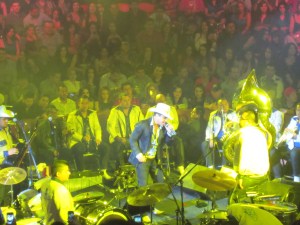
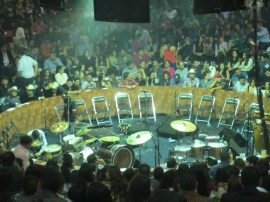
About 22 people were on stage the entire time. Julión was performing in a cock fighting ring at the State Fair; this was not Carnegie Hall. The newspaper said there were over 5,000 in attendance. Julión was surrounded by his band and performed “in the round,” making sure to turn and see all of his fans.

Gringos in the audience: 2

When we entered the venue, we presented our tickets (after our third security check and frisking of the night) and were escorted to our seats. A young man with a rag wiped down our seats and then asked if we wanted to give a tip. Whatever, ten pesos.

Following behind us as we found our seats was mesera (waitress) number 12. She presented us a typed laminated menu and asked if we wanted anything. Bottle of water, check. One beer, check (only Tecate Light, but don’t get me started on that). The rest of the menu was for other people: bottles of whiskey, tequila or rum priced at 1,000 pesos and up. Coke was 100 pesos and served in a two liter bottle. So, we sipped and we watched. An average group would arrive of four or five people. They would order a bottle of whiskey, 12 beers packed in ice, a few Red Bulls and maybe a snack. This scene would be repeated again and again all night long with groups placing reorders constantly. Bottom-line, these folks got drunk. And, thanks to the Red Bull, they were drunk and wide awake! With each order of a bottle of whiskey, they would receive a stack of cups with napkins, two buckets of ice and their 2-liter bottle of mixer (usually mineral water). Don’t forget that amidst all of this, the bag o’ beers had to fit on or around them. You can only imagine what it was like to get up and try to reach an aisle! The meseras were not the tiniest thing on the block either, in fact most of them were old battleaxes who didn’t give a hoot if they stood in front of you for 5 seconds or 5 minutes — they were just working the tips. Drunk young people trying to impress tip well.  This, of course, is not hard to do, when one round is anywhere from 3,000 pesos on up. Ouch! But, these young people of Culiacán seemed to just print money. They all, men and women, had fat rolls of cash and were not hesitant to spend it.

There are always distractions at public events — that’s what makes people watching so much fun. This night was no exception. The only problem is where to begin.

First of all, I need to try and explain palenque to you. Essentially, it is a legal, sanctioned cock fight and “raffle” popular at ferias (fairs). In this case in Culiacán, the palenque entrance and the concert venue are one and the same, so the ticket is as well. The whole State Fair is colloquially called the “Palenque.” Want to go watch and bet on the cock fights? Then you are going to see Julión Álvarez as well. Want to see Julión Álvarez? Then you are going to watch cock fighting (or go late). Our tickets said the cock fighting starts at 7:30 and the artist will be on at 11:30. We got in around 10:00 and said goodbye to the cock fighting MC just after midnight. Anyhow, as I was saying, the stage for the performance is a cock fighting ring. Watch the change happen here, or just look at the before and after pictures, same stage:

IMG_4414

IMG_4440

The fashion was really interesting. Most men had nice jeans and a nice shirt. Some men wore sport coats or slacks. There were lots of nice cowboy boots and a sea of white Stetsons. The women were the real story. Sequined shorts were all the rage and when I say shorts, I mean short. Leather pants in a variety of colors, leopard prints and tiger prints, were a common sight as well. I believe that Sinaloa women have a natural beauty, but the women of Culiacán are just not sufficed with that. They add. Push-up bras and obviously augmented breasts were a constant distraction to this writer, as were fake butt cheeks (sorry, I honestly don’t know what these things are other than unnatural and unflattering). Dianne was particularly fascinated with the “hair lifts.” The women wore their hair back and in doing so concealed a plastic foundation of some sort that raises the hair off the head, forming a ridge. Sorry, we could not get any decent pictures for fear of retribution. People did NOT want their photos taken!

IMG_4428

IMG_4430

There was a guy two rows ahead of that I was able, or almost forced, to watch all night. He did some really strange stuff. First of all, he was dressed nice (for a cock fight) and had no trouble spending lots of money. Had he not been mixing the Red Bull with his whiskeys, he would have passed out. As the night progressed, it got crazy. There were a lot of drunken people and multiple waitresses squeezing past our knees chasing sales and tips. As a waitress would squeak by this guy with a tray full of beer, ice buckets, etc., he would occasionally lighten the tray of a beer or two. It was like a game. All I kept thinking is that the poor waitress has to pay for them. He really pushed things at around 3:30 in the morning. There was a photographer working the crowd. He takes your picture with a fancy Polaroid, puts it into a cardboard frame, gets your money, and he’s gone. Business was a little slow, but he worked hard in his attempt to cover between 5,000 and 6,000 people. This guy carried a satchel across his body on a strap that he would turn toward his backside to get by some tight spots in the crowd. So as he is attempting to get by my friend, there is a waitress coming from the other end and he is forced to stop for a few seconds. When he does, this guy two rows up deftly reaches into the photographer’s satchel and removes a package of the frames — maybe around 50 or so. This is the kind of item no average person has the use for, agree? As the photographer walks on, clueless as to what happens, my friend starts to proudly show his buddies what he has done. One of his friends appeared to have a moral compass. His body language indicated that he was not happy and he began to see if he could locate the photographer. After extended minutes of arguing, the thief grabbed the frames back from his friend. A waitress working in the row above witnessed the whole thing, and even she had the guts to come over. She tried calling out for the photographer, but with the music it was next to impossible. Finally, after the photographer had cleared the row and exited to the promenade, the thief gave the frames to the waitress, who set out in the direction of the photographer, apparently intent on returning them.  My take was this guy was a skilled thief. Every move he made was made with confidence and no fear of recrimination. He did it for pure delight. I knew enough about Culiacan to mind my own business and say nothing (until now).

There was a small opening act of sorts that played for about twenty minutes. Julión and his band came on just before one in the morning and when we left at 4:20, he was still going strong. We understand the concert ended just after 4:30. He played non-stop. His only break from singing came when his tuba player, Cheque, sang a couple of songs. Even during those times, Julión kept busy signing autographs, posing for pictures, dancing with a seemingly never-ending line of women, and being a great host.

IMG_4469

In the first hour, Julión went through most of his biggest wide-reaching hits: La Maria, Las Mulas de Moreno, (click to view)  La Niña, Olvídame… Next, he played a series of his smaller hits and popular songs, and then switched to classic corridos, cumbias and banda songs — the same songs played by every banda group around, but with his amazing voice and incredible backing band. The crowd loved it. In fact, it was often hard to hear Julión’s voice for the sheer volume of the crowd, as they knew every word to every song and were not afraid to help out. Just watch! A few other videos for you:
For the Mazatlecos in the crowd, he sang our song!
See how into things the crowd was at 3:45 (great ad for Red Bull)
A quick shot of the crowd with some house lights on.

A few things made the night special. Julión was the consummate host. He welcomed people on stage to take pictures, dance a few turns or just high five him; it was as though he was returning to his home neighborhood to share in his good fortune. In the clips above, you will see some Down’s syndrome fans that Julión welcomed on stage to dance a few songs for the crowd and share their excitement with the world. When three kids ran on stage to dance, Julión gave clear instructions to his handlers to let them stay. It definitely made for a night that three families will never forget! For about 30 minutes straight, Julión invited all the women to line up and dance with him one at a time. Each gal got a quick spin, a smile, a kiss and if asked, a quick pose for a picture. Watch here. He never stopped making good eye contact with the audience, waving, smiling and making everyone feel welcome. He even gave a special wave to Dianne.

Culiacán — We have spent a little time in Culiacán and know the people there are different, but wow, was this an eye-opening night. Rare is it when we travel anywhere in Mexico that someone doesn’t talk to us about where we are from, were we live, how well we (Dianne) speak Spanish, etc. On this night not one person spoke one word to us. Mind you, we sat next to, in front of and behind people in very close quarters for hours, but nada!

Did we feel safe? Yes. Did we avoid trouble? Yes. Would we do it again? Yes, in a heartbeat. It was a fabulous night with great music in an awesome venue. The late night is no problem if you plan for it. We had a nearby hotel and planned on being out late. Our plans worked out well. I just need a white Stetson hat and a wad of a cash to blend in J (or not).

I was a Julión Álvarez fan before we went and I’m a bigger fan now. That’s the way it should be.

Here is a link to a YouTube playlist of all of the videos.

IMG_4466 IMG_4482 IMG_4463 IMG_4462