As locals, expats and immigrants gear up for Day of the Dead festivities here in Mazatlán, I wonder how many of us realize that there has been quite a backlash to cultural appropriation and commercialization of Day of the Dead by non-Latinos.
I first realized how “hot” Day of the Dead was on my recent visit to a US liquor store. There, I was astounded by the quantity of Day of the Dead- or calaca-themed beer and liquor! To be honest, skeletons and skulls in and of themselves seem to be popular, and anything Mexican (amigos, lucha libre….), Spanish (Don Quixote) or mystical (voodoo) as well. The commercialization is, indeed, real. Click on any photo to enlarge it or view a slideshow.
Living here in Mexico, where we are privileged to be steeped in the traditions as well as the festivities, I hadn’t realized the concerns about appropriation of Day of the Dead until I read a post by one of the bloggers I follow, Aya de Leon, entitled, “Dear White People/Queridos Gringos: You Want Our Culture But You Don’t Want Us — Stop Colonizing The Day Of The Dead.”
In reading her excellent article and researching the matter a bit more, it seems that most Latinos are proud of this holiday. They understand that recognizing the dearly departed is a universal desire. Most are happy to share and ready to welcome us into the Día de los Muertos traditions, which have existed since Aztec times. But they most definitely and understandably resent our taking on the traditions as our own and transforming them into something they’re not — emptying the traditions of their soul. She writes:
And the urge to colonization is born when your own land and resources have been taken over by the greedy and your cultures have been bankrupted. Halloween has a rich history as an indigenous European holiday that celebrated many of the same themes as Day of the Dead, but you have let it be taken over by Wal-Mart… You have abandoned Halloween, left it laying in the street like a trampled fright wig from the dollar store. Take back your holiday. Take back your own indigenous culture. Fight to reclaim your own spirituality.
Please. Stop colonizing ours.
Aya gives examples of Day of the Dead festivals organized by non-Latinos in which Latino voices and faces are not even present! She talks of a sort of Cinco-de-Mayo-ization (my words) of Day of the Dead, in which white hipsters wear calaca face paint, stand amongst broken marigolds listening to white bands, and drink gentrified, holiday-themed micro-brews, without so much as a thought to what the true tradition is or means. She explains, and rightly complains, that we love Mexican culture when it’s convenient and fun, but not when it involves advocating to solve undocumented immigration, illegal gun exports, or rampant femicide.
So where, exactly, is the line between participating in and honoring Day of the Dead and appropriating or colonizing it?
Cultural appropriation is often used as an accusation, implying theft. But cultures, their traditions and artifacts, often aren’t clearly distinguishable. Throughout history people have intermingled, shared, and been inspired by one another. As an interculturalist, I’m all about diversity, integration, collaboration, creativity. There is nothing inherently wrong in us learning from and building on one another; that is actually, rather, a really good thing!
The problem, Aya tells us, is many who are welcomed to the Day of the Dead table are poor guests. We don’t sit at the table; we take the table over. We don’t pay our respects, acknowledge our hosts, or say thank you. We need to be conscious that if we organize themed events, we should use them as opportunities to showcase Latino artists and musicians, and we should hold the tradition with reverence, respect, and a desire to learn and honor.
In an insightful piece in Quartz, Noah Berlatsky tells us that the problem with cultural appropriation is racism:
“There’s nothing wrong with Elvis loving and imitating Jackie Wilson. But there is something wrong with the fact that Elvis is hailed as the King of Rock n’ Roll, while most people barely know who Jackie Wilson is… White performers, like Taylor Swift or Miley Cyrus, use twerking in their videos on the way to becoming more successful and awarded than the black women who developed the style in the first place. When the white borrower, predictably, earns more accolades than the borrowee, artistic freedom and admiration is transformed into something much more problematic… While country music loves black music, it mostly excludes black artists, in the sense that those artists are not considered central, and their contributions aren’t recognized.”
Therefore, all of us need to be vigilant to extend power and privilege, credit and honor, to the origins and originators, not just to those who adapt. However, our modern-day systems are skewed against us. Those who write a book are credited with ideas expressed by others; individuals and corporations can copyright and trademark something that has a long tradition and belongs to a group of people.
Did you know that Disney even attempted to trademark Day of the Dead? They were making a movie called, Day of the Dead, and wanted to trademark the title. Thanks to huge response to a petition on Change.org, Disney rather quickly pulled its trademark application. According to an article in the Los Angeles Times, here’s what some of those opposing Disney’s trademark application had to say:
“Our spiritual traditions are for everyone, not for companies like Walt Disney to trademark and exploit,” wrote Grace Sesma, the petition’s creator. “I am deeply offended and dismayed that a family-oriented company like Walt Disney would seek to own the rights to something that is the rightful heritage of the people of Mexico. This is a sacred tradition. It’s NOT FOR SALE,” wrote Consuelo Alba, of Watsonville, Calif.
The trademark application was “odd” to Evonne Gallardo, executive director of the Boyle Heights art center Self Help Graphics. The center puts on one of the largest Day of the Dead celebrations in Los Angeles and has been sponsored by the Walt Disney Co. “The right thing to do is not to attempt to trademark a cultural and spiritual celebration,” Gallardo said. “I have yet to see a trademark on Christmas or Hanukkah.”
The movie was re-titled to “Coco,” no doubt so that Disney could trademark the title and create a website. One of the most spirited activists to oppose the trademark application was cartoonist Lalo Alcaraz, creator of that incredibly powerful graphic at the top of this post. In a great act of corporate listening and learning, he was recently hired on by Disney to work on the film about which he protested! Our speaking up to defend our heritage can have positive results! The movie is being made, showcasing a beautiful tradition, and it now includes more representation from the very culture it portrays.
Today as I started to write this post, I read an interesting article in The Atlantic: “The Dos and Don’ts of Cultural Appropriation.” In it, Jenni Avins provides six recommendations to prevent appropriation, including involvement of and engagement with members of the culture. She points out that cultures are fluid and constantly changing, so we can’t ask that they stay frozen in time. On the other hand, foreign passion has often helped preserve native traditions, arts, handicrafts, music, dance, literature and even languages. Like Aya, she highlights the importance of acknowledging and honoring the source, the origin, of cultural arts and traditions. Jenni also provides two “don’ts”: never wear blackface, and never use sacred artifacts as accessories.
As we all gear up to paint our faces and create our altars, let us participate in and enjoy the festivities, and use this time to truly remember those who have preceded us in death. Day of the Dead provides a perfect time for us to learn from our neighbors and hosts in this country, and to share with them a human universal: remembrance and longing for those we’ve loved and lost.
When have you felt the tug between honoring and participating in the local culture, and appropriating it?





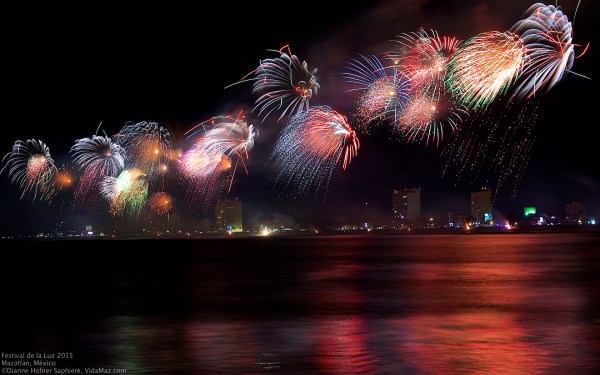 El Maratón del Pacífico was in danger of Hurricane Sandra this year, but she, fortunately, never materialized. But boy oh boy, the fireworks came through better than ever!


 ¡VidaMaz!