In the many years we’ve loved Mazatlán, a whole lot has changed. In the six years that we have lived here full time, one hugely noticeable difference is the focus on sports. It perhaps started with the Triathlon del Pacífico, now a hugely successful annual event.
We live on the malecón, right in front of the baseball stadium, and every weekend it seems there is at least one sporting event: a marathon, fun run, swim, bike, or mini-triathlon. Yesterday there was a big run in the Bosque/City Park. All weekend is the 4-wheeler/off-road race, Ruta PataSalada. This morning is another run in the Bosque, and, wonderfully for us, a 2 km obstacle course race on the beach in front of our house.
This slideshow requires JavaScript.
Participants, as you can see in the slideshow above, had to crawl, military style, under yellow tape. In another challenge they had to climb over huge sandbags and a pile of tires. The greatest part, however, was the finish. A fun-loving group of school kids dressed as Lucha Libre wrestlers jumped on and attempted to tackle the competitors as each of them reached the finish line. Can you imagine running in the sand, navigating obstacles and when the finish line is finally in sight, a line of would be luchadores is waiting for you? It was a total hoot as you can see in the video below:
Mexico surpassed the USA in 2013 to become the country with the highest rate of obesity in the world—33% of Mexicans are overweight. Mexico still ranks second behind the US in rates of diabetes—one in six people here have the disease, and 70,000 Mexicans a year die from it. This change in the culture of our city, to get people out and moving, and most importantly, enjoying themselves while doing it, is an enormously welcome culture change!
One frustration is that it is often hard to get good facts about events like today’s. They are advertised on the radio, in some of the fitness centers around town and sometimes mentioned in the paper. Luckily, we have two very good sources here in Mazatlan. The Mazatlan Running Group page on Facebook is a great source of information on various runs in the area. There is also an awesome blog called Carreras atléticas en Mazatlán. I do not know the writer of this blog, Xavier Padilla, but he takes a lot of time to find all of the information about running events as it becomes available here in Mazatlan. Gracias Xavier.
Greg sat out today as he is training for the 5 and 10K next weekend at the army base. We have always wanted to go to the base as it has truly unique views of Mazatlan. Greg practices running hills each week, so whatever the Mexican army has in store for him should not be too much of an issue. There is also another larger obstacle type race on April 12, the beginning of Semana Santa. This race will be in the Golden Zone at or near the paintball facility. It’s called La Carrera de la Bestia or The Run of the Beast. You can read about it on the blog in the paragraph above, but here is a picture of the course—get your reading glasses ready:
This the course for the Run of the Beast on April 12, 2014
As you can see, it has a pool of mud, a labyrinth, walls, a pool of ice and many more challenges. If we were not leaving town, Greg would be in this for sure. Hopefully some of you will sign up and report back—guest blog posts are welcome.
Stretch before and after, hydrate and train—see you outside!
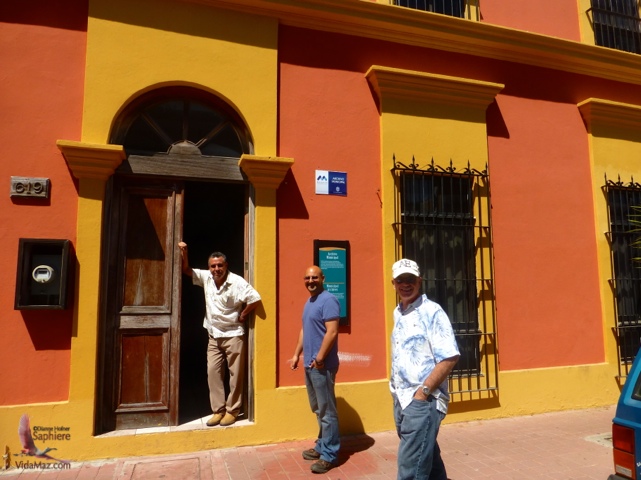
You’ve walked by it dozens of times, as you leave the Plazuela and head down towards Topolo or the Mercado Pino Suarez—El Archivo Municipal. It’s a beautiful and colorful old building, but have you ever peeked in?
Yesterday Greg and I got a terrific tour by a long-lost acquaintance of ours, Chon (Concepción), who was our waiter back in the day at the Hotel Camino Real, where we were married. We were thrilled to see it all! Our city, Mazatlán, has (literally) tons of written archives dating back to the early 1800s. It is a treasure trove of history and heritage!!! Rooms and rooms full of city historical records, piled floor to ceiling, many dating from the early 1800s! We saw some of the earliest maps of Mazatlán, Angela Peralta’s wedding certificate, construction permits for some of our most historic buildings, etchings of the French invasion of our port, and editions of every newspaper ever published in our fair city. Click on any photo to view it larger or see a slideshow.
While in Europe, Canada or the US such an archive might be something we take for granted or at least expect, the fact that we here in Mazatlán have such an incredible resource is truly remarkable! Culiacán’s archive burned down, so they lost most of their historical records. But, throughout the centuries and despite decades of minimal funding, our Archivo Municipal is a sight to behold! Historians, researchers, university and school-aged students are able to come in here to look up what they need to know, thanks to the foresight and perseverance of our forebears.
We met, or re-met, Chon, who speaks beautiful English. We met the lovely Lorena Ferral, who is so excited to see interest in the archives. They are very passionate about the work they do. They love the treasures they guard and catalog to the best of their abilities—and the limited resources allocated to them. The head of the Municipal Archive is Aristeo—Sergio Aristeo Herrera y Cairo Yarahuan—though he was not present during our tour yesterday.
Staff members bind some of the documents by hand, using serviceable yet antique, artesanal equipment. I thought you might like to see.
This slideshow requires JavaScript.
How did we come to be at the Municipal Archive? For several years we’ve been loving the photos of Viejo Mazatlán that the Amigos Viejo Mazatlán group has been sharing on Facebook. A year or so ago, we met Fernando Higuera when we went to the Plazuela to buy a CD of the photos from him. Monies received were earmarked to fund a museum of the photos of old Mazatlán. Since then, the Amigos Viejo Mazatlán has held several exhibitions, historical talks, and fundraising events. I wrote about one of those events here.
We’ve stayed involved with the group, and we keep hoping and working to create space for a photo museum here in town. The good news for our small yet significant project is that we might be given a room at the Municipal Archive in which to display historic photos of our fair city. What is especially exciting to me is the perfect dovetail this would be! Amigos Viejo Mazatlán could display historic photos alongside documents from the city archive. The Municipal Archive could be reinvigorated by public talks and events, by locals and tourists coming in to view photos, thus raising awareness of the treasures it guards within.
The Municipal Archive needs time and attention! Many of the documents are fading, crumbling; they need expert care. If you have archivist or restoration skills, please let Lorena Ferral at the Archive (981-00-48) or Fernando Higuera of Amigos Viejo Mazatlánknow! Join with us to help preserve and make public Mazatlán’s rich history!
The archive has a small display of books on Mazatlán’s history, along with a price sheet. If you read Spanish, you may be interested in a volume or three.
This is yet one more piece of bright news for our city’s heritage! Right now, several new museums are in various stages of planning: one of Sinaloan music, another on Carnavál history, and the new Neto Coppel city museum that was front page news earlier this week. To us that is all good news. Mazatlán has so much to be proud of! Locals, national and international tourists need to know about our claims to fame! And a city that is proud of its heritage builds on its strengths. I’d like to wish godspeed to all these worthwhile projects.
Tomorrow, Friday March 14 at 11:00 AM Salon El Dorado at the Hotel Playa Mazatlán
Meeting with Sub-Procuraduría de Justicia Zona Sur
(Attorney General of Sinaloa) Lic. Marco Antonio Higuera
The Attorney General would like to meet with the foreign community in Mazatlán to discuss the topic of extortion in Sinaloa. The Attorney General and other state prosecutors have expressed concern over extortions and wish to brief the foreign community on extortions and how to avoid them.
In February I wrote you all a blog post about scams and extortions. While I believe such scams are no more common here than in many other places, the approaches here are a bit culturally distinct from scam approaches in other parts of the world. We all are wise to know how to respond in locally appropriate ways. I believe it is wonderful that Lic. Higuera is taking his time and attention to share his advice and guidance with us! Please spread the word! See you there!
How in the world could we possibly top last year’s amazing Carnavál? The theme in 2013 was the movies. Everyone loves a good picture show, and last year’s parade most definitely made the most of that love! I figured there was no way anyone could top last year, so I was mentally prepared not to be sent over the moon by this year’s parade. NOT! Both 2014 Carnavál parades were incredible! The 34 floats, 23 dance troupes and 16 musical groups made for an absolutely fantastic nearly four hour event!
I love that we have two parades. For us, living here on the north end of the malecón, the first parade is an evening into night affair, making for a tremendous street party. The floats in the parade are all aglow, and the dancers are in party mode, grabbing us from our seats and cena on the curb to join in the merriment with them. The second parade, on Tuesday, has the floats lining up in front of our house from just after noon, ready for picture taking in the full light of day. The dancers and royalty come out about an hour before the parade, and it’s the most incredible photo opportunity of the entire year—dancers putting makeup on each other or rehearsing dance steps, bands warming up their instruments and tunes, people stretching, eating, laughing. I absolutely love both these events.
To me the very best thing about Carnavál Internacional de Mazatlán is that it’s a family affair. Nearly every family in town has a member who’s been Carnavál royalty, even if it’s a cousin or aunt, and nearly every Patasalada has danced in Carnavál at some point in his or her life. Royalty celebrate their silver and golden anniversaries, and what a joy it is to see them relive the original thrill, often accompanied by their children! Young children and grandparents dance in the parade, even though it’s such a long route. Several years ago I had a good friend from Mexico City who just hated Carnavál. She thought it was low class and tacky. What she hated most were what she called the beauty contests—that young people were taught to value superficial beauty rather than brains or talent. While I tend to agree with her about beauty contests in general, and I am very much saddened by the shadow cast over the voting for Queen of Carnavál the past few years and hopeful the process will become more transparent, the fact is that Carnavál is a festival of the people. It is much, much, MUCH more than a beauty pageant, involving literature, poetry and painting competitions, concerts galore, fireworks, a food festival, bullfight, several “manifestations” or pre-Carnavál energy-building events, the pomp and circumstance of the coronations, the parades and, of course, the huge street party in Olas Altas for six nights straight. Mazatlán has over a month’s worth of Carnavál-related events, and there’s enough variety to please everyone. Click on any photo below to enlarge it or view a slideshow.
Royal float
Young princesses
And Grandma Queens
Everyone’s royalty at Carnavál
King of Joy Adolfo Blanco
Floral Games float
DIF Queens from the different colonies of Mazatlán
Young royalty
Pretty in pink
Queen of Carnavál float
Floral Games float
Kids rule at the parade. Most of the dancers and musicians are teenagers, children or young adults, joining their friends from dance class, gymnastics, or school. They’ve worked for months to raise money for costumes and props, and have rehearsed their hearts out. They are eager to burst with joy and energy during that first parade. Then, by the second parade on Tuesday, they transform into relaxed, experienced parade marchers, more confident of themselves and the crowd around them.
Masked youth
Pierrot
Acrobats
Fairies
Growing into their bodies
Fun with friends
Hanging out
Helping with makeup
Hi!
Ready to play!
Can I get on the horse?
Vamping for the camera
REady to roll!
Eye makeup and false eyelashes
Lining up
Resting and readying
Ready to go
Smiles of joy
Clowning around
Miming
Samba man
And another samba man
Kisses!
Smiling after all that dancing!
Venetian masks
Venetian Carnavál
In Palazzo Ducale
Who are they? 😉
Hello!!!
A royal wave
Having fun
Ready for the ball
Japanese comparsa
Viva Japan-Mexico!
Africa was represented
Truck driver brings his daughter
The pre-parade sponsors
Cutie patootie
Shouts of joy
Amazon was represented
Gymnastics and hip hop dancing
Gorgeous young people
The other star of the parades is the setting—the route goes along the malecón, south to north on Sunday, then north to south on Tuesday, with a clear view out to the ocean and the islands of our bay, the glittering lights of downtown, and the changing colored lights of Valentino’s on the northern end.
Sunset over the parade route
Helicopter patroling for safety
Floats ready to go for the second parade
Sunset over the parade route
Sunset over the parade route
Sunset over the parade route
Sunset over the parade route
Monigote and the crowd
Floats ready to go for the second parade
Candy! Candy!
So, what made 2014 stand out for me? The most notable difference for me was the crowds! Usually people set out their chairs the night before the big day, but this year was unreal. There were solid chairs from one end of the parade route to the other, and it was reported that over 800,000 people—twice the population of the city—turned out to watch the first parade! We had three families that did not join our party because they couldn’t get through the crowd to get to us! It was a-m-a-z-i-n-g! The mayor tested out a bleacher system which seemed very popular with those wanting a seat at the last minute, but that met with huge pushback from those opposed to selling seats along the malecón. While I’d love to see seats and space continue to be free of charge, something obviously has to give if the crowds keep growing like they are. I’m sure we had many more spectators this year who joined us from Durango, Zacatecas and beyond, thanks to the new highway.
Last year you’ll remember that CULTURA invited a special group from Brazil to join us. They were scantily clad and a huge hit. I believe that is perhaps what influenced another change that we noticed this year: much sexier costumes, and many more scantily clad dancers. Several of the floats had hired models dancing on them, fortunately including scantily clad men as well as women, so everyone could enjoy. I noticed quite a few of the kids’ dance groups had sexier-than-usual garb, also. Perhaps that was in keeping with this year’s theme, Piel del Mar or “Skin of the Sea.”
My personal favorite float this year was the Venetian float that Francisco Igartúa made for Marcela I, Queen of the Floral Games. It transported all of us to the Palazzo Ducale, complete with a couple of gondola rides, and beautifully honored the style that Maestro Rigo Lewis established for royal carriages of Carnavál these past 50 years.
Gondolas of Venice on the malecón
Floral Games float
Floral Games float
Palazzo Ducale
Palazzo Ducale
Palazzo Ducale
Queen Lorena’s float was also incredible, representing Rio. It was begun by Maestro Rigo himself, and finished up by his family after his death. Suzset, the Child Queen’s float was also made by Maestro Rigo and the Lewis family, representing New Orleans. Maestro Jorge González Neri had a huge hit with the King of Joy, Adolfo Blanco’s, exuberant and colorful Cuban float. You can definitely see the different styles of the floats’ creators!
Royal float
Queen Lorena I
Queen of Carnavál float
Queen of Carnavál float
Queen Suzset
Queen Suzset’s float
Queen Suzset’s float
King of Joy Adolfo Blanco
King of Joy float
There were so many terrific floats, and also the LED-lit cars that we’ve grown to love these past few years. At least four continents were represented this year: the Americas, Europe, Africa and Asia. It was all definitely a feast for the senses!
Here are a few final pics of some of the dancers in this year’s parade. I hope you enjoyed it all as much as we did!
The past couple of year’s I’ve put together a video of Carnavál. This year, Mahatma Millan has already put together such a terrific one, that I figured I don’t need to bother. Let me share with you his terrific work:
Today is Ash Wednesday; Lent begins. Time to rest, reflect and recenter, after the exuberance and sleep deprival of the past week! Please, share with us your favorite part of Carnavál, in the comments below.
CULTURA has just released this list of the floats and dance troupes that will appear in this year’s Carnavál parades. Print this out and bring it with you to the parade, so you know what’s what and who’s who!
There will be 34 floats constructed by seven different teams, 23 dance troupes, seven typical Sinaloan tamboras de viento, five bands, plus two percussion groups and two school bands, who will ensure that all attending test our their dance moves!
The parade this year will be in four sections, as usual.
First Section
Homage to Carnavál in Rio
Queen of Carnavál 2014 Lorena I
Police
Fireworks
ECIMI
PRIMERA PLUS
Band from Technical Secondary School #5
Float #1: Pacífico Brewery, Carnavál sponsors, created by Jorge González Neri
Comparsa/dance group: Percusiones en la Costa Grupo Percusiones
Float #2: Percussions on the Coast, designed and produced by Monofaber
Comparsa/dance group: Splendor in Rio
Float #3: Splendor in Rio, created by Monofaber, with models from Brasil, Mazatlán, Colima and Durango
Electric Car: Brazil Tiger, first car with LED lighting
Float #4: The Amazon, designed by Graciano Grande, with professional models
Comparsa/dance troupe: A Mandela
Float # 5: A Mandela, designed by Jorge González Neri, homage to the African leader Nelson Mandela.
Comparsa/dance troupe: Sol Brasileño
Float #6: Sun, Sea and Fantasy, created by Jorge González Neri and representing South American nature
Comparsa/dance troupe: Volando a Rio
Float #7: Flying to Rio, created by Jorge González Neri, the sights of Rio
Rolling sculpture of recently departed Carnavál Maestro Rigo Lewis
Float #8: Royal Carriage of the Queen of Carnavál
Float #9: The Sphinx of Cleopatra, 50 Year Anniversary of Queen Lupita V (1964)
Second Section
Homage to Carnavál in Venice
Queen of the Floral Games 2014 Marcela I
Comparsa/dance troupe: Mexico-Japan Association (Nikkei), celebrating 400 years of the first diplomatic mission from Japan to Mexico.
Float #10: Saint John the Baptist, the name given in Spanish to the Japanese ship Date Maru of the Hasekura Expedition to New Spain. Float created by Monofaber.
Comparsa/dance troupe: Mexico-Japan Association
Comparsa/dance troupe: Carruaje Sobre el Adriático
Float #11: Carriage on the Adriatic
Comparsa/dance troupe: León Veneciano
Float #12: The Venetian Lion, symbol of the power of the Venetian Duke, created by Jorge González Neri, characteristic of a gondola
Comparsa/dance group: Spirit of Carnavál
Float #13: Spirit of Carnavál, Venetian personalities from the art of comedy: Harlequin, Pierrot, and Colombin, by Jorge González Neri
Float #16: Perfume of Carnavál, the costumes and decorations of Venetian Carnavál, by Jorge González Neri
Float #17: Royal Carriage of the Queen of the Floral Games, by Francisco Igartúa, respecting the style that Rigo Lewis established for Carnavál de Mazatlán for more than 50 years.
Float #18: The Winged Lion, illuminated work of Jorge Osuna, Henry Wilson and Rafael Mitchell Cruz, representing the legend of Mark the Evangelist who was greeted by an angel on Lake Venice, ascending to heaven and returning to earth as a winged lion.
Comparsa/dance troupe: Venetian Harlequins
Float #19: Venetian Harlequins, illuminated sculpture by Jorge Osuna, Henry Wilson and Rafael Mitchell Cruz.
Third Section
Homage to Carnavál of New Orleans
Child Queen 2014 Zuszet I
Musical Band from Puebla, guest school
Electric Car: The Harlequin
Comparsa/dance troupe: Masquerade
Float #20: Masquerade, the masks and contagious musical rhythms of Mardi Gras in New Orleans, by Jorge Osuna, Henry Wilson and Rafael Mitchell Cruz.
Comparsa/dance troupe: Flor de Lis
Float #21: Flor de Lis, which will transport the Queen of Poetry 2014. Signifies New Orleans’ origins as a French colony, created by Jorge Osuna, Henry Wilson and Rafael Mitchell Cruz.
Float #22: Challenge in the Swamp, commemorating the pagan spiritual traditions of New Orleans. Created by Jorge Osuna, Henry Wilson and Rafael Mitchell Cruz.
Electric car: Crab, created by Jorge Osuna, Henry Wilson and Rafael Mitchell Cruz.
Float #23: Carnavál on the Sea, created by Jorge Osuna, Henry Wilson and Rafael Mitchell Cruz.
Float #24: Royal Carriage of the Child Queen, in the traditional style of Dr. Rigoberto Lewis.
Comparsa/dance troupe: Wind, Percussion and Harlequins
Electric car: Saxophone, music of New Orleans
Float #25: Wind, Percussions and Harlequins, Ana Becerra debuts as a float designer. This float will transport Elba María Alcalá, commemorating her 25th anniversary as Child Queen, in 1989.
Comparsa/dance troupe: See You Later Alligator
Float #26: See You Later Alligator, which will transport Culiacán’s Child Queen. Float by González Neri, sponsored by El Debate.
Comparsa/dance troupe: Bird Over Louisiana
Float #27: Bird Over Louisiana, the diverse ecosystem of the New Orelans area, by Maestro González Neri.
Fourth Section
Homage to Carnavál of Havana
King of Joy 2014 Adolfo Blanco
Electric car: Rio
Comparsa/dance troupe: INAPAM María Elena Ríos (three cars from the port/API, with elderly women)
Float #28: Tropical Bird, by Monofaber with professional models
Comparsa/dance troupe: Cuban Flavor
Float #29: Cuban Flavor, drum rhythms since the times of slavery, memories of Carnavál’s history. Royal Court of the King 2013 will ride on this float designed by Maestro González Neri.
Electric car: Cubana
Comparsa/dance troupe: Burn the Bongo
Float #30: Burn the Bongo, muñecones and mamarrachos are distinctive of Carnavál in La Habana, complete with pots and pans as drums. Ramón Loaiza will ride this float to commemorate his 25th Anniversary as King of Joy. Float by González Neri.
Float #31: Royal Carriage of the King of Joy 2014, by Jorge González Neri
Float #32: Monarchs of the Caribbean, by González Neri.
Comparsa/dance troupe: Play, Black Man
Float #33: Play, Black Man, rolling float by González Neri
Electric car: Cuba
Comparsa/dance troupe: Cuban Rhythms
Float #34: Cuban Rhythms, rhythms and melodies from the island colonized by Spaniards and inhabited by African slaves, with a bit of Asian immigration thrown in. Float by González Neri.




 ¡VidaMaz!