Yo Soy Fuereña Nací de Aquí Muy Lejos/I was born a long way away from here

It took a man from Hidalgo, José Alfredo Jiménez, to write these words that echo in my head on an almost daily basis. The words of the song that most often echo through my heart though are tienen todos ustedes un orgullo, el gran orgullo de ser de Mazatlán — “you all have the pride, the great pride to be from Mazatlán.”

And this week Jimenez’ words from the Corrido de Mazatlán rang especially true for me. Let me tell you the top five reasons why. Want to listen to the Corrido while you read this post? Click here.

1. Compañia Danza Ballet de Mazatlán

Late last year our already-wonderful Mazatlán was blessed once again with the formation of a brand new professional ballet company, Compañia Danza Ballet de Mazatlán. How many small cities boast their own ballet company? Makes me so proud.

This week Danny and I had the good fortune to watch them in action at the historic and gorgeous Angela Peralta Theater, in a performance of Don Quixote. We sat in the sixth row center for a perfect view, at a cost of US$25 per seat, and witnessed Cuban ballerina Mariem Valdez Martinez dance the role of Kitry splendidly. Other hits in our opinion were Javier Diáz Dalannais in the role of Gamache (just looking at him with his flaming red curls and painted clown face was delightful; but add to that his buffoon antics and it counter-balanced the artistry brilliantly) and Jorge Gorostiza in the tile role of the elderly Don.

Thanks to Ustream and CULTURA, you can view the entire performance online. They have now unfortunately added commercials for upcoming events to the video, so you’ll have to wait through those to see it. I felt our local dance company did a much better job than the Russian State Ballet that visited last month, and at less than half the cost. Kudos to the directors, Zoila Fernández and Guillermo Carrillo! The dancing was solid, the sets and the costumes were outstanding, and the entire performance charmed the heck out of the standing-ovation audience.

2. Concurso Internacional de Canto/International Opera Singing Contest

World-renowned orchestra director/conductor and our neighbor, Enrique Patrón de Rueda, first organized this contest four years ago. It has become the premier contest of its kind in Mexico and perhaps in Latin America. Another pride. It is sponsored by the Sinaloan Institute of Culture, and is designed to encourage young singers (ages 18-33) in their opera careers. This year it will give out US$16,500 in prize money; pretty incredible considering that enrollment in world-class singing classes at the Centro Municipal de Arte costs about US$250/month!

Last night we were privileged to hear ten arias sung by ten incredible young soloists from Mazatlán, other parts of Mexico, Guatemala and Chile. It was an informal event, designed to give the performers experience in front of an audience prior to the official contest events. The arias were incredible, and what added to the experience was that we were able to witness Maestro Enrique interrupting the singers to correct them, and the singers responding by raising the caliber of their performances. What an education! And what a true delight! And, as with the affordable ballet tickets, tickets to this event were 100 pesos (about US$9). Note: Addition from Sunday 22 April: Today’s paper has an article about this event, if you’d like to read it.

3. Neblina/Fog

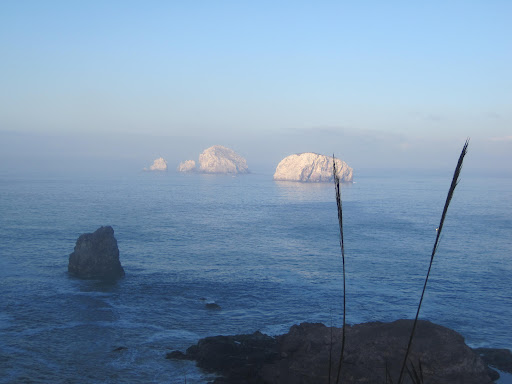
We are spoiled with wonderful weather here. My son tells me that my “zone of tolerance” is now about two degrees Centrigrade; otherwise I get too cold or too hot. Untrue; remember he’s 16 and is prone to exaggeration. Anyway, almost every day we have killer sunsets (you can view a few on our “Viva Mazatlán” channel on YouTube), gorgeous clear blue skies, views to the ocean and the islands, whales, turtles, dolphins, cranes, egrets, spoonbills and pelicans, and consistently hospitable weather (ok, summer gets sticky). This time of year brings a change of pace, however. The change of seasons means the cold air over the ocean mixes with the warm air over the land, causing heavy morning fog. It is so beautiful to see! Watching the islands do a striptease is quite a pleasure! That’s the photo leading this post.

4. Our Film Debut

If you read this blog, you know we love living here. That’s what this whole post is about. So what fun it was to this week receive copies of videos in which members of our family appear, talking about this place we call home! Please check it out and let us know what you think. Be sure to hang on to the end to see the joven:

The second video in the series, this one a bit different, and just as packed with what we love about Mazatlán:

The third and final video features Danny at the 2:00 minute mark:

5. Great Triathlon of the Pacific

We are also blessed with loads of special events and athletic activities here in Mazatlán, including the international marathon and the annual Travesía, where swim club members swim out to the island. This week was the triathlon, which is awesome because kids as well as adults compete, and we get to see them out in the ocean swimming, as well as biking and running up and down Avenida del Mar. This year there seemed to me to be more children than normal participating, which I find incredibly encouraging. And the adult winners included Mexican but also an Austrian, a Canadian, a Czech!

Come on! Tell us why you love Mazatlán!


Let No One Say Mexicans Don’t Know How to Load a Truck

We recently drove from Mazatlán to Morelia, and I ended up taking quite a few photos just of the creative and efficient ways in which people here in Mexico load their vehicles. Nothing if not practical! We can make it work! We can get it all there in one load! Take a look and enjoy the slideshow! If you’d rather see larger photos, click through to SmugMug.

A Hike on a Foggy Morning/El Faro Dentro de la Niebla

I’ve told you before about the wonderful lighthouse we have here in Mazatlán. We hike it once or twice a week, and we so enjoy the families, young couples, exercise groups, and elderly people, too, who make the climb up one of the ways they stay healthy. It’s a gorgeous view, and a terrific group of young Mazatlecos has been working hard to keep the area clean and maintained. I’ve heard the lighthouse is owned by API, the port authority. If so, Mis Estimados Señores del API, sure would be a wonderful community service for you to invest a bit of money in making this a better tourist attraction and community gathering area….. It’s so beautiful, it wouldn’t cost much… Just an idea 🙂

Anyway, yesterday morning was pretty foggy here. As we made our way down the malecón toward the faro there were lots of oyster divers and panga fishermen out, despite the foggy conditions. We are so spoiled here with clear, sunny weather, that seeing a bit of fog once in a while seems so absolutely gorgeous!

We wondered as we approached the lighthouse hill if we would be able to see anything as we made our climb. It sure did seem to be heavy fog.

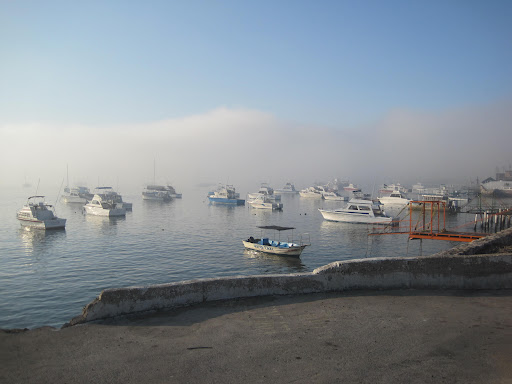
The harbor had more boats than usual, it seemed. We guessed that perhaps people had brought their boats out in preparation for Semana Santa.

As we started our climb it seemed we weren’t going to be able to see much of anything. It was pretty cool, sort of like walking in a spook house. In the photo at left, we SHOULD be seeing, or are used to seeing, all of Isla de la Piedra/Stone Island. Not today!

The cacti and vegetation, which are so gorgeous this time of year, were shrouded in veils of fog, making for a very mysterious feeling. There were way more hikers, bikers and runners on the trail than is normal, however. Again, we guessed that people are getting in a holiday mood.

As we reached the top of the lighthouse hill the fog had moved a bit. We couldn’t see much of anything of the city, but the teeny-top of the hill on Stone Island that I showed you above, much more of it was now visible. Kind of a nice change of pace to have changing scenery, when we’re spoiled with consistently perfect views…

Despite the fact that the view from the top was still foggy, the weather at the top was very clear and bright. I took a shot up, through a tree. You can see there was no fog whatsoever up high.

And one of the lighthouse’s many resident iguanas was more than happy to sun himself, more than ready for the R&R and hopefully increased sales that Semana Santa will bring for our local economy.

Cooking Class at Molika: Pesce in crosta di sale

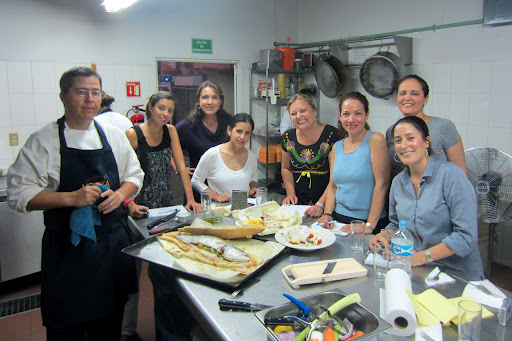
I’m privileged to have a terrific group of lady friends who like to cook, and we get together to learn and to teach one another once a month or so. In addition to our Thai cooking classes, we’ve made timballo (Italian “drum” with pasta and eggplant), tortas ahogadas, rajas, chicken mole, macarones, and lemon cake, among some other wonderful things.

Well, my friend Magda got the wonderful idea to book us a series of classes with Héctor at Molika, downtown on Belisario Dominguez near the Plazuela. While I’ve known Héctor for several years — he’s a GREAT bread baker (sourdough and ciabatta plus other good loaves) and I am in love with his grilled vegetables (which we also frequently make at home) — I discovered that he also truly shines as a teacher!

He is funny, charismatic, and I LOVE that he teaches METHODS rather than recipes! In one two-hour class on cooking fish, he demonstrated SIX different methods of preparing the fish we commonly have available here in Mazatlán. For me who learned to cook fish while living in Japan, I learned a lot. For example, he taught us to cut off the fins (see video above) before cooking the fish (you’ll know that most Asians LOVE the crispy fins and would never think of removing them before cooking), saying that the fins have too strong a flavor.

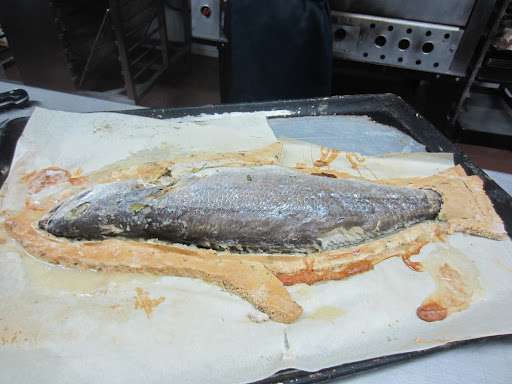
My favorite? Well, by now you know me. I love something different, and especially something impressive. And Héctor delivered: Pesce in crosta di sale, or fish in a “tomb” of salt. I’ve eaten many fish baked in salt crust before, but nothing quite like this!

Rather than just salt with aromatics, Héctor made a salt dough with the 2 salt : 1 flour, eggs, fresh herbs and a bit of water.

He kneaded it (see video above),

Rolled it out,

Pressed two pieces (top and bottom) to the form of the corvina, sealing the dough with beaten egg, decorated it a bit,

Trimmed it to shape (video above), and then baked it for 45 minutes.

The fish of course turned out incredibly moist, aromatic and flavorful. He said he prefers to use robalo rather than corvina, but I was plenty happy with this.

He suggested that we cut the rock-hard crust in the kitchen (you can see above that’s pretty challenging), then take the encrusted fish to the table, where we open it in front of our guests. That way the room fills with the wonderfully aromatic scents.

Finally, unlike Japan where everyone knows how to eat fish on the bone, Héctor suggested we remove the flesh from the fish in front of our guests, serving it up on plates. He removed and discarded the skin, saying that baked/steamed fish skin doesn’t taste good. I can hear the shocked gasps of my Asian friends now, but it was nice for me to learn a more European approach. I will definitely give this gorgeous dish a try. I must admit that I preferred the taste of several of the other dishes he prepared! This one was just a presentational stunner, like my timballo (thanks, Allison, for teaching me!).

We made pescado en papillote, fish steamed in paper. We stuffed the fish with aromatics: lemon peel, garlic and fresh herbs (basil, parsley, rosemary, thyme), then garnished with sliced fresh celery, onion and carrot. It was interesting to me, again with my Asian influence, that Héctor taught us to peel the celery, removing the fibers. Definitely a finer dining touch than I’m used to.

Above you can see Héctor opening the papillón.

A third dish we made in this two-hour class was the dish I swore every single Japanese restaurant serves: sole meuniere (lenguado). Many of the ladies were very happy to have Héctor teach them how to filet. Cleaning and preparing fish is fortunately one of the many skills I learned well in Japan. One of the key points he pointed out is to filet fish when it’s cold, fresh from the icebox. That way it’s much firmer and easier to handle.

Héctor studied and cooked in London before returning to his native Mazatlán, and he uses lots of olive oil and sea salt, as you’ve already seen (way more than I’m used to, though I will start putting a bit more olive oil on for taste at the end), and for this dish he used a whole lot of butter as well. Nobody said good cooking isn’t fattening! He did caution us to check the ingredients on the butter we buy, as ideally it should be made from milk, and not contain emulifiers and a bunch of chemicals. I do think that’s part of the baking challenge I’ve had since I moved here — gotta buy better butter.

And here we have the finished lenguado/sole, covered with sauce from the pan and garnished with a bit of parsley.

I had been craving salmon and asparagus, and just that morning bought both to make for lunch, so was fascinated to see Héctor make this as part of our repertoire for the day. He of course used clarified butter as it withstands higher heat, to get the nice crispiness on the salmon. Note: he removed the skin before cooking. I guess this is also either a European way or alta cocina, because personally I love the crispy skin. I was sooooo gratified to see him cook it the way I feel it should be. Héctor told us that salmon, tuna and swordfish should always be left rare in the center, and I heartily agree. People here in Mazatlán always seem to overcook fish.

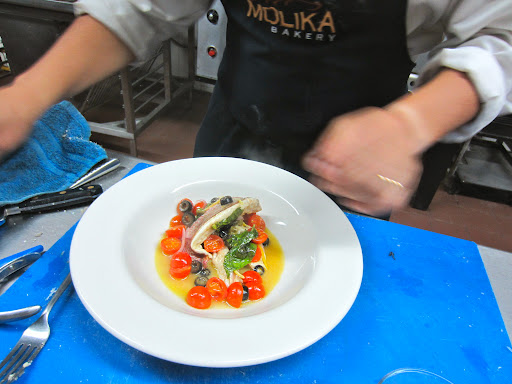
The fifth dish he made was swordfish. He cubed the fish, sauteed it with fresh herbs, cherry tomatoes, capers and olives. In addition to the lemon (yellow lemon) rind he added to most all these dishes, he also added a bit of lemon pulp. This concoction he poured over his famously to-die-for ciabatta, and oh my!!!! The bread somehow soaked up and enhanced the lemon flavor of the sauce, and it was soooooo delicious!

I’ve left my favorite dish for last. Fortunately, it was also probably the easiest to cook: pescado en la bolsa, fish in a bag. He used the same ingredients as most of the other dishes — fresh herbs, cherry tomatoes, olives, capers, sea salt, extra virgin olive oil. The wonderful part, besides the incredible taste?

He put all the ingredients in a ziploc bag and cooked it in near-boiling water on the stove! It took just a few minutes and there was nothing except the serving dish to clean up! My son is in Scouts, and they cook just like this on their campouts. Maybe not quite the gourmet ingredients as this, but still very tasty nonetheless.

Thank you, Magda, for setting this up for us! Thank you, Héctor, for a marvelous class! We are very much looking forward to our next one.

Anyone wanting to arrange a class for a group of friends, please give Molika a call: 669-981-1577. Héctor’s English and Spanish are flawless, and his kitchen skills are a gift to Mazatlán.

Pescadería del Mar/Our Fishmongers

One of the best aspects about living here in Mazatlán is the fresh fish we are able to buy every morning. Okay, well, we don’t go on Mondays, because there’s not been a lot of fishing on Sunday, but any day Tuesday through Saturday, you can bet we are happy campers.

We take our daily walk down the malecón and, in Playa Norte just across from the pangas, is our favorite spot: Pescadería del Mar.By now these guys know us and they’ve helped us to learn a lot about fish and fishing here in town: what’s seasonal, how fish are stored (on ice, frozen, salted) from the time they’re caught till they’re brought in to shore, and how to cook what’s available locally.

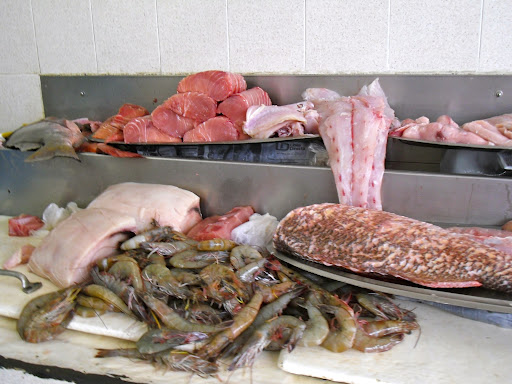
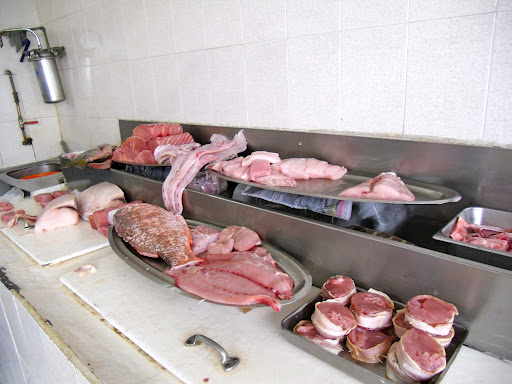
At 7 am when we’re there we usually have a terrific selection. Of course, depending on the season and the weather, we may have more or less fish to choose from. As you can see in this photo, though, there’s usually quite a variety.

The fishmongers will scale and clean any fish we choose, so I can cook it whole, or they’ll fillet (de-bone) and cut up anything we’d like, however we’d like it. They also get fresh shrimp, which I love, because they are deep water shrimp that have NOT been stored in salt, so they’re sweet rather than pungent. They get quite a bit of squid, also, which I love to saute with garlic and herbs. We can occasionally get fresh scallops, too. Our favorite is corvina, a nice firm fish that is sooooo savory! We can at least a couple of times a week get smoked marlin (usually still warm from the smoker and sooooooo aromatic!), and escabecheon Fridays.

It’s fun to watch either the fishermen fresh off their pangas across the street, or a dealer/go-between (usually on a scooter or motorcycle) come to deliver the fish to the fishmongers and make a deal. They have an outdoor scale to weigh what’s brought in, and an indoor scale to weigh what you purchase before it’s trimmed to order.

Having lived so many years in Japan, I am also very happy when they get sushi-quality tuna, though I do believe most of the fresh fish they have is sushi/sashimi quality. Chirashi has never been so delicious and affordable!

If you are a carnivore/omnivore, and do not take advantage of our local fresh fish, please do! You are missing some really flavorful and healthy, and easy and quick to cook, local delicacies!