Cerro de los Chivos/Goat Hill

P1110859©Who doesn’t love Stone Island? In the 35+ years we’ve been coming to Mazatlán, it’s been one of our favorite hangouts: pescado zarandeado/bbq fish over an open fire, hammocks,  calm ocean for swimming and killer views. Every time we go, we say, “we should climb Goat Hill.” And, every time, for 35+ years, we don’t. The hammock, a horseback ride, swimming, margaritas, a walk on the beach, a massage… these win out over the hike.

Well, today changed all that. Our friend Dallas loves hiking Goat Hill. His wife Rocio runs Restaurant Cerro de los Chivos (great food and service, open Fri-Sun) at the base of the hill. He has told us that the views are spectacular and that there are, indeed, wild goats. Both proved very true; we counted at least 26 feral goats. The top of the hill is like a tropical forest, and the bottom closer to a desert with lots of cacti. The view is 360 degrees and incredible. Click on any photo below to enlarge it or view a slideshow.

No doubt you are smarter than we are, and you’ve made the hike to the top. If you haven’t, be sure you do sometime soon!

Update on the Olympic Pool

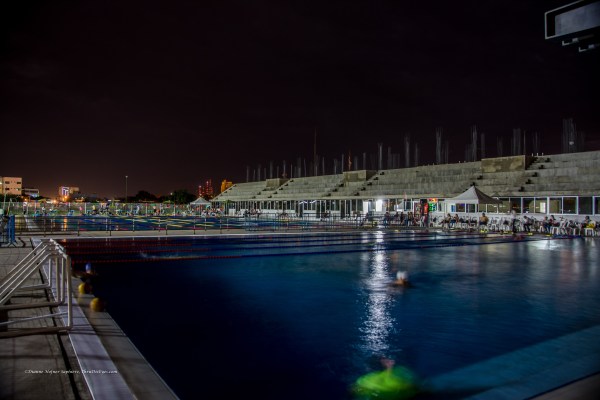
DSC_0023Back in January I reported to you about the opening of the Olympic pool. Well, I have sooooo enjoyed the past nine months swimming there! The people are great, and I can’t say enough wonderful things about Profe Rafael, who heads up the pool and teaches everyone willing to learn who shows up. He has an incredible work ethic, is an all around nice guy, and he really knows how to teach!

Rafa tells me that the pool now has over 1000 people registered to use it. That is terrific! Despite the lack of state or local funds to finish the project (I told you in January how the bathrooms, showers and bleachers weren’t yet finished), Rafa has managed to squirrel away enough money to get the bathrooms, showers and changing rooms for the women finished! Hooray! They are spacious and functional. There are ladders to get in and out more easily, and during kid swim times they put in platforms so the kids can rest without having to tread water.

Many of the Playa Norte Swim Club members come to the pool when they are not swimming in the ocean, as it’s easier to keep track of distance in the pool, time yourself, and they enjoy Rafa’s teaching. He doesn’t really tell you a whole lot about what to do, he just gives you a lot of different exercises using pull buoys, kick boards, swim paddles, and even flippers/swimfins. Using these items you really begin to feel (rather than think about) how you should be stroking or kicking; it’s quite amazing. There are also lots of swim teams that work out at the pool, primarily training here before major meets. The young energy is a hoot, and there are loads of older swimmers, too. It’s great to have a group of dedicated, fun-loving people to work out with.

The pool hours are pretty amazing, given the fact that there are only two instructors and they are out in the hot sun every day:

  • Mon-Fri, 5am-11am, 4pm-9pm
  • Sat, 5am-1pm

The price is still 500 pesos per month, and you can take classes if you don’t want to just free swim. The pool is on Ejército Mexicano just south of Avenida de los Deportes (the with University Autónoma de Sinaloa and the Aquarium), on the west side. Entrance is under the giant Tecate sign.

I usually swim in the morning, but last week I had early morning appointments a few days, so I ended up going at night. I was amazed at what a family hangout the pool has become! Parents sit around in the cool night air chatting and snacking as they watch their kids in swim classes. It was really wonderful. So, tonight when I went for a swim I took my camera. The donut man has found the location, so you can now easily eat three times the calories you burn swimming. Click on any photo to enlarge it or view a slideshow.

If you haven’t checked out the new pool, be sure to do so. It rocks. And remember, come winter, it’s heated.

¡Viva México! ¡Viva Mazatlán!

The Grito de la Independencia—“shout of independence” or “cry of Dolores“—is a traditional Mexican affair that you owe it to yourself to participate in at least once while you live here. We’ve done it a few times both here and on the 200th anniversary in Guadalajara.

In Mazatlán it happens every 15th of September at 11:00 pm in the Plaza República. The Mayor comes out on the balcony of city hall to ring a bell, shout the official words, and lead the crowd in the national anthem. Most of the country shouts at midnight, but since we’re an hour earlier here on the coast, we do it to coincide with them. Before the mayor’s cry there is folkloric dancing, singing (this year was Heidi Herrera) and other performances, and there’s always a name act that plays after the grito. The first time we went, that act was Chuy Lizárraga, who due to sound malfunction sang right over the national anthem. Click on any photo below to enlarge or view a slideshow.


This time we read in the paper that the fireworks were going to be fantastic, put on by the same group that does Combate Naval‘s Carnaval fireworks— Lux Pirotecnia (Jorge Márquez) of Mexico City. That was more than reason enough for me to want to go! I love fireworks (5, 4, 3, 2, 1)!

Poor Greg was tired as he’d just driven us from Wisconsin to Mazatlán, plus he had a cold, but when two girlfriends cancelled out on me, he agreed to go despite my assurances that I could go it alone. I was excited to try out my new camera with a brighter lens!

As it’s new, I’m not that good with it yet, so I missed many of the photos I wanted, and I overexposed a few because we were so darned close to the action and you just can’t predict how bright a firework is going to be. Plus, the cathedral wasn’t really lit up, and I wanted it to appear in the shot without having to do a composite.


All in all, though, I’m happy. I did get a few good pics; hope you agree. Greg got a great one of the flag and the cathedral; congratulations, sweetheart! And the view we got of the grito itself (above) is sure a different one than the press photographers took.


If you’ve never done the Grito, or if it’s been a long while, be sure to do it next year. This year was much less crowded than usual, I guess because the main act wasn’t as popular as other acts we’ve had. There is also a major parade on 15th September every year, including military, police, fire and first responders, and school children. Many children dress up as heroes and heroines of the War of Independence, so attending the parade or visiting a school on the 15th can be very much fun.

Focus on Responsible Tourism

Three cruise lines, new air connections, 12,000 rooms in 180 hotels… We greet hundreds of thousands of national and international visitors each year in Mazatlán. Any chance I’ve gotten over the past eight years I’ve tried to encourage travelers to get beyond the stereotypical but wonderful beer and beaches to experience a bit of the “real Mexico,” be it a visit to a small town, witnessing the shrimp or mango harvest, or admiring the Mayo-Yoreme traditions.

Recently, however, I’ve been working with a colleague in Milan, Maura di Mauro, on a project, and she cautioned me about how the culture of Mursi villagers in Ethiopia was changing due to tourism. Thanks to an influx of camera-toting tourists willing to pay for photos, the villagers increasingly exaggerate their traditional practices and even falsely embellish them, to make them more attractive to visitors. Lord knows I’ve witnessed this sort of thing happening in and around Mazatlán. She also told me about Chinese tourists descending en masse on a small village in The Netherlands. Many of the Dutch residents welcome the added economic boost such international tourism provides, but they have also experienced downsides to such tourism and, again, changes to their culture. We in Mazatlán sure experience the ups and the downs of tourism, and know how important it is to our economy.

Maura said there were documentaries about both of these topics, made by the same Dutch cinematographer. She got me excited and I can not WAIT to view the two films!

The first documentary Maura told me about is called Framing the Other” by Ilja Kok and Willem Timmers  (25 min, English and Mursi with English subtitles).

The Mursi tribe lives in the basin of the Omo River in the south of the east African state of Ethiopia. The women are known for placing large plates in their lower lips and wearing enormous, richly decorated earrings. Every year hundreds of Western tourists come to see the unusually adorned natives; posing for camera-toting visitors has become the main source of income for the Mursi. To make more money, they embellish their “costumes” and finery in such a manner that less of their original authentic culture remains. The film contrasts the views of Mursi women and those of Dutch tourists preparing for a meeting. This humorous and at the same time chilling film shows the destructive impact tourism has on traditional communities. A preview is below:


The second film is called Ni Hao Holland: The Chinese are coming” by Willem Timmers (25 min, Mandarin and Dutch with English subtitles).

698504_75d9e491d73b4eceb06792f5af9a02ed~mv2

It is a documentary about Chinese tourists and their quest for the authentic Dutch experience. Cherry, the main character, has long dreamt of swapping her home city Beijing for the Dutch village Giethoorn. She has heard and read a lot about this mythical place. The day arrives that she and her friend hop on the plane in search of adventure. In the meantime, entrepreneurs from Giethoorn work hard behind the scenes to cater to this “Holland experience.” They want to make the most of the fast-growing flow of Chinese tourists to their village. How is this authenticity created by some and experienced by others? A preview follows:


While I’ve yet to watch either of these movies, it sure sounds like there’s a lot to think about for tourism in Mazatlán and Sinaloa. I look forward to hearing your thoughts!

Rites of Passage

DSC_0717

Emiliano’s first “pega.”

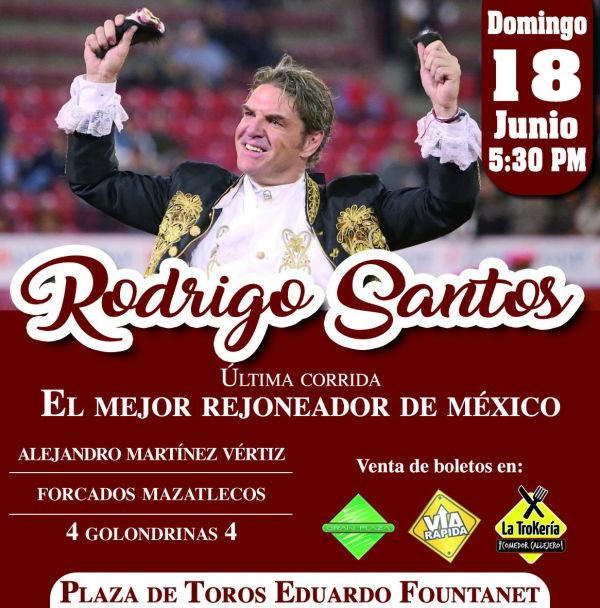
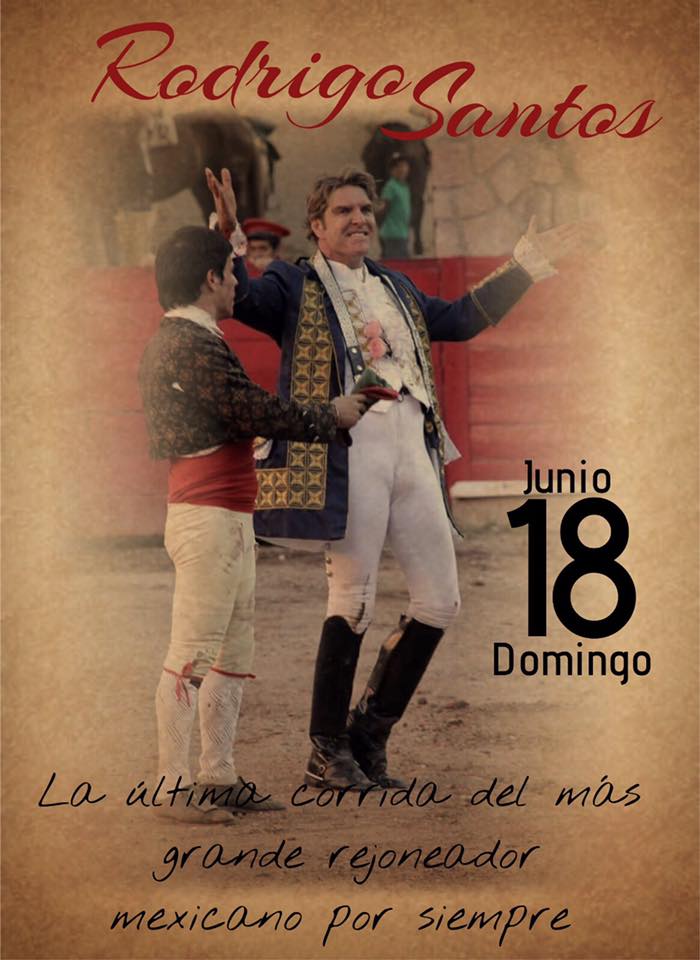
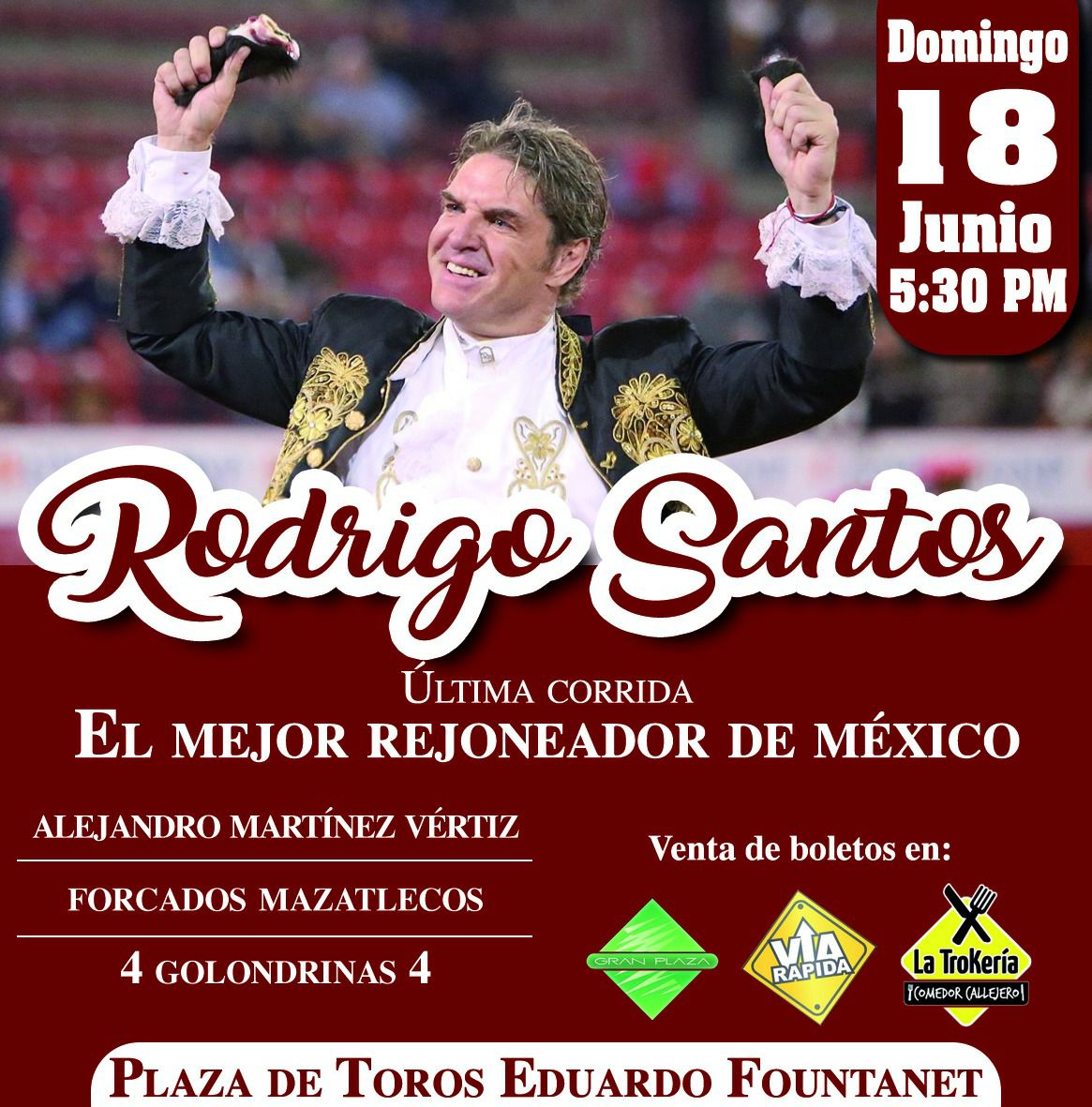
This Sunday afternoon, June 18, stating at 5:30 pm, Mazatlán will witness two rites of passage:

  • The last bullfight of Mexico’s greatest rejoneador (horseback-riding bullfighter)—Rodrigo Santos. He has intentionally chosen Mazatlán as the site of his retirement. He is from San Luis Potosí, but our home has much sentiment for him. This is a huge honor for our city.
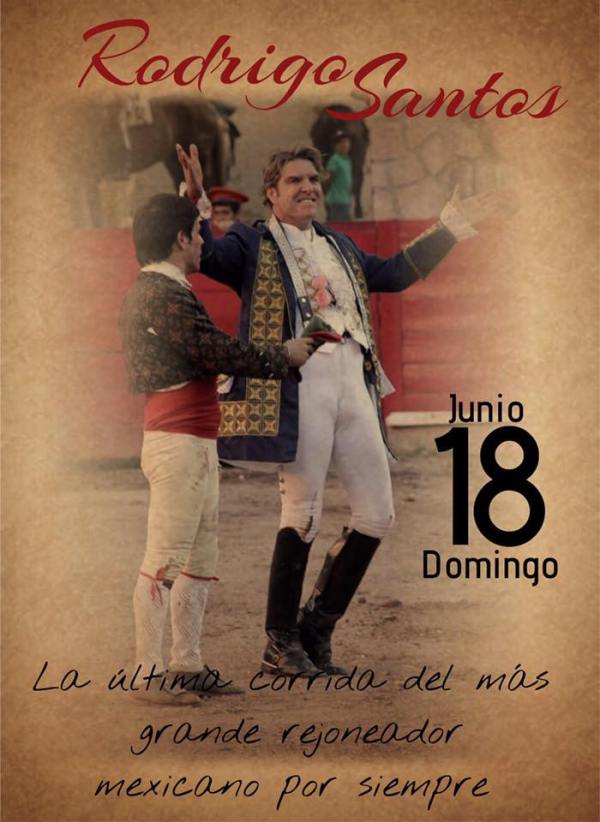
  • In the same event when this giant retires, but of much lesser importance, at least at this point, we will see the debut of a nine year old forcado—those who catch the bull’s face with their bare hands—named (Ariel) Emiliano Vàaquez Vargas. He will not face any of the four bulls on Sunday, but he will be granted the opportunity to walk into the ring with the rest of the 20-strong Forcados Mazatlecos group.

DSC_0723

In the 35 or so years Greg and I have been traveling to Mazatlán, we well remember that there used to be several bullfights each month, sometimes as many as once a week. It was a valued tradition in Mazatlán and throughout Latin America, one that came in with the conquistadors via Spain and Portugal. René Tirado, cabo or leader of the Forcados Mazatlecos, grew up in that tradition. He’s now doing his best to teach the next generations to carry on the art. Click on any photo to enlarge it or view a slideshow.

Recent years, of course, have seen a huge decline in bullfights, due to complaints of animal cruelty. To the rejoneadores, toreros, and forcados, however, bullfighting is an art and a way of life. While our bullfight ring looks tired and worn on the outside, I was happy to see it looking clean and well-cared-for on the inside. As René told us, “I understand if people don’t like what we do. Nothing is for everyone. But we should not judge something as bad and try to ban it without first trying to understand it. I would never critique a painting, as I’m not an art specialist.”

“The cattle industry actually helps preserve the lands we have here in México. These bulls graze on open range, they live life as kings. When they are four years old they enter the bullring. In the ring, if they succeed, they will live out the rest of their years on a stud farm, again as a king. If I were a bull, I would much rather die in the ring, with dignity, fighting for my life, with the chance of rescuing myself, than die in a slaughterhouse.”
—René Tirado

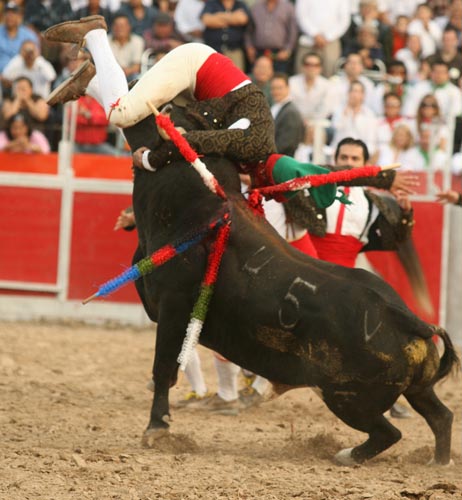
On Sunday there will be four bullfights: two with toreadores on foot, and two with rejoneadores on horseback. For the fights on horseback, the forcados, equipped with nothing but their team of eight, their hands and their speed—come in at the end to put their arms around the bull’s head and neck—ideally between not on the horns—in order to subdue him.
mazatlecos1forcadosvilafranca

Photo of Forcados Mazatlecos from Forcados de Vila Franca

The bulls are raised to fight; it’s in their blood. The evening we visited the bullring the forcados brought their children in, to get them acquainted with the sport and hopefully pique their interest in pursuing it. In addition to the four bulls in the plaza for next Sunday’s event, there was also a calf or becerra at the bullring. He must have been just six or eight months old, but he was feisty! He had such a good time chasing the men, and the children, around the ring. Even though he was just a baby, he could push the men right off their feet and into the air. He made short shrift of the fake bull that had the audacity to stand in the ring with him, too.

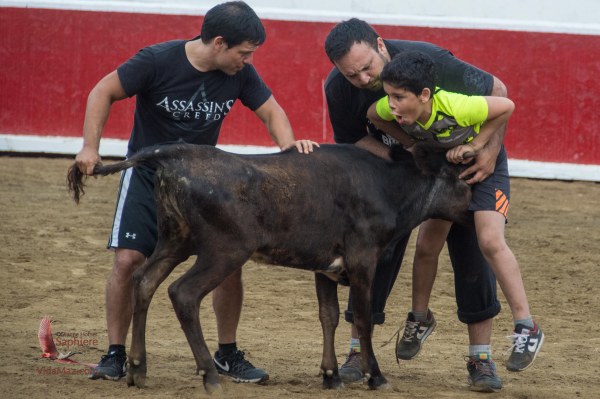
Emiliano, the boy who will stand with the forcados on Sunday, had his first pega or face-stop with that calf the afternoon we were there. Dad was with him to help out, and René was quick to assist. The calf really took the wind out of Emiliano, but his face glowed with pride that he was able to accomplish the feat. Below is a sequence showing the action:

The Forcados Mazatlecos are well known nationally and internationally, representing Mazatlán wherever they go. They were founded in 1987 by Arturo Castro Ortega. They travel about twice a month, sometimes even four times a month, to events around the country and internationally. They recently performed in Plaza México—the world’s largest bullring—and travel to Portugal. Amazingly, they all hold full-time jobs as the forcado gig is unpaid! They receive no help from CULTURA or IMDEM. Festivals that invite them to perform will pay their expenses and a small honorarium, but these artists do it for the love of the sport and the art; they are passionate and committed to what they do.

A couple of details I learned from René:

  • Forcados originally existed to protect the king and the royal court during bullfights in the plazas. A prince was killed at one point, and after that bullfights were held in bullrings built for the purpose, rather than in city plazas.
  • Spanish-style bullfighting has the torero on foot. Portuguese-style has the rejoneador on horseback. Traditionally you learned these arts if you grew up in a wealthy cattle family.
  • René has a horrible couple of scars down his right leg, where ten years ago he had an artery replaced. It saved his life. The accident happened during a bullfight right here in Mazatlán.

If you’d like to take advantage of this very unique opportunity, you can buy tickets at the Gran Plaza, in the kiosk right in front of Cimaco, or at Via Rápidas or La Trokería up in Sábalo. Tickets prices start at 100; general admittance in the shade 200; preferred seating in the sun 250; and preferred seating in the shade 300.