Mid-week. Wednesday. “Hump day.” We decided we needed to get out, see a bit of the “interior” of our beloved Mazatlán that we hadn’t seen in a while. Not like we don’t often do that, but, hey, it’s Wednesday and we’ve been working hard …
We ended up driving toward Infiernillo. We were so very psyched to spend time noticing just how clean everything looks, we suppose after it was cleaned up from the flooding last year. Danny’s Scout troop has gone out there many times cleaning up. But this was obviously a clean-up of larger, more mechanistic proportions. Well done, city!
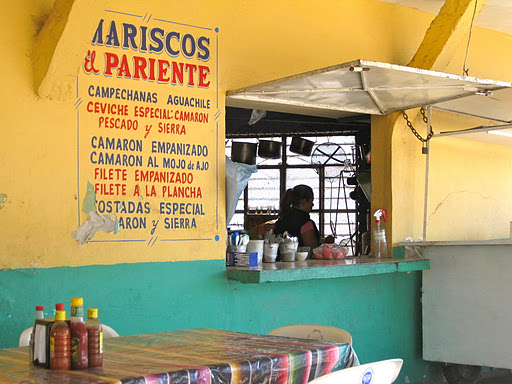
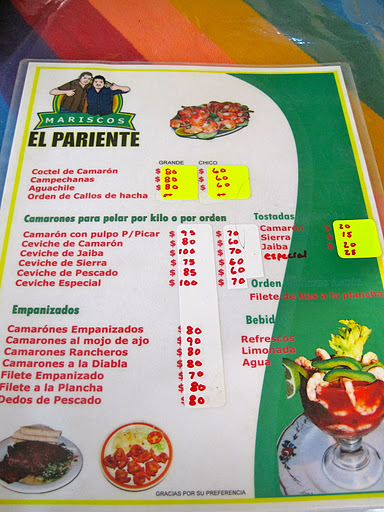
We stopped at a little mariscos and taquería that Greg had noticed yesterday, when he was refilling the gas for the grill. It is called El Pariente, and it did not disappoint.
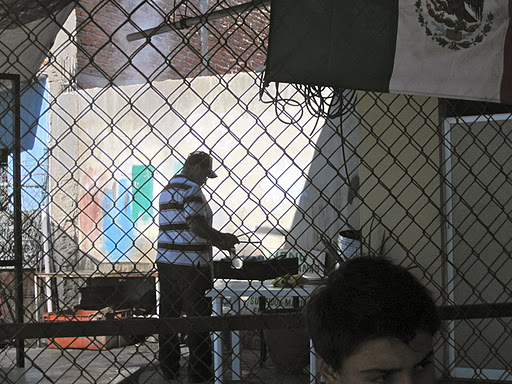
The owner was very gregarious, and worked busily on the outdoor grill. His wife worked the indoor kitchen.
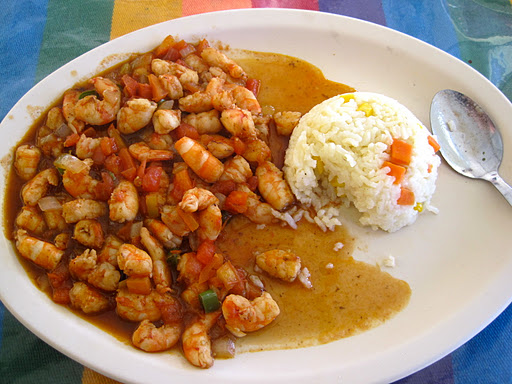
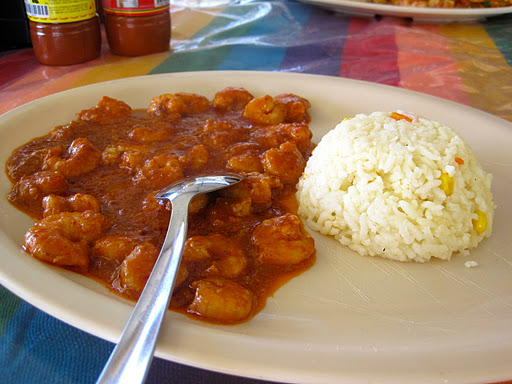
Despite the pull of the ceviche de jaiba and other cold dishes, we all ordered shrimp: camarones rancheros and
camarones a la diabla. Both were really tasty, portions were huge (we couldn’t finish), and
prices were definitely right: 80 pesos per plate.
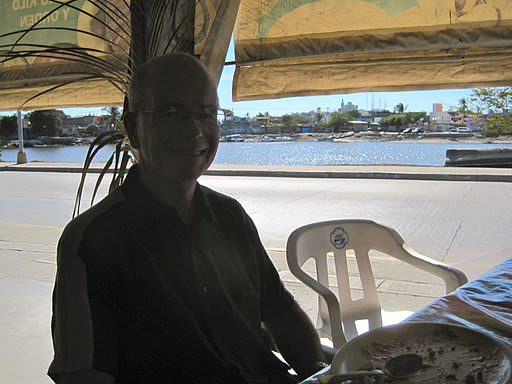
Plus, the view was very pleasant!
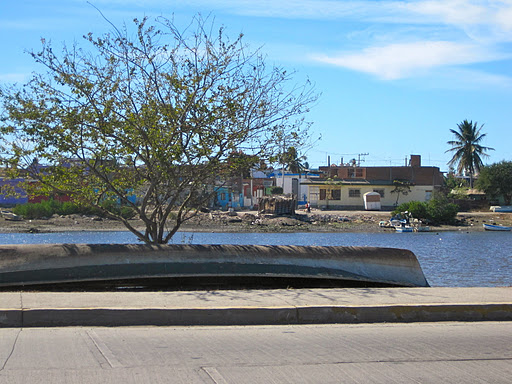
After lunch we drove around the other side of the estero, past the fishing pangas,
the waterfowl,
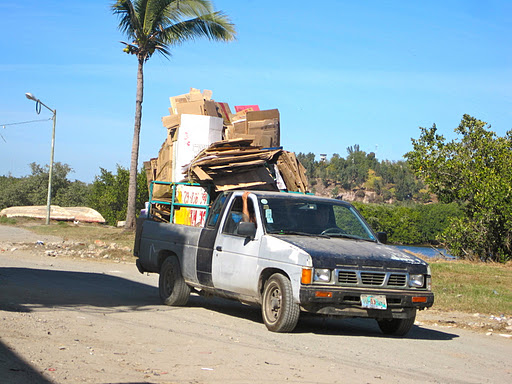
the recycling truck,
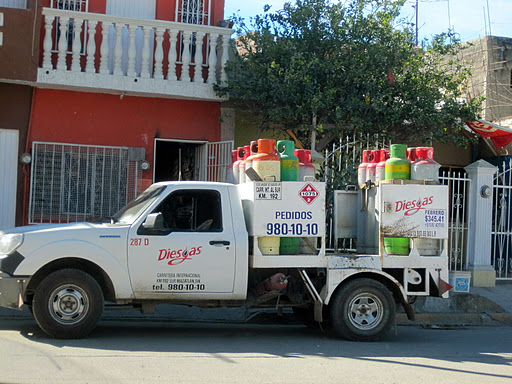
the gas delivery truck,
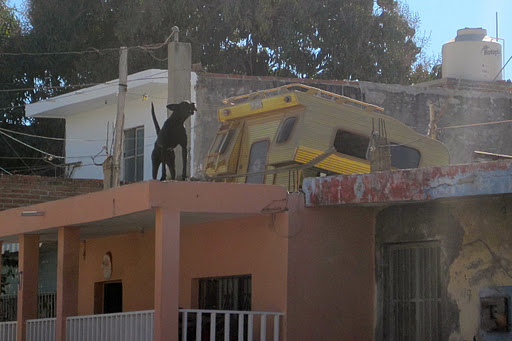
the roof dog protecting a roof-top camper shell (?),
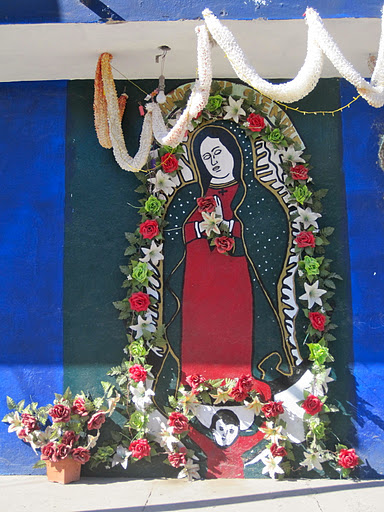
and a hand painted and festively decorated mural of the Virgen.
All in all, a most welcome mid-week respite to recharge our batteries and ground ourselves in the reality and security of our beloved city before we headed back to work.
We made a terrific new discovery today, out of the blue. A wonderful little restaurant right on the beach with a laid-back style and … drumroll please … a very creative menu: Jamaican jerk beef, sun dried tomato quiche, shiitake mushroom and vegetable spring rolls with mango-habanero salsa … How unusual is THAT for Mazatlán?
As if creativity weren’t enough (you know you can recite the ceviche/aguachile/pescado o camarones a la diabla, mojo de ajo o a la plancha of 90% of our local restaurants), items are made fresh, the menu changes weekly, and it includes lots of fresh veggies, salads and homemade soups. The owner loves music, so she chooses a musician of the week (this week is most rightly dedicated to recently departed Etta James) and tailors her weekly menu to the theme. As I said, creativity reigns in this place.
The restaurant, called “Surf’s Up,” is owned and operated by a vivacious young Canadian woman named Leanne Wright (that’s her at left, between my two boys). She relocated here from Vancouver a year ago, and together with her parents has spent the past year readying the cafe and an adjoining four-room bed and breakfast called “El Sol La Vida” for business. The “resort” opened nine weeks ago, and is located right next to Pueblo Bonito Emerald Bay (Camino al Delfín #520) in Sabalo Cerritos. It is definitely worth the drive!
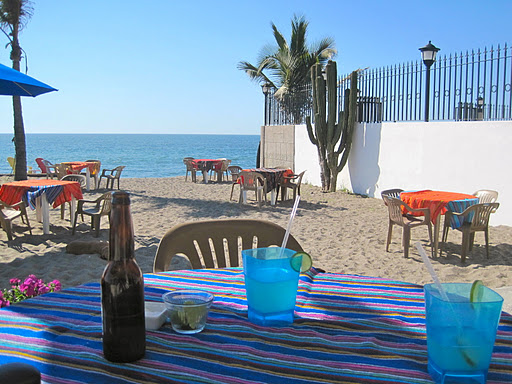
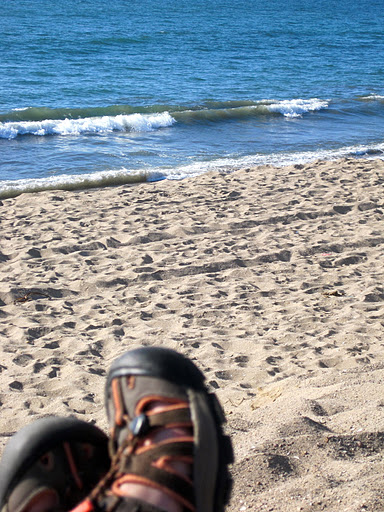
The inviting interior with open kitchen seats maybe 20-24 people, and there are outdoor terrace tables as well as numerous tables on the beach. The view is spectacular, the setting very peaceful and yet vibrant. Surf’s Up is open Wednesday through Saturday 8 am – 4 pm, and any evening for dinner with a prior reservation (669-164-1896). They also serve a Sunday brunch from 10 – 4. In addition to the substantial meal menu, there is a full coffee menu (lattes, cappuccinos, frappes).
Leanne (that’s her at left, between my two boys) told us she’s worked in food service for 14 years, and loves to travel the world taking cooking lessons with top chefs (this summer she’ll be in Tuscany). She buys breads from Héctor at Molika and produce from the new Organic Farmers’ Market in Plaza Zaragoza. Turns out that in addition to being an outgoing and upbeat cook with a keen sense of design (the whole place is really charming), she’s a highly ranked amateur boxer who will travel with the Canadian team to this summer’s London Olympics (she won’t be boxing, though, due to injuries from a car crash). And, no, she hasn’t yet made it to la cancha German Evers to see one of our local boxing matches.
There were three of us for lunch today, and we had the above-mentioned spring rolls served with a terrific side salad (spring mix lettuce with sweet onion, four colors of bell peppers, craisins, almonds and cheese);
a very tasty chicken tostada (the sweet onions made it);
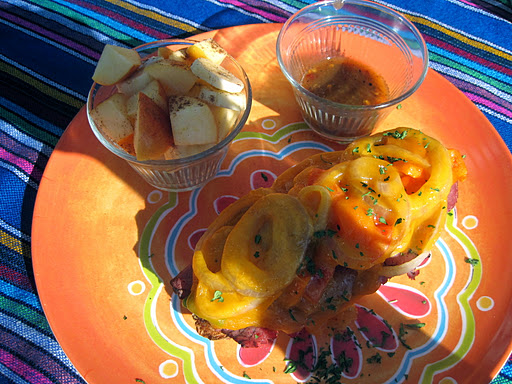
and roast beef on ciabatta with potato slices, two kinds of cheese, grilled onions, and mustard seeds. This last was listed on the menu as a breakfast item. The breakfast menu is lengthy and also creative, and is served all day.
For dessert we split a homemade oatmeal cookie with coconut, raisins and almonds. Leanne was just taking these out of the oven as we entered, and the smell was to-die-for. She also had slices of apple coconut cake available.
We all very much enjoyed our meals. Each of them was solidly good tasting, beautifully presented, and a welcome breath of fresh air in an exceptional setting. Keeping in mind this restaurant is only nine weeks young, it is our hope that as Leanne settles in and gets more comfortable, the flavor of her recipes will rise to the high level set by the creativity of her menu.
Menu items (most accompanied by soup or salad) ranged from 80 – 100 pesos, which we felt was very reasonable, though for some reason the hamburger is priced at a very high 150 pesos. Yes, it’s Henderson’s sirloin, but … My fear is that as Surf’s Up gets popular the extensive menu may have to be trimmed, and Leanne will obviously have to hire and train some more staff, which seems so often to make for difficulties with a new place. Changing menus each week can place added stress on a kitchen staff as well and quality may suffer; we will have to check back and see.
After lunch we toured the four rooms and common area of the bed and breakfast, El Sol La Vida. The rooms were large and airy. The wood carpentry has been beautifully done. All rooms except one had a terrace or patio.
Bathrooms have onyx sinks and marble tile work. Shower enclosures are glass block. Rooms are $129 Canadian per night, and the one without a terrace is $99/night.
Leanne’s parents were owner-operators of a garden center for years and it shows with wonderful landscaping and floral treats throughout the property.
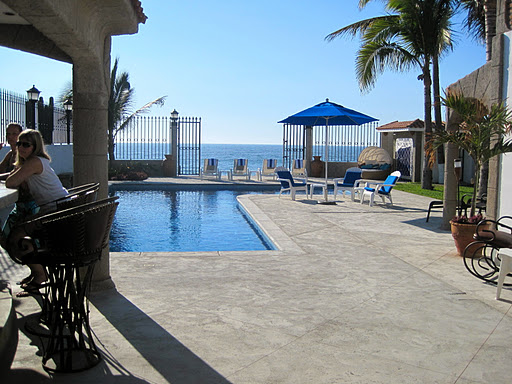
The pool is heated and well positioned. There is a poolside bar, and some incredibly comfortable-looking seating, plus easy access to the beach.
I wish Leanne and her parents all the best of luck! I do hope this place gains popularity in a way that will allow them to succeed; it has a terrific energy about it.
Welcome to Mazatlán, and thank you for being here!
One other small note:
As we drove in, we noticed a very interesting property next door. Danny said it reminded him of the Lord of the Rings. Sure enough, Leanne told us that the guy who built it had the book series in mind, and the 5-bedroom uniquely built place is now a rental property, called Sand Castle. Like elves? Check it out!
Our third stop on Meseta de Cacaxtla today was Los Llanitos. (Links to blog post 1/Chicayota or blog post 2/Guillermo Prieto) By the time we got there we had already decided we had had a terrific day. And it only got better! What a gorgeous place this was, by far the most economically successful, and the people were so much fun!
What stood out for me right away were the stories of jaguar in the area. I do hope that some day I might get to see one!
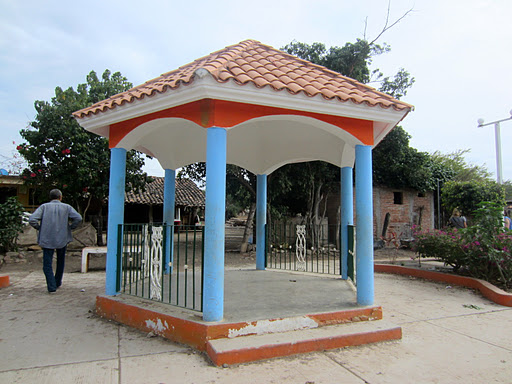
Los Llanitos was so fancy, after our previous two stops, that it even had a little kiosk in the plaza in the center of town! Very charming.
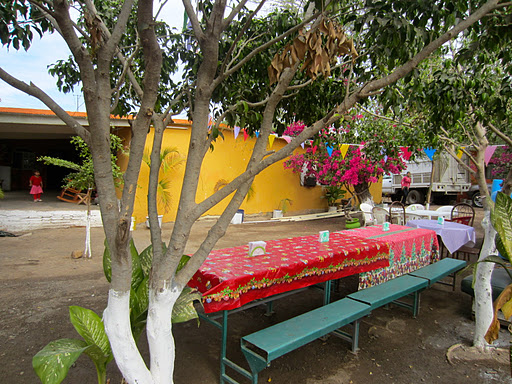
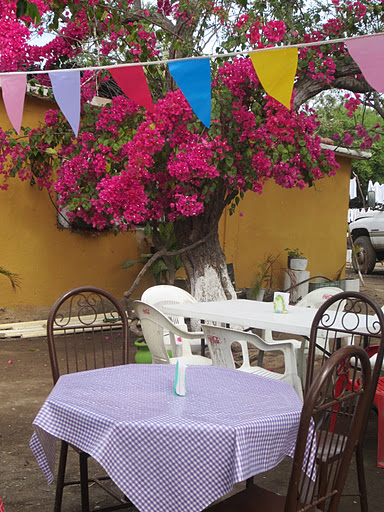
Our hosts were all ready to serve us lunch. I fell in love with the setting. It reminded me of picnicking in a vineyard in Italy, with the bright colors and flowers.
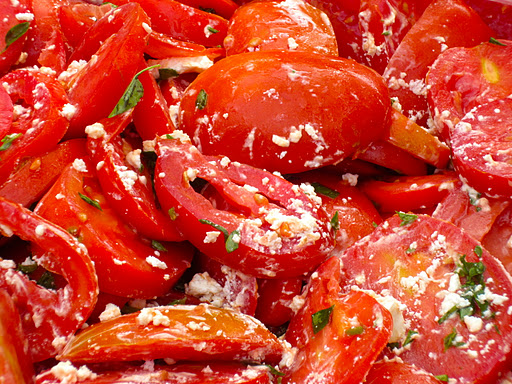
Carlos’ wife had taken some of the organic tomatoes, sliced them, and added goat cheese, fresh-picked basil, olive oil and a bit of low-sodium soy sauce. OMG! We were in HEAVEN!!!!! I think I ate about ten tomatoes they were so good!
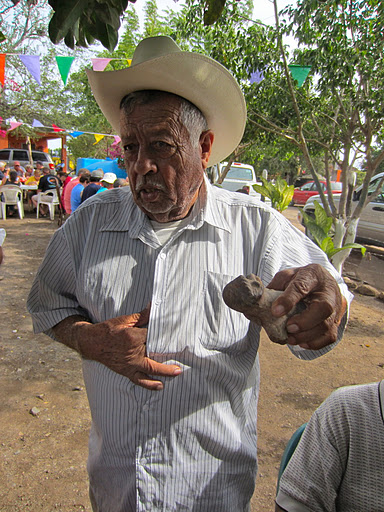
While we were munching, Maximiliano, the grandfather, started regaling us with stories of the pre-Hispanic artifacts he has found while tending his fields in Los Llanitos. The area, according to him, is home to the game of ulama; this town is where it originated, they say. Max brought out a couple of pottery figurines that he passed around to show us.
The figures had clear faces: eyes, nose and mouth, arms and legs. They seemed to be wearing shirts or tunics. They reminded me of the Chinese burial dolls, which I’ve also seen in Japan, as well as among some of the Pueblo Indians of the US Southwest.
Most fascinating to me, however, were what I first thought to be “angel wings” on the back of the dolls. Upon closer scrutiny, they seem to be the hands of other dolls. It would appear these dolls were part of a set or group of dolls, with one doll hugging the next.
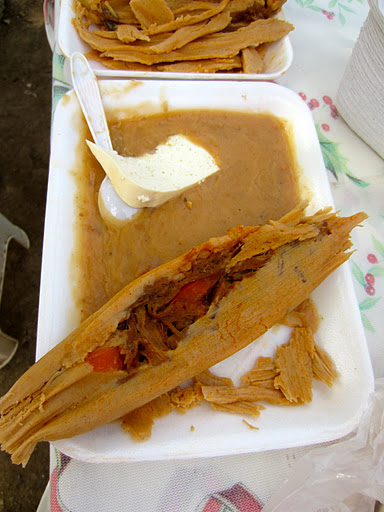
As if after our big breakfast and all the tomatoes we might still be hungry, our hosts in Los Llanitos brought out some of the best tamales I’ve ever had. Organic beef, tomato, chile, and squash, in a thin wrap of corn masa.
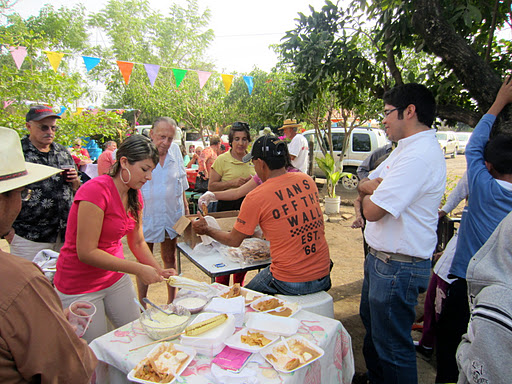
Followed by freshly harvested corn on the cob, which our pretty new friend proceeded to drench in fresh cream, cover with grated cheese, and serve up. Oh my!
But, no! That still wasn’t enough. There were homemade jamoncillos.
And my personal favorite, freshly baked empanadas de calabaza, pumpkin turnovers, made by one of the daughters in the family.
My new friend Consuelo lives in Mazatlán with her daughters. They are all three estilistas, beauticians who do manicures, makeup and hair styling. We hope to see them here again soon. She also has a son who was there for the winter holiday, Marcos. He is graduating soon as a biologist, from university in Ensenada, and will return to Los Llanitos to contribute to the local community.
The kids were really cute, but what really stood out for Greg and I were that the boys were sharpening knives for use in cockfighting or palenque. It seems they often hold cockfights in the backyard. I’ve seen men who love this, and I know families attend. I just didn’t realize that kids from such a young age raise chickens for fighting and get so excited about it.
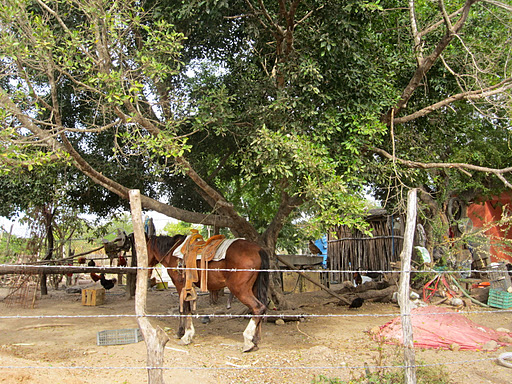
After lunch we walked or drove over to the fields, passing some corrals along the way.
One of Consuelo’s brothers, Gustavo, had a deerskin cell phone holder on his belt.
Gustavo, Greg, and his brother and daughter really hit it off well. They insisted we come back to visit soon, and we have every intention of doing so. This is obviously a very hard-working, wholesome Mazatlán community that we would love to get to know better.
The fields on one side of the road are organic. Gustavo told us the produce is mostly sold to Mexico City or exported abroad. They had many different kinds of vegetables here, scallions and corn. Acres and acres of green.
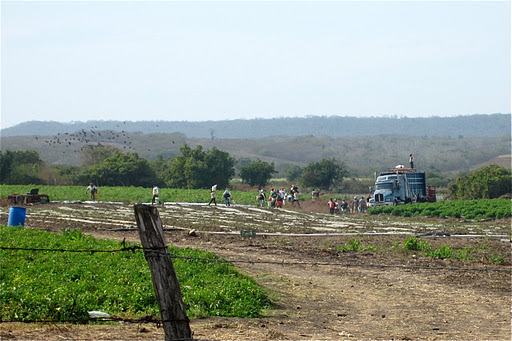
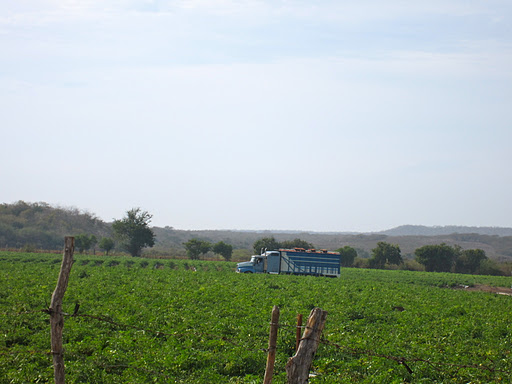
The fields on the other side of the road are “regular,” non-organic. These fields seemed to go on forever. We were there just as the field workers finished loading 16 TONS of tomatoes into a trailer truck, bound for DF.
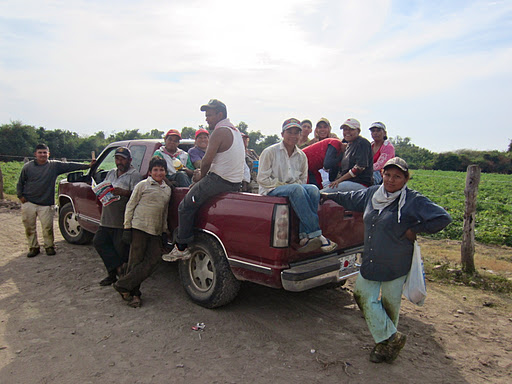
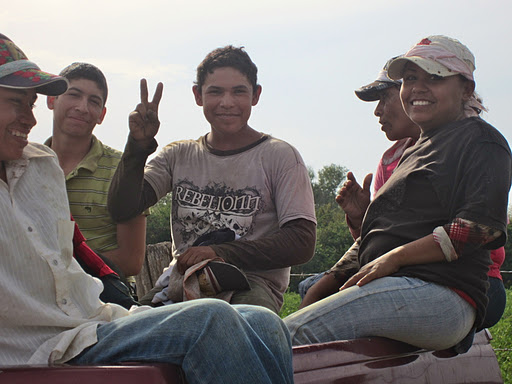
We had to leave earlier than the rest of the group, so we missed visiting the dairy and the “biodigestor” (compost system?). As we drove out, however, a group of field workers asked if I’d take their photo. Here it is, folks.
One young man in particular wishes to send a special hello to all the young ladies on Facebook 😉
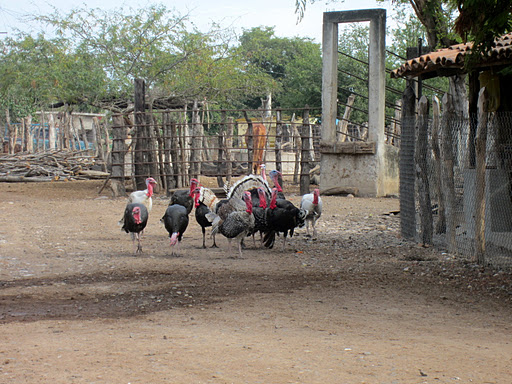
I’ll close with a beautiful shot that Greg took of some turkeys in the yard. It was a long and very wonderful day. Thank you, Martha, Gaby, and everyone else who helped make today happen. We are so happy to know you, and look forward to seeing you again soon and helping in any way we can to support you as you work to develop our area in environmentally respectful and sustainable ways.
Second stop on our tour today was at the organic community orchards and gardens of Comunidad Guillermo Prieto, a couple of kilometers north of La Chicayota on the highway. My oh my do they have beautiful produce! (If you missed it, link to blog post on our first stop, La Chicayota)
Lush, delicious, fresh; all they lack is a market. They sadly told us that much of their first-year bumper crop of scrumptious organic tomatoes went unsold! We of course immediately told them about the new Mazatlán Farmers’ Market/Mercado Orgánico de Mazatlán every Saturday morning in Plaza Zaragoza, Mazatlán. The cooperative’s leader, Sra. Sacramento, promised they would be here this Saturday to start the application process, so that their organic produce might also be sold there on Saturdays.
Sra. Sacramento… a beautiful name, don’t you think? That is her in the photo at left. When I told her she had a beautiful name, she said it’s what she’s been “saddled with” because when she was young her father moved north to tend fields in Sacramento, CA.
To Sacramento’s left, in the red shirt in the photo, is Carlos Carballo, an engineer, teacher of organic farming, holistic cattle raising, and ….
Hydroponics. These farms are located in an area of town that is sort of “off the grid.” The only source of water, other than private delivery by truck, is to have it piped in from Dimas, miles away. The water from Dimas is turned on once a day for two hours. To work around this shortage of water and be able to reuse some the precious water they do have, the community has turned to hydroponics.
Another difficulty facing the organic farms of Comunidad Guillermo Prieto is that they don’t have a steady market for their product. Traditional planting aggravates this market problem because crops ripen at the same time and need to be harvested quickly. Hydroponics, as we were told, allow the plants to root indoors in a greenhouse, protected from the sun, and provide the farmer a bit more leeway with when to put the plants in soil. In this way, the cooperative farmers can choose when to transplant a hydroponically rooted strawberry or lettuce plant, and extend the harvest!
Comunidad Guillermo Prieto uses two kinds of hydroponic systems. The first, as you see above and at left, is a tube system. The engineering uses readily available items (see the rebar holding the piping on the wood support).
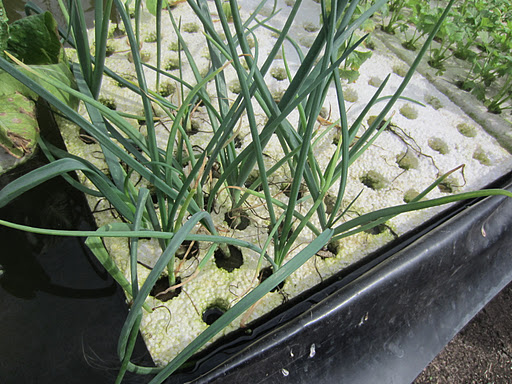
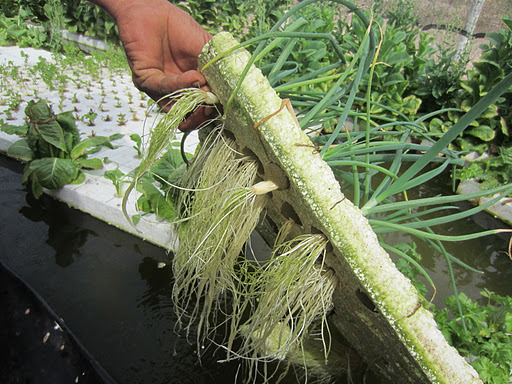
The second hydroponic system we saw here were floating gardens — plants rooting into the water through holes in styrofoam! It was really cool. Four times a day for 15 minutes each time, pumps are turned on to circulate and refresh the water.
We saw lots of kinds of lettuce, cilantro, and scallions growing in these floating gardens.
And here in the photo you can see how well the roots respond to the floating garden concept.
Because the community here doesn’t yet have sufficient greenhouse space or netting, they are unable to vine-ripen their organic tomatoes. If they allow the tomatoes to ripen on the vine, the birds eat their crop. Thus, they harvest them while still green, and allow the tomatoes to ripen inside the netted greenhouse, safely out of the way of the hungry birds.
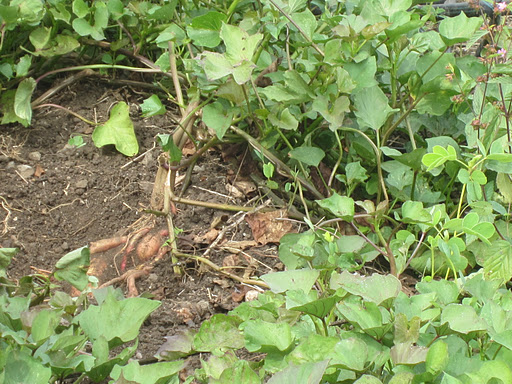
We saw a lot of different crops here, including peppers, camote(sweet potato), cherry tomatoes, and citrus fruits.
A bumblebee inside a camoteflower.
And some camote, peeking up through the soil.
A nice healthy broccoli plant…
Many thanks to our hosts. We weren’t able to spend a lot of time here. I would have loved to have toured the orchards and some of the other fields. As we left I was gifted with a huge bunch of basil and three gorgeously sweet grapefruit. I will be back, to buy some plants and produce, and to visit the terrific people we met. Thank you all!
(Link to third and final blog post from today’s journey, Los Llanitos)
UPDATE:
I am really happy to report that yesterday, Jan. 28, Sacramento and her crew were at the Mercado Orgánico Mazatlán. Conanp had submitted all their paperwork, and will be buying them a tent to aid their display. Hooray! So very happy that this trip and this post had a positive outcome in that way. Sacramento was psyched because they quickly sold out of greens and were well on their way to selling out of other vegetables as well. So glad also that MOM/Mazatlán Farmers Market and Conanp are also now in touch.
My previous experience with coffee in Mexico was Mexico City. I lived there during the summers from the time I was 13 till I was 19. Chilangos, in my experience, loved their coffee. My friends and I drank lots of expresso and cappuccino, over hours and hours of talking and laughing and generally enjoying being together. Most every restaurant we went to served delicious coffee drinks. Coffee grows in Mexico, it’s part of the traditional culture of the country, so I looked forward to this luxury when I moved to Mazatlán.
Thus, it was quite a shock to me when I discovered that most restaurants here in town, indeed, do not have an expresso machine! I’d order my beloved cappuccinos in a restaurant here in Mazatlán, and almost never would I get one. They only served that dreaded cafe americano, or worse yet, instant “Nescafé”! I’m not sure if the overall coffee culture has changed throughout Mexico, if it’s just DF that had that culture, or if it’s just Mazatlán that never really adopted a coffee culture. But here, I have to go to a coffee shop to get a good cup of cappuccino. With a few exceptions.
Every Friday we climb the lighthouse. Though my husband hates coffee, he generously and most kindly agrees to sit with me in the Looney Bean Olas Altas afterwards, prior to starting our work day. This last Friday something struck me. The place was really crowded, and it was puro gringo. This time of year all the snow birds are here, and El Centro in particular transforms itself. If I lived down there I’d be used to it, but it was a bit startling to me. So I started thinking. When I go out with my (local) girlfriends for coffee, it’s either late morning/noontime, or it’s in the evening around 8:00 or later. Then the coffee shops are filled with Nationals.
I like to drink coffee in the morning. Give me my caffeine; get my engine started! When Greg sits with me at a coffee shop in the morning, he says it’s like a methadone clinic: people are all anxious for their “fix”!!!! We wake up at 5:30 am Monday through Friday in order to get our son out the door to the school bus. Yes, I have an expresso machine; I can make my own cappuccinos. But I’d love to be able to go out and have a cup of good coffee early in the morning. Thus, my dismay when I moved here to discover that most coffee shops do not open till 10:00, a few at 9:00, many at 11:00 or later. Fortunately for me we have this wonderful gringo-owned, early-opening coffee shop in town!
Other differences: the length of time the patrons stay in the coffee shop; the comfort of the chairs; table side service or self-service; do the patrons eat or not, and how much (a pastry vs. a more substantial menu); sell “goods” (t-shirts, caps, bags of coffee) other than food or drink, or not.


























 ¡VidaMaz!