We have had several inquiries recently from parents who want to move to Mazatlán with their children. More and more Mazatleco-born parents seem to want to return here with their US-born-or-raised children, as well as Canadians and US American parents. So, I am reposting the below. Of particular importance to SEP (Mexican Education Ministry) is the apostille, and it takes the most effort on your part BEFORE you leave the USA or Canada, so be sure to get it before heading out, everyone!
The goal of this blog post is to explain some of the things we have learned while parenting a school-aged child in Mexico (or at least in Mazatlán, Sinaloa), and some of the contrasts with the US system of education. Much of the information below comes from the questions we are most frequently asked by those who are thinking about or planning to relocate.
Obviously the below is based on our experience as a family; many will have different opinions and experiences. It is worthwhile noting that people moving to Mexico City, Monterey or Guadalajara will have many more choices than we have here in the “provinces,” as they say in Spanish.
I hope some of this might help you as you think about relocating. I only wish this sort of information had been available to us when we moved!
Choosing a School Make the decision around choice of school…
My oh my oh my! Time most definitely does fly. This morning, as I was sitting in the Rigodanza Auditorium at ICO, looking out on the nearly 300-strong “Generación 59” graduating class, I just kept seeing them as youngsters! What a journey this has been.
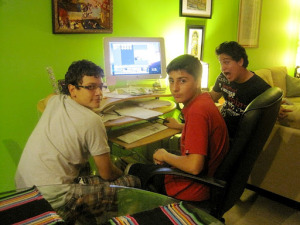
Six years ago, after our son Danny graduated primary school, we moved here to Mazatlán, Sinaloa, México, where he would start junior high. He didn’t speak Spanish, though he’d worked with a tutor twice a week for a year. So many people told us how crazy we were.
“Why in the world would you leave a Blue Ribbon School of Excellence for a Mexican school?”
“How dare you neglect your kid in this way! It is irresponsible parenting to move with a child to such a dangerous place.”
“We are from here. If we had any way to educate our kids anywhere else, we would. I can’t believe you’ve purposefully brought your son to Mazatlán.”
Well, we did purposefully bring our kid here. We wanted him to grow up as a member of a minority, to know how that feels—to build empathy, and to develop skills for living as a minority—a skill any global nomad needs, a valuable life skill, and one he may very well be needing soon as a “white boy” in his birth country (USA). So we had a passion and commitment in our choice to move here. But, really, with so many people, locals and foreigners, scolding us with such abandon for the past six years, what parent wouldn’t second-guess herself?
The past six years have not always been easy. Watch what you wish for! As a minority, Danny was (inadvertently) excluded from so many important communications about school, social gatherings, and sports practices. It was hard not to feel left out. He is a good actor, and was given one of the starring roles in a school play—unfortunately it was that of the ugly American boss who treats immigrants poorly and is only out for money. Really? Give me a break!
The first six months of our stay here were painful. As the person in our household with the best Spanish, it fell on me to tutor our son every night. Remember that in the eyes of a 13 year old boy, Moms know NOTHING. It was so frustrating, such a test of my patience, which is way too thin. Then, one night about six months into our lives here, he went to bed, and the next morning he understood Spanish. It was like a light switch flipped on. He didn’t understand everything, he didn’t speak or write perfectly, but I no longer needed to help him understand what his homework was.
The past few weeks this same young man, 18 now, has been interviewing local business and community leaders about our city’s future, what skills they feel our city needs, and how he might craft his studies and internships during university so that he can come back to Mazatlán and obtain a worthwhile position here. He loves this city as much as we do. He’s Mazatleco now; there is very often a culture gap between his immigrant parents and the Mexican, Blended Culture young man he’s become. Those interviewees are all telling him that his complete fluency in English and Spanish, his fluency with both cultures, is a huge asset that he must not lose when he goes to the US for school. He must find a way to retain and amplify it, ideally by adding Chinese language and culture. Wow.
He’s definitely not the same little boy who celebrated his 13th birthday at our pool with his brand-new school friends here, and was shocked as all get out when they gleefully shoved his face into the cake! What a surprise that was for him, especially when they all laughed. But he is much more flexible than his mother, and he took it all in stride, laughing and vamping for the crowd with frosting covering his face.
To those naysayers, who told us our son would not get a good education here, I am very relieved to have your prognostications proven wrong. Danny received an award from a Mexican university, and has fielded quite a few recruiting calls from other schools in Mexico. He also received six scholarships, several over US$80k, to well-respected US universities. He’s chosen a terrific small liberal arts college with an international focus, located in an ethnically rich metro area. I believe his incredible scholarship success is due, in major part, to the fact that he’s grown up abroad, and that he is able to demonstrate his biculturality and cultural bridging abilities. And the SAT scores show that, indeed, he received a very strong education here at local Mazatlán schools, both in junior high at Andes and in high school at ICO. He sure had a high school curriculum that put mine to shame—law, ecology, philosophy, ethics. My most heartfelt THANK YOUs to all his teachers—elementary, secondary and high school. Bless you for your patience and talent!
Today I had the huge privilege of speaking to Danny’s graduating class. I was part of a panel of six parents, given the opportunity to share with the kids what life has taught us. What an incredible gift for a gringa Mom to feel included in this way! To me it is a testament to the open-mindedness of the Xaverian education at ICO. Our panel included business owners and housewives, parents who graduated from name universities and those who attended technical school, locals as well as those from outside Mazatlán. I loved sitting up front, looking out and seeing the young men and women who have frequented our pool, our home, our beach, my son’s life. I felt distracted as I spoke, so hoping that those kids who are staying in town to study will stay in touch with us, despite the fact that Danny is leaving. Several of them feel like my own children, and I kept getting teary eyed.
For those of you who have followed our family on this journey, thank you for your companionship. I am very happy to report that, so far, the experiment has been a success. As Danny, who did not want to move to Mazatlán in 2008, said to us on our first anniversary here, “One year since the best decision we ever made!”
The next journey will be reentry: learning how to live happily, productively, and multiculturally, in the US of A. And, of course, learning how to do those same things in college!
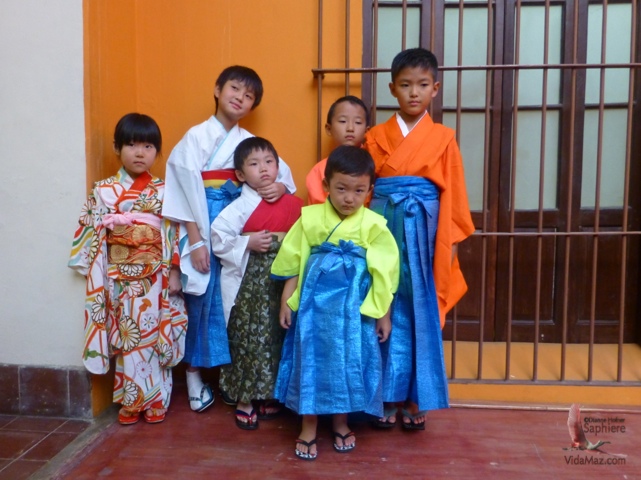
Some of our gorgeous Mazatleco Japanese kids, including my friend Chika’s children, wearing hakama and kimono for the occasion.
Well, the 12th National Nikkei/Japanese-Mexican Convention is coming to a close. Events included the election of “Miss Nikkei,” a dozen or so incredible conferences, an early morning dance on the beach combining traditional Japanese buyo and Aztec dancing—to symbolize the Mexican-Japanese mix. We had kimono, happi and hakama, t-shirts with the Mazatlán deer sketched in kanji characters, origami paper folding and shoudo calligraphy, and a terrific, quite large ikebana/flower arranging display. Kudos to the unbelievable Esperanza Kasuga and all the convention organizers, staff, and volunteers!!!! お疲れさまです!!!!Over 400 people registered for the full convention, and thousands of people attended the events this week, commemorating 400 years of Mexico-Japan relations.
One of the conferences
Two huge ikebana arrangements at the front of the main hall
The Hasekura ship from the Carnavál parade, parked in front of the Convention Center
Origami/folded paper booth at the Convention Center
Guillermo Osuna, volunteer extraordinaire, speaks with Dr. Kuroda
The Ambassador, Senator, and Mrs. Kasuga
Esperanza and the visiting dignitaries cut the ribbon of the photo exhibit
It was wonderful to meet so many people who were so thrilled to meet others with whom they share so much in common, and great to learn more of the history of Japanese people in Sinaloa and in Mexico. I met Mrs. Nakamichi, for example, who was joyfully proud to tell me about her grandfather (speaking in the video below, in front of a photo of her grandfather):
I was especially psyched to learn that kamaboko, traditional Japanese fish cake, is made right here in Mazatlán! How could I have lived here six years and not known that?! I am told I can buy it at Ricamar, which is on the right side as you head to the airport, just past Café Marino. Yippeee!!!
Some of Ricamar’s products
Local-made kamaboko!
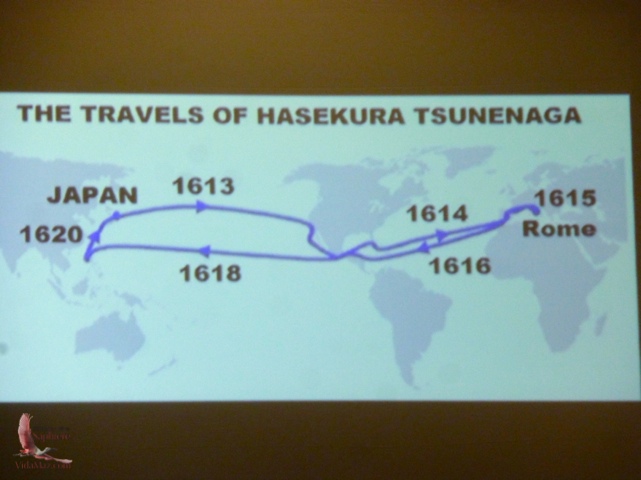
I loved the simple graphic below, outlining the first voyage of Japanese people to Mexico, then to Europe, and back again. Hasekura sure had perseverance and an adventurous spirit, as did Japan’s first immigrants to Mexico.
I was privileged to meet Hirofumi Nakasone, the Japanese Senator from Gumma Prefecture and former Minister of Foreign Affairs as well as Minister of Education (I met his father, the Prime Minister, years ago and immediately noted the family resemblance), along with Shuichiro Megata, Japanese Ambassador to Mexico, in Casa Haas at the opening of the historical photo exhibit on Friday.
Mr. Megata, myself, and Mr. Nakasone
My friend Joaquin Hernández showed us a few volumes from his astounding book collection, and I absolutely fell in love with this wood block print of Mazatlán. We are blessed with so many incredible intellectuals and all-around terrific people here, I am consistently amazed.
Mazatlán, Ukiyoe style. I need this!!!
Joaquín Hernández with the book
Another of Joaquín’s books
Another of Joaquín’s books
Need to find this book or a blowup of the Mazatlán image…
The photo exhibit at Casa Haas will be open for two or three more weeks, I am told, so do not miss it. In the rear room is a film made by a Japanese-Mexican woman from El Rosario, Sachiko Uzeta Amano, entitled, Del Otro Lado del Mar. The film was made in 1997 to commemorate the 100th anniversary of the arrival of Japan’s first immigrants to Mexico, and discusses their descendants cultural integration into Mexico and preservation of their Japanese heritage. I’ll have to go back in order to watch the whole thing. Seeing traditional Japanese festival accoutrements alongside the Virgen de Guadalupe sort of blew my mind!
Kitaoka brother and sister with a photo from their childhood
The ambassador, the senator, and Esperanza with the gorgeous kids
Japanese in Sinaloa celebrate the coronation of the Showa Emperor on 10 Nov. 1928
Japanese Association of Mazatlán celebrates the birthday of the Taisho Emperor in 1926; he died that December.
Esperanza with her family members
Working the fields in Ahome, Sinaloa
Around 1930, Ahome, Sinaloa
Japanese citizenship and Mexican immigration documents
Our dear Mexican virgin being celebrated by the Japanese-Mexican community
Information on the movie showing in Casa Haas during the photo exhibit
Below is a highlight reel of Friday night’s Nikkei Convention concert in the Angela Peralta Theater, with interview from baritone Adán Pérez.
Tomorrow, Friday March 14 at 11:00 AM Salon El Dorado at the Hotel Playa Mazatlán
Meeting with Sub-Procuraduría de Justicia Zona Sur
(Attorney General of Sinaloa) Lic. Marco Antonio Higuera
The Attorney General would like to meet with the foreign community in Mazatlán to discuss the topic of extortion in Sinaloa. The Attorney General and other state prosecutors have expressed concern over extortions and wish to brief the foreign community on extortions and how to avoid them.
In February I wrote you all a blog post about scams and extortions. While I believe such scams are no more common here than in many other places, the approaches here are a bit culturally distinct from scam approaches in other parts of the world. We all are wise to know how to respond in locally appropriate ways. I believe it is wonderful that Lic. Higuera is taking his time and attention to share his advice and guidance with us! Please spread the word! See you there!
How in the world could we possibly top last year’s amazing Carnavál? The theme in 2013 was the movies. Everyone loves a good picture show, and last year’s parade most definitely made the most of that love! I figured there was no way anyone could top last year, so I was mentally prepared not to be sent over the moon by this year’s parade. NOT! Both 2014 Carnavál parades were incredible! The 34 floats, 23 dance troupes and 16 musical groups made for an absolutely fantastic nearly four hour event!
I love that we have two parades. For us, living here on the north end of the malecón, the first parade is an evening into night affair, making for a tremendous street party. The floats in the parade are all aglow, and the dancers are in party mode, grabbing us from our seats and cena on the curb to join in the merriment with them. The second parade, on Tuesday, has the floats lining up in front of our house from just after noon, ready for picture taking in the full light of day. The dancers and royalty come out about an hour before the parade, and it’s the most incredible photo opportunity of the entire year—dancers putting makeup on each other or rehearsing dance steps, bands warming up their instruments and tunes, people stretching, eating, laughing. I absolutely love both these events.
To me the very best thing about Carnavál Internacional de Mazatlán is that it’s a family affair. Nearly every family in town has a member who’s been Carnavál royalty, even if it’s a cousin or aunt, and nearly every Patasalada has danced in Carnavál at some point in his or her life. Royalty celebrate their silver and golden anniversaries, and what a joy it is to see them relive the original thrill, often accompanied by their children! Young children and grandparents dance in the parade, even though it’s such a long route. Several years ago I had a good friend from Mexico City who just hated Carnavál. She thought it was low class and tacky. What she hated most were what she called the beauty contests—that young people were taught to value superficial beauty rather than brains or talent. While I tend to agree with her about beauty contests in general, and I am very much saddened by the shadow cast over the voting for Queen of Carnavál the past few years and hopeful the process will become more transparent, the fact is that Carnavál is a festival of the people. It is much, much, MUCH more than a beauty pageant, involving literature, poetry and painting competitions, concerts galore, fireworks, a food festival, bullfight, several “manifestations” or pre-Carnavál energy-building events, the pomp and circumstance of the coronations, the parades and, of course, the huge street party in Olas Altas for six nights straight. Mazatlán has over a month’s worth of Carnavál-related events, and there’s enough variety to please everyone. Click on any photo below to enlarge it or view a slideshow.
Royal float
Young princesses
And Grandma Queens
Everyone’s royalty at Carnavál
King of Joy Adolfo Blanco
Floral Games float
DIF Queens from the different colonies of Mazatlán
Young royalty
Pretty in pink
Queen of Carnavál float
Floral Games float
Kids rule at the parade. Most of the dancers and musicians are teenagers, children or young adults, joining their friends from dance class, gymnastics, or school. They’ve worked for months to raise money for costumes and props, and have rehearsed their hearts out. They are eager to burst with joy and energy during that first parade. Then, by the second parade on Tuesday, they transform into relaxed, experienced parade marchers, more confident of themselves and the crowd around them.
Masked youth
Pierrot
Acrobats
Fairies
Growing into their bodies
Fun with friends
Hanging out
Helping with makeup
Hi!
Ready to play!
Can I get on the horse?
Vamping for the camera
REady to roll!
Eye makeup and false eyelashes
Lining up
Resting and readying
Ready to go
Smiles of joy
Clowning around
Miming
Samba man
And another samba man
Kisses!
Smiling after all that dancing!
Venetian masks
Venetian Carnavál
In Palazzo Ducale
Who are they? 😉
Hello!!!
A royal wave
Having fun
Ready for the ball
Japanese comparsa
Viva Japan-Mexico!
Africa was represented
Truck driver brings his daughter
The pre-parade sponsors
Cutie patootie
Shouts of joy
Amazon was represented
Gymnastics and hip hop dancing
Gorgeous young people
The other star of the parades is the setting—the route goes along the malecón, south to north on Sunday, then north to south on Tuesday, with a clear view out to the ocean and the islands of our bay, the glittering lights of downtown, and the changing colored lights of Valentino’s on the northern end.
Sunset over the parade route
Helicopter patroling for safety
Floats ready to go for the second parade
Sunset over the parade route
Sunset over the parade route
Sunset over the parade route
Sunset over the parade route
Monigote and the crowd
Floats ready to go for the second parade
Candy! Candy!
So, what made 2014 stand out for me? The most notable difference for me was the crowds! Usually people set out their chairs the night before the big day, but this year was unreal. There were solid chairs from one end of the parade route to the other, and it was reported that over 800,000 people—twice the population of the city—turned out to watch the first parade! We had three families that did not join our party because they couldn’t get through the crowd to get to us! It was a-m-a-z-i-n-g! The mayor tested out a bleacher system which seemed very popular with those wanting a seat at the last minute, but that met with huge pushback from those opposed to selling seats along the malecón. While I’d love to see seats and space continue to be free of charge, something obviously has to give if the crowds keep growing like they are. I’m sure we had many more spectators this year who joined us from Durango, Zacatecas and beyond, thanks to the new highway.
Last year you’ll remember that CULTURA invited a special group from Brazil to join us. They were scantily clad and a huge hit. I believe that is perhaps what influenced another change that we noticed this year: much sexier costumes, and many more scantily clad dancers. Several of the floats had hired models dancing on them, fortunately including scantily clad men as well as women, so everyone could enjoy. I noticed quite a few of the kids’ dance groups had sexier-than-usual garb, also. Perhaps that was in keeping with this year’s theme, Piel del Mar or “Skin of the Sea.”
My personal favorite float this year was the Venetian float that Francisco Igartúa made for Marcela I, Queen of the Floral Games. It transported all of us to the Palazzo Ducale, complete with a couple of gondola rides, and beautifully honored the style that Maestro Rigo Lewis established for royal carriages of Carnavál these past 50 years.
Gondolas of Venice on the malecón
Floral Games float
Floral Games float
Palazzo Ducale
Palazzo Ducale
Palazzo Ducale
Queen Lorena’s float was also incredible, representing Rio. It was begun by Maestro Rigo himself, and finished up by his family after his death. Suzset, the Child Queen’s float was also made by Maestro Rigo and the Lewis family, representing New Orleans. Maestro Jorge González Neri had a huge hit with the King of Joy, Adolfo Blanco’s, exuberant and colorful Cuban float. You can definitely see the different styles of the floats’ creators!
Royal float
Queen Lorena I
Queen of Carnavál float
Queen of Carnavál float
Queen Suzset
Queen Suzset’s float
Queen Suzset’s float
King of Joy Adolfo Blanco
King of Joy float
There were so many terrific floats, and also the LED-lit cars that we’ve grown to love these past few years. At least four continents were represented this year: the Americas, Europe, Africa and Asia. It was all definitely a feast for the senses!
Here are a few final pics of some of the dancers in this year’s parade. I hope you enjoyed it all as much as we did!
The past couple of year’s I’ve put together a video of Carnavál. This year, Mahatma Millan has already put together such a terrific one, that I figured I don’t need to bother. Let me share with you his terrific work:
Today is Ash Wednesday; Lent begins. Time to rest, reflect and recenter, after the exuberance and sleep deprival of the past week! Please, share with us your favorite part of Carnavál, in the comments below.


 The goal of this blog post is to explain some of the things we have learned while parenting a school-aged child in Mexico (or at least in Mazatlán, Sinaloa), and some of the contrasts with the US system of education. Much of the information below comes from the questions we are most frequently asked by those who are thinking about or planning to relocate.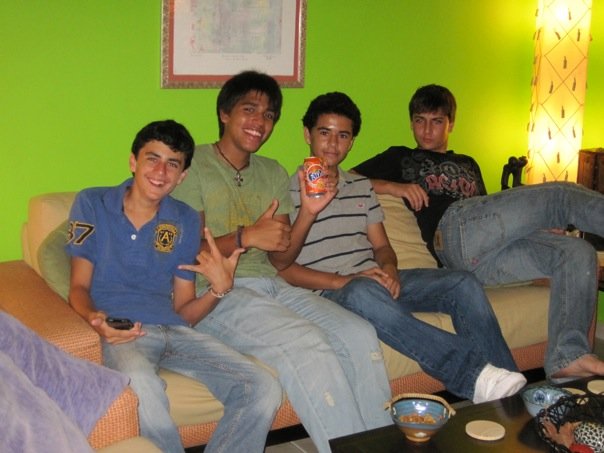








 ¡VidaMaz!