Lucha Libre: Despedida de El Angel

10370350_10203687017113077_2614208064520861891_n

Last night was a huge milestone in the life of a dear friend of ours, and also a major event in the sports history of Mazatlán. El Angel, the first world champion in Lucha Libre from Mazatlán, retired from the ring after a 30 year career. Some of you may know Tony Acuña, who owns a stand in the Pino Suarez Market, and previously owned several shops in the Golden Zone as well. We felt very privileged—and had oh-so-much-fun—helping him celebrate!

We invited a bunch of friends to this historic event—about 50 bought tickets to join us. I had been to Lucha Libre once before, in the bull ring, and don’t remember enjoying it very much. But last night ROCKED! I’d made signs supporting Angel, bought a bunch of noise makers, we all wore black shirts, and many of us bought masks as well. OH MY GOSH! Was it fun!

Yes, lucha libre is like a dance—one fighter follows the other’s lead, and there are some basic moves fighters must master plus variations and frills added on. It is absolutely full of joy, whether the luchadores are back-flipping off the ropes or hitting each other over the head with chairs. These men are up there to entertain. The luchadores are skilled athletes, many of them gymnasts. They love the kids, they take time to play with and take pics with the audience. They were even game to pose with us middle-aged sexy women 😉

Last night El Angel was joined by the very famous Blue Panther and the Mascarita Sagrada, who flew into town for this event. The Kempo Dragon, a young local lad with abs of steel and contact lenses that made his eyes look very spooky, was another hit with our group. We saw dozens of luchadores fight last night. It was a wonderful, action-packed, 3 1/2 hour event.

Most of the lucha teams last night—there were six or seven fights total—were composed of four members each. There is a técnicos team—the good guys, and the rudos team—the nasty guys. Booing the nasty guys is sooooo much fun! They came over and grabbed some of the signs I’d made, right out of my friends’ hands, and ripped them to shreds. My girlfriends scolded them and enjoyed themselves to pieces yelling at and then posing with them.

Our son had several young adult friends with him, and I haven’t seen them so happy since Carnavál.

If you are like me, and you haven’t really been to Lucha Libre, because you weren’t expecting to like it much, I’d recommend you reconsider. Going in a large group, revving everyone up for the event, and having some noisemakers, t-shirts, and signs to make sure the event is fully enjoyed, will really help.

Beer is sold in the Cancha German Evers, and usually you can get ceviche or salchichas or some other snacks as well. Masks are sold, as well as some other toys for the kids, and a guy walks around selling peanuts and chips. Highly recommended.

10306773_10204278646310736_8016062870084480031_n

La Cancha German Evers/German Evers Gymnasium is way up at the beginning of Zaragoza. It is across the street from the girl’s orphanage. Remember that Zaragoza is a one-way street. Both boxing and lucha libre are held here. Taxis and pulmonías wait out front to take people home after the events.

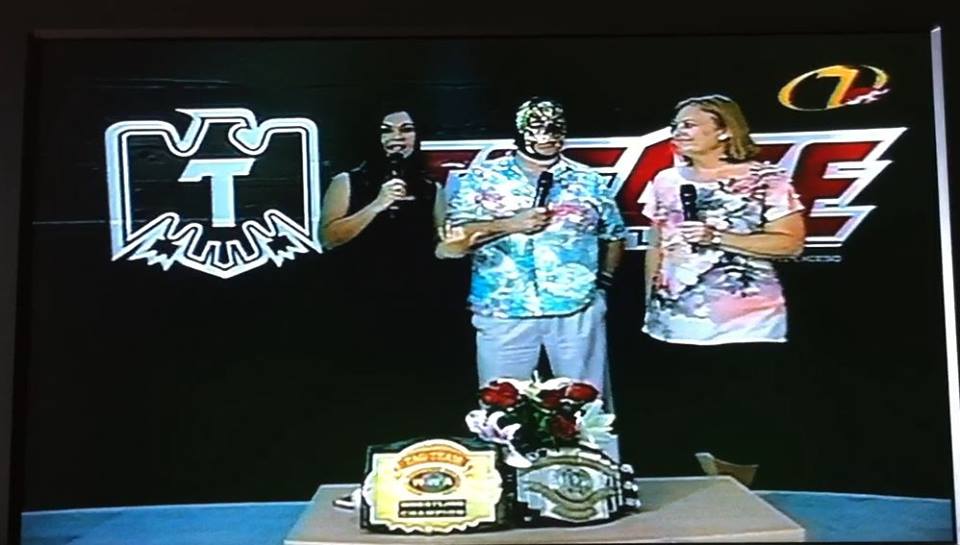
People ask me how they can know when there is a lucha libre or a boxing match. The sports section of the newspaper is the easiest bet. These events are also announced on radio and television sports programs (shot of me below on TV with El Angel), and on posters all over town. Keep your eyes and ears open!
10418402_10204265167493774_8876339337473679203_n

Tony, congratulations on an outstanding career! Thank you for doing so much to promote the sport in Mazatlán and throughout the Americas! We are proud to call you friend. And everyone who joined us, thank you for coming and for making this night so very special for Tony! PS, the mask-maker was VERY psyched to sell so much last night, and hopefully he’ll now be able to get his hip surgery done!


Nikkei Convention—Japanese in Mexico

P1130638

Some of our gorgeous Mazatleco Japanese kids, including my friend Chika’s children,
wearing hakama and kimono for the occasion.

Well, the 12th National Nikkei/Japanese-Mexican Convention is coming to a close. Events included the election of “Miss Nikkei,” a dozen or so incredible conferences, an early morning dance on the beach combining traditional Japanese buyo and Aztec dancing—to symbolize the Mexican-Japanese mix. We had kimono, happi and hakama, t-shirts with the Mazatlán deer sketched in kanji characters, origami paper folding and shoudo calligraphy, and a terrific, quite large ikebana/flower arranging display. Kudos to the unbelievable Esperanza Kasuga and all the convention organizers, staff, and volunteers!!!! お疲れさまです!!!!Over 400 people registered for the full convention, and thousands of people attended the events this week, commemorating 400 years of Mexico-Japan relations.

It was wonderful to meet so many people who were so thrilled to meet others with whom they share so much in common, and great to learn more of the history of Japanese people in Sinaloa and in Mexico. I met Mrs. Nakamichi, for example, who was joyfully proud to tell me about her grandfather (speaking in the video below, in front of a photo of her grandfather):

I was especially psyched to learn that kamaboko, traditional Japanese fish cake, is made right here in Mazatlán! How could I have lived here six years and not known that?! I am told I can buy it at Ricamar, which is on the right side as you head to the airport, just past Café Marino. Yippeee!!!

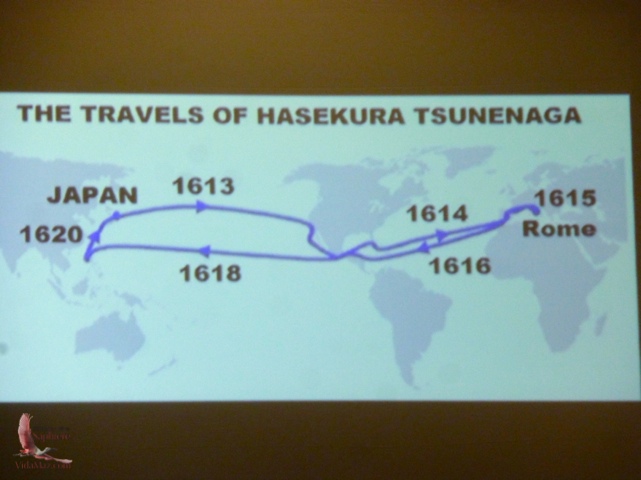
I loved the simple graphic below, outlining the first voyage of Japanese people to Mexico, then to Europe, and back again. Hasekura sure had perseverance and an adventurous spirit, as did Japan’s first immigrants to Mexico.

P1130606

I was privileged to meet Hirofumi Nakasone, the Japanese Senator from Gumma Prefecture and former Minister of Foreign Affairs as well as Minister of Education (I met his father, the Prime Minister, years ago and immediately noted the family resemblance), along with Shuichiro Megata, Japanese Ambassador to Mexico, in Casa Haas at the opening of the historical photo exhibit on Friday.

P1130701

Mr. Megata, myself, and Mr. Nakasone

My friend Joaquin Hernández showed us a few volumes from his astounding book collection, and I absolutely fell in love with this wood block print of Mazatlán. We are blessed with so many incredible intellectuals and all-around terrific people here, I am consistently amazed.

The photo exhibit at Casa Haas will be open for two or three more weeks, I am told, so do not miss it. In the rear room is a film made by a Japanese-Mexican woman from El Rosario, Sachiko Uzeta Amano, entitled, Del Otro Lado del Mar. The film was made in 1997 to commemorate the 100th anniversary of the arrival of Japan’s first immigrants to Mexico, and discusses their descendants cultural integration into Mexico and preservation of their Japanese heritage. I’ll have to go back in order to watch the whole thing. Seeing traditional Japanese festival accoutrements alongside the Virgen de Guadalupe sort of blew my mind!

Below is a highlight reel of Friday night’s Nikkei Convention concert in the Angela Peralta Theater, with interview from baritone Adán Pérez.

MZT: Center of Run for Fun

In the many years we’ve loved Mazatlán, a whole lot has changed. In the six years that we have lived here full time, one hugely noticeable difference is the focus on sports. It perhaps started with the Triathlon del Pacífico, now a hugely successful annual event.

We live on the malecón, right in front of the baseball stadium, and every weekend it seems there is at least one sporting event: a marathon, fun run, swim, bike, or mini-triathlon. Yesterday there was a big run in the Bosque/City Park. All weekend is the 4-wheeler/off-road race, Ruta PataSalada. This morning is another run in the Bosque, and, wonderfully for us, a 2 km obstacle course race on the beach in front of our house.

This slideshow requires JavaScript.

Participants, as you can see in the slideshow above, had to crawl, military style, under yellow tape. In another challenge they had to climb over huge sandbags and a pile of tires. The greatest part, however, was the finish. A fun-loving group of school kids dressed as Lucha Libre wrestlers jumped on and attempted to tackle the competitors as each of them reached the finish line. Can you imagine running in the sand, navigating obstacles and when the finish line is finally in sight, a line of would be luchadores is waiting for you?  It was a total hoot as you can see in the video below:

Mexico surpassed the USA in 2013 to become the country with the highest rate of obesity in the world—33% of Mexicans are overweight. Mexico still ranks second behind the US in rates of diabetes—one in six people here have the disease, and 70,000 Mexicans a year die from it. This change in the culture of our city, to get people out and moving, and most importantly, enjoying themselves while doing it, is an enormously welcome culture change!

One frustration is that it is often hard to get good facts about events like today’s. They are advertised on the radio, in some of the fitness centers around town and sometimes mentioned in the paper. Luckily, we have two very good sources here in Mazatlan. The Mazatlan Running Group page on Facebook is a great source of information on various runs in the area. There is also an awesome blog called Carreras atléticas en Mazatlán. I do not know the writer of this blog, Xavier Padilla, but he takes a lot of time to find all of the information about running events as it becomes available here in Mazatlan. Gracias Xavier.

Greg sat out today as he is training for the 5 and 10K next weekend at the army base. We have always wanted to go to the base as it has truly unique views of Mazatlan. Greg practices running hills each week, so whatever the Mexican army has in store for him should not be too much of an issue. There is also another larger obstacle type race on April 12, the beginning of Semana Santa. This race will be in the Golden Zone at or near the paintball facility. It’s called La Carrera de la Bestia or The Run of the Beast. You can read about it on the blog in the paragraph above, but here is a picture of the course—get your reading glasses ready:

This the course for the Run of the Beast on April 12, 2014

This the course for the Run of the Beast on April 12, 2014

As you can see, it has  a pool of mud, a labyrinth, walls, a pool of ice and many more challenges. If we were not leaving town, Greg would be in this for sure. Hopefully some of you will sign up and report back—guest blog posts are welcome.

Stretch before and after, hydrate and train—see you outside!

Farm to Table 2014—O•M•G!!!!!

1.P1100281

THE best meal we’ve had in six years in Mazatlán. Really. Good food involves the quality of the raw ingredients, the talent and creativity with which it’s prepared, the setting and ambience in which you eat it, and the magnificence of the people with whom you enjoy the meal. Today was cien por ciento, 100%!

Farm to Table 2014—the very first event of its kind in Mazatlán and, we believe, in Mexico. As with the first time for anything, we didn’t expect much. We hoped, but we didn’t expect. Well intentioned but poorly executed is the norm for first-time events. But no! This team pulled it off incredibly! An absolutely beautiful setting, a gorgeously perfect day, a multicultural, integrated group of very interesting, and fun-loving, intelligent people, amidst healthy, organic and delicious food, were all ours for leisurely enjoyment this afternoon. Every course, every single drink (from tequila to two wines to coffee), and the outdoor setting were beautiful! Kudos, kudos and more kudos to the organizers, chefs and servers!!!

About 100 people, including the mayor and his beautiful first lady, were seated in a field on Chuy Lizárraga’s farm at kilometer 21, just north of town. It was an absolutely perfect day—sunny, clear, yet cool enough to be enjoyable. No bugs, nothing uncomfortable, just pure unadulterated enjoyment!

Chefs from seven restaurants dedicated seven days of menus this past week to the “Farm to Table” event: Diego Becerra from El Presidio; Marianne Biascotti from Rico’s; Sarah Emerson & Gabriel Ocampo from First International Seafood House (F.I.S.H.); Enrique Espinoza of Rosso Nero; Enrique Freyre from Raggio; Hector Peniche of Molika & Krema; and Alastair Porteous of Water’s Edge. The culmination took place today at dinner in a farm field.

We were seated at long tables in the middle of a corn field, Italian style, decked out with fresh sunflowers, white linens, and all the wine and excellently prepared organic food the discriminating palate might desire. To top it all off, it was all in benefit of Avicultores Pérez Vidaña, an award-winning non-profit organization in Sinaloa that assists low-income families with severely handicapped children by teaching them to raise chickens and eggs for food. Proceeds from the event also support the Mercado Orgánico de Mazatlán’s educational programs.

Below is video of Sarah Emerson opening the meal.

Dinner (or lunch, if you prefer) consisted of eight different dishes, all prepared with organic ingredients and served family style: green salad, tabouleh, grilled veggies, chicken, quail, risotto, a dessert selection, and coffee with organic, artesanal ice cream. It was soooo wonderful to have so many vegetables, to eat one’s fill, and still feel healthy rather than weighted down! The sun was shining yet it wasn’t hot, the conversation flowed in several languages fluidly, and an excellent time was had by all.

Janet Blaser, the gorgeous, humble, hardworking, altruistic expat here in Mazatlán, has done sooooo much for our community. First she started M! Magazine, a bilingual publication we all love, which supplements other offerings and fills a much-needed gap here in town. Then she teamed with Verónica Rico, another absolutely beautiful, talented and intelligent woman, to establish the Mercado Orgánico, the MZT Farmers’ Market. None of us can imagine how we survived without the market all those years. And now, the two of them, plus a whole team of talented others, have given us the first Farm to Table Event! Below is video of her talk, just prior to dessert.

Jorge Luis Sanchez attended, a professor at UAS who also owns and operates his own organic farm. I learned soooo much by talking to him! Definitely want to take one of his classes! I suggested to Vero that they invite Jorge Luis to speak at one of the Saturday markets, so maybe that will happen. He knows so much about our environment, ecosystem, the human body, the origins of insecticides and herbicides and their impact on the world around us and our health, as well as having extensive knowledge about GMOs. With people like him in Sinaloa, our future is indeed bright!

May this be the first of many, many such excellent events. CONGRATULATIONS and thank you to all the organizers, chefs, wait staff and attendees!

Don’t Fall Prey to Scams!

extorcion

Scams are everywhere. From Canada to Chile, Russia to Italy, and China to Australia, you can bet con artists are eager to play with our ignorance (or innocence) and part us from our money.

North of the border we read so much advice about how to prevent online fraud, identity theft, or telephone scams. We know the criminals especially target retirees. Then we move to Mexico. The scams here are different. It’s a different place, a different culture. We need to learn the ropes, educate ourselves on how to avoid falling prey to a con. We may not know the language, or we may struggle with it, as well as with the customs and “fitting in.” Such factors can cause us doubt, feelings of powerlessness and thus, make us more prone to getting duped.

Con artists know human nature; they play on our hopes, fears and beliefs. And what’s one of the biggest stereotypical beliefs about Mexico these days? How violent it is—the preponderance of kidnappings and extortions. Most stereotypes are grounded in truth, but they become so generalized, applied so broadly, and become so firmly fixed in our psyches, that they become false “truths,” boxes into which we habitually throw people, without using our minds or our other senses as filters. The smallest glimmer of the stereotype in the back of our minds provides a direct beeline to our fear response. And that is just what the criminal wants, whether we’re a local or an immigrant.

Do you know the most common scam here in Mexico? It is a phone scam, 80% of which take place in private homes. Someone, most likely from a jail, calls our home. They either say they are our long-lost cousin or compadre who needs help, or they tell us they have our spouse or children held hostage. This latter is enough to get most anyone upset and, when we’re upset, we too often fail to act rationally. Remember that such phone scams are probably no worse than a scam north of the border but, because they play to our fears for our family, it can put us off balance. Think things through now, so that you are prepared if this happens to you.

Here is a summary of the advice I’ve most often read in the local press, about how to respond to a criminal call:

  1. First, think! Do we know the person on the line personally? Is this the person’s voice? Be assertive. Ask questions. Use common sense and intuition; if something doesn’t seem right, it’s probably not. Especially if the person is asking us to leave where we are, go outside, go into a hotel or certain store—don’t do it!
  2. Second, hang up. That is the advice we most often read in the local newspapers. If someone calls us and we don’t know who they are, especially if they are asking us questions or threatening us in any way, hang up. More often than not they will call back. Don’t pick up. We may worry about not understanding the Spanish, about offending someone by hanging up. But, if it doesn’t feel right, we are wise to trust our instincts.
  3. Never, ever, give out any personal information! This is true north and south of the border. If someone tells you they have your spouse or your children, or they are your long-lost cousin, don’t give them a name! Don’t tell them where you live. Don’t give them any information. Play the scenario through in your head, several times, so that the response will come more naturally should such a scam call ever come in. It’s a call we’re not prepared for. It plays to our deepest fears, and our deepest stereotypes. Don’t let it claim you.
  4. If you find yourself unable to hang up, press those on the phone for information. Plan this ahead of time, so you can think clearly in a crisis. Ask them what your spouse is wearing, or on which side of his head your (bald) spouse parts his hair. Hopefully hearing a wrong answer will then give us the courage to hang up the phone.
  5. Once you hang up, contact your spouse, children or cousin to verify that they are ok. You will feel better. Remind yourself that the caller was likely contacting you from outside Mazatlán. The most common calls here in town come from prison—and prisons even as far away as Tijuana! Most often, they just want spending money or time on their phones. But we’ve had friends, local and expat, who’ve given away much more than that. The caller is most likely not watching you or your family members. They are talking about kidnapping because they know it will more likely scare the money out of you.
  6. Call the police. That number is 066. Federal crime prevention can be reached at 088. The tourist police number is 669-914-8444. The anti-kidnapping unit can be reached at 01-800-3221-5803. Or, you can email noalfraudtelefonico@hotmail.com

Stay smart and safe, everyone! Remember, Mexico is a beautiful place, and we choose to live here for awesomely wonderful reasons. Like anywhere, we need to stay aware. Perhaps if we do, we can start to break the cycle of violence that is the kernel of truth in the stereotypes about our adopted home.