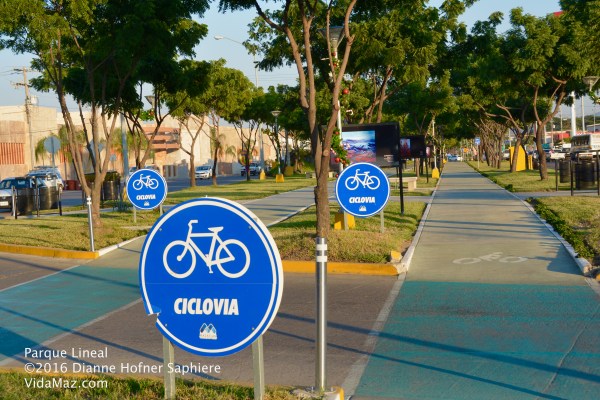
 Have you checked out the wonderful new Parque Lineal? It’s an incredible addition to our city, built to improve the quality of life of middle-class Mazatlecan families. The park provides much-needed green space for recreation and sports, and a secure place for families to play as well as for commuters on bicycles, in a very strategic area of town. Over 85,000 Mazatlecos can walk to the park and it is serviced by 28 transportation routes. I love the new space! It’s clean, green, and colorful, and you should visit it while it remains that way.
Officially called Parque Lineal Pérez Escobosa, it is 5.7 km long and is located in the median of Avenida Oscar Pérez Escobosa from Avenida Clouthier to Fraccionamiento Real Pacífico, passing right in front of Sendero Plaza. That median, you may recall, was previously an unkept, ugly ridge down the center of the road. The new park has a total of 42.7 hectares (105 acres) and cost approximately 130 million pesos, paid for with federal, state and municipal funds. Its stated purpose is to build community, bring families together, get people outdoors and physically active, and promote sports. It will bring economic benefits to the surrounding areas, and gives young people a safe and constructive place to hang out. Click on any photo to enlarge it or view a slideshow.
Called a “lung of the city,” the entire length of the park has grass, trees, and flowers watered by a sprinkler system. The park includes bicycle lanes, a skatepark, outdoor crossfit gyms, areas for exercise classes such as zumba and yoga, bicycle and pedal car rentals, a water park, basketball courts, tables to play chess and lotería, quite a few covered spaces for events, climbing bars and playgrounds, a jogging trail, picnic areas and barbecues, esplanades, pedestrian bridges, security and first aid stations (Municipal Police, firefighters, and Red Cross), restrooms and commercial concessions (cafes and snack stands). On the corner of Cristobál Colón is a beautiful fountain called Acueducto de los Cantaros. If you haven’t seen it or done more than drive by the park, you really should take a bike ride, walk, jog or car ride along the length of this new jewel of Mazatlán. Just know that parking is a hassle and crossing the street to get to the median is not for the faint-hearted.

The park has been built and unveiled in stages—the first section opened in March of 2015, and the sixth was dedicated in September of this year. The inaugurations were attended by Governor Malova, Mayor Felton, and the two different Secretaries of State Tourism who’ve had tenure during the two year period. The six parks-within-a-park are:
- Parque El Pata Salada, which was inaugurated in March 2015. It includes multi-use sports courts, outdoor gyms with stations for the differently abled, a jogging track, concrete walking trails, bicycle lanes, playground equipment, and a dog park that is not a run park like northerners might be used to, but has exercise or performance equipment to use with your leashed dog. It is 850 meters long, between Santa Rosa and Francisco Madera, and cost 18 million pesos.
- Parque de la Juventud opened in July of 2016 and is the most active portion of the park. It contains 850 meters of skateboard park, crossfit, open-air gyms, areas for exercise classes, bike lanes, bike rental, security, first aid, restrooms and commercial concessions, and represents a 20 million peso investment. It is between Avenida Francisco Madero and Highway 15 (Ejército Mexican). There are regular fitness classes held here, as well as in other areas of the park.

David and Rafael
- Parque del Arte y la Cultura, inaugurated in August of 2016, is located between Highway 15 (Ejército Mexicano) and Cristóbal Colón. At only 500 meters long, it’s the smallest of the six parks within Parque Lineal, and is designed to keep people connected to arts and culture. It features art exhibitions (painting, sculpture, photography) and performances (dance, poetry, theater), and was built at a cost of 7.6 million pesos.
- Parque de la Tranquilidad, which opened in Aug 2016, includes relaxation and exercise areas, a book lending library with computers, a cafeteria, green areas, jogging trails, bicycle lanes, a meditation garden, outdoor gym, a multi-use sports court, lighted esplanade, parking, security and first aid. This is where they projected the Festival Cervantino from Guanajuato earlier this year. This portion of Parque Lineal cost 22 million pesos.
- Parque de la Familia, where they cut the ribbon to open it in September of 2016, is located between Avenidas Manuel Clouthier and Munich, It is 1.5 km long and cost 36 million pesos. It has a jogging trail, bicycling lanes, picnic areas, barbecues, green areas and playground equipment, an open-air gym, a very cool pedestrian bridge over the Arroyo Jabalíes, three multi-use esplanades, and security.
- Parque de la Niñez was opened in two phases, with the second section that includes the water park opening most recently, in September. It’s between the streets Zapopan and Santa Rosa, 750 meters long, and cost 14 million pesos. This is a place for young children to play and has playgrounds, swings, slides and a colorful spray park.
I love bicycling, and it’s long been a dream of mine that our city would actually follow through on its plan to build ciclovías or bike lanes around town. One of the things I love most about the Parque Lineal is all the workers commuting in safe green space to and from work on their bikes! I still saw plenty of bikers not using the park, but rather riding on the street, so no doubt culture-change will take time.
As with any linear park around the world, in those places where major roads cross the park, walkers, joggers and bikers need to be very careful with the cross traffic. In some places city planners have installed topes/speed bumps on the cross-streets. I would hope those might be added in all along the route. Another great thing about the park is that the planners had the foresight to install loads of trashcans everywhere. Rather miraculous, no?
We know that many times public spaces get built and then fall into disrepair due to lack of maintenance (like that wonderful park for the differently abled that Rotary built, that’s now pretty much unusable) and vigilance (the Parque Lineal has already been hit by graffitists a couple of times, despite the security). I respect that this time the project seems to be much better thought-through: security on site, irrigation systems installed, LED lighting, first aid stations and commercial concessions, and an unbelievable amount of signage—very different from normal urban development projects here. In fact, there is SO much signage that I began to question who’s brother owns the sign shop. Let us hope that our beloved Mazatlecos can preserve this park in good condition and maintain it as intended: as a safe public space for the enjoyment and health of families.
The Christmas decorations that they’ve put up are really beautiful; yet another reason to get out soon and see this new park. It seems that instead of putting up Santa’s village, which for several years Mayor Felton and his wife installed in the Bosque/City Park, and then moved to the Plaza República, they invested in decorations here. The day I took photos a university was hosting a Christmas party for a group of local kids, transforming one of the covered areas into an energy-filled party zone.
I’ve read several articles saying that the Parque Lineal is the biggest in Mexico; you know how much people here love everything to be a record. However, Chapultepec Park in DF is 686 hectares (1695 acres), the largest in Latin America. Those claiming our park’s grandure may mean it’s the longest linear park or greenway in Mexico, but Parque El Encino in Chihuahua is 13.5 km long, and Ferrocarrilero in Aquas Calientes is 12 km. To me, Parque Lineal Pérez Escobosa doesn’t need to be Mexico’s biggest; it’s gorgeous, well-planned, -located and -built. Congratulations to all those involved! It will make a wonderful place to walk around and people-watch over the holidays.





 ¡VidaMaz!