Shark Tank, Mazatlán Style

dsc_0865UPDATE 3 February, 2017:
The aquarium is open again! Today a video purporting to be created by employees of the Aquarium is circulating on social media. It says that the Aquarium’s new director ordered employees to enter the tank and remove a yellow covering from the window shown above. As you can see in the photo, no yellow covering seems apparent. According to the video, the Aquarium personnel are not qualified to make any repairs or changes to the tank. Sadly, one erroneous hit with a tool, just as the workers finished, caused a crack in the acrylic. The video includes photos. It is hard to know, of course, what actually happened. To me this is hopeful, as it would mean the basic structure of the tank may be sound and the acrylic just needs replacing. Hopefully all will be sorted out soon.

UPDATE 2 February 2017:
The curved acrylic wall of the new shark tank, pictured above, cracked open yesterday afternoon about 6pm, just one and a half months after its inauguration. It was what so many had feared, given the storied history of the building of the tank and the final heated push to get it open before the change in city and state administrations. The rupture caused nearly two million liters of salt water to flood the surrounding area. Fortunately the fissure occurred after closing time, so no visitors were in the facility and staff were quickly evacuated. The Aquarium will be closed while a safety assessment is conducted and repairs are done. It has been reported that the 20 sharks and other sea animals are unharmed and will today be transferred to another tank. Mayor Pucheta promises legal action against those responsible for the shoddy design, labor or materials. Such a sad new chapter in this lengthy and expensive saga, and just before Carnavál.

Mazatlán’s long-awaited 2.5 million liter (660.5 thousand gallon) shark tank, which opened on December 23, includes one of those cool acrylic tubes you walk through to be completely surrounded by fish. The light in the kids’ eyes as they realize they are in the middle of a tank with 23 sharks is most definitely delightful.

Acuario de Mazatlán’s new Tiburonario was built at a cost of 80 million pesos over six years, two governors, three mayors and four aquarium directors; construction was far from the height of efficiency (final costs were 5x more than originally forecast), but unlike other projects, in the end this one delivered to us a first-rate attraction that will generate revenue and jobs for the city for years to come. The aquarium had 435,000 visitors in 2016—a 41% increase since 2013, and in early January when I visited the lines to enter snaked around the block and seating for shows was completely full. Last year the facility took in 20 million more pesos than in any prior year, and I have no doubt the new shark tank will add to that popularity. Click on any photo to enlarge it or view a slideshow.

I had the pleasure of spending the afternoon with the aquarium’s Director, Milay Quintero Beltrán, just days after she was sworn in to her new position. I was impressed with the knowledge she demonstrated with only four days on the job! Lic. Quintero is a public accountant and holds a master’s in human resources. Brenda García, the Director of Marketing, joined us on my visit. They both were charming, hospitable and extremely enthusiastic about the aquarium, and made sure I was hugged and kissed by a sea lion in a private show. I was guided through the rescue facility, including the veterinary clinic and the temperature-controlled building where the sea turtle eggs are hatched.

I had not visited the aquarium in a few years, remembering it as tired and outdated. Its recent major remodeling, which is nearly complete, is the first in 36 years and one well worth checking out. More modern architecture and new acrylic murals jazz up the space, and plans include a new restaurant beside the shark tank; more fish, additional decorations and finishing to the shark tank itself; overall remodeling and updating with a consistent tropical theme; and the addition of habitats for both penguins and dolphins! If, like me, you wonder why those tinacos/water tanks right in front are such an eyesore, Milay assured me they will be covered up shortly.

The Acuario de Mazatlán opened in September of 1980 as part of the Bosque de la Ciudad (city park) project. The one-hectare site includes 34 salt water and 17 fresh water exhibition tanks, a botanic garden with 75 kinds of trees from around the world, three aviaries, and Latin America’s only frog habitat. It has partnership agreements with both the Monterey Bay Aquarium in California and the Acuario de Veracruz. Mazatlán’s aquarium is administered by DIF (Family Development Department), SEMARNAT (Secretary of the Environment) and PROFECA (Environmental Protection). Its goals include education and rehabilitation. The aquarium regularly hosts school groups and collaborates with the Mexican Academy of Sciences to host “Science Saturdays” for local youth interested in science and technology. The on-site clinic has four veterinary staff who most commonly aid pelicans and sea turtles, but have been known to treat tigers, raccoons and all sorts of birds as well.
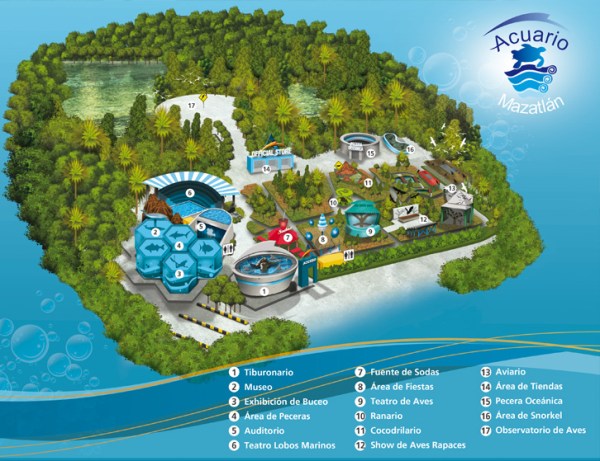
mapa-acuario-mazatlan

The aquarium’s sea turtle rescue program has protected over 4,500 nests and released nearly 300,000 babies. The hatchery facility is made of paja, or straw and clay walls, to keep the eggs at a consistent temperature. The eggs are all in OXXO coolers, as the chain of supermarkets sponsors the turtle rescue program. Did you know the eggs must be gathered from the beach within four hours of being laid? They gestate for about 40 days, and then the babies are immediately released. Mazatlán’s aquarium will host turtle specialists from all over Mexico in a convention February 7-9.

While sea turtle rescue is well known, you might not have heard about the aquarium’s Pato Pichichin program. The Pichichin ducks, who are in danger of extinction, reproduce on Bird Island, the northernmost island directly offshore—an environmentally protected area. Young pichichines leave the nest to come to Mazatlán’s lagoons, and some become separated from the flock. The aquarium receives about 300 of these babies annually. Aquarium staff also aid about 72 pelicans every year, most of them injured by fishing nets. Any wildlife that recovers sufficiently and is able to fend for itself is returned to its natural habitat.

The Acuario de Mazatlán is open 9 am to 5 pm every day of the week. You may, like me, be spoiled by having visited some of the world’s best aquariums. Mazatlán’s is much quainter in comparison. I went not expecting to enjoy myself, honestly, more out of curiosity, but I had a hoot of time! If you haven’t been, it’s well worth a visit.

In addition to the fish tanks there are extensive displays of reptiles, birds and amphibians. Admission includes access to all the shows; the four half-hour espectáculos run back-to-back from 10:30 am to 1:30 pm and 3:40 to 5:00 pm, and include tropical birds, sea lions, animals of prey and divers feeding the fish. Most of the aquarium’s show performers are rescue animals who cannot be returned to the wild.

Entry costs 115 pesos for adults and 85 pesos for children 3-11. Swimming with sharks or sea lions is an extra charge (300 and 400 pesos, respectively). The swimming still takes place in the aquarium’s original 123,000 liter main tank.

Did you know that sea lions live in captivity up to 40 years, and eat up to 25 kg of food per day? Or that an owl can turn its neck 270 degrees, not 360? I know you’ll pick up some more fun facts on your next visit, and greatly enjoy yourself. If you’re lucky, you might just get a sea lion kiss, too. Below is the official video from the inauguration of the shark tank.

Behind the Chamber 2017: Four-Note Opera


The eighth and final concert in this year’s 2017 Temporada Campbell will be held on Sunday, March 12, 2017 at noon  in the Angela Peralta Theater.

I interviewed Maestro Gordon Campbell and Guianeya Román in a sneak peek of the concert. To hear their “Behind the Chamber” interview about the performance click on the video below. Please note the video was created before a date change in the program; the date shown in the video is incorrect.

You can purchase your tickets for specific concerts (300 pesos each) or a series pass (2000 pesos) at the Angela Peralta Theater box office—open 9am-3pm and 5-7pm—or online at CULTURA Mazatlán.

15442147_1229524153781300_656067471523188239_n

Support the Camerata
Tax-deductible donations to recover costs of the Camerata and the community chorus are received by the Patronato Philomusica AC, Banco Bajio account number 14166839. Your donation is tax-deductible in Mexico and worldwide. Please help support the high caliber of arts in our community by pledging generously!

To watch other Behind-the-Chamber interviews click here.

Homemade Mobile Home

img_7509UPDATE 2 FEBRUARY:
Greg and I took Octavio to the doctor’s appointment that DIF had arranged. That doctor ordered an x-ray of his leg and gave him two boxes of pain medication. DIF wants to enroll Octavio in Seguro Popular, so he can get insurance and, thus, get care. However, he does not know his birthday, and it will take weeks to get a birth certificate and get him registered. Greg and I therefore offered to take Octavio to get the x-ray done, just so he could know his options and not have to wait so long. He will still get his birth certificate and register with Seguro Popular. The x-ray doctor recommended no surgery be done as all was healed, but said Octavio needs an insert in his shoes so he can walk better. He also needs a good cane, if any of you have one. We then took him to get the insert, but were told he needed a prescription from an orthopedic. One happened to be next door, so we took Octavio there. That doctor agreed that no surgery should be done. We will pick up the inserts today, and have a gently used pair of shoes for Octavio as well. We are hoping DIF will get him the medicines he needs and the inserts on an ongoing basis (every four months). I am hoping the kind ladies from Ojalá who so graciously offered to help might pay for the care he received yesterday; I’ll submit receipts to them. If you have a job that Octavio could do for you: painting, garden clean up, etc., he is very eager to work.

UPDATE 31 JANUARY:
I was able to get DIF involved. Dorita came out to interview Octavio, take photos, and approve him for a medical exam. They confirmed he is of sound mind, not on drugs or alcohol, and wants to get his life back. Greg and I will take him tomorrow and hopefully we can proceed towards treatment. Octavio will need official identification, which he does not have. That starts with a birth certificate, from Durango. So, after visiting the doctor, we will head to the Unidad Administrativa. A group of ladies from Ojalá has kindly offered to help with at least some of the medical expenses, depending on what they are. Please keep your fingers crossed!

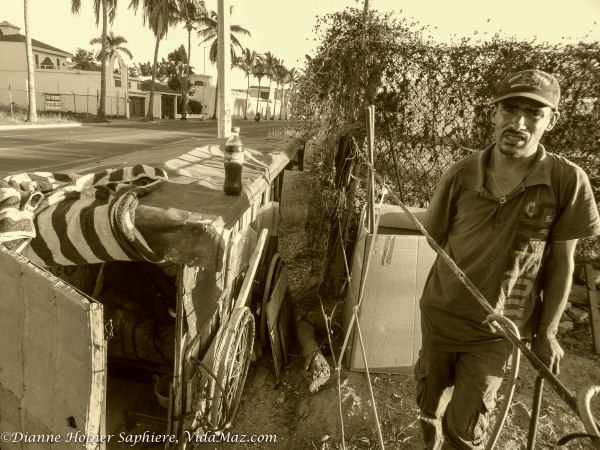
This morning I drove past an amazing sight—a bright yellow and red metal box, supported by cement block and the wheels from a wheelchair, which very much looked to me to be someone’s home. It had an angel hanging in the window, was made from recycled materials, and stood out to me for its ingenuity and joy. I called out hoping to find the owner, but no one answered.

The thought of who lived there haunted me all day, so this evening I decided to go back for a visit. Greg and I took some soda and water, as well as some money. Sure enough, there were two people there this time around. Could a couple be living in that homemade mobile home?

No. The owner, creator and resident of this practical beauty was the man, Octavio Castillo Silva. We found him intelligent, well-spoken and open to talking with us. We were told the lady with him, Martha, does not live there. She was a very different sort of person.

p1090497

Octavio Castillo Silva

Octavio comes from a rancho in Durango state. He came to Mazatlán in 2006 with four of his ten siblings. He tells us he loves it here, and was doing fine until two years ago when he was hit by a car. After the accident he spent eight days in the hospital, but couldn’t afford the surgery required to fix his leg. He showed us scars on his head and a misshapen left ankle wrapped in an Ace bandage. The leg looked very painful, and Octavio walks with a pronounced limp. He gets around with a cane that he has made out of recycled material.

Unlike many who are down on their luck, Octavio did not complain. He asked us for nothing. He told us he’s lived in his mobile home on the property behind Torre Azul and Banjercito for about two years. The owner has given him permission to stay there in exchange for cleaning up the lot. Octavio is excited because he also has permission to park cars there during Carnavál, and split the proceeds with the owners.

He explained that since the accident he has not had enough money to rent a room. He finds it difficult to find a job due to his injury. To get by, he collects recyclable material. He’s so enterprising that he assembled his home entirely out of recycled wood, plastic, metal and canvas. He is very proud that the walls are well-insulated: three layers thick, with four windows on either side. Octavio told us he stays warm in the winter and cool in the summer. When the cars drive by there’s a nice breeze. The roof of his home has both plaster and two layers of lona/canvas. He used the parts from a wheelchair to make his home movable. He bathes in the corner of his home, and has a makeshift mattress down the center.

Octavio sleeps during the day so that he can go out collecting recyclables at night. The trouble is, while he’s gone people steal his things. So, he’s taken to locking everything inside his shelter. He even locks himself inside while he sleeps, because he’s had trouble with “rateros.” He proudly unlocked his home to show us the inside, which he has appointed with care. Click on any photo to enlarge it or to view a slideshow.

Octavio would love to work for a living wage. Might you know someone who needs a security guard? Or who would donate medical assistance? Perhaps one of our readers is a surgeon who would donate her/his services, or would pay a surgeon to mend Octavio’s leg?  Here is a short video we recorded:

If you’d like to help Octavio out in a smaller way, I’m sure he could use food and drink. He’s made an outdoor kitchen for himself. When I asked him if he wanted anything, he said no, things just get stolen.

I will make sure that DIF knows about Octavio, and I plan to talk to my doctor to see if he might help him. We will keep him in our prayers and take him any leftovers from now on. God bless this creative, optimistic, hard-working soul! And thank you for your help.

img_7512

UPDATE 31 JANUARY:
I was able to get DIF involved. Dorita came out to interview Octavio, take photos, and approve him for a medical exam. Greg and I will take him tomorrow and hopefully we can proceed towards treatment. Octavio will need official identification, which he does not have. That starts with a birth certificate, from Durango. So, after visiting the doctor, we will head to the Unidad Administrativa. A group of ladies from Ojalá has kindly offered to help with at least some of the medical expenses, depending on what they are. Please keep your fingers crossed!

Behind the Chamber 2017: Pint Size Percussion

Fernando Correa

Fernando Correa

The seventh concert in this year’s 2017 Temporada Campbell will be held on Sunday, March 5, 2017 at noon  in the Angela Peralta Theater, and it is going to be an amazing treat! Eight children, aged eleven to fourteen, will demonstrate that, according to Maestro Gordon Campbell, “they are just as skilled as professionals.” These kids’ talent will blow your socks off!

The wide-ranging, high-energy program will include mambo, rhumba, rock-n-roll, Broadway show tunes, samba, and classical, directed by Fernando Correa. I interview Maestro Gordon Campbell and Guianeya Román in a “Behind the Chamber” sneak peek about the performance, below:

The full concert series takes place through March 12, 2017. You can purchase your tickets for specific concerts (300 pesos each) or a series pass (2000 pesos) at the Angela Peralta Theater box office—open 9am-3pm and 5-7pm—or online at CULTURA Mazatlán.

15442147_1229524153781300_656067471523188239_n

Support the Camerata
Tax-deductible donations to recover costs of the Camerata and the community chorus are received by the Patronato Philomusica AC, Banco Bajio account number 14166839. Your donation is tax-deductible in Mexico and worldwide. Please help support the high caliber of arts in our community by pledging generously!

To watch other Behind-the-Chamber interviews click here.

The Clock Whisperer

dsc_0984Gabriel Alfonso Gamez Zuñiga is Mazatlán’s resident clock whisperer, an incredibly talented, personable guy who is the last of a dying breed—the keeper of knowledge and skill that is nearing extinction.

People from throughout the municipio and surrounding communities ask Gabriel to work his magic on their timepieces. He does so with everything from the most expensive, bejeweled wristwatches— Chopard, Piaget, Rolex—to the brass mechanisms of antique wooden clocks and high-tech GPS-enabled dive watches. He also sells clocks and watches on commission. Click on any photo to enlarge or view a slideshow.

The son of clockmaker Alfonso Gamez, who learned his craft via a correspondence course with Swiss-based Vaucher, went on to train five different apprentices over a 60-plus year career, and was listed in the Guinness Book of World Records as Mexico’s best clockmaker, Gabriel grew up sweeping floors amidst the hairspring levers, count wheel trains, chiming movements and recoil escapements on his father’s workbench. He tells me he loves challenges in his work, “the more difficult the better.” He approaches his craft as problem solving: “it’s like putting together a jigsaw puzzle.” What he hates is boredom.

Gabriel is the last of his father’s apprentices still in business; he has been repairing clocks and watches for over fifty years—the longest in Mazatlán. Most of those decades he worked just up the street from his current location on the corner of Canizales and Rosales downtown. During that time he has seen clocks trend from the mechanical to electrical, quartz, chronographic, digital and back again. “Life is circular; everything old becomes new again. Now is the perfect time for my skills, because the old is in fashion again,” he tells me.

Gabriel is so humble that he refuses to call himself a relojero or clockmaker, but says he “only repairs” watches and clocks. Everyone else raves about how gifted he is. On any given day he also repairs lights, computerized car keys; you name it, Gabriel fixes pretty much whatever his beloved customers bring in. His shop is constantly bustling: several people at the counter, cars pulling up to drop off or pick up merchandise. When Gabriel needs time to focus on a project, he has to roll down the doors of his shop and refuse to answer the knocks or the phone. When he tries to take a day off people come to his home for assistance!

The demand for his skills is obvious. We live in an age that is hyper-vigilant of time—it blinks on our cell phones, dashboards, microwaves, computers and televisions. Over a billion watches are sold each year—we have more need than ever for clock makers and repairers. Despite that fact, Gabriel tells me young people just aren’t interested in learning his trade, and only a handful of clock repairers remain in Mazatlán; their “heyday” was in the 60s and 70s when there were dozens of shops in town. Gabriel is very social, so in addition to the steady flow of customers through his shop, there are usually at least one or two people just visiting.

Sprawled across Gabriel’s workbench are hundreds of movements, wheels, rods, and springs, yet our clock whisperer knows exactly what parts he has where. He buys his parts from the Central de Funitura, the clock market in Guadalajara. He has a magnet attached to the end of a pole to help him find and pick up any small, dropped parts, and another magnet in his pocket to capture pieces he might put there.

Relojes Gámez is open Monday through Friday Clock 9:30am to 1:30pm and 4:00-7:00pm, and on Saturdays 9:30am to 1:00pm, on the corner of Canizales and Rosales, telephone 985-5620.

Talented and dedicated tradespeople are one of the joys of living in Mazatlán. Here we are fortunate to be able to have shoes, pots and pans, electronics or clocks repaired expertly and at a reasonable price. Every year, however, it becomes more difficult to find these quality-driven artisans; the world has changed, and people no longer want to spend years apprenticing to learn a trade. It makes me all the more grateful to know Gabriel and endorse his work, as he has helped us with more than a few watches. If you know anyone seeking a much-needed and rewarding trade, I’d urge them to contact Gabriel!