Cooking Class at Molika: Pesce in crosta di sale

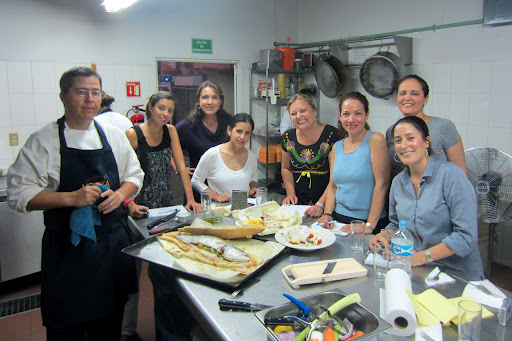
I’m privileged to have a terrific group of lady friends who like to cook, and we get together to learn and to teach one another once a month or so. In addition to our Thai cooking classes, we’ve made timballo (Italian “drum” with pasta and eggplant), tortas ahogadas, rajas, chicken mole, macarones, and lemon cake, among some other wonderful things.

Well, my friend Magda got the wonderful idea to book us a series of classes with Héctor at Molika, downtown on Belisario Dominguez near the Plazuela. While I’ve known Héctor for several years — he’s a GREAT bread baker (sourdough and ciabatta plus other good loaves) and I am in love with his grilled vegetables (which we also frequently make at home) — I discovered that he also truly shines as a teacher!

He is funny, charismatic, and I LOVE that he teaches METHODS rather than recipes! In one two-hour class on cooking fish, he demonstrated SIX different methods of preparing the fish we commonly have available here in Mazatlán. For me who learned to cook fish while living in Japan, I learned a lot. For example, he taught us to cut off the fins (see video above) before cooking the fish (you’ll know that most Asians LOVE the crispy fins and would never think of removing them before cooking), saying that the fins have too strong a flavor.

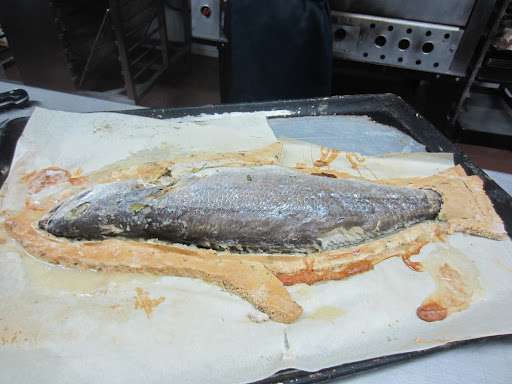
My favorite? Well, by now you know me. I love something different, and especially something impressive. And Héctor delivered: Pesce in crosta di sale, or fish in a “tomb” of salt. I’ve eaten many fish baked in salt crust before, but nothing quite like this!

Rather than just salt with aromatics, Héctor made a salt dough with the 2 salt : 1 flour, eggs, fresh herbs and a bit of water.

He kneaded it (see video above),

Rolled it out,

Pressed two pieces (top and bottom) to the form of the corvina, sealing the dough with beaten egg, decorated it a bit,

Trimmed it to shape (video above), and then baked it for 45 minutes.

The fish of course turned out incredibly moist, aromatic and flavorful. He said he prefers to use robalo rather than corvina, but I was plenty happy with this.

He suggested that we cut the rock-hard crust in the kitchen (you can see above that’s pretty challenging), then take the encrusted fish to the table, where we open it in front of our guests. That way the room fills with the wonderfully aromatic scents.

Finally, unlike Japan where everyone knows how to eat fish on the bone, Héctor suggested we remove the flesh from the fish in front of our guests, serving it up on plates. He removed and discarded the skin, saying that baked/steamed fish skin doesn’t taste good. I can hear the shocked gasps of my Asian friends now, but it was nice for me to learn a more European approach. I will definitely give this gorgeous dish a try. I must admit that I preferred the taste of several of the other dishes he prepared! This one was just a presentational stunner, like my timballo (thanks, Allison, for teaching me!).

We made pescado en papillote, fish steamed in paper. We stuffed the fish with aromatics: lemon peel, garlic and fresh herbs (basil, parsley, rosemary, thyme), then garnished with sliced fresh celery, onion and carrot. It was interesting to me, again with my Asian influence, that Héctor taught us to peel the celery, removing the fibers. Definitely a finer dining touch than I’m used to.

Above you can see Héctor opening the papillón.

A third dish we made in this two-hour class was the dish I swore every single Japanese restaurant serves: sole meuniere (lenguado). Many of the ladies were very happy to have Héctor teach them how to filet. Cleaning and preparing fish is fortunately one of the many skills I learned well in Japan. One of the key points he pointed out is to filet fish when it’s cold, fresh from the icebox. That way it’s much firmer and easier to handle.

Héctor studied and cooked in London before returning to his native Mazatlán, and he uses lots of olive oil and sea salt, as you’ve already seen (way more than I’m used to, though I will start putting a bit more olive oil on for taste at the end), and for this dish he used a whole lot of butter as well. Nobody said good cooking isn’t fattening! He did caution us to check the ingredients on the butter we buy, as ideally it should be made from milk, and not contain emulifiers and a bunch of chemicals. I do think that’s part of the baking challenge I’ve had since I moved here — gotta buy better butter.

And here we have the finished lenguado/sole, covered with sauce from the pan and garnished with a bit of parsley.

I had been craving salmon and asparagus, and just that morning bought both to make for lunch, so was fascinated to see Héctor make this as part of our repertoire for the day. He of course used clarified butter as it withstands higher heat, to get the nice crispiness on the salmon. Note: he removed the skin before cooking. I guess this is also either a European way or alta cocina, because personally I love the crispy skin. I was sooooo gratified to see him cook it the way I feel it should be. Héctor told us that salmon, tuna and swordfish should always be left rare in the center, and I heartily agree. People here in Mazatlán always seem to overcook fish.

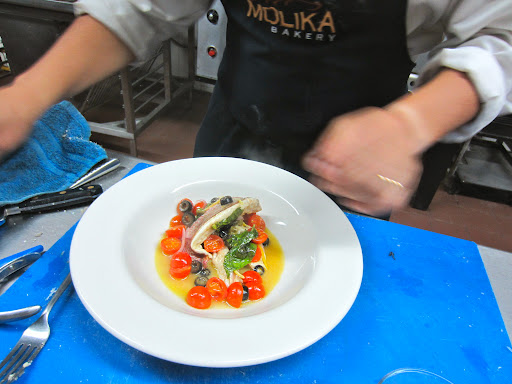
The fifth dish he made was swordfish. He cubed the fish, sauteed it with fresh herbs, cherry tomatoes, capers and olives. In addition to the lemon (yellow lemon) rind he added to most all these dishes, he also added a bit of lemon pulp. This concoction he poured over his famously to-die-for ciabatta, and oh my!!!! The bread somehow soaked up and enhanced the lemon flavor of the sauce, and it was soooooo delicious!

I’ve left my favorite dish for last. Fortunately, it was also probably the easiest to cook: pescado en la bolsa, fish in a bag. He used the same ingredients as most of the other dishes — fresh herbs, cherry tomatoes, olives, capers, sea salt, extra virgin olive oil. The wonderful part, besides the incredible taste?

He put all the ingredients in a ziploc bag and cooked it in near-boiling water on the stove! It took just a few minutes and there was nothing except the serving dish to clean up! My son is in Scouts, and they cook just like this on their campouts. Maybe not quite the gourmet ingredients as this, but still very tasty nonetheless.

Thank you, Magda, for setting this up for us! Thank you, Héctor, for a marvelous class! We are very much looking forward to our next one.

Anyone wanting to arrange a class for a group of friends, please give Molika a call: 669-981-1577. Héctor’s English and Spanish are flawless, and his kitchen skills are a gift to Mazatlán.

Carnavál de Mazatlán: Why We Love It

Mardi Gras is celebrated worldwide: from Russia, Croatia and Turkey to Angola, Cape Verde and the Seychelles; from Italy, Germany and the Netherlands, throughout North and South America and the Caribbean.

My favorite Carnavál memory is being in a very small pueblo in the Sacred Valley of Perú and being covered with florid blue, pink and purple powder, then squirted with water (it stained everything I was wearing), then passing around a communal giant beer bottle that gave me dysentary. My husband warned me not to imbibe, but I chose to partake of the festivities. Don’t regret it, either.

Rio’s Mardi Gras is the most famous. Some day I’ll get there, and samba with the masses. Mardi Gras in New Orleans is also well known; we’ve all seen the photos of the bare breasts flashing. But Mazatlán’s Carnavál holds its own. It’s family-friendly, diverse and a whole lot of fun. If you haven’t yet joined us, be sure not to miss the fun. It is held, as with most Carnavales worldwide, the five days prior to Ash Wednesday (Thursday through Tuesday nights).

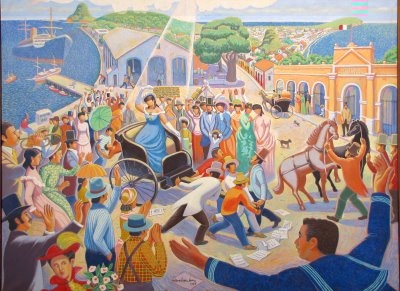
Carnavál has been celebrated in Mazatlán since the mid to late 1800s, though the first officially planned Carnavál de Mazatlán was in 1898. Back then, they celebrated with a Rey Feo (Ugly King) rather than today’s Rey de la Alegría (King of Joy), but for generations there have been Carnavál and Juegos Florales (Floral Games) Queens, and back as far as 1900 there was a ball for the kids. This community festival has a long, long history as a family event.

Carnavál de Mazatlán is noteworthy for its long association with our regional banda and tambora music, as well as with fine arts events (painting, literature, classical music).

What do I love about Mazatlán’s Carnavál? First, I absolutely love that it is a community event. The month before Carnavál, you can walk in many neighborhoods around town and see dance groups or marching bands practicing. As the weeks go by and Carnavál gets closer, these rehearsals become costumed dress rehearsals.

I love the decorations! Every year we get to see colored lights strung along the malecón, all the way from Olas Altas to Valentino’s. Interspersed among the lights, on the light poles, are banners reflecting the year’s Carnavál theme. Best of all, for me, are the monigotes: colorful giant statues that are made from papier mâché and erected at strategic spots up and down the boardwalk, to help build excitement. Every year the monigotes are different, and reflect that year’s Carnival theme.

Thirdly, I absolutely love the street party down at Olas Altas. It is one big “human wave” of revelers and merry makers.

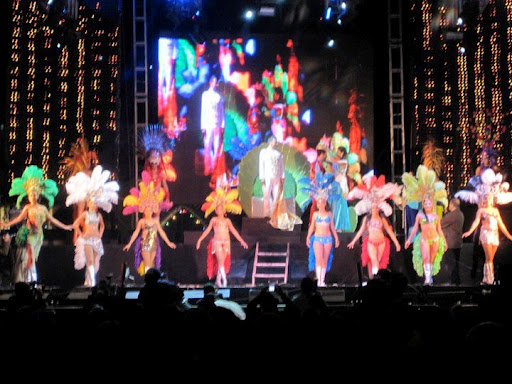
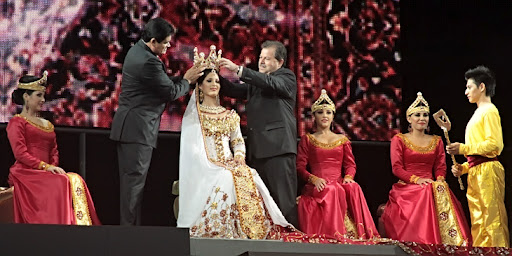
The King of Joy coronation, show and concert on Thursday night is one of the best nights. A well-known banda plays, for free, in the street on the Carnavál grounds. It is awesome! The party zone is open every night. There are maybe eight stages, each with a different kind of music playing: banda, ranchera, salsa, mambo, rock, reggaetón. Hawkers sell masks, eyelashes, hats, noisemakers, face painting, games, drinks and food. You will, literally, be dancing in the streets. Everyone has fun! It is a big crowd scene, so if you hate crowds do not purposefully go there. We love it. Don’t like the music? Grab your beer or margarita and shimmy down the street to another stage. A few years ago, they did things a little differently when Banda El Recodo was King. They held the coronation in the land off the street dedicated to their founder, Don Cruz Lizárraga. You can read about that night here.
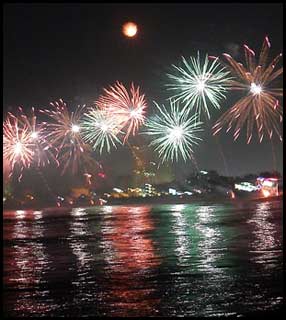
Let’s see, the fact that we have two, yes, TWO, huge fireworks shows during Carnavál is also wonderful. Everyone knows about Saturday night, when they burn the “bad humor” and fight the French in the Combate Naval fireworks. But on Monday night they also usually have a “Festival of Lights” along the malecón, which last year for the first time was accompanied by a mini-parade of lighted floats (not the main parade floats).

Fifth, it is awesome to have FOUR coronations, meaning four major stars or groups, performing in concert. Three of those concerts take place right behind my house. Who needs a ticket when I can sit on my terrace and listen? No, the performances are definitely worth the ticket price: major concert, fireworks, acrobatics and dance, music, pomp and circumstance of the coronation…. The coronations are truly cool events. And the King Coronation in Olas Altas on Thursday is free (except for the token admission to the party zone).

Sixth, I really love learning every year about artists and writers who I often don’t know. You see, every year there is a prize given for literature as well as for painting. And every year, it seems, I’m introduced to some terrific new-to-me talent.

Most incredible and wonderful to me are the Carros Alegóricos, the floats, of the two main Carnavál parades. The first one, on Sunday, usually starts in Olas Altas in daylight and heads north (though this year it’s announced to be starting at the Fisherman’s Monument), passing our house and arriving at Valentino’s in the dark. This parade is so popular that many people stake out their spots the night before. There is an entire parade village along the Avenue with families watching TV’s powered by generators and eating hot breakfasts in their lounge chairs. Also, enterprising folks erect bleachers everywhere they can and rent chairs for parade watching. All the businesses along the avenue advertise parade viewing space at premium prices. Can a parade really be that good you ask? YES! The floats are oh-so-gorgeous! The queens and princesses, kings and princes, shine! In 2010, we did a blog post about Maestro Rigo Lewis, long-time creator and overseer of the floats. Click here to read.
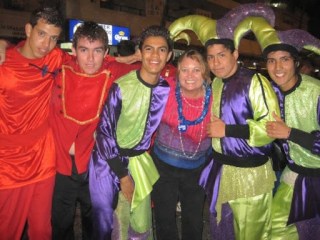
And the dancers! Young and old alike dance all the way, four miles or so, and most of them enjoy every single second! It is non-stop live music, oohs and ahs, and laughter. Do not miss the parades! The second one, on Tuesday, starts south of Valentino’s and heads down to Olas Altas. The second parade is not usually as good as the first, I feel. The floats are a bit tired, as are the dancers. But it’s still wonderful. The floats at night glow, and appear as they were designed to appear. Those are the photos I like best. But, they are hard to take, since the parade is moving. You might want to catch one of the parades in daylight and the other in night light, if you want to photograph.
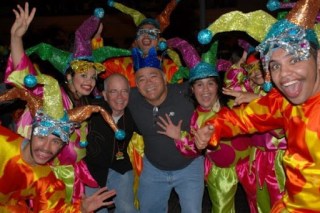
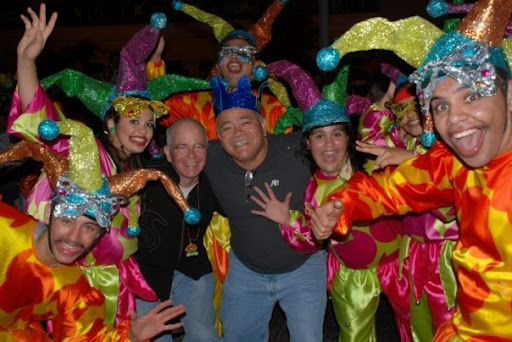
I especially urge you to visit the second parade before it starts, as they are setting up, as the kids are getting their makeup put on and dressing in their costumes. It is a wonderful time to chat with some of the dancers, and to get some terrific photo ops. The queen and king are usually there, as well, and happy to pose with you. I blogged about that as well, and there’s a movie to go with it.

Eighth, remember that between parades they tend to park the floats in the Gran Plaza. Since they just built the new theater this year, I’m not sure that’s still what they’ll do. If not, there’s the big lot over by Sam’s. But it’s fun to visit the floats when they’re parked, and marvel at the creativity and hard work that goes into making them.

The ninth thing I love about Carnavál? How proud families are that their great-grandmother, their second cousin, or their niece, was queen/child queen or king. It is wonderful multigenerational royalty tradition in this city. During the parades you will see floats with queens celebrating 25 years and 50 years since they were queen. You will see a cable car full of elderly ladies who are queens of their domino clubs or lunch groups. You will see queens who visit us from other countries, to share in our merriment.

Tenth? I LOVE the manifestaciónes: the early counting of votes for queen and king, pre-Carnival parades and gatherings. Much more informal than the main event, it is where I was able to get my photo taken with Banda El Recodo a few years ago, when they were Kings of Joy. Confetti, masks, beads, candies, music…. you’ll love the manifestations.

And, new the last couple of years has been a callejoneada, or alleyway crawl. While Mazatlán has traditionally had a callejoneada on Day of the Dead, holding one for Carnavál is something, at least to my knowledge, newer. We went last year and it was LOADS of fun. You’ve got to keep your ears open. This event is not nearly as well advertised as the other, more principle events.

Twelfth, there is a world class Velada de las Artes, played by an orchestra in the Angela Peralta Theater. If you enjoy classical music, you won’t want to miss it. If you didn’t get your ticket in time, you can still watch it in the Plazuela on one of the outdoor screens, or even over live streaming online.
SAFETY
You may be wondering how safe it is to attend the Carnavál events. Our family feels safe, as do thousands of other Mazatlecos. Please use the common sense you would for any major public event. People come to Carnavál from out of town just to pick your pocket, so don’t carry lots of cash or flashy jewelry, or your passport. Also, as with any large crowd, there is always a danger if people get spooked. State Fairs, the Super Bowl, concerts; if people get spooked and start shoving or running, it wreaks havoc. That is not normally the case in Mazatlán, but if it should happen, we’d urge you not to run even if those around you do. Stay calm and help others. Get to the side of a building or a place where you can get out of the flow of people. The greatest danger is losing your footing if there is a mad rush.

One final word of advice: if you visit the party zone in Olas Altas on Thursday (King of Joy Coronation) or Saturday (Combate Naval fireworks), plan ahead for your ride home. It is a mob scene. Nearby parking can be scarce, and getting a taxi home can be frustrating, since every one else is trying to hail a cab at the same time.

SUMMARY
In short, Carnavál Mazatlán has so much to offer that I am sure I have forgotten something. Yes! The ball! On Monday night there is a ball, attended by many of the city’s who’s-who, the international queens, and all manner of visiting dignitaries.

You like reserved seats? We’ve got the coronations and the Velada. You like street dancing? We’ve got six nights of the best in the world. You want world-class music? Check. You want black tie? The ball! You want to wear jeans and boots, or shorts and t-shirt? No worries! You want free-of-charge events? Got plenty of those!

We look forward to having you share with us one of the world’s best events, the pride of our local Mazatleco community, with over 100 years of respected history and tradition. This is an event we trust will continue for at least 100 more years. What terrific community-building it is!

Normally you can’t find all the Carnavál events listed in one place, so below I’ll do my best to help you navigate the maze a bit. The schedule is normally the same every year, though each year the dates change, because Carnavál falls on the days prior to Ash Wednesday (which changes dates year to year).

EVENTS LEADING UP TO CARNAVAL
In the weeks leading up to Carnavál:

  • Manifestaciones, usually three of these plus a Final Computation, located at various venues throughout the city. The last one tends to be on Friday night, two weeks before Carnavál, and the parades winds through downtown.
  • Callejoneada, or alley parade

Saturday night, two weeks prior to Carnavál:

  • Election of the Queen of Carnaval (contest), in the Angela Peralta Theater

The week before Carnavál:

  • Presentation of the Sate Painting Prize and opening of an exhibit, at Casa Haas, the art museum, or…
  • Presentation of the State Literature Prize, in the Angela Peralta Theater

The week before Carnavál and continuing through Carnavál:

  • La Feria, a fair, with rides and games and cotton candy, in the field by Sam’s Club/Colegio Andes

Friday before Carnavál: 

  • Velada de las Artes concert in the Angela Peralta Theater


EVENTS DURING CARNAVÁL 
Throughout the five days of Carnavál:

  • Olas Altas is ready to party! Many stages are put up for live music, and there are food and beverage stands galore. Men will usually be frisked as they enter. A small entry fee (30 pesos or so) is charged to enter the party zone. This area is going all night long into the wee hours of the morning. So, if the events below don’t strike your fancy, just head down to Olas Altas and enjoy the party! New this year: Imperio de los Mares, a water fountain and laser light show in the antique oceanside pool in the party zone! To take place at 7:15 and 10:30 each night, this sounds sure to be a spectacular addition to Carnavál.
  • The last few year’s they’ve announced a food fair to take place every day in the Plazuela Machado. This is a major misnomer in English. They do a televised fair opening with the mayor and Carnavál royalty, but other than that it pretty much means the restaurants in the Plazuela will each have a special. Oftentimes their normal menus are actually more limited during the busy-ness of Carnavál.

Thursday:

  • Muestra Gastronómica, or food demonstration, in the Plazuela Machado, in the afternoon (though this year this is supposed to be EVERY day!)
  • Coronation of the Rey de la Alegría/King of Joy, in Olas Altas, at night

Friday:

  • Coronation of the Reina de los Juegos Florales/Floral Games, in the baseball stadium (tickets required)

Saturday:

  • Coronation of the Reina del Carnavál, in the baseball stadium (tickets required)
  • Burning of the Bad Humor (Quema del Mal Humor), usually around 9 pm, in Olas Altas
  • Combate Naval, fireworks display, usually at 10 or 11 pm, in Olas Altas

Sunday:

  • 1st parade, usually starting at Olas Altas (tho this year it’s announced to begin at Fisherman’s Monument) around 4 or 5 pm and heading north to Valentino’s along Avenida del Mar

Monday:

  • Corrida de Toros, or Carnavál Bullfight, in the bull ring, beginning around 4 pm (tickets required)
  • Coronation of the Reina Infantil or Child Queen, in the stadium, headlined by a major singer (tickets required)
  • Children’s Ball, held at a hotel in town (tickets required)
  • Festival de la Luz fireworks, usually about 10 pm, also along Avenida del Mar

Tuesday:

  • 2nd parade, starting at the Bosque or the Aquarium around 4 pm and heading south on Avenida del Mar

Ash Wednesday: Party’s over! Lent begins!

Another Beautiful Mazatlan Sunday Bike Ride

I ride my bike a lot in Mazatlan. It is a great town for bike riding, at least as far as I’m concerned. Some people are put off by the traffic (pedestrian and vehicular), but I think it adds to the excitement and challenge.

Most people do what I used to do and go up and down the malecon (or boardwalk) along the ocean. It is relatively flat, very scenic and overall very safe. However, it is not very challenging and if you are trying to get in some good cardio or burn a few extra calories, you either tow a bag of bricks behind you or seek a tougher ride.

I started seeking tougher rides nearly two years ago. I started going north to the far end of town, but that involved too much street time and too many crazy drivers. It was all flat other than the two bridges that are more of a workout due to the speeding traffic then the incline or distance. I also have experimented with riding downtown and do still enjoy it from time to time. It is best to go really early and realize that for a great workout, you will be going up and down the same small  hills over and over.

Mazatlan has two big hills – both in the southern part of town, called Olas Altas. Mazatlan also has the second tallest natural lighthouse in the world. So, about six months ago, I decided to combine the challenge of an up and over a good sized hill with a climb to the top of the lighthouse for a good cardio workout.

If you do not know Mazatlan, you can’t imagine what a wonderful ride this is. So today I packed along my camera and took a few pictures in an attempt to show at least some of what I like about this ride. As for the hill, well, I admit it doesn’t look like much in these pictures, but it is a moderate challenge for me and of course is getting easier the more times I go. Try it and see.

Here is the malecon looking south from in front of our house:

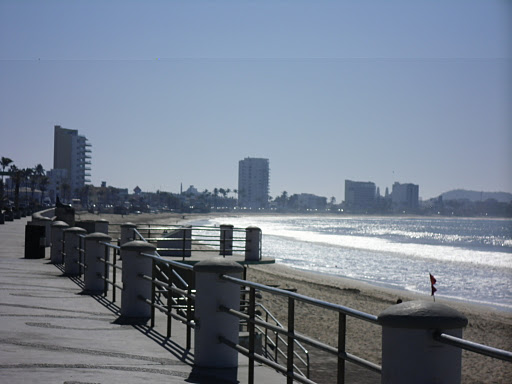
Here you can see the curve of the bay and how flat most of the malecon is:


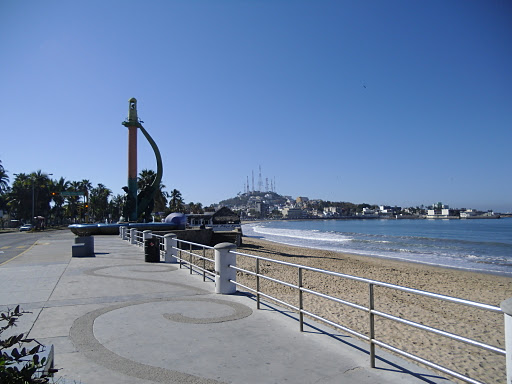
The curve and flatness continue as we go past the Fisherman’s Monument:

Once we get past the fishing boats, there is a small incline, but not much of a challenge:

Are you digging the view as much as I am? Can you see why so many people choose to just stay on the malecon? At this point we are directly across from where we live and have gone around the bay. Our building is circled:

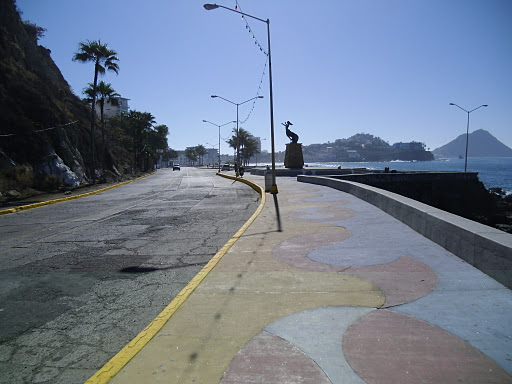
Now, there is another incline in the road to make for a little challenge:

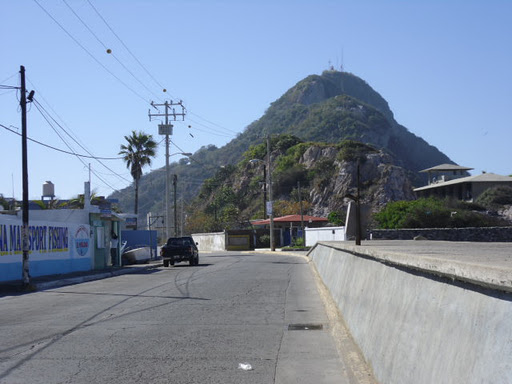
After we round the corner and go past some vendors and the huge flagpole, we begin to see the hill to the right of the statue in the picture below and the lighthouse on the far right:

As we get a little closer, we can zoom in on the first part of the hill that we will need to climb. Today, Sunday, is the easiest day. During the week the school (blue and white building) at the elbow in the road is very busy. The turn is extremely tight and there are cars and kids everywhere. The hill is essentially three little hills in one. We will go straight up towards the school, turn left away from the ocean and then turn right and rise up above and behind the school, before eventually turning right and enjoying the downhill ride to the road to the lighthouse.

Here we are ascending the hill towards the school and a shot looking back from the school:

Next we turn left and parallel the school (hill 2):

From the next corner we pause to look behind us:

And in front of us (hill 3):

It’s at this time that my heart is usually working the hardest. With an allowed maximum heart rate of 170, I am happy to see that I have not overdone myself today:

If you look closely, you can see that we have only been at this for 28 minutes. It’s taking longer to type this than to ride it!

Looking back down hill 3:

And ahead to the downhill ride the awaiting lighthouse:

The approaching lighthouse and a look back at the fun downhill ride we just had:

The road to the lighthouse – water on both sides. The lighthouse used to be an island, but a road was built over the rocks to accommodate traffic.

We have written about the lighthouse. You can read that entry here. Some people actually ride their bike up the switch back dirt path and then carry the bike up the stairs (or turn around). What I like to do is tie up my bike at the bottom. Fast walk up the path and 300+ steps, spend two minutes at the top, hurry down the stairs and then run down the path and jump back on my bike. It keeps my heart pounding and takes about 30 minutes depending on how many people I have to get around on the stairs. It is a great workout. My final picture is my bike tied up to a telephone pole waiting for me as I complete my trek down the hill. To get home, I go back the way I came. Total time is usually around 90 minutes, give or take as the wind and stopping to talk to friends often makes a difference.

A note about the picture. If you look to the right, you see three people sitting in the middle of the roundabout–one with a guitar. These three guys were sitting there when I got there and when I left just playing music and singing old Mexican ballads (quite well too). Just one of those little treats here in Mazatlan that helps me remember why we moved here.

If you ride a bike here, please be safe. It takes a little getting used to. Most of all be careful and have fun. Enjoy your ride!

Visiting Mazatlán with Kids

Kids love Mazatlán! The list below should help whether you are traveling here on holiday or whether you live here and are wondering about something new and different to do with your kids during school break. The to-dos are organized alphabetically.

  • Aquarium and bird show: The aquarium in Mazatlán is a lot of fun. The most exciting thing at the aquarium is you can swim with the sharks! In addition to the indoor marine exhibits there are entertaining bird shows held on an outdoor covered stage. Aquarium staff do most of the rescue of marine animals and birds here in town, so we all very much appreciate you supporting this venue.
  • Batting cages: On Avenida del Mar, right next to the double yellow towers (Las Gavias), is a batting cage called, “Wild Pitch.” There is now also a second one up on Avenida de la Marina in the new Mazatlán Golf Center.
  • Beach day: Pick a beach, any beach. You can get chair side service and lots of vendors at a hotel beach. You can dine on fresh, affordable seafood in a palapa/thatched hut on Playa Pinos. Make sand castles, pick up sea shells and sea glass, play soccer or football, volleyball or catch … You name it, you can’t go wrong with kids and a beach.
  • Bicycling: Biking along the malecón/oceanside promenade is gorgeous, easy and fun! From Valentino’s to the Pedro Infante Monument is about 4 miles one-way, it’s of course a very level ride, and safely out of the traffic. It’s easiest to borrow a bike from friends or your hotel if you can. Kelly’s Bike Rental used to be near the malecón, but now he’s moved up towards the marina so is a bit harder for the tourist to reach. Kelly (Güero) has a terrific mountain bike trail/course where he will gladly take older teenagers. He has bikes to loan out as well.
  • Bird watching, hiking and picnicking: The lush Estero del Yugo nature preserve on the north end of town makes for a day of hiking and bird watching. Bring a picnic lunch, binoculars, and your camera.
  • Boogie board: Bring your own, or buy one at one of the many shops along Avenida del Mar or Av. Camarón Sábalo. It’s a whole lot of fun!
  • El Bosque/City Park: Located one block off the malecón, this park has a large pond with waterfowl, swing sets and climbing gyms, a small zoo, and a walking trail. There are play areas in small parks throughout the city, though I recommend you check their safety beforE letting your kids climb up and slide down.
  • Bowling: Space Bowling, up on the north end of town near Marina El Cid, has fun laser-light bowling at night, and makes for good refuge if you happen to be here during rainy season.
  • Boxing: Older teenagers and young adults may enjoy a night of boxing. Our boys love it, as you get up close and personal to the boxers. I imagine the ring card girls don’t hurt their eyes either 🙂 Held on Friday nights about once every month, downtown in the Cancha German Evers.
  • Catamaran: You can have one of the playeros take you and your family out for a cruise around the bay for very little cash. Watch the sea lions (Mazatlán is their southernmost point), cruise past Bird and Deer Islands, see the city from the sea. A boat ride is always fun. We also have sailboats, or you can go out on a party boat and enjoy music, dinner or sunset.
  • Climb the lighthouse: One of our very favorite family activities, we do this once a week. The climb only takes about 20 minutes, and the view from the top is gorgeous!
  • Dolphin, whale and sea lion watching Also one of our favorite activities! DEFINITELY do this if you are traveling here! You can read our blog post about this trip.
  • Fishermen: Sitting near the pangas/boats at Playa Norte beach in the morning, watching the fishermen bring in their boats, unload and sell their fish, can make for a very enjoyable morning for a family.
  • Fly a kite: Buy one anywhere, and spend a few hours flying it on the beach. Enjoy some ceviche, fresh fruit or turnovers/empanadas from a strolling vendor, and maybe some live music from a passing band.
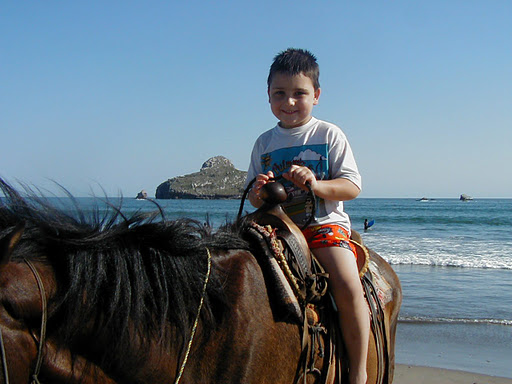
  • Horseback riding: There is nothing like a family horseback ride on the beach, or through a forest of palm trees. Rent horses on the north end of town at Playa Bruja, or out on Stone Island.
  • Inline skating: That 4-mile malecón is calling your name! You and the family can of course walk it, or you can rent skates in Olas Altas at the Looney Bean coffee shop.
  • Island day: Spending a day at either Deer Island (one of the three islands in the bay) or Stone Island (it’s actually a peninsula) feels like going back in time to a simpler, more charming era. Pretend you’re shipwrecked, or that you own your own private piece of paradise. On Stone Island there are plenty of restaurants with lots of adult beverages; the beach is great for kids as the ocean is pretty calm. On Deer Island you can get a few things to eat or drink. You can get tours to either island that include banana boating, snorkeling or jet skiing; Stone Island tours often include horseback riding. Stone Island has an affordable water ferry (about US$3 round trip per person).
  • Kayaking: Rent a couple of kayaks on the beach in front of one of the hotels, and enjoy some terrific family time paddling in the bay.
  • Movies: Movie theaters in Mazatlán are MUCH more affordable ventures than they are north of the border. If you don’t speak Spanish, be sure to see a subtitled movie rather than one that’s dubbed. Cinepolis is in the Gran Plaza; Gaviotas is an older theater near Valentino’s in the Golden Zone; and the two Cinemexes are in the main part of town on Insurgentes Street.
  1. Cinépolis 
  2. Cinemas Gaviotas
  3. CinemexMaz
  4. CinemexToreo
  • Paint ball: For some weird reason, paint ball is called “Gotcha” in Mazatlecan Spanish. The nearest location is Master Gotcha located behind Casa Country in the Golden Zone. Closed on Tuesdays, check their Facebook page for specials.
  • Parasailing: Before I parasailed I never imagined I’d enjoy it as much as I did! It is amazingly fun and exciting! Book a trip on the beach in front of your hotel.
  • Port: Watch the workings of the port from the Mirador or the Old Observatory. Drive, walk or bike up Paseo del Centenario to either of these places, and you will be rewarded with incredible views of the city of Mazatlán and the workings of its port. See the loading and unloading at the docks, the boats of the largest shrimping fleet in the Americas, as well as the tuna fleet.
  • Sea turtles: Release baby sea turtles, or see their mothers lay eggs. Sea turtles come in to the beach to lay their eggs starting in late August or September every year. It is an amazing process to watch, but please don’t bother the nesting Moms! You can read a blog post about the sea turtles here. If you call the aquarium you and your kids may be able to participate in a release of baby sea turtles, which the kids also really love.
  • Skate park: Bring your skateboard, rip stick, BMX bike or inline skates, or just your eyes and good humor to watch the festivities. The Skate Park is next to the outdoor gym in Playa Norte. We did a blog post about it.
  • Snorkeling: Playa Norte has a sheltered beach, just south of the swim club and the outdoor gym, which has pretty interesting snorkeling: lots of colorful fish and sea glass. On Deer Island you can snorkel for octopus or scallops.
  • Surfing: Many kids would love to learn how to surf! In Mazatlán there are a few options: Mazatlán Surf Center, Jah Surf School, Puras Olas, or just do a web search.
  • Swimming: This would seem to be a no-brainer. In the pool, in the ocean, Mazatlán is a swimmers’ paradise. Something our family loves is, in the early morning, to go down to Playa Norte and watch the swim club swimmers do their ocean swims. Many are grandmas and grandpas and boy can they swim! In November each year the club does a Travesía, during which swimmers swim out to Deer Island!
  • Swim with the sharks: The aquarium offers this cool activity. There are plans to swim with dolphins, but as of this blog post that’s not yet an option. But swimming with sharks sounds so cool and dangerous (yet isn’t)!
  • Tide pools: One of the BEST activities ever, on the planet, for families with young children. Bring a book of tide pool life along with you, put on some water shoes, and take a walk when the tide is out along the beach south of Valentino’s. Starfish, crabs, tadpoles, sea urchins… Gotta love it!
  • Video arcade: Ok, I don’t like going on vacation to have the kids go to an arcade, but I do remember traveling to Prague and having my kid beg for laser tag, so it happens. The best video arcade that I know of is in the Gran Plaza shopping mall. There is also a small, “cooler” one for teenagers just north of Valentino’s, on the second level.
  • Water park: If the kids want more slide action than the hotel pool can provide, take them up to Mazagua, on the north end of town on the way to the Hotel Riu or Emerald Bay.
  • Zip line: Huana Coa gets incredibly high reviews on TripAdvisor. While we haven’t gone on this one, if your kids are into this, it sure sounds like fun.
In addition to the above year-round activities, there are also terrific seasonal events that you should try not to miss. These include:
  • Carnaval/Mardis Gras (a very family-oriented five days)
  • MotoWeek, a huge gathering of motorcycles from around the continent. Includes concerts, an expo and a huge parade.
  • ExpoCar, usually held in December, this is a car show and, I guess, drag racing event. Exhibitions, concerts, and lots of burning rubber.
  • La Frasca/Shrimping in the estuary A once-in-a-lifetime experience for families, occurs only during shrimping season. You will need a car or driver and to speak Spanish or have an interpreter or guide.
  • Day of the Dead, altars and callejoneada parade
  • Easter Week processions
  • AeroFest, usually held in November along the malecón
  • Revolution Day
  • Independence Day, especially “El Grito” the night before in the main Plaza downtown
  • Look for signs for special events such as Monster Truck shows, Lucha Libre, circuses (one going on somewhere in town at least once/month), carnavals/fairs (5-7 every year), NBA exposition games, etc….
  • There are also “cultural” events such as bullfighting (held occasionally) and cock fighting (held all the time at various venues). Look for signs or ask around when you are in town if you are interested.
I’ve only included things right here in town. If you have something I should add, please let me know. There are also loads of things to do outside the city—small pueblos to visit, the petroglyphs at Las Labradas… Those will have to be for another summary post. 🙂
Enjoy your holiday! Or, rest assured that the kids will go back to school, eventually, ja ja.


New Skate Park

We are soooo happy about the new skate park that was built late last year right on the beach in Playa Norte, accessible from the malecón. Built with federal funds and after lots of campaigning by the city’s young people, it is a MUCH-needed space for teenagers to gather, stay out of harm’s way, and get some exercise.

Every morning when we take our walk, we’re amazed that there are kids out there fooling around so early. They’re on BMX bikes, inline skates, as well as skate boards. They have their music blasting, and it’s terrific to see all those smiling faces and physically active kids!

We’ve been a bit worried that construction didn’t seem to include reinforcement of the underlying structure, which to us seems really weathered and rusted, but so far the structure seems stable and the park itself, with its ramps and jumps, seems highly successful.

The first major event we know about occurred when we were out of town: Urban Fest on December 17, with break dancers and graffiti artists as well as skateboarders. We heard the turnout was great; a wonderful kickoff to the new space!

One day last week when Danny was running he met a lady who told him that she and her three children had lived for 32 years in the abandoned beachfront building that is now under the new skate park! That space is open to the elements, frequently floods with the tide coming in, and as far as we know there is no running water or sewer nearby, so it must have been quite a tough life for her raising three children there. She makes her living by selling fresh coconuts, and fortunately she told Danny that her business is on the uptake now with the skate park there. The other good news is that, when the government kicked her out in order to build the skate park, they gave her land and a two-room house. Now she has much better living conditions as well as a better income. Sometimes things work out.

Anyway, this last week Friday we were eating at Puerto Azul on the malecón. We were psyched because in addition to the incredibly beautiful view and perfectly sunny day, there was great music coming from the skate park next door. A huge crowd gathered, and it felt like the vibra of the old, pre-economic crash Mazatlán that we miss so much! Luckily for us, that afternoon was the “Reyes de la Calle” skateboard tournament. We enjoyed an incredible show of skateboard and in-line skate tricks, as well as BMX bike acrobatics and spray paint artistry, while we ate our shrimp and fish. Mazatlecos placed first and third in the competition, and there were about 100 kids who participated.

Below are two videos, made by young Mazatlecos, about the skate park. Enjoy! ¡Viva el Skate Park Mazatlán!