Can you imagine you are a child in a wheelchair, watching as your friends swing in the park? How do you feel? Watching them slide down the slide, or go up and down on the teeter totter, or round and round on the carousel, while you sit in your chair?
Rotary Club North chapter has worked for seven years in cooperation with many others in our community to build a park for “differently abled” children in Mazatlán. I love that term, along with the other commonly used term here, “special kids.”
The Grand Opening of the Marco Polo Park in Fraccionamiento La Campiña was this week, in commemoration of Children’s Day, and what a pride and joy to our local community it is! Huge kudos to everyone involved!
The first park of its kind in the state, there is hope that it’s success will spur the building of more parks with handicap-accessible play equipment throughout Mexico.
It is a true local success story. The first fundraising event for this park was held in December 2005, a chef’s dinner called De Amores y Sabores, with seven local chefs donating their time and talent. They served a seven-course dinner for 320 people. It was a huge financial and gastronomic success, and provided the initial funding to get started with the project.
With the cooperation of Rotary Club members and their wives, the land on which to build the park was secured. Several Rotary Presidents traveled north to Tucson and other places, visiting Rotary chapters to try to obtain funding to build the park. In the end, the park was funded locally, with municipal, state and federal government support, and many private companies from Mazatlán funding the manufacture of the special play equipment.
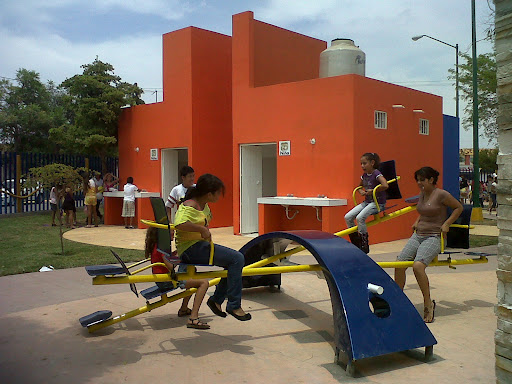
Leti Alvarado Fuentes assigned her architecture students a project: adapt common park play equipment so that special needs kids can use it and enjoy it. They did a terrific job. Then Jorge Medina, our resident iron work professional, found a gentleman who could manufacture the play equipment. And, oilá, Parque Marco Polo was born! The swing holds a wheelchair securely. The slide accommodates two people going down at once: one to hold the other safely. And the teeter-totter also accommodates two people: one to sit in back and hold the person in front. The merry-go-round wasn’t yet functional this week, so we have something to look forward to!
Below are two video clips. The first is television news coverage of the inaugural event, and the second is the early park animation that the Rotary Club used to attract donations.
Finally, here are a few vocabulary words I learned, since I don’t hang out in too many children’s parks these days.
The play equipment in the park is just called juegos.
The merry-go-round is the carosel. Easy enough!
The teeter-totter (some call it a seesaw) is the sube y baja. Also easy enough, but more fun in English I dare say, lol.
The slide is the resbaladilla.
And, drum roll please, the most important piece of park play equipment, the swing: columpio!
Hearty congratulations to all those involved in this park! Now children can play alongside one another regardless of ability, creating an equality of joy! I do hope that many more parks of this type might be built, throughout our state and country, providing more access to all children.
One of the cool things about foreigners who move to Mazatlán is the variety of lifestyles they can adopt here. While the vast majority are retirees, more and more we see families and working people relocating to Mazatlán.
At one end of the continuum we meet extranjeros who live very Mexican lives, adopting the culture, speaking the language and, perhaps, obtaining citizenship.
On the other hand we meet those who have little desire (or sometimes ability) to learn Spanish, who socialize primarily or exclusively with non-Mexicans, and who in many ways have replicated their lives from NOB (north of the border). People at both extremes seem to live happy and fulfilling lives here, which is great to see.
And, of course, there are lifestyles representing every combination in between these two extremes, including many who volunteer ceaselessly and selflessly and many who party and sunbathe daily, living the retirement life they always dreamed of. We have artists, lifelong students, those who start small businesses, and those who remodel and restore historic homes.
Amidst so much diversity, Cathy and Bill stand out. They don’t fit into the most common expat categories, and they are one of the most interesting couples I’ve met here. Both in their fifties, Bill has recently retired and Cathy is nearing retirement. They originate from the US east coast. A few years ago they vacationed in Mazatlán, fell in love, and bought a house on their very first trip here: on a whim, so to speak. The home they bought is in a typical, centrally located Mexican neighborhood. No modern marina area or Centro Histórico, areas in which many other expats live and where perhaps things might be easier for them. Ok, plenty of other foreigners live in neighborhoods with few foreigners. But, neither Cathy nor Bill spoke Spanish when they bought their home, though they are taking lessons and learning quickly. Talk about jumping into the pool rather than checking the temperature first with your toes!
They are not like some retirees who live in the typical neighborhoods because there they can live on social security and a small pension because life is cheaper. Nor do they live in a gated community with killer views. Cathy and Bill live in a nice home a block from the beach, in a mixed-use neighborhood of small homes and businesses.
What’s remarkable to me about Cathy and Bill is how completely open they are to the culture and the people here, despite their initial lack of language and experience with Mexico. To me as an interculturalist, getting to know them has been a breath of fresh air. We witness a lot of unfortunate cross-cultural misunderstanding and negative judgment in our daily lives here, and we ourselves are not immune to it as we create our community here. But Cathy and Bill are excellent role models of how to be open minded, and how to jump into a new community wholeheartedly.
They have befriended their neighbor, an air conditioner repair guy, who has “taken them under his wing,” so to speak. He has welcomed Cathy and Bill as a member of the family and local community. Thus, the couple is invited to the kids’ baseball games, school performances, and every extended family party and event. And Cathy and Bill go. They don’t let the lack of language or cultural understanding stop them; they see these as an opportunity to learn, to build friendships, and to build community. Their circle of friends here keeps growing exponentially, as they learn local slang, how to make ceviche, or how to rehab a car Mazatleco-style.
We first got to know them in the way we first connect with many of the foreigners we know here in town: online. Greg probably answered a few questions they had about living here. He happened to mention our plans to attend a Banda El Recodo concert with our neighbors. They asked us to buy tickets for them to attend as well. The first time we met them was when we delivered the tickets to their house.
We have not had the good fortune to get to know a lot of foreigners in town who attend bandaconcerts, though I know they exist. In fact, among the thousands of people attending that concert, I honestly believe we were about the only foreigners at the event. Cathy and Bill’s excitement about attending this concert paralleled our own. They didn’t stress, as so many new immigrants would, about the hours and hours we waited for the main event to commence. Concerns about safety or violence didn’t prevent their attendance, as it does so many others. They danced and hooted with everyone else, taking photos and videotaping with sheer delight. They ate and drank the local food, with no concern about getting sick. They looked around with us to try and figure out how people were getting chairs to sit on, and together we found the way and happily sat. Till the band came on, of course! It was really refreshing to witness in someone new to town; the differences seemed to energize them rather than intimidate them.
I can count on these two for a funny, self-deprecating story. They were recently invited to a “nephew’s” birthday party. Their friends explained and explained the location of the party to them. They drew them a map. The children attempted to explain in their best school kid English. But Cathy and Bill were still confused. But they’re committed. They drove around in circles, trying to find the location, until they finally found their friends waving at them: from Burger King! Yes, they hadn’t understood the Spanish pronunciation of those well-known words, but it didn’t hinder them from enjoying the party with their friends or from making the most of the story afterwards!
It so happens that in front of where Cathy and Bill live is a large empty lot. When they bought the house, they wondered about it: whether and when it would be developed, mostly. Little did they know that this lot becomes home to major city-wide events a few times a year. While the crowds, litter, noise till all hours of the morning, and dust might bother a lot of people, instead of complaining Cathy and Bill embrace the excitement. “What a great location we have the good fortune to live in,” they say!
Their open-mindedness and enthusiasm are supplemented with a real desire to thank those they feel have made their new home such a joy to them. Each fall for the past few years, when Cathy and Bill drive south to their winter home, they pack their vehicle to the brim with bicycles and sports equipment to give to local kids, and a few adults who are now able to get to work much more easily.
It’s people like Cathy and Bill who make me really proud to be an American. Thank you, friends.
Readers, I first wrote this post a year and a half ago. Somehow the file became corrupted, and this was never posted. Now that I’ve figured out how to “rescue” the file, I’d like to give you a short update.
Cathy and Bill drive down to Mazatlán every year. They spend their summers up in the US going to garage sales and second-hand stores, buying used baseball equipment, bicycles, baby swings — you name it, but things that people here might find useful and hard to find the extra money to purchase. They fill their truck and haul it all down here every fall. They spend the first month they are here finding good homes for all these items.Parties at their home have now become an annual tradition. The neighbors block traffic on the street, one neighbor cooks tacos, another provides the DJ service, Cathy and Bill provide the tables, chairs, paper ware and beer, and fun is had by all. Last time we went there had to be 150 people there; and the four of us the only foreigners! They have far more patience, perseverance, and tolerance for ambiguity than I could ever hope to have. They give so selflessly and so joyously, and their love is returned to them multiplied many times over.
They spend every weekend cheering on their local friends’ kids at the kids’ baseball games, and they’ve been invited to many, many homes and parties. Even though they are here part-time, their lives are so intertwined and important to their Mazatleco friends. It is really wonderful to see how loved they are. Just last night, their friends here hosted a surprise going-away party for these two. Over fifty people attended.
Way to go, Cathy and Bill! Thank you for helping keep Mazatlán the multicultural mix it has always been! And for helping make our world a better place. Enjoy your NOB summer! We will miss you!
It took a man from Hidalgo, José Alfredo Jiménez, to write these words that echo in my head on an almost daily basis. The words of the song that most often echo through my heart though are tienen todos ustedes un orgullo, el gran orgullo de ser de Mazatlán — “you all have the pride, the great pride to be from Mazatlán.”
And this week Jimenez’ words from the Corrido de Mazatlán rang especially true for me. Let me tell you the top five reasons why. Want to listen to the Corrido while you read this post? Click here.
1. Compañia Danza Ballet de Mazatlán
Late last year our already-wonderful Mazatlán was blessed once again with the formation of a brand new professional ballet company, Compañia Danza Ballet de Mazatlán. How many small cities boast their own ballet company? Makes me so proud.
This week Danny and I had the good fortune to watch them in action at the historic and gorgeous Angela Peralta Theater, in a performance of Don Quixote. We sat in the sixth row center for a perfect view, at a cost of US$25 per seat, and witnessed Cuban ballerina Mariem Valdez Martinez dance the role of Kitry splendidly. Other hits in our opinion were Javier Diáz Dalannais in the role of Gamache (just looking at him with his flaming red curls and painted clown face was delightful; but add to that his buffoon antics and it counter-balanced the artistry brilliantly) and Jorge Gorostiza in the tile role of the elderly Don.
Thanks to Ustream and CULTURA, you can view the entire performance online. They have now unfortunately added commercials for upcoming events to the video, so you’ll have to wait through those to see it. I felt our local dance company did a much better job than the Russian State Ballet that visited last month, and at less than half the cost. Kudos to the directors, Zoila Fernández and Guillermo Carrillo! The dancing was solid, the sets and the costumes were outstanding, and the entire performance charmed the heck out of the standing-ovation audience.
2. Concurso Internacional de Canto/International Opera Singing Contest
World-renowned orchestra director/conductor and our neighbor, Enrique Patrón de Rueda, first organized this contest four years ago. It has become the premier contest of its kind in Mexico and perhaps in Latin America. Another pride. It is sponsored by the Sinaloan Institute of Culture, and is designed to encourage young singers (ages 18-33) in their opera careers. This year it will give out US$16,500 in prize money; pretty incredible considering that enrollment in world-class singing classes at the Centro Municipal de Arte costs about US$250/month!
Last night we were privileged to hear ten arias sung by ten incredible young soloists from Mazatlán, other parts of Mexico, Guatemala and Chile. It was an informal event, designed to give the performers experience in front of an audience prior to the official contest events. The arias were incredible, and what added to the experience was that we were able to witness Maestro Enrique interrupting the singers to correct them, and the singers responding by raising the caliber of their performances. What an education! And what a true delight! And, as with the affordable ballet tickets, tickets to this event were 100 pesos (about US$9). Note: Addition from Sunday 22 April: Today’s paper has an article about this event, if you’d like to read it.
3. Neblina/Fog
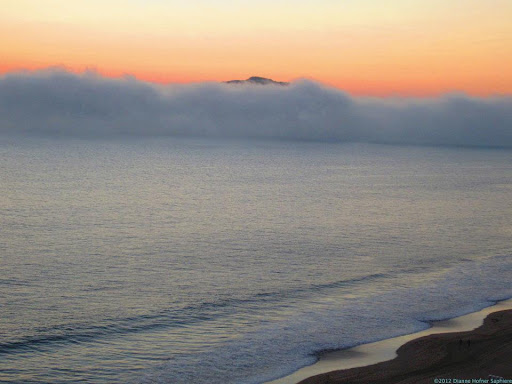
We are spoiled with wonderful weather here. My son tells me that my “zone of tolerance” is now about two degrees Centrigrade; otherwise I get too cold or too hot. Untrue; remember he’s 16 and is prone to exaggeration. Anyway, almost every day we have killer sunsets (you can view a few on our “Viva Mazatlán” channel on YouTube), gorgeous clear blue skies, views to the ocean and the islands, whales, turtles, dolphins, cranes, egrets, spoonbills and pelicans, and consistently hospitable weather (ok, summer gets sticky). This time of year brings a change of pace, however. The change of seasons means the cold air over the ocean mixes with the warm air over the land, causing heavy morning fog. It is so beautiful to see! Watching the islands do a striptease is quite a pleasure! That’s the photo leading this post.
4. Our Film Debut
If you read this blog, you know we love living here. That’s what this whole post is about. So what fun it was to this week receive copies of videos in which members of our family appear, talking about this place we call home! Please check it out and let us know what you think. Be sure to hang on to the end to see the joven:
The second video in the series, this one a bit different, and just as packed with what we love about Mazatlán:
The third and final video features Danny at the 2:00 minute mark:
5. Great Triathlon of the Pacific
We are also blessed with loads of special events and athletic activities here in Mazatlán, including the international marathon and the annual Travesía, where swim club members swim out to the island. This week was the triathlon, which is awesome because kids as well as adults compete, and we get to see them out in the ocean swimming, as well as biking and running up and down Avenida del Mar. This year there seemed to me to be more children than normal participating, which I find incredibly encouraging. And the adult winners included Mexican but also an Austrian, a Canadian, a Czech!
I’ve told you before about the wonderful lighthouse we have here in Mazatlán. We hike it once or twice a week, and we so enjoy the families, young couples, exercise groups, and elderly people, too, who make the climb up one of the ways they stay healthy. It’s a gorgeous view, and a terrific group of young Mazatlecos has been working hard to keep the area clean and maintained. I’ve heard the lighthouse is owned by API, the port authority. If so, Mis Estimados Señores del API, sure would be a wonderful community service for you to invest a bit of money in making this a better tourist attraction and community gathering area….. It’s so beautiful, it wouldn’t cost much… Just an idea 🙂
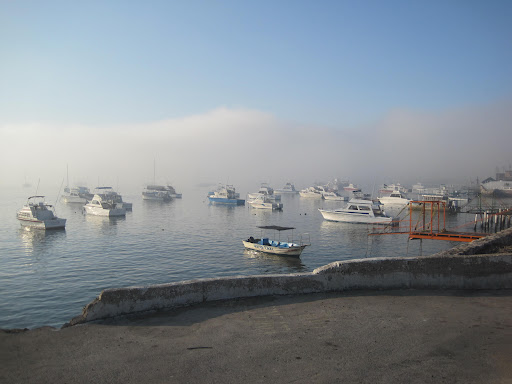
Anyway, yesterday morning was pretty foggy here. As we made our way down the malecón toward the faro there were lots of oyster divers and panga fishermen out, despite the foggy conditions. We are so spoiled here with clear, sunny weather, that seeing a bit of fog once in a while seems so absolutely gorgeous!
We wondered as we approached the lighthouse hill if we would be able to see anything as we made our climb. It sure did seem to be heavy fog.
The harbor had more boats than usual, it seemed. We guessed that perhaps people had brought their boats out in preparation for Semana Santa.
As we started our climb it seemed we weren’t going to be able to see much of anything. It was pretty cool, sort of like walking in a spook house. In the photo at left, we SHOULD be seeing, or are used to seeing, all of Isla de la Piedra/Stone Island. Not today!
The cacti and vegetation, which are so gorgeous this time of year, were shrouded in veils of fog, making for a very mysterious feeling. There were way more hikers, bikers and runners on the trail than is normal, however. Again, we guessed that people are getting in a holiday mood.
As we reached the top of the lighthouse hill the fog had moved a bit. We couldn’t see much of anything of the city, but the teeny-top of the hill on Stone Island that I showed you above, much more of it was now visible. Kind of a nice change of pace to have changing scenery, when we’re spoiled with consistently perfect views…
Despite the fact that the view from the top was still foggy, the weather at the top was very clear and bright. I took a shot up, through a tree. You can see there was no fog whatsoever up high.
And one of the lighthouse’s many resident iguanas was more than happy to sun himself, more than ready for the R&R and hopefully increased sales that Semana Santa will bring for our local economy.
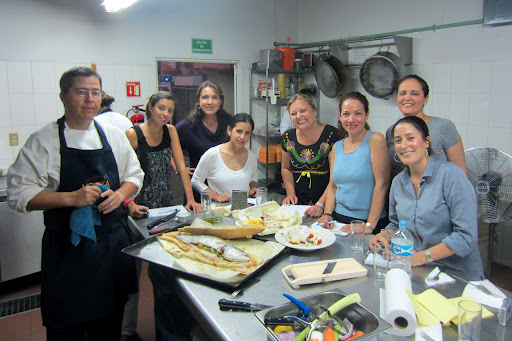
I’m privileged to have a terrific group of lady friends who like to cook, and we get together to learn and to teach one another once a month or so. In addition to our Thai cooking classes, we’ve made timballo (Italian “drum” with pasta and eggplant), tortas ahogadas, rajas, chicken mole, macarones, and lemon cake, among some other wonderful things.
Well, my friend Magda got the wonderful idea to book us a series of classes with Héctor at Molika, downtown on Belisario Dominguez near the Plazuela. While I’ve known Héctor for several years — he’s a GREAT bread baker (sourdough and ciabatta plus other good loaves) and I am in love with his grilled vegetables (which we also frequently make at home) — I discovered that he also truly shines as a teacher!
He is funny, charismatic, and I LOVE that he teaches METHODS rather than recipes! In one two-hour class on cooking fish, he demonstrated SIX different methods of preparing the fish we commonly have available here in Mazatlán. For me who learned to cook fish while living in Japan, I learned a lot. For example, he taught us to cut off the fins (see video above) before cooking the fish (you’ll know that most Asians LOVE the crispy fins and would never think of removing them before cooking), saying that the fins have too strong a flavor.
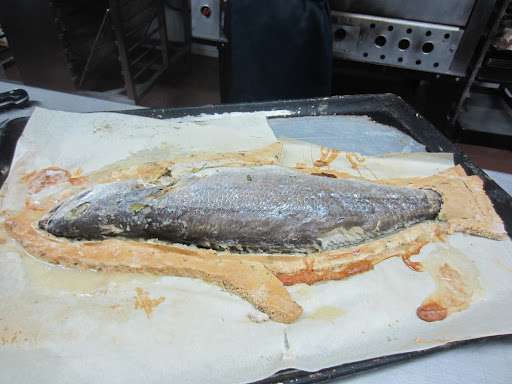
My favorite? Well, by now you know me. I love something different, and especially something impressive. And Héctor delivered: Pesce in crosta di sale, or fish in a “tomb” of salt. I’ve eaten many fish baked in salt crust before, but nothing quite like this!
Rather than just salt with aromatics, Héctor made a salt dough with the 2 salt : 1 flour, eggs, fresh herbs and a bit of water.
He kneaded it (see video above),
Rolled it out,
Pressed two pieces (top and bottom) to the form of the corvina, sealing the dough with beaten egg, decorated it a bit,
Trimmed it to shape (video above), and then baked it for 45 minutes.
The fish of course turned out incredibly moist, aromatic and flavorful. He said he prefers to use robalo rather than corvina, but I was plenty happy with this.
He suggested that we cut the rock-hard crust in the kitchen (you can see above that’s pretty challenging), then take the encrusted fish to the table, where we open it in front of our guests. That way the room fills with the wonderfully aromatic scents.
Finally, unlike Japan where everyone knows how to eat fish on the bone, Héctor suggested we remove the flesh from the fish in front of our guests, serving it up on plates. He removed and discarded the skin, saying that baked/steamed fish skin doesn’t taste good. I can hear the shocked gasps of my Asian friends now, but it was nice for me to learn a more European approach. I will definitely give this gorgeous dish a try. I must admit that I preferred the taste of several of the other dishes he prepared! This one was just a presentational stunner, like my timballo (thanks, Allison, for teaching me!).
We made pescado en papillote, fish steamed in paper. We stuffed the fish with aromatics: lemon peel, garlic and fresh herbs (basil, parsley, rosemary, thyme), then garnished with sliced fresh celery, onion and carrot. It was interesting to me, again with my Asian influence, that Héctor taught us to peel the celery, removing the fibers. Definitely a finer dining touch than I’m used to.
Above you can see Héctor opening the papillón.
A third dish we made in this two-hour class was the dish I swore every single Japanese restaurant serves: sole meuniere (lenguado). Many of the ladies were very happy to have Héctor teach them how to filet. Cleaning and preparing fish is fortunately one of the many skills I learned well in Japan. One of the key points he pointed out is to filet fish when it’s cold, fresh from the icebox. That way it’s much firmer and easier to handle.
Héctor studied and cooked in London before returning to his native Mazatlán, and he uses lots of olive oil and sea salt, as you’ve already seen (way more than I’m used to, though I will start putting a bit more olive oil on for taste at the end), and for this dish he used a whole lot of butter as well. Nobody said good cooking isn’t fattening! He did caution us to check the ingredients on the butter we buy, as ideally it should be made from milk, and not contain emulifiers and a bunch of chemicals. I do think that’s part of the baking challenge I’ve had since I moved here — gotta buy better butter.
And here we have the finished lenguado/sole, covered with sauce from the pan and garnished with a bit of parsley.
I had been craving salmon and asparagus, and just that morning bought both to make for lunch, so was fascinated to see Héctor make this as part of our repertoire for the day. He of course used clarified butter as it withstands higher heat, to get the nice crispiness on the salmon. Note: he removed the skin before cooking. I guess this is also either a European way or alta cocina, because personally I love the crispy skin. I was sooooo gratified to see him cook it the way I feel it should be. Héctor told us that salmon, tuna and swordfish should always be left rare in the center, and I heartily agree. People here in Mazatlán always seem to overcook fish.
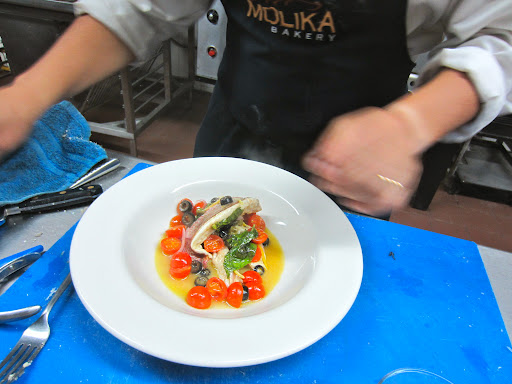
The fifth dish he made was swordfish. He cubed the fish, sauteed it with fresh herbs, cherry tomatoes, capers and olives. In addition to the lemon (yellow lemon) rind he added to most all these dishes, he also added a bit of lemon pulp. This concoction he poured over his famously to-die-for ciabatta, and oh my!!!! The bread somehow soaked up and enhanced the lemon flavor of the sauce, and it was soooooo delicious!
I’ve left my favorite dish for last. Fortunately, it was also probably the easiest to cook: pescado en la bolsa, fish in a bag. He used the same ingredients as most of the other dishes — fresh herbs, cherry tomatoes, olives, capers, sea salt, extra virgin olive oil. The wonderful part, besides the incredible taste?
He put all the ingredients in a ziploc bag and cooked it in near-boiling water on the stove! It took just a few minutes and there was nothing except the serving dish to clean up! My son is in Scouts, and they cook just like this on their campouts. Maybe not quite the gourmet ingredients as this, but still very tasty nonetheless.
Thank you, Magda, for setting this up for us! Thank you, Héctor, for a marvelous class! We are very much looking forward to our next one.
Anyone wanting to arrange a class for a group of friends, please give Molika a call: 669-981-1577. Héctor’s English and Spanish are flawless, and his kitchen skills are a gift to Mazatlán.


















 ¡VidaMaz!