Adios Estuary :'(

IMG_4169-1

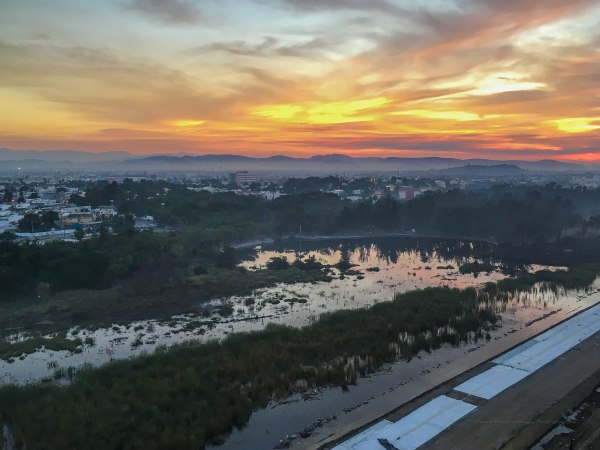
Sunrise over city park, with the new Avenida de la Bahía in the foreground

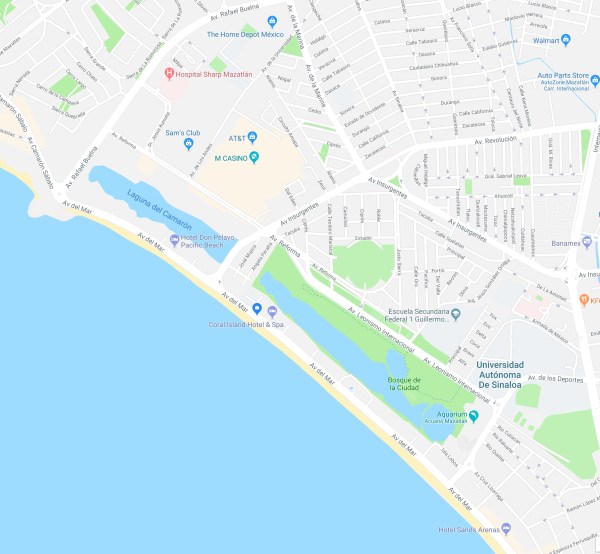
For eons Mazatlán has been the land of the estuary—brackish water, half fresh and half salt, that rises and falls with the tides. There used to be estuaries all over Mazatlán, from south to north, brimming with shrimp and mangroves, home to turtles and a myriad species of birds, but sadly not many remain. Most have been filled in completely, like those in the Golden Zone, which leads to the frequent flooding of that area in rainy season. Now we are losing Estero del Camarón, shown on the map below (as Laguna del Cameron), which runs south from Rafael Buelna over Insurgentes to the Aquarium at Av de los Deportes, thanks to the building of Avenida de la Bahía.

estero map

Avenida de la Bahía has been in the city’s plans for over a decade; it’s nothing new. What is new is that most everyone believed the road would be built in the “set aside” behind the existing buildings along Avenida del Mar. There was plenty of room beside the estuary for two lanes of traffic plus parking on both sides. Thus, when it was announced that the long-planned road would be built, there wasn’t too much ruckus.

People who live on Avenida del Mar are grateful to have a second egress, as this major city artery is so frequently closed due to races and other events. We actually, naïvely, were pleased to think that those who had “stolen” land from the estuary—hotels and salones de eventos that had “pushed out” into the estuary—would now have to give up that appropriated land in order for the road to be built.

Alas, no such luck. Despite the fact that city park is supposedly a wild bird sanctuary —”protected land,” we’ve always been told— construction of the new Avenida de la Bahía doesn’t even start till way beyond the land that we were told was set aside for the new road. Contractors have spent six weeks now filling in OVER HALF of the estuary facing the Bosque de la Ciudad/City Park! They have been working 24 hours a day seven days a week, dredging the estuary of plant life, then dumping trucks full of huge boulders into the water, dozens of truckloads per hour. They add dirt over the boulders, and cement on top of that. First they built two lanes, which we thought was bad enough; then four. Now they are adding diagonal parking on the west side and possibly more on the east. It just keeps getting wider and wider! The road is now wider than a freeway. After removing all the parking from Avenida del Mar, of course more parking is needed. But does the estuary have to pay the price? Click on any photo to enlarge it or view a slideshow.

The way they have built the new avenue actually leaves water trapped in between it and the Avenida del Mar—water that will attract mosquitoes and disease. I can only imagine they’ve left that area so that property owners (primarily the Tellería family, I believe) can build locales or storefronts facing the planned Parque Central.

The entire project is the most blatant disregard of our environment that I have witnessed. I was told the project was stopped, put in amparo, and according to the Noroeste, that is when they started working at night instead of during the day. A few days later they extended from night work to 24-7 work, and about ten days ago they put up signs that say they are taking care of the environment. I find the irony heartbreaking.

They are now within a couple hundred yards of Insurgentes. To my knowledge they have yet to buy any of the houses they will have to knock down to connect the new avenue with Insurgentes and continue north to Rafael Buelna. Eminent domain?

That housing area already floods in rainy season, as does the area in front of the Gran Plaza. I imagine now that they’ve reclaimed over half of the estuary, the area around the stadium, city park, Insurgentes and the Gran Plaza will flood much more dangerously; where is the water to go at high tide? They have built the road up high, to keep it from flooding. But we sure haven’t seen them build any exit for flood waters. Hopefully I’m just missing something.

Mazatlán’s allure for tourists and residents is its natural beauty, its marine life and seafood. Destruction of the environment like this is shortsighted. I was excited about Central Park and the new Mazatlán Museum, but if losing our estuary is the price we are paying for them, it is way too high.

Chickens for Christmas 2017

DSC_4956I trust you all are enjoying wonderful holidays, and that 2018 will bring you much health and joy.

This year as we handed out chickens and food to over 2500 needy families, the most popular items— other than the food, of course—were the blankets and tools! We had a few drills, some hand tools, and a couple of electric tools, and my oh my did this make the men happy! Fortunately we had 80 blankets, thanks to the generosity of one donor and the intelligence and kindness of an expat couple who traveled to Guadalajara to buy them. If we had had 800, people would have been thrilled. We chose the elderly most in need as recipients of the very soft and warm blankets. Click on any photo to view it larger or watch a slideshow.


The spinners and the balls were just some of the many toys that our nieces bought with the proceeds from the sale of their brownies. Lots of local children donated their gently used toys, so this year we were blessed to be able to make over 300 children very happy. Perla and Brisa, the two neighborhood girls who have accompanied us the past five years joined in again; they have gotten really good and bringing Christmas cheer to those in need. Baby things are also very popular: diapers, clothes, blankets.


Our group handed out food, clothing, shoes and toys in three places this year: Rincón de Mazatlán (in Colonia Universo/Ébano), El Basurón (the city dump) and Rancho de los Niños. We felt especially blessed that it was just our group this year: our family, our good friends the Hernández, and friends of ours and theirs. It rocked to be together with loved ones on Christmas bringing smiles to the faces of everyone from 90 to 3 months!

We tried a new method of handing things out that worked wonderfully. As you can imagine, people get anxious and over-eager, and that makes for lots of confusion if we don’t manage things well. Well, we lined up our heavily-laden trucks and cars as usual: chickens first, then despensas/food, followed by toys. Once all that was given out, we opened up the clothes, displaying them on the ground on sheets as if in a store, and keeping the line moving steadily.


We announced the plan to everyone ahead of time, so that those who wanted clothes would stick around. They were all lined up, the community leaders had made sure of that, and then our volunteers lined up as well, forming a human chain or wall between those in the line and the gifts. At first we felt awkward, but it worked beautifully! No more cutting the line, everyone got something, it felt organized and there was happiness galore. Bless all our volunteers and their smiling faces and love-filled hearts!

We had so many clothes and shoes this time that, despite serving over 350 families, we had extra! I especially loved how everyone tried on shoes to make sure they fit, leaving them for others if they didn’t, and then glowed with happiness when they found the perfect pair of leather flip flops or high heels. We packed up the leftover clothing and shoes and left them with the community leaders to hand out to those in need who couldn’t make our event on Christmas Eve morning.


People really love blankets and other bedding, including sheets and pillows. They love pots and pans and kitchen things; most have outdoor kitchens and these items don’t last long. If you have any extra tools you don’t use, or see any at garage sales this summer and you drive down, please bring them! My one great sadness this year was a gentleman who showed up at 11:30 with a ticket for a chicken AND food, but we’d already handed it all out. He didn’t want toys or clothes, and in his disappointment was very upset with us. We had asked them to show up at 8:30, so he was late. But, he really was looking forward to the chicken. I didn’t have any cash on me to give him, and he left in a huff. God bless him; I do hope something else happened to make his Christmas beautiful.

We started loading at Quince Letras about 6am. We are a multinational group of locals and expats, including dozens of young adults, many of whom have been doing this since they were kids and who now bring their friends—the next generation. I love watching them grow in strength of character and love each year. We also have a solid group of children who join in to help. We form bucket brigades or rally lines to load the trucks with food, toys and clothes, then set out on different routes to reach people all the way to Villa Unión. This year we also served the community of desplazados, those displaced by violence in the Sierras; I was thrilled with that! After loading all the trucks and cars, we form a large circle to say a prayer, and then we are off!


Our group first went to the Basurón, then Rincón de Mazatlán, and finished up visiting Rancho de los Niños, where we all enjoyed playing with the disabled kids. Hugging and loving on them made for a perfectly wonderful end to our Christmas Eve morning. We saw the new buildings that are being built for Rancho de los Niños by Back to Back Ministries, including a physical therapy pool. The new digs look great and should be ready early in the new year!


THANK YOU ALL immensely, for participating in the myriad ways you do! We look forward to seeing you again next year. I have written lots of stories and posted many photos of this event over the past 16 years. Just search for “pollos” or “chicken” in the search box if you’d like to see more. And remember, details can be found at www.VidaMaz.com/Pollos

Best Christmas Ever

P1120873

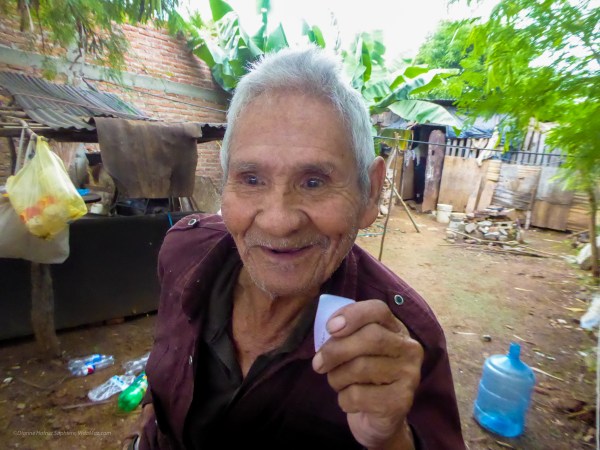
This happy gentleman is deaf and pretty much blind, also. Yet look at the light in his eyes!

Every year, when I go out with Yolanda to pass out tickets for chickens for Mazatlán’s neediest to eat on Christmas, I am amazed at people’s resilience. Living in such difficult conditions—tar paper shacks with rain water trickling (or sometimes crashing) through makeshift roofs and running in on dirt floors, they smile joyfully, decorate their homes with Christmas decorations, plant their yards with flowers, fruit trees and vines, hibiscus and vegetables, and build altars and shrines to those they worship. We find them working hard: washing clothes, sweeping their earthen floors, cooking on outdoor, makeshift stoves. Click on any photo to view it larger or watch a slideshow.

This year, instead of Colonia San Antonio, as we’ve done the past seven years, we went to Rincón de Mazatlán, in Colonia Universo. It’s always difficult. We can’t give chickens and foodstuff to everyone; we only have enough for 2500 families. We try to find the neediest: the disabled, the elderly living alone, those who are ill, injured or unemployed, widows with sick children, families living 13 or 18 people in one tarp-covered lean-to. There are so many of these, sadly.

I was tired when we finished today, yet Yolanda has gone out for the last five days straight, morning and night, to hand out tickets. She seems truly tireless, much more passionate and dedicated than I can dream of being. Oli and his crew have been packing rice, flour, sugar, oil, coffee—two weeks’ worth of foodstuff—every other day for two weeks. Many of you have contributed money, time and talent. A lot of work goes into feeding 2500 families over Christmas, and I am blessed, indeed, to be able to be part of the team. It’s a family tradition; our 22 year old has helped out since he was just six years old. Our nieces make and sell brownies to buy toys for the kids. One local 12 year old this year donated all her Barbie dolls with clothes and accessories in order to make other young girls happy. It’s such a beautiful effort.

Handing out tickets is always challenging. Whoever has a ticket will get a chicken the morning of December 24th. Community leaders want to tell us who to give things to, often because they want to buy votes for their political party with our donations. Or, they don’t want to give a chicken to a family that hasn’t paid their water or gas bill. We don’t want that. We want to help those in need; not play favorites or make demands. Churches will help people, too, but require them to attend their services. We are blessed with people in our community who build homes for the poor, but we are also told how neighbors scam the system, getting ministries to build homes that people who don’t ever plan to live in them rent out to make money.

Today we saw a manufacturing warehouse with an orchard next door, all surrounded by an expensive fence. The owner, we were told, lives in El Cid, and some government official gifted the person seven lots in this squatter community, despite the fact that most living here can barely scrape enough together to pay the property taxes required to eventually claim ownership of the property. Ah, corruption. Finding those who need the most help, who don’t have a voice, is not easy. We were cussed at by one man today when we refused to give him a ticket, yet neighbors told us he sells the surrounding land to unsuspecting buyers, even though he doesn’t own it, cheating them of their life savings. He lived in a nice brick home, and had a late model SUV, in big contrast to most who live here. Different members of families will come to us begging for a ticket, so that can get several sets of chicken and foodstuff; that’s why we need to keep track by house number, and travel with local people who know one the neighborhood and who’s who. Yet, so many people play favorites.

I look forward to Sunday morning, when we hand out the chickens, food, toys and clothes. It is so much fun. It makes Christmas. People are so happy when we arrive, so grateful. If you’d like to help, please join in. It’s a great experience for kids to see how people live without running water and other amenities. The information can be found at http://www.VidaMaz.com/Pollos.

Merry Christmas!I trust your holidays are filled with love and joy, and that the New Year brings you health, peace and community!

Comparing Hospitals in Mazatlán

Mazatlán is blessed with a number of private and public hospitals ranging from basic, clean and caring to world-class. Many locals and expats have a clear favorite, but the choice varies depending on whom you ask. Such disagreement of opinion causes me to wonder: what are the real differences between them? Obviously there are price differences, but what are the differences in equipment, facilities, caliber of the staff, and safety procedures?

International media has shared horror stories of foreigners not being released from Mexican hospitals until their bills are paid. In contrast, friends have regaled me with effusive accounts of wonderful care here in Mazatlán that saved their lives. I’ve heard reports of foreigners being gouged on prices, and tales of people paying just a few hundred dollars for several days of attentive ministrations.

To bring some clarity to the matter, I reached out to four hospitals popular with local expats, receiving answers to a 35-question bilingual survey, a tour of their facilities and an extensive interview. I chose hospitals with a variety of price points as well as locations throughout the city: Hospital Marina Mazatlán up north, Sanatorio Mazatlán in Centro Histórico, and Sharp Hospital Mazatlán, just south of the Golden Zone. Unfortunately, after initially agreeing, Clínica del Mar, with a price point higher than Sanatorio Mazatlán but normally cheaper than our other two participants, later declined participation.

The good news is that you can get excellent care at any of these three hospitals. They are all clean, well maintained and have an attentive staff. Each has surgical facilities, an emergency room, intensive care, laboratory, x-ray equipment, general practitioners, on-site specialists, a chapel and physical therapy. They are open 24/7. All three provide food for patients and have nutritionists on staff; some other local hospitals depend on families to provide that service. None of them are huge facilities, ensuring a more intimate environment, and all three have exclusively private rooms with handicap-accessible toilets and showers as well as small closets. There is a sofa bed or cot in every room for a family member or friend to sleep at night. All have transparent price lists for services with room rates posted on the wall in the reception area—per Mexican law. All in all, we are pretty darned blessed! And this is only three of the many neighborhood clínicas and public hospitals in our fair city.

Representatives at each of the three facilities told me that, yes, Mexican law requires patients to pay their accounts in full prior to leaving the hospital; so get used to that cultural difference! Marina and Sharp have their own ambulances, while Sanatorio uses the Red Cross. In an emergency dial 911 and request transportation to your preferred hospital. Depending on which ambulance comes for you, you may have to get pushy as some less reputable hospitals are said to pay ambulances to bring them patients. Remember that public ambulances such as those of the Red Cross may not have the services expats are accustomed to; often they have oxygen and can take your blood pressure, but not much else. The private ambulances from Sharp and Marina are both equipped to international standards, with Sharp’s having a bit more room for those attending to move around and Marina perhaps having a bit more in the way of supplies and equipment. If you want to be guaranteed to be taken to the hospital of your choice, direct number for Hospital Marina’s ambulance is 669-989-3336 and for Sharp’s ambulance 986-7911.

Of the three in our comparison, Sanatorio Mazatlán has been around the longest; built in 1934, it’s run by the Daughters of the Sacred Heart of Jesus. It is also the smallest and most economically accessible option in our comparison. Located at #1 Dr. Hector Gonzalez Guevara downtown, the facility has just 14 private rooms averaging 4.5 square meters/48 square feet in size that cost an incredible 550-650 pesos per night. Rooms have slightly different sizes, configurations and natural lighting; cost varies accordingly. Sister Martha Alicia Ramos told me that any doctor can provide services here. The hospital does not deal with insurance; patients pay cash and then file with their insurance for reimbursement. The facility is built around a central courtyard with a nice garden, keeping the interior cool yet filled with natural light. I found the space tranquil and quiet, with staff considerate and attentive. Telephone 981-2508. Quite a few local expats swear by the quality of the care here. Click on any photo below to enlarge it or view a slideshow.

Sharp Hospital is located at Ave. Rafael Buelna and Jesus Kumate, tel. 986-5678 (to 5683). It was built in 1994 and modeled after Sharp Hospital in San Diego; thus, it has wide corridors and is the only local hospital with sterile medical facilities completely separate from public access, built according to the USA Joint Commission of Accreditation of Hospitals standards of the time. It has 38 private rooms—26 standard and 12 VIP—with an average size of 24 square meters or 258 square feet. Room rates are 2089 to 3160 pesos/night; SHARP cardholders receive a 30% discount off those amounts. The higher rate is for the VIP rooms, which have added luxuries such as nicer furnishings, art alcoves, an amenity kit and medical hookups that are hidden by paintings. General Administrator Tarsicio Robles and Dr. Juan Barraza, head of Medical Tourism, told me that only doctors and surgeons who are vetted by Sharp’s Certification Committee, headed by the Medical Director, have surgical privileges. The hospital is certified by the Mexican Health Council and is the only hospital in Mazatlán endorsed by the National Transplant Center. Emergency room cost is 136 pesos, and use of the surgical facility is 1650 pesos/hour.

Sharp has a dialysis unit built to Canadian standards—Get Away Dialysis, a cath lab, neonatal ICU, shock and trauma room, fertility clinic and blood bank, as well as MRI, CT, EKG, mammography, fluoroscopy and stress test equipment. They are the only facility in my survey that answered the question about percentages of national vs. international patients: 5.16% foreigners. Things such as the ample size of the intensive care unit, numerous comfy waiting rooms, outpatient dressing rooms and posting of a “Patient’s Bill of Rights” will give Sharp a familiar feel for many expats.

Sharp has a bilingual Medical Tourism department and a team specializing in foreign insurance assistance. They tell me that in most areas on most shifts they have a bilingual Medical Tourism Department staff member available, as well as a list of interpreters in various languages. All signage is bilingual. www.hospitalsharp.com

The newest hospital in our comparison, Marina Mazatlán, was built in 2014. It is located at #6048 Ave. Carlos Canseco, telephone 669-913-1020. They have 22 rooms averaging 30 square meters or 323 square feet in size—the largest rooms in our survey—plus 3 beds in ICU. Rooms cost 1678 pesos/night. The facilities are beautiful, modern and sleek. Claudia Caballero told me that Hospital Marina welcomes any doctor, though they do need to register their medical curriculum at the hospital prior to attending a patient there. Hospital Marina has staff that helps out with foreign as well as domestic insurance. Emergency room cost is 492 pesos, and use of the surgical facility is 1326 pesos/hour.

Hospital Marina is in the process of accreditation with the Public Safety Council. They have a pain clinic, dialysis, a cath lab, neonatal intensive care, and an emergency room, and services provided include endoscopy, hemodynamics, stress test, Xrays, regenerative medicine, pneumology, neonatology, clinical nutrition, orthopedics and trauma, radiology, intensive therapy and intensive pediatric therapy. I was told they transport patients who require an MRI. I was told that quite a few of the nurses, doctors and staff are bilingual, so someone is usually available to translate in a pinch. www.hospitalmarinamazatlan.com

Both Hospital Marina and Sharp have bilingual signage, a fertility clinic, nursery, CT scans and pharmacy. They both have a restaurant with a full menu, while each of their patient rooms has a flat-screen TV and both a recliner and a sofa for guests. Sanatorio Mazatlán has a cozy, Mexican feel while Marina and Sharp both feel more generically hospital-like. Sharp proudly showed me their own generators and fire fighting equipment, as well as protocols for handling a community-wide emergency or an evacuation. If you drive, it could be worthwhile noting that Sharp has a large parking lot, while Marina Mazatlán’s is surprisingly small and tight for such a new facility; Sanatorio Mazatlán parking is on the street but readily available. Sanatorio Mazatlán and Marina have numerous doctors’ offices in their facilities, a common Mexican practice; Sharp has the Polimédica offices right next door. Speaking to the culture of each institution, I feel it’s worthwhile noting that at Sharp two doctors including one administrator toured me, while at Marina a very helpful public relations person conducted my tour; at the Sanatorio I was invited to show myself around.

Please note that this article is based on the answers I received during interviews, in the questionnaire, and during my tour. It is possible some points are not fully accurate or that, since I am not a medical professional, I misunderstood something. Please be sure to conduct your own investigation and determination on fit for your needs. Questions to ask yourself when choosing a hospital in Mazatlán might wisely include: Do I want or need English- or French-speaking staff? Does my favorite doctor have privileges at the hospital? Does the hospital have the equipment that my treatment will require? Does the hospital provide a specially priced package for the service I require (a common practice and well worth asking about).

The time to plan for your first or next hospital experience is now. You probably have a clinic or hospital right in your neighborhood. Taking a day to become familiar with what is available and most appropriate to your health needs and personal preferences, as well as budget, is time well spent. I certainly hope this article has motivated you to do so.

Below I post a complete recap of the survey results, word for word as the surveys were submitted to me. I trust you find it helpful. Click to view the images full size. You can also print these out, if you wish. To download original PDFs, click here.


Please help your neighbors and our visitors by sharing your experiences with hospital care in Mazatlán, and your advice. Thanks!

Comic-Con Mazatlán

DSC_2479©Ok, our local “Comic-Con” is a whole lot smaller than San Diego‘s, but it sure is a whole lot of fun and growing every year. The event also shows what one 20 year old young woman can do when she sets her mind to it! These young people know how to put on an event! And how to publicize it! Kudos and more kudos!

Yvonne Tirado, who is now 24, along with her team of six, just finished producing the fourth edition of Mazatlán’s “TomodachiFest,” a conference and “festival multicultural” that attracts young adults from at least three states who are passionate about anime, hip hop music, manga, comics, medieval arts and cosplay. I’ve been wanting to go for the past few years, but life didn’t let me attend until this year. And oh what energy and fun it was!

In my day we would maybe call these kids “geeks,” but here they call them “freaks.” They are largely highly intelligent, fun-loving and very creative young people who love fantasy, invest large amounts of time and talent in handcrafting costumes and memorabilia, and who are in seventh heaven once a year thanks to Yvonne and her team. The event this year took place on Saturday October 14th at the Convention Center from noon till 8pm. It was attended by well over 1100 people, mostly young adults, but also including children and families of “freaks.” Below are the poster and full program for this year’s event, as well as a photo of the t-shirt and main stage. Click on any photo below to enlarge it or view a slideshow.

TomodachiFest (“tomodachi” means “friend” in Japanese, and Japan is, of course, birthplace of anime, manga and cosplay) Mazatlán came to be because Yvonne and her friends were complaining that local conferences offered nothing of interest to young adults. They decided to change that, and despite being full-time students with little to no budget, they birthed the festival. They continue to produce the festival as volunteers.

The high energy event has several things going on at the same time. There are projections of movies and Asian pop music; a karaoke singing contest as well as a dance and cosplay/costume contests; presentations by YouTubers, illustrators and actors who dub films; workshops in drawing, crafts, medieval archery, and ink drawing; and autograph events; and several video game tournaments throughout the day; and a medieval tournament that was held outside in the late afternoon.

The contests have celebrity judges who come from out of town, and the costumes really blew me away. I’m used to seeing incredible cosplay outfits in Japan, but here in Mazatlán, where I know everyone has to make their own costumes and equipment, it truly was impressive.

There is an exhibition hall for the conference, where those attending can buy memorabilia—some of it handmade, comics, and apparel. There were also several computer stations set up for the video game contests.

I had a chance to speak with Alon Ramirez, the internationally known creator and illustrator of “Chico Detergente,” about his work. Born in Culiacán and a former resident of Mazatlán, he now lives in Tepic:

There was a long line for Alon’s autograph, and he took time to sign every one quite memorably:

Congratulations to everyone involved in TomodachiFest Mazatlán! You are shining examples that an individual and a handful of talented souls can, indeed, make a difference!