One of the best aspects about living here in Mazatlán is the fresh fish we are able to buy every morning. Okay, well, we don’t go on Mondays, because there’s not been a lot of fishing on Sunday, but any day Tuesday through Saturday, you can bet we are happy campers.
We take our daily walk down the malecón and, in Playa Norte just across from the pangas, is our favorite spot: Pescadería del Mar.By now these guys know us and they’ve helped us to learn a lot about fish and fishing here in town: what’s seasonal, how fish are stored (on ice, frozen, salted) from the time they’re caught till they’re brought in to shore, and how to cook what’s available locally.
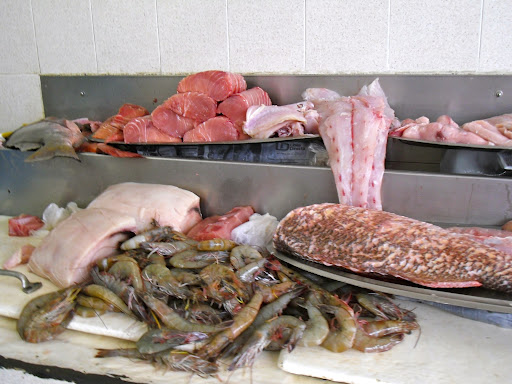
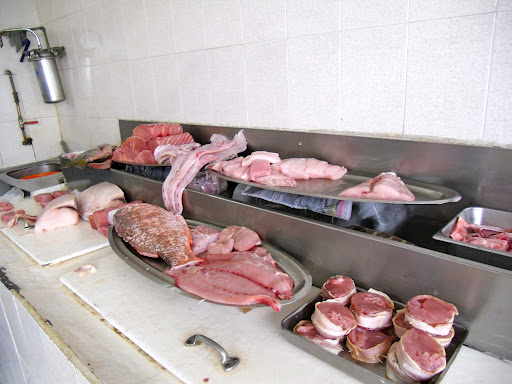
At 7 am when we’re there we usually have a terrific selection. Of course, depending on the season and the weather, we may have more or less fish to choose from. As you can see in this photo, though, there’s usually quite a variety.
The fishmongers will scale and clean any fish we choose, so I can cook it whole, or they’ll fillet (de-bone) and cut up anything we’d like, however we’d like it. They also get fresh shrimp, which I love, because they are deep water shrimp that have NOT been stored in salt, so they’re sweet rather than pungent. They get quite a bit of squid, also, which I love to saute with garlic and herbs. We can occasionally get fresh scallops, too. Our favorite is corvina, a nice firm fish that is sooooo savory! We can at least a couple of times a week get smoked marlin (usually still warm from the smoker and sooooooo aromatic!), and escabecheon Fridays.
It’s fun to watch either the fishermen fresh off their pangas across the street, or a dealer/go-between (usually on a scooter or motorcycle) come to deliver the fish to the fishmongers and make a deal. They have an outdoor scale to weigh what’s brought in, and an indoor scale to weigh what you purchase before it’s trimmed to order.
Having lived so many years in Japan, I am also very happy when they get sushi-quality tuna, though I do believe most of the fresh fish they have is sushi/sashimi quality. Chirashi has never been so delicious and affordable!
If you are a carnivore/omnivore, and do not take advantage of our local fresh fish, please do! You are missing some really flavorful and healthy, and easy and quick to cook, local delicacies!
Mazatlán is privileged to have a strong and vibrant expatriate community, many of whom volunteer long hours to help make our city a better place in which to live. Many in the foreign resident community have of course grown up and lived most of our lives elsewhere. We love our adopted home, but we often lack basic “cultural literacy” about our adopted homeland. I put myself in that category, of course. Every day, many times a day, I learn something new. It’s part of why I love living here.
Last week, I noticed the below comment on one of the local expat discussion groups:
“It is located across the Malecon between two statues: the Deer, Mazatlan’s symbol; and a Sinaloa composer holding his guitar and sombrero.”
The note surprised me, because I figured everyone who lives here knows our beloved Ferrusquilla! But, of course, we don’t “all” know anything; we all have different pieces of information. I see Don Ferrusquilla once in a while, dining around town or taking a walk, and I loved his INCREDIBLE acceptance speech at the Premios Oye! last month (drag the play bar to 6:46 to skip the homage and hear the original poem he wrote just for the occasion, full of love for our fair city).
But, of course, we all hold differing pieces of knowledge, so I thought I’d share a bit of what I know about this “Sinaloa composer holding his guitar and sombrero” in the statue. Maestro José Angel Espinoza Aragón, “Ferrusquilla,” is a national cultural icon, famous throughout all of Latin America and Spain, and one of the greatest orgullos of Mazatlán. The United Nations awarded him the the Medal of Peace in 1976, the University of Sinaloa presented him with an honorary doctorate just a few years ago, in 2008, and he’s received many other distinguished awards during his career.
His “master work” is the composition “Echame a mí la culpa,” sung by most every well-known Spanish-language singer (here it’s sung by Amalia Mendoza, “La Tariacuri;” or this one sung by Javier Solís). The song inspired a Spanish movie of the same name, and decades later (in 1980) was still so popular that it won “song of the year” in Spain, as sung by Englishman Albert Hammond. Ferrusquilla has acted in 80 motion pictures alongside actors that expats will recognize such as John Wayne, Clint Eastwood, Dean Martin, Boris Karloff, Richard Burton, Anthony Quinn, Brigitte Bardot, and Robert Mitchum, and has composed, to the best of my research, 97 songs.
José Angel Espinoza Aragón was born in Choix, Sinaloa on October 2, 1919. After his mother died his father moved the family to El Guayabo and then Los Mochis, where his father remarried. In 1935, after finishing junior high, his family sent José to study in Mazatlán. In 1937 he got on a train headed to Mexico City, to study medicine, but life didn’t quite work out according to plan.
According to one interview, in 1938 the young José was working a side-job at a radio station, one that broadcasted the popular late-afternoon children’s show “Fifirafas el Valoroso.” The role of “Captain Ferrusquilla” on the show was originally played by the head technician, Carlos Contel, brother of the station manager. After Carlos’ brother told him to choose whether to be a voice actor or a technician, the show was left without a Ferrusquilla. José had the good fortune to be present in the studio when the director, panicked, asked around for a male who could read the part. Thus, by fate, the “man of a thousand voices” with the nickname “Ferrusquilla” was born.
Ferrusquilla fell in love with the female lead of the radio show, Blanca Estela (María Blanca Estela Pavón Vasconcelos). According to this same interview, the two lived in New York for a year, dubbing the voices of actors such as Ingrid Bergman, Elizabeth Taylor, and Mickey Rooney. Blanca died tragically in a plane accident in 1949. After her death Ferrusquilla decided to commit himself to music, and composed his first song in 1951.
Ferrusquilla married and had two daughters with Sonya Stransky Echeverría in the 1950s (the marriage lasted five years). He tragically lost another loved one, his daughter Vindia, in a car accident in Mexico City in 2008. His daughter Angélica is a successful actress. He has said that his daughters have been the joy of his life.
By the way, the statue of Ferrusquilla, on the malecón in Olas Altas, made by artist Carlos Espino, was unveiled in time for Ferrusquilla’s birthday, in October of 2007.
Fellow foreign residents of Mazatlán: let’s all, proudly, be sure to call this landmark the “statue of Ferrusquilla”!!!! And, Mazatlecos and fans of Ferrusquilla: please teach all of us more about this incredible gentleman, sharing your life memories of the legacy he’s given us!
—
Note/Update: Jackie Peterson wrote an article on Ferrusquilla in the Pacific Pearl last year. Somehow I missed seeing it, but you can check it out here. And one of my friends has given me the Maestro’s number and asked me to give Ferrusquilla a call, to let him know about this post, so I will do that as well.
Update #2, March 5th: I met Maestro Ferrusquilla tonight. What a great man! He told me that in his younger years, he played for a year with Banda El Recodo, in the Cruz Lizarraga days, before he went to Mexico City and did the radio show. Cool trivia! He is a really nice and VERY interesting man and his English is GREAT! It felt very good to finally get up the courage to talk to him, and to have the honor of finally meeting him.
Ok, the title of this post sounds a little too “professional” for our family blog. But it’s about dear friends, Mexican society and our beloved malecón, so I think it belongs here. It is really the story of the power of one.
Our dear friend, Guy, retired from a career as an air traffic controller in Canada and relocated to Mazatlán about five years ago. He loves the “blue:” the ocean, the sky, the outdoors, the views. He is a passionate athlete. He started out running the malecón many times a day, and has evolved to roller blading it. He is a French speaker who also speaks English, and he has actively sought to learn Spanish since living here. Guy is very outgoing, optimistic and friendly. He loves coffee, and makes a great pot of cappuccino every morning, sharing it with those friends lucky enough to be nearby when it’s ready. Guy has become a city icon. Everyone knows the bald guy dressed in black who can be seen skating along the oceanside promenade nearly any time, day or night. To see him is to be reminded to enjoy this beautiful city in which we live—not to get lost in work or daily drudgery, but to take a look around and a deep breath, and to get out and move our bodies before we lose the ability to move them.
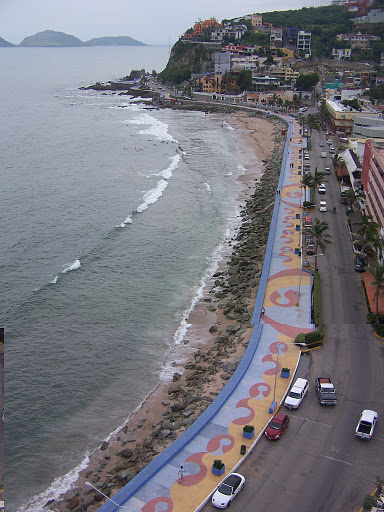
We also love walking and biking the malecón every day; it’s one of the best things about Mazatlán. In our opinion it’s the best oceanside promenade in the world, with 4+ miles of paved, gorgeous walkway between Valentino’s and Pedro Infante. We imagine that everyone would enjoy using the malecón. Thus, we have been repeatedly surprised by friends, mostly locals, who tell us they prefer to exercise at home or in a gym. I’ve had girlfriends tell me their husbands won’t “permit” them to use the malecón if they’re not with them. Girlfriends tell me they don’t use it because they don’t want to be out in the sun; it causes wrinkles and spots on their fair skin. Others say the malecón is dangerous; that you’re looking to get robbed.
And, honestly, I know very well that many people don’t use it because it’s beneath them. That is a side of society, any society, that I very much dislike. Beach vendors, people who can’t afford gym memberships, people whose only mode of transport is a bicycle or public bus, even beggars and homeless people, use the malecón. “I have more money than them. I was born higher class than them. I need to maintain my status by not associating with them.” No one in polite society says it directly, but it’s there; it’s palpable. And this is a side of any society that I’d love to change.
There are loads of Canadians and US Americans who come here and desire to make a mark on this gorgeous city, to help make our city better. They often wreak havoc on themselves and others despite their good intentions, because they come on like gangbusters and try to “change” or “fix” something they don’t yet understand, something that is much larger than they are (a culture, a society). I know this well; I’ve seen it worldwide; it’s my profession.
Guy didn’t set out to change anything. By setting out to enjoy himself and stay in shape, he has inspired many people to get out and move: to bike, run, walk, rollerblade… People from all walks of life started coming to Guy, asking him to teach them to rollerblade, to help them get started, to give him advice. They told him they’d pay him for his lessons. “No,” he’d say. “I’ll teach you for free, but you must pay it forward and in turn do something helpful for somebody else.” Thus his “entourage” was born, including a running group and a roller blading group, as well as, now, people who hang out at the coconut stand to share good conversation and homemade ceviche.
Guy has made a wide circle of friends from all different parts of society: government, big and small business, housewives and young singles, wealthy and humble. I am sooooo so so so happy to see the gatherings of people around him. It crosses socio-economic lines. There are people roller blading now who, personally, told me the malecón was no place for them! I have had friends who previously refused to use the malecón for the reasons above ask me if they could walk with us, bicycle with us. It’s because, I believe, they see these other people, “society” people, out there, exercising. Not just with Guy, of course. Kelly and his bicycling tours and groups, other running, roller blading and bike groups…. The culture is shifting. I’ve seen a huge shift towards egalitarianism and inter-mixing of the social classes on the malecón in the four short years I’ve lived here. Bravo!!! Long live culture change! Let’s keep it up! We aren’t there yet, but… Just the other day a friend asked another friend, aghast, “You have the coco guy’s phone number in your cellular?” Well, she did. And proudly so.
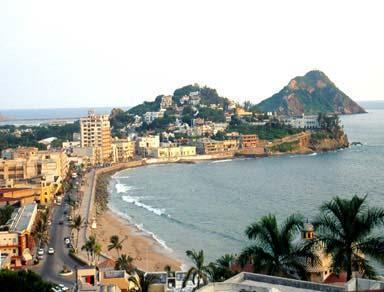
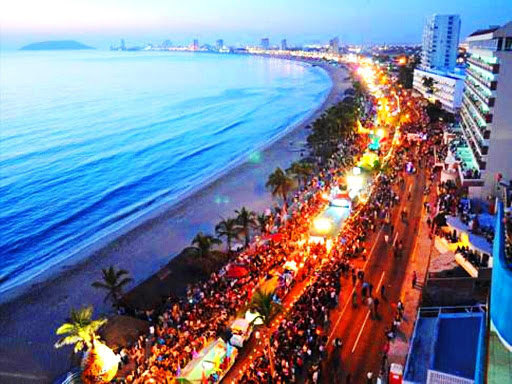
One last photo: this one of the malecón during Carnavál. Forbes Magazineranks our Carnavál/Mardi Gras one of the world’s top three. I will just add that it is VERY family-oriented. Come join us!
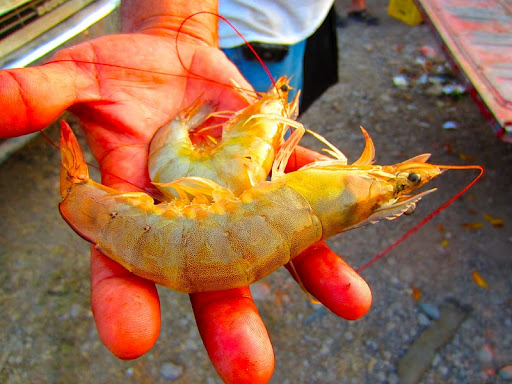
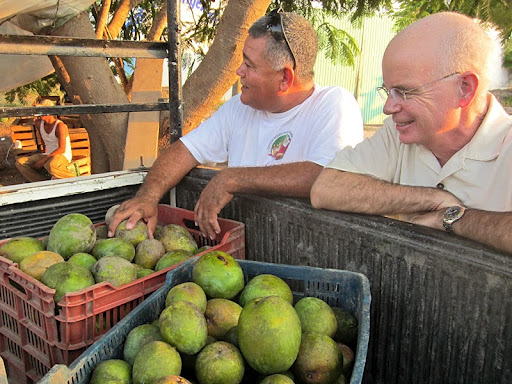
We had a FANTASTIC afternoon and evening learning about shrimping with a cast net/atarraya in the estuaries of Agua Verde, which is between Caimanero and El Rosario. We returned home with heartfelt smiles, new friends, 5 kilos of huge fresh shrimp (for which we paid about 7 bucks), a bunch of fresh crab (which our new fishermen friends gave us for free), and a bucketload of end-of-season mangoes ($4 for a crate full). ¡¡Viva Sinaloa y los Sinaloenses!!!!!!
We set out late Saturday afternoon with our compadres, Jorge and Silvia, to attend the first annual “Festival de la Frasca.” While Jorge told me “frasca” is not a word, and that I surely must be trying to say “zafra” or “open season,” local people tell us it is a southern Sinaloan term meaning “to capture shrimp from the estuary.”
The Festival de la Frasca was supposed to be a food fest with live music. But as usual they were running late setting up, and before we could really get into the party we found much more exciting things calling us.
Just one month ago we had driven this very same road, but shrimp season is now open, and it was an even more wonderful place! I HIGHLY recommend you visit during shrimping season! While the season lasts 6 months, the first few weeks are supposedly the best, as the shrimp and the shrimpers are the most plentiful.
As we drove in we saw men with cast nets (atarrayas) everywhere. Though mango season has finished, it is now the height of the shrimping season, and they have already planted tomatoes. After tomato season will come chile season, and so goes the year here.
Shrimp season is huge. We were told that opening day is like Carnaval—wall-to-wall people everywhere, with families fishing, picnicking and partying all night long. Family members come from all over the region back to Caimanero and Agua Verde to help with the shrimping, and to perform their obligations under the cooperativa(to work a minimum of so many hours and to capture a minimum of so many kilos). Women and children hang out with the fishermen, so it feels like life transfers from town to the estuary during this time.
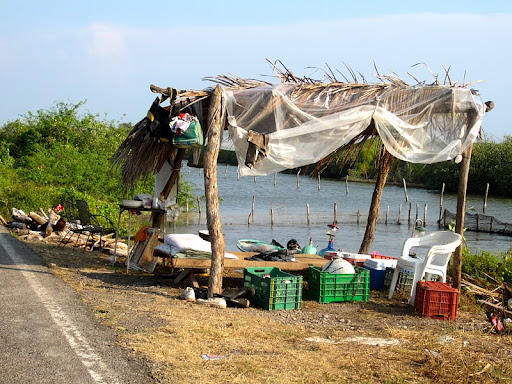
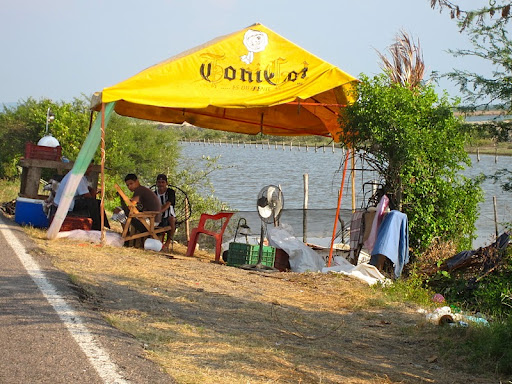
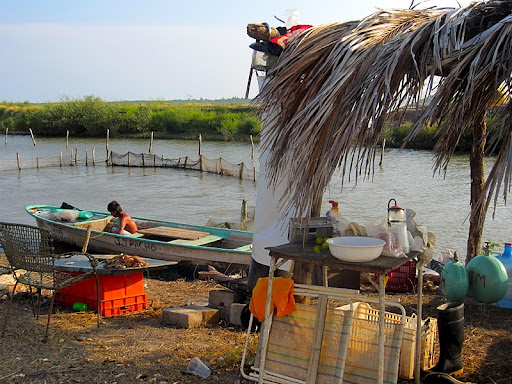
Beside the road that just two weeks ago looked so very different we saw little houses or shelters, many of them housing the shrimpers. A standard shelter like the one shown here has one or two lights powered by a propane tank, a plastic shelter for rain, chairs, a way to cook (usually a fire pit), a radio and a cell phone. As you can see, they sit just off the road. Can you imagine spending the night there with cars, trucks, and motorcycles coming by a few feet away from you all night?
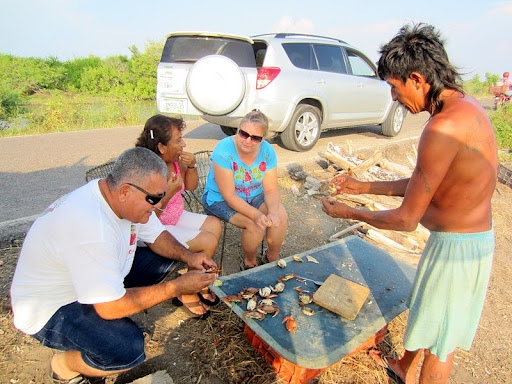
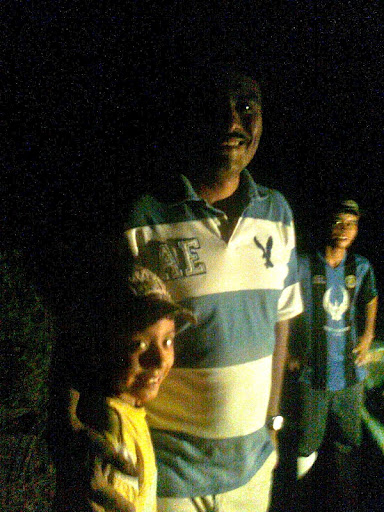
We greeted one of these guys, Rodolfo, at one of the stands, and he urged us to pull over and join him. So we did. The night crew, including Marco (who lives in Mazatlán but returns home for shrimp season), his 8 year old son and his 17 year old nephew, plus one other man, were just pulling up as we arrived.
Rodolfo proceeded to feed us a whole mess of fresh crab and shrimp, beside the road, in the fresh breeze, looking out over the estuary. La vida dura. While I well know, from living in Japan, how to crack open a fresh crab, scrape out the lungs, and eat the juicy brain and meat, this fisherman really enjoyed teaching us, and my comadre, Silvia, really enjoyed learning.
Here we also ate shrimp crudo with salt and lime (my all-time favorite—huge prawns, still wiggling; oh yum!), but he also cooked some for Silvia in a pot of broth.
We stayed here about an hour, chatting, feasting and just generally relaxing. We bought our first few kilos of shrimp, as well as receiving a huge bagful of cooked crab.
There were also many changueros, who we’ve heard about since arriving in Mazatlán, but this was the first time we met a few. They are estuary shrimpers who are not members of a cooperativa. They catch shrimp but legally are not supposed to be doing so. Many of the changueros used purina (shrimp chow) to get the shrimp up to the surface. None of the cooperativa fishermen we met used purina. They were very proud to explain to us that their shrimp were the purest.
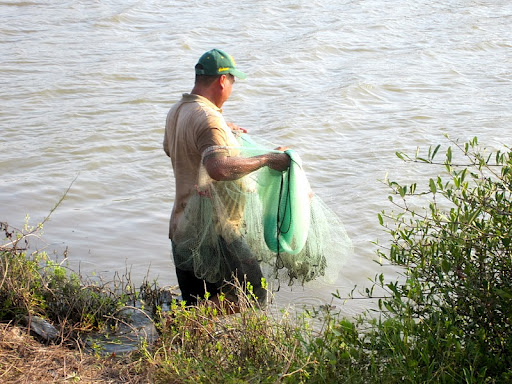
Below is a video of one shrimper casting a net, and his wife helping him take out the shrimp and put them into a bucket.
After getting back in the car, we made the rounds of several cooperativas. At the first one the view was spectacular.
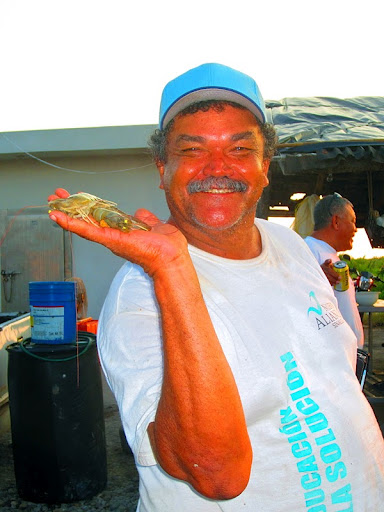
Rodrigo, a man we met there, sold us some more live shrimp. At left is his photo, and below a video of some of the shrimp wishing they could run away.
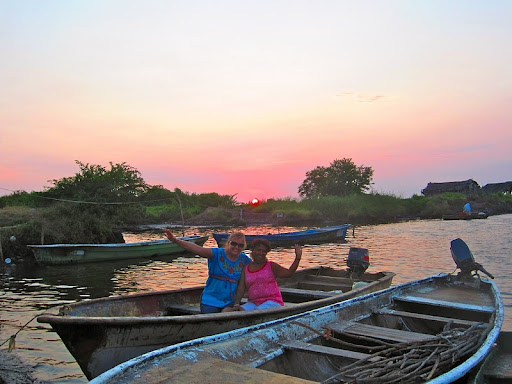
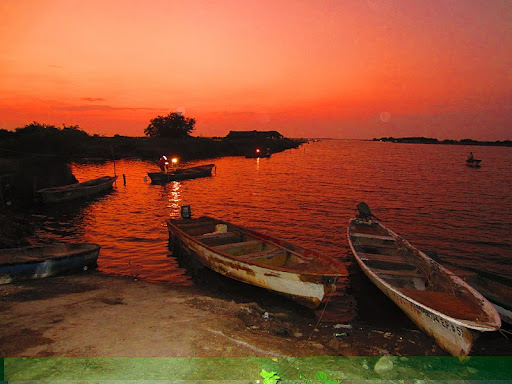
We had arrived here just in time for sunset. The sky and the water glowed. People were all so friendly, open and hospitable that it was amazing. Everyone was eager to talk, to explain this long Sinaloan shrimping tradition, and to share their catch of the day with us. To me this frasca tradition is soooo important; it’s Sinaloa’s history, and the if not some of the best shrimp in the world. And tons of it are harvested BY HAND here each year and shipped worldwide. I know such shrimping used to happen right here in Mazatlán; even next to Hotel Playa was an estuary (no wonder Zona Dorada floods).
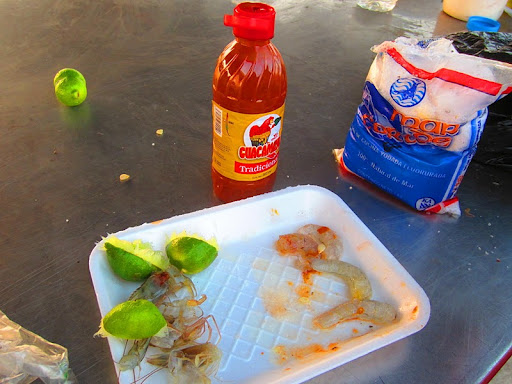
The fishermen brought out packets of salt, fresh limes and bottles of salsa, and urged us to eat from their catch to our hearts’ content. Alfresco dining overlooking the estuary with friendly, happy, relaxed, knowledgable people; it was a wonderful afternoon. Every boy we met knew how to cast a net. They seem to start as young as seven or eight.
“Girls just wanna have fun…”
We also sat here for quite a long time, again feasting on raw shrimp (no cooked ones this time), and watching the guys cast their nets in the scenic little harbor.
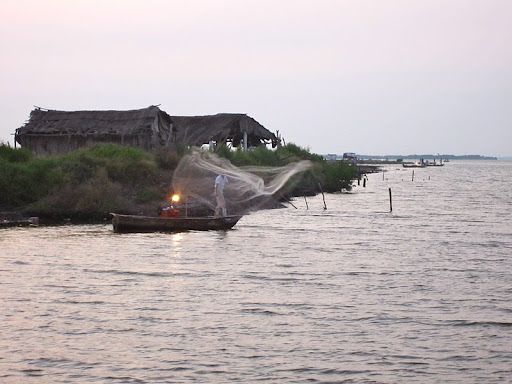
The video below shows a guy casting his net from a panga, so you can see that as well as the earth-bound approach shown above.
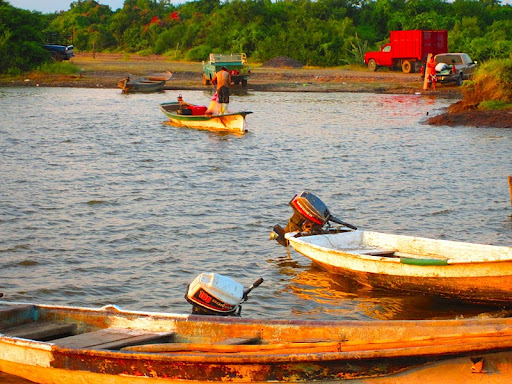
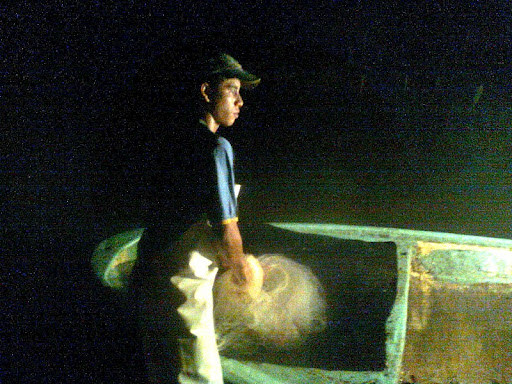
The pangas or small fishing boats go out with two guys normally, one remero or rower, and one atarrayero or net caster. Most of the estuary is only hip- or waist-deep, so the remero carries a long stick or remo and basically pushes the panga along, similar to the movement of the gondolas in Venice.
Below is a short clip of the gentleman at left rowing.
There are various cooperativas to which the shrimpers belong. This drive out to one of them was really something — estuary on either side of the road, with loads of lit pangas all around.
Below is a video, so you can get a better feel for this road-with-water-on-both-sides drive.
After visiting some very cool places and meeting lots of wonderful people, we ended up spending another couple of hours sitting with Marco and his family. It was so peaceful there, and so very pleasant. Excuse the poorer quality of the photos from here on. The batteries on our camera died, so the remaining photos are taken with our phone.
On the way out we stopped at one last cooperative, this one the largest we’d seen. Here they had a large building or warehouse, surrounded by dozens of pangasfishing. Families were sitting and standing everywhere, waiting for their husbands, fathers, boyfriends and brothers to come in with their catch.
A semi-truck full of ice was waiting nearby.
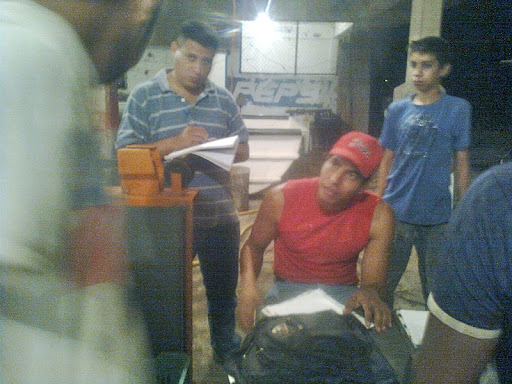
A group of men with a scale and ledgers was registering incoming shrimp.
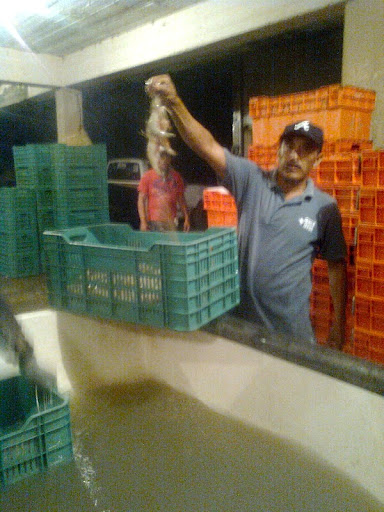
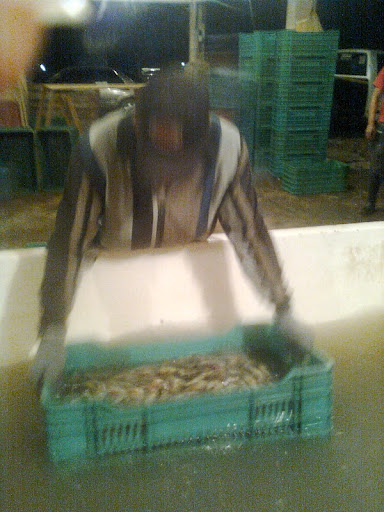
After dipping the bins full of shrimp into ice water, they placed the bins in the refrigerated truck where they are covered with ice and then taken to Mazatlán for sorting, packing and export.
It was at this last cooperative that we also saw our youngest atarrayero, this boy of about eight, at left.
We kept telling our friends that this was an otro mundo, or other world, that most guests in Mazatlán don’t know anything about or understand. We learned a lot about how the cooperativas function and about the life of a shrimper. We all got to eat live shrimp and enjoy some great company. The festival probably happened, but we know we had a lot more fun hanging out with our friends and meeting new ones. We already have plans to go back. We will definitely go opening night next year for the carnaval de cameron, and will head out some month just before the full moon when the really large shrimp are said to be much more plentiful and easier to catch. To be able to find Rodolfo and Marco’s shelter, we put their spot into our GPS and got their cell phone number. Stay tuned.
Part of what we love living here in Mazatlán is that you can buy almost anything you need so conveniently. “Ambulatory” street vendors walk, push carts, ride bicycles (many of them modified to carry their wares) or motorcyles around town, selling their wares. There are also many open-air stalls that make eating healthy (or not) quite convenient.
This blog post is just a collection of a few street vendors photos. Enjoy!
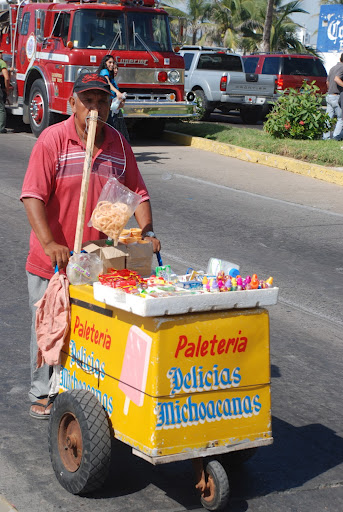
Ice cream vendor on Avenida del Mar
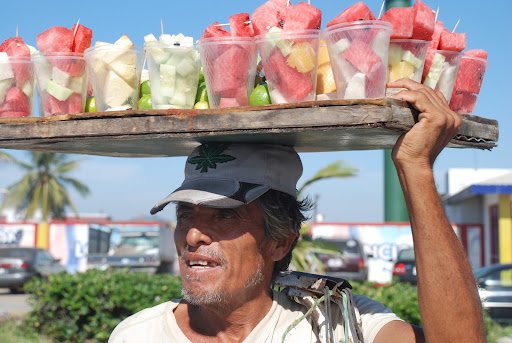
Our favorite fruit seller, who works our beach
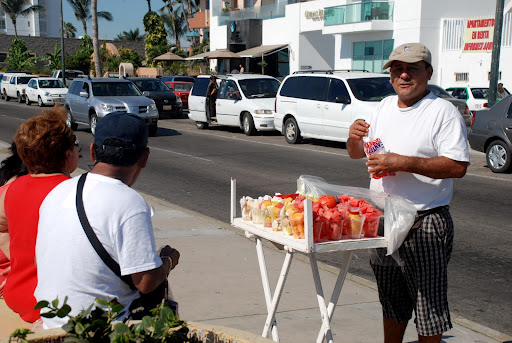
And one of his competitors
Gelatinas, or jello molds
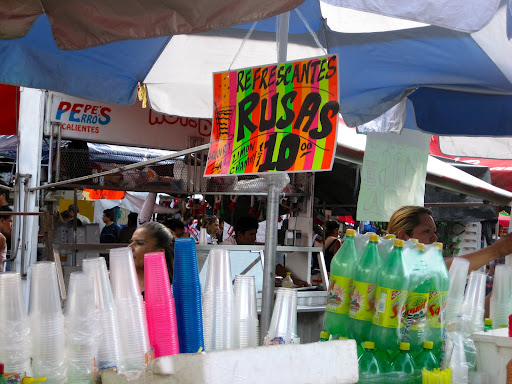
Various refreshing drinks, this photo taken in Guadalajara
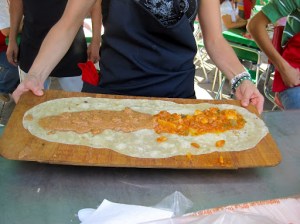
Giant burrito seller, again in Guadalajara
Vegetable seller: Nice to be able to buy healthy street food!
Another kind of fruit seller, not the ambulatory kind 🙂
Flower and plant vendor
Ceviche (fresh fish or shrimp with lime juice and some vegies) and Tostilocos (pack of tortilla chips covered with salsa and sometimes beans or cheese or meat)
Sugar cane and cane juice vendor, in a market
Broom and mop vendor
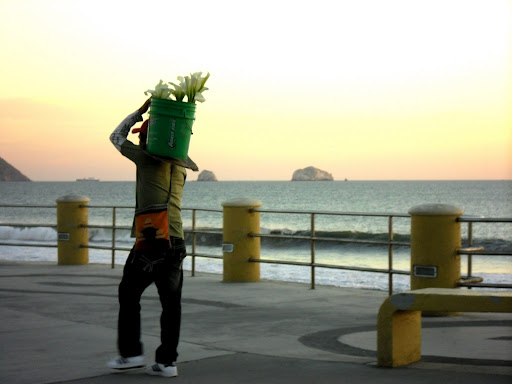
My favorite calla lily seller, at sunset on the malecón in front of our house
And this beach vendor came up to our house to measure my laptop and make me a custom-fitted computer bag out of beach trash (chip, candy and cookie wrappers)



























 ¡VidaMaz!