Carnavál 101

P1100207©

The 2018 dates of Carnavál de Mazatlán are February 8-13.

People worldwide—from Russia, Croatia and Turkey to Angola, Cape Verde and the Seychelles; from Italy, Germany and the Netherlands, throughout North and South America and the Caribbean—celebrate the public street party and parade most popularly called Mardi Gras or Carnavál. It is thus quite natural that Mazatlán, with our rich immigrant heritage, would be blessed with a Carnavál tradition that is the oldest in Mexico, dating back at least 191 years to 1827.
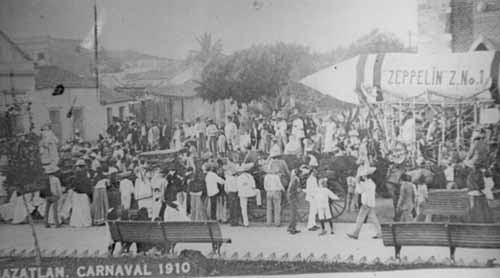
1910

Photo from the CD of the Friends of Viejo Mazatlán

Tourists frequently feel confused by the fact that Carnavál doesn’t take place on a set date each year. Carnavál in most parts of the world is traditionally held during the week leading up to Lent; it’s the last big blowout before the Christian season of fasting and reflection. Fat Tuesday, the last day of Carnavál, precedes Ash Wednesday, the first day of Lent. Calendar dates change annually because Lent is the 40-day period prior to Easter, a religious holiday based on an ecclesiastical calendar and celebrated on the first Sunday after the Paschal Full Moon.

In its first few decades Mazatlán’s Carnavál was a spontaneous “celebration of the people” during which revelers would decorate buggies, burros, horses, bicycles and eventually cars for the big parade and dance at masquerade balls and street parties. Carnavál de Mazatlán became an official city event with an organizing committee and budget in 1898. Which means that in 2018 we celebrate 120 years of our official fiesta máxima. Carnavál became official because it had grown in size and popularity and required coordination. The story behind that reality, however, is quite interesting.

You may be familiar with the tradition of juegos de harina or throwing colored flour and water during Carnavál, much like Holi in the Hindu tradition. Cascarones, filling egg shells with flour or confetti and then breaking them on people, are part of this tradition, too. The custom seems to have originated in Spain, and is popular throughout many of the former Spanish colonies. Well, those “flour games” (not to be confused with Floral Games) became very popular in the 1800s in Mazatlán—so popular that by the latter part of the century there were two “camps” of Carnavál revelers who annually “warred” with each other, rather similar to the “warring tribes” in New Orleans. According to historian Enrique Vega Ayala, the Abastos group held the territory between 21 de Marzo and Zaragoza streets, while the area belonging to the rival Mueyes went from 21 de Marzo through Playa Sur. People from these two camps would regularly decorate floats and ride them into “enemy” territory, bombarding anyone they could find with flour bombs. For years city officials and upstanding citizens tried to ban such over-the-top revelry, but without success. People like to have fun. Once Carnavál de Mazatlán became official, however, the city began funding the purchase of confetti and serpentine streamers, and the tradition of the “flour wars” receded into a distant memory.

Winnie Farmer

Winnie Farmer,                     Mazatlán’s first Carnavál Queen

For decades Mazatlán has had three queens each year: Queen of Carnavál (since 1900), Queen of the Floral Games (since 1937), and the Child Queen (since 1968). Historically, however, the king predates the queens. The first Carnavál King was crowned in 1898, two years before the first queen. The King of Joy was originally called the Rey Feo, or Ugly King—the title was changed in 1965. Mazatlán’s very first queen way back in 1900 was not Mexican but was born in Maine, USA: Winnie Farmer. She grew up in Mazatlán, was crowned at 17, moved back to the US in her thirties, and returned to Mazatlán in 1956—aged 64—to ride a float in the Carnavál parade once again.
cimg01331

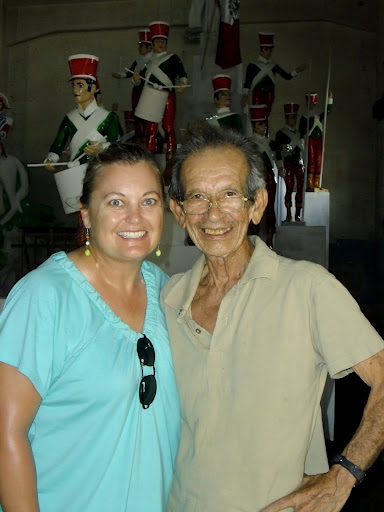
Maestro Rigo with me in his taller

One of my greatest thrills for many years was joining local legend Maestro Rigoberto Lewis in his workshop to watch him finish up the carrozas alegóricas or royal floats. Maestro Rigo always told me he was born during Carnavál and had it in his blood. He designed the Carnavál de Mazatlán floats for 54 years; those intricately decorated, classical floats, very tall, were his signature style. Maestro Rigo died in 2014, just prior to Carnavál.

Smaller than the revelry in Rio or New Orleans, Mazatlán is said to have the third-largest Carnavál celebrations in the world—remarkable for a city of its size. Our local tradition is a family-friendly one; as far back as 1900 a ball was held for children, and young people city-wide practice their dancing and instrument playing for months before the big day. Along the parade route you will see thousands of families, many of whom put chairs and tents out to guard their viewing area days before the two parades. Most every family in Mazatlán has at least one if not several members who have been in comparsas or dancing troupes in the parade, and many proudly have several generations that have run for Queen or King.

While Carnavál no doubt began among the city’s foreign immigrants, it quickly grew to include people from all strata of society and all walks of life. The five main days of Carnavál include four coronations with concerts (Thursday, Friday, Saturday and Monday), two major ocean-side parades (Sunday and Tuesday), a Burning of Bad Humor (firecracker-laced giant piñata on Saturday), a food show, a carnival with rides and games for the kids over by Sam’s Club, and an incredible fireworks spectacular (Saturday). The last few years they’ve also added a Monday night concert, usually banda Sinaloense music. Party central is the Carnavál zone, which this year they are moving several hundred meters north in order to protect the newly rehabbed Olas Altas. Cultura has reported that the party zone will begin at the deer statue in Olas Altas and extend along Paseo Claussen as far as Casa del Marino. There are usually nearly a half-dozen stages or so set up, each with a different kind of live music playing from evening through the wee hours of the morning: tambora or banda sinaloense, los chirrines (ranchera and norteña), boleros, rock, mariachi… you name it. You’ll find lots to eat and drink, and plenty of vendors selling hats, masks, eyelashes, wigs and lighted toys. More importantly, you’ll laugh and dance the night away! Click on any photo to enlarge it or view a slideshow.

The activities surrounding Carnavál begin months prior to the main events. Candidates for Carnavál royalty are presented in early October, along with the theme for the upcoming year. Aspiring royalty conduct their fund-raising campaigns including parades (manifestaciones) and ballot-counting in October, November and December, while various dance groups or comparsas city-wide also raise funds for costumes and spend lots of time rehearsing their moves. Excitement builds and most everyone in town is involved in some way or another in this máxima fiesta of the year.

A month or so before Carnavál we usually get an unveiling of the monigotes (1, 23) giant sculptures along the malecón and in the Plaza Machado. A couple of weeks before Carnavál there is an official election of the royalty that takes place in the Angela Peralta Theater. A poetry contest (Juegos Florales or “Floral Games”) has been held since 1925, and there is also a literature prize (since 1965) and one for painters as well (since 1996), with the winners celebrated in a Velada de las Artes concert and performance in the Angela Peralta the Friday before Carnavál.

One of my favorite aspects of Carnavál de Mazatlán is that there are queens and kings from every district of the city and every strata of society. Schools and clubs all over town, including community centers with lots of elderly people, choose a queen or king to dance and revel in the parade. I absolutely love cheering on the grandmas and grandpas each year, some of whom are in their 80s and dance the entire parade route. We are also regaled with the anniversary floats—those queens or kings celebrating their 25th or 50th year since being crowned.

While not “official,” there seems to be an annual “song of Carnavál” that most of the dance troupes play over and over again. We kept track for a few years. Back in 2009 it was Te Presumo; we were blessed that Banda El Recodo was the King of Joy that year. In 2010 it was Julión Alvarez’ La María; in 2011 Chuy Lizárraga’s La Peinada; in 2012 Gloria Estéfan’s WEPA; 2013 was Enrique Iglesias with Pitbull on I Like How It Feels. Let me know what you feel were the most popular songs the last few Carnaváls, and I’ll update the list.

The key thing to remember about Carnavál is: You’re in the right place! Carnavál de Mazatlán rocks, there are loads of activities of every type to enjoy, and you will be welcomed with open arms and lots of dance moves.

Tips for Enjoying Carnával De Mazatlán

  1. Buy your tickets to the coronations! These are spectacular, world-class events full of pomp and circumstance as well as pyrotechnics, dancing, music and a concert. Everyone should go to at least one, at least once. I’ve known several tourists who didn’t realize you needed tickets for these major events, but you do.
  2. When you travel to the Carnavál party zone:
    1. Don’t wear clothes or shoes that you don’t want to get dirty; your feet will be stepped on and beer may be spilled on you.
    2. Do not take valuables as the huge crowds tend to bring out pickpockets.
    3. There is a limit the last few years to the number of people permitted into the party zone at any one time. Don’t worry if you wait a while; you will get in eventually, and it’s for safety reasons that they limit entry.
    4. Remember also that in the zone there are so many people that cell phone networks get overloaded. Don’t rely on texting or calling to stay in touch with your group; name a rendezvous spot and time in case you get separated.
  3. If you want to see the spectacular Combate Naval fireworks, which recreates a sea-to-shore battle between Mexico and the French, be prepared to be in a human wave/near-million person crowd of revelers; view it as part of the fun. If you don’t want to stand, make your reservations at a restaurant or grab a seat on the malecón Those living in homes with a view will hold parties, if you’re lucky enough to be invited.
  4. Realize that you cannot attend the coronation of the queen on Saturday AND see the Burning of Bad Humor and Combate Naval fireworks unless you are hugely blessed. The people who do attend all three tend to have official escorts (e.g., royalty and elected officials)! The coronation takes place in the stadium, the fireworks are in Olas Altas, and the traffic in between the two is untenable. You will arrive to slow entry lines and possibly a party zone at maximum capacity. If you plan to see the fireworks, it’s best to attend the other coronations on a different day.
  5. Hotel rooms overlooking the party zone can be fully booked up to two years ahead of time, and quite a few hotels require a three-night minimum during Carnavál. You’ll see that many people set up whole party spaces along the parade route. The city usually puts up bleachers for the public to use, so if you get to the parade early enough, you might be able to find a seat.

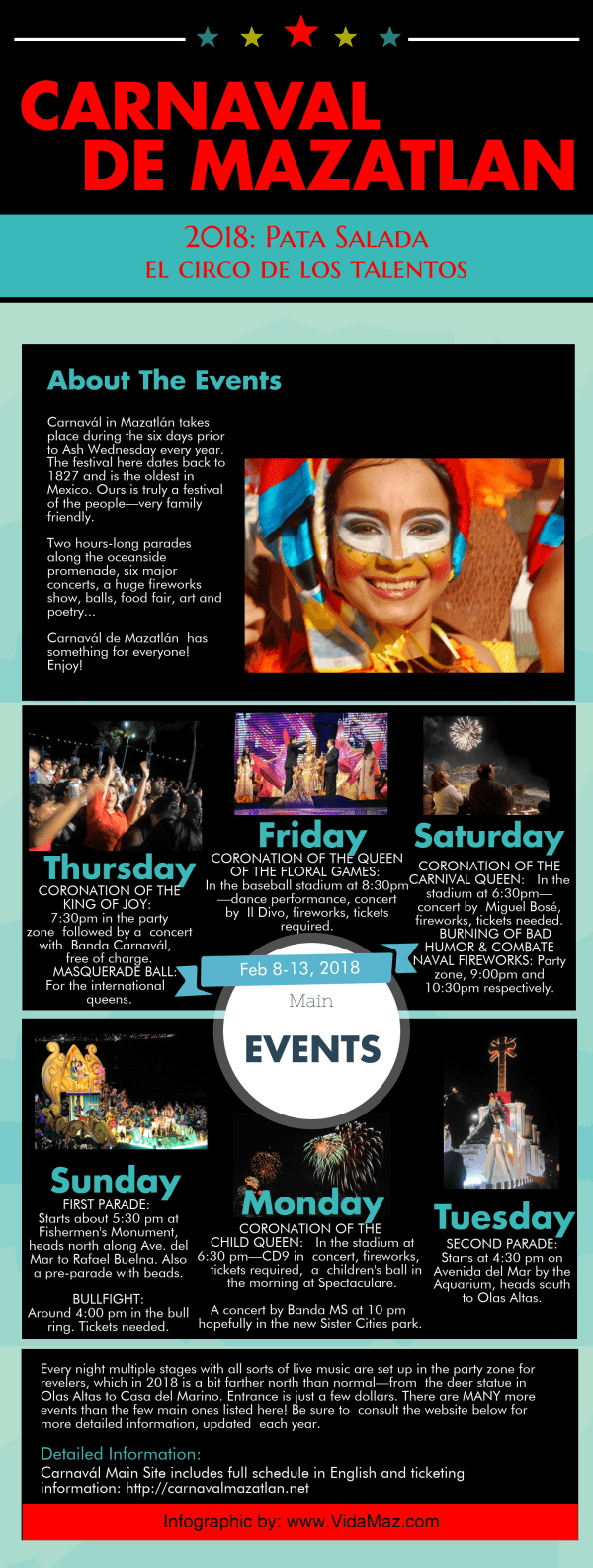
Annual Carnavál Infographic

We’ve got some amazing entertainers, world-class fireworks, two incredible parades and a whole lot of merriment coming up for Carnavál de Mazatlán—the oldest Carnavál in Mexico! Things may be a bit different from prior years due to the construction on the malecón and throughout the city, but we know that 2018 will be a Carnavál to remember!

You can choose “Carnaval” under “Categories” on this site or search these pages using keyword “Carnavál” to read some of the many in-depth stories we’ve written over the years about this terrific event.

Enjoy the infographic!

Carnaval2018 infographic2.png

Carnavál Fireworks: Behind the Scenes

p1100449edited

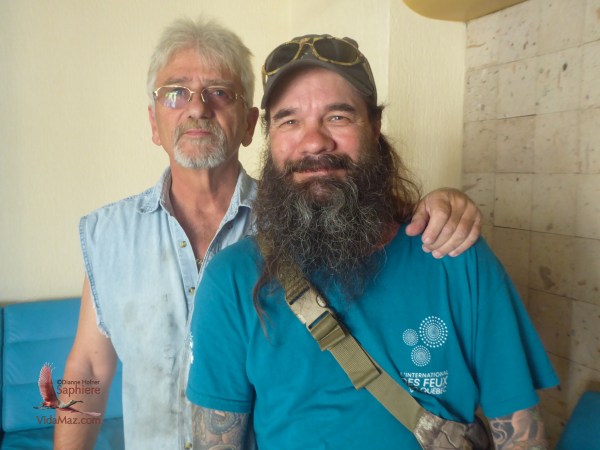
Mike Toth on the right, our connection Ted Allen on the left

I just love how social media and blogging work. Somebody commented on one of my photos of this year’s spectacular Combate Naval fireworks, saying, “My friend is down here from Canada helping with the show.” Really? How cool is that?! So I wrote back, “Please introduce us, and I’ll interview the person.”

Turns out that  Mazatlán’s annual fireworks show, put on when Raúl Rico is head of CULTURA by Lux Pirotecnia (Jorge Márquez) of Mexico City, involves not only Canadians but a German expert as well. Want to know the story?

Mike Toth, the gentleman I interviewed, works for Big Bang Fireworks out of Calgary, one of Canada’s top five fireworks outfits, owned by Dan Roy. Mike’s pyrotechnic journey started out like many of us; he lit off backyard fireworks that gradually gained in size and grandeur. Eventually he had to take a one-day safety course and become licensed. That was ten years ago, and he’s been learning on the job ever since. In Canada his fireworks job is pretty much May through September, plus Christmas and New Year’s.

He tells me the crew here are like brothers to him; they have a whole lot of fun together. They stay in touch throughout the year on WhatsApp and Facebook, despite huge language and culture differences. Two of the crew, Mauricio and Ramses, speak English (as do the three team leads), but most do not. Rodrigo comes from Durango: he’s a cowboy through and through, and César is evidently quite the comedian. Mike shared a few snapshots of his visit with me, below. Click on any photo to enlarge it or view a slideshow.

Mike’s technically not down here in Mazatlán working, but rather on vacation—hanging out with the pyrotechnists who are. But he did bring down with him a bunch of equipment: $40,000 worth, more or less. He brought seven panels and even some modules. Why? Well, fireworks equipment is expensive, especially the computerized kind that syncs music and explosions. Thus, Lux and Big Bang often collaborate in order to pool their resources and put on bigger and better shows.

Jorge (Lux) and Dan (Big Bang) are good friends; Jorge’s equipment often helps out during Canada Day (when Big Bang might have 30-40 shows in one day) or Edmonton Klondike Days (10 straight days of fireworks), and Dan’s equipment supplements shows in México during events on Constitution Day, Independence Day and Carnaval. I love fireworks, I’m all about collaboration, and this story is intercultural, so I find this trifecta of my passions very cool!

dsc_0211How does a fireworks show—our Combate Naval, for example—come to be? Jorge designs the show and its accompanying music and scripts it on paper, indicating the type and size of each firework, it’s color combination and time delay. I’m sure CULTURA is involved in some way at the design phase, too, though of course Mike doesn’t know about that. The shells are fixed into a string of ten or so and then put carefully into mortar tubes. There is no wasted space. Inside is an electric match; when the button is pressed, it launches.

Lux Pirotecnia is responsible for four major shows during Carnavál: the three coronations in the stadium, and the Combate Naval on Saturday night. I forgot to ask Mike about the crowning of the King of Joy. The fireworks are stored on a rancho just north of town.

Combate Naval 2017, for the first time ever, involved five barges; this allowed us to see the fireworks closer than we would if shooting exclusively from a ship in the bay. To me it was a HUGE improvement in the show! Unfortunately, however, one barge flipped over before the show due to the heavy waves. We ended up seeing fireworks from four barges or platforms. The barges are first put into position, then the pyrotechnicians go out in small boats to wire them up and turn them on. There was also a ship out there—yes, a real ship. Mike tells me they set up what looked like a helicopter landing platform on the deck of the ship, and from there the fireworks are launched. The capsized barge was rescued after the show, though of course the fireworks were ruined.

Wide-angle shot of Combate Naval

Wide-angle shot of Combate Naval

The main fireworks panel is just above where the Queen and the VIPs sit: at the Pedro Infante statue. All the music is precisely choreographed to each burst of the show, as we all know and so thoroughly enjoy each year—it’s computerization converting gunpowder into beauty for all our enjoyment.

Just how many people are involved in Mazatlán’s Carnavál-related fireworks? There are the three bosses: Jorge, Juan and David, from Lux. There are ten shell crew members, and ten one-shot crew members. There are also three drivers: two trucks and one van. I get a total of 26 fireworks technicians involved in Carnavál. How much does such a show cost? Again, Mike doesn’t get involved in that, and he can only quote Canadian pricing, which averages $1000/minute.

And where does the German connection come in? That would be Klaus Ulrich, the flame expert. If you attended any of the coronations in the stadium, you felt the heat as the  flames reached from the front of the stage towards the sky. That was Klaus’ work. We also experienced the heat of Klaus’ flames from the barges in the bay during Combate Naval.

dsc_0189

Innovative round or wheel-shaped fireworks: crane wheels, with some of Klaus’ flames coming off two of the barges in the bay.

While I love my photos of multiple bursts at once—sort of the panoramic view, Mike’s favorite photo of mine, he says, is that of the crane wheels. Crane wheels? He explained to me the names for some of the effects that we saw in Mazatlán during Carnavál 2017:

  • The most common fireworks effects are often called by flower names, just as they are in the original Chinese and Japanese:
    • Peony (most common)
    • Chrysanthemum (peony with a spark trail)
    • Dahlia (peony with fewer and larger stars)
  • There are also a couple of effects named after trees, including:
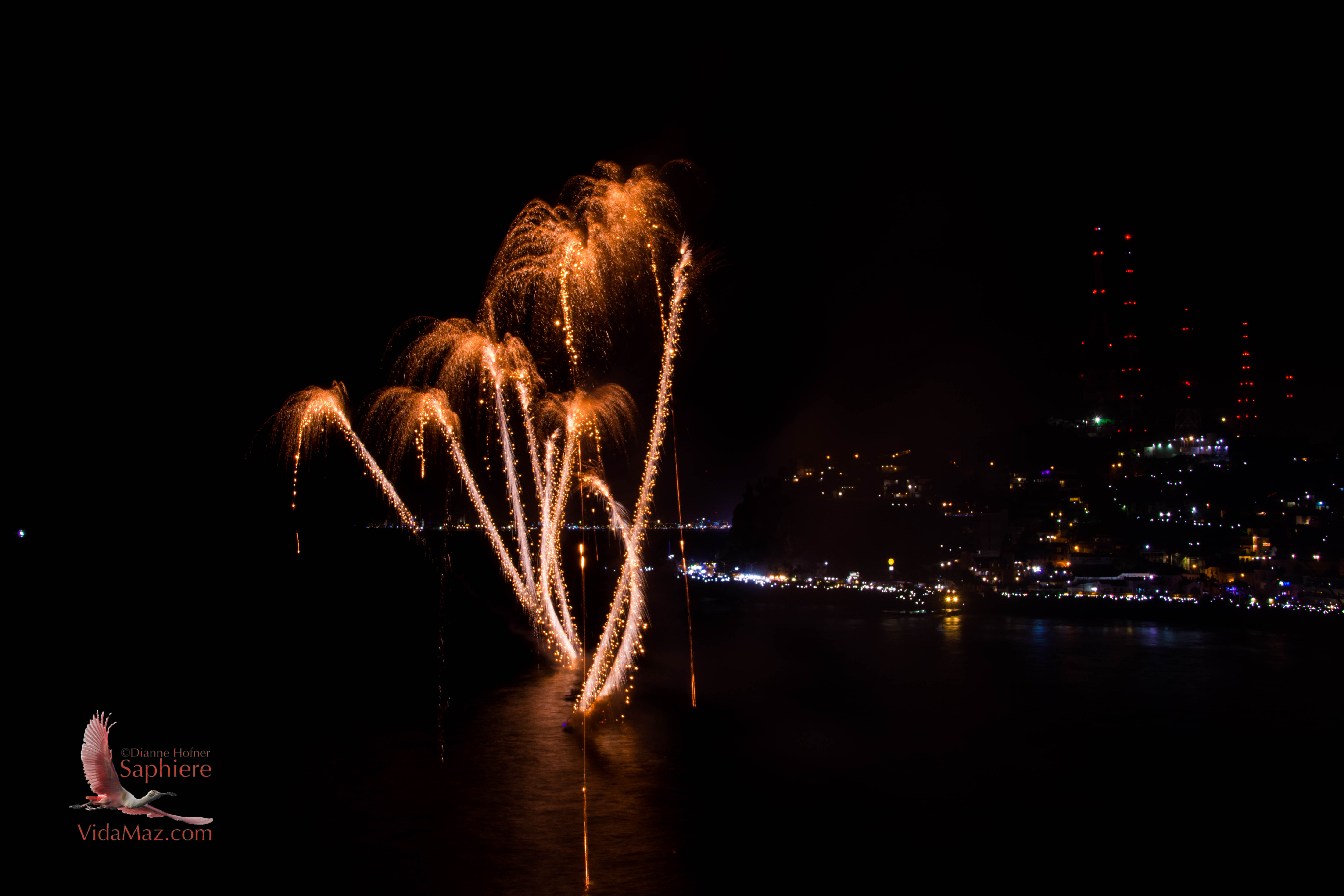
    • Palm: Rising tail that bursts at the top with large tendrils.
    • Weeping willow: long-burning stars in a dome-shaped, weeping willow-like arrangement.
  • Aquatics: fireworks that fly into the water and then blow up. Mike says everyone has them. Jorge’s are 8-inch Kamuro shells: a dense burst of silver or gold stars that leave a glitter trail.
  • Camaros: double dome-shaped weeping willow with twinkles that fall to the water or ground.
  • Crane wheels: a one-shot wheel that can shoot sunbursts or a wheel shape. About one meter round, clamps to a plate. One set of fireworks is set at an angle to rotate the wheel, the others are set for the display.
  • Fountains or Gerbs: a thick-walled tube with a narrowing in the tube that produces a long-lasting jet of sparks. We saw these in the stadium and during the Combate Naval.
  • Horsetails: heavy long-burning fireworks in the shape of a horse tail that only travel a short distance from the shell burst before free-falling as glitter to the ground. They’re also known as a waterfall shell.

    Horsetails over Mazatlán

    Horsetails over Mazatlán

  • Rings: launch into the sky and burst into circles, smiley faces, hearts, clovers…
  • Roman candles: long tubes containing several large stars which fire at regular intervals. This Carnavál they used roman candles up to 4 feet tall anchored to a wooden frame, mostly arranged in fan or crisscross shapes, at close proximity to the audience. We see these on the beach during Combate Naval, and also during the coronations.
  • UFOs: one of my favorites of Combate Naval, the best way I can describe it is a spinning top that launches into the air, leaving a twirling vertical tail. Ours then burst at the top to result in a palm tree-like shape. Mike says that in Canada they usually use a round plastic frame, but here in México it’s bamboo. Bravo for México! Our UFOs had 4 herbs to push up and 4 to rotate.

    Slowly rising fireworks that felt magical and looked like palm trees: UFOs

    Slowly rising fireworks that felt magical and looked like palm trees: UFOs

Below I share some of the terms Mike used during the course of our interview, in case you like getting inside the world of a pyrotechnist as much as I do.

  • One-shot tubes: just like the name sounds.
  • Cake: multiple tubes connected by a fuse. When connected they look like a box.
  • Shells or mortars: during Carnavál we saw 3 to 8 inch shells. They are round and look like bombs, which is probably why, in Spanish, they are called “bombas.”
  • Racks: stands that hold multiple fireworks tubes. These include:
    • Flat racks
    • Half moon racks
  • Panels: the computerized panel of buttons that controls the show.

He explained to me that a firework has a lift charge. The fuse wraps around a ball, and a couple of sticks are timed as fuses. That’s how they set timings. The pyrotechnicians can then launch a firework, it goes into the air with the lift charge, and in four seconds, or six, at the height of its trajectory, the secondary fuse sticks will fire and the effect will explode.

rpgs4cs

We all know that here in México people build fireworks. They do so in the USA also. But Mike told me that in Canada it’s against the law to build fireworks! The country’s last firework maker was Hands Company. One of Mike’s dreams is to work in Lux’s shop in Mexico City for a few weeks, so he can have the experience of building fireworks.

Another huge difference that stands out for Mike is, of course, safety. The hand-held bottle rockets that lead every parade in Mazatlán would never be permitted up north, nor would allowing people to sit so closely to the fireworks. He was amazed that people hang their legs off the malecón during the Combate Naval, for example, and loved hearing that people here consider ash burn lucky, just like bird poop. In Canada to launch fireworks you need insurance and permits (which I believe you need here in México as well, at least for the large ones), you have to launch on private property, and you can not shoot fireworks near a lake or river because it upsets the fish. I know fireworks are environmentally hazardous, but they definitely light up my soul.

13576002_1634239313559304_8928762512288910613_o

July 3, 2016 on the Lake Michigan waterfront in Milwaukee

We love Juan José Ruiz of Mazatlán Fireworks, our local expert. He and his guys put on a beautiful 45-minute show for our wedding anniversary party that thrilled all the kids who got to push the buttons on the panel. Juan José tells me that his firm has often done Carnavál Fireworks, also, but that he tends to be asked to do them when the PRI is in charge of the government.

I got hooked on fireworks as a child in Wisconsin, and deepened my love for them living for over a decade in Japan. Mike told me about a couple of fireworks competitions that I need to add to my bucket list, including GlobalFest in Calgary and Montreal’s L’International des Feux Loto-Québec, the world’s biggest fireworks festival. During my research I also found the Tianguis de Pirotecnia San Pablito Tultepec, which is coming up March 4-11 right here in México—we all remember seeing video of the huge explosion in a warehouse there last December. Frequent winners of the international competitions are, of course, Disney, and also Zambelli Fireworks out of Pennsylvania.

13575966_1633335656983003_5535104385485832430_o

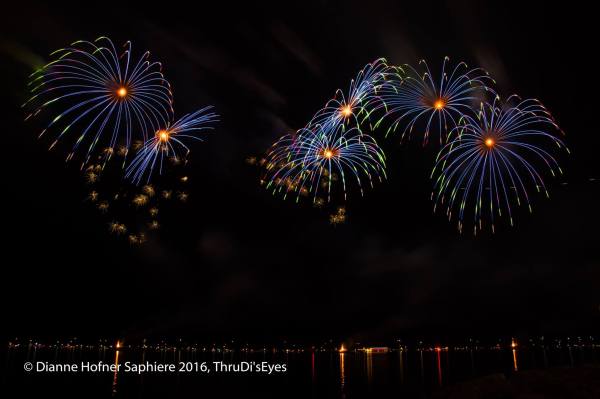
Fireworks over Lake Tichigan, Wisconsin, July 2, 2016

Next time you attend a fireworks show, stop and think about all of the people, time, preparation and work involved in delivering the performance you are enjoying. You just might find yourself appreciating the spectacle even more!

Combate Naval 2017

dsc_0211

Our annual Carnavál fireworks spectacular, the Combate Naval, which recreates the attack by the French right here in our port, was better than ever last night! The show was breathtaking—with 20 land-bound launch locations and five platforms in the bay, we were surrounded by explosive light.

It was a clear, calm night in Olas Altas, perfect for fireworks viewing. Just before 9pm we saw fireworks from near the Plazuela Machado. They wound their way into the Carnavál zone in Olas Altas, making their way down to the deer statue, where they recited this year’s poem roasting the “Mal Humor.” For the second year in a row, the Burning of Bad Humor was of Donald Trump, this time with his wall. Click on any photo to enlarge it or view a slideshow.


Over the next hour hundreds of thousands of people crowded into the zone, waiting the arrival of the queen. Once she, city and state officials and VIPs had taken their seats by the Pedro Infante statue, lights in the zone were dimmed: promptly at 10:30pm.


The show included several new types of fireworks, including round ones that looked like wheels, and some that launched so very slowly into the air it felt like magic. There was a whole lot of gold sparkly, and the colors of the Mexican flag for good measure. Briefer than usual at 20 minutes, the shorter version gets my vote because it was so very beautiful! My heart didn’t stop racing for nearly an hour afterwards.


The entire show, as usual, is choreographed to music. My favorite part was when the fireworks took a 20-second or so break for the smoke to clear, and once we heard Juan Gabriel singing “El Sinoalense” the fireworks resumed big-time.

The grand finale was an unforgettable capstone on a wonderful evening.


Congratulations and thank you to CULTURA Mazatlán, city and state government for allowing us to enjoy such fantastic entertainment!

Miss Universo Carnavál 2017

16729547_1868731800012115_2132236453093537905_n.jpgPlease block this Wednesday evening, February 22, for a wonderful show filled with joy and excitement that will benefit two children in desperate need of surgery. Belleza con Causa—Beauty with a Purpose, holds this annual event, a beauty pageant for the Drag Queen of Carnavál. I am very pleased to be judging for the second year in a row, along with other expat representatives Susie Morgan Lellero, Luis Ramírez, Ginger Borman and Shilo Downie.

The pageant will take place at Castillo de LuLu, Aquiles Serdán 60 (the same street Immigration is on, the salón is just farther down the street, off Carnavál) in Playa Sur, starting after 8pm. The event is BYOB, bring your own drink, though a lady there will be selling soft drinks. Entrance usually costs about 50 pesos, and all proceeds go to support the two children.

There will be loads of singing and dancing, flirting, whooting and hollering. The event usually includes a couple of star performances, and the pageant includes the queen aspirants modeling both cocktail and evening dresses, and answering a question. Three queens will be crowned: Miss Universo, Señorita, and Rostro Carnavál/Face of Carnaval.

Get your party on and come on out! Below are a few pics from last year; click on any photo to enlarge or view a slideshow.