Deer Dances in Las Labradas on the Spring Equinox

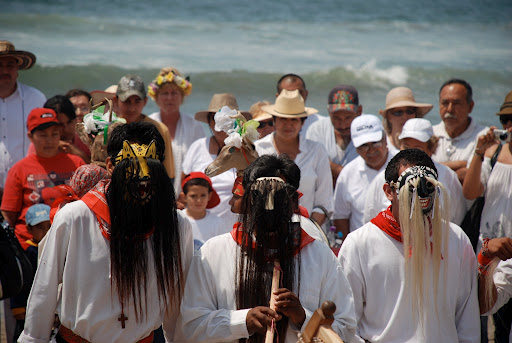
The two gentlemen in the photo above very kindly explained
a bit about the dance to me, and walked me through the ceremony.
They live in a pueblo between Guasave and Los Mochis.

Last year we were privileged to welcome spring with the famous Deer Dance (danza del venado), conducted in the scenic oceanside setting of Las Labradas petroglyph park, a 30 minute drive north of Mazatlán. The dance was conducted by the Yeu Matchue, a traditional dance group of Mayo or Yoreme Indians.

The dance will be conducted again this coming Wednesday, March 21 in the same location, as part of Mazatlán’s International Friendship Week. Be sure not to miss this event!

The Mayo are considered to have the purest native blood in Mexico. While centuries ago they performed the Danza del Venado in full deerskin clothing with a bow and arrow (it’s the dance of the hunt, and I am Dianne, the goddess of the hunt, ha ha), to welcome the spring solstice at Las Labradas they wore white cotton manta (symbolizing purity), leather belts with deer hooves and bells, they wrapped their shins in leggings made of shells (representing snakes entangled in the deer’s legs), red bandanas (to honor the deer’s sacrifice of its blood), and sonajas or wrist and ankle bands made of nuts and shells. They carry red gourd maracas or shakers.

I grew up in northern Arizona, spending many weekends as a child in the 70s with my friends on the Hopi mesas. I was able to witness the Snake Dance, eat my fill of piki bread spread by hand over a hot rock, and play with the Mudheads. The deer dances soooo reminded me of the Kachina dances! Amazing similarities in dress, adornment, line dancing, movement, underlying beliefs of harmony with the environment, even the music and chanting. The noise makers (shells, gourds) were reminiscent of artisan rattles worldwide, whether from Africa, Asia, Oceania…

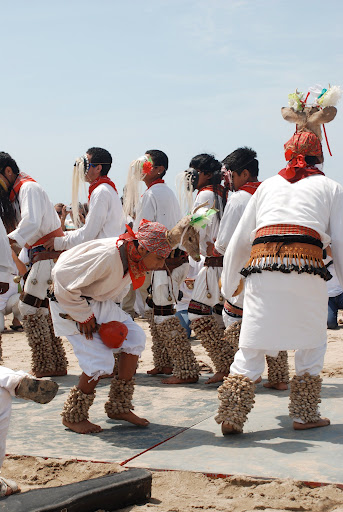
There were at least two dancers who wore taxidermic deer heads decorated with flowers, fastened to their heads with leather straps. They pranced, twitched, paused and sniffed, incredibly evoking the sense that we were watching a deer move through a clearing. It was eerie and beautiful to watch.
It was gratifying to see so many young people involved in the ceremony. It is obvious the young Mayo/Yoreme are eager to carry on the traditions of their elders and ancestors.
Above is a minute or so of video of the dance.
In addition to the boys with the headdresses, there were quite a few others dressed similarly but wearing masks. The masks were made of torote or poplar wood, both very sacred, and painted with smiling faces as well as Christian crosses, with long hair. Again, the long hair reminded me of the kachinas.

The musicians included a couple of fiddlers who sat in wooden chairs as they played, a large harp (played standing), gourds (sonatas de bule), jiruquias, and various drummers including a water drum.
The shaman had an altar or offering of fresh fruit, as well as a container of incense that he used for purification during the ceremony as well as to purify or bless the spectators afterwards. The purification ritual was very similar to what I’ve experienced at Teotihucán on the solstice, or in Mexico City nowadays on the street corners.
The dance was an interesting mix of indigenous and Christian ceremony, in the Mayo language and rhythms. When we arrived we saw several flags or banners with crosses on them on the beach. Beside these were placed the deer headdresses and rattles.

During the ceremony, the dancers made the Catholic sign of the cross and held their hands in prayer. It was evident that the Jesuits of the 16th century had much influence on these indigenous rituals.

As with almost any special event I’ve attended in Mexico, the Deer Dance ceremony also included fireworks.

An exhibition of the ancient ball game of ulama was also part of last year’s Spring Equinox events. It took place just outside the museum. A game is on the schedule for this year.

Las Labradas is a UNESCO World Heritage site. The oceanside petroglyphs, mystical figures carved into the rocks, are dated by INAH at 1000-1500 years old and of Toltec origin. There is a small museum at the site.

Mazatlán is named after the deer, which in the Náhuatl language is Mazatl (Tlaloc in the Aztec).
If you’d like to attend this event next week you can drive north of Mazatlán on Highway 15, exiting at Km. 51 where you’ll see the large petroglyph marker on the west side of the maxipista. It is a dirt road after you leave the highway, through Chicayota to Las Labradas. Alternatively you can take one of the buses that the Sinaloa State Tourism Office has arranged, to depart from la Mujer Mazatleca monument in Olas Altas at 9:00 am. To reserve your spot contact mazatlanturismocultural@gmail.com, or telephone 191-2005. Be sure to wear white clothing.

Update May 26, 2012: Today the Noroeste ran an article about these dances, including some of the dancers photographed above. It’s in honor of Festival de la Juventud.

Los Tigres del Norte Banned in Chihuahua

Los Tigres del Norte, one of my favorite (and one of the world’s most popular) bands, was banned yesterday from playing in the city of Chihuahua. They were banned for playing a very popular narco-corrido based on a soap opera and book, La Reina del Sur (the city of Chihuahua has banned narco-corridos).<.div>

The Mexican press, and most Mexican people, are upset about and vocal in objecting to this cavalier censorship.

I value free speech, and do not believe in censorship. It is interesting, though, that this ban occurred because Chihuahua city is trying to change its culture. It is trying to take the narco culture out of norteña culture, to stop the glamorization of criminal activity, to restore responsibility and good citizenship to its citizens.

Northern Mexican norteña culture has become closely mixed with narco culture. That cultural mix includes a style of dress (one extreme is those tippy-toed guarachero boots), a unique vocabulary and style of speech, songs (narco-corridos are songs that glorify the life of the outlaw), and even a patron saint whose image, likeness and altars can be found in most any colonía (Jesús Malverde, so-called patron saint of the drug lords and lost causes).

Mexico is a large country, as is northern Mexico, and norteña culture as influenced by narco culture has a diversity within it. There is also spillover; many people who have nothing to do with the drug trade may build an altar or light a candle to Malverde (unwed mothers may pray to him, for example, as might people who have lost their jobs) or have his face emblazoned on the window of their pickup truck. And, MANY of them listen to what can be called narco-corridos. The particular song for which my Tigres were banned, ironically, ends with the outlaw (a woman) being punished for her crimes.

Chihuahua’s ban is personally ironic to me because last year, I posted on the Facebook page of another favorite band of mine, la Banda El Recodo, sharing with them my disappointment that they had released a song so far below the respect and esteem with which they are held by the public (the song talks about guns, arms, bulletproof vests; it encourages people to get drunk and shoot bullets into the air; the official video involves non-stop drinking, high-priced cars and watches, and ends with the lead singer pretending to shoot the viewer). In hindsight, was I censoring? I know my motivations were the same as those of the city of Chihuahua: El Recodo is at the top of their craft; people respect them. I love them, and I love Mexico. I wanted them to stand for and promote what is good about Mexico, help make it a better place, not glorify and feed the worst of our local culture.

What do you all think?

Counterfeiting and Scalping, Teenage-Style 2012 (llegar de colado)


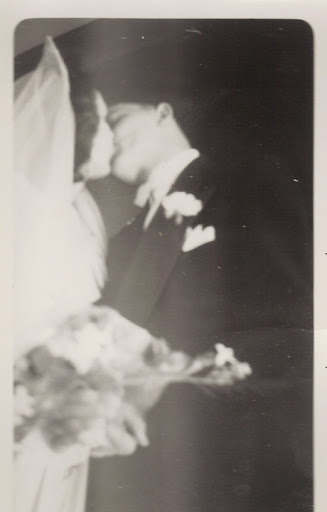
My parents met one night when they both crashed a wedding reception. Neither one of them had been invited to the party. Neither one of them even knew the people getting married!

They lived in small towns near each other, and told me that in the day it was common to show up to drink and dance whenever anyone nearby got married or had a party with a band. According to them, the hosts didn’t mind. They expected uninvited guests to “crash.”

They fell in love after meeting as uninvited guests, a love that lasted nearly 60 years.

Fast forward to four years ago, when we moved to Mazatlán from Kansas City. One of my son’s cultural adjustments was that early on he just could not bring himself to go to a party to which, in his words, he “wasn’t invited.” Which to him, a good US American, meant that the host of the party had not personally invited him. “But here in Mexico, baby, if your friend is invited, and the friend invites you, you are usually welcome if not expected to join.” No, he just couldn’t do it.

The day after such a party, his friends would say, “Hey, Danny, where were you last night? We missed you!” Sometimes even the host of the party would say it to him. So, he learned a more inclusive approach to party-going. He learned he usually didn’t need a personal or direct verbal invitation; friends are always welcome.

But, this “open invitation” approach to parties obviously can get out of hand, especially when kids attend a huge school, when they have a wide circle of friends, or, as with teenagers anywhere, “the word gets out” and there aren’t a lot of other parties that same night. Two weeks ago there was just such a “small” quinceañera to which 300 or so kids showed up! Parents, who pay the bills for the parties, wisely want to limit attendance. But how? It bucks cultural norms.

In order to bridge cultural norms and economic realities, the wrist bracelet was invented. Parents can say, “We are only paying for 100 people for your party. We’ll invite 20 of our friends, and you can invite 80.” Then the parent gives the kid 80 personalized party invitation bracelets to hand out. If you have a bracelet, you can enter the party. No bracelet, no dancing.

Seems clear enough to me.

Well, the other night I learned that kids COUNTERFEIT the bracelets! One of our son’s friends proudly showed me the pulsera he had purchased blank, and how he had taken a Sharpie and carefully and competently copied the personalized text so that he could get into the party. I of course dutifully scolded the kid, and threatened my son with what horrible things would become of him if he ever were to do such a thing. But, in the process I’ve learned that such counterfeiting, and even scalping, of party entrance bracelets is common these days.

The kids told me about a boy at school who has a whole counterfeiting operation. He goes to a party place and buys a bunch of the identical bracelets for that weekend’s party (bracelets come in all colors and many foil or reflective designs as well). He has a counterfeiting “kit” with 3 kinds of Sharpies plus Q-tips and alcohol to clean up any erroneous strokes that occur while making the fake bracelets. He sells the blank bracelets for 25 pesos (they must cost a few pesos at most at the shop, but hey, he delivers right to you at school). Buying a bracelet complete with the counterfeited markings costs 40 pesos (15 pesos for his copying prowess).

If you don’t want to participate in counterfeiting, you can buy a pulsera from someone who was “legally” invited to the party but can’t or doesn’t want to go. These “scalped” bracelets sell for 100 pesos. Who says young kids nowadays aren’t enterprising! Capitalism is alive and well among teenagers in Mazatlán.

Thank goodness that these bracelets didn’t exist in the 1940s. My parents may never have met, and I wouldn’t be here!


Cultural Change on the Malecón: A Case Study

Ok, the title of this post sounds a little too “professional” for our family blog. But it’s about dear friends, Mexican society and our beloved malecón, so I think it belongs here. It is really the story of the power of one.

Our dear friend, Guy, retired from a career as an air traffic controller in Canada and relocated to Mazatlán about five years ago. He loves the “blue:” the ocean, the sky, the outdoors, the views. He is a passionate athlete. He started out running the malecón many times a day, and has evolved to roller blading it. He is a French speaker who also speaks English, and he has actively sought to learn Spanish since living here. Guy is very outgoing, optimistic and friendly. He loves coffee, and makes a great pot of cappuccino every morning, sharing it with those friends lucky enough to be nearby when it’s ready. Guy has become a city icon. Everyone knows the bald guy dressed in black who can be seen skating along the oceanside promenade nearly any time, day or night. To see him is to be reminded to enjoy this beautiful city in which we live—not to get lost in work or daily drudgery, but to take a look around and a deep breath, and to get out and move our bodies before we lose the ability to move them.

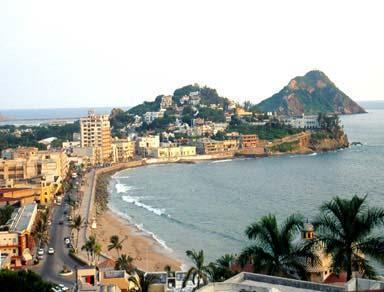
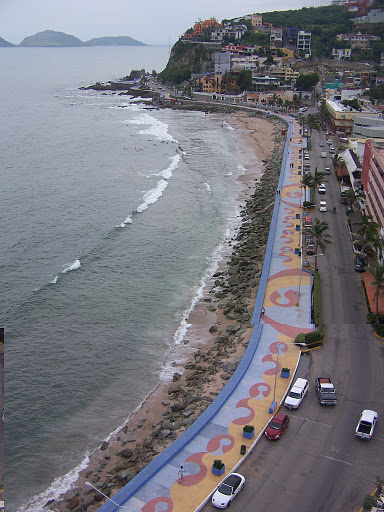
We also love walking and biking the malecón every day; it’s one of the best things about Mazatlán. In our opinion it’s the best oceanside promenade in the world, with 4+ miles of paved, gorgeous walkway between Valentino’s and Pedro Infante. We imagine that everyone would enjoy using the malecón. Thus, we have been repeatedly surprised by friends, mostly locals, who tell us they prefer to exercise at home or in a gym. I’ve had girlfriends tell me their husbands won’t “permit” them to use the malecón if they’re not with them. Girlfriends tell me they don’t use it because they don’t want to be out in the sun; it causes wrinkles and spots on their fair skin. Others say the malecón is dangerous; that you’re looking to get robbed.

And, honestly, I know very well that many people don’t use it because it’s beneath them. That is a side of society, any society, that I very much dislike. Beach vendors, people who can’t afford gym memberships, people whose only mode of transport is a bicycle or public bus, even beggars and homeless people, use the malecón. “I have more money than them. I was born higher class than them. I need to maintain my status by not associating with them.” No one in polite society says it directly, but it’s there; it’s palpable. And this is a side of any society that I’d love to change.

There are loads of Canadians and US Americans who come here and desire to make a mark on this gorgeous city, to help make our city better. They often wreak havoc on themselves and others despite their good intentions, because they come on like gangbusters and try to “change” or “fix” something they don’t yet understand, something that is much larger than they are (a culture, a society). I know this well; I’ve seen it worldwide; it’s my profession.

Guy didn’t set out to change anything. By setting out to enjoy himself and stay in shape, he has inspired many people to get out and move: to bike, run, walk, rollerblade… People from all walks of life started coming to Guy, asking him to teach them to rollerblade, to help them get started, to give him advice. They told him they’d pay him for his lessons. “No,” he’d say. “I’ll teach you for free, but you must pay it forward and in turn do something helpful for somebody else.” Thus his “entourage” was born, including a running group and a roller blading group, as well as, now, people who hang out at the coconut stand to share good conversation and homemade ceviche.

Guy has made a wide circle of friends from all different parts of society: government, big and small business, housewives and young singles, wealthy and humble. I am sooooo so so so happy to see the gatherings of people around him. It crosses socio-economic lines. There are people roller blading now who, personally, told me the malecón was no place for them! I have had friends who previously refused to use the malecón for the reasons above ask me if they could walk with us, bicycle with us. It’s because, I believe, they see these other people, “society” people, out there, exercising. Not just with Guy, of course. Kelly and his bicycling tours and groups, other running, roller blading and bike groups…. The culture is shifting. I’ve seen a huge shift towards egalitarianism and inter-mixing of the social classes on the malecón in the four short years I’ve lived here. Bravo!!! Long live culture change! Let’s keep it up! We aren’t there yet, but… Just the other day a friend asked another friend, aghast, “You have the coco guy’s phone number in your cellular?” Well, she did. And proudly so.

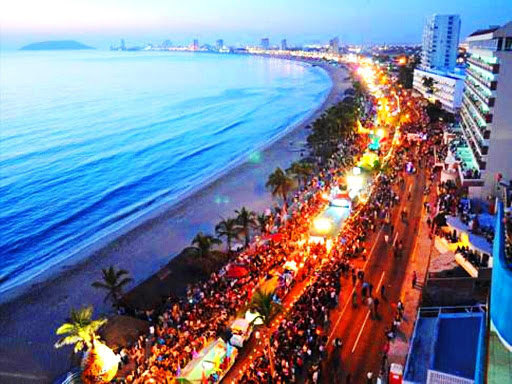
One last photo: this one of the malecón during Carnavál. Forbes Magazineranks our Carnavál/Mardi Gras one of the world’s top three. I will just add that it is VERY family-oriented. Come join us!

Coffee Shops/Coffee Culture in Mazatlán


My previous experience with coffee in Mexico was Mexico City. I lived there during the summers from the time I was 13 till I was 19. Chilangos, in my experience, loved their coffee. My friends and I drank lots of expresso and cappuccino, over hours and hours of talking and laughing and generally enjoying being together. Most every restaurant we went to served delicious coffee drinks. Coffee grows in Mexico, it’s part of the traditional culture of the country, so I looked forward to this luxury when I moved to Mazatlán.

Thus, it was quite a shock to me when I discovered that most restaurants here in town, indeed, do not have an expresso machine! I’d order my beloved cappuccinos in a restaurant here in Mazatlán, and almost never would I get one. They only served that dreaded cafe americano, or worse yet, instant “Nescafé”! I’m not sure if the overall coffee culture has changed throughout Mexico, if it’s just DF that had that culture, or if it’s just Mazatlán that never really adopted a coffee culture. But here, I have to go to a coffee shop to get a good cup of cappuccino. With a few exceptions.

Every Friday we climb the lighthouse. Though my husband hates coffee, he generously and most kindly agrees to sit with me in the Looney Bean Olas Altas afterwards, prior to starting our work day. This last Friday something struck me. The place was really crowded, and it was puro gringo. This time of year all the snow birds are here, and El Centro in particular transforms itself. If I lived down there I’d be used to it, but it was a bit startling to me. So I started thinking. When I go out with my (local) girlfriends for coffee, it’s either late morning/noontime, or it’s in the evening around 8:00 or later. Then the coffee shops are filled with Nationals.

I like to drink coffee in the morning. Give me my caffeine; get my engine started! When Greg sits with me at a coffee shop in the morning, he says it’s like a methadone clinic: people are all anxious for their “fix”!!!! We wake up at 5:30 am Monday through Friday in order to get our son out the door to the school bus. Yes, I have an expresso machine; I can make my own cappuccinos. But I’d love to be able to go out and have a cup of good coffee early in the morning. Thus, my dismay when I moved here to discover that most coffee shops do not open till 10:00, a few at 9:00, many at 11:00 or later. Fortunately for me we have this wonderful gringo-owned, early-opening coffee shop in town!

Other differences: the length of time the patrons stay in the coffee shop; the comfort of the chairs; table side service or self-service; do the patrons eat or not, and how much (a pastry vs. a more substantial menu); sell “goods” (t-shirts, caps, bags of coffee) other than food or drink, or not.