It’s a Horse Parade!

CabalgataDo you love horses? Do you love an excuse to party, and are amenable to doing so before, during and after you ride 25 kilometers on a horse? Do you have kids who enjoy watching horses dance? If so, you ought to join in the Familia Escobar’s cabalgata or cavalcade next year. The cabalgata is held up in Cerritos on the second to last weekend in January every year, and this time 600 horses and riders, from five states of Mexico, participated.

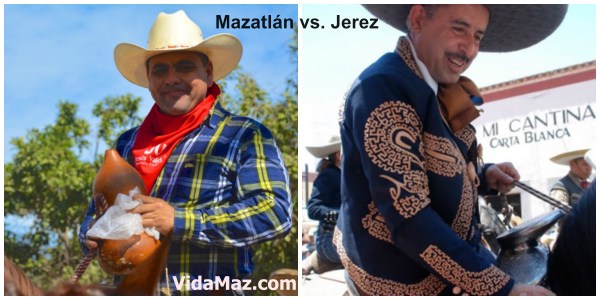
This was so very different from our first cabalgata—in Jerez de Zacatecas, on Holy Saturday of 2011. That one hosted thousands of charros with incredibly beautiful sombreros, tooled leather and embroidered suits. Here in Mazatlán, it’s puro Sinaloa, baby! Most everyone wore a cowboy hat rather than a sombrero, though we did see a few baseball caps as well. Almost everyone had a bandanna around their neck, jeans instead of leather, knee-high leather boots, and either a brightly colored shirt or a plaid shirt instead of an embroidered, fancy mariachi-like top. And, in typical Mazatlán style, we saw one guy without a shirt.

One surprising thing, at least to us: they were drinking a whole lot less here than what we witnessed in Jerez. Amazing? I’m confident they made up for it at the final ranch, or perhaps it’s because this is much more a family event, but we only saw beer, not the quantity of tequila and whiskey that we did in spring 2011 in Zacatecas. I will also say that Mazatlán wins, hands-down, in the friendliness department!

Men, women, children, couples, families, and singles participated. Riders told us there were over 1000 people participating, Tourism reported 600, but at most we saw 250-300 pass by us. We waited on the beach in Delfín for quite a while, significantly north of the bridge. However, the riders must have turned back to the road from the beach quite a ways north of Delfín, because we only saw a few on the beach—the bulk of them we saw on the road to Emerald Bay.

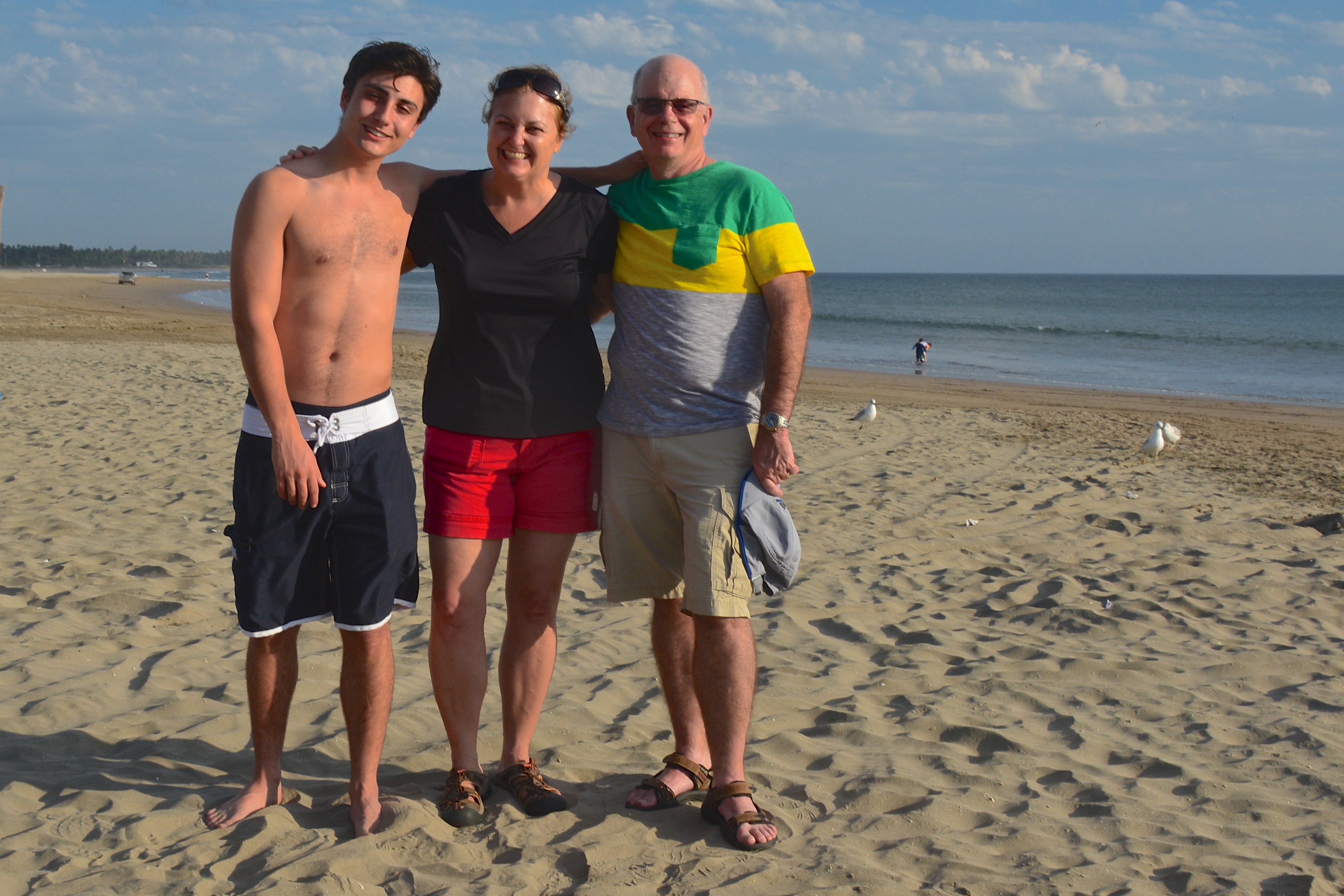
The cabalgata started at Rancho Chuchupira, which is about 14 km north of town. Because the bridge is under construction, the riders this year rested at Oceanica, the drug rehab center in Delfín just north of the wonderful new bridge. There the facility’s staff watered the horses, and guys on 4-wheelers handed out beer and water. The riders continued south along the railroad tracks, turning west for another rest at Rancho El Palomo, and then ate lunch and partied with beer, food and banda music at Rancho Las Habas. Quite a deal for 150 pesos! We met riders from Nayarit, Jalisco, Zacatecas, Durango and the USA, and were struck by how incredibly friendly everyone was. Greg and I both received multiple offers to hop on a horse and join the fun.

If you’ve never witnessed a cabalgata, it’s worthwhile taking the opportunity. Sinaloa is farm country; raising horses is part of one people do on the ranchos here. Cabalgatas are another wonderful cultural opportunity we can avail ourselves of here in Mazatlán. I do, however, recommend you ride rather than just observe. Looks a whole lot more fun!

Whale Watching in Mazatlán


1.DSC_0310 - Version 2

One of many happy humpback couples we saw on our excursion last week

I love how you all join in the excitement about our whale-watching trips with Onca Explorations. On our first trip in 2009 we had unbelievable good fortune; we had so many pods of whales come right up to the boat—breathing beside us and playing with us—that we lost count of how many whales we saw! The video on the link above will give you an idea. Remember, the camera is not zoomed on those shots! We felt like we could almost reach out and touch the whales, they came up so close to us.

Each year we have been blessed to see whales, though each time out has been a bit different. The humpbacks (ballenas jorobadas) that frequent our waters are the most acrobatic of the baleen whales; in fact, that’s how they got their name—the humped back motion they make when they breach out of the water. In addition to breaching, humpbacks spy-hop, lob-tail, tail-slap, and fin-slap. In our various outings we have seen humpbacks jump on top of each other and hit each other with their pectoral fins, which the males do to establish dominance and secure a mate. This time out, however, we saw a bunch of couples romancing—swimming around slowly and gently, courting and most probably mating with one another. Here, in warmer waters, is where the humpbacks mate and have their babies.

Onca’s owner, marine biologist Oscar Guzón, had to teach a class so did not go out with us this time. Saúl Herrera was our guide, and he told us that no one has ever recorded seeing humpbacks mate. Apparently it’s not uncommon to see huge gray whale penises in areas such as Baja, where they frequent. Saúl lowered a microphone so that we could hear the male humpbacks singing. They produce their haunting songs by pushing air through their nasal cavities.

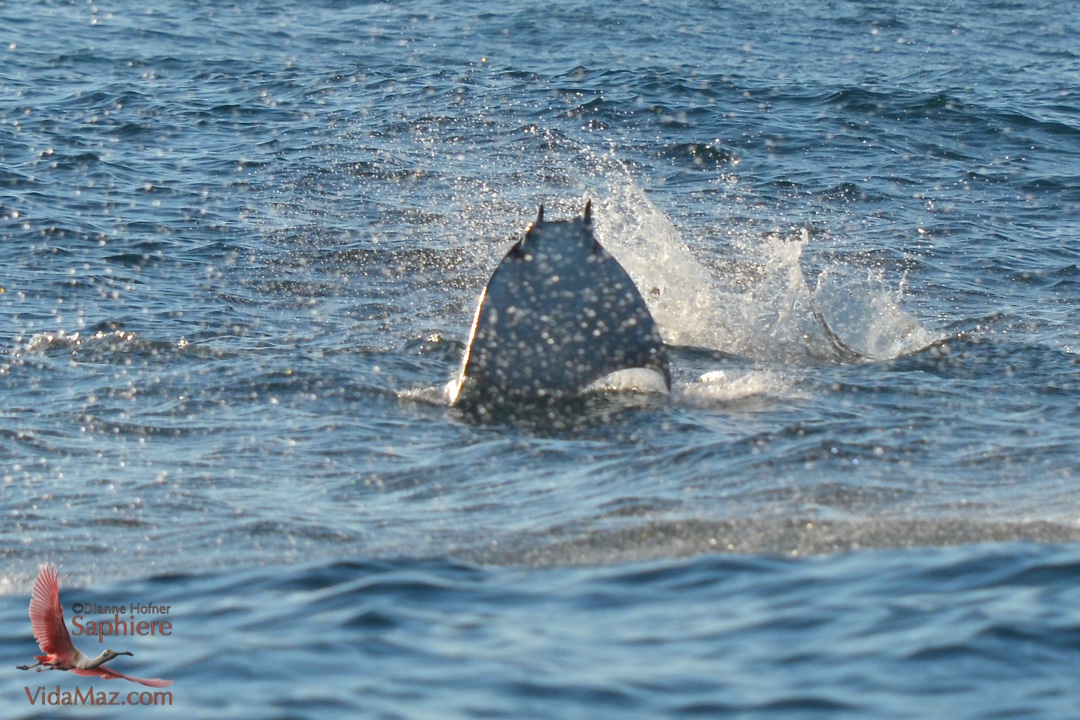
Below is a short clip of one of the happy couples, swimming about romantically, with the Baja Ferry and the smaller Onca I (we were on the Onca II) in the background. First you’ll see their spouts, then the dorsal (back) fins come up, and, finally, the whale on the right dives sharply enough that the fluke comes briefly out of the water. Ah, love. You can see how coordinated their water ballet is.

The gestation period for humpback whales is 11-12 months, so calves this year were conceived in our waters last year 😉 Mature humpbacks reach 40-50 feet in length and weigh about 80,000 pounds (females are bigger than males). Their tail flukes—up to 18 feet across—are like human fingerprints: individual identifiers. No two flukes are alike.

Humpbacks live up to 50 years and are sexually mature at 6-10 years. Below you can see some of the great variety of flukes, as well as some of the spouts, that we saw during this trip. As you can see, there was a whole lot of love going on out there! Click on any photo to enlarge it or view a slideshow.

Oscar is a marine biologist, and he, Saúl and the crew of Onca have now spent nine years cataloguing and tracking the whales that frequent our waters. Their research has made huge contributions to what scientists now understand about humpback behavior at the southern tip of the Sea of Cortéz. Below is a clip of Saúl telling us a bit about cetaceans in our waters, including that they have recorded sightings of 17 species of cetaceans here in Mazatlán.

In addition to whales, this year we saw two species of dolphins (bottle nose and spotted) and, the stars of the trip, the mantas. Be sure to click on the link if you haven’t seen those photos!

Another great advantage of this whale-watching excursion with Onca is the great view of Mazatlán from the water.


Manta Merrymaking

1.DSC_0260 - Version 3 In my next life, I want to be a manta. I’ve always said I want to be a Kobe cow, so I could drink beer and get massaged all day. But, in 2015, I hereby declare that being reincarnated as a manta ray looks oh-so-much more fun! We went out whale watching this week with Onca Explorations.

Whale watching has been our traditional Christmas gift to each other as a family since 2009. And a wonderful gift it is! The highlight of the trip this year for me were the mantas! We did, indeed, see whales; I will post pictures and write about that separately. But the mantas!

They were having so much fun! There were so very many of them—hundreds—and they kept jumping and flying and splatting and splashing, performing their high jinks all over our bay with their friends, for what seemed like forever. They just didn’t stop. What a joyful bunch they are! It reminded me of dancing sessions with my girlfriends…

The mantas’ bodies change so completely with every leap. They slap their wings against the water in a loud “thump!” 1.DSC_0253 - Version 2 That slap launches them into the air, where their wings curl up the opposite way, wrapping themselves backwards, in a rebound of sorts. 1.DSC_0261 - Version 2 They leap into the air—seemingly soaring over the skyscrapers on the beach, as you can see in the photos. 1.DSC_0246 - Version 3 They then fall back into the water with another loud “splat,” and start the process all over! 1.DSC_0234 - Version 2 And they do all of this in the company of hundreds of their joy-filled friends, frolicking about in a big band of craziness. 1.DSC_0279 - Version 2 And did I mention that mantas are HUGE? These looked to be maybe 3 or 4 feet across, and they get much bigger. Below is a short video clip of some of the manta merriment. I highly recommend you take a whale-watching excursion with Onca. Maybe, if you’re lucky, you’ll get to see some mantas!

What makes the mantas leap so? Are they mating and courting, and perhaps the manta with the biggest splash is the sexiest? Are they just having fun, partying hearty with their friends? Are they wanting some Vitamin D from the sun? Whatever the reason, I sure did enjoy them!

Click on any of the photos in the album below to view it larger or see a slideshow.

National Geographic published a video of the largest-ever-witnessed group of mobula rays in our Gulf of Cortes. It is incredible! Watch it below:

Our Beloved Favorite: Stone Island

DSC_0433 - Version 2

We all love Isla de la Piedra, Stone Island. We love the:

  • Serenity—the long stretches of gorgeous beach with, normally, very few people. In fact, our family describes it to our visitors as “Gilligan’s Island.”
  • Smiling, welcoming faces who greet us in this lovely little town.
  • Number of ambulatory musicians who come by.
  • Fishermen preparing their boats to take out in the evening, working tirelessly to repair their nets for their night’s work.
  • Vendors and, especially, those who have the thighs to bicycle along the beach.

And we love the fresh seafood, caught that day and served raw or barbecued over an open flame.

Our favorite place to spend the day is Pili’s. We met Rudy, Barbara and the family of Pili’s owners when Danny was just three or four. We were introduced by our compadre, Ruben. Danny fell in love with the pretty Alhondra, who was 11 or 12 at the time, and is now married with a toddler and living in Tijuana. Pill’s makes the BEST zarandeado. Barbara sells fresh oysters and clams, and the cold coconuts are always a hit. As is a bucket of beer, or a piña colada.

Stone Island is one of our favorites, and is always one of our visitors’ favorite places, too. No, it’s not an island. It’s a peninsula. We get there from Mazatlán by water taxi. It’s part of what all of us love about going to the Isla for the day.

We love how, despite Mother Nature’s havoc, the Islanders rebuild. August’s Hurricane Marie brought waist-high flooding to the places on the beach, and the water stayed for several days. It ruined over 27 of the restaurants on the beach, and despite promises from State Secretary of Tourism, Francisco Cordova, and Mayor Carlos Felton, the islanders never saw one centavo of assistance, from either the state or the municipio. At least that’s what our friends tell us, and the Noroeste reported. Since the islanders are no longer permitted to cut down trees, they had to rescue timber from the flood waters. But they did. They have rebuilt. The restaurants, at least most of them, are again open for business. Though you can still see bulldozers cleaning up debris.

1.DSC_0542

How much longer will we have the serene beauty that is Stone Island, this idyllic paradise that is only a five- or ten-minute water taxi away from our daily lives here in Mazatlán?

Soon they will widen and pave the road from the airport. It will be much easier for tourists, who arrive via the new highway or by air, to get to Stone Island without needing to come into Mazatlán. No doubt development will follow.

And the construction of Amaitlán continues. Planned to be an eco-friendly mega-resort with lots of green space, you can see the first parts of it in the “Botanic Garden” on Stone Island. The first few rental cabañas are currently being built.

Most of our friends on the Island, the ejidatarios, are excited about Amaitlán. They believe it will bring them jobs, income, sustainability for their families and the environment on the island. I am much more skeptical. But, I have my fingers crossed. I can hope. I do know that I would love to stay in one of these little cabañas, amidst all this lush, gorgeous greenery, assuming I could afford to do so.

I guess this post is really a homage to one of our absolute favorite places on earth these past 35 years. Nostalgic, because we don’t want it to change. Hopeful, as we pray things will change in sustainable ways that support the environment and local residents.

Let me close this post with a great story that Rudy told us during our last visit. He tells us that there was a rainstorm recently during which it rained fish—un aguacero de peces! And, even though they were drinking when this event occurred, he swears it really happened.

Furthermore, Rudy told us that it wasn’t the first time it’s rained fish here in Mazatlán! According to him, El Sol reported years ago about a rain of fishes in Playa Sur ( was unable to find such a story on the internet). Our interview took place during a perfect day on the beach, but somehow the ocean breeze caught my camera’s microphone. My apologies. I’ve done all I can to minimize that windy sound… The story is great though, so, heeere’s Rudy!

The People You Touch

DSC_0808 Faces and Places of Colonia San Antonio

Every year we are privileged to be able to help the Medina family and all the others who help out with Desayuno de los Pollos. This year, thanks to help from so many of YOU, we have already been able to purchase 2500 whole chickens and pack up 1500 packs of despensas, or 10 days worth of food. This should feed about 13,000 families this year. We also take gently used clothes, toys and candy to share. In the slideshow below are photos of just a few of the people you touch. And, of course, they are people who very much touch us back in turn, making our holidays bright. (Click the arrows in the slideshow below to view photos more quickly. Please let me know what you think of these portraits! Thanks!)

This slideshow requires JavaScript.

Yesterday I went out, as usual, with Yolanda and Jorge, to meet with community leaders of Colonia San Antonio. We handed out about 900 (!) tickets for food to members of the community. Why is this important? Because Colonia San Antonio, as so many other colonias on the outskirts of town (we give out food along 7-9 routes every year; San Antonio is just one of them), is an invasión. This means that the land on which the houses are built is privately owned, and the people living there are squatters. Normal procedure in these circumstances is that poor people move in, “squat” on the land, build homes out of pallets, recycled tarp, or even cardboard or metal. Eventually they band together and string electrical wire for themselves, and lay pipes for water. They have now done this in Colonia San Antonio.

Five or so years ago, when we first started going there to hand out chickens, they had neither water nor electricity. Now they do. I don’t see any transformers or breakers or anything, pretty much just a very long extension cord running from house to house. But, they do have electricity. Once the community grows large and successful enough, the city, or municipio, decides to access the colonia. The city pays the landowner for the land, and the people living in the invasión are required to start paying taxes.

The good news is, the squatters get to own their land and their homes. Some of the people who occupy the land in these invasiones, however, do not live there full time. Some come out to visit the homes they have only on the weekend, like a (very basic) country house. Others farm the land, but live in town. They basically squat as a way of making (a bit of) money, eventually, when the city decides to give the squatters a deed to the land they occupy.

Yolanda, Jorge and I go out here to meet with community leaders, so that they can take us around, home to home. They can tell us who lives here full time, and who only happens to be here once in a while. The community leaders tell us which families are most in need (maybe they need two chickens or packs of food, or extra clothing), and which are doing better than others. In this way, we can be as equitable as possible in what we hand out. This week, we were there from about 10 am till 2:00 pm.

It is one of my favorite days of the year. I am able to meet with incredible community leaders, people who themselves have fallen on hard times, don’t have much in the way of money, but who have the caring and the fortitude, the vision and the sense of justice, to better their communities. I also have the privilege to meet the people I’ve met with over the past five or so years that we’ve been going to Colonia San Antonio. I get to visit with people we know, and get a glimpse into how people there live.

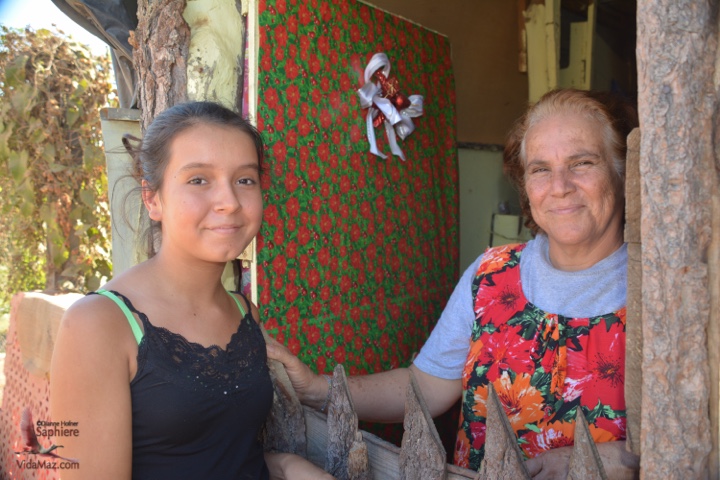
This year, I made a point of taking photos of two things: the faces and the places of Colonia San Antonio. The first slide show, above, is of some of the faces of this invasión. You can see the joy, the dignity, and the difficulty these people experience every day. I have so very much to learn from so many of these people. I am so grateful to be able to meet with them and, hopefully, share with them a bit of joy and ease their burden just a bit.

The second slide show, below, is of the places: the homes, stores, and plazas of this colonia. It amazes me how simply people here live, how hard they work for what they have, yet how clean they keep their homes, the care and love they bestow on their children. How, despite the dust EVERYWHERE, most everyone has clean clothes and skin and hair. Nearly every home is decorated for the holidays, and many of them have beautiful demonstrations of religiosity as well, especially for the Virgen de Guadalupe. (Click on the arrows in the slideshow below to view all photos more quickly.)

This slideshow requires JavaScript.

You are most welcome to join us on Christmas Eve morning, Wednesday this week, to caravan out to the 7-9 routes we’ll go on and hand out chickens, food, clothes, toys and candy. We’ll meet at Quince Letras downtown, 6:30 am if you have a pickup truck, 7:00 am if you are coming to help out. We should be finished by noon. Merry Christmas and see you Wednesday morning!

Part of the #MyGlobalLife Link-Up.