Don’t Fall Prey to Scams!

extorcion

Scams are everywhere. From Canada to Chile, Russia to Italy, and China to Australia, you can bet con artists are eager to play with our ignorance (or innocence) and part us from our money.

North of the border we read so much advice about how to prevent online fraud, identity theft, or telephone scams. We know the criminals especially target retirees. Then we move to Mexico. The scams here are different. It’s a different place, a different culture. We need to learn the ropes, educate ourselves on how to avoid falling prey to a con. We may not know the language, or we may struggle with it, as well as with the customs and “fitting in.” Such factors can cause us doubt, feelings of powerlessness and thus, make us more prone to getting duped.

Con artists know human nature; they play on our hopes, fears and beliefs. And what’s one of the biggest stereotypical beliefs about Mexico these days? How violent it is—the preponderance of kidnappings and extortions. Most stereotypes are grounded in truth, but they become so generalized, applied so broadly, and become so firmly fixed in our psyches, that they become false “truths,” boxes into which we habitually throw people, without using our minds or our other senses as filters. The smallest glimmer of the stereotype in the back of our minds provides a direct beeline to our fear response. And that is just what the criminal wants, whether we’re a local or an immigrant.

Do you know the most common scam here in Mexico? It is a phone scam, 80% of which take place in private homes. Someone, most likely from a jail, calls our home. They either say they are our long-lost cousin or compadre who needs help, or they tell us they have our spouse or children held hostage. This latter is enough to get most anyone upset and, when we’re upset, we too often fail to act rationally. Remember that such phone scams are probably no worse than a scam north of the border but, because they play to our fears for our family, it can put us off balance. Think things through now, so that you are prepared if this happens to you.

Here is a summary of the advice I’ve most often read in the local press, about how to respond to a criminal call:

  1. First, think! Do we know the person on the line personally? Is this the person’s voice? Be assertive. Ask questions. Use common sense and intuition; if something doesn’t seem right, it’s probably not. Especially if the person is asking us to leave where we are, go outside, go into a hotel or certain store—don’t do it!
  2. Second, hang up. That is the advice we most often read in the local newspapers. If someone calls us and we don’t know who they are, especially if they are asking us questions or threatening us in any way, hang up. More often than not they will call back. Don’t pick up. We may worry about not understanding the Spanish, about offending someone by hanging up. But, if it doesn’t feel right, we are wise to trust our instincts.
  3. Never, ever, give out any personal information! This is true north and south of the border. If someone tells you they have your spouse or your children, or they are your long-lost cousin, don’t give them a name! Don’t tell them where you live. Don’t give them any information. Play the scenario through in your head, several times, so that the response will come more naturally should such a scam call ever come in. It’s a call we’re not prepared for. It plays to our deepest fears, and our deepest stereotypes. Don’t let it claim you.
  4. If you find yourself unable to hang up, press those on the phone for information. Plan this ahead of time, so you can think clearly in a crisis. Ask them what your spouse is wearing, or on which side of his head your (bald) spouse parts his hair. Hopefully hearing a wrong answer will then give us the courage to hang up the phone.
  5. Once you hang up, contact your spouse, children or cousin to verify that they are ok. You will feel better. Remind yourself that the caller was likely contacting you from outside Mazatlán. The most common calls here in town come from prison—and prisons even as far away as Tijuana! Most often, they just want spending money or time on their phones. But we’ve had friends, local and expat, who’ve given away much more than that. The caller is most likely not watching you or your family members. They are talking about kidnapping because they know it will more likely scare the money out of you.
  6. Call the police. That number is 066. Federal crime prevention can be reached at 088. The tourist police number is 669-914-8444. The anti-kidnapping unit can be reached at 01-800-3221-5803. Or, you can email noalfraudtelefonico@hotmail.com

Stay smart and safe, everyone! Remember, Mexico is a beautiful place, and we choose to live here for awesomely wonderful reasons. Like anywhere, we need to stay aware. Perhaps if we do, we can start to break the cycle of violence that is the kernel of truth in the stereotypes about our adopted home.

Town Hall Meeting for US Americans in MZT

75900_10202828512891008_1922606009_n

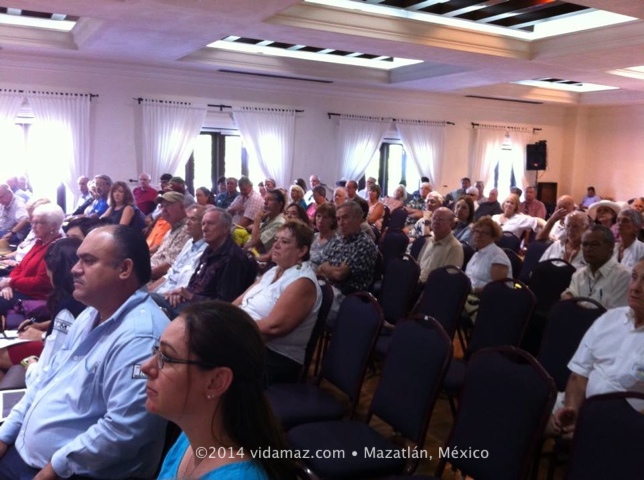
Yesterday, Friday January 24th, was our annual USA citizens’ town hall meeting at the Hotel Playa at 11 am. Several people have asked us for a report. Please allow us to summarize here on the site what we heard yesterday. Feel free to add in what we’ve missed, or to correct something you may have heard differently!

John, our wonderful consular officer, was here from Hermosillo, accompanied by Rob, the security officer, and Ian, also from their office, who’s been filling in a bit for Luís Ramirez while he’s out of town. Heather and Lety, our local consular office staff members, received a big round of applause, as did Luís in absentia. Adriana from our local office of Migración gave a short presentation, interpreted by Isa Medina. No one from Aduana/Customs attended. Iván Pico from the Mayor’s office was present, but was not asked to speak.

The meeting last about 90 minutes, and was well attended, though there were fewer people than in prior years (maybe 150 people?). John gave an overall report and then asked for questions, as did Ian and Rob. Last up was Adriana.

The meeting is primarily a chance for our consular staff to meet with and hear from US residents and visitors. This year not a lot of new information was shared, since there seems to have been pretty good communication throughout the year. Some interesting highlights included that:

  1. John asked for a show of hands for how many present had lived in Mazatlán less than five years, more than five, more than ten, etc. Most present have lived here over five years. The person present who has resided here the longest was Khacho, of JungleJuice fame, who said she’s lived in Mazatlán for 39 years. Only two or three hands were raised by people who had lived here fewer than five years. Interesting. Not sure if newer immigrants just didn’t attend the meeting or hadn’t heard about it.
  2. Rob and John both congratulated our governor for all the hard work he’s done to stem violence in our state as well as to change perceptions of violence here. Everyone agreed all is much calmer than it was for a while. In response to a request that the officials present do all in their power to stem the tide of sensationalistic State Department reports, Rob explained about the “double standard” law on the books in the US. It states that if any officer of the US government cautions any employee about safety protocol, that same message must be shared with all US citizens. Rob said that while the intent of the law is good, that’s why we get so many warnings that may seem silly or overly cautionary. Interesting to know; puts things in context a bit.
  3. Adriana from Mexican Immigration read the definitions and prices for the top three visa categories, with Isa interpreting. There were two main lines of questions for Adriana.
    1. The first was about how to renew visas. Such information is publicly available, and Adriana patiently attempted to answer audience members’ questions. It was obvious that too many rumors are going around about changes in visa status, that those in the room who have renewed visas are comfortable with the new process, and that accurate information on this topic is available online as well as in the Immigration office, so expatriates are encouraged to go to the source rather than believing or passing on hearsay. Towards the end of that discussion, 15 minutes were spent on personal inquiries, which John ably redirected to private discussions upon conclusion of the larger group meeting.
    2. The second line of questions for Adriana was around car importation, which of course is a matter for Customs and not for Immigration, and thus outside her area of expertise. She did clarify that local Aduana can not register cars that are supposed to leave the country and reenter; the local Customs office doesn’t have the necessary software nor authorization. Such can only be done by Customs at the border. O’Neal asked for an update on Luis’ efforts to get a representative of Aduana from the border down here, explaining that we have many retirees in Sinaloa and Nayarit who are no longer able to make the long trek of driving their cars to the border to re-register them, and others whose cars are so old that they are not mechanically fit enough to make it to the border for re-registration. John and Ian promised they would ask Luís about it. Several of those in attendance assured the audience that importing an auto is not really that difficult; most of the paperwork can be done through email prior to heading north. There are customs agents who are professional and speak English. One of our readers, Kitty Krohne, tells us, “We imported two vehicles. It was very straightforward….actually it was easier then getting the plaques here. If I can help or share more info with anyone I will certainly be happy to do so. You are welcome to pm me.”
    3. Quite a bit of discussion was had around the need for residents to check in and out when they leave the country. While the process at the airport is streamlined, land crossing is met with much confusion on the part of the foreign community. It was clarified that if leaving on Highway 15, one should check out and in at the 21KM checkpoint, even if they have no automobile-related business to tend to. It was pointed out that an official request to the Mexican government has been made to install signage for northbound travelers, and to improve traffic safety at this point. Adriana pointed out that there will be circumstances where checking in or out is not possible, with the example being any foreigner who travels overnight on a bus. The response to this was the familiar, ni modo.
  4. An inquiry was made about U.S. Notary services while Luís is out of town. It was pointed out by John that the Hermosillo office was sending officers down as needed to deal with this and other necessary work. If U.S. Notary service is necessary, one should check with Heather or Lety to see when such service will be available.
  5. A brief discussion around mordidas, or bribes to police officers, included a show of hands of who has been “shaken down” and who has not. Fortunately, very few have ever encountered issues. Those that do are asked to do their best to get the patrol car number, note the day and time, and report all to Iván Pico at the Mayor’s office.

Not so much to report. It was good to see everyone. I believe you all join me in gratitude that John and his staff hold these annual Town Hall meetings for us. Also many thanks to Lance at the Hotel Playa for donating use of a large salón for this purpose.

On a personal note, let’s all remember that we are guests in Mexico. Mexico is a sovereign nation free to change laws that affect us without consulting us or the U.S. Government. While we can ask our government representatives to explain what they believe is going on and ask them to inform their Mexican counterparts of our concerns, Mexico is under no obligation to heed such input. Mexicans are the first to admit that some of their laws and procedures are outdated, inefficient and nonsensical. Such is true in most countries. But we are obligated to follow those laws and we have no right or expectation that our government can change things. Expecting otherwise will most likely only get one frustrated.

Ready for Carnaval de Mazatlán 2014?

1515044_617581938313990_1319879249_n

Shoreline: The Skin of the Sea is the closest I can get to translating this year’s rich Carnavál theme, which will unite Mazatlán with the Mardi Gras of New Orleans, Rio de Janeiro, Santiago de Cuba, and Venice, which are all located on the water, of course. Are you getting excited? It’s hard not to, with lights already hung along the Avenida del Mar parade route, and all the great photos people keep sending me. February 27-March 4th is coming soon!

Two great pieces of personal Carnavál news for me this year! One is that our recently departed dear Maestro Rigo’s two wishes, which we reported to you last year, will be realized! This year’s float for the Queen will be 15 meters tall! Secondly, on this 400th anniversary of Japan-Mexico relations, we will have a Japanese float and comparsa/dance troupe in the parade this year! And, they will do a tequila-odori!

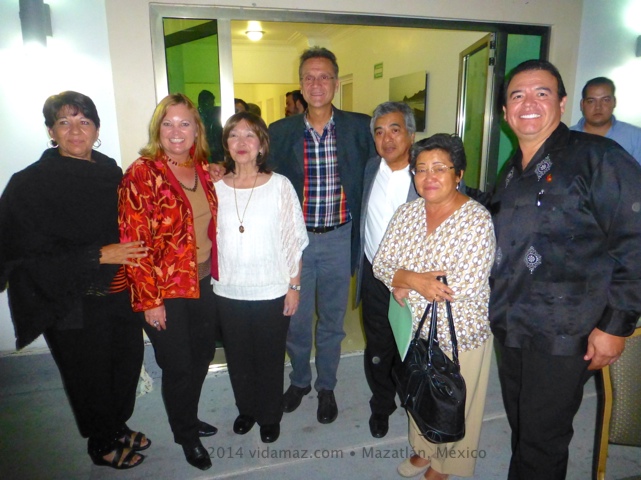
My friend Sandra and I with our Mayor, State Secretary of Tourism, and Esperanza Kasuga, who is organizing Mazatlán's celebration of the 400th anniversary of Japanese-Mexico relations.

My friend Sandra and I with our Mayor, State Secretary of Tourism, and Esperanza Kasuga, who is organizing Mazatlán’s celebration of the 400th anniversary of Japanese-Mexico relations.

While we have lost Maestro Rigo to this life, his two carrozas, for Queen and Child Queen, are about 60% finished. His sister, Ana Lewis Rodríguez, is continuing his legacy, at least for this year. She says that Rigo’s dream was to have the Queen’s float (with a Brazilian theme this year) crowned with 300 ostrich feathers. Since each one costs 100 pesos, there will perhaps be some fundraising involved to make that happen. The 15 meter height for the float, which Rigo dreamed of, also requires special materials, not just the standard papier maché. So, here’s hoping…

This morning I received photos of the seamstresses working on the royal costumes, which seem to get more luxurious and fantastical every year. Enjoy the sneak peek! Sodelva Rios de García and her team have been making the royal costumes for almost 40 years. You’ll remember that we showed you the King of Joy’s vestments she made last year.

Do you know that CULTURA’s costume department produces over THREE HUNDRED costumes for Carnavál each year?! Our kudos to Elisa Espinoza, head of the costume department! While the women are primarily in charge of the costuming, props are coordinated by two gentlemen: Adrián Javier Ledesma Ruíz and Jesús Julio Robles Jaramillo.

This year the Child Queen will be dressed with a French influence, in honor of New Orleans, in gold, silver, purple and green. Some of the vestments for the dancers, which have to be comfortable as well as free-moving, will be finely detailed with airbrush. The King of Joy’s theme is Cuba—the colors will be vivid, tropical colors with a lot of shine and ruffles.

Photo courtesy CULTURA Mazatlán

Photo courtesy CULTURA Mazatlán

The election of the Queen this year will take place on Saturday, February 15th, in the Angela Peralta theater. As in recent years, the candidates will model designer evening dresses and clothing designed by Jacobo Borge and Sandra Vite, and jewelry designed by Gustavo Helguera (whose designs have been worn by Naomi Campbell and Carolina Kurkova).

Are you trying to plan your trip here or your friends’ stays? Or how you’ll navigate all the Carnavál events? Check out this “Why We Love Carnavál” so you can pace yourself and your energy. Remember that this year El Recodo will play Monday night, which is traditionally the night of the fireworks on the malecón and the light parade—even more events than in a normal, very full Carnavál year.

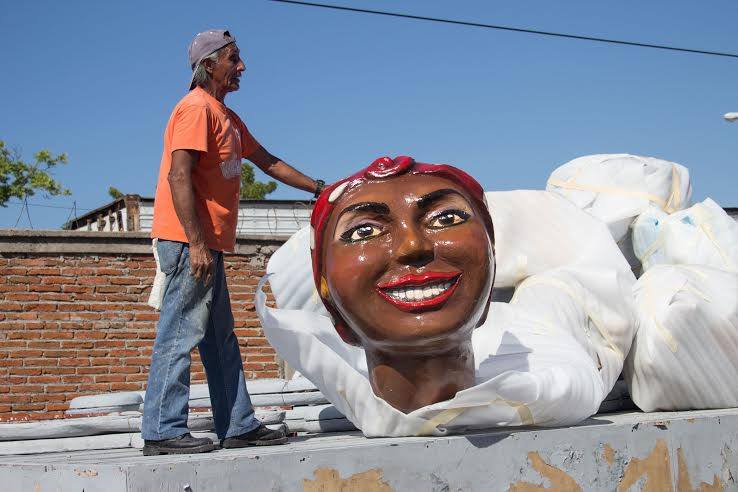
I keep wanting to make it over to Maestro Jorge González Neri’s taller, to see what he’s up to (LOVE seeing the works in progress!), but life has just been too busy (5 sets of visitors over the holidays, the 25th anniversary of my business in 2014, and the 10th anniversary of my Cultural Detective project coming up in February, plus just so many events in town)! Here is a peek from last year at this time: Monigotes—The Making of a Giant Statue. The work these artists do for our pleasure is truly remarkable!

photo from CULTURA

photo from CULTURA

I’m excited with all the musical acts this year, and that amidst the international-caliber classical music selections we also see three major banda that originate in our hometown: El RecodoLos Recoditos, and Chuy Lizárraga. What a proud reclaiming of our roots! Say, do you recall the songs of Carnavál from recent years? While, to my knowledge, there is no annual “official” Carnavál song, each year there seems to be that song that gets played and replayed so much that it comes to represent our memories of that year. Greg wrote a post about that, read it here and test your memory.

I suppose the next thing is to wait till the monigotes or giant statues get put up, as well as the flags along the parade route. While we wait, I suggest we all get our “skin of the sea” wear in order!

European Week for Mazatlán

I don’t think anyone has officially declared this “European Week,” but I hereby make the nomination. Mazatlán is quite famous in western Europe these days… I’m sure you’ve heard that our State Secretary of Tourism, as well as the mayors of Cosalá, El Fuerte and El Rosario, are in Madrid, Spain this week for FITUR, the International Tourism Fair, as part of the Mexican national delegation. The fair opened yesterday and goes through Sunday the 26th. FITUR is a huge event with enormous upside potential, with over 120,000 tourism professionals from 165 countries  attending.

This slideshow requires JavaScript.

Just now I’ve learned that a crew from BBC (yes, British Broadcasting Corporation) has been here in town. So, the European connection continues! A director, producer, cameramen and two Irish actors, Dara O’Briain and Ed Byrne, are here for two days to film a documentary series on Sullivan C. Richardson’s Pan American Highway Expedition of 1940-1941 — the first successful attempt to drive an automobile from the United States to the tip of South America. Their route would eventually become the Pan American Highway. In 1942 Richardson wrote a memoir of his journey, titled Adventure South: Three Men and a Lone Car Blaze the Pan American Highway Route Down Two Continents to Cape Horn! Apparently the original expedition made its way through Mazatlán, and the book records that they had a very pleasant stay here. Richardson wrote of the warmth of the Mazatleca people, and the fact that his group spent the night down by the divers in Olas Altas, as they didn’t have money for lodging. They are filming at the diving platforms and the Hotel Belmar, as well as the Mazatlán-Durango Highway and the Baluarte Bridge. The series is planned to air on BBC this coming December.

Have you not seen them around? Here’s a short video clip that SECTUR assembled:

What next, everyone? May Mazatlán’s fame and fortune on the European stage continue 😉

Jungle Tour of a Mangrove Swamp, right here in Mazatlán

1.DSC_0476 - Version 2

Jungle Tour Mazatlán

Many people don’t play tourist in their hometowns; it’s very often the truth worldwide. For years, we’ve seen advertisements and heard about a “jungle tour” here in Mazatlán. Those tours weren’t offered, or at least we never heard of them, back when we came here as tourists. We’ve thus never been on one, but I’ve been curious.

We did a “jungle tour” last Christmas in Nayarit that was one of the most incredible birdwatching experiences of my life, and a few years ago we’d done a Marismas Nacionales tour down in Teacapán, where there are over 250 species of birds. We very much enjoyed both of these tours. But here in Mazatlán we’ve already lost so much of the gorgeous mangrove swamps and brackish water estuaries that are this city’s heritage, in which those delicious shrimp and crab thrive, attracting that great variety of water fowl. Would we be disappointed? Would there be much to see up here? We obviously have a lot of gorgeous water fowl here in Mazatlán, so maybe, just maybe, we’d enjoy such a tour.

Then, at Christmas, on the way back from Stone Island, the panga driver asked me if I’d be interested in a jungle tour. He said he could do one for us, and assured me that we’d journey through mangrove swamps, see loads of water fowl and maybe even some mammals, and that there was a farm at the end of the tour with crocodiles. He promised, over and over again, that we’d love it, and gave us a price (1500 pesos for 8 people). He gave us his cell phone number, and when we had a group of friends here with a young boy, and another group that loves the outdoors but really doesn’t enjoy climbing, we thought the jungle tour might make both groups happy. And, indeed, we were all thrilled! HIGHLY recommended!

The tour began in one of the water taxi pangas, departing from the embarcadero near the brewery. Our guide wanted to leave at 11:00 am for a 90-minute tour, but because we all wanted to spend the day eating zarandeado and lounging on Stone Island, we told him we wanted to leave at 9:00 am. I’m glad we did! LOTS of birds were out and about, and we didn’t make it to Stone Island to eat until about 1:00 pm! Our guide kindly took us wherever we wanted to go, allowed us to dally as long as we wanted, and the journey transformed into a four hour one that everybody greatly enjoyed.

As always, the tour of the port itself was fun. We saw shrimp boats coming in, a small panga decked out with a homemade sail (somehow reminiscent of southeast Asia), and loads and loads of tuneros, camaroneros, and ship repair yards. I’ll post about those later, but here are some basic photos of the port portion of our tour.

We turned right, southeast, at the end of Parque Bonfíl, and into swampland. At first the passage was fairly wide, but gradually it became narrower and narrower, shallower and shallower. Our guests, three from Italy, one from LA, and another from Nebraska, saw mangroves for the first time in their lives. They especially enjoyed seeing how the oysters grow on the roots of the mangroves, and the six-year old Italian kept his eyes peeled for wild cayman (we didn’t see any this day, sadly for him).

Bird watching was not disappointing! Everyone in the boat was shutter-happy, and Jesús was happy to cut the motor or pull the boat around in order to help us get the best photos of our subjects. As always, I wished I’d brought my bird guide, or that I knew the names of more of the birds than I do. Please feel very welcome to tell me what these birds are in the comments below, and I’ll label them properly.

After about an hour, we pulled into a small farm, that of Jesús’ brother-in-law. There they harvest palm fronds, drying, cutting and bundling them for sale to broom manufacturers, and they also make their own homemade brooms for sale. Their farm was gorgeous, with papaya, mangrove, banana and coconuts growing. During the week, Monday-Friday, the couple lives here in very minimalist quarters, and then go “home” on the weekend. I assume they have electricity and running water at home, as they sure didn’t have that here. We saw a baby iguana, and to humor our young guest, Jesús caught it so Leonardo could pet the reptile.

From this small farm, we walked across to a larger place, where the King David tours put in. Here they’ve built an open-air restaurant where we sampled some of THE BEST cocadas I’ve ever eaten. Here we also saw the cocodrílos, lots of chickens and ducks, and a huge beehive up in a tree. On this farm they were growing squash and yaka. Nothing too exciting, but a pleasant walk. From here it would have been a short walk over to the beaches of Stone Island, but we were way down south from where the palapas are. So, we got back in the panga so Jesús could take us back and drop us off for lunch.

It was a terrific day for all, and one we highly recommend. If you have access to a boat you could do this trip yourself, and I’m confident that most any panga driver would take you for a fee. I am guessing our trip was more expensive than it possibly could have been, as Jesús went through the official channels—we paid at the embarcadero ticket booth. This was just the ticket to enjoyment for three very different groups of travelers!

1.DSC_0422