A Saint in My Family

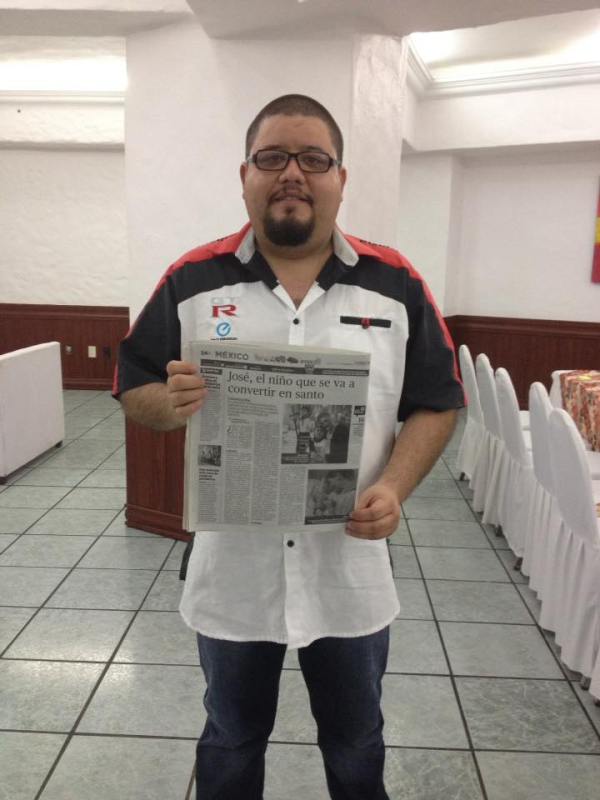
I recently heard about the Mazatlecan connection to a saint who was canonized just a few weeks ago, on October 16, 2016. I spoke to the saint’s great-nephew, Samuel Parra Sánchez, and he kindly agreed to write an article for us about Saint Joselito. I am happy to share his story with you.

11220849_320179115016506_4224063944948504846_n

Saint Joselito, left, and baby Ximena with her mother, Paulina, on the right

I do not know how many Canadians or US Americans celebrate a day dedicated to a religious saint who answers people’s prayers with miracles. It’s difficult to believe if you are not a follower of Jesus Christ, maybe because faith means everything to us. I am referring to the people who practice Roman Catholicism.

The story I am going to tell you is difficult to believe because the main character is already dead. On October 16 of 2016, Pope Francis canonized as a saint a 14-year-old boy who gave his life in protest against a bunch of murderers who, at the beginning of the 20th Century, tried to banish Mexican priests. That boy was named José Luis Sánchez del Río—Joselito—and he was my great, great, grand-uncle.

According to PEW Research:

  • 81% of Mexicans self-identify as Catholic, 9% as Protestant, and only 7% as unaffiliated with a religion.
  • While 71% of US American citizens identify with the Christian religion, only 21% are Catholic. 23% are unaffiliated with any religious belief, and 6% are non-Christian (Jewish, Muslim, Buddhist, Hindu, etc).
  • 39% of Canadians, in contrast, identify as Catholic, 24% as unaffiliated, and 11% with other religions.

Thus, I am not sure how am I going to convince you that there´s a saint in my family. Let’s start from the beginning  of the validated miracle.

The story opens with a baby girl, Ximena Magallón Guadalupe Galvéz, born on September 8, 2008 in the United States—so technically she´s American. After she was born, Ximena’s parents took her to the city of Sahuayo, located in the state of Michoacan, the same state where the Blessed Joselito had been born. When she was 15 days old Ximena fell into a fever that turned into meningitis and tuberculosis. She suffered seizures and a cerebral stroke. Paulina Gálvez Avila, Ximena’s mother, shared her baby’s story, saying that “humanly, Ximena had no hope of life.”

Her parents took Ximena to the pediatrician and he tried his best to help her, but she did not improve. They took X-rays to rule out pneumonia. Ximena was admitted to the Hospital of Santa María Sahuayo.

Doctors discovered she had fluid in her lungs, tests showed she had tuberculosis, and the smile on her face was lost after she fell into a vegetative state. Doctors induced a coma after they determined that 90 percent of Ximena’s brain was dead. They were going to disconnect her from life support.

“We went to Mass every day to ask God and Joselito to intercede for my baby, to perform a miracle. Before disconnecting her, I asked them to let me be with Ximena and hug her. After that they disconnected the machines. At that point, I put Ximena in the hands of God and the intercession of Joselito. Suddenly, my baby opened her eyes and smiled at me,” her mother said.

Ximena looked at the doctors and began to laugh with them. They could not explain what had happened, because they had done everything medically possible and it hadn’t helped. That is when they saw it was a miracle.

Medical personnel gave the baby a CT scan and an EEG, and 80% of her brain was somehow recovered. The next day her brain was completely healthy. Hospital staff advised that the baby would not be able to suckle. However, when her mother gave her the bottle she drank eleven ounces of formula. The doctors were amazed. They believed that if Ximena survived she probably would not walk, talk, see, or hear, because of the aftermath of the stroke she suffered.

Against all medical predictions, Ximena fully recovered and is perfectly fine, thanks to God and to the intercession of Joselito. Click on any photo below to enlarge it or view a slideshow.

José Luis Sánchez del Río was tortured and killed at age 14 during the 1924 – 1928 religious persecution of Mexican President Plutarco Elias Calles. José Luis had enlisted in the ranks of the Cristeros, under General Prudencio Mendoza.

He was captured by the federal army and his martyrdom took place on Friday 10 February 1928. They cut the soles of Joselito’s feet, and he was led barefoot to his grave. As he walked, José Luis prayed and shouted, “Viva Cristo Rey y la Santísima Virgen de Guadalupe!”—“Long live Christ the King and the Blessed Virgin of Guadalupe!”

At his tomb Joselito was hung on a tree and stabbed. One of the executioners asked him what message he would like to give his parents. The boy replied, “Que Viva Cristo Rey and that we’ll meet in heaven.” Hearing this response, the man shot him in the head and killed him.

Well, this is the story about a saint in my family. You can choose to believe it or not, you can say I am a dreamer, or a guy who likes witchcraft or mumbo jumbo. But do not waste time thinking about who has the best logic. Tell me, how great is your faith?
14479823_320828438284907_7183814868769127870_n

Contact Samuel via his websiteFacebook page, or YouTube channel.

Book Club, Pata Salada Style

14639875_10210580158437302_5183939219515694889_n.jpg

Worldwide, Australians purchase more books per capita than any other nationality, and Indians spend the most time reading—an average 10 hours and 42 minutes per week per person. Interestingly, it would seem that Canadians, Mexicans and US Americans don’t vary significantly in how much we read. Canada wins with 5:48 hours/week/person, next USA with 5:42, and finally Mexico with 5:30. They say 33% of US Americans never read a book after high school, 56% read at least 10 books a year, and 14% read 10-20 books/year.

The members of the book club I belong to here in Mazatlán definitely beat those averages. Some of my friends easily read four or five books every month.

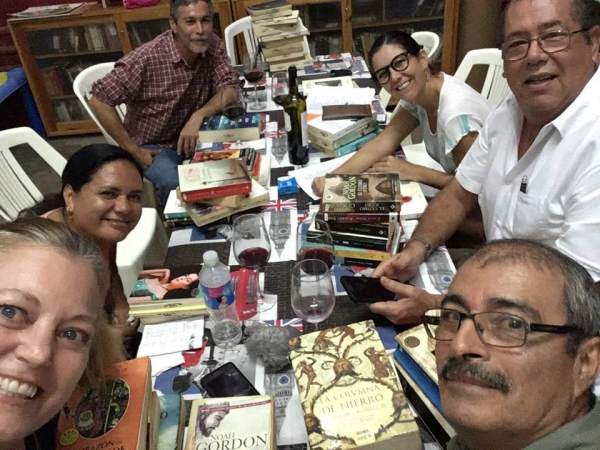
Are any of you members of book clubs here in Mazatlán? If so, what would you say are the key similarities and differences between a Pata Salada/Mazatlecan book club and a club north of the border? If you are not, check out the selfie of my club, above, for some clues.

The Story
A year or so ago a friend of mine invited me to join his group. It’s a Spanish language book club. Honestly, I was flattered that he’d invited me, but I worried he’d over-estimated my Spanish language ability. I wasn’t sure I could read books in Spanish, at least not if I were going to enjoy them. I’d read Spanish language books back in college, but, hey, that was quite a few decades ago! And, it was required reading.

Of course, I didn’t let my concern stop me. I agreed to give the club a go.

Next I second-guessed my decision because I’m already so busy—full-time job, photography passion, two blogs, trying to stay physically active— and I don’t really read that many novels. I tend to read non-fiction. My new book club reads fiction. Maybe not officially, but that’s what they read. I joined anyway, figuring all I could do was my best and see how it would work out.

Then, my friend told me I’d need to attend the first meeting to have everyone meet me and “approve” my joining! Wowzer! This was like interviewing for a job. Maybe some north-of-the-border book clubs do that; it makes sense that they would want everyone to get along well with one another.

My first meeting was great, but it was also intimidating. I really liked the club members. They were funny, lively, intellectually curious, and socially engaged. I was psyched. This would be a great way to get to know some interesting new friends! One of the women, however, scared the heck out of me that first meeting. She was very tall, outspoken, dressed up and made up, and she said, in front of everyone, “Diana, if you don’t completely read one book in Spanish every month, we will not keep you in the club. You have to read minimum one book a month.” Jeepers! Looking around the room, the books were thick! Nothing like pressure! I told myself she was joking, but no one laughed.

After that, I had my third wave of doubt: would I be able to effectively summarize what I’d read to my new friends in Spanish? Could I be engaging and interesting, able to explain what I’d enjoyed or hadn’t in a book?

I promised myself early on not to use a dictionary. If I find vocabulary that I don’t understand, consulting a dictionary would make my reading feel like homework. Obviously it would help me learn. But I know myself; I knew it would slow me down and ruin the joy of a good novel.

Well, I’m happy to report that so far, one year on, I have pleasantly surprised myself. I understand the novels just fine, and I’ve really enjoyed some great Spanish-language fiction this past year. I may not summarize the books I’ve read with one-tenth of the poetic flair my fellow members do—somehow native Spanish language communication style is so much more colorful and metaphorical than my gringa Spanish language style—but my friends humor me. They listen to me with interest and ably build on my ideas.

I am very happy I joined the club. We have a delightful group of people, from different professions, experiences and walks of life. Yes, I even enjoy that tall, outspoken, well-dressed lady who intimidated me in the first meeting—she rocks.

I’ve learned that I only want to read books written in Spanish, rather than translations. Somehow to me it just feels better, and I feel like I’m learning real Spanish, and getting an insight into the mindset of a native speaker. And, I’m especially interested in books that teach me something about Mexico or Latin culture (obviously my way of getting my non-fiction fix while enjoying a good novel).

The Differences and Similarities
So, what are some of the differences that I’ve noticed between this book club and others I’ve been a member of in the USA? In the photo at the top of this post, did you notice all the books? All the different books? Most obviously and importantly to me, we do not read the same book each month and then discuss it. That is what we’ve done in every other book club that I’ve ever been a member of.

Here, we all read different books and take turns talking about them; then we trade books, depending on who wants to read what. At first I found it so very weird. I missed the in-depth conversation that, for me, a “normal” book club provides. I still do. What is cool, however, is how this process allows each of us to read exactly what we want to—complete freedom! It exposes us to loads of new authors, and keeps our costs for buying books down, as well.

How does it keep costs down? Each month we pay a nominal amount to the club kitty. Periodically we take turns going to the book store and choosing new books that club members might enjoy. We then vote on which if any of the books to purchase and add to the club library. So, each month, we’ve got a whole library of books to choose from. We can check out as many as we wish to read, and periodically that library expands, as well. That’s especially wonderful because the price of Spanish language books tends to be much higher than similar books in English.

Look at the photo again. See those glasses and bottles? A second major difference is the amount of alcohol that we consume, at least in our book club here. I have been in book clubs up north where perhaps we each had a glass of wine or two during the evening, but here, in our club at least, we all bring a bottle of wine every meeting! And it’s good wine, not the cheap stuff. Sort of makes up for any cost savings on books, lol. Most times there is leftover wine for the following meeting, but sometimes… 😉

The other truly “Mazatleco” part of book club, to me, is that communication is done via WhatsApp. I remember a couple of years ago when I discovered that WhatsApp was the secret to any event planning here. It was so liberating! Quick responses there, whereas emails, e-vites or Facebook messages rarely let me know who’s really coming to a gathering and who’s not.

So, what’s similar? Book clubs are all about books and reading, right? Both sets of clubs, here and NOB, definitely encourage reading, broadening our horizons with new topics and new authors. Every club I’ve ever been in also serves as a social outlet, allowing us to get to know people more deeply, expanding our network.

Book Fair
This year Casa del Caracol book shop is celebrating its 12th anniversary. To help celebrate, the owner, Laura Medina, organized a “book fair.” It was really cool. Book clubs in town were invited to rent a table at the event, and sell the books they no longer wanted in their libraries. All books were sold for the same price (I think it was 30 pesos; incredible deal, right?)

So, our book club got together and went through our entire library. We all voted on the books we wanted to keep, and put them back in the cupboard. Of the books that we as a club were willing to get rid of, we took turns choosing the ones we personally wanted to buy—for 50 pesos each. Those that were left over, we sold at the fair. It was amazing how many books changed hands that night! It was so incredible to know how many readers there are in this town! And I learned that there are at least two Spanish-language clubs in town that all read the same book at the same time, just like so many clubs NOB.

Those of you in a book club here, what other differences and similarities have you noticed?


Chicken Breakfast 2016

1-p1090521

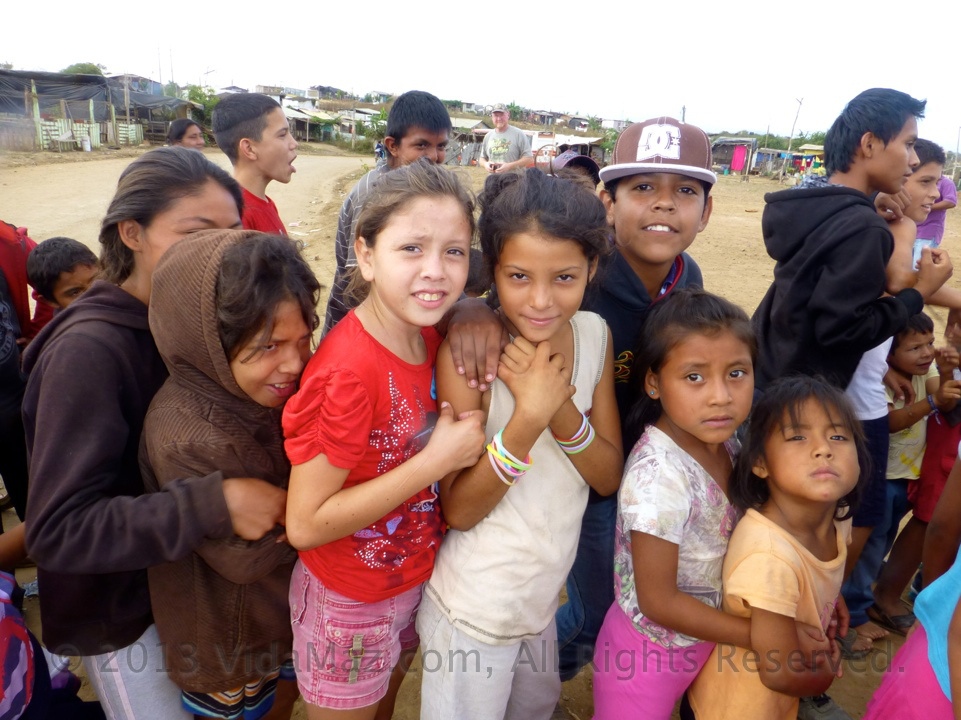
Kids charming the camera woman while they line up for candy!

Want to have the best Christmas ever? Join us to bring joy to those in need! It’s a whole lot of fun, and a memory you will never forget!

Since 1990, Yolanda Medina and her family from the Quince Letras area of town have spearheaded an effort to feed those in need at Christmas time. In 2015, we fed over 3000 families with your help!

What is the “Chicken Breakfast?”
It is a two-step process to feed the neediest in our community.

First is a fundraising breakfast held in early December to raise money to buy one whole chicken and ten days’ worth of food for each family—we buy for as many families as we possibly can.

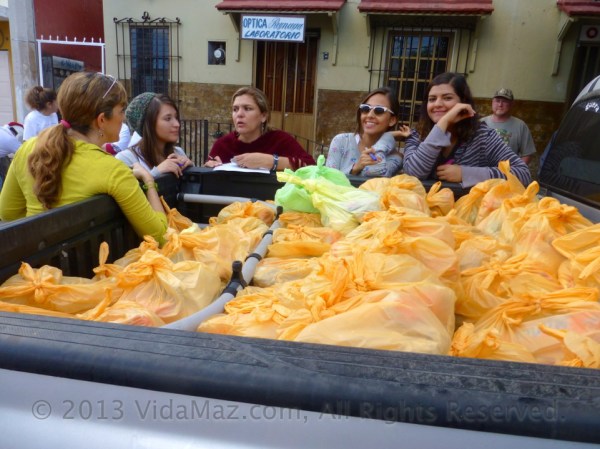
Second, on Christmas Eve morning (24 December), dozens of us gather together to load trucks and go out to the invasiones, the poorest, “squatter” areas of Mazatlán, to make people happy and hand out the goods! We give the chickens and foodstuffs, plus gently used clothing, linens, shoes, coats, and new toys and candy.

It is important to know that several of us go out to the squatter areas the week before Christmas. There we meet with area leaders and go around with them to hand out tickets, to ensure that those in need receive what they need, and that no one cheats or “double dips.” We especially want to ensure that we get food and clothes to the elderly and the disabled, so we go door to door to make sure everyone knows about the event, and to make plans to get things to those who can’t walk to the delivery site.

The history:

Yolanda Medina’s daughter, María Yolanda, was very sick. She and her husband kept vigil in the hospital, taking care of all their daughter’s needs. As Yoly’s sister-in-law Isa tells the story:

“It was Christmas Eve 1990, and María Yolanda’s days were counted. Yolanda and her late husband, Modesto, were in no mood to eat, let alone have a Christmas Dinner with all the fixings. But that night, a woman knocked on the hospital room door and peeked to see if there was someone with the patient. She came in to hand Yolanda and Modesto a box with a hot Christmas Dinner meal — and told them Merry Christmas and that God was with them. Yolanda never forgot that gesture.

After María Yolanda passed away, Yolanda got us all together and told us what had happened. So, the first couple of years, we had culinary arts students volunteer their time to prepare a Christmas Dinner meal, with donated ingredients from friends and family, and all of us volunteered to fill disposable thermal boxes with the hot dinners, load them into cars and pick-up trucks, and off we went, to hospitals, traffic intersections, parks — wherever we thought we might find people that, for one reason or another, wouldn’t be privy to a nice Christmas Dinner.

However, this was a huge effort, and very expensive, so we couldn’t cover that much ground. So we thought in terms of something more practical, something that could be cooked and prepared at home. This way, we could make sure many more families could have a Christmas Dinner. That’s when we started the Desayuno de los Pollos.”

How to help:

  1. Buy (or sell) tickets for the fundraising breakfast. Contact me at dianne@vidamaz.com, or buy them from anyone selling them around town. Post and Ship in the Golden Zone (beside Dolce Mami, across from FedEx) will have tickets also.
  2. Download a poster you can print out to help sell tickets or collect donations. Write on the poster with your details.
  3. Make crafts or baked goods to be sold at the bazaar during the breakfast.
  4. Donate (or gather) items for the silent auction (download a gift certificate, artwork, restaurant meals, hotel stays, airfares…)
  5. Help set up, cook, serve or clean up after the breakfast.
  6. Donate money (in person or click on the link), gently used clothing, diapers, lightly worn shoes, linens, blankets coats, new toys, or candy. 100% goes to those in need. Post and Ship will be happy to collect items if you drop them off there (beside Dolce Mami, across from FedEx).
  7. Help pack the food into packets—the week before Christmas.
  8. Help us load the trucks and deliver the goodies on December 24th! This is, of course, the most fun and a terrific tradition with friends and family.

When and where is the breakfast?
In 2016, it’s on Saturday December 10th, 8:30-10:30 am in the cruise ship dock/API. Please join us and bring all your friends! Your 180 peso ticket includes a full homemade breakfast, coffee and juice, a ticket for the door prize, a ticket for the raffle, and access to the Christmas bazaar.

API dock is on Emilio Barragón nearly across from the new OXXO. Below is a map. If you can’t find it, ask any taxi driver or blue shirt/Tourism Volunteer.

API

How can I get to Quince Letras on December 24th, or to help pack?
Come by 6:30 am if you are driving a truck, 7:00 am if you are helping us load and deliver. We usually finish by 11:30 or noon, but some years it’s taken longer (depends how many routes you participate in).

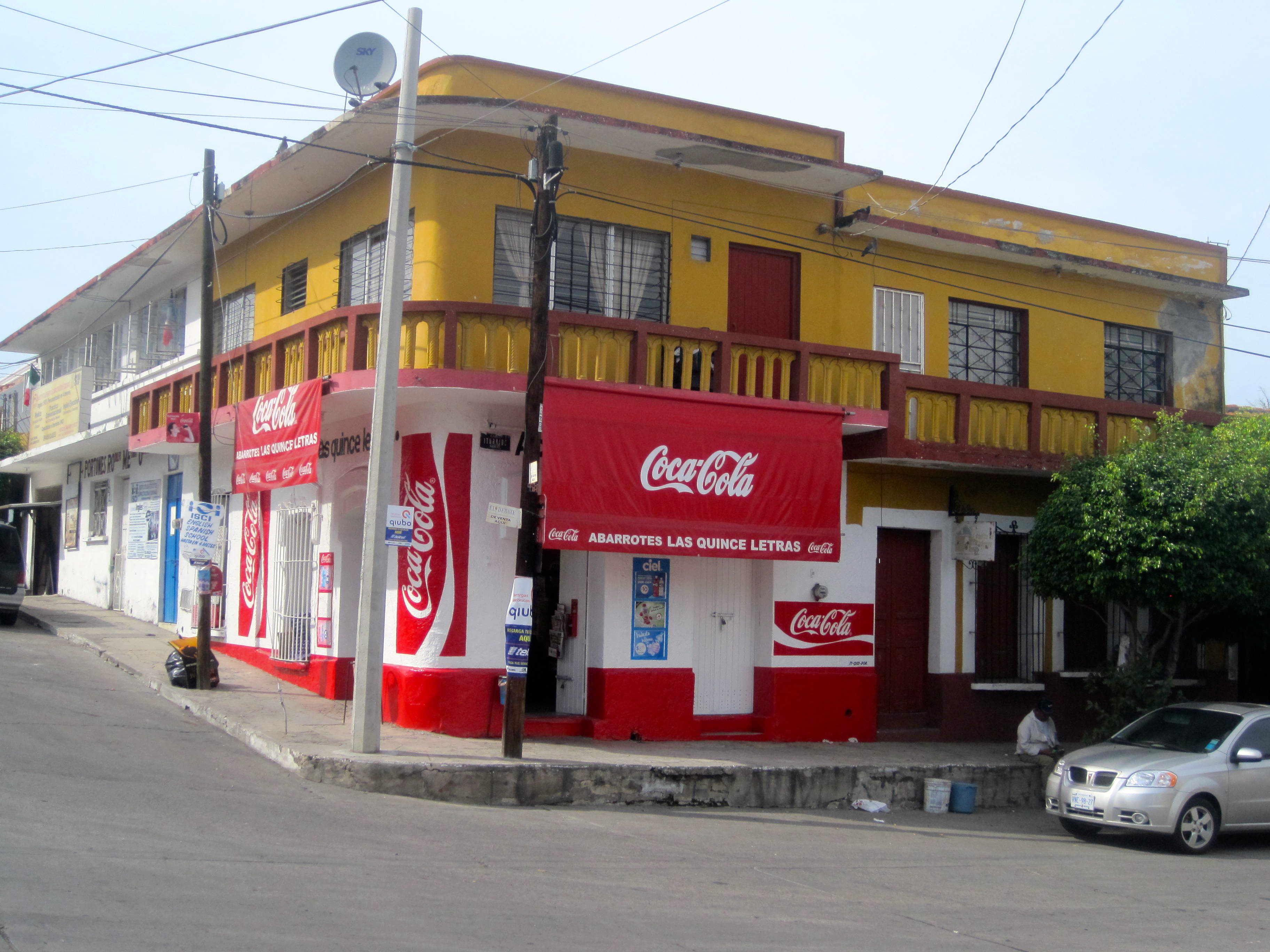
Quince Letras, corner of Tampico and Francisco Villas streets We load from either side of this

Quince Letras, corner of Tampico and Francisco Villas streets We load from either side of this “Coca Cola” store on the corner

LOCATION: 15 (QUINCE) LETRAS, corner of Francisco Villa and Tampico, just down the hill from the Church of Cristo Rey (Christ the King—photo below).

  1. From Avenida del Mar turn East at the Fisherman’s Monument.
  2. Go to the first light and turn right.
  3. Proceed one block and turn left (Francisco Villa street, just before the Pemex station).
  4. Go two blocks.
  5. If you are NOT driving a truck or transporting supplies, please park in the next block. This will give us room for loading. Once you’ve parked, walk another block down, past the iron works business called “Quince Letras.” On the corner of Francisco Villa and Tampico you will see a small store with a bright red “Coca Cola” hand painted on the outside, across from a tortillería. A door next to the Cocheras Automaticas business will be open. That’s Yolanda’s mother’s house, and it’s from there that we’ll be loading.
  6. If you are driving a truck or transporting supplies, please drive up to Tampico street (the “Coca Cola” store on your right on the corner), turn right, and park. We will be loading right there.

IMG_0669If you can’t find it, just ask someone for “Quince Letras” or “Desayuno de los Pollos/Medina family.” Everyone in the area will know.

Merry Christmas to all! And see you there!

  1. Download a poster you can print out to help sell tickets or collect donations. Thank you for your help!
  2. Download and view or use a PowerPoint presentation with a full explanation of the project: chicken-breakfast-presentation
  3. Download a gift certificate to fill out, and we’ll advertise your business or service at the breakfast! Just contact us and we’ll pick it up!

Have questions? Contact the organizers:

  • Jorge Medina (speaks English well) on his mobile, (669) 110-0744
  • Yolanda Medina (some English) at (669) 431-4529

Tourism Mazatlán’s Julio Birrueta

julio2

Quick!

  • What’s the percentage of national to international tourists in Mazatlán these days?
  • On average, who pays more for their holiday?
  • Why are airfares to Mazatlán more expensive than those to other Mexican destinations? (Answers are at the end of this article.)

I recently had the pleasure of interviewing Julio Birrueta, the friendly, no-nonsense Director of both the 25-year-old Mazatlán Tourism Board and the Mazatlán Hotel Association. It’s his office that runs the wonderful GoMazatlan.com site.

Mazatlán a Leader in Mexico
Julio told me that Mazatlán has been a leader in tourism on the national stage for decades. When the Mazatlán Tourism Trust was founded 25 years ago, it was the first public-private partnership for tourism promotion in the country. Today, Mazatlán and Cancún are the only two destinations in Mexico with private-public partnerships to promote tourism. Other destinations express their envy of Mazatlán, because purely government-run tourism promotion often equates to an inconsistent message— the government changes every few years and new people bring new ideas.  Other destinations also envy our 3% tax on accommodations; the amount is fully earmarked for tourism promotion. Thanks to this tax, as well as help from the Federal Tourism Board and SECTUR, Mazatlán is able to employ PR agencies in Canada, the USA, and Mexico.

“I don’t know that we’ve ever publicly thanked Mazatlán’s foreign community in an English language outlet for their incredible support. I’d like to do that now. Thank you. Your love of our city made a huge difference to its future.”
—Julio Birrueta

Mazatlán has also been a national leader for the way we recovered from recent setbacks. In 2008, the world economic crisis hit. In 2009, it was the Bird Flu. In 2010, Mexico’s national economy fell, and in 2011 the cruise ships pulled out. Julio explained that it was thanks to Mazatlán’s very active and engaged expatriate community that things turned around. Many visitors as well as foreign residents recorded videos talking about their experiences here, addressing safety issues in particular. Julio and others played those videos at every industry event for nearly two years. Audiences believed the message because it was people like them saying it, rather than something a tourism official claimed. “I don’t know that we’ve ever publicly thanked Mazatlán’s foreign community in an English language outlet for their incredible support. I’d like to do that now. Thank you. Your love of our city made a huge difference to its future.” Julio told me that when Puerto Vallarta recently had its own crisis, the Federal Tourism Board called SECTUR to get advice and hear the inside scoop on how Mazatlán engineered its recovery. After their success, Acapulco came asking for help, as well.

The Tourism Board
The Mazatlán Tourism Board is comprised of our two local hotel associations, the municipality, and the state. The Technical Committee meets three times a year to agree on plans and budget. The Marketing Committee, composed of the Sales Directors of every hotel as well as the three GMCs, meets at least every two months, and of course there are ongoing phone calls, meetings and texts.

While Julio’s office only has three employees, staff at hotels around the city volunteer their time, expertise and connections to perform the various roles needed. For example, a local hotel sales director is responsible for encouraging airlines to bring more seats our way, and a hotel vice president negotiates how much money we get from Federal Tourism.

The Mazatlán Hotel Association includes 80% of the municipality’s hotels, including those in Centro Histórico north to the Fishermen’s Monument, and from Valentino’s north. Mazatlán’s original Tres Islas Hotel Association includes the hotels on the malecón from south of Valentino’s to the Fisherman’s Monument—the other 20% of the hotels in Mazatlán. Tres Islas, for example, created the Festival de la Luz, the fireworks show held annually in conjunction with the Maratón del Pacífico, and everyone promotes the event.

We are fortunate that every hotel in town promotes Mazatlán as a destination; the port has a very united message. The destination is first, and hotels pay their own expenses and contribute rooms, meals or staff to help make events happen.

The video below includes excerpts of my hour-long interview with Julio, including his appreciation to our local international community, Mazatlán’s recovery from the triple crises 2010-2013, his opinions on AirBnB and Uber, and the Tourism Board’s future plans:


Distinct Types of Tourists
Mazatlán is blessed with two distinct seasons for different kinds of tourists. Nationals love to visit Mazatlán’s beaches in the hot summer months; winter is too cold for most of them, at least for the beach. In contrast, Canadian and US American snowbirds love it here in the winter months. The new highway to Durango has brought us record occupancies in the warm months.

Before 2010 Mazatlán had an equal balance of international and national tourists. By 2013 that had changed to 80% nationals and 20% internationals. That drastic change was very tied to the changing image of Mexico in North America and on the world stage. Now the trend is reversing and more international tourists are coming.

As most of us observe, Julio reports that national tourists tend to travel with extended family: three to four kids and the mother-in-law—“with the dog and the parrot,”  as they say in Spanish, or “familia burrón.” Nationals generally make their travel decisions close to the date of travel, and because of that they pay 30-40% more for their accommodations. They stay and average of two to three nights—over a weekend. They want banda music on the beach, and the younger crowd wants to go out clubbing. Fortunately, their transportation expenses to get to Mazatlán are less, whether they come by highway (bus transportation is popular) or air.

International tourist, on the other hand, tend to stay no less than five nights, often seven or fourteen. They spend more money in Mazatlán because they’re here longer, they take more tours, and they go out and dine at different types of restaurants. They play golf, go fishing, and purchase more time shares than nationals do, though that’s changing.

2017 Tourism Plans
I asked Julio what plans they have that our readers would be interested in knowing about—perhaps he had a secret or a scoop to share with us?

He tells me they plan to double the advertising budget in 2017, and increase the public relations budget by 20%, thanks to higher occupancy rates, more money from the state, and hopefully more federal funds as well. Plans are to bring in foreign journalists and bloggers, focusing on special events and unique experiences. They’ll add in a section on their website for conventions and events at the International Center (MICA: Meetings, Incentives, Congresses and Events comprises 28% of our national occupancy and growing), and another section for destination weddings.

Readers of this page know that for nearly a decade I’ve been promoting cultural and religious tourism to the municipality of Mazatlán. Fortunately Tourism has started to value and promote our cultural heritage more. The good news that Julio shared with me is that from 2017 the Tourism Board will add religious tourism to their promotions.


Answers to Opening Questions
So, do you want the answers to my lead-in questions?

  • Julio says that nationals currently comprise about 70% of our tourists (and 70% of them arrive by car). If you count cruise ship passengers, that total goes to 60% national and 40% internationals.
  • Surprising to me, on a per-night basis nationals tend to pay 30-40% more for their stay in Mazatlán than do internationals—foreigners tend to plan farther ahead, stay longer, and purchase package deals. Of course, because international tourists tend to stay longer, they invest more total money in Mazatlán on a per capita basis.
  • Airfare prices are a definite concern for Julio. He says the solution is to bring in more airlines so that competition and more seats lower prices. Their strategy is to focus on specific markets with marketing plans, as Mazatlán has done with Calgary and Minneapolis. Foci will include Chicago, Denver and Seattle, which will in turn give Mazatlán more connectors from a broad number of cities. As to the frequent rumor that other cities subsidize the airlines, Julio bets they don’t.


5 Ways to Combat Mazatlecan Zombies

dsc_0363Day of the Dead is the main holiday in Mazatlán this time of year. Children and young adults, however, also celebrate the import—Halloween. Young children dress up and go Trick-or-Treating to shopping centers, while young adults dress in sexier costumes and head to the clubs. In our blue-skied, beach side community, we are thus normally spared the dangerous threat of many of the Halloween monsters from up north, such as witches, werewolves, vampires, mummies, devils and—zombies. The key word is “normally.”
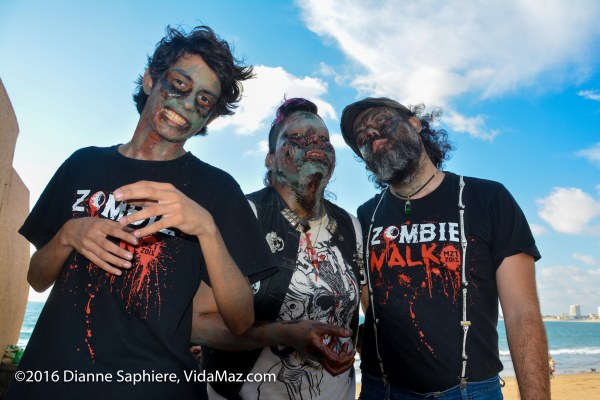
Due to the unrelenting passion of a small group of zealots, Mazatlán has had the misfortune to have fallen prey to a zombie invasion for the past four years.

I put on my anthropologist’s hat today, as well as my bravery, to risk life and limb in order to gain insight into these most mysterious and menacing of characters. Gratefully I’ve lived to tell the tale—barely. My life is owed to the one brave survivor who fought the zombies off and defended both my life and our fair port.

Below I will share with you five key insights I gained today during my perilous anthropological investigations. I trust they might better help us combat the zombie invasion should it happen again next year. Click on any photo to enlarge it, or to view a slideshow.

dsc_0233

Isaac, Yezil and Wert Lovehorror

1. You may be deluded into thinking that there are no zombies in Mazatlán, that only catrinas frequent our fair city. No! Once a year, zombies roam the malecón! They’ve done so every Halloween for four years. It’s become an untenable menace! The leader of the Zombie Walk Mazatlán is Wert Lovehorror. His wife Yezil and their eldest son, Izack play key roles in the horrible happening. It is they who are responsible for this threat.

2. You may think of zombies as angry—grimacing, screaming, groaning and glaring. Mazatlecan zombies, however, smile—even their muerte se pasa sin llorar (their death passes without crying, playing on the Corrido de Mazatlán). They also pose for pictures and freely give interviews. Do not be misled! Despite their charms, they are highly treacherous!

3. When humans are in short supply, zombies eat ice cream! I feared for the ice cream vendor when he approached the invaders, but he was fearless. He assured me that zombies could be diverted away from human fare by playing upon their love of ice cream. And, sure enough, he knew what he was talking about! Our local zombies seem to have no clear preference regarding the type of ice cream they’ll go for, however—they devoured their frozen prey with gusto in all sorts of different flavors. If a zombie approaches you, get out the ice cream! They also talk on cell phones, so you can hand them one as a diversion.

4. Mazatlecan zombies are kind! They think of others and give to the needy. Every zombie or survivor who participates in the zombie walk is asked to bring despensas/food stuffs for Hambretón. Hambretón’s annual food drive, by the way, concludes next Saturday, November 5, in Sendero Plaza from 11:00am to 2:00pm. Join them there! And bring some canned goods or dry food! Do not let this kindness fool you…

5. Zombies apply makeup free of charge, and give out lessons and tips on how to make disgusting things. Need blood? Honey mixed with red food coloring; absolutely sickening. Need peeling skin? Mix white glue in with your face paint, and it’ll look like you have leprosy. Want to have no eyes? Cover them with tulle fabric. How about the ugliest, slimiest-looking intestine you might want to have falling out of your gashed-open stomach? Gelatin and pantyhose!

Will you fall for their tricks? Will you join the ranks of the zombies next year? Or will you be one of the survivors, and fight to defend Mazatlán?