Organic Gluttony Report

dsc_0412

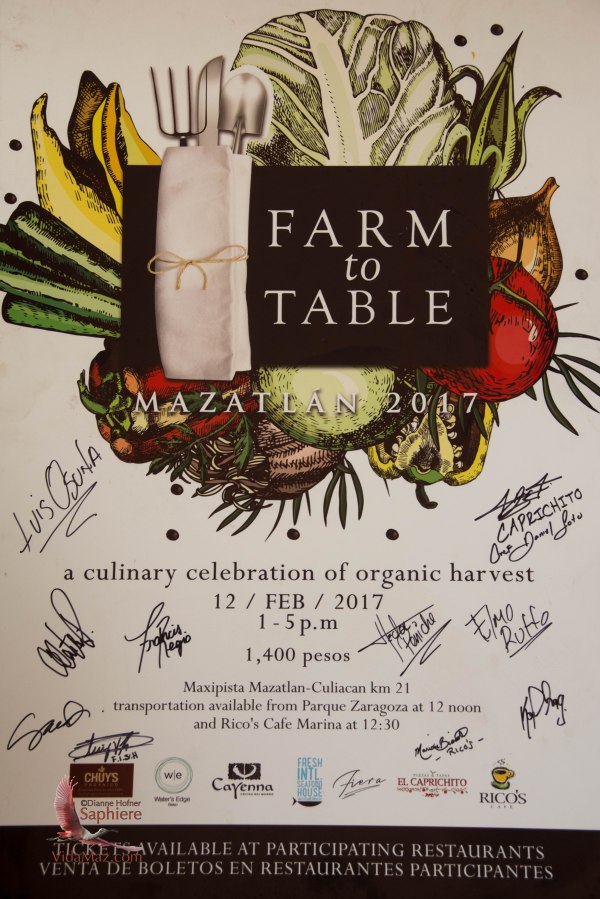
Farm to Table events are a worldwide trend, often related to the slow food movement, and the desire for organic, local-grown, farm-fresh and free-range ingredients. Mazatlán is blessed to have had three major Farm to Table events, with the latest one being held this past Sunday, February 12, 2017, on Chuy Lizárraga’s organic farm (Chuy’s Organics) just north of town.

What makes our Mazatlán event so unique? First, it’s held out in the middle of a pepper field, next to the green houses; we are surrounded by bird song, green crops, fresh air and sunshine. The chefs have to plan and prepare ahead, as in the middle of a farm field they have limited access to what a professional kitchen might have. They work out of tents, on a propane stove and open fires. Second, rather than having just one main chef, as is usually the case at such events, our FTT is a collaboration of some of the best chefs in Sinaloa. Greg and I have been fortunate to have attended all three Mazatlán FTT, and I have the double chin to prove it.

Let me get right to the food and drink, which is our main reason for traveling north of town about 20 minutes. Click on any photo to enlarge it or view a slideshow. This year’s menu included:

  1. Welcome Cocktail: Cucumber margarita with fresh mint, Chef Alistair Porteous, Water’s Edge Bistro
  2. Ceviche FISH: Shrimp and pocked mahi, pineapple and red onion marinated in chipotle and garnished with avocado. VERY tasty with a nice smoky flavor complemented by the freshness of the pineapple. Gabriel Ocampo and Luis Vargas, Fresh International Seafood House
  3. Mazatlán Pilsner: Specially brewed for this event and not available at the brewery, this beer is infused with German hops, giving it an aroma of white wine, herbs and citrus. We loved it! A bit champagne-like, especially with the glass. Brewmaster Edvin Jonsson, Cervecería Tres Islas
  4. Organic Salad: Green beans, trio of tomatoes, ricotta and mussels with a red mustard and honey dressing. Chef Elmo Ruffo, Fiera
    This dish completely rocked! OMG! That ricotta sauce brought everything together and made it to die for. And, of course, I’m a sucker for mussels. Having met the charming owner of Fiera, Yamil González, and now knowing Elmo, you can bet we’ll be visiting Fiera again soon and regularly!
  5. Grilled Seafood Salad: Grilled shrimp with chimichurri, octopus with heirloom tomato marmalade, roasted sweet peppers with cranberry vinaigrette, and ash-roasted sweet potatoes and greens, goat cheese, and an apple and honey dressing. Chef Daniel Soto, El Caprichito Mio
    Another dish that was unbelievably delicious! Danny Soto is two for two; his cold salad last year was such a standout that we drove all the way to Culiacán to dine in his restaurant. His hot salad this year hit it out of the park as well. He loves gorgeous fresh vegetables just like we do! First a video with Daniel, followed by pics of his dish and the preparation.

  6. Jicama Tagliatelle: The menu said turnips, but they were past their prime in the fields. The chefs then used grated jicama as the pasta, in a sauce of shrimp bisque, mustard greens and green garlic vinaigrette. Chefs Francis Regio and Karl Gregg, guests from Vancouver BC

  7. Asian Duck Confit Tamales: What a wonderful twist on a traditional Mexican dish. Star anise, a mix of spices, orange, carrot and green onions with a garnish of crispy duck, accompanied by caramelized vegetables. Chef Alistair Porteous, Water’s Edge Bistro
    Alistair and his wife Tracey of course organized this whole event, though it is a collaboration, with everyone involved taking on major roles. Thank goodness they tell me we will have another FTT next year!
  8. Braised Pork Breast Ribs: In a miltomate sauce with barbecued duck and mushroom risotto. Chef Luis Osuna, Cayenna
    Another UNBELIEVABLY incredible taste combination! Two dishes in this course, and they were, indeed, heavenly. Another trip to Culiacán is definitely in order. We should be getting a Cayenna here in Mazatlán soon, thank goodness.
  9. Pumpkin Flan: with a crispy crumble topping. Hector Peniche, Hector’s Bistro
  10. Dessert Coffee: Organic expresso over vanilla ice cream, puré of coconut and spices, with a sweet expresso-coffee reduction. Marianne Biasotti and Enrique Ochoa, Rico’s Cafe
  11. Wines: All we could possibly drink of Cabernet Sauvignon and Sauvignon Blanc, thanks to Javier Ramírez of Vinoteca and Oscar Gámez of Cava del Duero. There was iced hibiscus tea for those who didn’t want alcohol.
  12. Trio of fresh breads

As always, we were seated at long tables, which enabled us to make new friends as dining is family-style. There were nearly 300 people attending this year, including two reporters from Gourmet Magazine. This time we were lucky enough to sit with a gentleman who brought wine from his own cellar, just in case they didn’t serve enough. As if! His was great, though—thank you!

The chefs looked nearly as happy as we did when the day was finished. Glasses in hand, they happily accepted our accolades.

Our dear Gail Blackburn, from La Rosa de las Barras Farm, provided garlic snaps and other wholesome, flavorful goodies. As always, there was a raffle at the end, this year in benefit of Refugio San Pablo, a new home downtown for teenage boys—for which we raised $24,000 pesos! Our table was very fortunate, with several winners including Greg!

Music was provided by a strings duo, and they provided wonderful accompaniment to the birdsong and the buzzing of the fields.

The 25 wait staff were led by Andrés, as in prior years, and they did an outstanding job.

Thanks to my friend Martha Parra for a few of the photos! I will admit that sometimes I was too busy eating to get a good shot of a dish, so I appreciate her helping me. We were blessed with a most incredible day, capped off with a gorgeous sunset.

A Morning in the Botanic Garden

Yesterday morning a photographer friend and I went to the botanic garden on Stone Island to see if we could capture a few pictures. It was a clear pleasant day and so very enjoyable! We saw a LOT of birds, and while my friend knows the names of most of them, I do not. Here I’ll share a few photos though.
I also really enjoy bees and butterflies. Sometimes these photos turn out well, and sometimes they don’t, as I don’t have a macro lens per se. I just zoom in on them and do my best to get good focus.

Since I last went to the garden, Amaitlán has built a whole new section. It’s not yet finished, but it looks to have three new ponds. The colors of the flowers, accompanied by the green of the trees and the water, sure delights the soul. Reflections also fascinate me, so I’ve always got to take a few of those as well.

After our photo safari we stopped to get a drink and have a few snacks. I couldn’t resist a few pics of the dive-bombing pelicans and the island in the bay, which is the reason Stone Island got its name.

On the way back to Mazatlán in the water taxi, I had to get the requisite shot of the two cruise ships in port with the lighthouse in the background. And the brewery 😉

Thanks for the beautiful morning, John!

We All LOVE Our Monigotes!

dsc_0430We love Carnával, and it’s widely acknowledged to be the third largest in the world. I would posit it the best, as it’s so accessible to everyone, involves the entire community, and is HUGE.

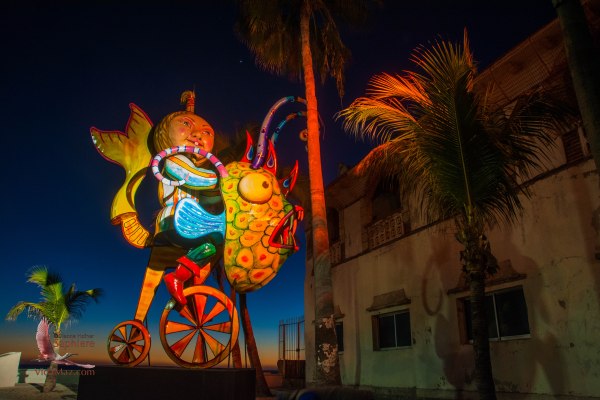
About ten years ago, CULTURA started to put up papier-mâché statues on the malecón. The very first year, at least to my memory, these statues were egg-shaped. While the originals were a meter or so high, over the years, they have grown in size and they now tower over our fair city. One year they were soldiers from around the world—warriors, humongous guardians of Mazatlán. In 2013 they were movie stars, from Marilyn Monroe to Elvis, Cantinflas and Pedro Infante. The monigotes, or giant statues, are made by Jorge González Neri and his artists in their taller. I love taking a peek every year just to see what’s coming up.

Well, it’s obvious that you love the monigotes, too! The first couple of years, my photos got a few “likes” on Facebook. Those likes have steadily grown, and as of tonight you have shared my monigotes 2017 album over 3000 times! Some of the individual photos have themselves been shared over 500 times! It gives me such joy to read how you think this one is a Pokemon, that you live in that block and it’s “your” monigote, or that one is your favorite. Kudos to CULTURA and to González’ taller; they only get better. Now we hope the carrozas or floats do as well, because we still miss Maestro Rigo Lewis in that regard….

There are 11 giant statues this year, unless you count the two in the Plaza República. Those two went up first, and tantalized us for well over a week while we waited for the others. Click on any photo to enlarge it or view a slideshow. I’d like to give a MAJOR shout-out to Greg, who accompanies me and makes sure I don’t get hit by a car or bike or something else while I’m peeking into my camera! Often times he finds the best shots, too.

I like to take photos as soon as I’m able to after the monigotes are up. Thus, most of the photos don’t have the titles yet; CULTURA puts those in white lettering on the black stand of each of the statues. Sometimes they also make changes or additions. For example, the awesome-looking snail below had a papier maché rider added to it the day the queen was crowned. It’s in front of Valentino’s/Fiesta Land and was one of the first to be made; Greg and I saw it in the workshop, finished and waiting. Then by chance we were able to come upon it as the CULTURA workers hand-pulled it all the way from Playa Sur to its home at the north end of the malecón. It’s called Carrera del Tiempo or “Time’s Race.”

Coming south, the next monigote is where Insurgentes intersects Avenida del Mar. It’s pretty scary looking, if you ask me, and is called Dragón Polinesio or “Polynesian Dragon.” Of course, the theme of Carnavál this year is “Alebrijes y Dragones.” Alebrijes are those hand-carved wooden animals from Oaxaca with all the little pieces, and dragons are, well, they fly and look fierce. The giant statue at the top of Insurgentes is a dragon alebrije. I waited for a pulmonía to come by, just at sunset, so we get a bit of Abbey Road al Mazatleco action going on:

Next up is the one in front of Las Gavias. It looks very much like a Carnavál clown, and is called Carnavál en Babuchas. “Babuchas” is a word for those Oriental or Arabic-looking slippers with the long curly toes.

Just south of that one, in front of SECTUR—or La Botana, or Franki Oh’s, depending on your preference— is a really cool dragon with a person on top. It’s one of my favorites. It’s called Elegancia Alada, or “Winged Elegance.” The monigotes of course look good during the daytime, with our bay as a backdrop, and they are lit up at night, so gorgeous then, too. I’m confident that shortly CULTURA will add a title to each and every one.

Where Avenida de los Deportes meets Avenida del Mar—the Aquarium street, where the liquor store/Cava del Duero is, we can see a monigote that is just the reverse of the last one. This one is a person with the dragon on top. Night lighting is not yet working on this monigote. The name of it is Pio Cabeza Madame, or “Pious Head Madame.”

dsc_0182

You know that Mazatlán is “land of the deer” in Nahuatl, and on the malecón facing the Lola Beltrán statue (The Vue condos) is a monigote with a deer on top. It’s called Carnavál del Sol, or “Carnaval of the Sun”:

Continuing our journey south you’ll see a giant ostrich, on the malecón in front of Hotel Aquamarino, on the corner with Banjército, beside the pulmonía monument. She is called Una Diva con Patas Largas, or “Long-Legged Diva.”

At the Fishermen’s Monument you’ll find a Viking-looking guy riding a pogo-stick dragon, and it’s appropriately called Cabalgata Vikinga or “Viking Horseback Ride.” It’s creative, even if it’s connection to the Carnavál theme isn’t exactly self-evident.

Next comes another favorite of mine, Pio Cabeza Gato, or Pious Head Cat. People tell me this one seems to be based on the Pokemon character “Meowth.” Personally, he looks straight out of “Where the Wild Things Are”/”Donde Viven los Monstruos.” I love where this monigote is located, as you get the pangas/fishing boats and a good shot of the bay in the photo. It’s where Belisario Dominguez intersects Paseo Claussen.

dsc_0302

From here you can take a detour into town and see the really cool alebrije statue in the Plazuela Machado. I love that in the past few years CULTURA puts a monigote here, as it’s where the original Carnavales were held in Mazatlán, and it’s a gorgeous spot for partying. I tried to photograph the giant statue with landmarks in the background: Casa Machado and our original hotel. The name of this gorgeous monigote is Equilibrio Frágil, or “Fragile Equilibrium.”

Ok, I’ve left the BEST FOR LAST!!!!! The southernmost monigote is in front of my BELOVED and screaming for restoration Casa del Marino. And is it every whimsical! I call it “fish cycle,” but CULTURA calls it Un Alebrije de Oriente or “An Alebrije from the East”:

Not that we need an excuse to walk, roller skate, jog or bike the malecón, but now is most definitely the time! Oh… don’t forget your camera or cell phone!

Shark Tank, Mazatlán Style

dsc_0865UPDATE 3 February, 2017:
The aquarium is open again! Today a video purporting to be created by employees of the Aquarium is circulating on social media. It says that the Aquarium’s new director ordered employees to enter the tank and remove a yellow covering from the window shown above. As you can see in the photo, no yellow covering seems apparent. According to the video, the Aquarium personnel are not qualified to make any repairs or changes to the tank. Sadly, one erroneous hit with a tool, just as the workers finished, caused a crack in the acrylic. The video includes photos. It is hard to know, of course, what actually happened. To me this is hopeful, as it would mean the basic structure of the tank may be sound and the acrylic just needs replacing. Hopefully all will be sorted out soon.

UPDATE 2 February 2017:
The curved acrylic wall of the new shark tank, pictured above, cracked open yesterday afternoon about 6pm, just one and a half months after its inauguration. It was what so many had feared, given the storied history of the building of the tank and the final heated push to get it open before the change in city and state administrations. The rupture caused nearly two million liters of salt water to flood the surrounding area. Fortunately the fissure occurred after closing time, so no visitors were in the facility and staff were quickly evacuated. The Aquarium will be closed while a safety assessment is conducted and repairs are done. It has been reported that the 20 sharks and other sea animals are unharmed and will today be transferred to another tank. Mayor Pucheta promises legal action against those responsible for the shoddy design, labor or materials. Such a sad new chapter in this lengthy and expensive saga, and just before Carnavál.

Mazatlán’s long-awaited 2.5 million liter (660.5 thousand gallon) shark tank, which opened on December 23, includes one of those cool acrylic tubes you walk through to be completely surrounded by fish. The light in the kids’ eyes as they realize they are in the middle of a tank with 23 sharks is most definitely delightful.

Acuario de Mazatlán’s new Tiburonario was built at a cost of 80 million pesos over six years, two governors, three mayors and four aquarium directors; construction was far from the height of efficiency (final costs were 5x more than originally forecast), but unlike other projects, in the end this one delivered to us a first-rate attraction that will generate revenue and jobs for the city for years to come. The aquarium had 435,000 visitors in 2016—a 41% increase since 2013, and in early January when I visited the lines to enter snaked around the block and seating for shows was completely full. Last year the facility took in 20 million more pesos than in any prior year, and I have no doubt the new shark tank will add to that popularity. Click on any photo to enlarge it or view a slideshow.

I had the pleasure of spending the afternoon with the aquarium’s Director, Milay Quintero Beltrán, just days after she was sworn in to her new position. I was impressed with the knowledge she demonstrated with only four days on the job! Lic. Quintero is a public accountant and holds a master’s in human resources. Brenda García, the Director of Marketing, joined us on my visit. They both were charming, hospitable and extremely enthusiastic about the aquarium, and made sure I was hugged and kissed by a sea lion in a private show. I was guided through the rescue facility, including the veterinary clinic and the temperature-controlled building where the sea turtle eggs are hatched.

I had not visited the aquarium in a few years, remembering it as tired and outdated. Its recent major remodeling, which is nearly complete, is the first in 36 years and one well worth checking out. More modern architecture and new acrylic murals jazz up the space, and plans include a new restaurant beside the shark tank; more fish, additional decorations and finishing to the shark tank itself; overall remodeling and updating with a consistent tropical theme; and the addition of habitats for both penguins and dolphins! If, like me, you wonder why those tinacos/water tanks right in front are such an eyesore, Milay assured me they will be covered up shortly.

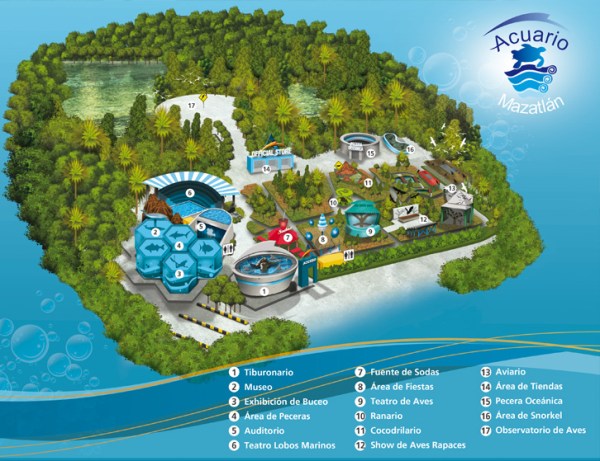
The Acuario de Mazatlán opened in September of 1980 as part of the Bosque de la Ciudad (city park) project. The one-hectare site includes 34 salt water and 17 fresh water exhibition tanks, a botanic garden with 75 kinds of trees from around the world, three aviaries, and Latin America’s only frog habitat. It has partnership agreements with both the Monterey Bay Aquarium in California and the Acuario de Veracruz. Mazatlán’s aquarium is administered by DIF (Family Development Department), SEMARNAT (Secretary of the Environment) and PROFECA (Environmental Protection). Its goals include education and rehabilitation. The aquarium regularly hosts school groups and collaborates with the Mexican Academy of Sciences to host “Science Saturdays” for local youth interested in science and technology. The on-site clinic has four veterinary staff who most commonly aid pelicans and sea turtles, but have been known to treat tigers, raccoons and all sorts of birds as well.

mapa-acuario-mazatlan

The aquarium’s sea turtle rescue program has protected over 4,500 nests and released nearly 300,000 babies. The hatchery facility is made of paja, or straw and clay walls, to keep the eggs at a consistent temperature. The eggs are all in OXXO coolers, as the chain of supermarkets sponsors the turtle rescue program. Did you know the eggs must be gathered from the beach within four hours of being laid? They gestate for about 40 days, and then the babies are immediately released. Mazatlán’s aquarium will host turtle specialists from all over Mexico in a convention February 7-9.

While sea turtle rescue is well known, you might not have heard about the aquarium’s Pato Pichichin program. The Pichichin ducks, who are in danger of extinction, reproduce on Bird Island, the northernmost island directly offshore—an environmentally protected area. Young pichichines leave the nest to come to Mazatlán’s lagoons, and some become separated from the flock. The aquarium receives about 300 of these babies annually. Aquarium staff also aid about 72 pelicans every year, most of them injured by fishing nets. Any wildlife that recovers sufficiently and is able to fend for itself is returned to its natural habitat.

The Acuario de Mazatlán is open 9 am to 5 pm every day of the week. You may, like me, be spoiled by having visited some of the world’s best aquariums. Mazatlán’s is much quainter in comparison. I went not expecting to enjoy myself, honestly, more out of curiosity, but I had a hoot of time! If you haven’t been, it’s well worth a visit.

In addition to the fish tanks there are extensive displays of reptiles, birds and amphibians. Admission includes access to all the shows; the four half-hour espectáculos run back-to-back from 10:30 am to 1:30 pm and 3:40 to 5:00 pm, and include tropical birds, sea lions, animals of prey and divers feeding the fish. Most of the aquarium’s show performers are rescue animals who cannot be returned to the wild.

Entry costs 115 pesos for adults and 85 pesos for children 3-11. Swimming with sharks or sea lions is an extra charge (300 and 400 pesos, respectively). The swimming still takes place in the aquarium’s original 123,000 liter main tank.

Did you know that sea lions live in captivity up to 40 years, and eat up to 25 kg of food per day? Or that an owl can turn its neck 270 degrees, not 360? I know you’ll pick up some more fun facts on your next visit, and greatly enjoy yourself. If you’re lucky, you might just get a sea lion kiss, too. Below is the official video from the inauguration of the shark tank.

Homemade Mobile Home

img_7509UPDATE 2 FEBRUARY:
Greg and I took Octavio to the doctor’s appointment that DIF had arranged. That doctor ordered an x-ray of his leg and gave him two boxes of pain medication. DIF wants to enroll Octavio in Seguro Popular, so he can get insurance and, thus, get care. However, he does not know his birthday, and it will take weeks to get a birth certificate and get him registered. Greg and I therefore offered to take Octavio to get the x-ray done, just so he could know his options and not have to wait so long. He will still get his birth certificate and register with Seguro Popular. The x-ray doctor recommended no surgery be done as all was healed, but said Octavio needs an insert in his shoes so he can walk better. He also needs a good cane, if any of you have one. We then took him to get the insert, but were told he needed a prescription from an orthopedic. One happened to be next door, so we took Octavio there. That doctor agreed that no surgery should be done. We will pick up the inserts today, and have a gently used pair of shoes for Octavio as well. We are hoping DIF will get him the medicines he needs and the inserts on an ongoing basis (every four months). I am hoping the kind ladies from Ojalá who so graciously offered to help might pay for the care he received yesterday; I’ll submit receipts to them. If you have a job that Octavio could do for you: painting, garden clean up, etc., he is very eager to work.

UPDATE 31 JANUARY:
I was able to get DIF involved. Dorita came out to interview Octavio, take photos, and approve him for a medical exam. They confirmed he is of sound mind, not on drugs or alcohol, and wants to get his life back. Greg and I will take him tomorrow and hopefully we can proceed towards treatment. Octavio will need official identification, which he does not have. That starts with a birth certificate, from Durango. So, after visiting the doctor, we will head to the Unidad Administrativa. A group of ladies from Ojalá has kindly offered to help with at least some of the medical expenses, depending on what they are. Please keep your fingers crossed!

This morning I drove past an amazing sight—a bright yellow and red metal box, supported by cement block and the wheels from a wheelchair, which very much looked to me to be someone’s home. It had an angel hanging in the window, was made from recycled materials, and stood out to me for its ingenuity and joy. I called out hoping to find the owner, but no one answered.

The thought of who lived there haunted me all day, so this evening I decided to go back for a visit. Greg and I took some soda and water, as well as some money. Sure enough, there were two people there this time around. Could a couple be living in that homemade mobile home?

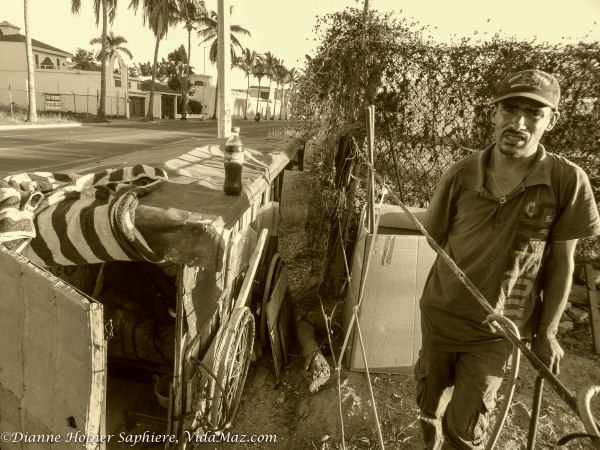
No. The owner, creator and resident of this practical beauty was the man, Octavio Castillo Silva. We found him intelligent, well-spoken and open to talking with us. We were told the lady with him, Martha, does not live there. She was a very different sort of person.

p1090497

Octavio Castillo Silva

Octavio comes from a rancho in Durango state. He came to Mazatlán in 2006 with four of his ten siblings. He tells us he loves it here, and was doing fine until two years ago when he was hit by a car. After the accident he spent eight days in the hospital, but couldn’t afford the surgery required to fix his leg. He showed us scars on his head and a misshapen left ankle wrapped in an Ace bandage. The leg looked very painful, and Octavio walks with a pronounced limp. He gets around with a cane that he has made out of recycled material.

Unlike many who are down on their luck, Octavio did not complain. He asked us for nothing. He told us he’s lived in his mobile home on the property behind Torre Azul and Banjercito for about two years. The owner has given him permission to stay there in exchange for cleaning up the lot. Octavio is excited because he also has permission to park cars there during Carnavál, and split the proceeds with the owners.

He explained that since the accident he has not had enough money to rent a room. He finds it difficult to find a job due to his injury. To get by, he collects recyclable material. He’s so enterprising that he assembled his home entirely out of recycled wood, plastic, metal and canvas. He is very proud that the walls are well-insulated: three layers thick, with four windows on either side. Octavio told us he stays warm in the winter and cool in the summer. When the cars drive by there’s a nice breeze. The roof of his home has both plaster and two layers of lona/canvas. He used the parts from a wheelchair to make his home movable. He bathes in the corner of his home, and has a makeshift mattress down the center.

Octavio sleeps during the day so that he can go out collecting recyclables at night. The trouble is, while he’s gone people steal his things. So, he’s taken to locking everything inside his shelter. He even locks himself inside while he sleeps, because he’s had trouble with “rateros.” He proudly unlocked his home to show us the inside, which he has appointed with care. Click on any photo to enlarge it or to view a slideshow.

Octavio would love to work for a living wage. Might you know someone who needs a security guard? Or who would donate medical assistance? Perhaps one of our readers is a surgeon who would donate her/his services, or would pay a surgeon to mend Octavio’s leg?  Here is a short video we recorded:

If you’d like to help Octavio out in a smaller way, I’m sure he could use food and drink. He’s made an outdoor kitchen for himself. When I asked him if he wanted anything, he said no, things just get stolen.

I will make sure that DIF knows about Octavio, and I plan to talk to my doctor to see if he might help him. We will keep him in our prayers and take him any leftovers from now on. God bless this creative, optimistic, hard-working soul! And thank you for your help.

img_7512

UPDATE 31 JANUARY:
I was able to get DIF involved. Dorita came out to interview Octavio, take photos, and approve him for a medical exam. Greg and I will take him tomorrow and hopefully we can proceed towards treatment. Octavio will need official identification, which he does not have. That starts with a birth certificate, from Durango. So, after visiting the doctor, we will head to the Unidad Administrativa. A group of ladies from Ojalá has kindly offered to help with at least some of the medical expenses, depending on what they are. Please keep your fingers crossed!