Three Years in Mexico with a Junior High School Student


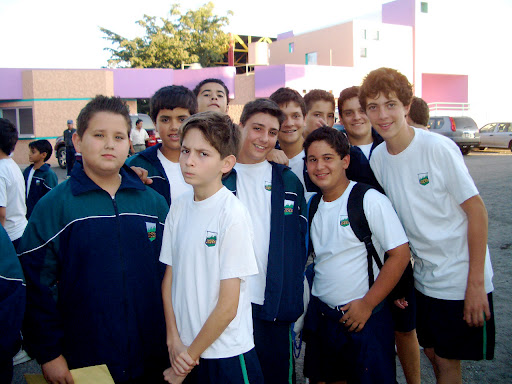
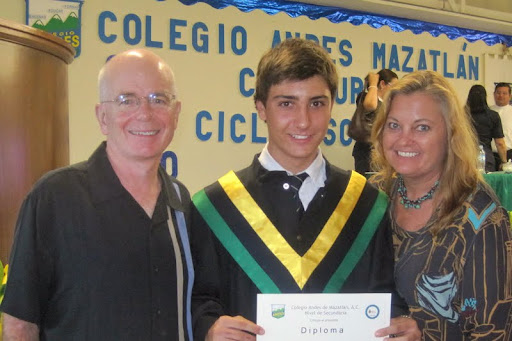
We moved here three years ago. Today our son graduated from secundaria/junior high/middle school. He has gained enormously by living here, as have we.

When we moved here our son didn’t speak much Spanish; now he pretty much passes for Mazatleco if Mom and Dad aren’t around. Bilingualism is way better than speaking only one tongue, for sure. After 3 years our 15 year old is not yet grammatically perfect in Spanish, but then, he isn’t really in English, either 🙂  Key for me is he is now extremely comfortable speaking Spanish or English, one on one, in a group, public speaking, in a formal meeting with adults. He can lead his peers, he can motivate, he can tell jokes and stories and crack people up, in both languages. Three years well invested, and at least three more to go.

When we left the US, our son’s mind was on our neighborhood, city and maybe the state in which we lived. He didn’t think about much beyond that in the world, and he didn’t like languages or cultures. He was a science, history and math guy. Now, three years on, he knows what it’s like to live as a minority member of society. He has gained confidence making new friends, going into new situations and figuring out how to get along. Not much intimidates him.

He now loves languages and thinks he’s good at learning them, anxious to try out Italian and French. He’s gone from wanting to see movies dubbed into English to wanting to see movies in their original language, with subtitles if needed. He gets that the original provides the most honest portrayal and feeling. He is keenly interested in international affairs, environmental concerns. He can recite to you UN resolutions and the rights of women, children and people worldwide.  He still loves history, and likes science and math. He talks of going to university in, well, South America, Italy… he now sees that there is a whole world out there. This is the primary reason we moved here: to provide him a broader worldview, and I thank goodness that he has done such a terrific job in this regard.

As our son graduates to high school (or preparatoria), he looks forward to a new adventure in a larger school with only a few of his current classmates. Being in a small private school now, there is a bit of a reshuffling as students decide where to study for the next three years. His graduating class of about forty will be spread out across various schools in town, breaking up this close knit bunch of kids who entered and experienced the hardest years of adolescence together. This is in sharp contrast to the normal trek in the United States, of elementary schools merging into middle schools and middle schools merging into high schools, where groups of friends remain intact and take on new friends. With this new school, he will enter as a Spanish speaker and a bit of a “local.” There will be close to 275 kids in his grade, so the huge size increase may be the biggest adaptation he has to make.

Before we moved, our son gave us strict instructions that he didn’t want to live in Mexico like some “rich gringo.” While of course the average wage in Mexico is much lower than that of the US, which he was speaking to, his eyes have been opened to just how rich the rich can be in a country like Mexico, where there are huge gaps between rich and “middle class.” He is able to describe class differences, their customs and values. He has become a “blended culture” person in the sense that he now knows what he likes and dislikes, personally, about the various cultures with whom he has contact. He doesn’t judge, knowing every worldview is “right,” but he doesn’t let himself get lost, either. I’m proud of him for that.

Thank you, Mazatlán. Thank you to his teachers, tutors, mentors, Scout leaders and friends.

And to you friends, many of whom we now love, too: best of luck in prepa! Remember to maintain these precious existing friendships!

Other posts on this blog about schools:
High Schools and Foreign Residents in Mazatlán
Inauguration of Soccer Season
Moving to Mexico (Mazatlán) with School Kids


High Schools and Foreign Residents in Mazatlán


The most popular post on this blog has been the one about choosing schools, entitled “Moving to Mazatlán with Kids.” It would seem that more and more families are moving to Mexico, and Mazatlán in particular, with families, and there is a dearth of English-language information available to them.

Next year our son will be entering high school/prepa. We have gone through quite the comprehensive process with him, so that we could choose the most appropriate high school for his needs. I therefore thought it might be worthwhile to share with you some of the information we gained, in hopes it might help you with your planning, and spur further conversation/information sharing.

I will write a review of the four high schools that we looked at. Please know there are many more schools than this in town (none currently offer an IB program), including the public (federal) school that is actually the most highly ranked on national ENLACE tests, Vasconcelos. We have several (local) friends whose children go there, and they rave about the education and the caliber of the students at this school. While it is not one of the four I’ll review below, it may well be worth a look. There are also at least two brand-new schools coming to town, though I do not know if either (will) include a high school: Montfort and Rex. We also increasingly meet people who are homeschooling their children, and they seem very happy with their choice.

All the schools below have bus and cafeteria service, as well as after-school sports teams and cultural clubs and activities. All of the schools listed conduct study for the TOEFL test, which most kids will need if they graduate high school in Mexico and want to attend university in an English-speaking country. They all have virtual classrooms, but use them to VERY varying extents. Electives are not offered, other than the specialized tracks offered by some schools third (senior) year.

Colegio Andes
This private school is part of the Universidad Anáhuac system (an affiliation that started in 2010). While it is not owned by the Catholic church, it is affiliated with the Legionaires of Christ. There is a mass once a month, weekly “social participation” (kids volunteer in the community), and a heavy emphasis on values and morals.

The content taught in the classes is of high caliber. Math classes include calculus and science is also quite advanced. Most of the students come up through Andes from primary school (which is bilingual), so they speak English fairly well. French is taught in high school; another advantage of this program.

The high school is fairly new (maybe five years ago they expanded from junior high to include a high school?) and thus still fairly small. It is located next to the University of Durango, behind Sam’s Club. A graduating class currently has at most 20 students. This can be a huge advantage, as the ratio of counselors/advisors to students is an amazing 1:3, and students obviously get focused attention in class. The disadvantage to the small numbers is, of course, on the social side of things: kids at this age end to want friends and lots of them.

Andes is comprised of an L-shaped building, with preschool and primary school on the lower floors, junior high on the middle floors, and high school on the top floor. They have a 3D model for a new high school building to be built on the property, though construction dates seem to keep changing. The facility is noisy as there are usually small children playing on the playground. They have an auditorium, a library, and a science lab. Sports facilities include several basketball courts (maybe half size) and a soccer field (again, maybe half size), though last year they built a full-size field that is still dirt.

Advantages to Andes include that students are automatically accepted to any Anáhuac university worldwide. Anáhuac offers quite a few national competitions as well as scholarship opportunities for students. Students become Microsoft-certified from junior high. During high school they can be certified in 4-6 applications. They can also participate, as of this writing, in Model United Nations; the only school in Mazatlán and perhaps in Sinaloa that participates in this terrific simulation. In senior year Andes has four areas of specialty from which to choose, though they due to low enrollments they have not yet offered all four. Kids have cubbies in the classroom and wear uniforms.

Contact: Miss Carmelita Sapién, Directora, eiramarina@hotmail.com
Costs: Registration: $5200-$6500; Tuition: $3400/mo; Bus: $600/mo (amounts in pesos)


Anglo-Moderno
Also a private school, this one is not affiliated with any church. It seems to have the largest number of foreign children amongst its students; we were told during our visit here that there are two or three in each class, while someone else during this same visit told us nearly 1/3 of their school is non-Mexican (Chinese, Indian, French, American). The facilities are brand new; this was their first year in the new facility, in the marina next to Tec, near the new International Center. The new buildings house the junior high and the high school; primary school remains at their old facility in town.

Content taught here is also of high caliber. Each class at the prepa level has about 30 kids, and there are two salones or groups at each grade level (60 kids each grade). We were told there is a maximum of 35 students per class, and on our visit it appeared that there were a lot more girls at Anglo than boys.

The school includes a science lab (with safety shower), and library (small with few books). Sports facilities include a basketball court with a special floor, tennis courts, and a soccer field with grass (VERY hard to find in Mazatlán). There are plans to build a 3-story gym and we were told they also have plans to build an Olympic-sized swimming pool this next summer (note that plans often are not implemented per schedule here). English is taught at Anglo from primary school, and French language is taught from junior high. Thus, it is the most advanced language-wise, but any kids entering at the high school level who have not taken French will be playing catchup.

Kids here have cubbies with no locks. They wear jeans and a uniform shirt that is quite fashionable (newly designed last year).

Contact: Ms. Sashenka Acosta Palacios, 916-5090/91, PR,  Dir. Prepa: Mrs. Nora Cevallos
Costs: Registration: $6454; Tuition: $3598/mo; Bus: $600/mo; $3000 books; $200 shirt, $250 shorts, $170 sports shirt (amounts in pesos)

ICO
This is the oldest of the schools we looked at, founded by the Franciscans at the request of the city of Mazatlán in 1951. It is huge, feeling almost like a city unto itself. ICO is a tradition in Mazatlán. You will generally find that when locals talk about where they went to school, they absolutely glow with pride when saying they attended ICO. It also hosts primary school, junior high and high school, so always has a lot going on. Class size is large: 50 students per class is common, and there are five salones or classes at each grade level (750 kids total in high school). While there are few if any non-Mexican students here, they do host about five foreign exchange students each semester.

ICO has the most extensive facilities of any of the schools listed here, though they are older and more basic. There is a large amphitheater at the school, and the high school has its own auditorium, built last year and very nice. They have three science labs (including safety showers and an eye wash station!): biology, physics, and chemistry, with extensive equipment and supplies. Definitely the best outfitted of what we saw. They claim to have the biggest library of books in Sinaloa (we saw school libraries that had nearly zero books on the shelves). They have large sports fields and a gymnasium. They even have their own radio station, run by the high school students! There is a large computer lab, but the computers were the most dated of any of the schools listed here. High school students can get Microsoft certified.

Religion is taught two hours per week, there is a “vocational” class one hour a week (focused on living out God’s word, whether you enter the ministry or remain a lay person), and mass is held once per month. Teachers here seem to stay here; they appeared to be the most experienced/longest tenured of those at schools we visited. Thus, teachers here tended to be older than at other schools (they stay till retirement).

In senior year the students in ICO have four tracks or specializations from which they can choose. High school students here have no cubbies or lockers; each student takes home all their books every night, and carries them around every day. They have uniforms. In our estimation ICO is the most socio-economically diverse of all the schools listed here, the others attracting upper-class or upper-middle-class children and perhaps a few scholarship students. Here you will see variations in skin color. Another plus for us with ICO is that they have rooms at school for trabajo en equipo, a SEP (secretary of education)-mandated “group work” for all secondary and high school kids. We are used to running all over town to shuttle kids to other kids’ homes for group work, and the fact that ICO encourages kids to do group work at school was a huge plus, in our opinion.

Contact: Ms. Rosa María Hernández Alvarez, Directora de Prepa, 983-2766, rmhd_54@hotmail.com

Alicia, sub-director, speaks English
Costs: Registration: +/-$3000; Tuition: $2022/mo (amounts in pesos)

Prepa Tec Milenio
This high school was originally part of Tec de Monterrey, but when Tec pulled out of Mazatlán last year, Tec Milenio (a subsidiary) took over the high school. I point this out because Tec de Monterrey has an excellent reputation worldwide; Tec Milenio is not quite the same so should not be confused. This campus is also very new, second only to Anglo.

Classes average about 30 kids per class, with 110 kids in each grade, 280 kids total at the high school. We were told maximum class size is 36. They have plenty of room to expand and are eventually planning to build a separate high school on the campus (university and high school are currently in the same facility). Tec also has more girls than boys, on an 11:9 ratio we were told. There is one tutor for each of the three grade levels of high school.

The positives about Tec, to us, included that they did not have primary school and junior high on site. It is primarily a university, so we felt the high school kids get well-prepared for college during prepa. Many of the teachers teach at the university level as well, and the high school entrance exam is a College Board test, with just a lower cut-off score than for those entering university. The other thing we liked about Tec was, well, how high-tech it is 🙂 High school students don’t carry books; they carry their laptops to school. Homework is online, and submitted to teachers online. Students can be sure what has been assigned and whether it was submitted, and parents can log in and check students’ progress anytime. Communication with teachers is by email, or you can schedule a meeting. Most every classroom had a projector mounted on the ceiling.

Facilities include an auditorium, computer labs (very modern), language labs, a science lab (with safety shower and eye wash) and a library (with quite an extensive collection of books). Sports facilities include a gymnasium (brand new), basketball and tennicourts, and a soccer field. Like ICO, Tec has special rooms at school for trabajo en equipo, which we consider a major plus. Tec also has a “VIP Lounge” exclusively for students on the honor roll. There are no uniforms, which is of course a huge plus for most kids.

Contact: Dinorah: dsarabia@tecmilenio.edu, 182-52-50 ext 7951
Costs: Registration: $4212; Tuition: $4212 x 5; Bus: $2500/semester; After-school activities: $1000/mo; Insurance: $420 accident and $522 tuition/year; Only 3 books or so; No uniforms

It is a challenge to compare high schools by any objective measure. The national ENLACE tests are an objective measure of ability, and I paste those below. However, I think it is important to point out that most of the private schools, at least the ones described in this post, do not appear to teach to the ENLACE tests. Each of these schools test once every other month on their own content, and once every other month on the SEP-mandated tests. In contrast, public schools, notably Vasconcelos, below, are said to target teaching to the ENLACE tests. Thus, the scores below, I feel, are not necessarily an accurate measure of the caliber of the education in the school. It is also important to remember that, according to OECD 2009 data, Mexico ranks 34th (out of 65 ranked countries) worldwide in math and reading (and science) scores (USA ranked 14th, Canada 3rd). I don’t think any of us chose to bring our children here purely on the basis of the quality of in-classroom education.

ENLACE Results
2010
Insufficient
Basic
Good
Excellent
Reading
National Average
10.1
26.7
47.3
16.0
Andes
0.0
25.0
45.0
30.0
Anglo
0.0
6.9
55.2
37.9
ICO
0.4
6.7
53.3
39.6
Tec
0.0
4.0
68.0
28.0
Vasconcelos
0.0
1.0
21.4
77.7
Mathematics
National Average
36.5
36.8
17.6
9.0
Andes
38.9
22.2
38.9
0.0
Anglo
6.9
41.4
41.4
10.3
ICO
6.4
34.5
34.1
24.9
Tec
0
47.6
33.3
19.0
Vasconcelos
1.8
12.3
43.9
42.1

In summary, after three years of living here, we are loving it. Danny has completely changed his outlook: he is now a citizen of the world, and looks at countries worldwide as places he could study or live, perspectives he could learn, rather than looking no farther than the next city (which was his outlook when we lived in KC). He is bilingual and bicultural, and growing more so every day. People here ask him if he speaks English, which brings me true joy (though occasionally I myself wonder the same thing!). We feel that moving here has GREATLY enhanced the quality of his education, his upbringing, and his life. What he has learned, inside and outside the classroom, is good. Not always on a par with what he learned in his (nationally blue-ribbon-rated) school in the US, but sometimes better, and definitely much broader, including world laws, children’s and women’s rights, values and morals, how to be a good citizen, etc.

Anyway, I hope that if you are moving to Mazatlán with school children, or are attempting to choose a high school, that some of the above might serve you.


Foro Empresarial COPARMEX Mazatlán, 26 Nov 2010, No. 1

Yo soy fuereño nací de aquí muy lejos
y sin embargo les digo en mi cantar
que tienen todos ustedes un orgullo
el gran orgullo de ser de Mazatlán.

I love my adopted city. It is absolutely gorgeous. Our daily morning walks and bike rides along the seawall to buy fresh fish and shrimp, greet our neighbors, watch the fishermen play dominos, or talk to the oyster divers … make this place home. Some of the world’s most hospitable and happy people live here, in Mazatlán, nestled between some of the world’s most beautiful beaches and mountains.

But, as I’ve written about before, my beloved adopted home is sick. We hear the statistics about drug trafficking, we hear of murders amongst drug lords. As I look around my fair city I see more and more a numb reaction to the loss of human life, and, even in some of my most beloved (and internationally successful) banda groups, a glorification of violence. Living here drives a wedge between my extended family and us, as they cannot imagine why we would move to such a violent place.

We continue to feel much safer here than we did living in a US city. The violence here seems much more targeted and, honestly, carefully executed then what we were lived with in the States. Every Sunday as we set up for mass in the cathedral we lit a candle for each victim of a murder in Kansas City. By the end of the year it took me the better part of half an hour to light all the candles!

I struggle with what I can do to help my city. Our son participated in Model United Nations last year. They took up the theme of combating narcotrafficking. They didn’t find great solutions, as we might hope young people would. Rather, they got stuck, discouraged, just like all of us seem to. It’s a tough and complicated problem.

Today our local branch of COPARMEX held a business forum entitled Sinaloa: Un Futuro Extraordinario. I was able to attend, and it was incredibly educational as well as emotional! I learned a lot, for sure, and it’s going to take me a couple of blog posts to tell you about all of it (warning!). It was emotional for two reasons: the first speaker was awesome but depressed the heck out of me, but he perfectly set up the final speaker, who seemed to, finally, have some of the answers.

The first speaker was David Calderón, Director General of “Mexicanos Primero.” His presentation was excellent, full of informative, well-presented, meaningful statistics, all from their 2010 report (just released last week), which unfortunately does not yet seem to be posted online. So why did I find his talk so depressing? Because it caused me to think: Why in the world had we purposefully brought our son to a country in which 51% of its kids score “insufficient” on the country’s own national competency tests (ENLACE for secundaria)? And to a state where over 50% of the kids scored “below basic” on those same tests (ENLACE, PISA, EXCALE)? What were we thinking? I totally believe that education is the key to our future. Why had we brought Danny here? I know our reasons were precisely those: to get an education, a real one; to become bilingual, multicultural; to gain experience living as a minority rather than a majority member of society.

Today’s final speaker, a man with whom I would absolutely love to have a very long, wine-fueled, philosophical dinner, had such passion. He voiced clarity, he communicated his own inadequacies and gifts, and I found his message bringing tears to my eyes and hope to my heart. Yes! That was why we brought our son here! For him to learn first-hand that social inequality is not a good thing! We came here to motivate our son to want to help our world distribute power and opportunity, to understand in the marrow of his bones that an educated, empowered people is much healthier, safer, and saner than a populace filled with the vitriol and despair of socio-economic disparity and immobility. Our final speaker today was the former mayor of Medellín, Colombia, Sergio Fajardo Valderrama.

I figure I’ll need about three blog posts to summarize today, at least in my own mind.

  1. First, I hope to tell you a bit of the message I gleaned from Doctor Fajardo, a mathematician and architect’s son-turned-mayor.
  2. Second, I’d like to try to find “Mexicanos Primeros” 2010 report and summarize for you some of its powerful statistics.
  3. Finally, I’d like to do a lighter post on some of the cultural differences I found attending a business leadership conference like this, the first I’ve had the privilege to attend here since moving to Mazatlán.

I hope this introduction has whetted your appetite! Now I just have to find the time to write the posts ☺

Read post #2about this Foro.

Moving to Mexico (Mazatlán) with School Kids

The goal of this blog post is to explain some of the things we have learned while parenting a school-aged child in Mexico (or at least in Mazatlán, Sinaloa), and some of the contrasts with the US system of education. Much of the information below comes from the questions we are most frequently asked by those who are thinking about or planning to relocate.

Obviously the below is based on our experience as a family; many will have different opinions and experiences. It is worthwhile noting that people moving to Mexico City, Monterrey or Guadalajara will have many more choices than we have here in the “provinces,” as they say in Spanish.

I hope some of this might help you as you think about relocating. I only wish this sort of information had been available to us when we moved!

Choosing a School
Make the decision around choice of school with thought and care, after thinking about your goals and realities. In addition to the questions you’d ask in evaluating any new school, some of the questions I’d recommend when considering schools in Mexico include:

  • Do you want your child to learn Spanish? If so, do you want him/her to develop native-level fluency, or just foreign-language level fluency?
  • How long will you be living in Mexico? Will your next assignment be in another country, or back home?
  • Do you want to give your child an international experience or a Mexican experience?
  • Do you speak Spanish? Does your child? If not, are you committed to learning?
  • In what grades are your children? If they will be entering university after graduating school in Mexico, you want to be sure s/he will have the qualifications needed for the university of choice, of course.
  • How will the school help your child to acculturate, and to learn Spanish? Do they have a new student/family orientation, and a mentor/buddy system? Is there tutoring available?
  • It’s also wise to ask about testing and minimum grade requirements, as some schools require students maintain a certain grade average to remain in school.
  • Ask how the school will handle things if your child gets poor grades the first few terms due to lack of Spanish language skill.
  • Ask for a schedule of tuition and fees, including fees for after-school activities, transportation, books, uniforms and other miscellaneous expenses such as photo IDs.

Schools, both private and public, are clearly ranked by SEPyC (Department of Education) according to test scores. Ask other parents and people in the community for their recommendations as to the best local schools and why.

Class size can vary remarkably by school, sometimes with as few as 15 students per class to as many as 50 or more. School facilities will also vary. Be sure to take a look at computer labs, science facilities, sports fields and gymnasiums, if these are important to you. It can be especially difficult to find schools that have grass on the futbol (soccer) fields, or nets on the basketball hoops, for example. Ask about school-sponsored after-school activities, as some schools offer music, sports, and drama vespertinas, supervised by the teaching staff, on the school grounds. Some also offer after-school homework help or tutoring, sometimes at no additional fee. You may also wish to inquire about before and after school transportation, as walking or riding bicycles to school is not common in Mexico as it is in the the States or Canada.

Search the Internet, ask around, and select a few schools you would like to visit. Be sure to visit in person, and allow a few hours so you can meet with the staff, see the facilities, and visit a classroom or two. Please be aware that use of the Internet and email in schools is not nearly as prevalent as it is north of the border. Calling the school to speak with personnel, or better yet, a visit live and in person, will usually get you much more information than an email, which may often go unanswered or even unread.

Remember that schools are usually organized as primaria (grades 1-6), secundaria (grades 7-9) and bachillerato or prepa (grade 10-12). Primarias may include kindergarten and pre-K. Many schools will not include prepa on the same campus, so be sure to ask. Some prepas (preparatorias) lead directly into and are a part of a university. These tend to be the better schools, in our experience. Be careful; many Mexicans, when speaking English, will use the words “high school” to mean secundaria. This is perhaps because secundaria is the highest level of required education.

Something that new immigrants may not think about is to ask if the classrooms have air conditioning. Here in Mazatlán, as in most places in the US, we feel it is very important to also take a close look at campus security.

Types of Schools
International
Large urban areas in Mexico may have international schools or American schools abroad. These schools teach in English, using the US or another international system. Such schools also teach Spanish as a foreign language, sometimes as a second language. I’d recommend an international or American school abroad if you are planning to only spend a year or two in Mexico, and particularly if there is a good chance that once you complete your assignment in Mexico you’ll be moving to another international location. The advantages to an international school are that your child will be meeting kids from a broad variety of nationalities. Connections tend to be good: children of business executives, diplomats. Families at these schools tend to be mobile, so it’s easier to make friends quickly, and the schools are accustomed to welcoming and integrating new children and families. Downsides are that you and your child will not get a very “Mexican” experience at school. As of this writing (and still in 2014), there is no official International or American school in Mazatlán.

Bilingual
Most Mexican cities will also have “bilingual” schools. These are private schools with classes taught in Spanish, but with a major emphasis placed on the children learning English (or another) as a second language. Some classes will be taught in English, and others in Spanish. You will need to pay careful attention, as many schools that are not really “bilingual” call themselves such, though there are many that truly seem to be.

Talk to several of the teachers; are they bilingual? Talk to some of the children; are they? Review the curriculum and the textbooks your children will be using. The advantages to a bilingual school are that your children will have an easier transition to learning Spanish and adjusting to the system, and as parents you’ll be able to speak to school administrators in English to help clarify and resolve initial adjustment issues. Other advantages include that your children will be attending school with Mexican children from families that are committed to their success, and often who have themselves traveled or lived internationally. Disadvantages of the bilingual school include that tuition can be pricey for Mexican nationals; thus, your children may go to school primarily with children from wealthy families rather than from a cross-section of society. According to your beliefs, this could be perceived as an advantage.

A bilingual school was our choice. When we arrived in Mexico, our son did not speak Spanish. Having some of the classes (in his case English and science) in English really helped with the transition and his self-esteem while he settled in, and having school mates and teachers who could speak English, at least somewhat, helped, too.

Public
Every community will have public schools. These schools teach in Spanish and are publicly funded. These schools are free to the public, although there are still fees associated with attending, and books and supplies to buy. Parents at public schools are expected to participate more in school activities (such as cleaning the school if there is an illness) than are parents at private schools. English as a foreign language is part of the curriculum. Some of the public schools can be very excellent. Facilities tend to be basic. Check if the school has heating or air conditioning, as may be needed in your area, and its track record on flooding or leaking during the rainy season if that happens in your area. Even a public school may have a principal or key teachers who speak English or who have lived overseas, so you may get lucky in that regard.

Advantages to the public school are its ease and affordability, and the fact that most of the children attending the school will be local. Thus, your children will be able to get to know their neighbors and easily meet playmates. As parents you will also get to know your neighbors and more easily become part of the local community or neighborhood. Another little-touted advantage is that most if not all public schools have testing every other month, according to the SEPyC calendar.

Disadvantages tend to be in the quality and maintenance of the facilities, which will vary by school and parental/teacher involvement. We visited our local public school before enrolling our son in a private school, and that school was our second choice. The principal and teachers were very enthusiastic and excited about having an international student in their student body, and we felt very welcomed.

In our experience many Mexican families who are middle class or above avoid the public schools and put their children in private schools. However, our experience in Mazatlán has taught us that there are some truly excellent public schools. If you are interested in this option, check them out, ask around and compare. It seems pretty easy to have your child go to a high quality public school other than the neighborhood school, if that’s your enrollment preference.

Parochial
There are parochial (mostly Catholic) schools in most communities. These schools have varying degrees of religiosity. Some are run by the church/priests, others by nuns, some by lay people. The quality of the education and facilities can be very good, but varies by school.

Private
There are also private schools that are not “bilingual” per se. Many of them are “chains” that you will see in most Mexican cities. Some schools may specialize in technology, global citizenship, a Montessori approach, or some other subject. Some are much better regarded than others, and the tuition varies as well. These schools tend to have a good diversity within the student body, attracting students from all over town. Advantages to these schools are that you can select the quality and the focus of education that you desire. We have found that most Mexican families who can afford the tuition prefer to send their children to private school. Private school tuition in Mexico is much lower than in Canada, the US or Europe. Tuition at private schools in Mazatlán, for example, can be anywhere between US$50 and US$300/month.

Documents for Registering Your Child for School
Be sure to get all your child’s school documents in order before you move. Remember that Mexican officials love to be official; they require documents on letterhead that include signatures and stamps or embossing—the more the better. If you bring a computer printout from the USA, which is so common there, have the principal or some other school official sign and stamp the printout. You will need:

  • Original certified versions of your child’s birth certificate—be sure they are stamped, preferably with an embossed seal. Bring several of these with you when you move, as they are harder to get from Mexico, and you’ll need them for visa purposes as well as school registration.
  • Apostillized records of your child’s school record, particularly noting the last grade completed and the next level of education the child is authorized to enter. Apostillized records can be a bit challenging to obtain. You’ll need to call your school’s district office and may have to visit your state’s Secretary of State’s office. They will give the records to you in a sealed envelope that you should not open.
  • At least one and preferably three years’ worth of original, signed grade cards/report cards.
  • Passport-sized photos of your child.

Not necessary but helpful:

  • Letters from the school principal, a teacher or two, a Scout leader, minister or community leader, recommending your child. While these are not required, they smooth the way to help you get into the best school, and can help ensure a quicker SEP (Board of Education) registration as well.
  • Copies of any awards the child has received.

Uniforms
Most schools in Mexico require that the children wear uniforms, even from pre-primary. Usually there are at least two and fairly often three different uniforms you will need to purchase. Uniforms include shoes and often specify the color of socks and belt. There is the everyday uniform, most often a logoed polo shirt and slacks with black leather shoes for boys, and a polo and skirt or jumper with black leather shoes for girls. There is also usually a “deporte” or PE uniform, most often shorts, logoed t-shirt, and white sports shoes, but often also including a sweat suit with logoed jacket and pants. Finally, many schools have the dress uniform or “gala,” which for boys includes a tie.

In addition to uniforms, most schools also have a dress code including requirements on length of dresses/skirts, length of hair, etc.

Adjusting to School and Life Here
Your children’s experiences will of course be different than ours, but I’ll explain our son’s experience adjusting. We moved as he was entering middle school (secundaria), seventh grade. We purposefully moved then, before he was much older, because we believed it would be harder to move as friendships solidified in junior high and high school. Moving as we did seemed to be perfect timing. Our son was changing schools from elementary to middle school anyway; he just changed countries of residence and language of instruction, too.

Language
We knew Spanish would be a big hurdle. We very much wanted our son to become bilingual. Therefore, before we moved we had a tutor come in to our home twice a week for a year to help our son learn Spanish. His school also taught Spanish twice a week, k-6 (but unfortunately the kids could still barely count and say “hello how are you”). At the end of the year of tutoring, he still didn’t speak Spanish, but the experience he gained and the familiarity with the basics of the language were invaluable.

Once we arrived, we again hired a tutor to help him with Spanish, homework and test prep for about the first 4-5 months. This got expensive and oh-so-time-consuming, but it was invaluable. He learned little by little, and about the time we were all starting to go crazy because the homework load felt so heavy and there was no light at the end of the tunnel, he went to bed one night and woke up the next morning understanding Spanish. Honestly, I don’t know how else to explain it. He had a steady learning curve with the language until one day, boom, the light switch flipped on and he could understand. I’m guessing something similar will happen for your child as well. I wish it would happen that way for us!

Friends
From the first day of school our son felt very comfortable and welcomed by the other kids and by the teachers. He of course felt completely lost because of his lack of language comprehension, but he did not experience exclusion, bullying, or anything like that. He was invited to parties (he often didn’t realize he was being invited, or he wouldn’t understand who/where/when, but he was invited) and gatherings. People here tend to be inclusive and very friendly. Though of course there are jerks everywhere! Our son likes his alone time, so with the stress of acculturation the first year, he chose not to socialize a whole lot. This worried us a bit. We feel that the second year has been a lot better. He’s much more relaxed, and is attending at least two parties or outings each week.

Another great thing we did was to have our son continue with Scouts. He was a Boy Scout in the US, and he was interested in continuing here. Here in Mazatlán there are four troops, and those troops include both boys and girls from k or 1st through about 23 years old. It is an absolutely terrific experience. They meet in the city park each Saturday afternoon, they get a lot of exercise, release a lot of energy, learn a bunch, and these kids truly love and care for each other. They also go hiking, biking and camping, and do some out-of-state regional or national Scout activities several times a year. It was very fortunate for us to have a second group of friends for our son to bond with.

On our one-year anniversary living here, our son said that moving to Mazatlán was the best decision of our lives. He loves it here. He has a terrific lifestyle on the beach, he’s getting a sound education, he has terrific friends with good values, and teachers, neighbors and friends who care about his welfare. We are blessed.

As far as adjusting goes, it tended in our experience to be the little things that would trip us up. For example, in the beginning you don’t know where to buy school supplies. The notebooks we ended up buying were too small, and one of the teachers told Danny to go to a papelería and have them stitch two notebooks together into one! And, surprisingly to us, they did this for us! We were also told we had to have the notebooks laminated. We procrastinated for quite some time, figuring it was one detail we could blow off and not bother with in our very busy setting-in schedule. But, no, it seemed to be a highly important requirement. Live and learn.

US Schools vs. Mazatlán Schools
In the US our son went to a public school, a very good one. The school here is much smaller than what had at home. The homework load is about the same—a couple of hours a night. This feels MUCH heavier in the beginning, when everything needs to be translated. The kids here wear uniforms to school, which includes a dress shirt and tie on Mondays, and leather dress shoes with slacks and polo every day except gym day. Hair is kept short. Cell phones are not allowed.

Our son’s friends in middle school in the US study 6 subjects, at least two of which are electives. Our son has no electives and 13 different classes: Spanish, math, history (last year geography), civics and ethics, PE, technology, theater, home room, religion, critical thinking, English and science (last year biology, this year physics), and social participation. In addition, he also has a social participation activity once a month on Saturday morning, an outreach program in which the students do some good for the community around them.

We feel that the caliber of the basic classes is not as strong as what he had in the US. The math is at a lower level than we were used to, for example. But it’s still strong, and he went to a very good school in the US. The thing we love about the school here is the breadth of subjects that are studied. There is also a good depth of subjects, including, last year, how to be a good citizen of the community! We are very happy with the values-based education he is obtaining here.

The school year in the States is usually based on two semesters, four quarters. Here they have five “blocks.” The school year here starts in mid-August, and goes through early to mid-July. The length of the school year was a big surprise to us. We expected to have more time during the summer vacation to visit family north of the border. We did find last year that classes often end in late June. There are a couple of semi-“dead” weeks, when kids come to school or not, and there are lots of group activities. Then, in early July, there are awards ceremonies, graduation, and final grades handed out. For those of us eager to get out to visit grandparents and cousins, the end of the year finds us chomping at the bit. Our son, however, looks forward to this low-key time with his friends.

Grades are given each month, and a formal report card is given each block. In the States, grades tend to be A, B, C, D and F. Here the grades tend to be 1-10, with 10 being the high score. In our school 7 or below is unacceptable and considered failure.  It seems to us a much narrower scale than we are used to. Grades for a given class or grade level seem to cluster heavily in the 8s and 9s, with a difference of only a hundredth or perhaps a tenth of a point to distinguish the top in the class from the bottom.

One of the realities that we really dislike here is the constant testing. Sometimes we feel they spend as much time preparing for and taking tests as they do learning anything! The board of education (national and state) requires bi-monthly testing, to ensure that students are meeting minimum standards. While this is no doubt a great thing, the problem we see is that most private schools (or no doubt good public schools) are way beyond those minimum requirements. This then begets a double system of testing. One month the kids do 3-4 days of SEP (board of education) testing. The next month they are tested on the more advanced material that the school is actually teaching them. It’s sort of like keeping two sets of financial records. Our son found this very confusing and difficult to get used to, but now we’ve got it down.

Another interesting phenomenon here is the emphasis on group work. We have been told that the national government has instructed the schools to teach Mexicans to be more collaborative, to work better in teams. Thus, the board of education requires (we have heard) that a certain amount of work be done, not individually, but by small groups (3-7 kids in our case). We were excited about this, and we still enjoy it. But it is definitely logistically challenging. As one might expect, some kids tend to do all the work and others not much; some kids always show up for group meetings and others don’t; large projects tend to be left till the last minute and then panic sets in; kids love to get together and play and school work is the last thing they want to do; etc. As parents we have really appreciated the chance to host the kids’ group meetings in our home, as it allows us to get to know the kids better. It’s just that, in our experience, there is a lot of it.

The PTA was a big deal in our school in the US. In our experience thus far, it is not so important here. I am a “room mother” this year. The duties seem to entail opening official test packages on occasion (requires parental supervision) and conducting the school carnival/fund raiser. We do not feel nearly as connected to the school here as we did in the US. Part of that of course is the difference between primary school and junior high, but in the States it seemed like we were always at a school event. Here we have the school carnival, sports games, and the occasional play or poetry reading, but nothing near the parental attendance and socializing that we were used to NOB.

It is worth noting that many schools here do not have a school library. Those that do frequently have a very small library that is very rarely used. A school library does not seem to be the resource here that it is in the US. Most of the kids here seem to eat school lunch, which is a la carte, at least at our school, and reasonable in cost. Food ranges from tortas (sandwiches) to sushi, raw veggies and burritos or molletes (beans on bread with melted cheese). Our eighth grader attends school from 6:50 am to 2:30 pm, and during the school day he has two recesses/lunch breaks.

A final difference that comes to mind is the ritual of the drop off and the pick up. This can be a major social activity for the Moms, depending on the school, and it can be a major pain in the butt traffic- and time-wise. We have found it MUCH easier to use the school-provided (but expensive) bus transportation, which picks our son up right at our front door, and drops him off there as well. It was pretty funny when we first came to town. Since we live five minutes from school, we asked if our son could ride his bicycle to school. The administrators were horrified we’d even consider such a dangerous activity!

Extracurricular Activities
Our school has quite a broad selection of after-school activities, as do most of the private schools and some of the public ones. This is definitely a good question to ask.

Most schools have after-school asesorías or tutoring in the core subjects (science, math). There are usually several sports teams or clubs (futbol/soccer, volleyball, cheerleading, and gymnastics at our school), and some arts clubs as well (theater, music, choir, guitar).

In addition to the school-affiliated activities, most towns and cities have private sports leagues and clubs, art and music institutes, language schools, and country-club facilities (golf, tennis, swimming).

Providing your children access to another culture and language are invaluable gifts. We highly encourage you to take advantage of the opportunity, and to do so as thoughtfully as possible. Remember that transitions are delicate times, and can be trying for all family members; be gentle with yourselves.

Links to Some Well-Known Schools in Mazatlán
A complete list
Colegio Andes
Anglo Moderno
ICO (Instituto Cultural del Occidente)
Tec Milenio (prepa)
Instituto Británico

Inauguración de la temporada de futbol

Danny has played soccer since he was about four years old. We’ve been through the routine: practice, practice, practice. Hand out the uniforms. Receive a season schedule, as well as a sign-up sheet for parents to bring oranges and drinks to one of the games. Take the group photo. Pay for the photos, and forget to send the photos you’ve purchased to friends and relatives, so that you save a whole pile of years of soccer photos in the drawer, untouched. Attend the games and yell and scream and have a terrific time with the other parents. Play in a tournament or two, and maybe win a trophy or medal. No ceremony for the winners; the medal or trophy is handed out whenever, after the close of the tournament. Have a swim party at a parent or coach’s house to celebrate the end of the spring season.

So, this is our first year in Mazatlán. Danny’s now in junior high. He was psyched to be able to make the school futbol team; he was worried his American skills wouldn’t be good enough down here, where kids have grown up playing street soccer every day. They do have great ball handling, but Danny’s fast, and a sound defender. He’s gratefully on the team.
Last week Wednesday we are told that he needs to be at ICO, the major school in town, tomorrow at 4:30. No other info. Forget that we might have other plans; everything here is always last minute (like hearing on Friday night that the first game of the tournament will be Saturday morning at 8 am, or hearing Tuesday night that Wednesday there won’t be school. People here aren’t big on planning and prior notice). On Thursday at school Danny’s told to bring 20 pesos, a copy of his birth certificate and school ID, and his PE uniform to ICO that afternoon.
So, we drive to ICO. We’ve taken a small camera, just in case. We are not sure what to expect. Sign-up for the soccer season? If so, we expect long lines, and figure that’s why we’ve brought the birth certificate and 20 pesos. Perhaps a scrimmage or a game? Maybe team photos? We have taken Danny’s soccer team uniform, shin guards, cleats and ball just in case—good Boy Scouts that we are, we are prepared for anything as we have no idea what to expect. As usual. 🙂
We arrive at ICO. No parking places, as it appears every car in Mazatlán is at this school. Obviously this is not a simple gathering but something major. We enter ICO for the first time; these Franciscans have some money—it is a huge school with new and well-maintained buildings, a central promenade of palm trees, and numerous gymnasiums, courts and stadiums. They are obviously sports nuts. The facilities are unbelievable and envy-producing. The crowd (hundreds of people, if not a thousand–a huge crowd) is walking down the palm-lined promenade to the other end of the school, which feels about three blocks away. There is a large outdoor covered auditorium, encircled by cement bleachers. We find Danny’s team and wait. We are surrounded by other teams, coaches, parents, cheerleaders, bands, you name it. It is definitely noisy and crowded. It’s a party. Everything here is; any excuse for a party. We love it.

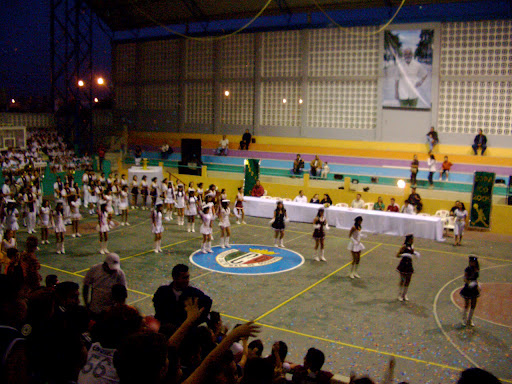
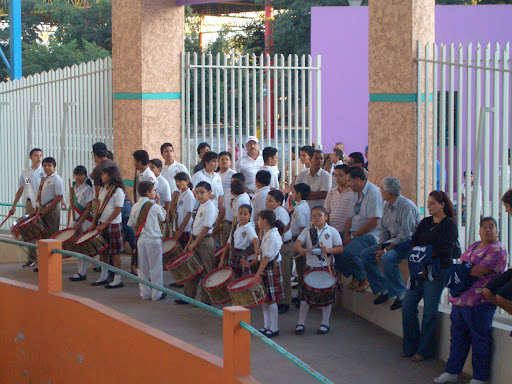
An hour after the appointed time, about 5:30, we file into the auditorium. The kids go under the bleachers. Apparently there is a very large room down there, because there have got to be about 30 or more teams that gather down there. Along with the cheerleaders, pom pom girls, flag girls, drum majors, and bands. Ok, this seems like it’s going to be a big ceremony. We are now told it’s the “inauguration of soccer season,” the ICO Cup Tournament.

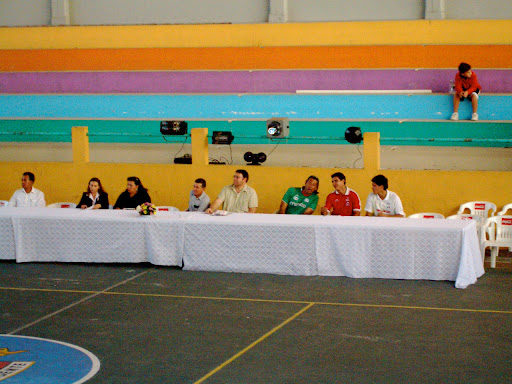
There is a head table. A few speeches are given. ICO is exhalted as a wonderful school about 11 times. Come on already. It’s nice of you to sponsor the tournament, but enough horn-tooting and advertising for the school.
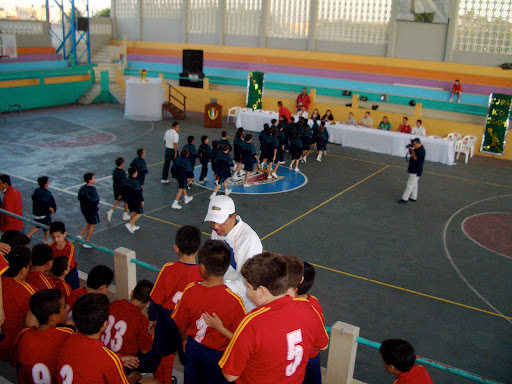
A band plays. There is dancing. The teams are announced, and school by school they parade out into the auditorium, circle the main floor, and are seated. Much fanfare. You’d think you were at the Olympics.
.
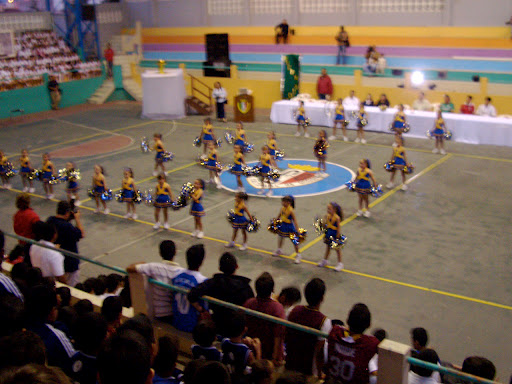
Another band plays. There is smoke and a light show. Fire jugglers entertain us. Several dance routines by scantily clad young women and primary school girls. Confetti is dropped from the rafters. Kids cheerfully jump to catch the confetti, amidst another laser light show and dance routine. Just like the start of the recreational soccer season at home. Ha! Not even pro soccer in the US gets this much fanfare. And I only have my little camera. I say about ten times how I wish I’d brought the good camera. Who would have known? We see our friend Bob Gallagher, and Maria Anderson. They both knew it would be the inauguration, but neither of them told us. We didn’t know they’d be here, so we didn’t know to ask them. Oh well, such is life in a new place.

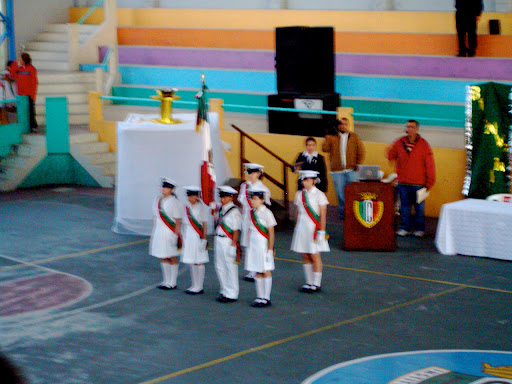
Then, what we’ve evidently all been waiting for: the lighting of the torch. Two men, this year’s tournament heads, are handed a lit torch by last year’s tournament leader. The torch seems to be burning out of control. The two men don’t really want to hold it–it looks dangerous. One of them takes the torch, but seems to want to slam it to the cement floor and stomp on it to put out the fire. But, no, he’s urged to climb the steps, towards the fire pot, to light the large Olympic-style fire container. The man obviously is very uncomfortable. The torch is nearly burning his hand and arm off. He hurries. He lights the main fire container. While everyone cheers and applauds, the out-of-control torch is hurled to the ground and several men try to jump on it to put the fire out. But, burning liquid pours out from the torch, and we now have a fire show: a three-meter-long firefall behind the main Olympic fire. Cool, but obviously unintended. Definitely dangerous. Thank God for concrete buildings!

It’s now about 7:30 pm. We’ve been at ICO three hours. We’ve heard five or six bands, seen about 12 dance routines. We’ve had laser light shows and confetti drops, as well as the intended and unintended fire shows. Everyone’s itching to get home; enough’s enough. Parents start to stand up, walk over and get their kids to take them home. Father Ian, the head of ICO, grabs the microphone to ask people, in fluent Spanish, to please stay just 15 minutes more. No one listens. There is chaos as parents push through the crowd, weaving amidst the marching band and dancing flag girls with no care as to how long these poor kids have prepared for this night. They get their kids and jam the aisles and the performance arena as they attempt to leave. Thank goodness the auditorium is not on fire, as no one is able to get out quickly. Miraculously no one is injured, no ambulances called. By 8:00, the auditorium is empty, the cacophony had died down. A terrific inaugural, for sure. A delicious slice of the cultural life of Mazatlán.