Un Domingo Típico Mazatleco/Sunday Afternoon in Mazatlán

Mazatlán has so very many terrific aspects, but one of our absolute favorites is the music. Live music. Whether it be a single bohemio with guitar strolling past, a world-class symphony or opera in the Angela Peralta, a norteña on the beach, or a complete live band, we trust this enjoyable aspect of life here in our port will never fade!!

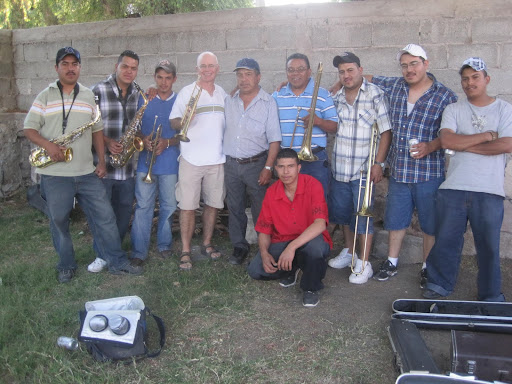
We are fortunate to have compadres y comadres we’ve known for over 30 years, and we love to enjoy a “quiet” Sunday afternoon of fresh fish, seafood and, of course, beers for the adults, together with them.  One recent Sunday the “boys” started outdoing each other (God bless machismo, a veces), and before the afternoon was over they had hired three separate bands to play for us for hours. Here is a taste.


This first clip above is an instrumental, by the house band that played first for us that Sunday. The name of the song is “Tecateando,” but as we live in the home of Grupo Modelo, we prefer to call it “Pacifiqueando.” Enjoy! You’ll see the signs around for zarandeado, fresh oysters… We have terrific seafood here. You’ll also get a taste of the gorgeous weather we enjoy.


The second clip, above, I post as a tribute to the lead singer. In this one he’s singing Chuy Lizárraga’s popular song, “La Peinada.”


This third clip is of our second band of the day, a smaller norteña group. You can see how difficult it is to relax here, lol…


And, as always, the best for last: El Tololoche Chicoteado! By now things have warmed up, food has been eaten, and beer has been imbibed. This third group had a drummer who took the bass player’s place to dance with the bass, as you’ll see. Once he finished, the bass player decided he wasn’t so elderly after all, and he could dance and jump with his bass as well as the drummer could. It made for a terrific culmination to the day.

When you come to Mazatlán to visit, we know you’ll LOVE our músicos. If you live here, please, please help support our local live music scene! I’ll finish this post with a photo of a cubeta from a typical Sunday afternoon here:

Oh What a Night! • Día de la Música 2011


Oh what a night! One of our favorite events all year, this year was fantastic as usual. The winning combination?

  • Five open-air stages with 20 bands performing throughout the night
  • A sixth open-air venue, this one where we could watch visual artists create
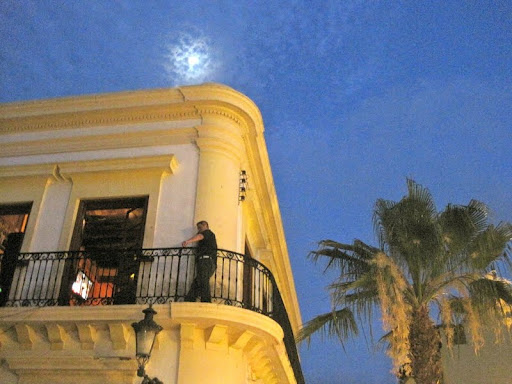
  • Perfect weather, including a gorgeous moon
  • Mazatlán’s beautiful architecture and the ocean waves as a backdrop
  • The fun-loving, joyous, quick to laugh and dance-till-they-drop Mazatlecos
  • Enough of a crowd to feel the pulsating energy, yet uncrowded enough that you can find a good seat, a terrific view, and enjoy a good drink, cena or botanas…

I have not danced, sweated and laughed so much in a while. Thank you, Mazatlán! Below is my two-minute highlight of the evening. After you click “play” you can toggle to view in HD.

Twenty musical groups performed last evening between 7 pm and about 1 am. Those performing on Escenario Paseo Olas Altas (Banda y Tropical):

  1. Ensamble de percusiones
  2. Banda la Mazatleca
  3. Grupo Fussion (my personal favorite of the evening)

Performing on the Escenario Machado:

  1. Coro Guillermo Sarabia
  2. Camerata Mazatlán
  3. Pumcayo
  4. The Sconek-T
  5. Klezmerson
Performing on Calle Niños Heroes and Mariano Escobedo, the Escenario Rock y Tendencias:
  1. Venus Rex Machina
  2. Claussen
  3. Carlitos Ojos Rojos
  4. Los Insensatos
  5. Dapuntobeat
Performing on Calle Venustiano Carranza, in front of the Art Museum (Música del Recuerdo):
  1. Suncai Gitano (they were very good also)
  2. Grupo Fussion (they performed on two stages)
  3. La Negra, La Blanca y La Redonda
  4. Zarzuela al Piano
On Calle Venus, entre Constitución y Sixto Osuna (Escenario Fusión), were:
  1. Chadoma Social Club
  2. The Lori Davidson Group
  3. Radio 3
  4. Belle et Fou Texas
Visual artists at A la Vuelta de Venus:
  1. Carlos Olvera
  2. Ster Aguirre
  3. Dave Gamez
  4. Hello Sobre
  5. Iván Lizarraga
  6. Rodolfo Loaiza
  7. Iván Mayorquín
  8. Nava One
  9. Bacse
  10. Mayk Silvas C.
  11. Angelferd
  12. Salomon Cusehr
  13. Ferruco
  14. Norte 23
  15. Alex Knives
  16. Julio Montero
  17. Pablo Llamas
  18. Crisarth
  19. Paulina Rueda
  20. El Dante
  21. Roberto Vásquez
  22. Braulio Armenta
Link to our friend Nancy’s blog entry on last night’s events. She has some very nice quality video.


Travelogue Spring Break 2011, Day 4: Machinez

Machinez is a small town, or pueblo about 15 minutes by car outside of Zacatecas. The residents we know there call it their “rancho”. The rancho has no governance, no police department, no real services. This somewhat organized series of houses, farms, lots and makeshift streets is home to about 250 families. There is a school and a couple of tiendas selling the basics of beer, refrescos and food staples. Most residents raise some portion of their own food, be it meat, produce or both. There is a soccer field and a park of sorts with a few old children’s slides and swings. There is a river crossing through town. The river was fairly dry on the day of our visit, but in rainy season is a force to be reckoned with. The river is a major source of water as we saw tinacos and water trucks being filled from the river. Most homes have electricity and some plumbing (but not much).

So, from this brief description, you may be asking why I have decided to dedicate an entire blog post to the subject. Well, the point of this post has nothing to do with Machinez per se, but about how we came to visit there this day.
The story that unfolds in Machinez occurs throughout Mexico time and time again. It is a story of hard work and resolve to improve one’s life and one’s family’s life. It is a story of the proverbial analysis of risk/reward. And yes, for us, it is a story or reconnecting with friends we have not seen in years.

The friends we came to visit are like many other Mexicans. They are recent returnees from the United States having braved the perilous border crossing to get to a city where a friend or a cousin says they can get work. The hope of that work is promise to the families of the ranchos. You see, it is with the money earned in the States that the ranchos are able to survive. We spent considerable time at two houses on this day – the house of Alvaro and the house of Eduardo. Both of these young men started as dishwashers in Kansas City. Both showed great potential, the willingness to learn English and the desire to get ahead. Eventually they both became cooks during the busy lunch rush. They routinely put out between 100 and 200 lunches of extremely high standard meals under the guidance of a C.I.A. trained chef. They became leaders in the kitchen as they continued to absorb the culture of the workplace and of the States.

The plight of the illegal immigrant is widely publicized and debated. This blog is not about that debate. Is grounded in the facts – like them or not, these are the facts.

As Alvaro and Eduardo continued to work hard and grow as cooks, they hit a ceiling of sorts. They were illegal. They were forever limited in their employment opportunities. And, they were lonely. Eduardo and Alvaro were both single and aside from a few cousins in town, void of social opportunities. Living in the shadows of Kansas City, they hesitated to venture out. A broken turn signal can domino into a bus ride to Tijuana and the loss of everything. Also, going out cost money and was seen as frivolous spending. Like many others, to relieve the loneliness and boredom they took a second job. A second job fills the time, provides additional social interaction and keeps the money coming in. This after all is the goal. We can fall in love with these guys all we want, but our love is not going to keep them around. They are on a mission. Years ago, the goal was to make a life and then bring everyone else up to share in the new life. This has changed dramatically due to the legal/political climate. Now, the goal is to make enough money to build the house back home, buy the car, put the sister through college, pay for dad’s eye surgery, whatever. Rare is the visitor who finds a way to stay permanently (marriage, sponsorship, etc.).

And so it goes in Machinez. The houses that Alvaro and Eduardo have built are some of the finest in town. Big and strong, nicely appointed, two levels high with incredible vistas, they are symbols of a success found by taking off for five to ten years and working really really hard towards a goal. Each has surrounding land with crops and a few livestock. Each is connected to or very close to family homes, also very nice. Their efforts provided economic stimulus for the rancho. The jobs provided were local jobs. The supplies were purchased from locals and money went back into the community. Alvaro has since married. He has a beautiful baby girl and another on the way. Eduardo is still single—but working on it. As they tour us through their homes, they proudly show pictures of their family and point out which cousin or in-law is still in the States. These family members, they tell me, are making the same sacrifice they did in the name of getting ahead. They are missed by many, especially the older family members who realize that they may not live long enough to see their son or daughter’s return. Yet, they understand the reality of the situation.

Alvaro and Eduardo’s lives are quite simple. They work, they celebrate life. They enjoy beautiful weather and scenery. They listen to music everyday (often played by the family band). They share everything with their friends and family in town. This includes their homes and their SUV’s (brought down from the States). They don’t have cell phones, Internet or cable TV. They drink some beer, dance to banda music and retire for the evening. They have little or no crime in their clean community. They don’t have a mortgage or credit cards. They can and do live on very little. If they weren’t under 40, they would sound like they are living the life pursued by retiring gringos.

But they are not retiring gringos. These young men are starting families; they have financial responsibilities and need to work. No problem, right? They are well trained in the kitchen. They cook better than many chefs and restaurateurs that I know. They are certified in serv-safe, understand cross utilization, understand wine basics, can lead a team, can work with vendors, and speak two languages. But you see a great cook in the States, even one that has worked for ten years at an exclusive upper-end dining establishment is nobody in Mexico. To get the attention of a kitchen manager they need to have a degree from a vocational school specializing in culinary arts. They need to have diplomas from Mexico and they have none. There is an outside chance that they can find a friend of a friend in the food industry to introduce them to someone, but it a chance not worth waiting for. Instead, my two friends are gas station attendants. They receive a minor minimum salary and cash tips. They work various shifts, but all are long –both days and nights. Their jobs are dead end to say the least. They work along a busy highway and risk getting robbed or worse. They spell of gasoline and other chemicals when they return home. Like many workplaces in Mexico there are poor sanitary and safety conditions.

What does the future hold for my two friends? I really don’t know. They will not return to the States unless there is a major shift in politics that offers some sort of path to legalization. They would love to cook again and have a job with some potential. Being technically uneducated and from a “rancho”, their options are very limited. There houses will survive almost anything thrown at them and they will always be able to work enough to keep food on the table and the lights on. With any luck they will have children who are able to go one step further, finish school and get a job with some promise. Until then, the beautiful sunset on the western horizon of Machinez will usher in another session with the local band. The moms and daughters will dance with each other and the few men not in the band. As night falls, they will turn in with the adventures in the States a distant memory until the next time a certain gringo comes to town for a visit. And don’t worry, he will.

Banda is not Spanish for Band!

I have heard Banda and Norteño music described as “an acquired taste,” “a God-awful racket,” and “the best music on the planet.” Realistically speaking, I agree with all three.
 
First off, what is Banda? Banda is a style of music popular in Mazatlán and the rest of Sinaloa, the state in Mexico from which it hales. It is growing in popularity elsewhere, but especially in the United States.
 
Banda style music dates back to the late 1800’s. It was imported from Germany when the Germans came over to invent Pacifico beer. You won’t find this fact validated by any reference checking, but I can assure you that the German’s greatest contributions were Banda and Pacifico. In fact, I’m drinking one now.
A Banda band is a band ranging size from around 8 to around 24 – give or take a few. A band consists of mainly brass or wind instruments like clarinets, trumpets, trombones and tubas. There are always drums – many of them. One drummer will usually play a snare drum and some cymbals (or cowbell, etc.), another will play tom-toms and still a third might play a bass drum with a cymbal on top. Because of these drum types, you will often see drummers standing when playing. String instruments are rare; as are keyboards. Normally there won’t be an accordion. Most often a Banda-like band with an accordion is actually a Norteño band. While some Norteño does come from Sinaloa, most comes from the more northern states of Mexico. Norteño can also thank the Germans (and the Czechs) for its beginnings. It is more of a rural sound, and I really like it too. You will hear Norteño music on Banda radio stations and see the videos on Banda video channels.
 
When it comes to the Banda “sound,” there are many. The most common are cumbias, rancheras and corridos. At the end of this post I will put links to a variety of videos so you can hear for yourself. If you think this is confusing, it is. These three types of music are not limited to Banda, but also played by Norteño bands. Why is this a problem? Well, people will say, what kind of music do you like? Do you like Banda? What kind? Norteño? How about Mariachi? Are you wondering why Pacifico is needed to get this all straightened out?
For purposes of clarity (and ease for the author), I will use Banda from this point on to mean Banda and Norteño.
 
Often Bandas will have more than one singer, making it difficult to hear a song on the radio or in a restaurant and know who you’re listening to. So, apparently to solve this problem, Bandas are known for singing out the name of their band (and home city or state) sometime during the song (usually at the beginning). I find this system very efficient and would highly recommend it to bands elsewhere in this world. Not only are there concurrent multiple singers, but as bands age, singers are replaced. Some Bandas have been around for many years. The most famous and best example is Banda El Recodo. The full name of the band is Banda Sinaloense el Recodo de Don Cruz Lizárraga. The band has been under the control and guidance of the Lizárraga family for over 70 years. Their current lead singer sounds very different than the last singer, but he is great and is very young and hopefully will be the primary voice of Banda El Recodo for years to come. Note the full name tells you who founded the band and where it is from, very efficient. You will often see Banda names with a founders name included or a city or state of origin. This helps designate a band if someone else in the country has a similar name and shows hometown pride. I like it!
 
Banda is not exclusively a male-dominated genre. There are some female Banda bands, but they have not had the successes associated with today’s well-known Banda bands.
 
Sometimes Banda sounds over-amplified and distorted. This is usually due to the tuba being played and used in a way that is uncommon to most music listeners. Other times it is due to the fact that the band will amplify one or more of the singers and put the tuba too near the microphone at which point it is over-amplified and distorted.
 
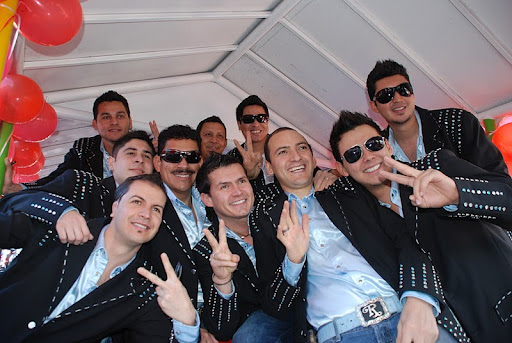
The more popular or more successful a Banda becomes, the better they become. They get better instruments, better musicians and uniforms. A good-looking Banda is quite a sight. Think about 18 guys in matching cowboy hats, brightly colored jackets, western shirts, matching pants and boots, all swaying to the beat of a song. Along with this, musicians swirl or pump their instruments in between stanzas. It is quite a sight to behold. You’ll get the picture in the videos.
 
Speaking of videos, Banda videos are fun! Often they tell a story, either about the song, or just about life in Sinaloa. Many are filmed in my wonderful city of Mazatlán. If you are ever in Mexico and have the opportunity to watch TV, check out a channel called BandaMax (Mazatlán cable, channel 11).
 
A Banda concert may at first glance look like controlled chaos, but it is very enjoyable and festive. But, there are a few things you should know. First, gentlemen need to wear their best jeans with stitching, a “western shirt” with glitzy design on back and/or front, your best cowboy hat and boots made from a dead animal. Ladies, anything tight that highlights cleavage will do great and really high heels. Banda concerts start late and go later. It is not uncommon to be going home at 3 or 4 in the morning. Beer is usually no more than 100 feet away at any given time. The event is very loud. I have been to a lot of rock concerts in the states, a Banda concert is louder.
 
Outside of a concert, how do you get to see a Banda? Acts just starting out will walk the beach or between restaurants looking for work on busy days. There are some restaurants and cantinas in town that are known for having Banda music. Some have a house band and others have different bands playing. Often, two will show up and it becomes a “Battle of the Bandas”. Bandas play little dance halls and cantinas. If they have a name or following, there will be signs advertising the Banda. For larger touring acts, concert venues are used. If you want to hire a Banda for a party, you can ask for cards of any Banda you see, or just go down to the area of town where they “hang out” and find one. If you’re in Mazatlán, just go east at the Fisherman’s Monument to the corner of Gutierrez Najera and Juan Carasco. You will find Banda bands looking for work hanging out there.
 
If you read this far, I’m impressed. What’s the bottom line on Banda? What you think of it when you first hear it will depend on how you hear it. If you hear a professionally recorded song by a mainstream Banda band, it will probably sound like Latin pop with horns. If, however, you are sitting in a cantina with your compadres and drinking a bucket of Pacificos, then you will think it is too loud, unorganized chaos. Remember in elementary school when Miss Carlson, the music teacher, arrived? She would open a big box of musical instruments, some shinier than others, but all capable of pleasing a child’s senses and wonderment and making a noise that, to a child under ten, passes for music. Remember Susie and Vicki would always fight over who got to play the triangle and whip it like mom’s mashed potatoes. Remember how Bobby always got the tambourine and ran around shaking it like a Hari Krishna? And remember how we would all just bang and tap and strum and hit and run to our own little personal beat? Remember that sound and how good it felt? Well, to many people, that’s what Banda sounds like the first time. The real problem with Banda is it needs room to breathe. Like good wine, the more it breathes, the better it gets. Keep listening and after a while, you will start to recognize the songs. They actually have a beat (and yes Dick Clark, you can dance to it) and the band is organized. In fact, the better the band, the better the organization.
If you decide you like a Banda song or a group and you want to buy the music, good luck. A mainstream act like Banda El Recodo can be found on line (iTunes, etc.) as well as some music by Julion Alvarez, Banda El Limon, and others who have had some success outside of Mexico. Beyond that, you are stuck. If a band gets lucky enough to get a record deal, they may have very limited, if not regional, distribution. I have spent weeks trying to find some CD’s and went so far as emailing the bands through their websites, Facebook pages and My Space pages. I still don’t have anything. I got some vague instructions on how one store might have something (not), I got a guy at a music store who was going to order them and call me (not). So, I have learned how to extract the audio from a YouTube video into MP3 format–problem solved–sort of. If you want to catch a Banda when they come to town, just check their websites and pages for a concert schedule, or watch for signs around town and their tour busses. How to get a ticket? I’ll save that for another time.
 
I created a playlist in my YouTube account with a whole bunch of videos. If you have about 45 minutes, you will see some of my favorite videos, many filmed in or about Mazatlán. You will:
·Learn a lot about typical Mexican life
·Enjoy a Banda remake of a 1970’s US pop classic.
·See Banda El Recodo live at a concert I attended
·See Grammy and Latin Grammy award winners
·Experience life on a Mazatlán beach during carnaval
·Learn about pigs, cheese, peanuts, cars, girls, beer…
·See that I snuck in one Mariachi song because it’s all about Mazatlán!

The Posada

It’s posada season in Mazatlán! Everyone you talk to is a bit bleary-eyed from all the partying going on this time of year. “Posada” is a term for parties traditionally held during the nine nights just prior to Christmas: December 16 through 24. A posada can be a private party held in a family home, but it is more typically a street or block party or an end-of-the-year celebration for company employees or club members. If you didn’t attend a posada last night, you no doubt heard the banda music from the party down the street, well into the early hours of the morning. The badge of honor is to be able to brag that you partied till 4:00 or 5:00 am—desvelarse or stay up till morning. Yes, even if, like me, you are nearly fifty, or if you are seventy, or older. Posadas have no age limit.

Music and Food

A typical posada has music, of course, preferably live music. There may be dancing, and partygoers often sing villancicos or carols. Typical posada dishes include tamales, buñuelos, pozole, colación (candy mix), and atole or ponche. Ponche is made from seasonal fruits like tejocote, guava, plum, mandarin, orange, or prune, sweetened with piloncillo (a brown sugar) and perfumed with cinnamon sticks or vanilla. Some piquete (sting) may be added for grownups—a bit of rum or tequila—to make the ponche “happier.”

Piñata

Children at a posada enjoy breaking open a piñata in the shape of a seven-pointed star. It is said the piñata originated in China as a springtime festival treat. Marco Polo transported the idea to Italy, where piñatas came to represent the triumph of good over evil. The seven points of a traditional Mexican Christmas piñata represent the capital sins, and the stick that the children use to break open the piñata represents the power of faith to overcome those sins. The people watching the child with the stick, hitting the piñata, sing this song:

Dale, dale, dale,
 no pierdas el tino;
porque si lo pierdes,
 pierdes el camino.

In English:
Hit it, hit it, hit it, 
don’t lose aim;
because if you lose it, 
you will lose your way.

The Pastorela

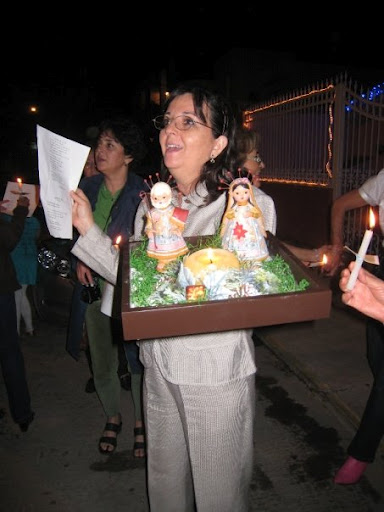
Traditionally a posada also includes a pastorela, a procession commemorating Mary and Joseph’s journey to Bethlehem for the census. As the Bible tells us, they searched everywhere for lodging and were turned away, there being no room at any inn. Sometimes a boy and a girl dress as Mary and Joseph, and Mary may even ride a burro. In some pastorelas you may see shepherds, cows, kings—it can be an entire Christmas pageant.

More typically, however, the guests at a posada carry candles, and they parade from house to house along a street or block. One person or several carry a nacimiento or manger scene. Some members of the posada group stand outside, and some stand inside the gate of each house. The people standing outside, carrying the nacimiento, ask for lodging, usually using the song or chant below. The people standing inside the house gates turn them down, again following the chant or song below. This pattern is repeated at each house on the block: the Holy Family and group outside plead for lodging, and the group inside the house turns them down in a threatening manner. It’s a sad and moving scene. Below is the song:

Español
English
Outside Singers
Inside Response
Outside Singers
Inside Response
En el nombre del cielo
os pido posada, pues no puede andar mi esposa amada.
Aquí no es mesón,
sigan adelante. Yo no debo abrir, no sea algún tunante.
In the name of Heaven I beg you for lodging, for she cannot walk, my beloved wife.
This is not an inn, so keep going. I cannot open; you may be a rogue.
No seas inhumano,
tennos caridad, que el Dios de los cielos te lo premiará.
Ya se pueden ir y no molestar porque si me enfado os voy a apalear.
Don’t be inhuman;
Have mercy on us.
The God of the heavens will reward you for it.
You can go on now and don’t bother us, because if I become annoyed I’ll give you a thrashing.
Venimos rendidos desde Nazaret, yo soy carpintero de nombre José.
No me importa el nombre, déjenme dormir, pues que yo les digo que nos hemos de abrir.
We are worn out coming from Nazareth. I am a carpenter, Joseph by name.
I don’t care about your name. Let me sleep, because I already told you, we shall not open up.
Posada te pide,
amado casero,
por sólo una noche
la Reina del Cielo.
Pues si es una reina
quien lo solicita,
¿cómo es que de noche anda tan solita?
I’m asking you for lodging dear man of the house. Just for one night for the Queen of Heaven.
Well, if it’s a queen who solicits it, why is it at night that she travels so alone?
Mi esposa es María,
es Reina del Cielo y madre va a ser del Divino Verbo.
¿Eres ú José? ¿Tu esposa es María? Entren, peregrinos,
no los conocía.
My wife is Mary
She’s the Queen of Heaven and she’s going to be the mother of the Divine Word.
Are you Joseph?
Your wife is Mary?
Enter, pilgrims;
I did not recognize you.
Dios pague, señores,
vuestra caridad, y que os colme el cielo de felicidad.
¡Dichosa la casa
que alberga este día
a la Viren pura, la hermosa María!
May God pay, gentle folks, your charity, and thus heaven heap happiness upon you.
Blessed is the house that shelters this day the pure Virgin, the beautiful Mary.
Finally, at the last home, the owner of the house throws open the gates and joyously welcomes in the Holy Family. Upon opening the doors at the final stop, the tune changes, the pilgrims enter, and all sing these final verses in unison:
Entren, Santos Peregrinos, reciban este rincón, que aunque es pobre la morada,
os la doy de corazón.
Enter, holy pilgrims, receive this corner,
for though this dwelling is poor, I offer it with all my heart.
Oh, peregrina agraciada, oh, bellísima María. Yo te ofrezco el alma mía para que tengáis posada.
Oh, graced pilgrim, oh, most beautiful Mary. I offer you my soul so you may have lodging.
Humildes peregrinos Jesús, María y José,
el alma doy por ellos, mi corazón también.
Humble pilgrims, Jesus, Mary and Joseph, I give my soul for them and my heart as well.
Cantemos con alegría todos al considerar
que Jesús, José y María nos vinieron a honrar.
Let us sing with joy, all bearing in mind
that Jesus, Joseph and Mary honor us by having come.
To conclude the pastorela the guests often sing “Ave María” and perhaps “El Rorro” (Babe in Arms).
Flores de Noche Buena/Poinsettias
 
Poinsettias are native to México, and their name in Spanish means “Flowers of the Holy Night.” Its name in English comes from the last name of the American man who popularized the shrub. It is a very typical Christmas gift as well as a decoration here in Mexico.

There is an interesting legend surrounding the poinsettia. A young child, Pepita (the child is variously a boy or a girl and with varying names depending on the storyteller), is heading to church on Christmas Eve. Pepita’s heart is filled with sadness; she very much wants to give the Christ Child a gift, but she is poor and has nothing to give. The child’s cousin, Pedro (or variously her mother, friend, or brother, again depending on the storyteller), tells Pepita that even the most humble gift when given in love will make Jesus happy. Pepita kneels down by the side of the road, her heart full of love, and gathers a bouquet of weeds. When Pepita places her weed bouquet beside the baby Jesus in the church, miraculously the weeds burst into blooms with bright red, star-shaped petals and brilliant yellow centers.