Julión Álvarez live at Culiacan’s Palenque 2012 – The Full Report!

Read this blog post and you will get:

  • A video-packed report of our attendance at a Julión Álvarez concert
  • A better understanding of what “palenque” means
  • Insight into buchones and other things Culiacán

=========================

Well, it finally happened. I got to see Julión Álvarez perform live. What a road it’s been for him and for us. Adopted by Mazatlán, Julión sang for Banda MS (MS standing for Mazatlan, Sinaloa) for three years before going solo as Julión Alvarez y su Norteño Banda. His first album was released in 2007, and sometime after that and before we moved to Mazatlan in 2008, I was introduced to and hooked by his music.
IMG_4443

So, it was a huge opportunity when Julión Álvarez was scheduled to play outside at Sumbawa in April, 2009. How nice to be able to walk down the street and see someone who I knew was going to be huge one day, live in a small venue! What could go wrong — how hard could this be?  Well, some pigs in Asia ruined it all. In March of 2009, the H1N1 swine flu “pandemic” took off in Mexico and part of the official government reaction was to cancel all large gatherings of the general public. Click here to read our blog post from that time. Ignorantly, I assumed Julión would simply reschedule. Ha!

Fast forward 42 months. I’m reading the paper one day and see an article listing the music schedule for the Feria Ganadera in Culiacán, Sinaloa. There he is closing night — three albums, countless videos and hit singles later, Julión Alvarez y su Norteño Banda! Two hours away in the capital of Sinaloa in a city many people warn us not to travel to; Julion is going to be the closing night performer at what amounts to the State Fair. He is to play on December 1. I don’t care what else is going on (and there was a lot) —we’re going!  Somehow by going we earned some “street cred” with the locals. Looking back, part of me gets it, but not completely. Read on and see for yourself.

Buying tickets in Mazatlán for an event in Culiacán was surprisingly difficult. Searching the Internet, I could not find a Culiacán website that sold them, and Ticketmaster didn’t have them. Danny reached out to a friend there and he couldn’t help us. A local friend reached out to her friend there and she said they were not on sale yet. Not atypical. As the date got closer, she reached out again and I reached out to a friend in the state government. Both reported back that they had friends who could get tickets for us. So, our friend’s friend got us two tickets and delivered them to Mazatlan the following week.

The annual International Marathon of the Pacific was held the same weekend. This meant we would miss the annual Festival of Lights fireworks ceremony for the first time since living here, as well as have to deal with stashing our car around the block to get around because our street would be closed for two days.

These issues amounted to little more than minor speed bumps on the way to a great night.

Our tickets were 750 pesos each — or about $60 USD — very expensive by local standards.

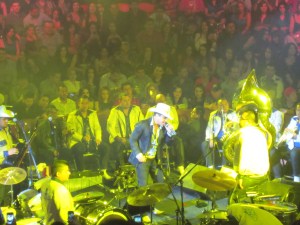
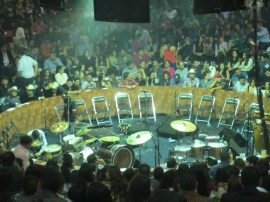
About 22 people were on stage the entire time. Julión was performing in a cock fighting ring at the State Fair; this was not Carnegie Hall. The newspaper said there were over 5,000 in attendance. Julión was surrounded by his band and performed “in the round,” making sure to turn and see all of his fans.

Gringos in the audience: 2

When we entered the venue, we presented our tickets (after our third security check and frisking of the night) and were escorted to our seats. A young man with a rag wiped down our seats and then asked if we wanted to give a tip. Whatever, ten pesos.

Following behind us as we found our seats was mesera (waitress) number 12. She presented us a typed laminated menu and asked if we wanted anything. Bottle of water, check. One beer, check (only Tecate Light, but don’t get me started on that). The rest of the menu was for other people: bottles of whiskey, tequila or rum priced at 1,000 pesos and up. Coke was 100 pesos and served in a two liter bottle. So, we sipped and we watched. An average group would arrive of four or five people. They would order a bottle of whiskey, 12 beers packed in ice, a few Red Bulls and maybe a snack. This scene would be repeated again and again all night long with groups placing reorders constantly. Bottom-line, these folks got drunk. And, thanks to the Red Bull, they were drunk and wide awake! With each order of a bottle of whiskey, they would receive a stack of cups with napkins, two buckets of ice and their 2-liter bottle of mixer (usually mineral water). Don’t forget that amidst all of this, the bag o’ beers had to fit on or around them. You can only imagine what it was like to get up and try to reach an aisle! The meseras were not the tiniest thing on the block either, in fact most of them were old battleaxes who didn’t give a hoot if they stood in front of you for 5 seconds or 5 minutes — they were just working the tips. Drunk young people trying to impress tip well.  This, of course, is not hard to do, when one round is anywhere from 3,000 pesos on up. Ouch! But, these young people of Culiacán seemed to just print money. They all, men and women, had fat rolls of cash and were not hesitant to spend it.

There are always distractions at public events — that’s what makes people watching so much fun. This night was no exception. The only problem is where to begin.

First of all, I need to try and explain palenque to you. Essentially, it is a legal, sanctioned cock fight and “raffle” popular at ferias (fairs). In this case in Culiacán, the palenque entrance and the concert venue are one and the same, so the ticket is as well. The whole State Fair is colloquially called the “Palenque.” Want to go watch and bet on the cock fights? Then you are going to see Julión Álvarez as well. Want to see Julión Álvarez? Then you are going to watch cock fighting (or go late). Our tickets said the cock fighting starts at 7:30 and the artist will be on at 11:30. We got in around 10:00 and said goodbye to the cock fighting MC just after midnight. Anyhow, as I was saying, the stage for the performance is a cock fighting ring. Watch the change happen here, or just look at the before and after pictures, same stage:

IMG_4414

IMG_4440

The fashion was really interesting. Most men had nice jeans and a nice shirt. Some men wore sport coats or slacks. There were lots of nice cowboy boots and a sea of white Stetsons. The women were the real story. Sequined shorts were all the rage and when I say shorts, I mean short. Leather pants in a variety of colors, leopard prints and tiger prints, were a common sight as well. I believe that Sinaloa women have a natural beauty, but the women of Culiacán are just not sufficed with that. They add. Push-up bras and obviously augmented breasts were a constant distraction to this writer, as were fake butt cheeks (sorry, I honestly don’t know what these things are other than unnatural and unflattering). Dianne was particularly fascinated with the “hair lifts.” The women wore their hair back and in doing so concealed a plastic foundation of some sort that raises the hair off the head, forming a ridge. Sorry, we could not get any decent pictures for fear of retribution. People did NOT want their photos taken!

IMG_4428

IMG_4430

There was a guy two rows ahead of that I was able, or almost forced, to watch all night. He did some really strange stuff. First of all, he was dressed nice (for a cock fight) and had no trouble spending lots of money. Had he not been mixing the Red Bull with his whiskeys, he would have passed out. As the night progressed, it got crazy. There were a lot of drunken people and multiple waitresses squeezing past our knees chasing sales and tips. As a waitress would squeak by this guy with a tray full of beer, ice buckets, etc., he would occasionally lighten the tray of a beer or two. It was like a game. All I kept thinking is that the poor waitress has to pay for them. He really pushed things at around 3:30 in the morning. There was a photographer working the crowd. He takes your picture with a fancy Polaroid, puts it into a cardboard frame, gets your money, and he’s gone. Business was a little slow, but he worked hard in his attempt to cover between 5,000 and 6,000 people. This guy carried a satchel across his body on a strap that he would turn toward his backside to get by some tight spots in the crowd. So as he is attempting to get by my friend, there is a waitress coming from the other end and he is forced to stop for a few seconds. When he does, this guy two rows up deftly reaches into the photographer’s satchel and removes a package of the frames — maybe around 50 or so. This is the kind of item no average person has the use for, agree? As the photographer walks on, clueless as to what happens, my friend starts to proudly show his buddies what he has done. One of his friends appeared to have a moral compass. His body language indicated that he was not happy and he began to see if he could locate the photographer. After extended minutes of arguing, the thief grabbed the frames back from his friend. A waitress working in the row above witnessed the whole thing, and even she had the guts to come over. She tried calling out for the photographer, but with the music it was next to impossible. Finally, after the photographer had cleared the row and exited to the promenade, the thief gave the frames to the waitress, who set out in the direction of the photographer, apparently intent on returning them.  My take was this guy was a skilled thief. Every move he made was made with confidence and no fear of recrimination. He did it for pure delight. I knew enough about Culiacan to mind my own business and say nothing (until now).

There was a small opening act of sorts that played for about twenty minutes. Julión and his band came on just before one in the morning and when we left at 4:20, he was still going strong. We understand the concert ended just after 4:30. He played non-stop. His only break from singing came when his tuba player, Cheque, sang a couple of songs. Even during those times, Julión kept busy signing autographs, posing for pictures, dancing with a seemingly never-ending line of women, and being a great host.

IMG_4469

In the first hour, Julión went through most of his biggest wide-reaching hits: La Maria, Las Mulas de Moreno, (click to view)  La Niña, Olvídame… Next, he played a series of his smaller hits and popular songs, and then switched to classic corridos, cumbias and banda songs — the same songs played by every banda group around, but with his amazing voice and incredible backing band. The crowd loved it. In fact, it was often hard to hear Julión’s voice for the sheer volume of the crowd, as they knew every word to every song and were not afraid to help out. Just watch! A few other videos for you:
For the Mazatlecos in the crowd, he sang our song!
See how into things the crowd was at 3:45 (great ad for Red Bull)
A quick shot of the crowd with some house lights on.

A few things made the night special. Julión was the consummate host. He welcomed people on stage to take pictures, dance a few turns or just high five him; it was as though he was returning to his home neighborhood to share in his good fortune. In the clips above, you will see some Down’s syndrome fans that Julión welcomed on stage to dance a few songs for the crowd and share their excitement with the world. When three kids ran on stage to dance, Julión gave clear instructions to his handlers to let them stay. It definitely made for a night that three families will never forget! For about 30 minutes straight, Julión invited all the women to line up and dance with him one at a time. Each gal got a quick spin, a smile, a kiss and if asked, a quick pose for a picture. Watch here. He never stopped making good eye contact with the audience, waving, smiling and making everyone feel welcome. He even gave a special wave to Dianne.

Culiacán — We have spent a little time in Culiacán and know the people there are different, but wow, was this an eye-opening night. Rare is it when we travel anywhere in Mexico that someone doesn’t talk to us about where we are from, were we live, how well we (Dianne) speak Spanish, etc. On this night not one person spoke one word to us. Mind you, we sat next to, in front of and behind people in very close quarters for hours, but nada!

Did we feel safe? Yes. Did we avoid trouble? Yes. Would we do it again? Yes, in a heartbeat. It was a fabulous night with great music in an awesome venue. The late night is no problem if you plan for it. We had a nearby hotel and planned on being out late. Our plans worked out well. I just need a white Stetson hat and a wad of a cash to blend in J (or not).

I was a Julión Álvarez fan before we went and I’m a bigger fan now. That’s the way it should be.

Here is a link to a YouTube playlist of all of the videos.

IMG_4466 IMG_4482 IMG_4463 IMG_4462


Pescadería del Mar/Our Fishmongers

One of the best aspects about living here in Mazatlán is the fresh fish we are able to buy every morning. Okay, well, we don’t go on Mondays, because there’s not been a lot of fishing on Sunday, but any day Tuesday through Saturday, you can bet we are happy campers.

We take our daily walk down the malecón and, in Playa Norte just across from the pangas, is our favorite spot: Pescadería del Mar.By now these guys know us and they’ve helped us to learn a lot about fish and fishing here in town: what’s seasonal, how fish are stored (on ice, frozen, salted) from the time they’re caught till they’re brought in to shore, and how to cook what’s available locally.

At 7 am when we’re there we usually have a terrific selection. Of course, depending on the season and the weather, we may have more or less fish to choose from. As you can see in this photo, though, there’s usually quite a variety.

The fishmongers will scale and clean any fish we choose, so I can cook it whole, or they’ll fillet (de-bone) and cut up anything we’d like, however we’d like it. They also get fresh shrimp, which I love, because they are deep water shrimp that have NOT been stored in salt, so they’re sweet rather than pungent. They get quite a bit of squid, also, which I love to saute with garlic and herbs. We can occasionally get fresh scallops, too. Our favorite is corvina, a nice firm fish that is sooooo savory! We can at least a couple of times a week get smoked marlin (usually still warm from the smoker and sooooooo aromatic!), and escabecheon Fridays.

It’s fun to watch either the fishermen fresh off their pangas across the street, or a dealer/go-between (usually on a scooter or motorcycle) come to deliver the fish to the fishmongers and make a deal. They have an outdoor scale to weigh what’s brought in, and an indoor scale to weigh what you purchase before it’s trimmed to order.

Having lived so many years in Japan, I am also very happy when they get sushi-quality tuna, though I do believe most of the fresh fish they have is sushi/sashimi quality. Chirashi has never been so delicious and affordable!

If you are a carnivore/omnivore, and do not take advantage of our local fresh fish, please do! You are missing some really flavorful and healthy, and easy and quick to cook, local delicacies!

Los Tigres del Norte Banned in Chihuahua

Los Tigres del Norte, one of my favorite (and one of the world’s most popular) bands, was banned yesterday from playing in the city of Chihuahua. They were banned for playing a very popular narco-corrido based on a soap opera and book, La Reina del Sur (the city of Chihuahua has banned narco-corridos).<.div>

The Mexican press, and most Mexican people, are upset about and vocal in objecting to this cavalier censorship.

I value free speech, and do not believe in censorship. It is interesting, though, that this ban occurred because Chihuahua city is trying to change its culture. It is trying to take the narco culture out of norteña culture, to stop the glamorization of criminal activity, to restore responsibility and good citizenship to its citizens.

Northern Mexican norteña culture has become closely mixed with narco culture. That cultural mix includes a style of dress (one extreme is those tippy-toed guarachero boots), a unique vocabulary and style of speech, songs (narco-corridos are songs that glorify the life of the outlaw), and even a patron saint whose image, likeness and altars can be found in most any colonía (Jesús Malverde, so-called patron saint of the drug lords and lost causes).

Mexico is a large country, as is northern Mexico, and norteña culture as influenced by narco culture has a diversity within it. There is also spillover; many people who have nothing to do with the drug trade may build an altar or light a candle to Malverde (unwed mothers may pray to him, for example, as might people who have lost their jobs) or have his face emblazoned on the window of their pickup truck. And, MANY of them listen to what can be called narco-corridos. The particular song for which my Tigres were banned, ironically, ends with the outlaw (a woman) being punished for her crimes.

Chihuahua’s ban is personally ironic to me because last year, I posted on the Facebook page of another favorite band of mine, la Banda El Recodo, sharing with them my disappointment that they had released a song so far below the respect and esteem with which they are held by the public (the song talks about guns, arms, bulletproof vests; it encourages people to get drunk and shoot bullets into the air; the official video involves non-stop drinking, high-priced cars and watches, and ends with the lead singer pretending to shoot the viewer). In hindsight, was I censoring? I know my motivations were the same as those of the city of Chihuahua: El Recodo is at the top of their craft; people respect them. I love them, and I love Mexico. I wanted them to stand for and promote what is good about Mexico, help make it a better place, not glorify and feed the worst of our local culture.

What do you all think?

Ferrusquilla: "That statue of a composer…"

Mazatlán is privileged to have a strong and vibrant expatriate community, many of whom volunteer long hours to help make our city a better place in which to live. Many in the foreign resident community have of course grown up and lived most of our lives elsewhere. We love our adopted home, but we often lack basic “cultural literacy” about our adopted homeland. I put myself in that category, of course. Every day, many times a day, I learn something new. It’s part of why I love living here.

Last week, I noticed the below comment on one of the local expat discussion groups:

“It is located across the Malecon between two statues: the Deer, Mazatlan’s symbol; and a Sinaloa composer holding his guitar and sombrero.”

The note surprised me, because I figured everyone who lives here knows our beloved Ferrusquilla! But, of course, we don’t “all” know anything; we all have different pieces of information. I see Don Ferrusquilla once in a while, dining around town or taking a walk, and I loved his INCREDIBLE acceptance speech at the Premios Oye! last month (drag the play bar to 6:46 to skip the homage and hear the original poem he wrote just for the occasion, full of love for our fair city).

But, of course, we all hold differing pieces of knowledge, so I thought I’d share a bit of what I know about this “Sinaloa composer holding his guitar and sombrero” in the statue. Maestro José Angel Espinoza Aragón, “Ferrusquilla,” is a national cultural icon, famous throughout all of Latin America and Spain, and one of the greatest orgullos of Mazatlán. The United Nations awarded him the the Medal of Peace in 1976, the University of Sinaloa presented him with an honorary doctorate just a few years ago, in 2008, and he’s received many other distinguished awards during his career.

His “master work” is the composition “Echame a mí la culpa,” sung by most every well-known Spanish-language singer (here it’s sung by Amalia Mendoza, “La Tariacuri;” or this one sung by Javier Solís). The song inspired a Spanish movie of the same name, and decades later (in 1980) was still so popular that it won “song of the year” in Spain, as sung by Englishman Albert Hammond. Ferrusquilla has acted in 80 motion pictures alongside actors that expats will recognize such as John Wayne, Clint Eastwood, Dean Martin, Boris Karloff, Richard Burton, Anthony Quinn, Brigitte Bardot, and Robert Mitchum, and has composed, to the best of my research, 97 songs.

José Angel Espinoza Aragón was born in Choix, Sinaloa on October 2, 1919. After his mother died his father moved the family to El Guayabo and then Los Mochis, where his father remarried. In 1935, after finishing junior high, his family sent José to study in Mazatlán. In 1937 he got on a train headed to Mexico City, to study medicine, but life didn’t quite work out according to plan.

According to one interview, in 1938 the young José was working a side-job at a radio station, one that broadcasted the popular late-afternoon children’s show “Fifirafas el Valoroso.” The role of “Captain Ferrusquilla” on the show was originally played by the head technician, Carlos Contel, brother of the station manager. After Carlos’ brother told him to choose whether to be a voice actor or a technician, the show was left without a Ferrusquilla. José had the good fortune to be present in the studio when the director, panicked, asked around for a male who could read the part. Thus, by fate, the “man of a thousand voices” with the nickname “Ferrusquilla” was born.

Ferrusquilla fell in love with the female lead of the radio show, Blanca Estela (María Blanca Estela Pavón Vasconcelos). According to this same interview, the two lived in New York for a year, dubbing the voices of actors such as Ingrid Bergman, Elizabeth Taylor, and Mickey Rooney. Blanca died tragically in a plane accident in 1949. After her death Ferrusquilla decided to commit himself to music, and composed his first song in 1951.

Ferrusquilla married and had two daughters with Sonya Stransky Echeverría in the 1950s (the marriage lasted five years). He tragically lost another loved one, his daughter Vindia, in a car accident in Mexico City in 2008. His daughter Angélica is a successful actress. He has said that his daughters have been the joy of his life.

By the way, the statue of Ferrusquilla, on the malecón in Olas Altas, made by artist Carlos Espino, was unveiled in time for Ferrusquilla’s birthday, in October of 2007.

Fellow foreign residents of Mazatlán: let’s all, proudly, be sure to call this landmark the “statue of Ferrusquilla”!!!! And, Mazatlecos and fans of Ferrusquilla: please teach all of us more about this incredible gentleman, sharing your life memories of the legacy he’s given us!

Note/Update: Jackie Peterson wrote an article on Ferrusquilla in the Pacific Pearl last year. Somehow I missed seeing it, but you can check it out here. And one of my friends has given me the Maestro’s number and asked me to give Ferrusquilla a call, to let him know about this post, so I will do that as well.

Update #2, March 5th: I met Maestro Ferrusquilla tonight. What a great man! He told me that in his younger years, he played for a year with Banda El Recodo, in the Cruz Lizarraga days, before he went to Mexico City and did the radio show. Cool trivia! He is a really nice and VERY interesting man and his English is GREAT! It felt very good to finally get up the courage to talk to him, and to have the honor of finally meeting him.

Cerritos Beach, Otro Domingo Típico Mazatleco/Another Typical Mazatlecan Sunday

I know a tranquil beach where the views are spectacular,

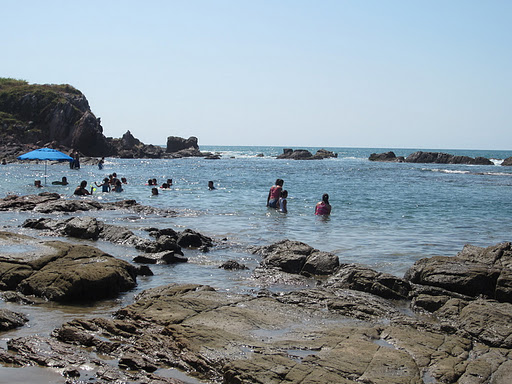
Where rock outcroppings shelter swimmers from rough tides.

I know a beach where both the music and the food are fantastic.

The restaurants are basic, in no way luxurious…

But, they serve fish, seafood and shellfish caught just minutes earlier…

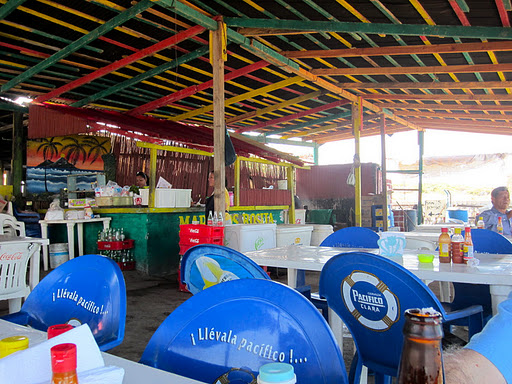
In a shady, ocean breeze-cooled environment. Along with the seafood they serve cold beers and…

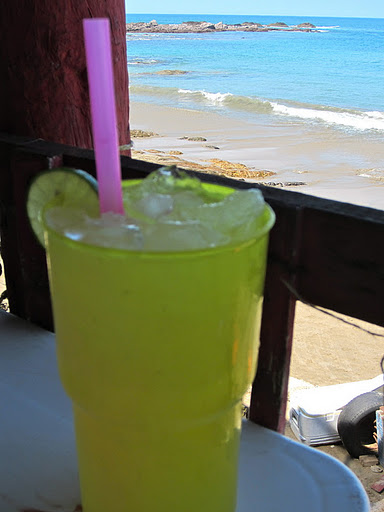
Freshly squeezed, ice cold lemonade!

I know a beach where the restaurants are plenty comfortable, and you can’t beat the freshness of the food served, the spectacular views, the joy of the environment, or the price. (Greg and I had barbecued corbina, two beers, and a fresh lemonade today, and we paid 220 pesos or about US$18 for the privilege.)

I know a beach where, in addition to the music, the food, the drink, there is plenty to keep you entertained while you are relaxing, including watching families out for a Sunday afternoon picnic and swim, and fishermen putting their boats in.

If you are from Mazatlán you of course know this beach: Cerritos. Decades ago when we first started visiting Mazatlán, Cerritos was a long drive up a lonely dirt road. The beach was great, and there were a few open-air restaurants just like today.

But today the road is paved, Cerritos is right next door to the huge, world-class El Riu hotel complex, and it lies at the end of a shopping mall that caters to gringos who stay in the trailer park. It is a mere 15 minutes from the Golden Zone. And Cerritos is still, fortunately, wonderful!

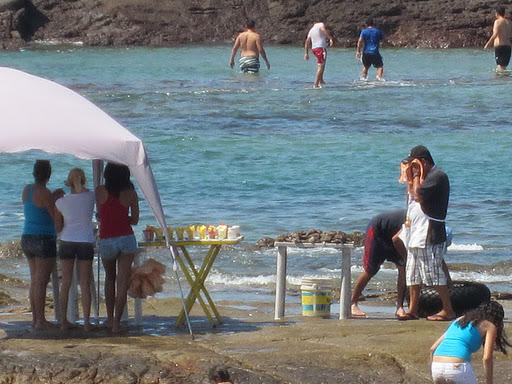
If you don’t want to visit a restaurant, you can picnic on the beach. You can bring your own shade, or, even easier, bring your ceviche and shrimp paté and…

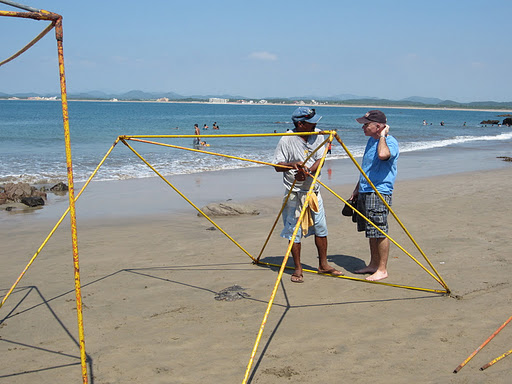
Rent some shade: 130 pesos for day use of a tent, a table and four chairs.

If you haven’t been to Cerritos in a while, you are overdue! If you’re heading down to Mazatlán, be sure to add Cerritos to your agenda!

Below I’ll add just a few random photos taken today that I thought you might enjoy.

Fishing net on the beach

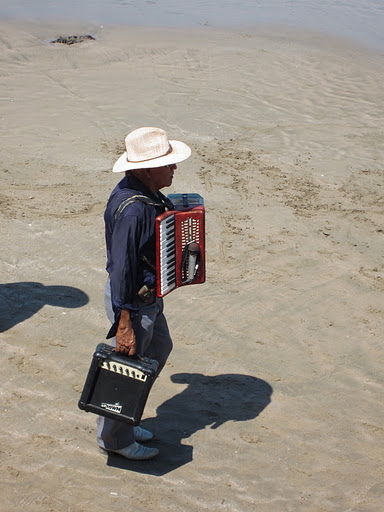
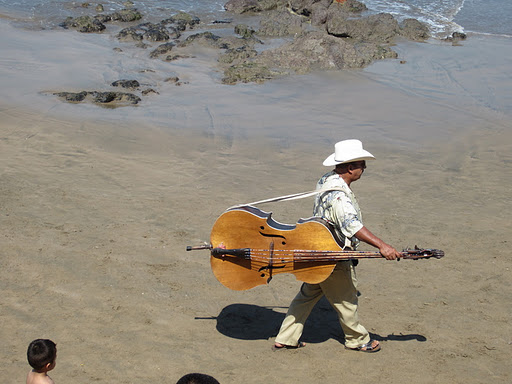
Músicosready to serve

Singly or in conjuntos

Natural swimming pool

Lots of families enjoying a day in the shade

Our restaurant from the outside

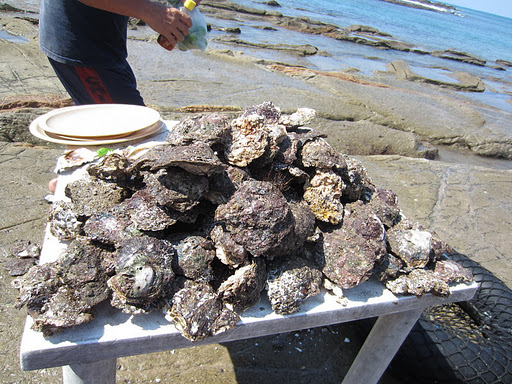
Oysters for sale