An "Aha!" into Mexican Culture

Agreeing on a time to meet and then having the other person show up late. Very late, at least by the clock. Or perhaps they don’t show up at all. You call the person. “Oops; plans changed. Can’t meet.”

Every expatriate living in Mexico knows that locals and expats often have very different orientations to time. It’s Mexican Culture 101. But knowing the difference, expecting the difference, doesn’t necessarily make it less frustrating when you’re living it on a daily basis.

Live and learn. That’s, hopefully, the story of life and most definitely the story of living abroad—a new adventure every day. We have sure learned a lot about Mexican and Mazatleco culture in the past four years of living here.

One of the learnings we’ve had that has really stood out for me this week is something I call “auto-protectivos” or “self-protectiveness.” In my day job I run a collaborative project in which we publish materials and a method for collaborating across cultures. I remember talking at length with my good friend, Rossana, co-author of Cultural Detective Mexico, after we first moved here. I told her that in my experience with Mexicans I didn’t really “get” the value she writes about called auto-protectivos. At the time she gave me lots of examples and talked me through it. It made sense. But I can’t recall what she taught me. I suppose I was not yet ready for it. I kept thinking, “but most Mexicans are very inclusive and welcoming. They’re not self-protective,” which I somehow saw as exclusionary.

On a very separate train of thought, I have repeatedly marveled at how Mexicans (or at least Mazatlecos) lack consideration for others. Please remember that I lived for years in Japan, the land of consideration for others. Any culture seems lacking in consideration compared to that. I’ve never felt locals here in Mexico lack consideration in a deep sense, as they are very loving people by and large. But in a superficial sense, more like: do they scoot down on a bench to make room for you to sit down or do you need to ask them? Or do they serve themselves food at a buffet without thinking about leaving some for those following them in line, that sort of thing.

Well, it turns out these two very different things — self-protection and my perception of lack of consideration — are actually very interrelated. I’ve finally developed my own “sense” around what this value that Rossana so kindly taught me means. It is fascinating how the learning comes in waves when you live overseas.

Let me share with you a few examples, from our experience, of when local friends have behaved (or we should have behaved) in a self-protective way, and how that relates to a possible outsider perception of lack of consideration for others:

  1. Yesterday, Greg and his compadre showed up at Sergio’s (another buddy’s) house at about 5:00 in the afternoon on a Friday, unannounced. Sergio greeted them in sweat pants and an undershirt. He got them plastic chairs and a beer and set them out in the shade of the street. He told them he’d be right back, and went inside to shower. We can’t imagine this happening in the States. If friends were to show up at my house unannounced, I might take a couple of minutes to change my blouse or to freshen my hair or face, but I’d sit down with my guests right away. But here the “wait while I bathe or finish what I’m doing” happens all the time, in our experience. While in the beginning I’d feel guilty for disturbing someone (“I should have called so they could have been ready”), I am now able to see their reaction as very functional auto-protectivo behavior. Sergio needed to bathe. He was happy to see his friends. He knew he’d be more comfortable if he were clean and refreshed, and he knew they would wait. They were comfortable. He was comfortable. All was well. No stress.
  2. Example two: Also yesterday, Danny had an event with a friend. He had another meeting with a second friend scheduled after the first. He was really excited about the first meeting. He wanted to make the second meeting, but more out of a desire to help a friend in need, more out of obligation. Well, at lunch we reminded Danny, who is by now quite bicultural but very responsible about his commitments to friends, “If you are having a great time this afternoon, don’t let the clock regulate you. Just call your other friend and tell him you’re running late. Take the time to enjoy yourself with your friend in the afternoon.” Well, sure enough, Danny did have a great time in the afternoon. When he called the second friend to tell him he’d be latE, the friend told him that oh, by the way, he’d have to cancel after all, because plans had changed. All was well. Everyone was happy. No worries. Four years ago, Danny would have ended his afternoon fun, arrived at the meeting spot on time by the clock for his second friend, had his friend not show, and then feel bad that he’d been blown off. It does strike me that this “self-protection” or taking care of yourself is actually a really healthy thing that a lot of gringos can learn from.
  3. Example three: We have a very good friend who is very handy. We often hire him to fix things for us around the house. He’s a compadre, so we’ve been all over the hora mexicana or hora gringa thing over the years. We both know cultures are different, and we know we are who we are. This morning our friend was due to come to our house at 10 am to fix an air conditioning thermostat that had gone bad. Greg and I needed to run a few errands. I said, “let’s go run them. Call him and let him know you’ll be back by 10:30. That way we can get our stuff done and still be on time by the Mexican clock.” “No,” Greg said, “I want to wait for him.” We talked it over. We decided that most probably he would arrive later than the appointed time, and we needed to take care of our own needs. If he arrived while we were out, he would call us or wait for us. So, we ran our errands. Got home about 10:45. Our friend had not come while we were out. When he did arrive just prior to noon, we were not at all inconvenienced. We had gotten done in the morning what we needed to get done. We had not inconvenienced ourselves, and we were happy to see our friend.

By exercising self-protectiveness in this cultural milieu, we don’t find ourselves getting upset at having waited, and we are able to take care of ourselves. It’s a very workable way of doing things. Importing some foreign concept of time or consideration of others just doesn’t bring joy or value to life here. We all have to find our own way, and acculturation is an ongoing process. We sure are enjoying the journey!

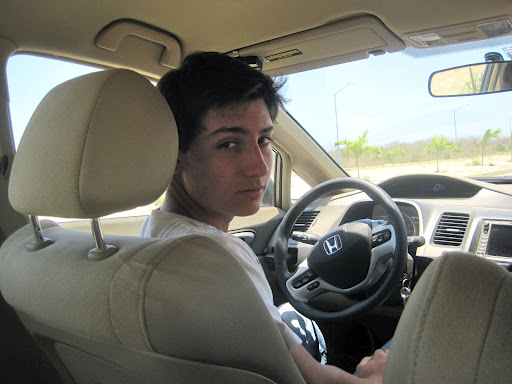
Getting a Mexican Driver’s License in Mazatlán

For many of us, obtaining our first driver’s license was a treasured rite of passage. When it comes to our kids getting their licenses, however, like many parents the thought scares me. And the scariness factor is amplified because our son is learning to drive in what, for us, is a foreign land, and one in which the driving, at times, can seem a bit crazy. Guardian angels please protect him and those near him!

Greg and I obtained our Sinaloa driver’s licenses shortly after we arrived. We took the required class, submitted our documents, drove around the block, had our photos taken, and oilá. Others pay a “fee” and have it all done for them, but we did it above-boards and it was easy-peasy. In fact, the class was downright enjoyable — the teacher is a very good storyteller!

Now Danny’s just gotten his license, so I thought telling you about it might prove helpful for someone.

In his case, he’s a new driver, and we’ve been teaching him whenever we get a chance for about a year and a half. He started out slow, as does everyone, but these days he’s become quite competent.

He wants to work this summer to save money to buy a used car, and he will probably end up buying one with a stick shift. But, our car, the one on which he’s learned, is automatic. So, we enrolled him in a driving school so that he could learn how to use a clutch. The series of classes cost 1450 pesos, and included four rounds of driving of two hours each time, or eight hours total. In addition, there was a three hour classroom session during which they studied rules of the road. He seems to have taken to the standard transmission like a charm.

On Saturday he went to the tránsito, which is located just in front of the Aquarium here in Mazatlán. From the malecón, turn on the street towards the Aquarium. Go past the statue of Don Cruz Lizarraga, and turn right on the street on the far side of the vacant lot. The DMV office (tránsito) is at the end of the street, last building on your left, on the corner. There are two doors. The door on the right is where you file your paperwork.

The door on the left is where you take a class.

First-time drivers under the age of 18 have to take a five-hour class. They tell us the class is offered twice/month on Saturdays from 8:00 to 1:00. The classes seem to be pretty full, and the kids get a certificate upon completion which entitles them to be able to submit paperwork for a license. They do not take a written test.

When we got our Sinaloa licenses we already had U.S. driver’s licenses, so we only had to take a one hour class. At the conclusion of the class, they gave out a written test. There was an English language version of the test that they give out here in town, which seems much much easier than the Spanish language version (it’s multiple choice).

After the class and after you pass the written test, they give you paperwork so that you can go next door and get your license.

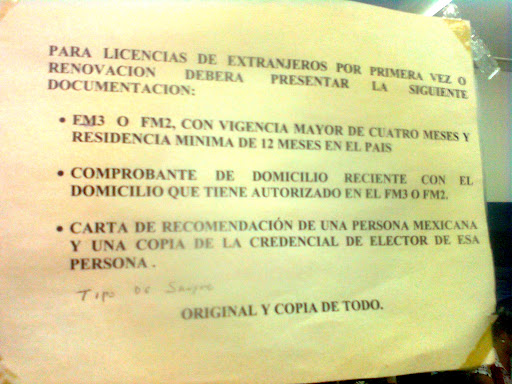
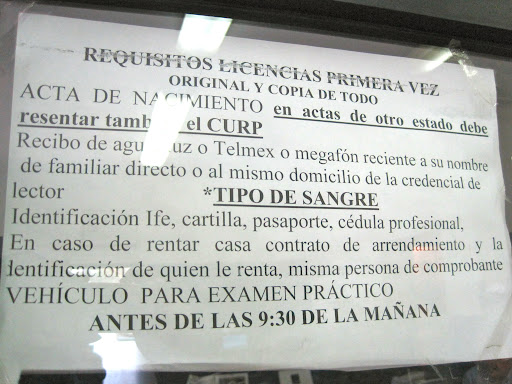
The documents a foreigner will need include (original and one copy of everything):

  1. Your Mexican visa or residency document
  2. Proof of residence/domicilio (water or electric bill with your name on it and your address)
  3. Letter of recommendation from a Mexican national, vouching that the person knows you and you are an upstanding person. This needs to be signed and accompanied by a copy of the signor’s voter registration card.
  4. You need to know your blood type (no proof required; just know it). If you don’t know, supposedly there is a lab about a block away where you can get tested. We know our blood types, so we didn’t experience this part of the process.
  5. The correct fee (see the photo at right for the chart of fees). Foreigners with FM3s are limited to 2-year licenses. First-time licensees pay for “Aprendiz.”


For first-time drivers like our son, you also need to bring:

  1. Birth certificate (to prove age)
  2. CURP
  3. Passport
  4. Parent needs to be present to sign

When you present your paperwork, they will usually ask you to do a driving test. So, you will need a car. They just asked us to drive around the block, nothing too challenging. We’ve been told that they want to be sure you buckle your seat belt and instruct the examiner to buckle his; this didn’t happen for us. Danny was also told that they ask you to pop the hood of your vehicle and show the examiner where you insert water, oil, coolant, etc., though he was not asked to do this.

Be careful as the street beyond the DMV office is one-way to the left; you don’t want to turn the wrong way. Also there are quite a few topes on the road leading up to the DMV office, as well as a stop sign conveniently hidden behind a tree.

After you drive with the officer, you pay your fee at a booth on the right side. Currently that fee is 344 pesos for a two-year period.

Next they take your photo and produce the license while you wait.

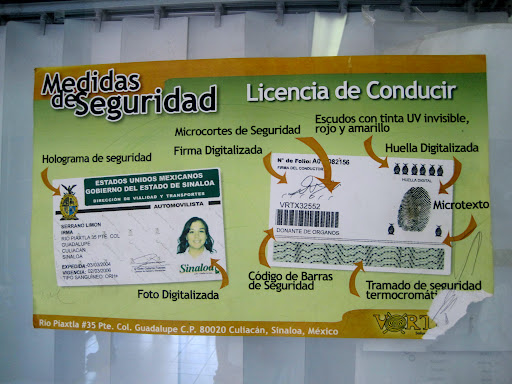
Each license contains a fingerprint of the license holder, so that’ll be the last step in the process. For us we filed the paperwork, did the drive around the block and got our licenses in under 90 minutes.

Licenses are issued Monday through Friday 8 am to 2:30 pm.

Renewals (as well as license plates, titles) can be done at this same office. However, we have had much better luck renewing our licenses at the DMV office in the Gran Plaza — it’s less of a crowd and seems to go quicker.

Good luck and drive safely!

NOTE: Our son said he learned a lot more in the driving school than he learned in the tránsito class, although he enjoyed both, and that he highly recommends the school for new drivers.

Expat Lifestyles in Mazatlán: Cathy and Bill

One of the cool things about foreigners who move to Mazatlán is the variety of lifestyles they can adopt here. While the vast majority are retirees, more and more we see families and working people relocating to Mazatlán.

At one end of the continuum we meet extranjeros who live very Mexican lives, adopting the culture, speaking the language and, perhaps, obtaining citizenship.

On the other hand we meet those who have little desire (or sometimes ability) to learn Spanish, who socialize primarily or exclusively with non-Mexicans, and who in many ways have replicated their lives from NOB (north of the border). People at both extremes seem to live happy and fulfilling lives here, which is great to see.

And, of course, there are lifestyles representing every combination in between these two extremes, including many who volunteer ceaselessly and selflessly and many who party and sunbathe daily, living the retirement life they always dreamed of. We have artists, lifelong students, those who start small businesses, and those who remodel and restore historic homes.

Amidst so much diversity, Cathy and Bill stand out. They don’t fit into the most common expat categories, and they are one of the most interesting couples I’ve met here. Both in their fifties, Bill has recently retired and Cathy is nearing retirement. They originate from the US east coast. A few years ago they vacationed in Mazatlán, fell in love, and bought a house on their very first trip here: on a whim, so to speak. The home they bought is in a typical, centrally located Mexican neighborhood. No modern marina area or Centro Histórico, areas in which many other expats live and where perhaps things might be easier for them. Ok, plenty of other foreigners live in neighborhoods with few foreigners. But, neither Cathy nor Bill spoke Spanish when they bought their home, though they are taking lessons and learning quickly. Talk about jumping into the pool rather than checking the temperature first with your toes!

They are not like some retirees who live in the typical neighborhoods because there they can live on social security and a small pension because life is cheaper. Nor do they live in a gated community with killer views. Cathy and Bill live in a nice home a block from the beach, in a mixed-use neighborhood of small homes and businesses.

What’s remarkable to me about Cathy and Bill is how completely open they are to the culture and the people here, despite their initial lack of language and experience with Mexico. To me as an interculturalist, getting to know them has been a breath of fresh air. We witness a lot of unfortunate cross-cultural misunderstanding and negative judgment in our daily lives here, and we ourselves are not immune to it as we create our community here. But Cathy and Bill are excellent role models of how to be open minded, and how to jump into a new community wholeheartedly.

They have befriended their neighbor, an air conditioner repair guy, who has “taken them under his wing,” so to speak. He has welcomed Cathy and Bill as a member of the family and local community. Thus, the couple is invited to the kids’ baseball games, school performances, and every extended family party and event. And Cathy and Bill go. They don’t let the lack of language or cultural understanding stop them; they see these as an opportunity to learn, to build friendships, and to build community. Their circle of friends here keeps growing exponentially, as they learn local slang, how to make ceviche, or how to rehab a car Mazatleco-style.

We first got to know them in the way we first connect with many of the foreigners we know here in town: online. Greg probably answered a few questions they had about living here. He happened to mention our plans to attend a Banda El Recodo concert with our neighbors. They asked us to buy tickets for them to attend as well. The first time we met them was when we delivered the tickets to their house.

We have not had the good fortune to get to know a lot of foreigners in town who attend bandaconcerts, though I know they exist. In fact, among the thousands of people attending that concert, I honestly believe we were about the only foreigners at the event. Cathy and Bill’s excitement about attending this concert paralleled our own. They didn’t stress, as so many new immigrants would, about the hours and hours we waited for the main event to commence. Concerns about safety or violence didn’t prevent their attendance, as it does so many others. They danced and hooted with everyone else, taking photos and videotaping with sheer delight. They ate and drank the local food, with no concern about getting sick. They looked around with us to try and figure out how people were getting chairs to sit on, and together we found the way and happily sat. Till the band came on, of course! It was really refreshing to witness in someone new to town; the differences seemed to energize them rather than intimidate them.

I can count on these two for a funny, self-deprecating story. They were recently invited to a “nephew’s” birthday party. Their friends explained and explained the location of the party to them. They drew them a map. The children attempted to explain in their best school kid English. But Cathy and Bill were still confused. But they’re committed. They drove around in circles, trying to find the location, until they finally found their friends waving at them: from Burger King! Yes, they hadn’t understood the Spanish pronunciation of those well-known words, but it didn’t hinder them from enjoying the party with their friends or from making the most of the story afterwards!

It so happens that in front of where Cathy and Bill live is a large empty lot. When they bought the house, they wondered about it: whether and when it would be developed, mostly. Little did they know that this lot becomes home to major city-wide events a few times a year. While the crowds, litter, noise till all hours of the morning, and dust might bother a lot of people, instead of complaining Cathy and Bill embrace the excitement. “What a great location we have the good fortune to live in,” they say!

Their open-mindedness and enthusiasm are supplemented with a real desire to thank those they feel have made their new home such a joy to them. Each fall for the past few years, when Cathy and Bill drive south to their winter home, they pack their vehicle to the brim with bicycles and sports equipment to give to local kids, and a few adults who are now able to get to work much more easily.

It’s people like Cathy and Bill who make me really proud to be an American. Thank you, friends.

Readers, I first wrote this post a year and a half ago. Somehow the file became corrupted, and this was never posted. Now that I’ve figured out how to “rescue” the file, I’d like to give you a short update.

Cathy and Bill drive down to Mazatlán every year. They spend their summers up in the US going to garage sales and second-hand stores, buying used baseball equipment, bicycles, baby swings — you name it, but things that people here might find useful and hard to find the extra money to purchase. They fill their truck and haul it all down here every fall. They spend the first month they are here finding good homes for all these items.Parties at their home have now become an annual tradition. The neighbors block traffic on the street, one neighbor cooks tacos, another provides the DJ service, Cathy and Bill provide the tables, chairs, paper ware and beer, and fun is had by all. Last time we went there had to be 150 people there; and the four of us the only foreigners! They have far more patience, perseverance, and tolerance for ambiguity than I could ever hope to have. They give so selflessly and so joyously, and their love is returned to them multiplied many times over.

They spend every weekend cheering on their local friends’ kids at the kids’ baseball games, and they’ve been invited to many, many homes and parties. Even though they are here part-time, their lives are so intertwined and important to their Mazatleco friends. It is really wonderful to see how loved they are. Just last night, their friends here hosted a surprise going-away party for these two. Over fifty people attended.

Way to go, Cathy and Bill! Thank you for helping keep Mazatlán the multicultural mix it has always been! And for helping make our world a better place. Enjoy your NOB summer! We will miss you!

Pescadería del Mar/Our Fishmongers

One of the best aspects about living here in Mazatlán is the fresh fish we are able to buy every morning. Okay, well, we don’t go on Mondays, because there’s not been a lot of fishing on Sunday, but any day Tuesday through Saturday, you can bet we are happy campers.

We take our daily walk down the malecón and, in Playa Norte just across from the pangas, is our favorite spot: Pescadería del Mar.By now these guys know us and they’ve helped us to learn a lot about fish and fishing here in town: what’s seasonal, how fish are stored (on ice, frozen, salted) from the time they’re caught till they’re brought in to shore, and how to cook what’s available locally.

At 7 am when we’re there we usually have a terrific selection. Of course, depending on the season and the weather, we may have more or less fish to choose from. As you can see in this photo, though, there’s usually quite a variety.

The fishmongers will scale and clean any fish we choose, so I can cook it whole, or they’ll fillet (de-bone) and cut up anything we’d like, however we’d like it. They also get fresh shrimp, which I love, because they are deep water shrimp that have NOT been stored in salt, so they’re sweet rather than pungent. They get quite a bit of squid, also, which I love to saute with garlic and herbs. We can occasionally get fresh scallops, too. Our favorite is corvina, a nice firm fish that is sooooo savory! We can at least a couple of times a week get smoked marlin (usually still warm from the smoker and sooooooo aromatic!), and escabecheon Fridays.

It’s fun to watch either the fishermen fresh off their pangas across the street, or a dealer/go-between (usually on a scooter or motorcycle) come to deliver the fish to the fishmongers and make a deal. They have an outdoor scale to weigh what’s brought in, and an indoor scale to weigh what you purchase before it’s trimmed to order.

Having lived so many years in Japan, I am also very happy when they get sushi-quality tuna, though I do believe most of the fresh fish they have is sushi/sashimi quality. Chirashi has never been so delicious and affordable!

If you are a carnivore/omnivore, and do not take advantage of our local fresh fish, please do! You are missing some really flavorful and healthy, and easy and quick to cook, local delicacies!

Los Tigres del Norte Banned in Chihuahua

Los Tigres del Norte, one of my favorite (and one of the world’s most popular) bands, was banned yesterday from playing in the city of Chihuahua. They were banned for playing a very popular narco-corrido based on a soap opera and book, La Reina del Sur (the city of Chihuahua has banned narco-corridos).<.div>

The Mexican press, and most Mexican people, are upset about and vocal in objecting to this cavalier censorship.

I value free speech, and do not believe in censorship. It is interesting, though, that this ban occurred because Chihuahua city is trying to change its culture. It is trying to take the narco culture out of norteña culture, to stop the glamorization of criminal activity, to restore responsibility and good citizenship to its citizens.

Northern Mexican norteña culture has become closely mixed with narco culture. That cultural mix includes a style of dress (one extreme is those tippy-toed guarachero boots), a unique vocabulary and style of speech, songs (narco-corridos are songs that glorify the life of the outlaw), and even a patron saint whose image, likeness and altars can be found in most any colonía (Jesús Malverde, so-called patron saint of the drug lords and lost causes).

Mexico is a large country, as is northern Mexico, and norteña culture as influenced by narco culture has a diversity within it. There is also spillover; many people who have nothing to do with the drug trade may build an altar or light a candle to Malverde (unwed mothers may pray to him, for example, as might people who have lost their jobs) or have his face emblazoned on the window of their pickup truck. And, MANY of them listen to what can be called narco-corridos. The particular song for which my Tigres were banned, ironically, ends with the outlaw (a woman) being punished for her crimes.

Chihuahua’s ban is personally ironic to me because last year, I posted on the Facebook page of another favorite band of mine, la Banda El Recodo, sharing with them my disappointment that they had released a song so far below the respect and esteem with which they are held by the public (the song talks about guns, arms, bulletproof vests; it encourages people to get drunk and shoot bullets into the air; the official video involves non-stop drinking, high-priced cars and watches, and ends with the lead singer pretending to shoot the viewer). In hindsight, was I censoring? I know my motivations were the same as those of the city of Chihuahua: El Recodo is at the top of their craft; people respect them. I love them, and I love Mexico. I wanted them to stand for and promote what is good about Mexico, help make it a better place, not glorify and feed the worst of our local culture.

What do you all think?