I don’t think anyone has officially declared this “European Week,” but I hereby make the nomination. Mazatlán is quite famous in western Europe these days… I’m sure you’ve heard that our State Secretary of Tourism, as well as the mayors of Cosalá, El Fuerte and El Rosario, are in Madrid, Spain this week for FITUR, the International Tourism Fair, as part of the Mexican national delegation. The fair opened yesterday and goes through Sunday the 26th. FITUR is a huge event with enormous upside potential, with over 120,000 tourism professionals from 165 countries attending.
This slideshow requires JavaScript.
Just now I’ve learned that a crew from BBC (yes, British Broadcasting Corporation) has been here in town. So, the European connection continues! A director, producer, cameramen and two Irish actors, Dara O’Briain and Ed Byrne, are here for two days to film a documentary series on Sullivan C. Richardson’s Pan American Highway Expedition of 1940-1941 — the first successful attempt to drive an automobile from the United States to the tip of South America. Their route would eventually become the Pan American Highway. In 1942 Richardson wrote a memoir of his journey, titled Adventure South: Three Men and a Lone Car Blaze the Pan American Highway Route Down Two Continents to Cape Horn! Apparently the original expedition made its way through Mazatlán, and the book records that they had a very pleasant stay here. Richardson wrote of the warmth of the Mazatleca people, and the fact that his group spent the night down by the divers in Olas Altas, as they didn’t have money for lodging. They are filming at the diving platforms and the Hotel Belmar, as well as the Mazatlán-Durango Highway and the Baluarte Bridge. The series is planned to air on BBC this coming December.
Have you not seen them around? Here’s a short video clip that SECTUR assembled:
What next, everyone? May Mazatlán’s fame and fortune on the European stage continue 😉
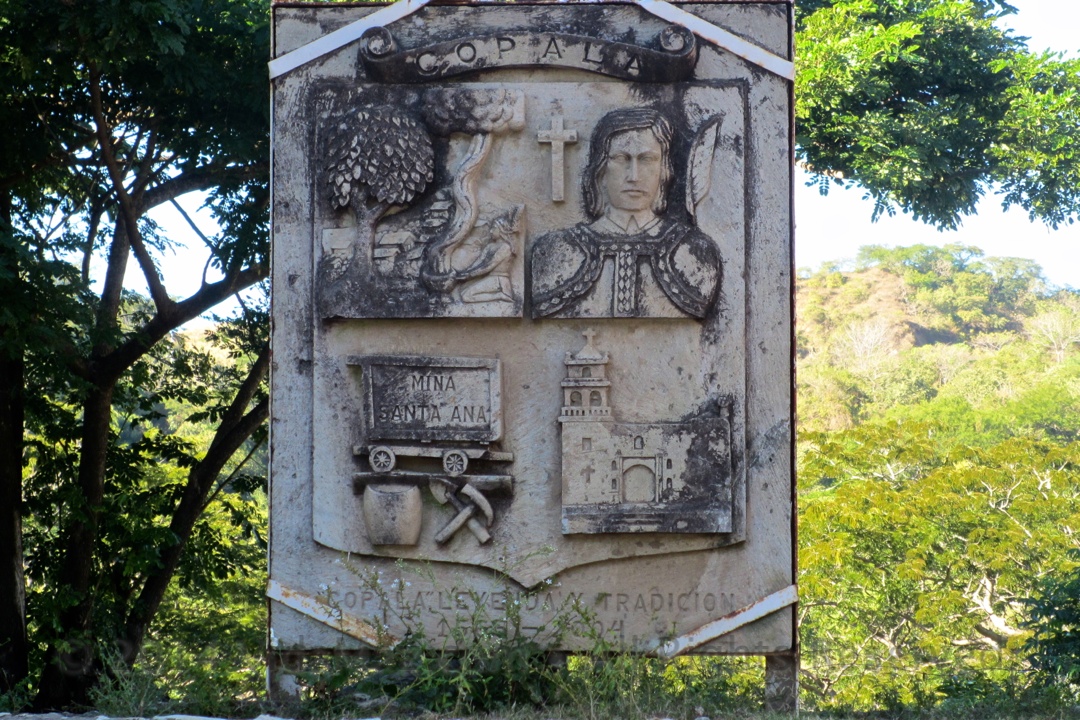
Copala (San José de Copala) is a picturesque little town southeast of Mazatlán, just past Concordia. The smallness of this village, the charm of its winding, hillside cobblestone streets, and the friendliness of its people, make it one of our favorites.
Populated by indigenous people and then “founded” by Francisco de Ibarra, veins of silver were discovered nearby Copala in 1565 and the town grew to serve the mines. It was destroyed during an uprising by the Tepehuan Indians in 1616; its church was built much later, in 1748.
You can tell by the beauty of its church and central plaza how wealthy Copala became, but it has definitely fallen on tough times now. The incredibly lovely church has plants growing from its steeple and facade, and is in desperate need of restoration—though this mix of opulence and ruin does create a thoughtful charm.
Coming into town
Entering Copala
Entering Copala
Along the main street
Church in Copala
Door of the church
At least there’s no Santa Claus…
Interior of the church
The altar
Closeup of the altar
Rain spouts on the church
View from the church
The belltower
Closeup of the belltower
The side door of the church
Over the side door of the church
Window of the church
Over the main entrance
Closeup of the bellower—plants growing
Closeup of the bellower—plants growing
On the town square
Mural on the town square
Town square
Tiled rooves
Tiled rooves
Tiled rooves
Copala architecture
Copala architecture
Copala architecture
Copala architecture
Copala architecture
Copala architecture
Copala architecture
An elderly resident crosses the square
Bougainvillia
Bougainvillia
Typical homes
Typical homes
Lush foliage
Cobblestone streets
House of stone
Old window
Carved stone
Old home
Stone wall
Coming home from school
Coming into town you drive past a small cemetery. Once you are in town, children will likely approach you with hand-carved wooden replicas of the home of Copala, quite nice souvenirs. There are several restaurants in which to eat here. Years ago we always ate at Daniel’s, but that is closed since his death. Chalva’s famous banana coconut cream pie (or a replica of it) is still served in several local places. The last time we went to Copala, we ate at a new restaurant—Alejandro’s—just down the hill from the plaza. The view was outstanding, and the cook (owner’s wife) even more so. For such a small town, it is surprising that Copala also has several places to spend the night.
Cemetery on the east end of town
Cemetery on the east end of town
View from the terrace of Alejandro’s Restaurant
One of the places to eat or stay
Cemetery on the east end of town
Another restaurant
There are souvenir shops and a mining museum that, despite appearances, we are assured still opens regularly. It was not open the last time we visited Copala. While there isn’t a whole lot to see here, we highly encourage a leisurely visit. It’s a very welcome respite in a busy life: a beautiful place to read a book, make some sketches, or just sit, visit, and relax a spell. Copala is also a very worthwhile stopover on the way to or from Durango.
The mining museum
The mining museum
Driving Directions: Copala is just over one hour southeast of Mazatlán. Take highway 15 south pass the airport to Villa Unión (about 13 miles from Mazatlán). Turn east on the free (libre) version of highway 40, towards Durango. After about 15 miles, you will pass through Concordia (read here about this wonderful furniture making town) and another 15 miles later you will see the exit for Copala.The exit is clearly marked, but easy to miss if you are speeding or distracted. As soon as you exit, you will be on a cobblestone road — one of the hallmarks of this magic town. The road splits quickly and you should go to the left. You will pass by a beautiful cemetery and wind your way into town. Just stay on this main road, and you will find yourself in the plaza in front of the old church. The drive is beautiful and easy, as you pass plantations of coconuts, mangoes and bananas. Just don’t get on the new highway.
For those traveling this way from Durango on the new highway, there is a cutoff to the old highway which lands you in Concordia. From there it is a simple 15 minute drive back northeast to Copala. It is a very convenient stopover and well worth a little extra time.
Chairman Kuroda receiving a plaque from State Secretary of Tourism Cordova, State Secretary of Health Echeverría, and Mazatlán Mayor Felton.
Mexico’s General Health Council has given Mazatlán’s own Hospital Sharp an impressive 9.5 out of 10 points on a prestigious patient care accreditation, making it one of only two hospitals in Sinaloa to achieve such a ranking. The award comes after several years of painstaking work by administration and staff—from janitors, cooks and bookkeepers to doctors, nurses and technicians. Greg and I were pleased to be join the banquet on top of SECTUR’s offices on the malecón last Wednesday night, to honor those involved in this effort to better position Mazatlán in national and international medical tourism markets. It was a joy to be in the presence of so many different types of medical professionals enjoying one another’s company and accomplishments.
In attendance were Mazatlán’s Mayor Carlos Felton and the first lady, Sinaloa State Tourism Secretary Francisco Córdova and his wife, and Sinaloa State Secretary of Health Ernesto Echeverría. During the banquet 35 division heads and key staff received commemorative plaques. Ing. Juan Manuel Kuroda, who is Chairman of the Hospital’s Board of Directors and the primary investor in Hospital Sharp (yes, also owner of Kuroda tile), says, “We are very proud of our 219 dedicated employees who were instrumental in achieving this result. In addition to serving the needs of our local population and foreign visitors, with this certification we are also able to compete on a level playing field in the Medical Tourism market worldwide.”
The accreditation centers on patient care. Each aspect of the quality of medical attention and patient safety, from evidence gathering to diagnosis and treatment as well as accurate record keeping with precise checks and balances was evaluated against international standards.
Hospital Sharp has a modern physical facility with open spaces and 41 single-bed rooms, along with constant fresh air intake to lessen the transfer of germs and illness. It is a full service, 24-7 surgical facility, has the only dialysis facility in Mazatlán, and is completely self-sufficient—equipped with powerful generators in the event of a disruption in electrical service. Construction began in 1994, and the facility was built to USA standards. Hospital Sharp Mazatlán is located at Av. Rafael Buelna y Dr. Jesús Kumate S/N Fracc, Hacienda Las Cruces C.P. 82126, Mazatlán Sinaloa, telephone (669) 986 56 78.
Mayor Felton’s speech from the event:
Judy Setrakov, who works at Sharp as a medical tourism consultant, received a special tourist ambassador award. She, Doctor Juan Fernando Barraza, and Christian Barrios form Sharp’s Medical Tourism group. They can be reached at the number above, extension 336.
On a completely different note, I also found out on Wednesday evening some extremely exciting news. Carnavál Internacional de Mazatlán will have a Japanese-themed float and dance group this year, to commemorate 400 years of Japan-Mexico diplomatic relations. The float will be a samurai ship. I have been invited to the dance troupe. Special choreography, including a “tequila o-dori,” will be performed, taught to us by a Japanese dance professional from Mexico City. That changes up our annual parade party, but it sure should be fun!
Over Christmas and New Year’s we had the pleasure of hosting five different sets of visitors to Mazatlán. It felt so incredibly wonderful to spend time with loved ones, and to be able to share the gorgeousness and warmth of our adopted home with them. It was fascinating to us how each group experienced Mazatlán differently. Our city has so many different faces, there is truly something for everyone—the beach bums, the farmers and ranchers, the culture mavens, those who love to eat, party or shop.
During this time we took several trips to our nearby mountain towns. We so love these trips, to a simpler life, a slower and more rural life. It struck me that we have not written that many posts on these day trip towns, so I aim to remedy that. Since we visited at least five, and that’s a whole lot of writing, I trust you’ll permit me to tell you their stories primarily in photos. Photos will give you a sense of the place, and let you know if you’d like to visit—whether for the first time or the 50th.
Let me begin with Concordia, about an hour southeast of Mazatlán, towards Durango. It’s easy to remember Concordia among the many beautiful small towns in southern Sinaloa, because the main plaza in town has that gigantic chair, representative of the solid wooden furniture crafted here. Sit in it, with the gorgeous church behind you, and you feel the joy of childhood again. Concordia is also the birthplace of the famous raspados, or shaved ice flavored with real fruit syrup. Founded as “Villa San Sebastián” in 1565 by Francisco de Ibarra, Concordia today has about 9000 residents. Its history is steeped in the gold, silver and copper mining of this region.
A window on the main square of Concordia
Main square of Concordia, Sinaloa
The Palacio Municipal/City Hall
Main square of Concordia, Sinaloa
Inside the Palacio Municipal
Side view of the Palacio Municipal
Walking the streets of Concordia
Walking the streets of Concordia
Walking the streets of Concordia
Three Kings’ Day parade remnant
The tortilla factory ladies
Walking the streets of Concordia
Walking the streets of Concordia
A second church
Walking the streets of Concordia
Walking the streets of Concordia
Loved this door
Walking the streets of Concordia
Walking the streets of Concordia
Walking the streets of Concordia
Walking the streets of Concordia
Bike awaiting its rider
Flowers along the street
An old window
Giant chair in the main square
The main church, San Sebastián, is really beautiful. Built in 1785, it has an ornate baroque facade.
Iglesia San Sebastián
The altar
The interior
Door to the church
A crucifix
Gorgeous interior doorway
Baby Jesus with some toys
I liked this saint; not sure who he is?
The Virgen
The screen at the front entrance
Detail of the facade
The belltower
View of the belltower
Rain spouts
Founding plaque
Concordia also has hot springs, which are on the left, down a dirt road, just before you get into town.
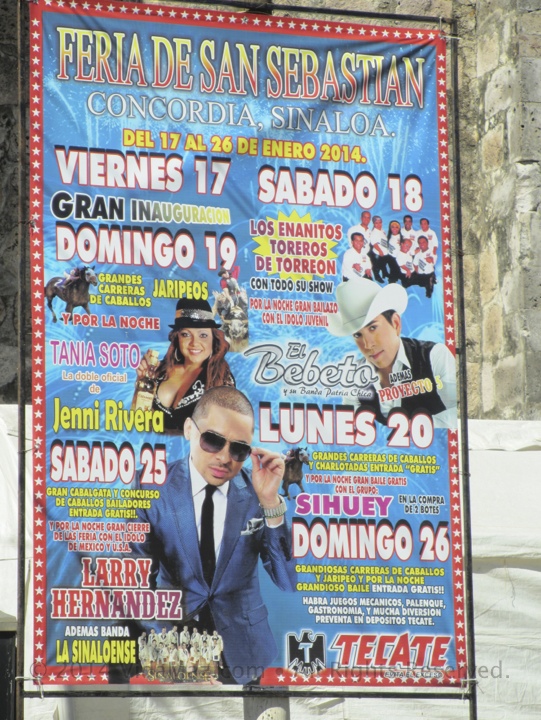
If you’re looking for something to do this weekend, the Féria de San Sebastián takes place over two weekends: from today (Friday January 17th) through Sunday the 26th. This Sunday the 19th is the seventh annual cabalgata or horse race, starting at 11 am and going from Mesillas to Concordia, concluding at the fairgrounds after a march around town. They are anticipating 450 participants in the cabalgata, and you’re sure to see some gorgeous charrería.
My friend Salvador Herrera made a video of Concordia for the “Un Mundo Mágico” project.
Driving Directions:
Concordia is one hour southeast of Mazatlán. Take highway 15 south to Villa Unión (about 13 miles from Mazatlán). Turn east on highway 40, the old free road to Durango, and continue about another 13 miles. The drive is beautiful and easy, as you pass plantations of coconuts, mangoes and bananas. Just don’t get on the new highway. For those traveling this way from Durango, Concordia is also a very convenient stopover.
How would you like to win some incredible items, and help those in need in our community at the same time? It’s a combination that can’t lose!
Desayuno de los Pollos, “Breakfast of the Chickens,” is this Saturday, December 7th (tomorrow), beginning at 8:30 am. This is a morning-long event. Tickets are 150 pesos each and include breakfast and a raffle ticket. Buy tickets at the door! Breakfast will be held at the Cruise Ship Terminal (API). You can also donate some money (100% goes to buy food for the needy) using this link. There will be a silent auction and a full holiday bazaar of handcrafted, donated items for your shopping pleasure.
There are many more gifts than those below. Please join me in THANKING those who have donated to support our community. Mention your appreciation to them next time you see them, won’t you?
Original artwork of an ulama player by Armando Nava
A 300 peso gift certificate to Tippy Toes Salon or Marrakesh Spa
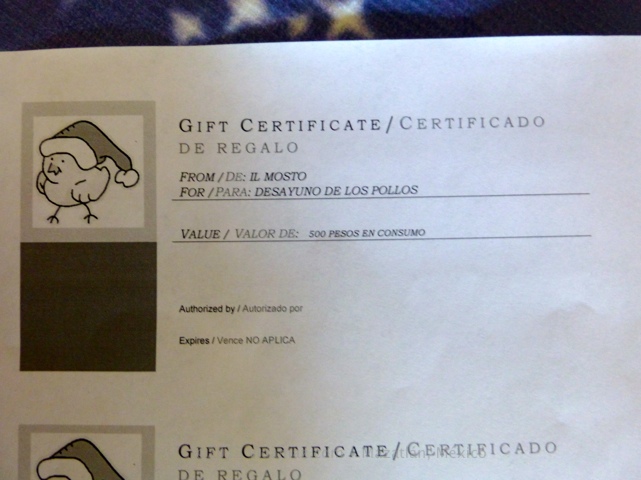
500 peso gift certificate to Il Mosto
Handmade leather mask from NidArt
Two facials and massages from María José Wong Loubet
Two beautiful handmade baby quilts
A handpainted wooden school desk
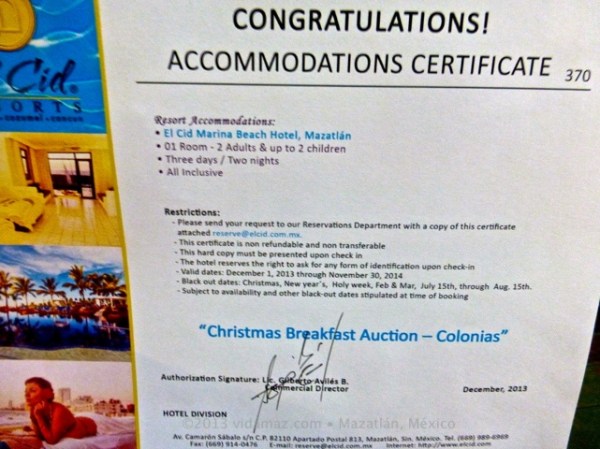
All inclusive two days/three nights for two adults and up to two children at the luxurious Marina El Cid.
Two nights in the beautiful Casa Buena Vista at La Rosa de las Barras, on the beach in Barras de Piaxtla.
Click on any of the photos in the collage below to enlarge it or to view a slideshow of other prizes and auction items.
Three one-year agendas that includes a weekly photo of Historic Mazatlá
100 peso certificate for Cafe Allegro
Five certificates for 30 kg of gas from GasPasa
20 one month subscriptions to the Noroeste newspaper
A car wash from Joaquin and company
Several haircuts from Kaly
2 hamburgers and drinks at Beach Burguer
Gift certificate for 200 pesos worth of dry cleaning from Imperial Cleaners
One specialty pizza from La Rustica
Five certificates for chiropractic treatment from Diego Martin López
Two gourmet breakfasts with a view for two people at the elegant Las 7 Maravillas.
A beautiful woven scarf/shawl/wrap, in a gorgeous print, from Casa Etnika.
A delicious breakfast for two people at Lauren’s restaurant in the chic Hotel Jonathan.
One free meal (of your choice) from Chikkowi.
One gift certificate for a one-hour massage and a facial, and a second for a pedicure, at the luxurious Athina Spa. You deserve it this holiday!










 ¡VidaMaz!