
My Thursday Pendientes (Errands)

Warning – this is a long and potentially complicated little story, but it is a typically wonderful slice of everyday life in our new home.

I had arranged to meet Jesús at noon in front of his office. Jesús is the agent who sold us our major medical insurance coverage. He signed us up for a plan that has discounts for three things: having an account with their bank, paying automatically from that account and paying one year up front. So far so good, right? We set the account up with the minimum balance of 30,000 pesos about ten days ago. He was there to help us (by the way, did I mention he speaks no English and very much enjoys my Spanish?). When we made the deposit, we had to pay a government tax of 2.5% on everything over 25,000. Not a big deal, just a surprise. I assume that this is Mexico’s way of getting a piece of the underground economy that exists here, but who knows. Anyway, the problem is that the insurance costs just over 30,000 and we have to maintain the minimum balance. We realize that we need to deposit 35,000 more. Jesús remembers that we don’t like paying the tax and, being the kind and helpful guy that he is, he tells me he has a way to get around it.
The plan: meet him at noon, go to, for lack of better words, the telegraph office by the post office in El Centro. Deposit the money, which gets recorded as a transfer instead of a deposit, and thus no tax. Sounds very strange to me, but okay, we’ll go and learn.
I pick him at noon on the busiest street in Mazatlán. I hate driving on Ejercito Mexicano. It is always packed and dangerous. I know where we’re going, but not his way. I know parking will be a you-know-what—it always is.
We get to the general area of the office uneventfully. We start looking for a parking space.

Learning #1 – the relaxed approach to finding a parking space. He directs me through a series of four right turns covering about a three block radius. Very patient, never frustrated, prepared to drive all day if necessary. We don’t see a singles spot. He doesn’t comment, other than instructing me repeatedly, “a la derecha” (to the right).
We find a spot three blocks from the office. As usual, there are car wash guys on the street. I am in the habit of always saying no. I say no, the guy gives me the sign of he’ll watch my car for me. Great, I think. He then asks me again if I want the car washed—he points out that he has fresh, clean water. I remember that Dianne wants the car washed so I ask how much. He says three dollars. I say no. As I am about to say 30 pesos, Jesús takes over and says 20 pesos. I guess I have always paid too much! They go back and forth and can’t agree. Then they start negotiating the time it will take. The guy says 30 minutes. Jesús says 15. The guy finally comes down to 25 pesos; Jesús simply tells him we’ll pay 20 and we’ll be back in 15 minutes.
Learning #2 – Only pay 20 pesos to have my car washed on the street.
We walk to the telegraph office. Dark windows, no sign, it looks abandoned. There are two large counters inside. One is labeled Telegraph/Fax. The other has no label and has two staff members behind a teller cage with computers. There is a large banner hanging on the wall behind the counter, and it has the logos of all the utility bills you can apparently pay here. There is only one customer and he is a blind guy who is just finishing up something.
Jesús tells the guy we need to deposit money. He asks for my account number and name. I give him that and he proceeds to push buttons on his computer. The application he is using is web driven and he keeps getting web errors. At this point I am not optimistic. As the “teller” works on this, he and his fellow staff members are giving directions to the poor blind guy on how to get out of the office. “Derecha!” (right), they yell, but the blind guy keeps going “derecho” (straight). He has an old wooden stick that he is trying to use and he is about to walk into a white moto-scooter parked in the lobby of the office (don’t ask). The guy apparently is not just blind, so Jesús goes over to walk him out the door.
Learning #3 & #4 – Help blind people and don’t park your moto in a telegraph office lobby.
When Jesús returns, the teller is midway through telling me that the bank has rejected my money. Jesús asks him to try 30,000 pesos instead, then 25,000, then 20 and finally 15. No luck; we are rejected. At this point, I have invested 30 minutes and for 20 pesos hope to have a clean car. I don’t mind paying the tax, I explain as we head back to the car. No problem, Jesús tries to explain. He has another plan where we put money in some other account(s) (his maybe?) and then transfer them to mine. Not fully understanding, I nod and appear to be distracted by the passing circus advertisement.
What is a circus advertisement? It is a caravan of six or seven very large cages on trailers pulled by large pick up trucks that parades through town followed and led by mini trucks with loudspeakers repeating how great this circus is and why you need to take your kids to it. As we walk, we see five tigers, four camels, one buffalo, two zebra, and a few miscellaneous other animals. We turn away from the circus parade towards the car.
The car appears to be clean. It has the standard “finished” symbol: wipers sticking up and away from the windshield. The guy who washed our car is not around and someone else is in his place. There are four guys on the street all washing and parking, but my guy has apparently moved to another part of the street. Jesús says to get in and we’ll pay as we turn the corner.
We drive about ten feet when one of the other car wash guys stops me to have me roll down the window. He wants 40 pesos. I tell him no, 20, and no, not to you. Jesús takes over and they jabber back and forth about 40 pesos and 20 pesos and the gist of it is this guy says they never clean for 20 and he wants to get paid. Jesús says to give him 20 and drive away. Traffic has opened up in front, I am getting beeped at, and so I agree. I hand him 20 and drive away. The guy we paid walks ahead and greets the guy who did wash my car and hands him the money. That guy looks at me like I have robbed him. I lock the door, roll up the window and drive away.
Learning #5 – Maybe 20 pesos is not enough for a car wash.
As we turn on the one-way street to get back to the Avenida Del Mar, I see really bad news. We are now in the middle of the circus caravan. For the next 12 minutes, I listen over and over to the announcement as Jesús and I practice the Spanish and English words for all of the animals. With the help of some desperate pulmonia drivers, we create a second “lane” and attempt to get around the circus. Doesn’t work; the circus parade is too damn long. The police officer who could be helping direct traffic is too busy with his camera phone taking pictures of the African safari passing by his intersection. A few minutes later, we do get back onto the Avenida Del Mar and head back to Jesús’ office.
I find parking one half block before his office and tell him that we’ll be walking. Parking?—American Style. Very effective. As we walk in the bank, he tells me to wait for a minute. I then clearly and strongly tell him in Spanish that I have taken too much of his time today and I am happy to pay the tax (besides this, there is no line at the moment, a rarity in Mexican banking). He smiles and says he will wait for me. They have a silly rule about no more than one person at the window at one time. I guess thieves travel in pairs or something.
I manage to deposit my money quite easily and no tax is ever spoken of. Great! I tell Jesús the good news about no tax as I prepare to leave and, unbelievably, he goes over to talk to the teller! He returns and without mentioning anything about taxes, tells me that I have to go back and collect my contracto. I go back and she asks for my account number and passport. I give her my passport and a piece of paper with my account number. She hands back the passport and says, in Spanish, “no, yours.” I look at what I thought was my passport and see that I have been carrying Dianne’s passport around all day. Great, sure glad the telegraph office didn’t need it. We go back and forth about my Kansas driver’s license and why it is curved and why you can’t read the address and yes, that is me, just a few years ago, please, please please. No, evidently whatever this contracto is, it can’t be given to just anyone. Final answer, I will need to come back mañana.
Learning #6 – Don’t carry anyone else’s passport other than yours.
Time invested so far, about an hour and ten minutes. Money, 20 pesos for a mediocre car wash. My next job is to go shopping and get food for lunch and get home in time to cook before Danny gets home. I decide to go to the Old Ley as it is close. I get my cart and proceed to the back of the store where the milk always is. I need milk, apples, bananas, and something for a main dish. I park my cart in the middle of the aisle and walk over to grab some milk. I find two with good dates and as I am walking back to my cart, the power goes out.
Lesson #7 – There are no emergency lights in Old Ley.
The old women start screaming, the staff starts hooting and I reach for my cell phone in the hopes of getting a little light in the midst of jet-black darkness. A few hundred feet away there is light coming in through the front door, but none of it can reach those of us in the bowels of the refrigerated section of the store. In a few seconds, one phase of the power comes back on. This gives some light, no air, and no refrigeration. In my mind, I’m thinking how often does this happen and no wonder the meat is funky sometimes.
I get home two hours after I left. I made a bank deposit, bought some excellent pork, got the car washed, practiced Spanish with my new friend Jesús, and if I ever need to send a telegraph I know where to go!

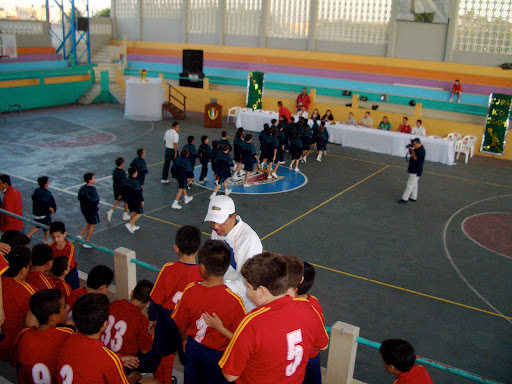
Inauguración de la temporada de futbol

Danny has played soccer since he was about four years old. We’ve been through the routine: practice, practice, practice. Hand out the uniforms. Receive a season schedule, as well as a sign-up sheet for parents to bring oranges and drinks to one of the games. Take the group photo. Pay for the photos, and forget to send the photos you’ve purchased to friends and relatives, so that you save a whole pile of years of soccer photos in the drawer, untouched. Attend the games and yell and scream and have a terrific time with the other parents. Play in a tournament or two, and maybe win a trophy or medal. No ceremony for the winners; the medal or trophy is handed out whenever, after the close of the tournament. Have a swim party at a parent or coach’s house to celebrate the end of the spring season.

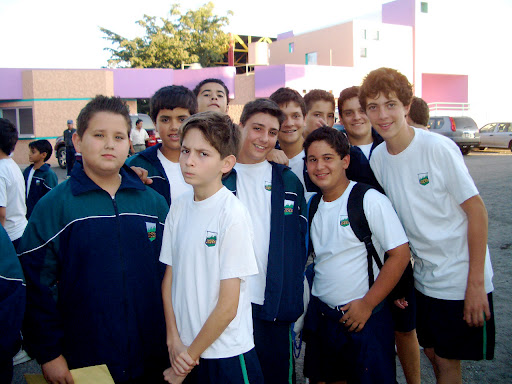
So, this is our first year in Mazatlán. Danny’s now in junior high. He was psyched to be able to make the school futbol team; he was worried his American skills wouldn’t be good enough down here, where kids have grown up playing street soccer every day. They do have great ball handling, but Danny’s fast, and a sound defender. He’s gratefully on the team.
Last week Wednesday we are told that he needs to be at ICO, the major school in town, tomorrow at 4:30. No other info. Forget that we might have other plans; everything here is always last minute (like hearing on Friday night that the first game of the tournament will be Saturday morning at 8 am, or hearing Tuesday night that Wednesday there won’t be school. People here aren’t big on planning and prior notice). On Thursday at school Danny’s told to bring 20 pesos, a copy of his birth certificate and school ID, and his PE uniform to ICO that afternoon.
So, we drive to ICO. We’ve taken a small camera, just in case. We are not sure what to expect. Sign-up for the soccer season? If so, we expect long lines, and figure that’s why we’ve brought the birth certificate and 20 pesos. Perhaps a scrimmage or a game? Maybe team photos? We have taken Danny’s soccer team uniform, shin guards, cleats and ball just in case—good Boy Scouts that we are, we are prepared for anything as we have no idea what to expect. As usual. 🙂
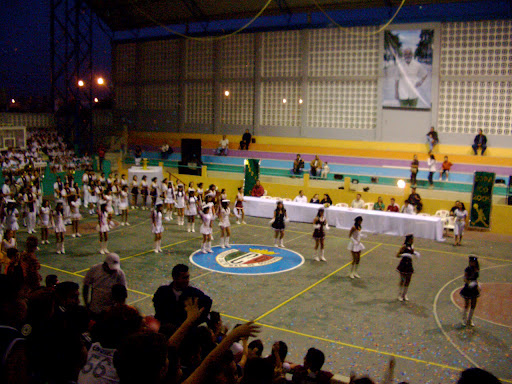
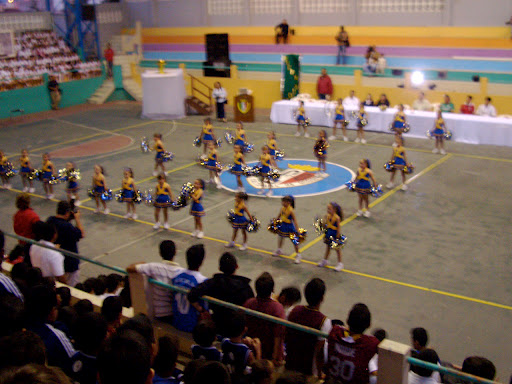
We arrive at ICO. No parking places, as it appears every car in Mazatlán is at this school. Obviously this is not a simple gathering but something major. We enter ICO for the first time; these Franciscans have some money—it is a huge school with new and well-maintained buildings, a central promenade of palm trees, and numerous gymnasiums, courts and stadiums. They are obviously sports nuts. The facilities are unbelievable and envy-producing. The crowd (hundreds of people, if not a thousand–a huge crowd) is walking down the palm-lined promenade to the other end of the school, which feels about three blocks away. There is a large outdoor covered auditorium, encircled by cement bleachers. We find Danny’s team and wait. We are surrounded by other teams, coaches, parents, cheerleaders, bands, you name it. It is definitely noisy and crowded. It’s a party. Everything here is; any excuse for a party. We love it.

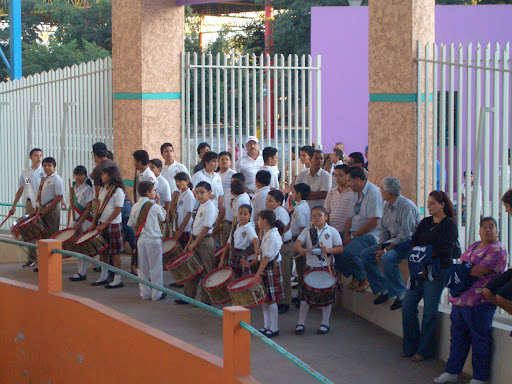
An hour after the appointed time, about 5:30, we file into the auditorium. The kids go under the bleachers. Apparently there is a very large room down there, because there have got to be about 30 or more teams that gather down there. Along with the cheerleaders, pom pom girls, flag girls, drum majors, and bands. Ok, this seems like it’s going to be a big ceremony. We are now told it’s the “inauguration of soccer season,” the ICO Cup Tournament.

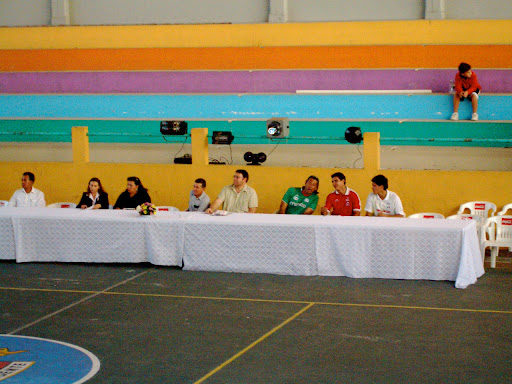
There is a head table. A few speeches are given. ICO is exhalted as a wonderful school about 11 times. Come on already. It’s nice of you to sponsor the tournament, but enough horn-tooting and advertising for the school.
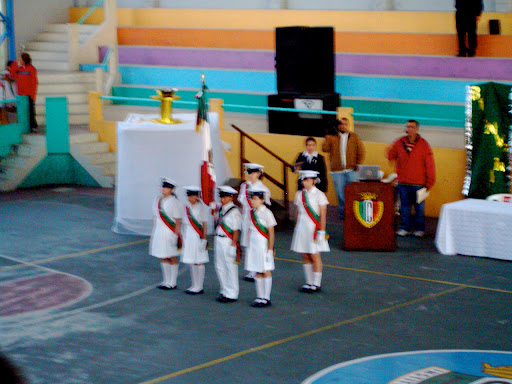
A band plays. There is dancing. The teams are announced, and school by school they parade out into the auditorium, circle the main floor, and are seated. Much fanfare. You’d think you were at the Olympics.
.
Another band plays. There is smoke and a light show. Fire jugglers entertain us. Several dance routines by scantily clad young women and primary school girls. Confetti is dropped from the rafters. Kids cheerfully jump to catch the confetti, amidst another laser light show and dance routine. Just like the start of the recreational soccer season at home. Ha! Not even pro soccer in the US gets this much fanfare. And I only have my little camera. I say about ten times how I wish I’d brought the good camera. Who would have known? We see our friend Bob Gallagher, and Maria Anderson. They both knew it would be the inauguration, but neither of them told us. We didn’t know they’d be here, so we didn’t know to ask them. Oh well, such is life in a new place.

Then, what we’ve evidently all been waiting for: the lighting of the torch. Two men, this year’s tournament heads, are handed a lit torch by last year’s tournament leader. The torch seems to be burning out of control. The two men don’t really want to hold it–it looks dangerous. One of them takes the torch, but seems to want to slam it to the cement floor and stomp on it to put out the fire. But, no, he’s urged to climb the steps, towards the fire pot, to light the large Olympic-style fire container. The man obviously is very uncomfortable. The torch is nearly burning his hand and arm off. He hurries. He lights the main fire container. While everyone cheers and applauds, the out-of-control torch is hurled to the ground and several men try to jump on it to put the fire out. But, burning liquid pours out from the torch, and we now have a fire show: a three-meter-long firefall behind the main Olympic fire. Cool, but obviously unintended. Definitely dangerous. Thank God for concrete buildings!

It’s now about 7:30 pm. We’ve been at ICO three hours. We’ve heard five or six bands, seen about 12 dance routines. We’ve had laser light shows and confetti drops, as well as the intended and unintended fire shows. Everyone’s itching to get home; enough’s enough. Parents start to stand up, walk over and get their kids to take them home. Father Ian, the head of ICO, grabs the microphone to ask people, in fluent Spanish, to please stay just 15 minutes more. No one listens. There is chaos as parents push through the crowd, weaving amidst the marching band and dancing flag girls with no care as to how long these poor kids have prepared for this night. They get their kids and jam the aisles and the performance arena as they attempt to leave. Thank goodness the auditorium is not on fire, as no one is able to get out quickly. Miraculously no one is injured, no ambulances called. By 8:00, the auditorium is empty, the cacophony had died down. A terrific inaugural, for sure. A delicious slice of the cultural life of Mazatlán.

The Smells of Mazatlán

Mazatlán is gorgeous, there is no doubt about it. The clear blue sky, ocean to the horizon, daily killer sunsets, long sandy beaches, mountains surrounding, estuaries filled with grasses and birds. Seeing Mazatlán is probably the most popular way to experience the place.

Mazatlán is rich, diverse, and complex, however; definitely a multi-sensory experience. Our sense of smell also plays a major in our experience of this paradise. When we came here as tourists, I must admit we didn’t notice the olfactory input so much as we do now that we live here. Back then we were no doubt overwhelmed by the visual beauty and thought the smells were intermittent, a side dish. Once you live here, smells play a much more important role.
I’ll keep adding to this list, but I do want to record some of the important smells of life in Mazatlán, for better and for worse:
  • TUNA. There are mornings we wake up to a permeating, cooked-fishy sort of smell. Greg, Danny and I all look at each other and grimace. It’s the tuna smell. Mazatlán has a huge tuna business. The Mazatún factory is just outside of town. We don’t know if it’s the way the wind blows, the days they happen to cook or can, or what, but there are certain days when you can’t escape it: it’s tuna time!
  • Zarandeado. The smell of barbecue emanating from the palapas along the beach. You walk the beach, or the malecon. You’re not hungry when you start. But boy, smell that fish on the barbie, and you will be!
  • Sewer gas. One of the greatest joys of life in Mazatlán is the malecon, the oceanside promenade. Walking down it towards the Fisherman’s Monument is gorgeous: the world’s biggest gymnasium, we like to call it. But oftentimes near that very monument, where most parades in town gather before starting, the sewer smells are overwhelming; you actually have to cover your nose and mouth. The city recently did drainage work down there, and the smell appears to have abated somewhat. We can only hope. But there are areas throughout town where you’d swear you were in a bathroom. In the historic downtown, for example. Gorgeous architecture, millions of pesos invested into updating and converting these homes into glory, but once you step outside…..
  • Chile and lime. This favorite seasoning combination teases the nostrils at nearly every fiesta, and there are daily fiestas. Put chile and lime and potato chips or corn chips. Put it on kernels of corn in a cup, or corn on the cob. Put the taste combo on the fruit cup you buy from the vendor on the beach. On your ceviche or fish. Nearly anywhere you wander in Mazatlán, you’ll get a whiff of this winning combination.
  • Salt. As in the fresh salt air, the ocean breeze, the sticky thick liquid that gets stuck on the screens of the sliding doors to the terrace, or in the corners of the tile floor and requires much scrubbing to remove. Salt also as in added taste for beer and margaritas, in combination with lime, of course. Salt is definitely a key smell of those with “las patas saladas.”
  • Tortillas. This is true for many places in Latin America, but/and including Mazatlán. There is no smell so wonderful as fresh tortillas being baked. Who can pass by the tortillería without grabbing a few? Especially when the government subsidizes their cost and you can get a kilo of fresh corn tortillas for less than a dollar.
  • Garbage burning. Don’t ask me why. We recycle. There are families that live at the dump and scavenge all the recyclable items to sell them and make a living. There is regular garbage collection city-wide. But burning of garbage is a fact of daily life here. There appear to be no regulations against it, or at least none that seem to be observed. So, when coming to Mazatlán, be prepared to see plumes of dark smoke from various locations around town, and the charming smell of garbage being incinerated.
  • The honey wagon. Yes, one of my favorite euphemisms for the truck that pumps the waste out of the port-a-potties on the beach. Mazatlán has beautiful, permanent concrete bathrooms built along the malecón. But use them? Agh, why use such a resource? Better to have citizens and tourists alike use the port-a-potties that the palapa restaurants have installed, and have those palapa restaurants pay to have the honey wagon pump them clean every day or two or three. The hoses are a hazard as you walk the malecón in the morning, but worse is the smell the put off. Definitely carry a wash cloth or be prepared to put your shirt over your nose as you pass by.
  • Coffee. Cafe Marino, our local brew, is some of the best-tasting coffee you’ll find. Reasonably priced, locally grown and roasted, it is a frequent component of the gift packages we send overseas. And, again, depending on the air currents and whether the roasteries is roasting or not, the wonderful smell of coffee fills the air of our port city.
  • Diesel. Ok, of course if you’re near the international highway you smell the diesel of the semi trucks, but even in the heart of Mazatlán city proper, the smell of diesel can overwhelm you at times. Those city buses, in addition to being driven by kamikazes, emit thick black smoke that will choke you if you’re not careful. Definitely not the best air to breathe while you are jogging or biking, but a fact of life in Mazatlán. Thank God for the ocean breeze.
  • Fish. Yes, one of the biggest advantages of living in Mazatlán is the fresh fish and the visits to the fishermen and their boats. But, in addition to the terrific taste of the fish and the pleasant sight of the weathered, friendly fishermen and their colorful pangas, we must admit that the smells of fresh, as well as rotting, fish and its entrails definitely fills playa norte.
  • The Market. El mercado is sensory overload and está lleno de holores: raw meat, fresh fruits and vegies, leather…

Customs Related to New Year’s


Last year, our first New Year’s as almost-residents, we spent a wonderful New Year’s Eve in the multicultural home of our dear friends María and Bill. Bill is a Scotsman, María a Mazatleca, and they met, married and began raising their children in the Arab Gulf. Anyway, it is with María and Bill that we first learned the Mexican custom of eating grapes on New Year’s Eve. 12 grapes, sometimes in two different colors, one for each month of the new year. 12 wishes for the new year. You eat each grape as you make your wish–save room!

The other interesting New Year’s custom I learned about was that those who wish to travel in the New Year take their empty suitcases out into the street on New Year’s Day. It brings good fortune of the travel-related variety:)

This morning in the newspaper I’ve learned yet a third interesting New Year’s-related custom: women buy new lingerie (bras and panties) just prior to the New Year. On New Year’s Eve/Day, to greet the new year, they buy and wear either Red (they want love in the New Year) or Yellow (they want money in the New Year). The lingerie shops around town report to the newspaper that traditionally red intimate wear has far outsold the yellow. However, this year, yellow was the top seller. Yet another example of the multitude of ways that economic hardship touches lives.

Favorite Things in Mazatlán

Fresh seafood, of course! Life here means waking up, getting Danny off to school, and walking or biking the malecón (oceanside promenade) with a cooler. We may decide to visit the pescaderos (fishermen) at their pangas (boats) in Playa Norte, or one of the two little pescaderías right across the street, to buy pargo (seabream), lenguado (sole), huachinango (snapper), or maybe sierra (saw fish) for a good ceviche. We can buy enough fish for two meals for US$3.50, or pay a bit more for swordfish or dorado, and significantly less for octopus (sometimes US$1 per kilo!) or squid. We might buy a kilo of fresh prawns for 40 pesos (US$4), or oysters from the ostioneros as they come to shore with their inner tubes and netting (US$4/dozen). We have some great conversation, beautiful views, shop for lunch, and exercise, all at an easy pace and before beginning our work day.

Zarandeado (bbq), al mojo de ajo (garlic sauce), a la parilla (roasted), in ceviche (marinated in lime juice), or raw, Mazatlán’s seafood and seafood sellers have me singing “el gran orgullo de ser de Mazatlán!” (the great pride of being from Mazatlán)
—–

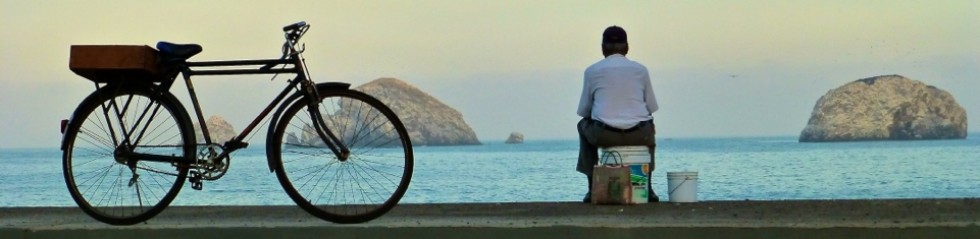
The Green Man. Yes, he is one of my favorite things here in Mazatlán, along with dozens of other really cool and unique vehicles of all descriptions. The first time we saw him, he was also dressed up all in green and wearing a green helmet with horns, like a Jolly Green Giant version of a Viking. These days he’s added the cart to the back of his bike, and he always has his dog with him.