Fiesta de Nuestra Señora de Guadalupe

El Día de Nuestra Señora de Guadalupe
December 12
The Virgin

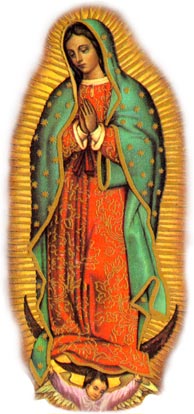
Our Lady of Guadalupe is the patron saint of the Americas, and she is often referred to as the Queen of Mexico. Her image appeared both on the flags of the Mexican War of Independence and of the Revolutionary War. Most Mexicans pray to the Virgin of Guadalupe for their most intimate and heartfelt desires, as do many people throughout Latin America. She is seen as an indigenous saint, the saint of the Indians and the poor, someone to whom the humble may turn to ask for help. She is a symbol of pride and comfort to indigenous people of Latin America.

In Flagstaff Arizona, where I grew up, we have a parish church named La Virgen de Guadalupe. My father dearly loved the Virgin, and his funeral mass was held in that beautiful small church, with the parish priest wearing robes with the Virgin’s image. She is near and dear to my heart.

The Tradition

Guadalupe Day is today, December 12th. This year it falls on a Saturday, so the Virgin’s feast is even more festive than usual. Every woman named Guadalupe also celebrates her saint’s day today, which in Mexico is celebrated much like a birthday.

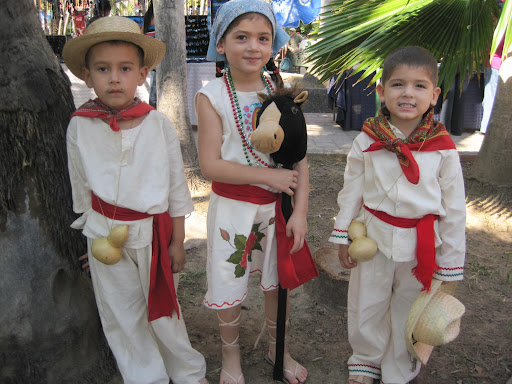
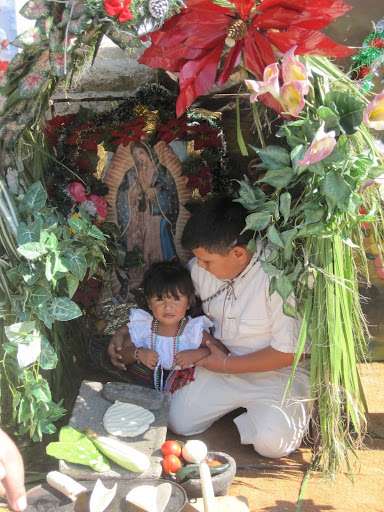
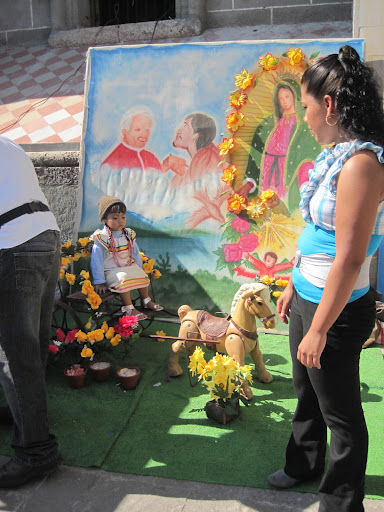
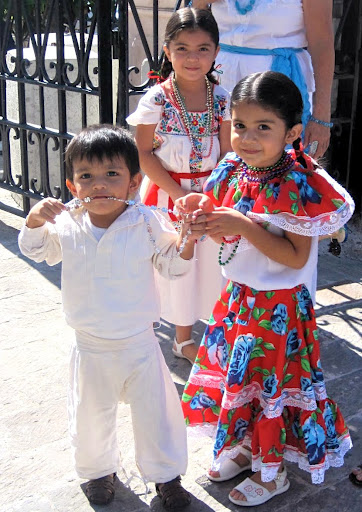
The most enjoyable tradition for me is that many children are dressed in indigenous costume. While during the rest of the year many Mexicans strive to look less Indian, on Guadalupe Day even young babies have long black braids clipped into their hair.  In Mazatlán, where we live, the emphasis is on “costume.” The clothes may not be real or even typical, but the kids are darling. Take a look at a few:
Each year on the eve of Guadalupe Day there are processions all over town. People parade her image through the streets to various churches. There is usually a midnight mass. A picture of one of the floats that is carried, holding the Virgin’s image, is below.

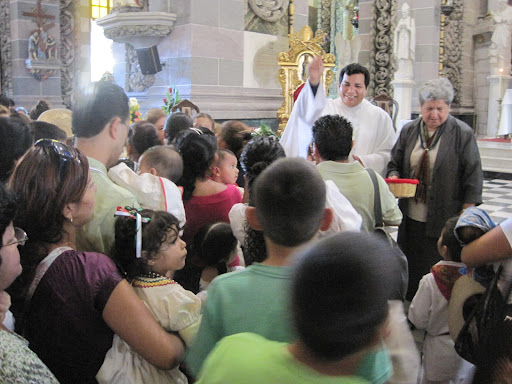
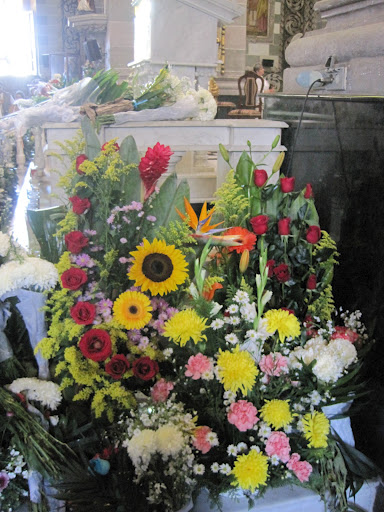
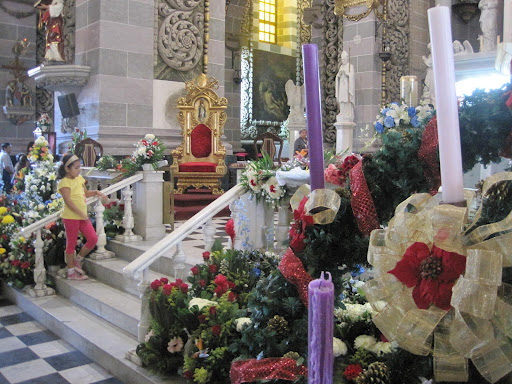
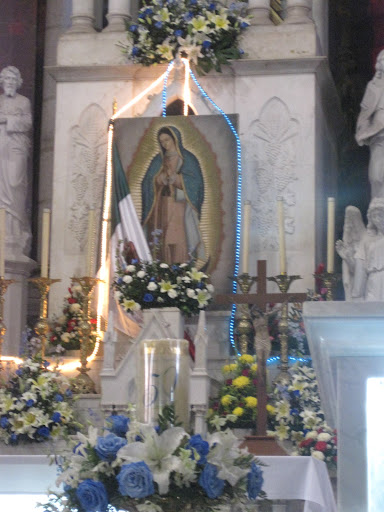
Then, on Guadalupe Day itself, there are masses nearly every hour on the hour from early morning. Parents bring their young children in to be blessed by the Virgin, and by the parish priest. The church is filled with gorgeous and fragrant flowers, people, and activity from the evening before Guadalupe Day to late that night. Masses are said, the Virgin’s image is front and center on the altar, and the priest blesses the children with holy water.
 All around the church and filling the plazas in front of the churches are food stands and stalls with toys and holy images, as well as numerous bands playing, creating a very festive atmosphere. It’s a great day for photographers, as many of them set up studios around the cathedral with images of the Virgin and props such as donkey-drawn carts. Parents and grandparents pay them to take photographs of their costumed children on this important day.

The Story, or The Legend

Saturday December 9, 1531, 10 years after the fall of the Aztec empire to Spanish forces, a young girl of about 15 years of age appeared to a 57 year old Indian man (Juan Diego, born Cuauhtlatoatzin) while he was walking in the mountains just north of Mexico City. He frequently walked three and a half hours to church in bare feet, and was doing so when he saw the girl. By the words she used and the message she conveyed, Juan Diego knew her to be the Blessed Virgin Mary.

The Virgin addressed Juan Diego in his native Nahuatl language, and asked him to speak to the local Catholic bishop, so that a church in her honor might be built on the site where they’d met (Tepeyacac, Capilla del Cerrito). The bishop, a Franciscan Spaniard named Fr. Juan Zumarraga, is said to have received and listened to Juan Diego’s story, but did not believe him. Juan Diego returned to Tepeyacac, apologized to the Virgin, explained he had done what she requested, and asked that she please enlist the assistance of someone with more stature than he to talk to the bishop. The girl told Juan Diego to return to the bishop the next day, which he did.

The following day, after Sunday Mass, Juan Diego again secured an audience with the bishop. The bishop asked him to explain his story in more detail this time, and sent Juan Diego away telling him to bring him a sign to prove his story. Juan Diego walked home and met the Virgin on the way, telling her this latest news. She asked him to return to her in the morning, and she would give him the sign.

On Monday Juan Diego did not return to visit the Virgin, because his uncle, Juan Bernardino, had fallen gravely ill. On Tuesday morning before dawn Juan Diego set out walking to town to call the priest, to provide the last rites to his uncle. He did his best to avoid the site where he saw the Virgin, so as not to be delayed in his quest to get the priest quickly for his uncle. Nonetheless, the Virgin saw him. She assured him that his uncle would be cured of the disease and would not die from it. She told Juan Diego to climb to the top of the hill where they had met, and to cut the unusual flowers that he would find there. Juan Diego did, gathering in his cape (tilma) many different types of beautiful and fragrant Rosas de Castilla from the bishop’s native Spain, in full bloom during a time of freezing weather.

When Juan Diego finally was able to appear before the bishop, he opened his tilma to show the bishop the flowers, and there on the fabric to everyone’s surprise was also imprinted the image of the Virgin! The bishop this time agreed to build a temple in the Virgin’s honor at the site where she appeared in Tepeyacac.

The following day, Tuesday December 12, the bishop and his staff accompanied Juan Diego to the site of the apparition, so that they could know where to build the temple. Once they arrived, Juan Diego asked to be excused in order to visit his uncle who had been ailing, and make sure his Uncle Bernardino was healthy. The bishop and his entourage made the journey with Juan Diego. When they arrived at the home of Juan Bernardino, they found him to be healthy and happy. He reported to the group that he had been cured when the Virgin visited him, and that she had told him her name was the Holy Mary of Guadalupe.

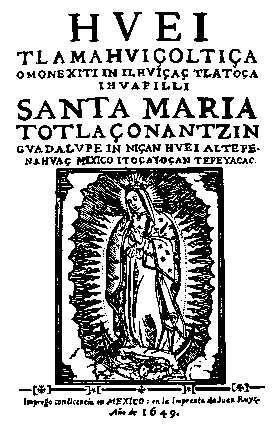
The above story is based on the Nican Mopohua, or Huei Tlamahuitzoltica, written in Nahuatl, the Aztec language, by the Indian scholar Antonio Valeriano around the middle of the sixteenth century. 
Unfortunately the original of his work has not been found. A copy was first published in Nahuatl by Luis Lasso de la Vega in 1649. Its cover is shown here:
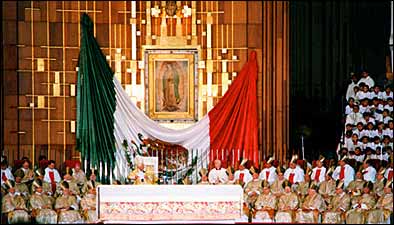
Nearly 500 years after the Virgin’s appearance, Juan Diego’s cactus-cloth tilma shows no signs of decay, and the image of the Virgin remains. 25 Popes have honored her, and in 1999 Pope John Paul II declared December 12 a liturgical holy day for the continents of the Americas. 18-20 million people per year make the pilgrimage to her basilica.
More information on the story can be found in English, Spanish or Portuguese:

Also you can read more at:

Tropical Storm Rick

We were VERY fortunate that Rick was no longer a hurricane when it reached us. The huge rough waves (all day on 20th October 2009 and the morning of the 21st), rain and sustained strong winds (from 10 pm till about 11 am) were definitely significant.

Click to see individual photos in the storm slideshow above.The damage around town was still fairly significant. Trees, signs and beachside restaurants were especially hard hit. The beaches ended up with far less sand than they started with, as you can see in several of the photos. Click to see individual photos.

The calm after the storm: sunset on Wednesday the 21st. Moon set with some of the fishing boats in the bay, trying to make up for lost fishing time. Click to see individual photos.

Our local newspaper, the Noroeste, posted some short videos on the storm:
During the storm.
A look at property damage in the wake of Rick.
A look at Stone Island.

Monster Truck Show – Mazatlan Style

Okay, so there is nothing new about a monster truck show, right? Well, despite my efforts to never write a blog post centered on “they sure do it differently down here,” I just cannot resist telling you that what happens at a Monster Truck Show here is inconceivable in the States.

Little things first.

The event cost 80 pesos, or around $6 US. Parking (on the street) was free, cold cervezas delivered to our seats were 20 pesos, and salchichas (sausages) were 35 pesos. The event was held at a “salon.” Sounds like something indoors, right? Monster trucks indoors? Well, we approached the entrance to what looked like a large building, gave over our tickets, and rather than walking into a building we emerged through the door into an open-air arena on the other side.

Medium things next.

It is 4:30 on a Sunday afternoon. The sun sets around 7:15. It is about 85 degrees F out and the humidity is about the same. As we enter the arena, there is little shade and there are no chairs available in what little shade there is. We decide to rough it in the sun in order to sit in front. As we sit for 45 minutes and watch things get set up, I start noticing all the empty white chairs in the sunny section of the arena. They are not filling up but rather, they are disappearing! People entering the arena and not wanting to sit in the sun like us are stacking up chairs by the dozens and relocating them to the spot of their choice with absolutely no regard for space limitations or courtesies. A shady area designed to hold 50 chairs at best is now holding over a hundred. You can’t get to the restrooms, as the walkway into the area is packed with chairs. Amazing.

In between “acts”, the MC entertained the crowd in various ways. There was an ugly dad contest, a mom with the most kids contest, that kind of thing. At one rather long intermission (after motorcycles and before trucks), the MC asked for a dozen girls to come on down to the arena. After he got his 12 young girls, he asked for 12 young boys. He ended up with around 18 boys, but he didn’t mind. Once he had them there, he lined the girls up separate from the boys and announced the “sexy dance contest”. So, here we have around 30 kids, aged 5 to 11 or so and they are supposed to “sexy dance”. He would have the music play for 30 seconds, stop it, and eliminate a few kids. This went on and on until one child on the contest. From the first sound of music, it was obvious to everyone who would win. While most of the kids just stood there or swayed back and forth a little bit, two standouts emerged. A little boy, no more than 5, took off his shirt, started gyrating around and passing the shirt back and forth under his legs. A little girl around 10 or 11, who was around 30 or 40 pounds overweight, started thrusting and “dirty dancing” by herself. It was incredible. As the contest got down to the final four, the MC stopped everything and asked the four finalists to introduce themselves and indicate who had brought them that day. After that was done, the MC said to the parents, uncles and grandparents that what he was seeing performed by these children was not taught in school and asked where the kids had learned such moves. Anyhow, when all was said and done, the little boy was the winner as voted on by crowd applause. He won a poster and a T-shirt for him and his dad.

Okay moms, the big differences are for you.

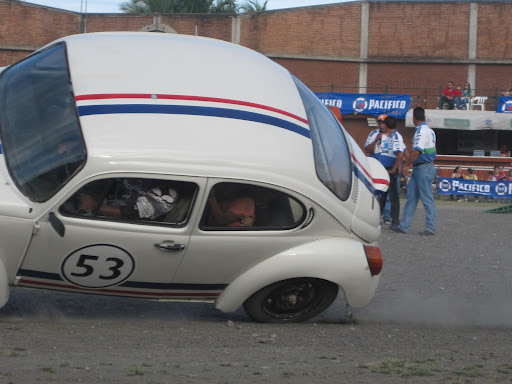
We have all seen the “drive a car on two wheels” thing before, maybe at a circus, a car show or a county fair. Nothing new here, except that after the driver makes a couple of laps in his “Herbie the Love Bug”-inspired Volkswagen, the MC of the event calls for the bravest dad to come out and take a ride. One does. Next he calls for two señoritas to come for a drive. Two do. They climb in with the driver, and go for a two-wheeled spin. Then the MC calls for kids to come for a ride. A few dozen kids charge the field and after some unknown sorting process, six are chosen.


They cram into the Volkswagen, and take two, two-wheeled laps around the track. You can see them if you look closely at the picture.

We don’t need no stinkin’ liability waivers! Nor any seatbelts, helmets, or other safety equipment.

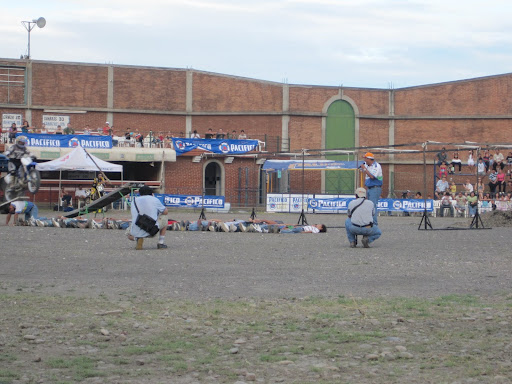
After the Herbie show, motorcycles start zooming around. Some men come out and erect a ramp, and the MC announces that he needs 15 boys on the field. Again, dozens run out, and 15 are selected. Next, the 15 are lined up on the ground, laying down, face-up and side-by-side, in front of the ramp. I guess it is too old-fashioned to jump over a school bus or something. Why not endanger a dozen kids instead?

I think maybe it’s ok for the first or fifth kids, but I wouldn’t want to be the 15th kid on the end. After the motorcycle successfully jumps over all 15 kids, they add a few more kids, and then a few more, until they have about 30 kids lined up. Again, no waiver, no safety equipment, no nothing. Moms, would you let your kids… Oh, never mind.

The kicker to all of this, if you look closely at the pictures, you will see that the wedge that angles the motorcycle ramp up was actually a guy from the crew! More kids? No problem; he just arched his back higher for more lift.

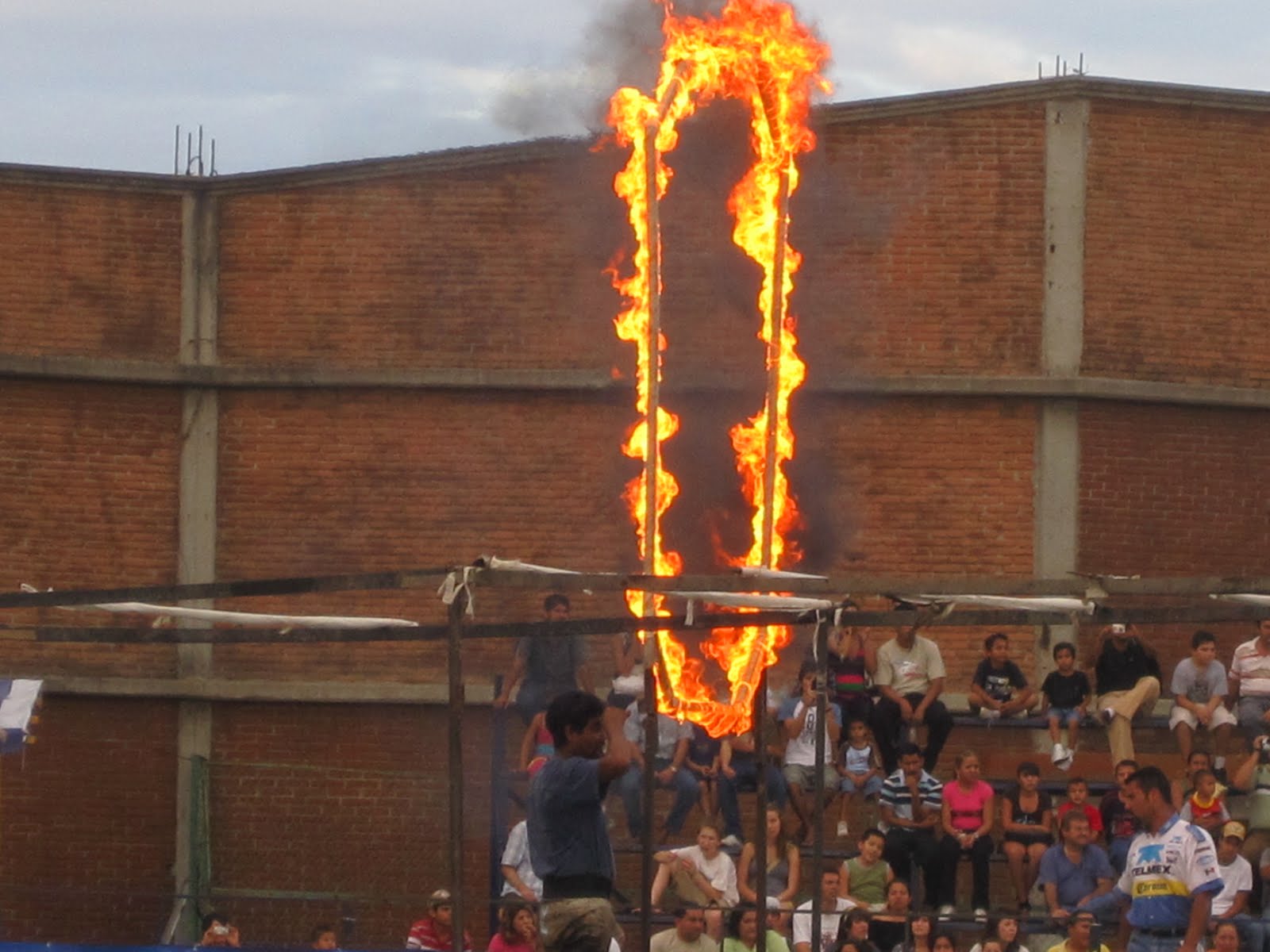
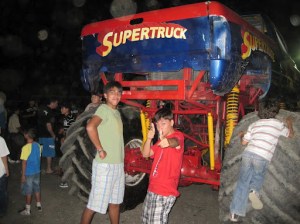
After the motorcycles and the kids, the bikes jumped through various burning things and then the monster trucks came out and smashed some old cars and that was that. There was one notable event in which a man climbed into a box, and they exploded the box. The explosion was so loud and so powerful that the earth vibrated, our seats shaking. But, hey, the man survived. Not sure with his hearing intact, but…

All in all it was an entertaining afternoon. Danny and his friend Enrique enjoyed themselves, as did Enrique’s dad and I. I like the idea that I am getting used to a culture that is not run by lawyers and insurance companies and allows people to have fun without worrying about the what-ifs all of the time. Today, however, I was a little blown away. I would think that by next year, when we do this again, I might be running out on the field! Just what most mothers want to sign their husbands and kids up for, right?

A few found fotos

Every now and then I get around to downloading the pictures off of my TelCel cell phone. This last time, I found a few random shots of life in Mazatlán that I thought were worth of sharing:


This dog is very calm. When we lived in Kansas City, I couldn’t drive a car with our dog inside. I can’t imagine how you teach a dog to lay still on a motorcycle at speeds of 40-60 kmh, or 25-35 mph.With the heat index well over 100 degrees everyday, this is not the most efficient way to deliver ice!

No comment required!

Saludos…

El Gimnasio Más Grande del Mundo/The World’s Biggest Gymnasium

Every morning we’re privileged to walk the malecón, our front yard, Mazatlán’s 10 km oceanside promenade. Sometimes we walk it again in the evening, just because it feels so good.

We expected when we first moved here to love the views, the sunsets, sunrises, watching the sailboats and the party boats, the catamarans and the parasailers, the oyster divers, shrimp boats, cruise ships, ferries, and the jet skis. The really remarkable thing to me after living here awhile, however, is realizing that the malecón has got to be the world’s largest gymnasium (and swimming pool).

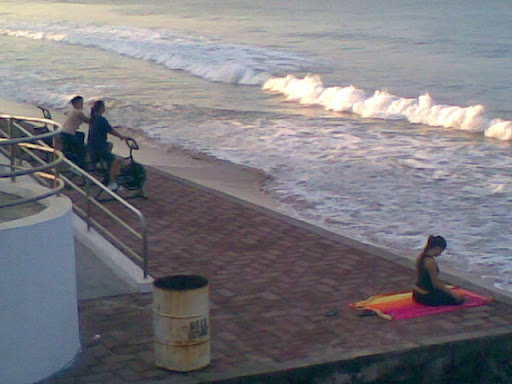
The photo above left is of a few spinning bicycles, and a lady practicing yoga, in one section of the malecón. As you can see, exercising on the malecón is both an incredible audio and visual experience!

Below I list just some of the myriad exercisers and health nuts we see every day, all day long.
The people on the cement (used to be tile) walkway, including:

  • The walkers: fast and slow, limping and smooth, sometimes with a walker, in expensive sports shoes or recycled tires, wearing sweat-repellant high-tech fibers or charity duds, some in the midst of such heated conversation they fail to notice anyone else, others greeting, hugging and kissing nearly every person they meet, the guy who squeezes a ball in his hand as he walks, those who carry weights and do arm lifts as they walk, those who take a few steps and then lunge, those who walk backwards, those who listen to ipods, and those who walk dogs (or whose dogs walk them).
  • Joggers: old and young, fat and slim, jolly and focused, that guy who jogs with his arms stretched straight out in front of him, the lady who swings her arms hard enough to knock someone out, and the guys who pump their arms. There are joggers with both knees bandaged, or braces on both knees; but they are jogging.
  • The runners, and boy do some of them run, evidently from one end of the malecón to the other! Every day! Maybe more!
  • Rollerbladers: newbies, professionals, those who stumble, those who go 50 kph, those who wear pads and helmets, and mostly those who don’t.
  • Bicyclers: on antique bikes, beat-up bikes, and state-of-the-art bicycle technology, ridden by nationals and foreigners, old and young, those dressed for the Tour de France and those in flip flops and cut-off jeans, those with brakes and without :), and those who steer with their hands and those lovely young men who don’t use any hands (some who steer by weight better than others!)
  • Those who use the cement benches for sit-ups and stomach crunches.
  • Those who use the steel railings for push-ups and leg stretches.
The people on the beach, including:
  • More joggers: those who jog in the hard sand and those who really get a workout in the soft sand. And, unbelievably, those who jog backwards in the sand (thank goodness they don’t usually do this up on the malecón itself).
  • More walkers: including those who have shoes and those who go barefoot, and those who stop to collect shells.
  • And even bicyclers: yes, mostly vendors, but those who commute, too, and have much stronger thighs than I do!
  • Those practicing yoga: usually they are in a group, with bed sheets spread out over the sand. There are quite a few different groups, with various teachers, meeting in various places at different times of the day.
  • Tai C’hi: taught by our friend Rick in the Taboada on Tuesday eves and Saturday mornings.
  • Those people who wield those sticks into contortionist poses. Looks like a martial art, but I’m not sure what it is.
Sports teams: including beach volleyball, futbol soccer and futbol americano, but also teams from schools who hold gym classes on the beach.
Boot camps/training: groups of adults (lifeguards, firefighters, police) who train on the beach, performing calisthenics, playing weird games where they carry one another or crawl through each others’ legs…


The people in the water, including:
  • Those incredible swimmers, who swim long distances down the coast and back, alone and in groups, with wet suits and without, those who have done it for years and those who join a class to shape up or improve swim strokes. There is an official “swim club” down near the fishermen’s pangas, and anyone can go early on Saturday or Sunday for lessons, during which they teach you to swim in the ocean and learn the currents. Ocean swimming is a completely different sport than pool swimming, of course.