I have heard Banda and Norteño music described as “an acquired taste,” “a God-awful racket,” and “the best music on the planet.” Realistically speaking, I agree with all three.
First off, what is Banda? Banda is a style of music popular in Mazatlán and the rest of Sinaloa, the state in Mexico from which it hales. It is growing in popularity elsewhere, but especially in the United States.
Banda style music dates back to the late 1800’s. It was imported from Germany when the Germans came over to invent Pacifico beer. You won’t find this fact validated by any reference checking, but I can assure you that the German’s greatest contributions were Banda and Pacifico. In fact, I’m drinking one now.
A Banda band is a band ranging size from around 8 to around 24 – give or take a few. A band consists of mainly brass or wind instruments like clarinets, trumpets, trombones and tubas. There are always drums – many of them. One drummer will usually play a snare drum and some cymbals (or cowbell, etc.), another will play tom-toms and still a third might play a bass drum with a cymbal on top. Because of these drum types, you will often see drummers standing when playing. String instruments are rare; as are keyboards. Normally there won’t be an accordion. Most often a Banda-like band with an accordion is actually a Norteño band. While some Norteño does come from Sinaloa, most comes from the more northern states of Mexico. Norteño can also thank the Germans (and the Czechs) for its beginnings. It is more of a rural sound, and I really like it too. You will hear Norteño music on Banda radio stations and see the videos on Banda video channels.
When it comes to the Banda “sound,” there are many. The most common are cumbias, rancheras and corridos. At the end of this post I will put links to a variety of videos so you can hear for yourself. If you think this is confusing, it is. These three types of music are not limited to Banda, but also played by Norteño bands. Why is this a problem? Well, people will say, what kind of music do you like? Do you like Banda? What kind? Norteño? How about Mariachi? Are you wondering why Pacifico is needed to get this all straightened out?
For purposes of clarity (and ease for the author), I will use Banda from this point on to mean Banda and Norteño.
Often Bandas will have more than one singer, making it difficult to hear a song on the radio or in a restaurant and know who you’re listening to. So, apparently to solve this problem, Bandas are known for singing out the name of their band (and home city or state) sometime during the song (usually at the beginning). I find this system very efficient and would highly recommend it to bands elsewhere in this world. Not only are there concurrent multiple singers, but as bands age, singers are replaced. Some Bandas have been around for many years. The most famous and best example is Banda El Recodo. The full name of the band is Banda Sinaloense el Recodo de Don Cruz Lizárraga. The band has been under the control and guidance of the Lizárraga family for over 70 years. Their current lead singer sounds very different than the last singer, but he is great and is very young and hopefully will be the primary voice of Banda El Recodo for years to come. Note the full name tells you who founded the band and where it is from, very efficient. You will often see Banda names with a founders name included or a city or state of origin. This helps designate a band if someone else in the country has a similar name and shows hometown pride. I like it!
Banda is not exclusively a male-dominated genre. There are some female Banda bands, but they have not had the successes associated with today’s well-known Banda bands.
Sometimes Banda sounds over-amplified and distorted. This is usually due to the tuba being played and used in a way that is uncommon to most music listeners. Other times it is due to the fact that the band will amplify one or more of the singers and put the tuba too near the microphone at which point it is over-amplified and distorted.
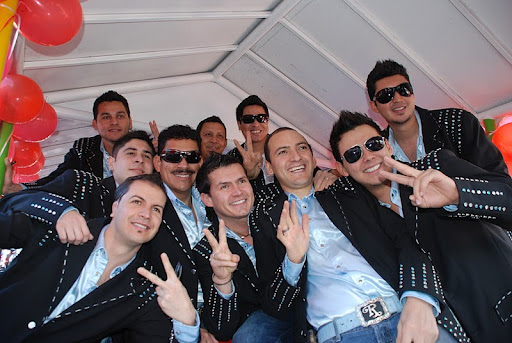
The more popular or more successful a Banda becomes, the better they become. They get better instruments, better musicians and uniforms. A good-looking Banda is quite a sight. Think about 18 guys in matching cowboy hats, brightly colored jackets, western shirts, matching pants and boots, all swaying to the beat of a song. Along with this, musicians swirl or pump their instruments in between stanzas. It is quite a sight to behold. You’ll get the picture in the videos.
Speaking of videos, Banda videos are fun! Often they tell a story, either about the song, or just about life in Sinaloa. Many are filmed in my wonderful city of Mazatlán. If you are ever in Mexico and have the opportunity to watch TV, check out a channel called BandaMax (Mazatlán cable, channel 11).
A Banda concert may at first glance look like controlled chaos, but it is very enjoyable and festive. But, there are a few things you should know. First, gentlemen need to wear their best jeans with stitching, a “western shirt” with glitzy design on back and/or front, your best cowboy hat and boots made from a dead animal. Ladies, anything tight that highlights cleavage will do great and really high heels. Banda concerts start late and go later. It is not uncommon to be going home at 3 or 4 in the morning. Beer is usually no more than 100 feet away at any given time. The event is very loud. I have been to a lot of rock concerts in the states, a Banda concert is louder.
Outside of a concert, how do you get to see a Banda? Acts just starting out will walk the beach or between restaurants looking for work on busy days. There are some restaurants and cantinas in town that are known for having Banda music. Some have a house band and others have different bands playing. Often, two will show up and it becomes a “Battle of the Bandas”. Bandas play little dance halls and cantinas. If they have a name or following, there will be signs advertising the Banda. For larger touring acts, concert venues are used. If you want to hire a Banda for a party, you can ask for cards of any Banda you see, or just go down to the area of town where they “hang out” and find one. If you’re in Mazatlán, just go east at the Fisherman’s Monument to the corner of Gutierrez Najera and Juan Carasco. You will find Banda bands looking for work hanging out there.
If you read this far, I’m impressed. What’s the bottom line on Banda? What you think of it when you first hear it will depend on how you hear it. If you hear a professionally recorded song by a mainstream Banda band, it will probably sound like Latin pop with horns. If, however, you are sitting in a cantina with your compadres and drinking a bucket of Pacificos, then you will think it is too loud, unorganized chaos. Remember in elementary school when Miss Carlson, the music teacher, arrived? She would open a big box of musical instruments, some shinier than others, but all capable of pleasing a child’s senses and wonderment and making a noise that, to a child under ten, passes for music. Remember Susie and Vicki would always fight over who got to play the triangle and whip it like mom’s mashed potatoes. Remember how Bobby always got the tambourine and ran around shaking it like a Hari Krishna? And remember how we would all just bang and tap and strum and hit and run to our own little personal beat? Remember that sound and how good it felt? Well, to many people, that’s what Banda sounds like the first time. The real problem with Banda is it needs room to breathe. Like good wine, the more it breathes, the better it gets. Keep listening and after a while, you will start to recognize the songs. They actually have a beat (and yes Dick Clark, you can dance to it) and the band is organized. In fact, the better the band, the better the organization.
If you decide you like a Banda song or a group and you want to buy the music, good luck. A mainstream act like Banda El Recodo can be found on line (iTunes, etc.) as well as some music by Julion Alvarez, Banda El Limon, and others who have had some success outside of Mexico. Beyond that, you are stuck. If a band gets lucky enough to get a record deal, they may have very limited, if not regional, distribution. I have spent weeks trying to find some CD’s and went so far as emailing the bands through their websites, Facebook pages and My Space pages. I still don’t have anything. I got some vague instructions on how one store might have something (not), I got a guy at a music store who was going to order them and call me (not). So, I have learned how to extract the audio from a YouTube video into MP3 format–problem solved–sort of. If you want to catch a Banda when they come to town, just check their websites and pages for a concert schedule, or watch for signs around town and their tour busses. How to get a ticket? I’ll save that for another time.
I created a playlist in my YouTube account with a whole bunch of videos. If you have about 45 minutes, you will see some of my favorite videos, many filmed in or about Mazatlán. You will:
·Learn a lot about typical Mexican life
·Enjoy a Banda remake of a 1970’s US pop classic.
·See Banda El Recodo live at a concert I attended
·See Grammy and Latin Grammy award winners
·Experience life on a Mazatlán beach during carnaval
·Learn about pigs, cheese, peanuts, cars, girls, beer…
·See that I snuck in one Mariachi song because it’s all about Mazatlán!





 ¡VidaMaz!