Birdwatching here in the center of town is so very incredible. It never ceases to astound me how, amidst the traffic and pedestrians, and despite the bulldozers that are currently working full blast, the lagoon fills with every kind of gorgeous water fowl: ibis, cranes, herons, storks, ducks, bobos, spoonbills… It makes for a splendid sight, and wonderful sounds as well!
Estero del Camarón is arguably the heart of our city, located as it is halfway between the historic downtown and the delightful marina area, next to the Gran Plaza shopping center, just south of the Golden Zone, one block off the malecón, and one block north of city park/El Bosque de la Ciudad. The estuary, or “laguna” as most Mazatlecos call it, is representative of the brackish waters that dotted all of Mazatlán back in the day, when anyone could cast a tarraya net and bring in enough shrimp or fish to feed their family.
Today, instead of heading over to zumba, I enjoyed a peaceful morning taking pictures of some of those delightful sights in Estero del Camarón. By the looks of all the fish these birds were catching, food is plentiful and the water fowl are hungry! Click on any photo to enlarge it or to view a slideshow.
Today there were two guys fishing in the estuary; you can see them in one of the photos above. I also met Salvador, who was wading through the lagoon shirtless and barefoot, removing the litter that mindless passersby throw into this wildlife sanctuary. Thank you, Salvador! I met another man who told me he stops here every morning to sit for half an hour before work; what a wonderful way to start his day! I’ve previously done an article on the restaurant here, which is currently offering 40 peso breakfasts. I HIGHLY recommend you join them, and bring your binoculars 😉
Panoramic photo of the first estuary, right by the new bridge in Delfin
On Mothers’ Day Greg and I took a photo safari up north of Delfín, to where Greg has been riding his bike the past few weekends. We took a cooler filled with drinks and lunch, so we could have a picnic. It was a truly gorgeous place to visit. I imagine those who live in Delfín hike this area often. But for me, it was my first time going up quite this far, and I highly recommend it. It made for a most wonderful Mothers’ Day!
The area where we went parallels the railroad tracks, and is full of estuaries. It is secluded enough that it lends itself well to really enjoyable hiking. I loved how we could hear the surf so loudly, but the second we got back in, even just a little bit, we couldn’t hear the surf anymore.
The beaches felt so private to a “city girl” who lives on the malecón. A man lives up next to the tracks (see his home below), and there are lean-tos that I suppose were built by the railroad workers to shelter them from the sun during construction or repair of the tracks. The grass up this way is really cool. It grows so thick, and the wind whips it all one way or the other. You could tell the area floods during high seas, as there was sand and beach debris everywhere. I was especially fascinated with the railroad trestle. I grew up next to one in Wisconsin, and the reflection of this one in the water was quite captivating. About five minutes after we crossed the trestle the second time, sure enough, a train came by. I was quite happy we were, by then, getting out our picnic! Click on any photo to enlarge it, or view a slideshow.
View of the mountains over an estuary
One of the lean-tos beside the RR bridge
Erosion on the beach
Sea grass
View of the mountains over an estuary
Gorgeous estuary and ocean views
The house I mentioned beside the tracks
The train trestle reflects nicely in the water
The three islands and El Riu
Estuary view
View of the mountains over an estuary
Estuary view
We saw loads of gorgeous flora and fauna—birds, reptiles, insects, mammals, trees, flowers, plants and cactus. We found quite a few different bones and skeletons along the way as well. It was a bit too overcast for my taste and for great photos, but, on the other hand, it made for comfortable hiking. I will most definitely hike up this way many more times.
Heron
Ibis
Skeleton of what?
Cactus flowers
Cactus flowers
Gorgeous bark
More gorgeous bark
Closeup of the bark
Twisted branches and vines
Ibis
A nest
So so many birds, of every sort!
So so many birds, of every sort!
So so many birds, of every sort!
So so many birds, of every sort!
So many birds, of every sort
An iguana crossing the road
To get to Delfín, just drive north on Camarón Sábalo to the road to Pueblo Bonito Emerald Bay. Turn left and go past PBEB, and just keep driving. Eventually the unpaved, very rustic road will fork. The right-hand fork takes you through a ranch and out to the highway. The left-hand fork is the one we took. We planned to park at the estuary by the train trestle, and hike north from there. However, we ended up spending quite a bit of time at the first estuary right by the new bridge, as it was filled with every kind of waterfowl you can imagine—herons, storks, ibis, pelicans, spoonbills… We also spent a significant amount of time at the second estuary—just walking around and enjoying ourselves. So, in the end, we didn’t end up hiking north of there along the dirt road, as had been our original plan. I guess we’ll just have to go again!
Please, share with me one of your favorite hiking spots!
Carpa Olivera Pool, Mazatlán, México • May 1, 2015
The renovation to Mazatlán’s historic Carpa Olivera—the ocean-fed public swimming pool in Olas Altas—positions the destination among a very elite group of cities worldwide with scenic ocean-fed swimming pools. Most such pools are steeped in history, as is ours, built in 1914 by Chilean chef Antonio Olivera, but most of them are NOT free of charge and open to the public, as ours is.
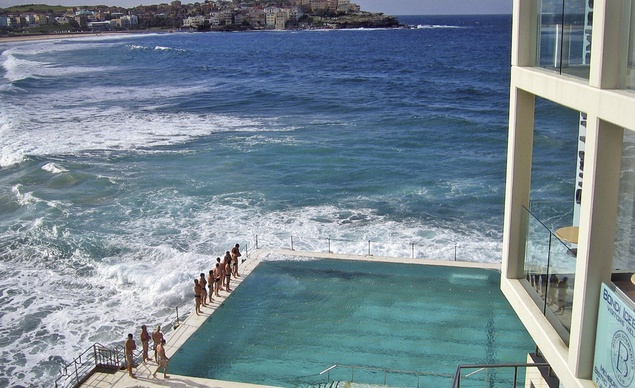
The Bondi Baths in Australia, for example, have been around for over 100 years. Costing $6.50/person or $18/family to enter, Bondi hosts swim clubs, oceanside yoga, a gym and restaurant. Its facilities are also a gorgeous location for weddings and events. From where I sit, Bondi looks better than Carpa Olivera. But, Australia is quite a ways away!
Bondi Beach, Australia
Ocean water pools are quite popular down under. In addition to the Bondi Baths, Sydney has quite a few ocean water swimming pools, and Balmain harbor is home to Australia’s oldest tidal-fed swimming pool, the Dawn Fraser Baths, built in the 1880s. Dawn Fraser offers a snack shop and hot showers. I’m confident Carpa Olivera’s showers won’t have hot water. But, then, we don’t really need it, either—especially not in the summer.
Dawn Fraser Baths, Australia
It’s said that New South Wales has over 100 ocean-fed pools. A humpback whale was even found dead in one of the pools in Sydney; see the video below. Outside of Australia, however, ocean water pools are few and far between. That’s what makes Carpa Olivera so unique—a touristic feature we should tout loudly! The Carpa Olivera restoration, in my opinion, puts Mazatlán ahead of leading tourist destinations such as San Francisco—where I’ve long wondered why someone doesn’t restore the historic Sutro baths, and Honolulu—where the Waikiki Natatorium remains a ruin. Especially a shame, since the natatorium was built as a war memorial in 1927! Click on a photo below to enlarge it or view a slideshow.
Sutro Bath ruins, San Francisco
Waikiki Natatorium
England has a long tradition of sea-fed swimming pools; my guess is they probably gave the idea to the Aussies who then ran, er, swam with it. The community-supported Shoalstone Pool near Devon, England, built in 1896, remains a gorgeous place—and entry is free! Just like Carpa Olivera, its water is refreshed every time there’s a high tide. There’s also the Sea Pool at Bude, built under the cliffs on the north Cornwall coast in the 1930s.
Shoalstone, England
Kistilano Pool, Vancouver
Sea Pool at Bude
The tidal pool outside the fortress city of Saint-Malo, France, is home to the largest tides in Europe—26 feet between high and low tides! At high tide, only the dive platform of the pool is visible, but at low tide, the entire swimming pool emerges. It was built in 1937, and is covered with algae much like Carpa Olivera was before the new remodel.
Capetown, South Africa, also has an ocean water pool with a killer view, though the water is pumped in rather than tidal fed. It’s called Sea Point Swimming Pool., and they bill it as “the most breathtaking public swimming pool in the world.” I beg to differ, as I much prefer Mazatlán’s Carpa Olivera view and more natural, rustic nature.
Seapoint Pool, Capetown
Seapoint Pool, Capetown
My favorite seawater pool is perhaps the Blue Lagoon in Reykjavík, with its thermal waters and killer views. It is, however, more of a spa than a swimming pool, and costs minimum 35 Euros to get in. Of course, you can pay extra to get a massage, facial, sauna, etc.
Blue Lagoon in Iceland
Blue Lagoon
Blue Lagoon
Copenhagen has the Kastrup Sea Bath, which looks more like diving boards and interesting architecture in the ocean, rather than a swimming pool.
Kastrup Pool, Copenhagen
Canada has a couple of ocean water swimming pools, including Kitsilano Pool in Vancouver and another in New Brunswick’s Fundy National Park. Both are filled with ocean water, but rather than being fed naturally by the tide, the water is pumped in.
Kistilano Pool, Vancouver
Pool in Fundy Park, New Brunswick
Coral Gables, Florida has the very cool public pool, the Venetian, built in a coral rock quarry. It’s been around since 1923, but it is filled from an aquifer rather than from the ocean.
Venetian Pool in Coral Gables
Have you visited a cool ocean-fed pool? Share with us your favorite!
How did I end up researching ocean-fed pools this May Day? Well, back in December we told you about several exciting, high-profile development plans for Mazatlán. We’ve recently heard from several sources that the renovation of the historic (built in 1916) balneario/ocean water swimming pool in Olas Altas—called Carpa Olivera—is scheduled to open in May. That is in plenty of time for the summer enjoyment of local and national tourist families! Ahead of schedule, really. Could it be true?
Having photographed Carpa Olivera just four short months ago when it was completely torn apart (see photos below), and knowing how many projects in town are so often chronically behind schedule and over budget (are we EVER going to see a new shark tank?), I wondered whether such good news could really be factual. The construction is hidden behind large tarps/lonas, and we don’t often walk along that portion of the malecón, so we didn’t know.
Photo from December 2014
Photo from December 2014
Today after we hiked the lighthouse we decided to check out progress, and the workers kindly gave us a tour. Progress is incredible! And, I’m very pleased to report that reality closely parallels, for a change, architectural renderings!
The view from the top level over the pool and out to the bay is incredible. That top terrace is lined with benches, so it’s sure to become a popular resting spot for families enjoying the views from our oceanside promenade. A second level down towards the ocean includes another large terrace and a snack shop, while the ocean level houses the bathrooms, water fountains for playing, the water slide, and the pools. The wood on the walkways and ramp as pictured in the renderings appears to have been changed to decorative/3-dimensional concrete, which seems much smarter to me.
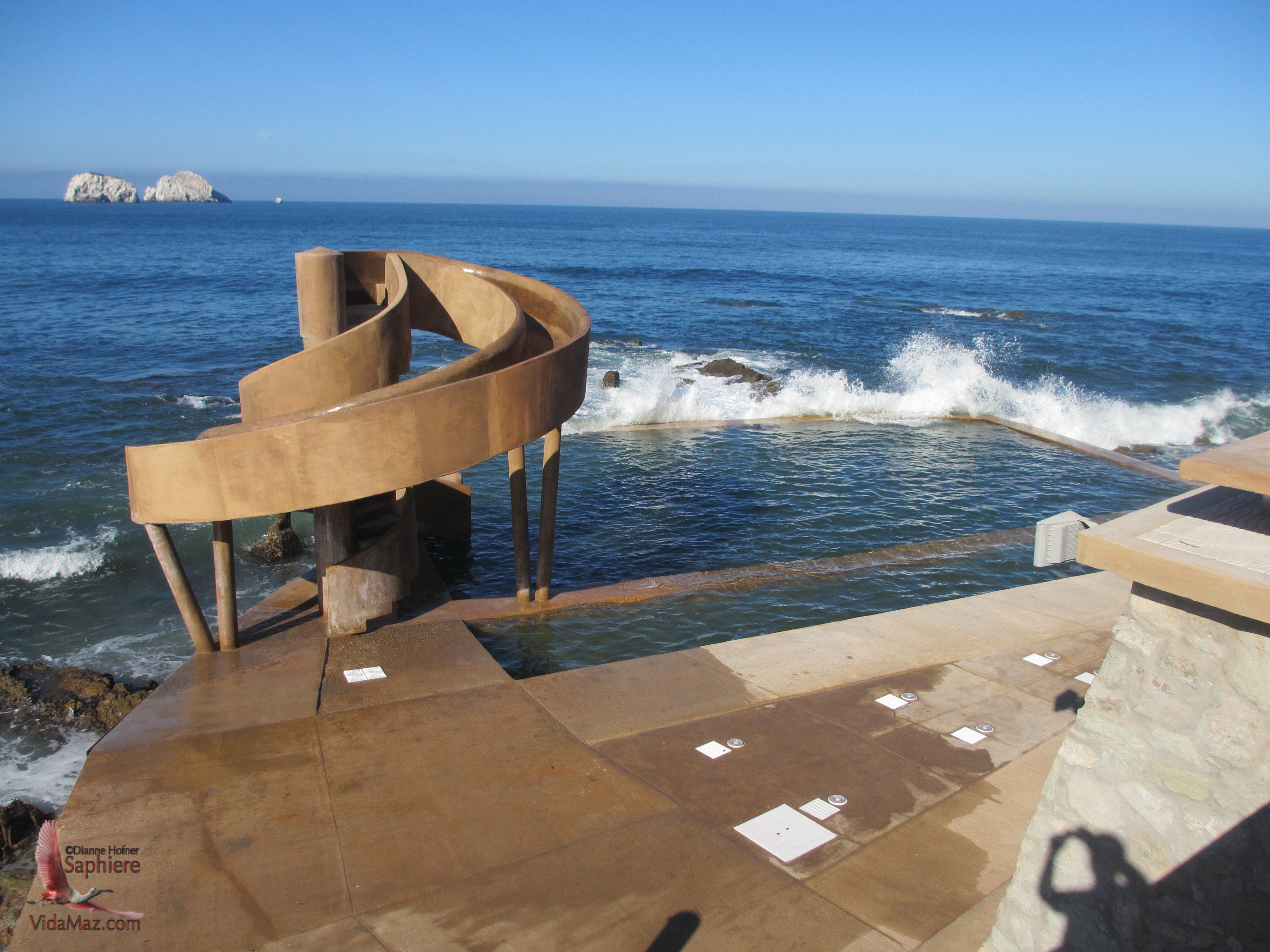
Today, workers were chipping away at hardened concrete to give walkways traction/make them less slippery, as well as to give them more visual appeal. The ramps make the pool area completely wheelchair accessible, though of course if I were physically challenged I wouldn’t want to get into the pool itself. It’ll be nice for accompanying one’s family and friends, however. The cool-looking spiral water slide is in place, as it has been for some time. It is still missing the fountain that goes on top.
With the high waves coming in this morning, the pool looked very exciting, indeed! It has been refaced, so is much cleaner and more appealing than it used to be. The ocean splashes most of the lower level terrace at high tide or in rough waters, so bathers will still need to be attentive. But, that’s part of the attraction of an ocean-fed public pool! Click on any photo to enlarge it or view a slide show.
Bathrooms are fully plumbed, tiled, and nearly ready to go. The modern, molded concrete sinks are in place; toilets and faucets have yet to be installed. One worry: there is only one toilet stall and one shower nozzle in each of the bathrooms, men’s and women’s—woefully inadequate for the amount of use the place will surely get.
Bathroom interior
Molded concrete sink in the bathroom
Snack bar on the second level
View from top terrace down to the second level ramp
The walls that are finished have a much lighter rock face than in the architectural drawings (see the photo above of the snack bar). I don’t like it nearly as much. The walls along the ramp and terraces have not been finished, so it wasn’t clear to us if they will have a darker/richer rock facing of the type we’ve been expecting; we sure hope so, as it would add so much visual appeal to the facility. My guess is the facing will be identical to what’s already been installed.
Note the fountains and rock facing on the walls
Unfinished walls on the terrace
Improvements like the new and improved Carpa Olivera make me proud of our city and the current administration. The renovations are coming in on time and on budget, as far as I know. We asked the workers if entrance to the pools would be free or if there would be a fee, but they didn’t know the answer, and I have yet to ask someone who’d know. Whether there’s a fee, or whether it’s free, Carpa Olivera puts Mazatlán front and center as home to one of the world’s most scenic and exciting ocean-fed swimming pools!
Readers of this blog know how much Greg and I enjoy hiking up, or, in Greg’s case, running up, lighthouse hill. You can read many posts on this blog about the lighthouse, the hike, the flora and fauna in different seasons, and events held there. After he broke his leg last April, however, the resultant nerve damage meant that Greg could barely walk for months, say nothing about running or hiking. We stopped going to the lighthouse. I could have gone alone or with a friend, but instead I immersed myself in zumba classes and the new girlfriends I met there. Our friend Carlos, who works at the top, got worried.
Finally, just in the past month, Greg is BACK. And, our hikes up the lighthouse are back. He’s run up a couple of times now, but he’s done it on Sundays while I’m in church. Today, the two of us made the first of our now-resumed twice-weekly treks. Click on any photo to enlarge it or view a slideshow.
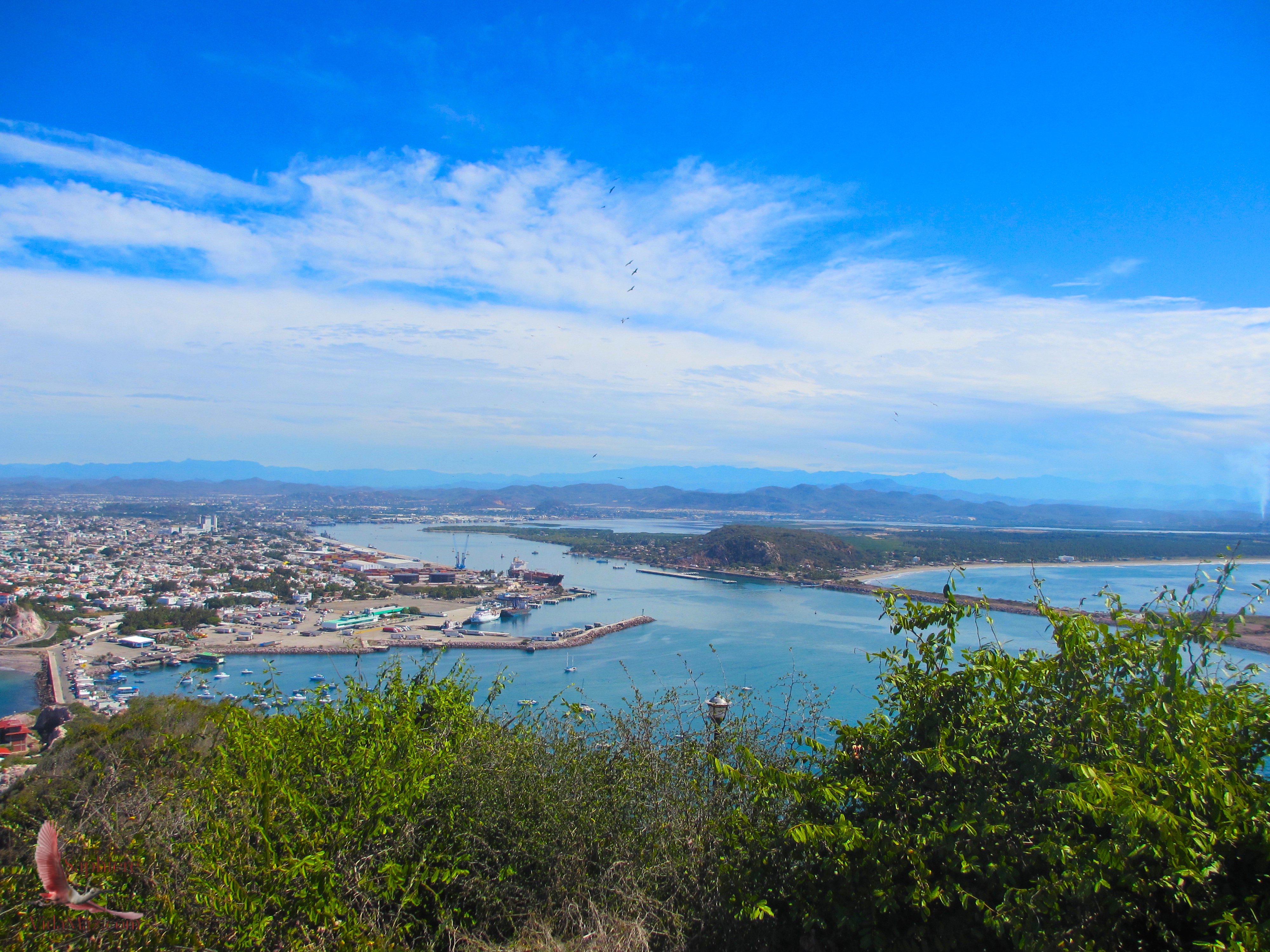
And what better day could there be to hike up the lighthouse? Clear, blue, warm but not humid. Oh, how I missed those views! Today we had a clear view to the bay, the Golden Zone all the way up to the marina, downtown, the port, and the length of Stone Island.
There were many more hikers than usual, due to the holiday weekend. Lots of families and small children, which I always find encouraging. No better way to build strong families than enjoying the outdoors together.
We had three large ships anchored just outside the port today. Just look at how gorgeously clean and blue that water is!
An iguana enjoyed posing for my camera while he was sunning—at least until the kids behind me came running and shouting down the hill.
On this extended puente or “bridge” weekend, commemorating Benito Juárez’ birthday, Greg and I are both back from trips: he to San Antonio for a conference, me to Venice and Milan to teach a course. While it’s always great to travel, see new places, and connect with colleagues and friends, it is also such a joy to return home to the sunshine, the warmth, the affordable fresh seafood, and the joyous people.
Since it is a puente weekend, we wanted to join in a bit of the fun and be among the many local and national tourist families that are out enjoying Mazatlán’s dozens of miles of gorgeous beach. And where better to do that than at Cerritos and Playa Bruja?
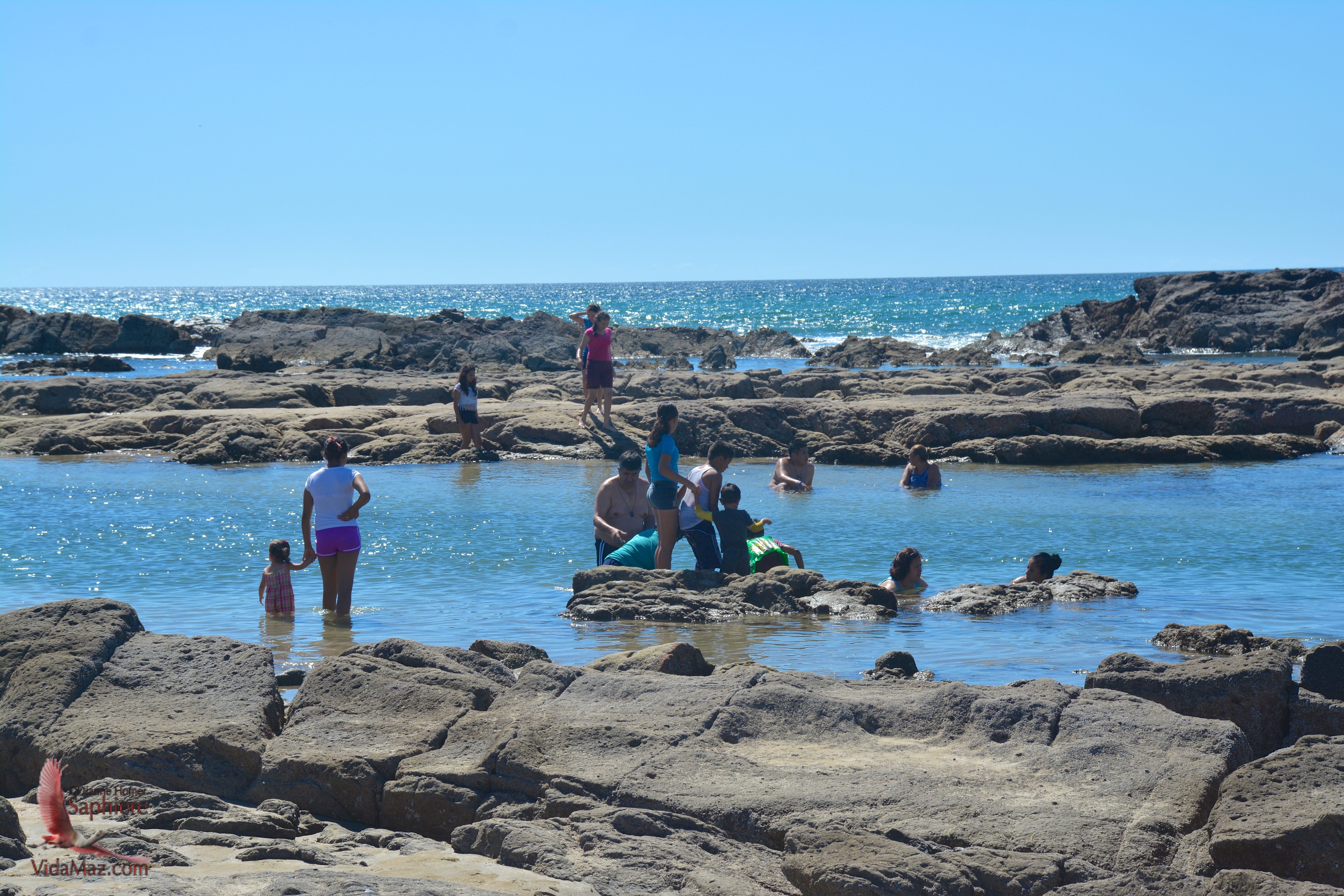
We drove up, I ordered lobster and a coconut while Greg ordered fish and a Pacífico, and we commenced the people watching. While in town we have the fishermen and their pangas at Playa Norte, the sheltered swimming bay at Los Pinos (along with its great surfing farther out), and the miles of sandy beach along the malecón itself, Cerritos is a more complicated mix of sand and rocks, forming sheltered, shallow pools that are perfect for families with small kids to enjoy. It is also home to the fishermen up there, a juxtaposition of people eating, swimming, and working, all from the same rather small beach.
Playing in the shallows
Playing in the shallows
Taking the beer out to the point
Playing in the shallows
Families picnicking and playing
Pangas coming in
Pangas on the beach
Homemade anchor and oyster diving equipment
Playing in the shallows
This weekend, I enjoyed marveling at the ingenious ways people came up with to shade themselves from the sun.
Around the point from Cerritos we of course have Playa Bruja, with Lionso’s Restaurant. There are so many people out and about that Lionso’s has a guard stationed at the gate, to ensure that only people who will eat or drink come in.
Since the last time I paid attention there are a couple of new little places to eat at Bruja—one called “Tiburones” along the beach, and another tucked into the shelter of the rocks. Both are basic palapas. It was wonderful to see the beachside service of food and drinks, and the number of tents put out for tourists and locals to enjoy the day.
Mariscos El Tiburón
Huts against the cliff
Beachside service
Beachside service
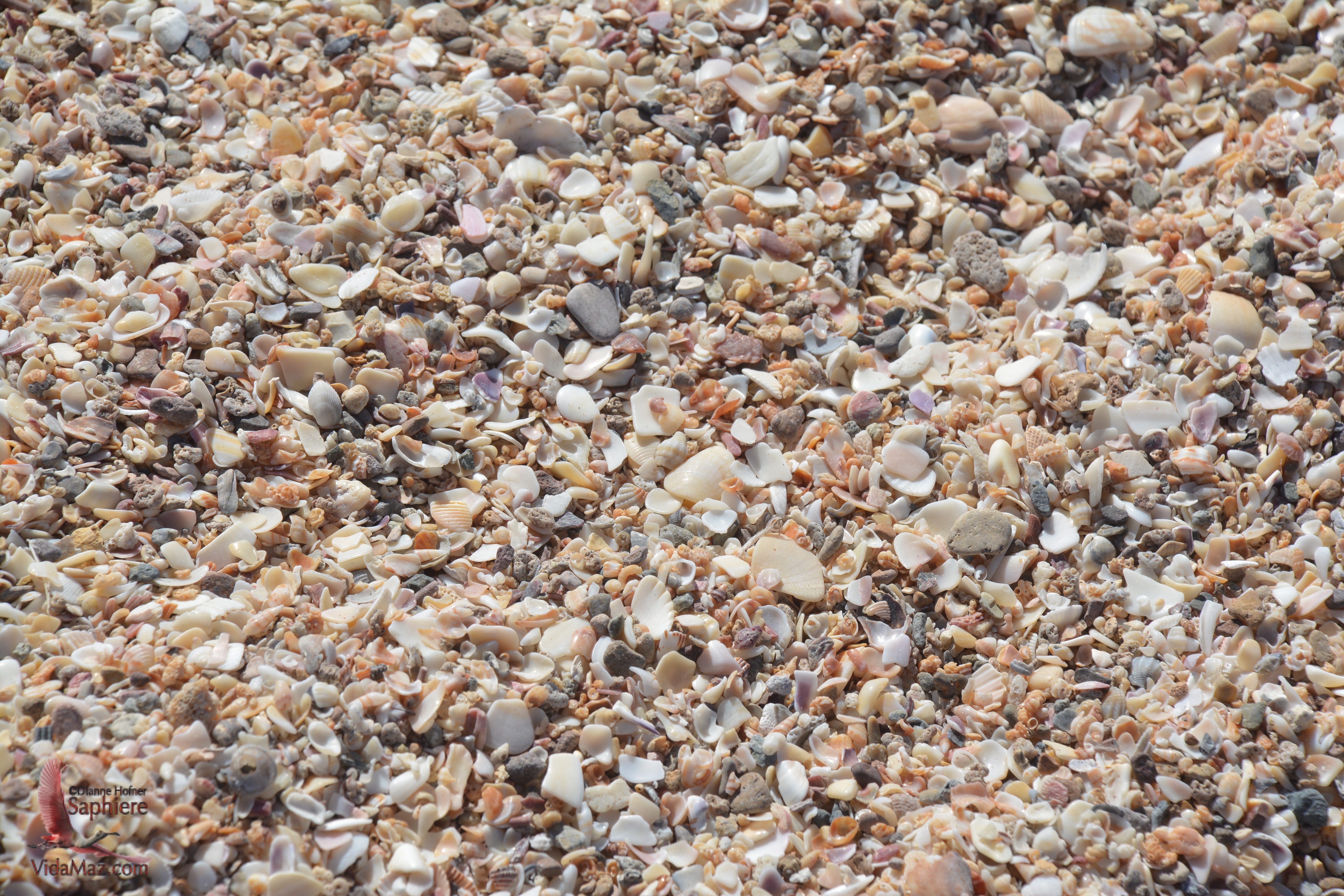
The beach at Bruja is not the fine sand that caresses your feet, as it is in town. Rather, here you’ll find loads of gorgeous shells, just waiting to be crushed and ground up into sand, but, right now, they are razor-sharp and make footwear a requirement unless you’ve got very hardy feet.
On a puente weekend the beach vendors are happy. They’re selling lots of jewelry, hats, sunglasses, cover-ups and cotton candy. The weather is absolutely perfect: sunny, clear, warm but not humid, and the band members from Mr. Lionso’s have to get outside to enjoy their tostilocos, even though they probably shouldn’t.
There’s a huge new housing development going up right beside Lionso’s, heading south towards El Riu. It looks to be a mix of single family homes and condos.
This time of year, the snowbirds are starting to go home, and puente weekends like this, and soon enough Semana Santa as well, remind those of us who live in Mazatlán year round what it’s like to live in a Mexican town.

 Birdwatching here in the center of town is so very incredible. It never ceases to astound me how, amidst the traffic and pedestrians, and despite the bulldozers that are currently working full blast, the lagoon fills with every kind of gorgeous water fowl: ibis, cranes, herons, storks, ducks, bobos, spoonbills… It makes for a splendid sight, and wonderful sounds as well!










 ¡VidaMaz!