Rigo Lewis, Maestro De Carnaval

We LOVE Carnavál de Mazatlán, as you know. It is the third largest (and best 🙂 ) in the world. We’ve done several blog posts about the two annual parades (see 2010 parade photos here), as well as the
crownings (this one links to crowning my favorite Banda, El Recodo, King of Joy) and wonderful pre-events.

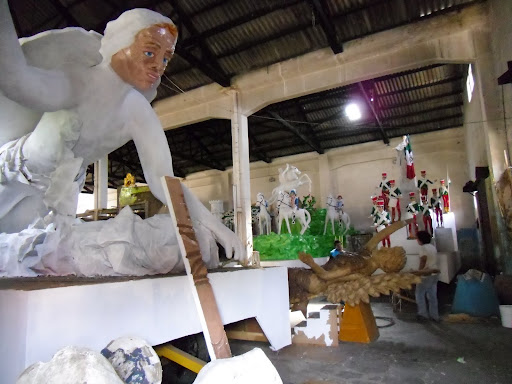
Carnavál in Mazatlán has some of, if not the best, carrozas alegóricas or floats of any Mardi Gras parade anywhere. And, the man behind most of that has been Maestro Rigoberto Lewis.

This afternoon luck was with us. It’s hot out. We dropped Danny off at Scouts, and we had eaten lunch downtown. We were going to stop by Mati for a paleta. It’s a wonderful, historic ice cream maker here in town.

Well, as we got out of the car to walk over to buy our paletas, we noticed a big door open to our right, and, lo and behold, carrozas alegóricas!!! We were so excited! El tallér! But, even better than that, there were a few people putting the finishing touches on the frontispiece of a statue, and who was supervising but… Maestro Lewis!

Maestro Rigo has made the carrozas for over fifty years (he started as a sophomore in high school), as well as designed most of the royal costumes (starting in 1961). He was born during a Carnavál, on February 14. He is a Valentine’s baby, but the fact that he was born during Carnaval has been a much more defining fact of his life.
He very graciously invited us in. We watched them work for a bit, and then he proceeded to tell us a few stories about the plans for next week’s defile carnavalero for Independence Day, as well as his current thoughts about life. He showed us the floats he created originally for Culiacán, but which those of us here in Mazatlán will be fortunate enough to enjoy instead. He allowed Greg to take the picture of him with me that you can see above.

We talked for a while, we watched, we looked around, we went across the street to buy ice cream and bring some back for Maestro Rigo and his workers, and we delighted in our good fortune.

This is a photo of El Maestro that I took as he walked in the Carnavál parade No 1 earlier this year, 2010. I have some great footage of him straightening the queen’s dress as she mounts the float, too. The second parade was marred, unfortunately, by mass panic. The first parade was perfect.

This photo of Maestro Rigoberto is taken from the Carnavál de Mazatlán site.

Some other articles on Rigoberto Lewis and his history of float-making:

El Sol de Mazatlán, 2008
Pacific Pearl, in English, 2001
El Noroeste, 2009

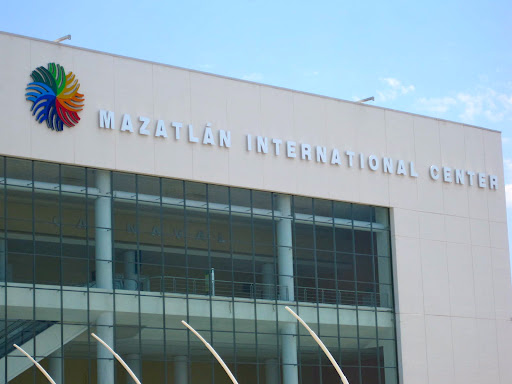
Mazatlán International Center

Mazatlán is gorgeous, and I am very proud to say that we now have a state-of-the-art convention facility, the Mazatlan International Center. Please think about booking your next association or organizational event here in our gorgeous hometown!

The Mazatlán International Center is designed around an aquatic theme, and is the largest facility of its kind on the west coast of Mexico. It is located just north of town near the marina, and the facility’s largest hall accommodates up to 4500 people. Here is a video of the facility.

You see the marine theme from your first approach to the convention center. The fence street-side undulates like the waves of the ocean.  If you come by bus or park your car, you are greeted by shaded areas that evoke seagulls.

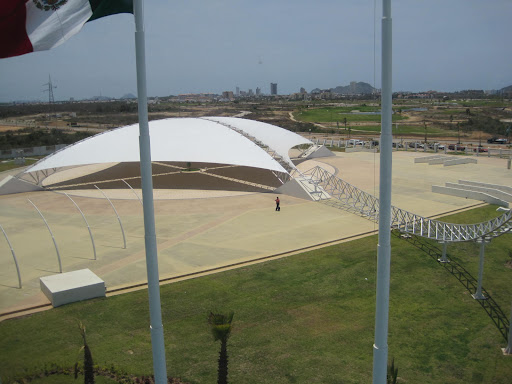
As you enter the facility there is a gorgeous open-air canopied space, which is constructed in the form of a manta ray.

As you enter the main building you walk between metaphorical whale ribs.
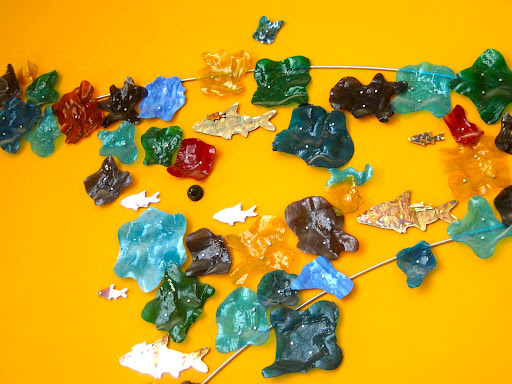
The artwork is fantastic. On the outside wall is, according the Guinness Book, the world’s largest mural, a three-dimensional mosaic of tile work called the “Sea of Cortez.”

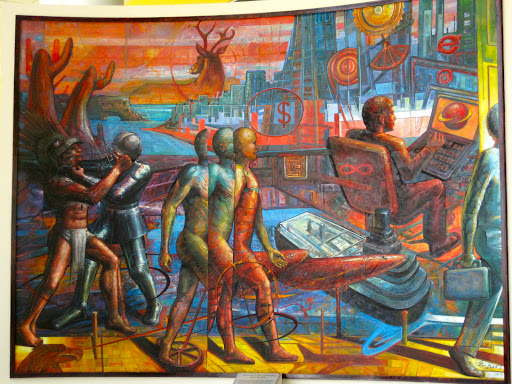
The entry hall holds a painting that takes us on a whirlwind tour of history, and the hallways contain gorgeous paintings as well as glass sculpture, all echoing the maritime theme.
The ground level includes four meeting room named after the islands of Mazatlán: Isla Pájaros, Isla de Venados, Isla de Lobos (each accommodate 300 people), and Isla de la Piedra (room for 130 people), plus a large exhibition hall.
The mezanine has four meeting rooms, named after the beaches of Mazatlán: Playa Olas Altas is the largest, holding nearly 400 people; Playa Cerritos, Playa Sábalo and Playa Delfin each hold nearly 200 people. There is also a business center on this floor, with private meeting spaces, full secretarial services, and two restaurants.

The top floor holds the Gran Salón Mazatlán, which divides into six smaller rooms or, in its large format, holds up to 4500 people. The Carnaval meeting room also divides into three smaller rooms, and in its larger format holds 630. This floor is also where the kitchen is located.

Holy Week and Easter in Mazatlán/Semana Santa y Pascua en Mazatlán

If you say “Semana Santa” and “Mazatlán” in the same sentence, most people think of masses of national tourists crowding the beaches, partying in the clubs, and enjoying banda music.

We took a couple of videos of the banda Las Brisas on the beach at Inn at Mazatlán, if you’d like to see.

But this, the first Holy Week that we’ve actually stayed in Mazatlán, turned out to be quite a sacred event as well, thanks in large part to the young people of Pajuma, the Catholic youth group. This group of young people assembled behind us, in the stadium, from Thursday through Saturday to celebrate Holy Week and to pray for peace.

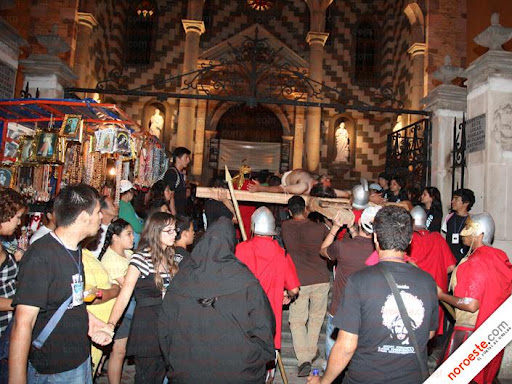
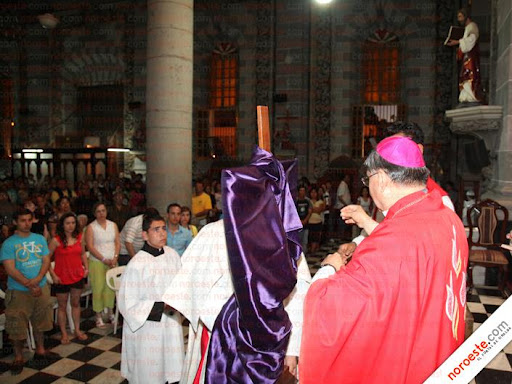
Most of the photos in this blog post are from the local newspaper, as I didn’t take any photos in church, and didn’t have my camera ready for many of the events.

PALM SUNDAY/DOMINGO DE RAMOS
Palm Sunday surprised me, as we showed up at church to find an entire marketplace of palm frond braiders selling their wares in the little plaza in front of the church. There was quite a variety of these beautiful folk art pieces, many of them very detailed, and very reasonably priced.

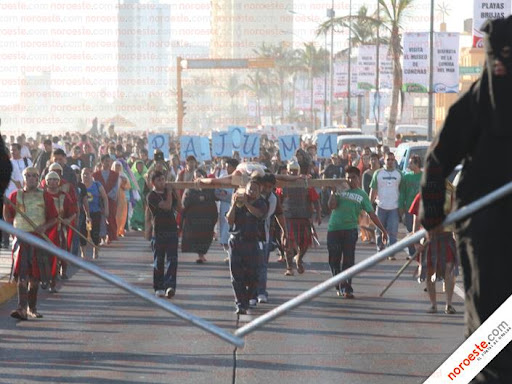
Most parishes in Mazatlán seem to conduct a reenactment of Jesus’ procession into Jerusalem. Actors dress up as Jesus on a donkey, as well as as the Apostles. Observers carry their palm fronds and cheer as Jesus comes into Jerusalem. These are some photos from the procession downtown, conducted by the Pajuma kids. They left the Templo de San José to proceed to the Catedral, and then after mass to go on to the statue of the Virgin of Guadalupe down at La Puntilla.


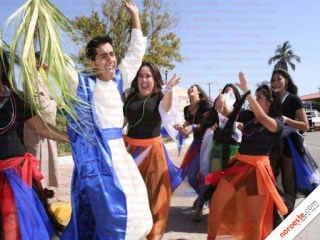


MAUNDY THURSDAY/JUEVES SANTO
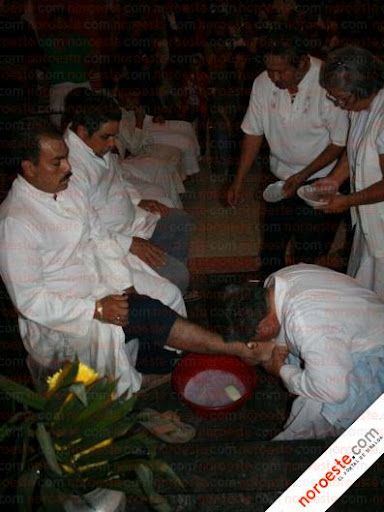
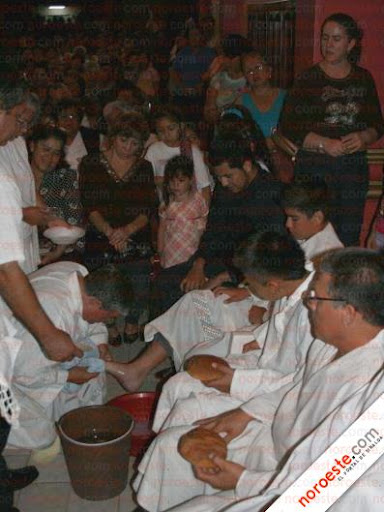
Masses on Thursday usually include the traditional washing of the feet. This is of course the night of Passover, Jesus’ last supper with his Apostles. At that Passover celebration, the Bible tells us Jesus washed the feet of his friends. The humility inherent in washing someone else’s feet makes Maundy Thursday one of my favorite religious celebrations. Here, however, they wash feet a bit differently than what I’m used to in the States (I’m used to us parishioners either getting our feet washed or being able to wash the feet of others). Here the priest washes the feet of 12 men from the parish, representing the 12 Apostles, who are seated in front of the altar.

At the end of mass the altar is stripped and communion is stored away until we can celebrate Jesus’ resurrection. Parishioners exit Mass in silence, or stay in the church for the Easter Vigil (Adoración al Santísimo), accompanying Jesus during his night of prayer in the Garden of Gethsemene.

This mass, for me, was quite awkward. We were all inside, meditating on the impending sacrifice of Our Lord. Outside, pulmonías (open-air taxis) were going by, music blaring on giant speakers, filled with drunken revelers hooting and hollering. While I felt happy for Mazatlán that people were filled with joy, and that much-needed money was flowing into the local economy, it poignantly captured the “life separate and apart” from larger society that Christians are exhorted to follow.

GOOD FRIDAY/VIERNES SANTO
One of the holiest days in the Christian calendar, today commemorates the day on which Christ died on the cross. Many parishes in Mazatlán conduct a Vía Crucis, or the way of the cross, reenacting Christ’s carrying of his cross to Calvary and, sometimes, his hanging and death. These reenactments can get painfully graphic.
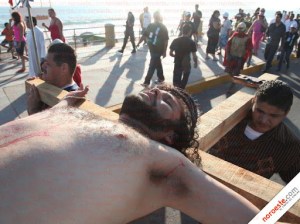
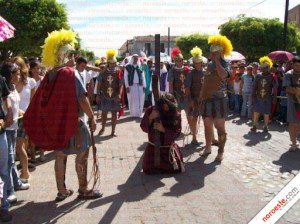
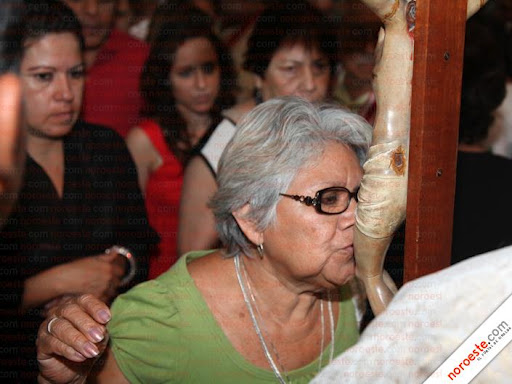
The Vía Crucis usually culminates with a mass, during which parishioners kiss the feet of Jesus on the cross. Again, this is one of my favorite religious ceremonies of the year. Here in Mazatlán they stand and kiss the cross. In the US I was used to kneeling to kiss the feet of Jesus, on a larger cross than what is the custom here.


HOLY SATURDAY/SABADO DE GLORIA
Culminating Holy Week for many Catholics, Saturday evening is the lighting of the pascal fire, or the “fuego nuevo.” I always love this night, because the church is completely dark. Every parishioner brings a candle, which are, in Mexico, conveniently sold in front of the church on Holy Saturday. Fire is brought in from a bonfire outside, and used to light parishioners’ candles. The fire is passed from parishioner to parishioner, and the church is gradually filled with light and hope. It’s a gorgeous sight. A few Easter hymns are sung, during which the lights of the church are gradually turned on as well, and we can again sing “Aleluya,” because Christ is risen.

It is at this mass that we renew our baptismal covenant, renouncing evil and professing our faith. Holy water and sacred images are blessed. We can all go home and eat what we want, because the penance you’ve observed for the 40 days of Lent is complete. Unless, of course, you wait till Easter Sunday to attend mass 🙂

Whale Watching

We went whale watching today, one of our Christmas gifts to each other. It was an INCREDIBLE day!!!!

This slideshow requires JavaScript.

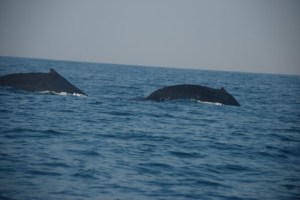
We were told we’d go out 3-5 miles to see the whales, but we were barely on the outer edge of the bay when we saw two whales:

All of a sudden there were three:

Before we knew it there were four…

We’d be with a pod of whales, and then we’d see another off to the right, and yet another off to the left. We were surrounded by humpbacks! We were told humpbacks often travel alone, or maybe in twos (most often 2 males or a male and female), but we were so fortunate today and saw several groups. By the end of the day, we way lost count of how many whales we saw.
Below is some video that Greg took of the whales, to give you an idea of 45 seconds of our day. It starts out a bit blurry but gets much better. Or,  click here to view the video in higher def.

Oscar and Belen from Onca Exploraciones RoCK!!! If you haven’t gone out with them yet, you definitely need to. I have gone whale watching about eight times in my life, I’ve seen much bigger whales (blue whales vs. humpbacks, for example), and Danny and I even spent ten days at a marine biology camp, but this was really special. The boat, Oscar, and Belen are pictured below (Belen is in the middle in the photo on the right; Oscar’s photo is blurry because he’s always moving and speaks with passion—surely no photographer error, lol):


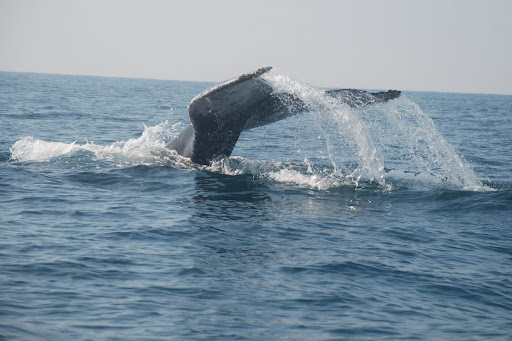
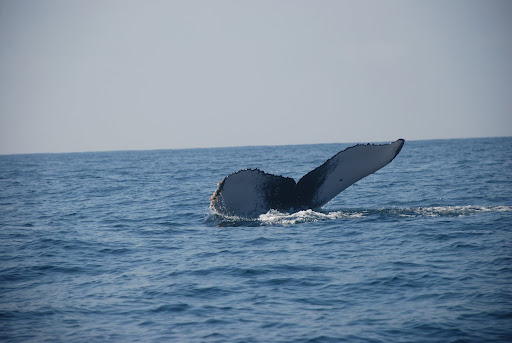
Oscar and Belen are both marine biologists. Oscar is working on his PhD research, a project to photo-ID the whales that frequent the waters of Mazatlán. Amazingly, to date this has not been done. Over the past three years, Oscar has photo-identified 174 different whales. Like human fingerprints, whales have unique visual identifiers, often the underside of their tail fins, sometimes also the scars they bear, and this is what they track. I post a couple of photos of flukes below, so you can see the uniqueness, as well as a close-up of some scarring, to give you an idea of how they ID the whales. Oscar, if I’m wrong about this, let me know and I’ll correct this wording. Below you can see:

  1. The first tail has white spots all along the edge.
  2. The second has barnacles or something stuck to the edge of the tail.
  3. The third has specks of white on the outside, becoming more fully white in the center underside of the tail.
  4. The fourth has white on either side, but a black triangle in the center underside of its tail.
  5. The last photo below shows some typical scarring, which can also help identify the whales.


So, anyway, their goal is to take photos of the whales and give each of them a name or identification, so that they can then be tracked and their patterns learned. The good thing for us is we get to ride along. It is a small boat—maximum six passengers, so we were able to get very close to the whales. We were able to get so close that we felt we could almost reach out and touch the gorgeous creatures. Danny and our neighbor Brian wanted to jump out of the boat and swim with the cetaceans.


Oscar gave us a pre-trip briefing on whales, particularly humpbacks. We learned a lot both before departure and during the cruise. For example, humpbacks are balleen whales. There are three main northern Pacific groups: those that migrate from the Arctic to Japan, those that go from Alaska to Hawaii, and the whales we see here, that migrate along the coast of North America. The humpbacks have striations on their stomachs, the wrinkles we have all seen in pictures. We learned these are like stretch marks (my analogy :)), so that the whales’ stomachs can stretch out when they suck in a bunch of plankton and water, and so that the stomachs resize themselves to normal when the whales push out all that extra water. We learned that when the humpbacks are up north, in the summer, they eat and eat and eat, storing up blubber. Then, when they come south, they don’t eat for four months or more! Down south here is their breeding ground, where they have their babies. The adult males are busy showing off for the adult females, since there seem to be MANY more males than females, and great demand to win the honor of partnering with a lady whale. The men sing to attract the women; the longer the song, the stronger his lungs. The men also fight to attract the women, or at least to establish their ranking in the whale hierarchy and be the first in line to collect their winnings… We saw whales thrashing around a lot. Typical me, I delighted in the fact that they were playing. No, Oscar told me, they are actually fighting with each other–hitting one another with their fins, and we even saw some jumping on top of one another as if they were wrestling. A slide show is below:

Whales Fighting

This slideshow requires JavaScript.

Today was the first day of Christmas break, so of course Danny was NOT excited when he had to wake up for a 7:30 am rendezvous in the marina:
But, after a few whales, here’s what the teenager had to say about the day:

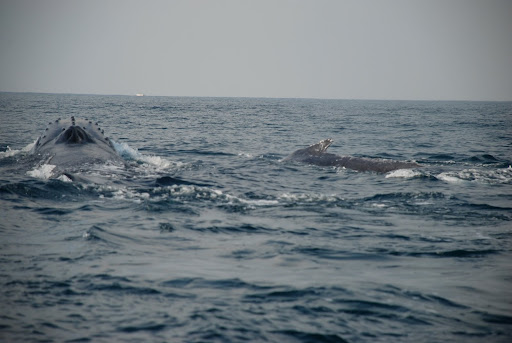
The thing that made this trip so different for me was the SOUND. It is quiet out there, with the motor off and only a few people on board the boat. If you’ve been out in a sailboat, you know the feeling. But, when you are in the midst of so many whales, what you hear is silence plus, suddenly, the whales breeching, or blowing; you can even hear them breathing…. it is sooooo beautiful! The first photo below you can see a whale’s blowhole, on the whale on the left. The second photo below shows a humpback’s head.

 
National Geographic Traveler highlighted whale watching in Mazatlán as one of the great adventures on our planet. 🙂


Whales Diving

Finally, let me conclude this blog post with one last slideshow, of a humpback taking a dive. Merry Christmas and happy new year!

This slideshow requires JavaScript.

El Gimnasio Más Grande del Mundo/The World’s Biggest Gymnasium

Every morning we’re privileged to walk the malecón, our front yard, Mazatlán’s 10 km oceanside promenade. Sometimes we walk it again in the evening, just because it feels so good.

We expected when we first moved here to love the views, the sunsets, sunrises, watching the sailboats and the party boats, the catamarans and the parasailers, the oyster divers, shrimp boats, cruise ships, ferries, and the jet skis. The really remarkable thing to me after living here awhile, however, is realizing that the malecón has got to be the world’s largest gymnasium (and swimming pool).

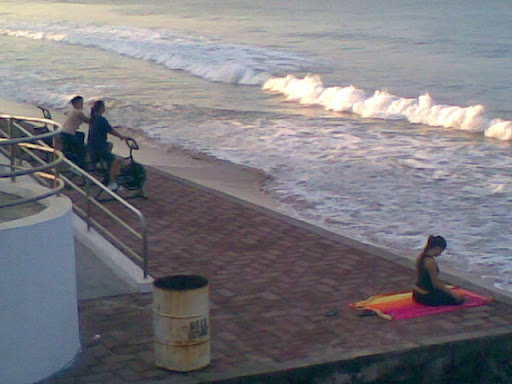
The photo above left is of a few spinning bicycles, and a lady practicing yoga, in one section of the malecón. As you can see, exercising on the malecón is both an incredible audio and visual experience!

Below I list just some of the myriad exercisers and health nuts we see every day, all day long.
The people on the cement (used to be tile) walkway, including:

  • The walkers: fast and slow, limping and smooth, sometimes with a walker, in expensive sports shoes or recycled tires, wearing sweat-repellant high-tech fibers or charity duds, some in the midst of such heated conversation they fail to notice anyone else, others greeting, hugging and kissing nearly every person they meet, the guy who squeezes a ball in his hand as he walks, those who carry weights and do arm lifts as they walk, those who take a few steps and then lunge, those who walk backwards, those who listen to ipods, and those who walk dogs (or whose dogs walk them).
  • Joggers: old and young, fat and slim, jolly and focused, that guy who jogs with his arms stretched straight out in front of him, the lady who swings her arms hard enough to knock someone out, and the guys who pump their arms. There are joggers with both knees bandaged, or braces on both knees; but they are jogging.
  • The runners, and boy do some of them run, evidently from one end of the malecón to the other! Every day! Maybe more!
  • Rollerbladers: newbies, professionals, those who stumble, those who go 50 kph, those who wear pads and helmets, and mostly those who don’t.
  • Bicyclers: on antique bikes, beat-up bikes, and state-of-the-art bicycle technology, ridden by nationals and foreigners, old and young, those dressed for the Tour de France and those in flip flops and cut-off jeans, those with brakes and without :), and those who steer with their hands and those lovely young men who don’t use any hands (some who steer by weight better than others!)
  • Those who use the cement benches for sit-ups and stomach crunches.
  • Those who use the steel railings for push-ups and leg stretches.
The people on the beach, including:
  • More joggers: those who jog in the hard sand and those who really get a workout in the soft sand. And, unbelievably, those who jog backwards in the sand (thank goodness they don’t usually do this up on the malecón itself).
  • More walkers: including those who have shoes and those who go barefoot, and those who stop to collect shells.
  • And even bicyclers: yes, mostly vendors, but those who commute, too, and have much stronger thighs than I do!
  • Those practicing yoga: usually they are in a group, with bed sheets spread out over the sand. There are quite a few different groups, with various teachers, meeting in various places at different times of the day.
  • Tai C’hi: taught by our friend Rick in the Taboada on Tuesday eves and Saturday mornings.
  • Those people who wield those sticks into contortionist poses. Looks like a martial art, but I’m not sure what it is.
Sports teams: including beach volleyball, futbol soccer and futbol americano, but also teams from schools who hold gym classes on the beach.
Boot camps/training: groups of adults (lifeguards, firefighters, police) who train on the beach, performing calisthenics, playing weird games where they carry one another or crawl through each others’ legs…


The people in the water, including:
  • Those incredible swimmers, who swim long distances down the coast and back, alone and in groups, with wet suits and without, those who have done it for years and those who join a class to shape up or improve swim strokes. There is an official “swim club” down near the fishermen’s pangas, and anyone can go early on Saturday or Sunday for lessons, during which they teach you to swim in the ocean and learn the currents. Ocean swimming is a completely different sport than pool swimming, of course.