NBA Players in Mazatlán’s LoboDome

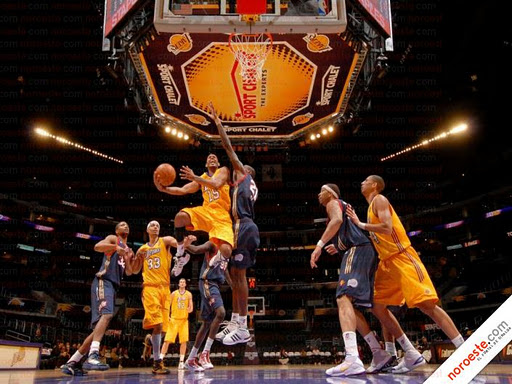
The boys are excited! For 350 pesos (the equivalent of about US$30) we have court-side seats to see 20 NBA players up close and personal (intimate venue) this evening in the LoboDome. 


Our state governor, Mario López Valdez, arranged for them to come down to Mazatlán to play an exhibition game while they are off the court in the US due to labor negotiations. The NBA stars signed autographs and were available for photos this morning on the malecón, and are planning to do so again this evening prior to the game. They also were kind enough to provide free clinics for children here yesterday and today.

Players we should get to see tonight are:
  • Eduardo Nájara (Charlotte)
  • Steve Nash (Phoenix)
  • Jason Kidd (Dallas)
  • Paul Pierce (Boston)
  • Shawn Marion (Dallas)
  • Kevin Love (Minnesota)
  • Tyson Chandler (Dallas)
  • Marcus Camby (Portland)
  • Corey Maggette (Milwaukee)
  • Jarrett Jack (New Orleans)
  • Jordan Hamilton (Denver)
  • Jerryd Bayless (Toronto)
  • Earl Watson (Indiana)
  • Dahntay Jones (Indiana)
  • Anthony Randolph (Minnesota)
  • Hyland Jordan (Clippers)
  • Ryan Hollins (Cleveland)
  • Anthony Tolliver (Minnesota)
  • Dominic McGuire (Charlotte)

I’ll give you all an update on how it goes!


Link to Noroeste story “All Star Show
Link to the story about how fast the tickets sold out 

This is the first part of a two-part story. For the second part click here.


El Faro/The Lighthouse

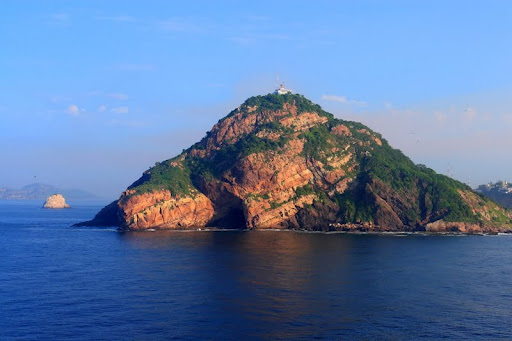
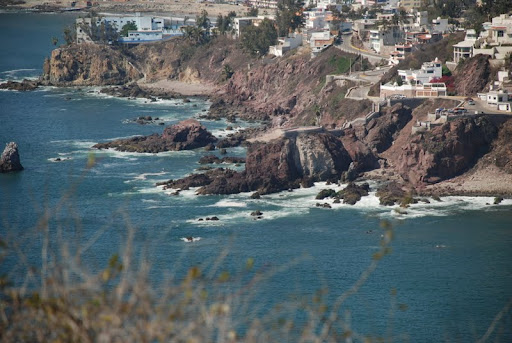
At 160 meters above sea level, the El Faro de Mazatlán is said to be the highest naturally located lighthouse in the world. I don’t know for sure that this is true, but neither can I find evidence to contradict it (see my notes on Gibraltar at the end of this post). What I do know is that a hike up our beloved El Faro hill is WELL worth it. In every season of the year it is gorgeous!

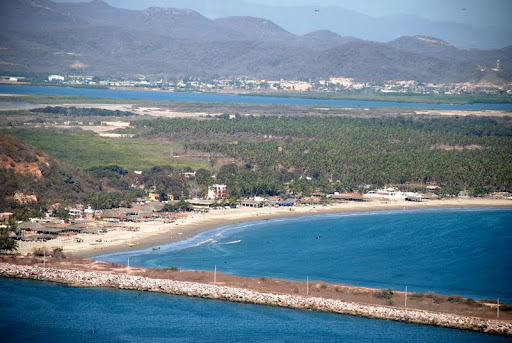
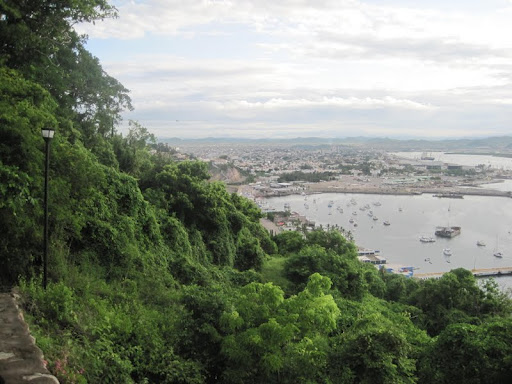
The view from the top of the hill is of course SPECTACULAR. You can look west to the Sierras, out over the city and waterways of Mazatlán, or east to the vast expanse of the Pacific. It’s a great place to sit and have a picnic, and take some panoramic photos of the pristine beaches of Isla de la Piedra while they remain undeveloped.

Your hike up the hill will only take 15-20 minutes. There are plenty of people who run the route. It starts out as a dirt path, and higher up turns into about 300 concrete steps which wind their way around a few switchbacks. Each turn and each elevation provides you a different vantage, and all are delightful. It’s as pretty on a clear day as on the rare cloudy or rainy one.

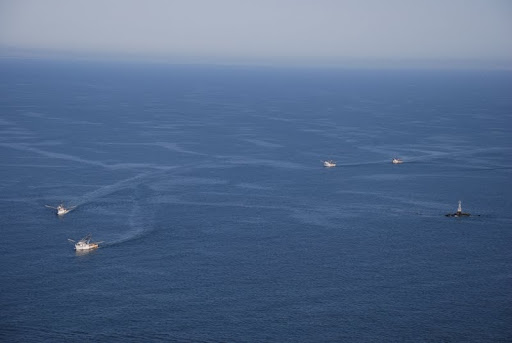
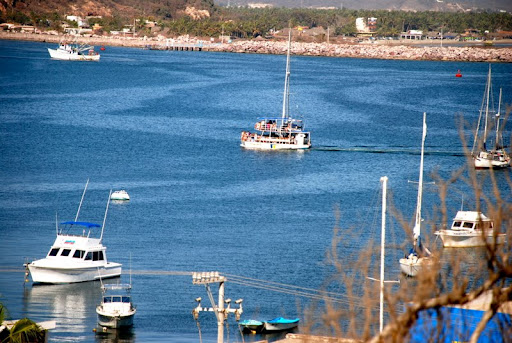
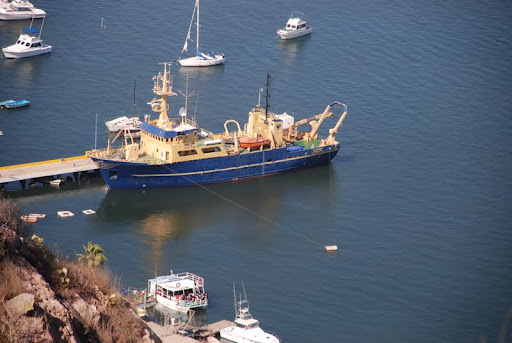
You’ll see ferries, cargo ships, shrimping boats, fishing boats, party boats, sailboats, and pangas.

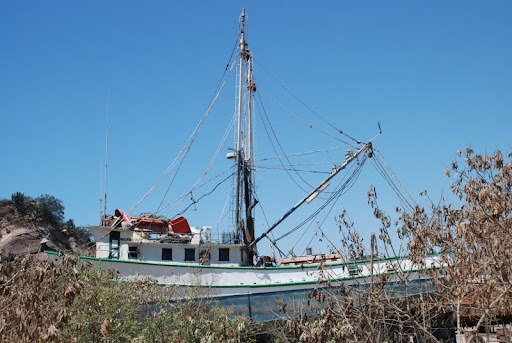
You start your hike on the east side of the port. This is where many of the fishing excursions and party boats load their passengers, and there are a few dry docks and boat repair facilities to catch your interest.

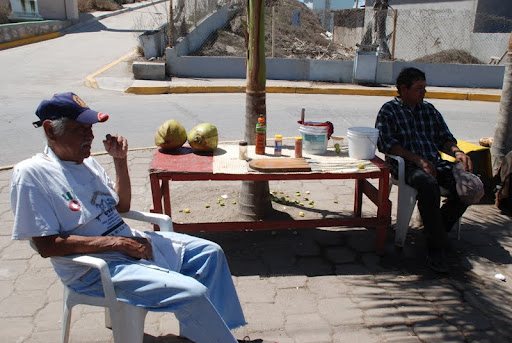
At the entrance to the lighthouse walk, at the base in front of the port, is a coconut seller. You might want to join him for some refreshment on the way up or down.

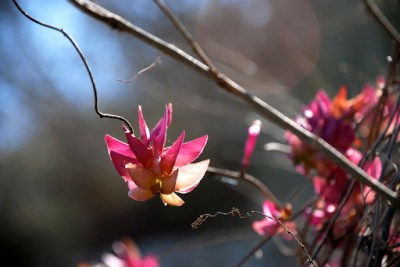
The flora and fauna on your hike will delight your senses. In the early spring the cacti bloom. The green contrasting with the brilliant blue of the ocean will make you so glad you came! In just about any season of the year you’ll see something flowering.


We climb the lighthouse hill at least once a week, we enjoy it that much. Two weeks ago I told everyone we were “Wasting Away Again in I-gu-a-na-ville,” because we saw at least eight different iguanas sunning themselves during our climb to the top. We saw lime green, deep green, yellow, orange, brown and black iguanas.

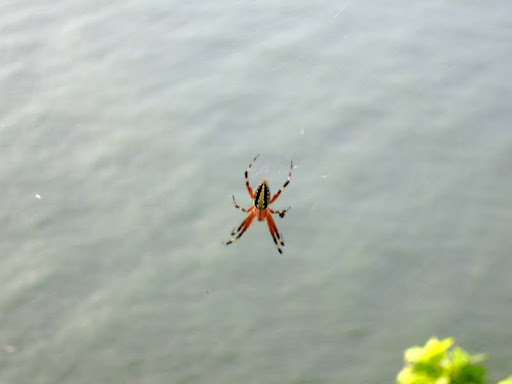
This week I had to change that to “Arañaville,” as the spiders were out spinning their webs in whatever direction you cared to look. It was incredibly gorgeous!

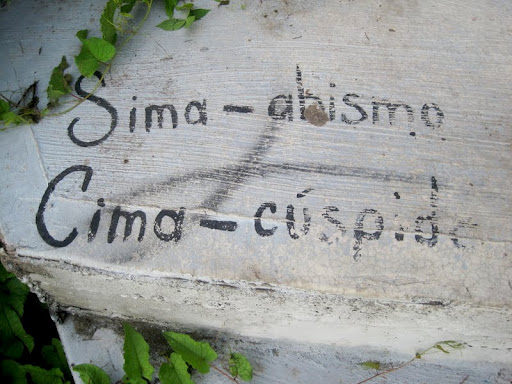
Along the route people have graffitied the stairs. Near the top of the stairs is one of my favorites: a Spanish lesson. It teaches the difference between “top” and “abyss,” which sound similar in Spanish (or at least the Mexican version of the language).

Once you reach the top, and after you take in the view to your heart’s desire, there is also a trail that takes you down behind the lighthouse, on the other side. There are several resting places, and a steep climb involving rope at one point that leads down to the water.

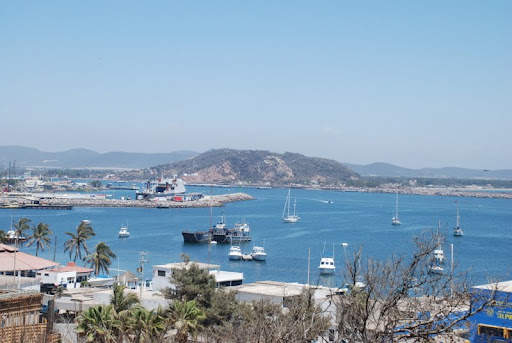
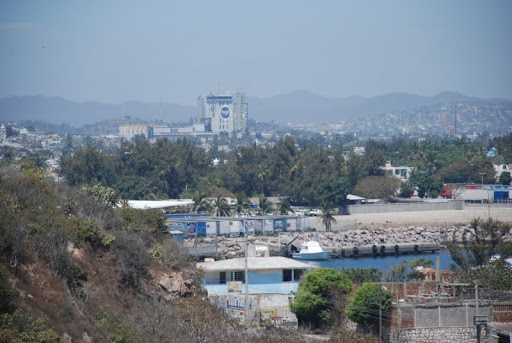
Here you can see our much-worshipped cervecería, the Modelo beer brewery, from lighthouse hill.

NOTE: The highest lighthouse in the world, some have told me, is the Europa Point lighthouse on Gibraltar. However, though the Rock of Gibraltar is 426 meters high, the lighthouse is located on the waterfront, not the top. There is only an aviation beacon at the top of the Rock of Gibraltar. Thus, I’m not sure how our local El Faro ranks globally. It may indeed be the highest.

El Gimnasio Más Grande del Mundo/The World’s Biggest Gymnasium

Every morning we’re privileged to walk the malecón, our front yard, Mazatlán’s 10 km oceanside promenade. Sometimes we walk it again in the evening, just because it feels so good.

We expected when we first moved here to love the views, the sunsets, sunrises, watching the sailboats and the party boats, the catamarans and the parasailers, the oyster divers, shrimp boats, cruise ships, ferries, and the jet skis. The really remarkable thing to me after living here awhile, however, is realizing that the malecón has got to be the world’s largest gymnasium (and swimming pool).

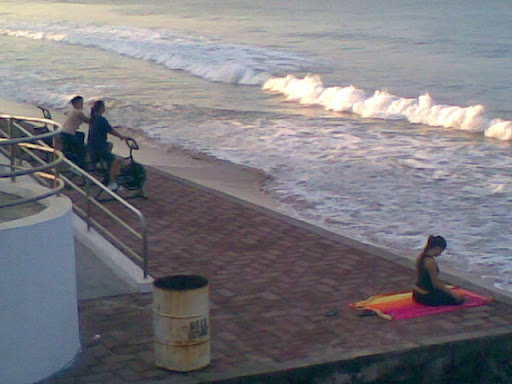
The photo above left is of a few spinning bicycles, and a lady practicing yoga, in one section of the malecón. As you can see, exercising on the malecón is both an incredible audio and visual experience!

Below I list just some of the myriad exercisers and health nuts we see every day, all day long.
The people on the cement (used to be tile) walkway, including:

  • The walkers: fast and slow, limping and smooth, sometimes with a walker, in expensive sports shoes or recycled tires, wearing sweat-repellant high-tech fibers or charity duds, some in the midst of such heated conversation they fail to notice anyone else, others greeting, hugging and kissing nearly every person they meet, the guy who squeezes a ball in his hand as he walks, those who carry weights and do arm lifts as they walk, those who take a few steps and then lunge, those who walk backwards, those who listen to ipods, and those who walk dogs (or whose dogs walk them).
  • Joggers: old and young, fat and slim, jolly and focused, that guy who jogs with his arms stretched straight out in front of him, the lady who swings her arms hard enough to knock someone out, and the guys who pump their arms. There are joggers with both knees bandaged, or braces on both knees; but they are jogging.
  • The runners, and boy do some of them run, evidently from one end of the malecón to the other! Every day! Maybe more!
  • Rollerbladers: newbies, professionals, those who stumble, those who go 50 kph, those who wear pads and helmets, and mostly those who don’t.
  • Bicyclers: on antique bikes, beat-up bikes, and state-of-the-art bicycle technology, ridden by nationals and foreigners, old and young, those dressed for the Tour de France and those in flip flops and cut-off jeans, those with brakes and without :), and those who steer with their hands and those lovely young men who don’t use any hands (some who steer by weight better than others!)
  • Those who use the cement benches for sit-ups and stomach crunches.
  • Those who use the steel railings for push-ups and leg stretches.
The people on the beach, including:
  • More joggers: those who jog in the hard sand and those who really get a workout in the soft sand. And, unbelievably, those who jog backwards in the sand (thank goodness they don’t usually do this up on the malecón itself).
  • More walkers: including those who have shoes and those who go barefoot, and those who stop to collect shells.
  • And even bicyclers: yes, mostly vendors, but those who commute, too, and have much stronger thighs than I do!
  • Those practicing yoga: usually they are in a group, with bed sheets spread out over the sand. There are quite a few different groups, with various teachers, meeting in various places at different times of the day.
  • Tai C’hi: taught by our friend Rick in the Taboada on Tuesday eves and Saturday mornings.
  • Those people who wield those sticks into contortionist poses. Looks like a martial art, but I’m not sure what it is.
Sports teams: including beach volleyball, futbol soccer and futbol americano, but also teams from schools who hold gym classes on the beach.
Boot camps/training: groups of adults (lifeguards, firefighters, police) who train on the beach, performing calisthenics, playing weird games where they carry one another or crawl through each others’ legs…


The people in the water, including:
  • Those incredible swimmers, who swim long distances down the coast and back, alone and in groups, with wet suits and without, those who have done it for years and those who join a class to shape up or improve swim strokes. There is an official “swim club” down near the fishermen’s pangas, and anyone can go early on Saturday or Sunday for lessons, during which they teach you to swim in the ocean and learn the currents. Ocean swimming is a completely different sport than pool swimming, of course.

Inauguración de la temporada de futbol

Danny has played soccer since he was about four years old. We’ve been through the routine: practice, practice, practice. Hand out the uniforms. Receive a season schedule, as well as a sign-up sheet for parents to bring oranges and drinks to one of the games. Take the group photo. Pay for the photos, and forget to send the photos you’ve purchased to friends and relatives, so that you save a whole pile of years of soccer photos in the drawer, untouched. Attend the games and yell and scream and have a terrific time with the other parents. Play in a tournament or two, and maybe win a trophy or medal. No ceremony for the winners; the medal or trophy is handed out whenever, after the close of the tournament. Have a swim party at a parent or coach’s house to celebrate the end of the spring season.

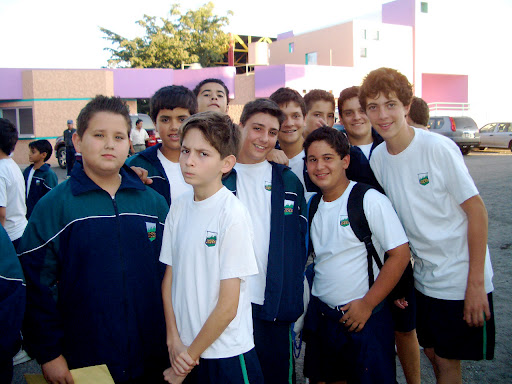
So, this is our first year in Mazatlán. Danny’s now in junior high. He was psyched to be able to make the school futbol team; he was worried his American skills wouldn’t be good enough down here, where kids have grown up playing street soccer every day. They do have great ball handling, but Danny’s fast, and a sound defender. He’s gratefully on the team.
Last week Wednesday we are told that he needs to be at ICO, the major school in town, tomorrow at 4:30. No other info. Forget that we might have other plans; everything here is always last minute (like hearing on Friday night that the first game of the tournament will be Saturday morning at 8 am, or hearing Tuesday night that Wednesday there won’t be school. People here aren’t big on planning and prior notice). On Thursday at school Danny’s told to bring 20 pesos, a copy of his birth certificate and school ID, and his PE uniform to ICO that afternoon.
So, we drive to ICO. We’ve taken a small camera, just in case. We are not sure what to expect. Sign-up for the soccer season? If so, we expect long lines, and figure that’s why we’ve brought the birth certificate and 20 pesos. Perhaps a scrimmage or a game? Maybe team photos? We have taken Danny’s soccer team uniform, shin guards, cleats and ball just in case—good Boy Scouts that we are, we are prepared for anything as we have no idea what to expect. As usual. 🙂
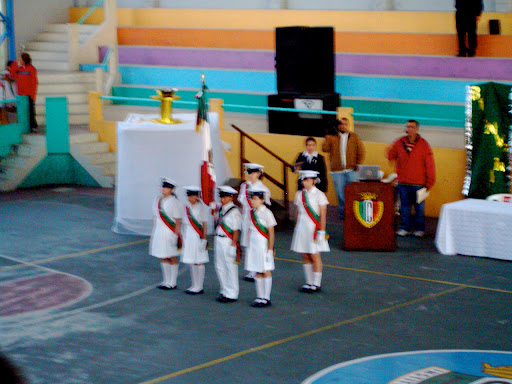
We arrive at ICO. No parking places, as it appears every car in Mazatlán is at this school. Obviously this is not a simple gathering but something major. We enter ICO for the first time; these Franciscans have some money—it is a huge school with new and well-maintained buildings, a central promenade of palm trees, and numerous gymnasiums, courts and stadiums. They are obviously sports nuts. The facilities are unbelievable and envy-producing. The crowd (hundreds of people, if not a thousand–a huge crowd) is walking down the palm-lined promenade to the other end of the school, which feels about three blocks away. There is a large outdoor covered auditorium, encircled by cement bleachers. We find Danny’s team and wait. We are surrounded by other teams, coaches, parents, cheerleaders, bands, you name it. It is definitely noisy and crowded. It’s a party. Everything here is; any excuse for a party. We love it.

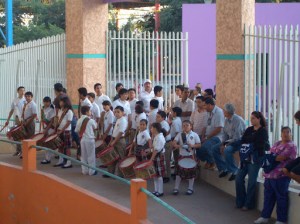
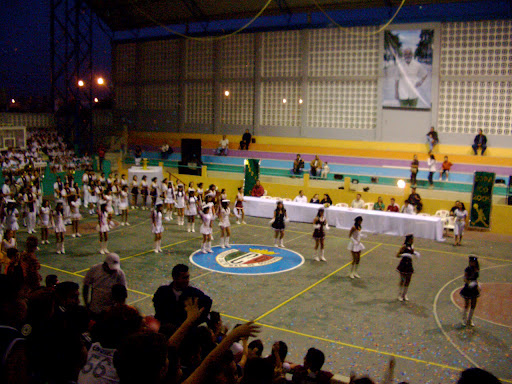
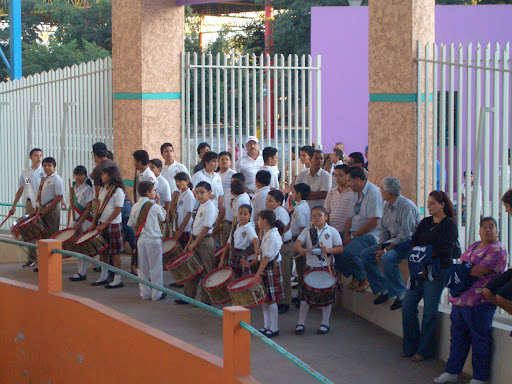
An hour after the appointed time, about 5:30, we file into the auditorium. The kids go under the bleachers. Apparently there is a very large room down there, because there have got to be about 30 or more teams that gather down there. Along with the cheerleaders, pom pom girls, flag girls, drum majors, and bands. Ok, this seems like it’s going to be a big ceremony. We are now told it’s the “inauguration of soccer season,” the ICO Cup Tournament.

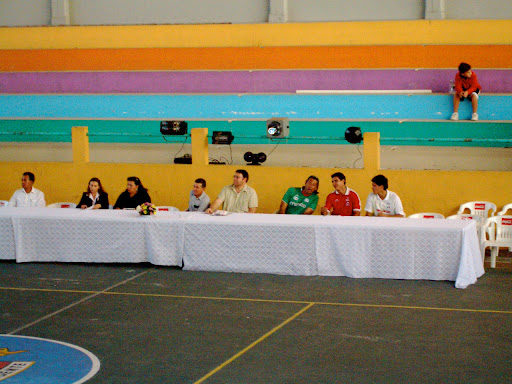
There is a head table. A few speeches are given. ICO is exhalted as a wonderful school about 11 times. Come on already. It’s nice of you to sponsor the tournament, but enough horn-tooting and advertising for the school.
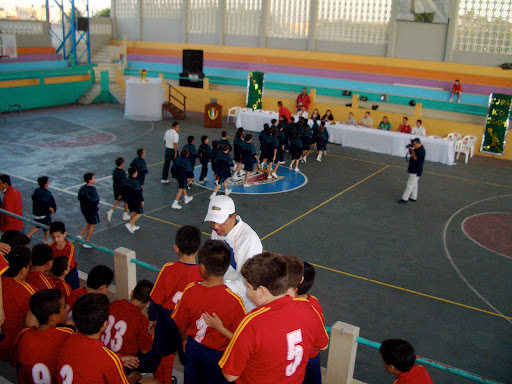
A band plays. There is dancing. The teams are announced, and school by school they parade out into the auditorium, circle the main floor, and are seated. Much fanfare. You’d think you were at the Olympics.
.
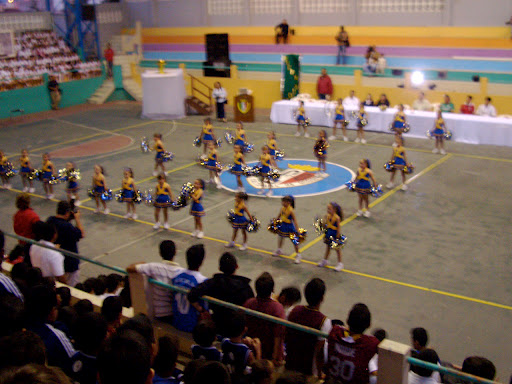
Another band plays. There is smoke and a light show. Fire jugglers entertain us. Several dance routines by scantily clad young women and primary school girls. Confetti is dropped from the rafters. Kids cheerfully jump to catch the confetti, amidst another laser light show and dance routine. Just like the start of the recreational soccer season at home. Ha! Not even pro soccer in the US gets this much fanfare. And I only have my little camera. I say about ten times how I wish I’d brought the good camera. Who would have known? We see our friend Bob Gallagher, and Maria Anderson. They both knew it would be the inauguration, but neither of them told us. We didn’t know they’d be here, so we didn’t know to ask them. Oh well, such is life in a new place.

Then, what we’ve evidently all been waiting for: the lighting of the torch. Two men, this year’s tournament heads, are handed a lit torch by last year’s tournament leader. The torch seems to be burning out of control. The two men don’t really want to hold it–it looks dangerous. One of them takes the torch, but seems to want to slam it to the cement floor and stomp on it to put out the fire. But, no, he’s urged to climb the steps, towards the fire pot, to light the large Olympic-style fire container. The man obviously is very uncomfortable. The torch is nearly burning his hand and arm off. He hurries. He lights the main fire container. While everyone cheers and applauds, the out-of-control torch is hurled to the ground and several men try to jump on it to put the fire out. But, burning liquid pours out from the torch, and we now have a fire show: a three-meter-long firefall behind the main Olympic fire. Cool, but obviously unintended. Definitely dangerous. Thank God for concrete buildings!

It’s now about 7:30 pm. We’ve been at ICO three hours. We’ve heard five or six bands, seen about 12 dance routines. We’ve had laser light shows and confetti drops, as well as the intended and unintended fire shows. Everyone’s itching to get home; enough’s enough. Parents start to stand up, walk over and get their kids to take them home. Father Ian, the head of ICO, grabs the microphone to ask people, in fluent Spanish, to please stay just 15 minutes more. No one listens. There is chaos as parents push through the crowd, weaving amidst the marching band and dancing flag girls with no care as to how long these poor kids have prepared for this night. They get their kids and jam the aisles and the performance arena as they attempt to leave. Thank goodness the auditorium is not on fire, as no one is able to get out quickly. Miraculously no one is injured, no ambulances called. By 8:00, the auditorium is empty, the cacophony had died down. A terrific inaugural, for sure. A delicious slice of the cultural life of Mazatlán.