Tell anyone you’re heading over to the fort, and odds are they won’t know what you’re talking about. El Fuerte 31 de Marzo, built in 1894 to commemorate the battle against the French 30 years after it happened, lies neglected and largely inaccessible beside Casa del Marino, another building in huge need of saving. But this article is about the fort.
On Thursday night this week several groups of concerned citizens united forces, including Toto Tirado, Mario Martini, Gustavo Gama, and Fernando Higuera, Friends of Old Mazatlán, Friends of the Fort, among many others, in an effort to restore the property and use it for public education and entertainment. They have had architectural plans drawn up by Arturo Garduño that involve not just the fort but the entire Paseo Claussen area.
Marco Antonio Tirado
Dianne, Greg and Gustavo Gama
Dianne, Arturo Garduño and Mario Martini
Former mayor Alejandro Camacho, Fernando Higuera, and Greg
Plans for the fort itself include two salons of history on the Revolution and the Reforma, restoring and protecting the remaining walls, base and ceiling, so that the space is accessible to the public and usable for events. There are plans for an esplanade at the entrance, complete with a monument to Mazatlecos who died protecting our city. Click below to view the project’s video proposal.
With its setting right on the water, overlooking the three islands in our bay, restoration of the fort would be a huge asset to Mazatlán, and a perfect way to interest people in learning about our history!
The event Thursday night was attended by 200-250 people, I estimate, and included three wonderful musical acts, the debut of the video outlining the proposal, and some terrific fireworks. They are selling a booklet with DVD for 120 pesos each to raise funds, and of course will welcome donations as well.
Sebastian
Penelope Luna
Los Hermanos Osuna
Personally, I think getting the vendors off the malecón and down onto the Glorieta Sanchez Taboada, as shown in the video proposal, can happen next week! Let’s do it rather than wait any longer!
We have been very excited about the incoming mayor, Carlos Felton González. We first met him during the inauguration of the photo event up on top of the lighthouse. While all the other dignitaries were sweating and heaving with the effort of climbing up, Felton bounded up with energy and later ran down with great glee. He’s obviously fit. We see him in Playa Norte at many of our fair city’s athletic events, and were overjoyed this morning to hear his support for the ciclovías/bike lane plans that have been previously announced and so long in coming to fruition.
One man alone can not make change happen, so we can only hope that his Cabildo, cabinet, committees, staff, and all ciudadanos can jump on board and make this new administration the best it can be for our beloved adopted hometown!
The swearing-in ceremony in the Angela Peralta Theater this morning began promptly at 8:00. Five key opera singers from CULTURA regaled us for 30 minutes. While that took place, the official swearing-in ceremony—oaths of office—were taking place in the Cabildo.
At 8:30 am, the dignitaries walked into the theater: the Governor of Sinaloa, Mario López Valdez; the Secretary of the Government, Gerardo Vargas Landeros; the Commander of the Third Military Region, Moisés García Melo; the Commander of the Fourth Naval Zone, Francisco Márquez; and the Governor of Durango, Jorge Herrera Caldera; and a stage filled with other prominent people. Click on any image to enlarge it or view a slideshow.
Settling in
Finishing up
The abrazo with the gov
Opening introductions and thanks took a full 10 minutes. What impressed me was the sincerity of those thanks—Felton mentioned so many people by name, describing his affection and respect for so many of them. He definitely seems to be a man not driven by pure ego, as is so often our political fate.
The theater was over-filled, with dozens of members of the press standing to get photos, the ground floor and all balconies standing-room-only. A viewing area with seating had also been set up in the Plazuela Machado, with a huge screen streaming events from inside.
Felton shared with us a very clear and highly motivating vision, and seems to have plans in place to get started putting those plans in action. I was sure impressed with his slate of functionaries/cabinet officials that he announced yesterday. Points in Felton’s remarks this morning that stood out for me included:
Almost his very first comment was that he is a padre de familia, a parent, and that he is committed to a community in which families thrive, are valued, feel safe, and have the resources they need. Such values and priorities sure resonate with me.
His commitment to reaching out to all citizens, and his commitment to serve—especially those who are poorest and most marginalized. He also talked of his commitment to the differently abled.
His focus on creating a strong and sustainable economy here in Mazatlán, one in which our children, older and experienced adults—everyone—can find jobs worth having. His commitment to partnering with private industry and to retaining talent here in our port, rather than continuing the brain drain of our top talent to other cities, was music to my ears.
He thanked all foreign residents for their choice to live in Mazatlán, for the affection we show for this city, and for so often setting a good example for others in how to care for and show responsibility for creating the best living conditions possible. This was remarkable—one of maybe three times people interrupted his speech with applause. Given that 95% of the audience or more were locals, this was remarkable.
He had another huge round of applause thanking the police and the military leaders for all their work in securing safety here in Mazatlán. Felton pointed out that no matter how much economic or tourism success we might have, if our port experiences violence, it’s all for naught. Again, it was refreshing to hear a politician giving others credit for the work they so ably do. I attend far too many events where you’d think the only capable person present is the one speaking.
He quoted Khalil Gibran in closing, while thanking his mother, and also extended thanks to his wife and children. He recognizes that his public duties will mean less of him and his time for his family. For me, it was gratifying to hear public acknowledgement of that.
After the official events (outgoing Mayor Higuera was missing from this event), Felton hosted a beautiful reception in the Plazuela, complete with empanadas, donuts, canapés, and nonalcoholic sangria/jamaica cocktails, served in champagne flutes. I was gratified to see that the public was welcome to this reception; many children and obviously lower income people were enjoying mingling with the city’s rich and famous. Playing was my favorite local band: videographer and talented singer Julio Recinos with La Falsa Orquesta Cubana Sazón. Given the perfect, sunny yet cool and pleasant morning and the gorgeous architecture of the theater and the Plazuela Machado, it all seemed auspicious, indeed! As we exited the theater, luck would have it that we crossed paths with Governor Malova, just in time for me to get a good morning kiss.
We are all skeptical of politicians these days, sadly. We hear good words and take them with a grain of salt. It is my sincere hope that someone with such deep ties to Mazatlán as Felton has, someone who has over the years shown his love for our city and its downtrodden, someone married to someone as wonderful and values-focused as Sylvia Treviño, someone who loves sports, the outdoors, the environment, and who respects history and heritage as well as diversity, might have a hope of truly making a difference.
May our city pull together and, as Felton says, truly transform itself!
One final note: We shared with you recently the gorgeous dress that the town of El Rosario had created to honor its town. Evidently Mazatlán has taken their example, as today we witnessed the unveiling of two new dresses representing our port. Photos below.
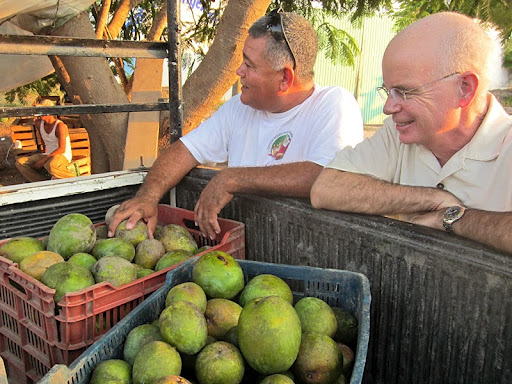
You probably recognize them from our Saturday Mazatlán Farmers’ Market. Productos Rivera are from Escuinapa, just south of Mazatlán, and have been growing mangoes since 1970. They hold US organic certification. Today in the Noroeste I read that they have just signed a new contract with UK-based Marks and Spencer.
I’m so excited for southern Sinaloa, for our farming industry, and especially for organic farming in this gorgeous part of our fair state! Thank you for leading the way and strengthening our local economy, our environment, our health, and our reputation in world markets!
22,000 hectares of land around Escuinapa, Concordia and El Rosario are dedicated to mango; southern Sinaloa has perfect conditions and micro-climates for the best mangoes the world has to offer. Productos Rivera already sell their mangoes in the US market, and they have been attending international trade shows and trying to crack the European market for the past 15 years.
In an attempt to provide more year-round employment to the 150 people they employ in season (May-September), Productos Rivera began dehydrating mangoes in 1995. They sell fresh as well as dried mango, dried mango with chile, and decorative dried fruit arrangements. To quote the Noroeste article, “Last year we produced 50,000 tons of mangoes, and most of it was exported fresh to the USA. But we need to find a way to add value to our product and to differentiate it, because when we have good harvests and lots of mango, the prices fall,” said Ernesto Rivera Valdez, Director General of the firm.
Productos Rivera already exports about 100 tons of dehydrated mango per year to the US, where they are sold in Starbucks, Whole Foods, CVS, Draeger’s, Wegmans, and Hudson News. Thanks to this new agreement, an initial shipment of nine tons of dried local mango will soon depart for London. May the Londoners learn what we already know: Sinaloan mangoes ROCK!
My heart goes out to all the fresh water shrimpers and shrimp farmers in our fair state. As you have no doubt read, “Early Mortality Syndrome” has killed 90%-98% of the estuary shrimp in Sinaloa, robbing so many local families of their livelihoods. It is heartbreaking. This is the same disease that has decimated shrimp populations in much of Southeast Asia (China, Thailand, Vietnam) as well as Sonora and Nayarit.
Sinaloa has a long and proud history of both deep water and estuary shrimping. Our state produced 50 thousand tons of shrimp in 2011, making us the main producer of shellfish in Mexico.
This is not the first time such a disaster has occurred. White Spot Syndrome and Taura Syndrome are two diseases that have previously wiped out the year’s shrimp harvest, and such aquaculture diseases seem to be increasingly common worldwide.
Let’s hope the deep water shrimpers do better! I know we all thoroughly enjoyed the “necklace on the bay” when all the boats headed out to sea on Friday night.
Here’s the original Frasca post:
—
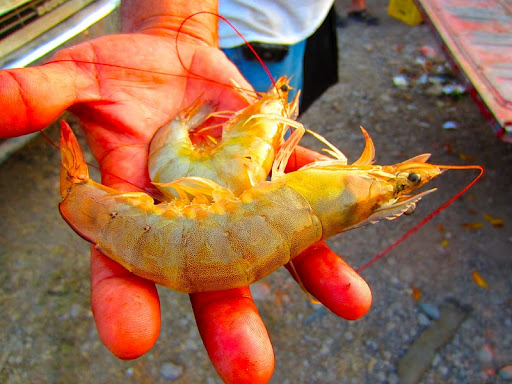
We had a FANTASTIC afternoon and evening learning about shrimping with a cast net/atarraya in the estuaries of Agua Verde, which is between Caimanero and El Rosario. We returned home with heartfelt smiles, new friends, 5 kilos of huge fresh shrimp (for which we paid about 7 bucks), a bunch of fresh crab (which our new fishermen friends gave us for free), and a bucketload of end-of-season mangoes ($4 for a crate full). ¡¡Viva Sinaloa y los Sinaloenses!!!!!!
We set out late Saturday afternoon with our compadres, Jorge and Silvia, to attend the first annual “Festival de la Frasca.” While Jorge told me “frasca” is not a word, and that I surely must be trying to say “zafra” or “open season,” local people tell us it is a southern Sinaloan term meaning “to capture shrimp from the estuary.”
The Festival de la Frasca was supposed to be a food fest with live music. But as usual they were running late setting up, and before we could really get into the party we found much more exciting things calling us.
Just one month ago we had driven this very same road, but shrimp season is now open, and it was an even more wonderful place! I HIGHLY recommend you visit during shrimping season! While the season lasts 6 months, the first few weeks are supposedly the best, as the shrimp and the shrimpers are the most plentiful.
As we drove in we saw men with cast nets (atarrayas) everywhere. Though mango season has finished, it is now the height of the shrimping season, and they have already planted tomatoes. After tomato season will come chile season, and so goes the year here.
Shrimp season is huge. We were told that opening day is like Carnaval—wall-to-wall people everywhere, with families fishing, picnicking and partying all night long. Family members come from all over the region back to Caimanero and Agua Verde to help with the shrimping, and to perform their obligations under the cooperativa(to work a minimum of so many hours and to capture a minimum of so many kilos). Women and children hang out with the fishermen, so it feels like life transfers from town to the estuary during this time.
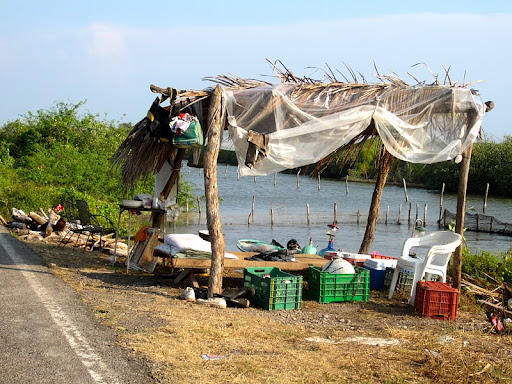
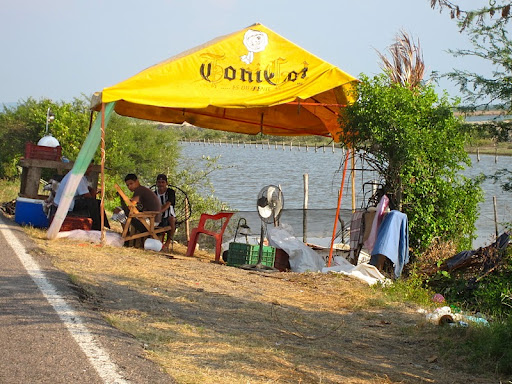
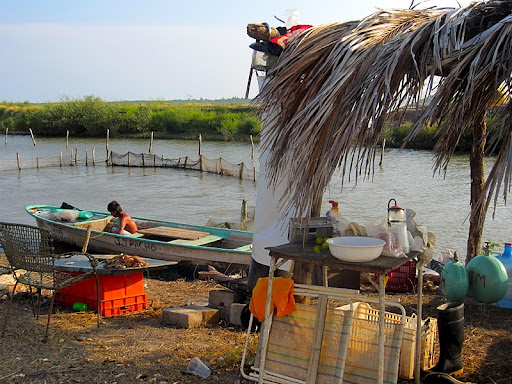
Beside the road that just two weeks ago looked so very different we saw little houses or shelters, many of them housing the shrimpers. A standard shelter like the one shown here has one or two lights powered by a propane tank, a plastic shelter for rain, chairs, a way to cook (usually a fire pit), a radio and a cell phone. As you can see, they sit just off the road. Can you imagine spending the night there with cars, trucks, and motorcycles coming by a few feet away from you all night?
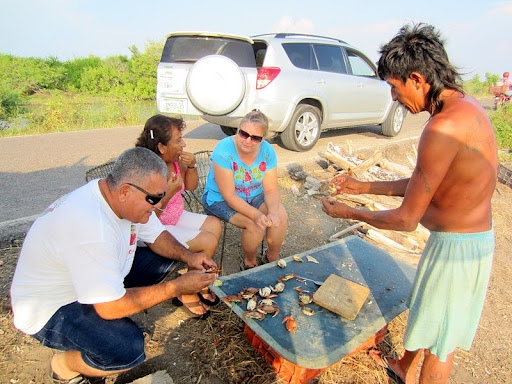
We greeted one of these guys, Rodolfo, at one of the stands, and he urged us to pull over and join him. So we did. The night crew, including Marco (who lives in Mazatlán but returns home for shrimp season), his 8 year old son and his 17 year old nephew, plus one other man, were just pulling up as we arrived.
Rodolfo proceeded to feed us a whole mess of fresh crab and shrimp, beside the road, in the fresh breeze, looking out over the estuary. La vida dura. While I well know, from living in Japan, how to crack open a fresh crab, scrape out the lungs, and eat the juicy brain and meat, this fisherman really enjoyed teaching us, and my comadre, Silvia, really enjoyed learning.
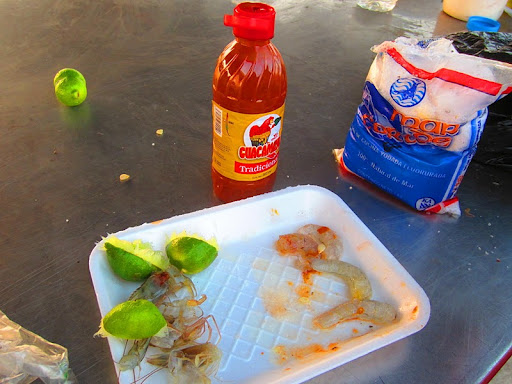
Here we also ate shrimp crudo with salt and lime (my all-time favorite—huge prawns, still wiggling; oh yum!), but he also cooked some for Silvia in a pot of broth.
We stayed here about an hour, chatting, feasting and just generally relaxing. We bought our first few kilos of shrimp, as well as receiving a huge bagful of cooked crab.
There were also many changueros, who we’ve heard about since arriving in Mazatlán, but this was the first time we met a few. They are estuary shrimpers who are not members of a cooperativa. They catch shrimp but legally are not supposed to be doing so. Many of the changueros used purina (shrimp chow) to get the shrimp up to the surface. None of the cooperativa fishermen we met used purina. They were very proud to explain to us that their shrimp were the purest.
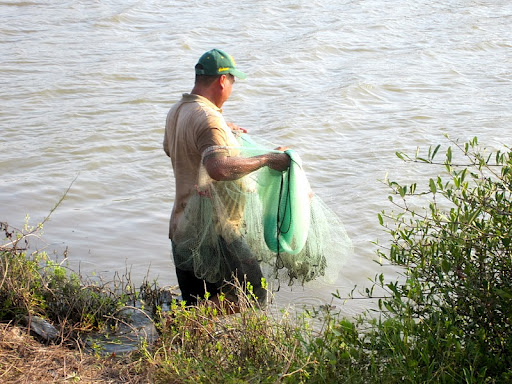
Below is a video of one shrimper casting a net, and his wife helping him take out the shrimp and put them into a bucket.
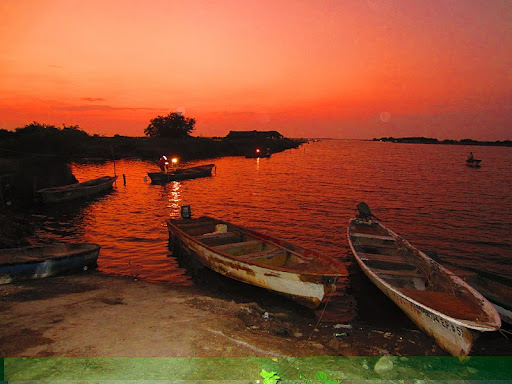
After getting back in the car, we made the rounds of several cooperativas. At the first one the view was spectacular.
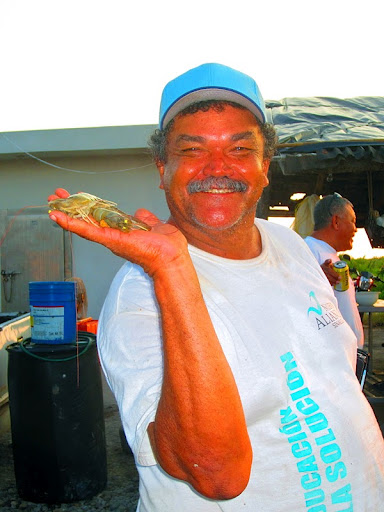
Rodrigo, a man we met there, sold us some more live shrimp. At left is his photo, and below a video of some of the shrimp wishing they could run away.
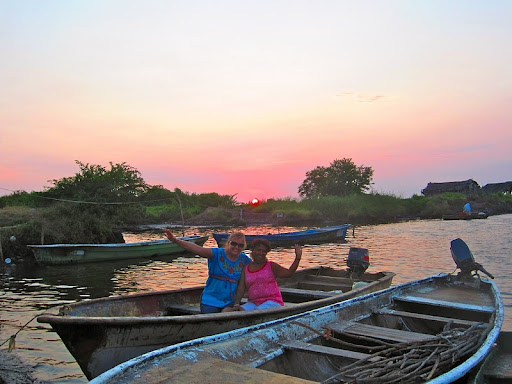
We had arrived here just in time for sunset. The sky and the water glowed. People were all so friendly, open and hospitable that it was amazing. Everyone was eager to talk, to explain this long Sinaloan shrimping tradition, and to share their catch of the day with us. To me this frasca tradition is soooo important; it’s Sinaloa’s history, and the if not some of the best shrimp in the world. And tons of it are harvested BY HAND here each year and shipped worldwide. I know such shrimping used to happen right here in Mazatlán; even next to Hotel Playa was an estuary (no wonder Zona Dorada floods).
The fishermen brought out packets of salt, fresh limes and bottles of salsa, and urged us to eat from their catch to our hearts’ content. Alfresco dining overlooking the estuary with friendly, happy, relaxed, knowledgable people; it was a wonderful afternoon. Every boy we met knew how to cast a net. They seem to start as young as seven or eight.
“Girls just wanna have fun…”
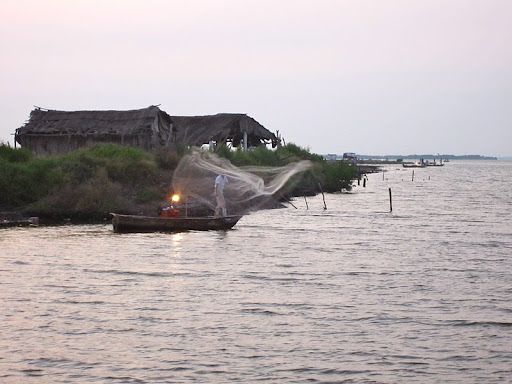
We also sat here for quite a long time, again feasting on raw shrimp (no cooked ones this time), and watching the guys cast their nets in the scenic little harbor.
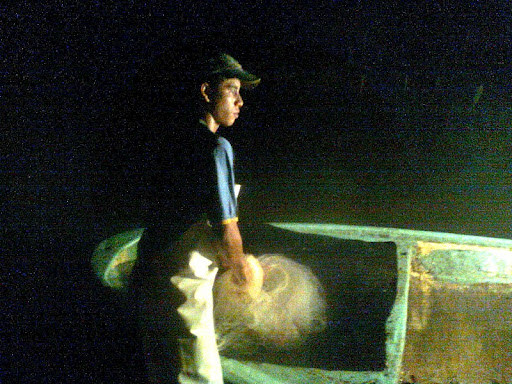
The video below shows a guy casting his net from a panga, so you can see that as well as the earth-bound approach shown above.
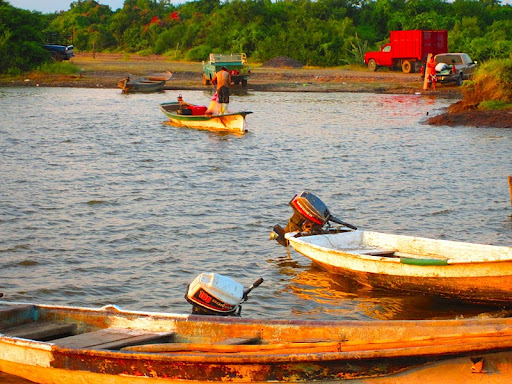
The pangas or small fishing boats go out with two guys normally, one remero or rower, and one atarrayero or net caster. Most of the estuary is only hip- or waist-deep, so the remero carries a long stick or remo and basically pushes the panga along, similar to the movement of the gondolas in Venice.
Below is a short clip of the gentleman at left rowing.
There are various cooperativas to which the shrimpers belong. This drive out to one of them was really something — estuary on either side of the road, with loads of lit pangas all around.
Below is a video, so you can get a better feel for this road-with-water-on-both-sides drive.
After visiting some very cool places and meeting lots of wonderful people, we ended up spending another couple of hours sitting with Marco and his family. It was so peaceful there, and so very pleasant. Excuse the poorer quality of the photos from here on. The batteries on our camera died, so the remaining photos are taken with our phone.
On the way out we stopped at one last cooperative, this one the largest we’d seen. Here they had a large building or warehouse, surrounded by dozens of pangasfishing. Families were sitting and standing everywhere, waiting for their husbands, fathers, boyfriends and brothers to come in with their catch.
A semi-truck full of ice was waiting nearby.
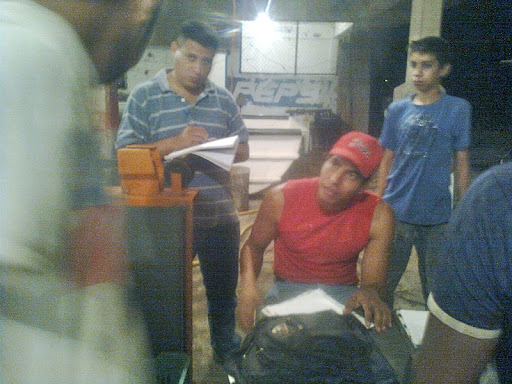
A group of men with a scale and ledgers was registering incoming shrimp.
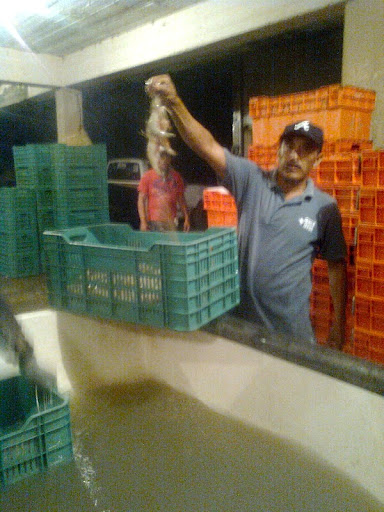
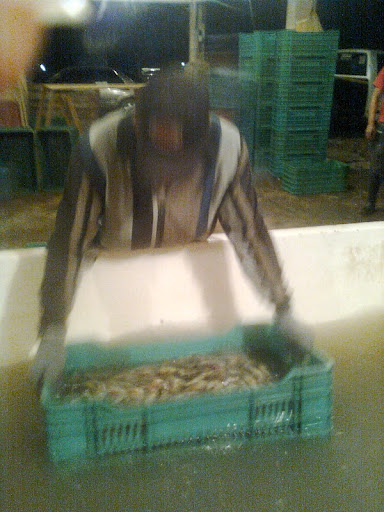
After dipping the bins full of shrimp into ice water, they placed the bins in the refrigerated truck where they are covered with ice and then taken to Mazatlán for sorting, packing and export.
It was at this last cooperative that we also saw our youngest atarrayero, this boy of about eight, at left.
We kept telling our friends that this was an otro mundo, or other world, that most guests in Mazatlán don’t know anything about or understand. We learned a lot about how the cooperativas function and about the life of a shrimper. We all got to eat live shrimp and enjoy some great company. The festival probably happened, but we know we had a lot more fun hanging out with our friends and meeting new ones. We already have plans to go back. We will definitely go opening night next year for the carnaval de cameron, and will head out some month just before the full moon when the really large shrimp are said to be much more plentiful and easier to catch. To be able to find Rodolfo and Marco’s shelter, we put their spot into our GPS and got their cell phone number. Stay tuned.
This is one of the best stories I’ve read recently on the drug war. The month or so I spent in the US this summer, it was THE most frequent question I heard. Whether I travel to India, Japan, or Europe, it’s the question I get most frequently. “What about the violence? What’s up with the drug wars there?” Here’s some insight.
Last year our kids participated in a Model United Nations conference. The goal was to generate new ideas from young people, thinking outside the box, on how to end the violence. They worked so hard, they put their minds to it, but it’s complex. It defies un-unified resolution, I feel. And it definitely demands global attention and resources; one country can not stop this alone.If you are interested in the culture that has arisen around the drug trafficking, you might be interested to read an earlier blog I wrote, on Jesús Malverde.An amazing blog, to me, is the Blog del Narco. Obviously written by, or contributed to by, people with insider information. It has been taken down and started again in recent weeks, but is currently back up. It’s in Spanish.
May our world gain in wisdom, equity, and peace, starting with each of us and how we treat others in our lives. And may our friend Enrique rest in peace. He was a very good man.



















 ¡VidaMaz!