The Posada

It’s posada season in Mazatlán! Everyone you talk to is a bit bleary-eyed from all the partying going on this time of year. “Posada” is a term for parties traditionally held during the nine nights just prior to Christmas: December 16 through 24. A posada can be a private party held in a family home, but it is more typically a street or block party or an end-of-the-year celebration for company employees or club members. If you didn’t attend a posada last night, you no doubt heard the banda music from the party down the street, well into the early hours of the morning. The badge of honor is to be able to brag that you partied till 4:00 or 5:00 am—desvelarse or stay up till morning. Yes, even if, like me, you are nearly fifty, or if you are seventy, or older. Posadas have no age limit.

Music and Food

A typical posada has music, of course, preferably live music. There may be dancing, and partygoers often sing villancicos or carols. Typical posada dishes include tamales, buñuelos, pozole, colación (candy mix), and atole or ponche. Ponche is made from seasonal fruits like tejocote, guava, plum, mandarin, orange, or prune, sweetened with piloncillo (a brown sugar) and perfumed with cinnamon sticks or vanilla. Some piquete (sting) may be added for grownups—a bit of rum or tequila—to make the ponche “happier.”
Piñata

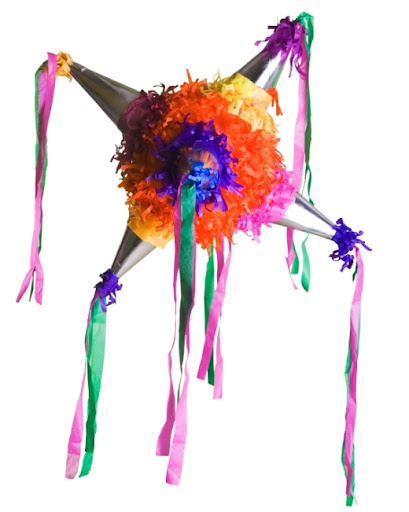
Children at a posada enjoy breaking open a piñata in the shape of a seven-pointed star. It is said the piñata originated in China as a springtime festival treat. Marco Polo transported the idea to Italy, where piñatas came to represent the triumph of good over evil. The seven points of a traditional Mexican Christmas piñata represent the capital sins, and the stick that the children use to break open the piñata represents the power of faith to overcome those sins. The people watching the child with the stick, hitting the piñata, sing this song:

Dale, dale, dale,
 no pierdas el tino;
porque si lo pierdes,
 pierdes el camino.

In English:
Hit it, hit it, hit it, 
don’t lose aim;
because if you lose it, 
you will lose your way.

The Pastorela

Traditionally a posada also includes a pastorela, a procession commemorating Mary and Joseph’s journey to Bethlehem for the census. As the Bible tells us, they searched everywhere for lodging and were turned away, there being no room at any inn. Sometimes a boy and a girl dress as Mary and Joseph, and Mary may even ride a burro. In some pastorelas you may see shepherds, cows, kings—it can be an entire Christmas pageant.

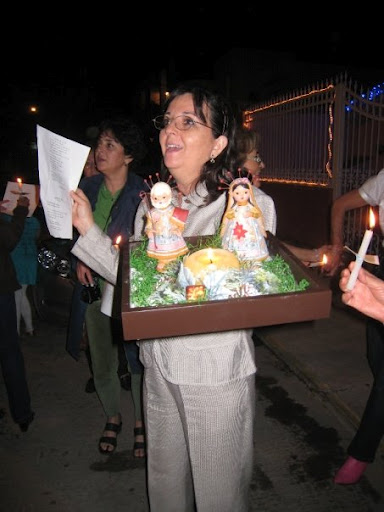
More typically, however, the guests at a posada carry candles, and they parade from house to house along a street or block. One person or several carry a nacimiento or manger scene. Some members of the posada group stand outside, and some stand inside the gate of each house. The people standing outside, carrying the nacimiento, ask for lodging, usually using the song or chant below. The people standing inside the house gates turn them down, again following the chant or song below. This pattern is repeated at each house on the block: the Holy Family and group outside plead for lodging, and the group inside the house turns them down in a threatening manner. It’s a sad and moving scene. Below is the song:

Español
English
Outside Singers
Inside Response
Outside Singers
Inside Response
En el nombre del cielo
os pido posada, pues no puede andar mi esposa amada.
Aquí no es mesón,
sigan adelante. Yo no debo abrir, no sea algún tunante.
In the name of Heaven I beg you for lodging, for she cannot walk, my beloved wife.
This is not an inn, so keep going. I cannot open; you may be a rogue.
No seas inhumano,
tennos caridad, que el Dios de los cielos te lo premiará.
Ya se pueden ir y no molestar porque si me enfado os voy a apalear.
Don’t be inhuman;
Have mercy on us.
The God of the heavens will reward you for it.
You can go on now and don’t bother us, because if I become annoyed I’ll give you a thrashing.
Venimos rendidos desde Nazaret, yo soy carpintero de nombre José.
No me importa el nombre, déjenme dormir, pues que yo les digo que nos hemos de abrir.
We are worn out coming from Nazareth. I am a carpenter, Joseph by name.
I don’t care about your name. Let me sleep, because I already told you, we shall not open up.
Posada te pide,
amado casero,
por sólo una noche
la Reina del Cielo.
Pues si es una reina
quien lo solicita,
¿cómo es que de noche anda tan solita?
I’m asking you for lodging dear man of the house. Just for one night for the Queen of Heaven.
Well, if it’s a queen who solicits it, why is it at night that she travels so alone?
Mi esposa es María,
es Reina del Cielo y madre va a ser del Divino Verbo.
¿Eres ú José? ¿Tu esposa es María? Entren, peregrinos,
no los conocía.
My wife is Mary
She’s the Queen of Heaven and she’s going to be the mother of the Divine Word.
Are you Joseph?
Your wife is Mary?
Enter, pilgrims;
I did not recognize you.
Dios pague, señores,
vuestra caridad, y que os colme el cielo de felicidad.
¡Dichosa la casa
que alberga este día
a la Viren pura, la hermosa María!
May God pay, gentle folks, your charity, and thus heaven heap happiness upon you.
Blessed is the house that shelters this day the pure Virgin, the beautiful Mary.
Finally, at the last home, the owner of the house throws open the gates and joyously welcomes in the Holy Family. Upon opening the doors at the final stop, the tune changes, the pilgrims enter, and all sing these final verses in unison:
Entren, Santos Peregrinos, reciban este rincón, que aunque es pobre la morada,
os la doy de corazón.
Enter, holy pilgrims, receive this corner,
for though this dwelling is poor, I offer it with all my heart.
Oh, peregrina agraciada, oh, bellísima María. Yo te ofrezco el alma mía para que tengáis posada.
Oh, graced pilgrim, oh, most beautiful Mary. I offer you my soul so you may have lodging.
Humildes peregrinos Jesús, María y José,
el alma doy por ellos, mi corazón también.
Humble pilgrims, Jesus, Mary and Joseph, I give my soul for them and my heart as well.
Cantemos con alegría todos al considerar
que Jesús, José y María nos vinieron a honrar.
Let us sing with joy, all bearing in mind
that Jesus, Joseph and Mary honor us by having come.
To conclude the pastorela the guests often sing “Ave María” and perhaps “El Rorro” (Babe in Arms).
Flores de Noche Buena/Poinsettias
 
Poinsettias are native to México, and their name in Spanish means “Flowers of the Holy Night.” Its name in English comes from the last name of the American man who popularized the shrub. It is a very typical Christmas gift as well as a decoration here in Mexico.

There is an interesting legend surrounding the poinsettia. A young child, Pepita (the child is variously a boy or a girl and with varying names depending on the storyteller), is heading to church on Christmas Eve. Pepita’s heart is filled with sadness; she very much wants to give the Christ Child a gift, but she is poor and has nothing to give. The child’s cousin, Pedro (or variously her mother, friend, or brother, again depending on the storyteller), tells Pepita that even the most humble gift when given in love will make Jesus happy. Pepita kneels down by the side of the road, her heart full of love, and gathers a bouquet of weeds. When Pepita places her weed bouquet beside the baby Jesus in the church, miraculously the weeds burst into blooms with bright red, star-shaped petals and brilliant yellow centers.

Tropical Storm Rick

We were VERY fortunate that Rick was no longer a hurricane when it reached us. The huge rough waves (all day on 20th October 2009 and the morning of the 21st), rain and sustained strong winds (from 10 pm till about 11 am) were definitely significant.

Click to see individual photos in the storm slideshow above.The damage around town was still fairly significant. Trees, signs and beachside restaurants were especially hard hit. The beaches ended up with far less sand than they started with, as you can see in several of the photos. Click to see individual photos.

The calm after the storm: sunset on Wednesday the 21st. Moon set with some of the fishing boats in the bay, trying to make up for lost fishing time. Click to see individual photos.

Our local newspaper, the Noroeste, posted some short videos on the storm:
During the storm.
A look at property damage in the wake of Rick.
A look at Stone Island.

A few found fotos

Every now and then I get around to downloading the pictures off of my TelCel cell phone. This last time, I found a few random shots of life in Mazatlán that I thought were worth of sharing:


This dog is very calm. When we lived in Kansas City, I couldn’t drive a car with our dog inside. I can’t imagine how you teach a dog to lay still on a motorcycle at speeds of 40-60 kmh, or 25-35 mph.With the heat index well over 100 degrees everyday, this is not the most efficient way to deliver ice!

No comment required!

Saludos…

El Gimnasio Más Grande del Mundo/The World’s Biggest Gymnasium

Every morning we’re privileged to walk the malecón, our front yard, Mazatlán’s 10 km oceanside promenade. Sometimes we walk it again in the evening, just because it feels so good.

We expected when we first moved here to love the views, the sunsets, sunrises, watching the sailboats and the party boats, the catamarans and the parasailers, the oyster divers, shrimp boats, cruise ships, ferries, and the jet skis. The really remarkable thing to me after living here awhile, however, is realizing that the malecón has got to be the world’s largest gymnasium (and swimming pool).

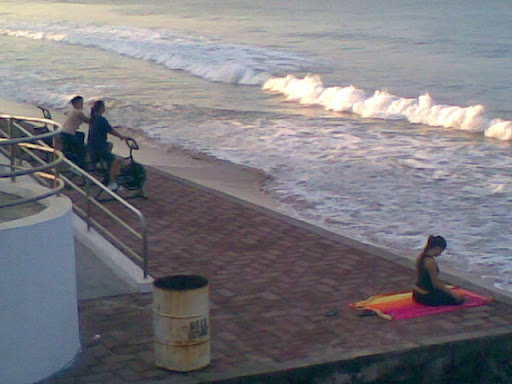
The photo above left is of a few spinning bicycles, and a lady practicing yoga, in one section of the malecón. As you can see, exercising on the malecón is both an incredible audio and visual experience!

Below I list just some of the myriad exercisers and health nuts we see every day, all day long.
The people on the cement (used to be tile) walkway, including:

  • The walkers: fast and slow, limping and smooth, sometimes with a walker, in expensive sports shoes or recycled tires, wearing sweat-repellant high-tech fibers or charity duds, some in the midst of such heated conversation they fail to notice anyone else, others greeting, hugging and kissing nearly every person they meet, the guy who squeezes a ball in his hand as he walks, those who carry weights and do arm lifts as they walk, those who take a few steps and then lunge, those who walk backwards, those who listen to ipods, and those who walk dogs (or whose dogs walk them).
  • Joggers: old and young, fat and slim, jolly and focused, that guy who jogs with his arms stretched straight out in front of him, the lady who swings her arms hard enough to knock someone out, and the guys who pump their arms. There are joggers with both knees bandaged, or braces on both knees; but they are jogging.
  • The runners, and boy do some of them run, evidently from one end of the malecón to the other! Every day! Maybe more!
  • Rollerbladers: newbies, professionals, those who stumble, those who go 50 kph, those who wear pads and helmets, and mostly those who don’t.
  • Bicyclers: on antique bikes, beat-up bikes, and state-of-the-art bicycle technology, ridden by nationals and foreigners, old and young, those dressed for the Tour de France and those in flip flops and cut-off jeans, those with brakes and without :), and those who steer with their hands and those lovely young men who don’t use any hands (some who steer by weight better than others!)
  • Those who use the cement benches for sit-ups and stomach crunches.
  • Those who use the steel railings for push-ups and leg stretches.
The people on the beach, including:
  • More joggers: those who jog in the hard sand and those who really get a workout in the soft sand. And, unbelievably, those who jog backwards in the sand (thank goodness they don’t usually do this up on the malecón itself).
  • More walkers: including those who have shoes and those who go barefoot, and those who stop to collect shells.
  • And even bicyclers: yes, mostly vendors, but those who commute, too, and have much stronger thighs than I do!
  • Those practicing yoga: usually they are in a group, with bed sheets spread out over the sand. There are quite a few different groups, with various teachers, meeting in various places at different times of the day.
  • Tai C’hi: taught by our friend Rick in the Taboada on Tuesday eves and Saturday mornings.
  • Those people who wield those sticks into contortionist poses. Looks like a martial art, but I’m not sure what it is.
Sports teams: including beach volleyball, futbol soccer and futbol americano, but also teams from schools who hold gym classes on the beach.
Boot camps/training: groups of adults (lifeguards, firefighters, police) who train on the beach, performing calisthenics, playing weird games where they carry one another or crawl through each others’ legs…


The people in the water, including:
  • Those incredible swimmers, who swim long distances down the coast and back, alone and in groups, with wet suits and without, those who have done it for years and those who join a class to shape up or improve swim strokes. There is an official “swim club” down near the fishermen’s pangas, and anyone can go early on Saturday or Sunday for lessons, during which they teach you to swim in the ocean and learn the currents. Ocean swimming is a completely different sport than pool swimming, of course.

Tortugas Marinas/Sea Turtles

One of the many fortunate aspects about living on the beach in Mazatlán is that often, whether we’re walking the beach or the malecón, or sitting on the beach eating lunch or dinner, a marine turtle may suddenly crawl up to shore to lay her eggs. It is always cause for joy. It is such a gorgeous miracle to witness, and one we can easily take for granted.

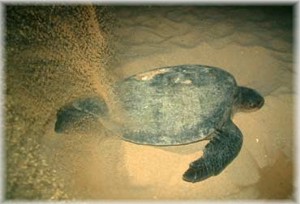
The season starts in September each year, and yesterday I saw my third sea turtle so far this year. The turtle is usually fairly strong as she crawls up onto the beach. She is obviously made for the water, and struggles in the sand, but she crawls up to well above the high-tide line. She settles on a nesting spot, and then begins to dig a hole in the sand.


The turtle then buries her backside in the sand, above the hole, and lays her eggs. They lay a LOT of eggs at once. After she lays her eggs, the turtle usually rests for a few moments, but she is also usually very eager to get herself back into the ocean, where she is more mobile and less at risk of harm. It is so very heart wrenching to watch the mother sea turtle make her way back over the sand and into the ocean. She has no energy left, she is so very tired, and she just struggles something awful. Most people who watch tend to start cheering her on from a distance. It’s a nice community-building event.

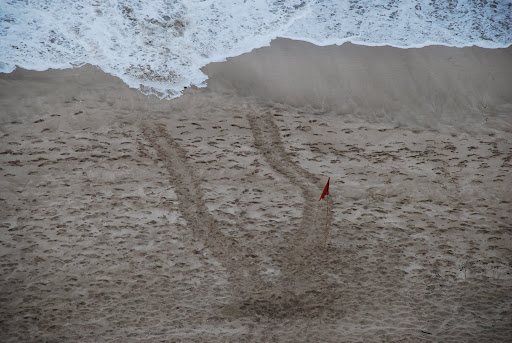
Here is a photo taken from our terrace of a turtle’s tracks, in and out, to lay her eggs. You can see the spot in the sand where she laid her eggs. This photo was taken after the Aquarium official had already removed the eggs for safe-keeping.

Sea turtle eggs unfortunately fetch a high price on the black market. I think people eat them as an aphrodisiac. Some people also kill the endangered turtles; “caguama” is a beloved, though black market, dish for many Mazatlecos, sadly. People use turtle hide to make things, and they use the oils in skin lotions and creams. Years ago I remember seeing a lot of turtle lotions and items for sale in the beach areas of Mexico. Fortunately these days we see a lot less.

I am no naturalist, but in doing some research on the internet, it seems we have three primary species that nest here on the east coast of the Sea of Cortés, Green Sea Turtles, Hawksbills, and Kemp’s Ridley Sea Turtles: http://www.greenpacks.org/2008/08/25/sea-turtles-endangered-marine-life

The sea turtles are endangered:
http://www.panda.org/what_we_do/endangered_species/marine_turtles/
There are signs everywhere on the beach that if you see a turtle, please call the police or the aquarium immediately, as they will come to keep the people away (so that the turtle can lay her eggs in peace), and they will make sure no one steals the eggs.

Despite the best efforts of most people, who keep a respectful distance away, there seem to be plenty of idiots who try to “help” the turtle by getting in her face and crowding her. Just what any birthing mother wants, right? Watch this YouTube for an example of some people’s heartbreaking behavior:
http://www.youtube.com/watch?v=WXka-FQJvsQ&feature=related

The turtle eggs are taken to one of three local spots that I know of for hatching, the Mazatlan Aquarium (click on Mazatlan on the map): http://www.grupotortuguero.org/imap.php?l=1

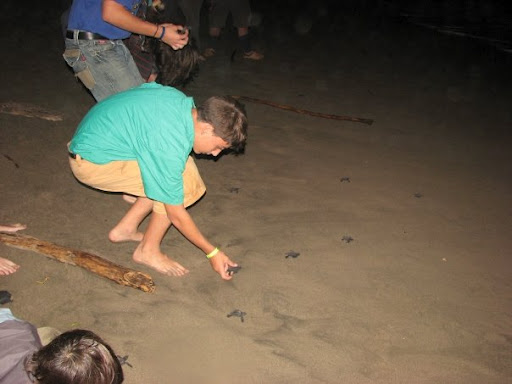
Down south to Estrella del Mar (a golf resort that has a sea turtle hatching facility), and up north in Marmol. They regularly hold baby sea turtle “release” events, where the babies are released into the ocean. Danny’s been fortunate enough to release baby turtles several times, including with the Scouts. Each year his troop hikes north on the beach for 6-7 hours or so, releases baby turtles, then camps overnight and celebrates with a huge bonfire on the beach. Below are some photos:

And there is a YouTube video of a baby turtle’s quest for the open waters:
http://www.youtube.com/watch?v=xthy69jHKOQ