Caimanero & Walamo: Day Trip from Mazatlán

Though Danny’s been in school a week already, tomorrow is the “official” first day of school. He took off with a bunch of friends to Isla de la Piedra, so Greg and I figured we should head out for a day trip as well. Where to go? We’ve been wanting to get back to Cosalá, but since it was already late by the time we were ready to leave that seemed too far to go.

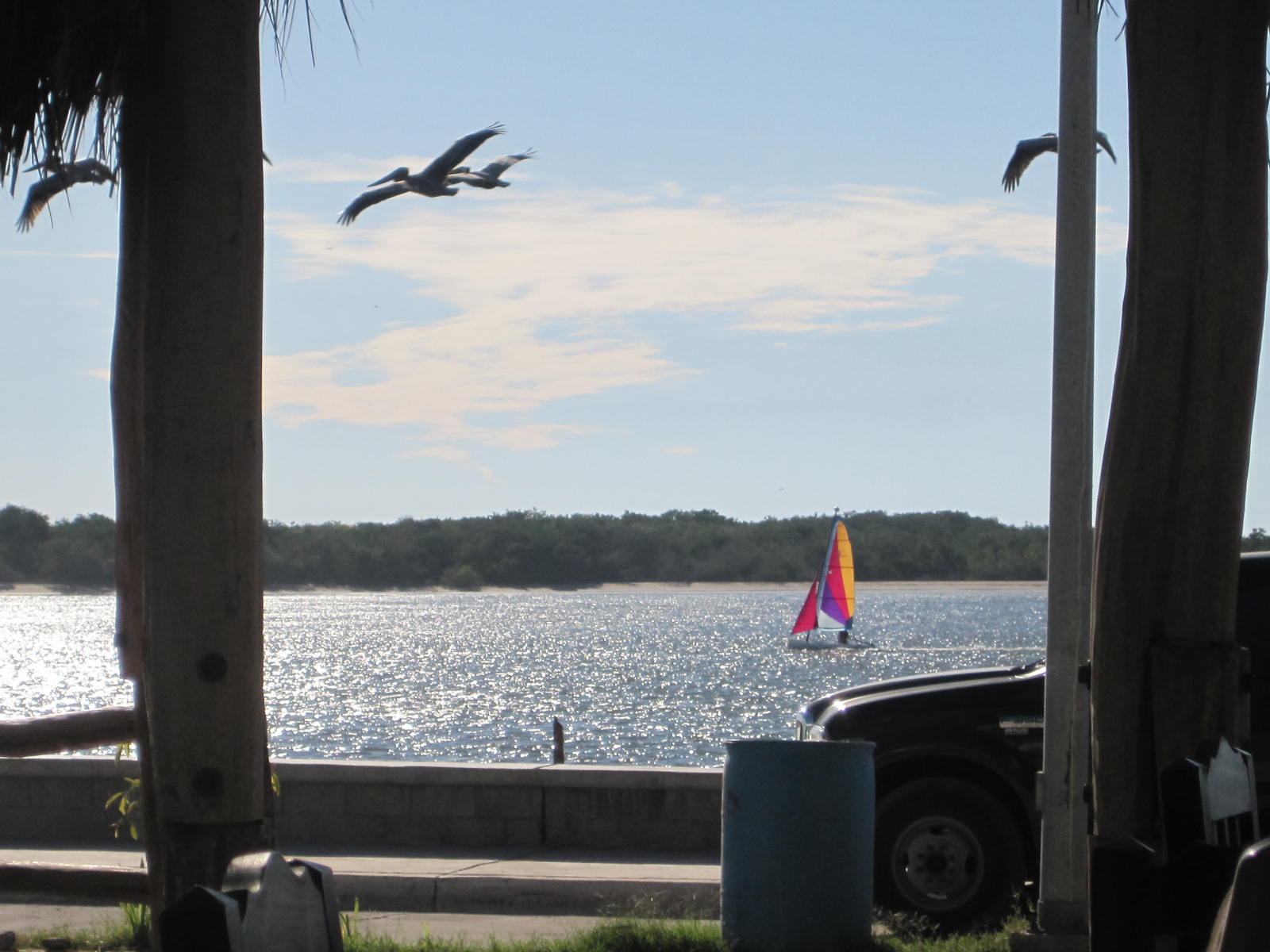
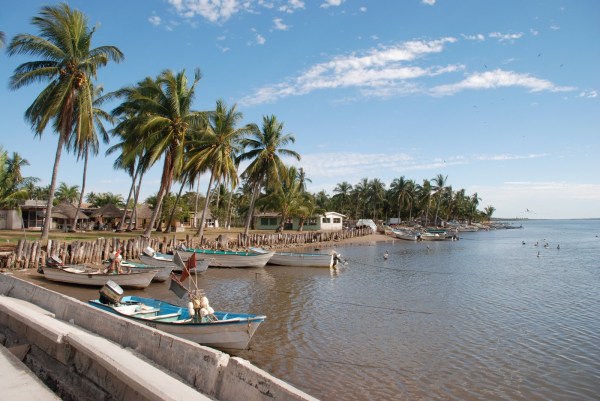
We hadn’t been to Caimanero in a while. How about some zarandeado? Yeah! Even in the heat of summer, the beach has a nice breeze, so as long as we’d be under a palapa at one of our favorite restaurants, fresh fish, a gorgeous drive and an incredible view sounded great!!!!The drive to Caimanero is super easy and very scenic. You basically only make one turn, through Walamo, to get to Caimanero from Mazatlán. The drive is very relaxing, with lots of rural vistas and small town scenes. Estuaries with waterfowl (cranes, storks…), beaches and palm trees, mountains, and aguaculture farms (both shrimp and fish).

We left at 11:30, we were home by 6:00, we stopped a dozen or more times, and we ate a very leisurely and delicious lunch that only cost us 250 pesos with tip for two people with beer. Get your day trip gear on and take a trip, people! Enjoy! Be sure to watch the slideshow below to see just how incredibly lucky we are to live in Mazatlán, with so much to offer in the city and nearby.

Talk with State Secretary of Tourism, 18 Feb 2011

Since I do not run a business here in Mazatlán, I don’t get out and around to many business or chamber-type meetings. Yet, I am a business person, and this is my community. So occasionally, when I do get a chance to attend such a meeting, I tend to get really jazzed. Such was the case last November with the Sergio Fajardo event that I blogged about, and such was the case last Friday when I had breakfast with Oralia Rice Rodríguez, our Sinaloa State Secretary of Tourism, along with about 65 local business leaders.

It is wonderful to get a glimpse into how business and politics are conducted here. I learn a lot about conversational and discussion styles, meet some cool local movers and shakers, and improve my Spanish. And, at least this week, I got a heads-up on some major news prior to it being released publicly (at least, I hadn’t yet heard about it!). Thank you to all who attended and were gracious enough to help me feel welcome!

Please know that any errors in my reporting below are due to inadequate notes or my lack of comprehension. I continue learning about my new home and its people. I post to this blog with the intent to share information in English, not as an expert, but as a resident. I welcome your (helpful  :)) corrections.

So, what happened that was of interest? The big stuff has since the meeting been reported in the press:

  1. Our beloved Las Labradas archeological zone (petroglyphs) will be named a UNESCO World Heritage site. WONDERFUL to hear about that in a venue such as this! I was amazed there was not an outpouring of enthusiasm when Secretary Rice said it; perhaps the others present already knew? The official naming will take place next November.
  2. They are trying to organize a major concert to commemorate the above event, and have invited Andrea Bocelli. This, again, was terrific news, and came out in response to a comment from one of the participants, who suggested that Mazatlán should start hosting world-class, big-name stars on a more regular basis, to resurrect our “golden age.”

In addition to the big news, a couple of trivia pieces that I found of interest: Sec. Rice told us that “Escuinapa” means “Queen of Love” in the Chametla language, and “Teacapán” means “Where love grows.” I did not know Chametla was a language. I googled both of these, but I couldn’t find the details; eager to hear my readers’ insights!

Humberto Rice kicked off the morning by introducing his sister, and then Oralia talked for 15 minutes or so. She seemed to know the majority of the people in the room, and appeared to be very comfortable speaking informally and conversationally to us. She told us:

  • Despite the travails our port and state have been through the past couple of years, hotel room occupancy is actually up about 4%.
  • Mazatlán is in sixth place in Mexico as a tourist destination.
  • The story about the cruise ship tourist who reported her purse stolen, and the homeless man who returned it to the port when he found it sitting beside a bench in the plaza (ALL its contents including ID papers, credit cards and cash intact). We do have terrific people who live in this town! (She did not mention the collection our local foreign residents took up to help and thank the homeless man.)
  • This administration wants a very inclusive and open government; that the shield of Sinaloa belongs “to everyone.”
  • When Malova called her and asked her to be Secretary of Tourism, she asked him why. He told her, “because I want to make Sinaloa the best place in which to live.”
  • She has an open office and any of us are welcome to come to visit her without an appointment. Very surprising to me, she even gave out her cell phone number!
  • At some length about the damage that has been done to our local economy by the US travel warning issued last year that includes Sinaloa and Mazatlán. She said Governor Malova has met with the US State Department, and many state officials have had meetings at the US Embassy in Mexico City, to push for the repeal of this bulletin.
  • She would like to hear how we would like Sinaloa to be six years from now, when the governor finishes his term. That they would like the public and private sectors to work together, to be congruent. That they have or can find the resources, but what they desire are proposals from the local community about how to develop our city going forward.
  • That we have a whole lot of room for development, saying there are 44,000 hotel rooms in Cancún and only 10,000 in Mazatlán, and that she’d be meeting that afternoon at 4:00 to discuss the strategic plan.
  • About the big project in the Historic Center, a pedestrian street along Constitución leading from the cruise ship dock to the Plazuela Machado, into which 6 million pesos will be invested this year.
  • She shared a vision for Mazatlán: To make our Pearl of the Pacific the number one destination for beach and culture in Mexico. I heard several people in the audience murmur that it already is.
  • She encouraged investment into textile plants, including tablecloths and uniforms. Maybe my Spanish comprehension fell apart here, but I wasn’t quite sure how this point fit into the overall theme.
  • The affluence of Sinaloa had risen 8.8% over prior year, despite the economic crisis, and that the numbers of tourists in various categories (cruise ship, national, international) were up 20-30%. This data sure hit me by surprise; I will say that living here, I do not feel an increase in tourism or affluence around me.
  • That TV Azteca would be broadcasting the Carnavál de Mazatlán events live, and that some local hotels are already reporting 100% booking for that period.
  • She shared another vision for Mazatlán: To make our city the “Barcelona of Mexico” and the Angela Peralta “La Scala of Mexico.”
  • Though there was a lot of talk about cruise ships, she also twice to my memory mentioned the importance (very happily to me) of ecologically sound development, and mentioned the upcoming (April 7-10) Congreso de Turismo de Naturaleza (Sustainable Nature Tourism Symposium).
After Secretary Rice finished speaking, the floor was opened to proposals and recommendations, with a format in which three people would each speak, Secretary Rice would respond, and then there would be another two rounds of three in the same manner. We ran out of time before getting to round 3, so only six proposals were offered. They were:
  1. Every tourist destination seems to have a lifecycle. We in Mazatlán do not want to be like Acapulco. We had a golden age, when the world’s best entertainers came here on vacation (rather than Hawaii, Cancun or Arruba). We need to do a big event, invite someone like Placido Domingo, to put us back on the world stage. We should also do surveys of the tourists in the airport.
  2. We need to clean our city: the roads from the airport into town, the malecón, which in the morning smells like a bathroom. This will benefit everyone, visitors and residents. Let’s not take the tourists around the dirty parts, avoiding them; let’s clean them up.
  3. Leticia Alvarado from Recrea read a proposal that was by far my sentimental favorite. She said that tourists come back to visit places where they meet people and can share emotional connections with them. She said we need to work to integrate locals and visitors, by filling our parks, our plazas and our public spaces with life, by cleaning them up, making them beautiful, and holding regular public events (VERY congruent with what Sergio Fajardo told us). She told us about a program in Culiacán where they have walking tours of the city at night, designed to increase safety/decrease fear. She said we need to make people proud to play futbol at the fields in Urías.
  4. There was a question about what COPARMEX can do to support tourist development. Apparently there has been talk for quite some time about making a Tourism Commission within the group, and that will finally be happening soon.
  5. Munir Aún said that we should not limit our dreams, that we should aim high. He suggested we move parallel with FONATUR’s plan for a Teacapan-Stone Island-Mazatlán corridor. It is obviously of utmost importance for Mazatlán to be an integral part of that corridor.
  6. The final question was asked by a developer who said that cruise ship passengers are in town for only a few hours, but part-time residents, whether national or international, spend on average 15 thousand pesos per month that they are in town, and most of them come on average for four months. He encouraged the Secretary to be sure to include this type of tourist in her planning.
Secretary Rice concluded the approximately two-hour meeting by asking those business leaders in the room, “Are we ready for the highway from Durango to open?” She talked about what an incredible opportunity the highway will open for Mazatlán, how much work it’s been. If people come and are disappointed, they won’t come back. We need to be ready, to capitalize on the opportunity. She talked about a “pueblo digno,” a proud city of Mazatlecans who love our heritage and our port. She reminded us that as seafarers and mariners we know how to survive a storm. And, again, she urged everyone to submit their ideas and proposals to the Secretary of Tourism; if they don’t have the resources, they will work with the other departments to get them.

In conclusion, I was left with several things in my mind. So hear goes my personal opinion:
  1. Couldn’t we put together an online “sign this petition,” asking for people’s support to have Mazatlán removed from the US State Department’s travel advisory? I receive several such online petitions every week; they can’t be that hard to do, right? And it couldn’t hurt?
  2. I realize the cruise ships are big money. They are said to build tourism because cruise ship visitors come back for longer stays later. And, we all know how ecologically unsound these ships are. I also very much worry about the impact they have on a local community. During certain hours of the day certain places are crowded and overloaded, while others remain empty. It’s a dynamic that does not seem to me either sustainable or sound for a community. But, yes, the money and exposure are good; many local families survive on that business. So, I would LOVE to see that the Secretary of Tourism keeps the cruise ship business in perspective. I invite her to look at the two vision statements she shared with us on Friday: Mazatlán as THE beach AND culture destination of Mexico, the Barcelona of our country, with El Teatro Angela Peralta being La Scala of the new world. We can all support these visions. Overly focusing on cruise ship tourism could very easily sidetrack us away from that vision, rather than helping to fund and maintain it.
  3. Mazatlán and its environs are absolutely gorgeous. Yet, when I look at photos from decades ago, I realize how much of that beauty we have lost. The gorgeous estuaries along the coast that we used to have! The mangrove forests! The clear blue skies! Any sustainable tourism development plan, it seems to me, MUST include a plan for preserving our natural environment. Ecologically sound development must guide us. The scrubbers on the power plants will be a good start, but we need to convert our buses for clean-air energy. Neither tourists nor locals want to wake up to black clouds of inverted air pollution! There are grants available internationally for this sort of thing. Let’s go, Mazatlán! We can clean and beautify our environment while we create a better style of life for our people! Cleaner air (and water) means healthier people and fewer medical bills.
  4. I’d like to echo what Leticia Alvarado Fuentes said. By bringing life to our public spaces, and encouraging year-round cultural activities, we will overcome violence, build community, and attract tourism. Year-round cultural activities, for everyone. Let us not get stuck in an us vs them, tourist vs local, mindset of hosting cultural activities in the tourist season with nothing for the locals the rest of the year. Mazatlán has an incredibly rich cultural life, and showing it off all year long can do nothing but extend our tourist season!

Teacapan, Sinaloa

Teacapan, Sinaloa

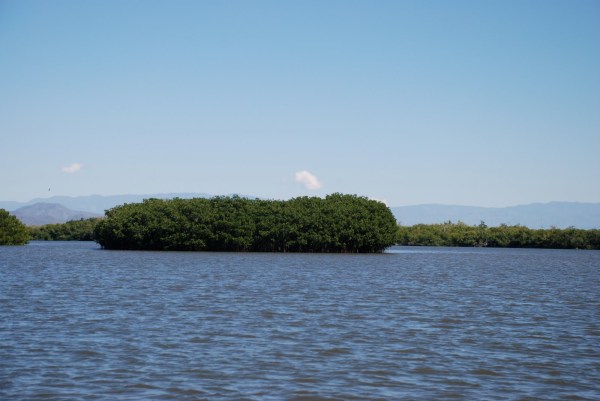
We visited the peaceful fishing village of Teacapán this past weekend, a beautiful place for bird watching, kayaking, fishing or just relaxing that is located a couple of hours south of Mazatlán. The biodiversity of the mangrove forest and estuary were breathtaking.

The area between Escuinapa and Teacapán is scheduled by FONATUR for major development. In a few decades the Mexican government plans for this charming and pristine area, teeming with wildlife, to look a lot like Cancún.

This of course breaks our hearts, but it seemed to be excellently good news to most of the locals with whom we spoke. Development for them means jobs, income, food, and a better quality of life. To us, it means destruction of the incredible mangrove ecosystem, estuary and bird habitat, very similar, no doubt, to how Mazatlán’s Golden Zone looked in the 1950s, before the estuary here was filled in, the mangroves destroyed, and the hotels built. The estuary or lago as those in Teacapán called it, is filled with fish, oysters, crab, and shrimp.

Getting There
The drive from Mazatlán to Teacapán is very easy. You take Highway 15  (toll or free road) south through Villa Unión to Escuinapa (88 km from Mazatlán), then turn onto Highway 1 along the coast to Teacapán (another 40 km). The latter highway has its share of potholes. The vista on the journey is excellent. We made a very quick trip, arriving on Sunday afternoon and returning on Monday evening due to the holiday.

The Town
We were told Teacapán has 6000 inhabitants. It lies right on the border between the states of Sinaloa and Nayarit, though it is part of Sinaloa. It is built around a central plaza which has the traditional band stand and a quaint church.

It is right on the coast, but faces a long peninsula that the locals call “el otro lado.” Yes, that’s usually the term used to refer to the United States, “the other side,” but in Teacapán it refers to the “island” (it’s a peninsula but is called isla by the locals) offshore, covered in mangrove trees, the other side of which is supposedly an incredibly gorgeous beach. Trouble is, you need a lllloooooonnnngg drive to get to that beach! There is also a place on the island called “Texas.”

Looking from town, you can see what looks like an inlet/outlet to the ocean, but mostly you look at the calm lago (which is really a 30 mile long estuary) and beyond that the island. Thus, you don’t hear crashing waves as you would on a more usual bay.

The valley is rimmed with mountains, so it’s a very gorgeous view. One of the main mountaintops is said to look like a man’s face. The locals say it looks like George Washington.

Lodging and Food
Our hotel (María Fernanda) was clean, bright, affordable, had two pools and a restaurant, and the shower had hot water. It was located right on the water with beautiful views. There was wireless internet in the lobby but not in the room.

Teacapan, Sinaloa
The town seemed to have very few formal restaurants. We ate in the hotel; there was another restaurant run by a Canadian right next door (Wayne’s), and a family-owned palapa restaurant was just down the malecón. We saw was a cocina económica on the plaza, and various more informal eateries and botaneros on the main road into town.

We ate a wonderful pescado zarandeado for dinner the day we arrived, and there were crab, prawns, and scallops galore. We bought some fresh prawns and crab meat to bring home with us for dinner; yum!

Mangroves and Wildlife
The mangroves of Teacapán are a famous bird watching area, home to 250 species of birds. The Marismas Nacionales are the largest coastal mangrove area on Mexico’s Pacific coast. We saw great herons, and little blue herons, white herons, cranes, lots of osprey, roseated spoonbills, cormorants, a fairly unusual bird called a boot-billed heron (I believe), flycatchers, and a host of other birds big and small, including the usual gulls, pelicans and frigate birds.

(You bird lovers may like to read my “Crane Convention” blog post, which took place in Mazatlán last year.) 

We found a terrific guide, Victor Méndez Denis (tel 695-954-5386). He told us he is licensed by the federal Department of Tourism as an ecotour guide, the only one in town. He has a very nice, clean, covered boat with a very quiet motor that holds about 15 people. When he told us he could talk to the birds we thought he was joking; we laughed and called him Dr. Doolittle. But, indeed, Victor called quite a few birds, and seems quite adept at calling. I’m confident most birders would be thrilled.

He took us on a cruise out to “the other side,” Bird Island and a few other places, and we found him to be very knowledgeable. He explained to us that four out of the seven kinds of mangroves in the world can be found in Teacapan: black, white, red and button. The red mangroves are especially plentiful, extending their roots down into the water to form a “reef” in a very similar manner to the way in which coral grows. This reef teems with wildlife: birds in the tree branches, crabs and all sorts of aquatic animals among the tree roots. We were told there are cayman in the water, but we did see quite a few people snorkeling, either oystering or spearfishing.

In quite a few areas along the “other side,” the island, there are oyster shell mounds, said to be the remains of oysters harvested by native people over 4000 years ago. Some say they are burial grounds. The mounds are extensive.

Teacapan, Sinaloa

Fishing
There are loads of oysters to be found in the fresh water here. They are easy to harvest, too; not like the rock oysters in the ocean off Mazatlán, which require the divers to hammer and chisel. The Teacapán oyster divers that we saw only used their hands. Our guide, Victor, bought 10 kilos of fresh oysters for 150 pesos. Quite a great deal, we thought. He tells us they are much sweeter and better than the rock oysters.

The fishing tours advertise fishing for snook, red snapper, grouper, sea bass, trigger fish, jack crevalle.


Next Time
Next time we go, we’d like to tour the estuary at low tide. Victor told us many of the islands in the estuary actually become connected at low tide, and the birds come out from the mangroves to eat on the sand bars. Would definitely like to see that!
Teacapan, Sinaloa
Would also like to rent a kayak and glide through the mangroves; it would be gorgeous. I’d like to get out to the beach. Seems to me you should be able to take a boat out around the peninsula and access the beach that way, rather than making the long drive. But, as we didn’t do that, I am not sure.

Isla Isabel is a couple of hours boat ride from Teacapán. We could also go from Mazatlán. I have long wanted to go to this national park to see the blue-footed boobies. People call it a miniature Galapagos, nearby here in the Islas Marias. It is one of the main seabird nesting areas in the Pacific, with 92 bird species recorded. There is also good snorkeling. Due to CONANP protection, a visit means you must be accompanied by a licensed guide, and I believe you have to camp if you want to stay overnight.

Come on in…

This one is a little hard without pictures, but here it goes:

Over Spring Break, we were joined by Dianne’s niece, Ceci and her friend Kristen. Both are in college, both under 20 and both here to explore Mexico over spring break. When we contacted them prior to arrival we explained some of the options for things to do and one they both seemed interested in was a drive up into the mountains to a couple of small towns. So on Sunday, the second full day of their trip, we head off towards Concordia and later Copala.

Concordia is a common tourist stop and is famous for furniture. The whole town seems to be engaged in some aspect of furniture production, distribution or sales. We wanted to show our guests traditional furniture and as were entering the town picked one of the many roadside dealers to stop at. As we pulled in the dirt parking lot to the open air store front it was just before noon. The store has all of its display pieces facing the street to catch the eye of any would be buyer who drives by. Sitting on the right hand side in a very uncomfortable looking wooden bench was a very old looking man, nicely dressed with a lot of class, but only a few teeth. He was speaking with a younger gentleman wearing a sport shirt and tie. Odd appearance for a mountain town, but it was Sunday. To their left in the middle of the store front was another gentleman sitting in a rocker. As we approached the store, I went left and the rest of our gang went right. I was quickly engaged in conversation with the gentleman in the rocker who from his questioning and eagerness to sell was an employee and/or the owner. The others were just out of ear shot, but I could see that they were having a very engaging conversation with the old gentleman and he seemed to be having a great Sunday chat with the young girls. I could hear Dianne and even Danny laugh every couple of minutes and eventually saw Dianne go to the car for Ceci’s camera.

Around this time, I asked my guy if the old man was his father. “No, he just lives next door”, was the answer. Well, next door didn’t look like much, so I can see why the guy hangs out at a furniture store in his free time. When Dianne returned with the camera, she asked the neighbor if she could take his picture with the girls. He beamed a big ol’ wonderful toothless smile, slid himself to the middle of the bench and with his wrinkled probably arthritic hands, patted either side of the bench next to him as if to say, “Absolutely, right here girls”. The picture was taken, followed by more laughter. After the picture, the old man wanted to come over to meet me. He was a great guy and I told him that he looked good for 77 as I had been told his age by the salesman. Again, he beamed and proudly told us that he turned 78 the next day. A few congratulations followed and I asked him if he would want a beer to celebrate as we had a cooler in the car. “No”, the non-drinking old man from next door said, “postre!” Ahh, he has a sweet tooth for baked goods. Sorry, we only have beer and Doritos. A short while later, we said our goodbyes and got back in the car. As we drove off, I commented that it would be nice to bring him back dessert or something as we have to drive by again on the way home.

The day progressed and after seeing Concordia and Copala we found ourselves on the way home and as we neared the center of town, I remembered the postre for our new friend. All we could find open was a bread bakery that happened to have some cookies. We got our friend a sprinkled cookie and wrapped it in a plastic bag. We figured he would still be perched on his bench and if not, he would be at home.

We pulled in with a huge cloud of dust and the salesman recognized us immediately. I think he thought we were going to by two rockers and strap them to the top of the Honda. Sorry to disappoint. The girls hopped out to go make birthday dreams come true and there was no old man in sight. Dianne rolled down the window and asked the storekeeper where the old man was and told us that he had gone home. We pointed to the house for the girls and told them to knock on the door. Did I mention that neither speaks any Spanish? We move the car up near the house which is long and narrow. It looks like it has been there forever, like most of the stuff sitting outside of it. The old wooden door has an old screen door on the outside to offer protection on hot days, and is flanked by two good size windows with the standard Mexican bars over them. We watch as the girls knock on the door and as the door then slowly opens to reveal a very nice lady, obviously the man’s wife, who is staring at two cute young girls from somewhere other than here holding a clear plastic bag with a cookie. What they said, I don’t know, but eventually Dianne helped out by yelling from the car that we were looking for the old man we had met earlier. The wife told the girls that he was showering and then used her hands to motion the washing of hair, just in case we didn’t get it. “Oh, too bad”, the girls said. Sensing the disappointment in the girls’ tone, the lady told them in Spanish loud enough for us to hear, “wait right here”. The girls stand there and wait and Dianne and I expressed concern that this lady is going to interrupt this man’s shower just for a cookie. Not exactly. At that moment, the window to the right flies open to reveal a very wet and obviously not clothed almost 78 year old man, standing in the shower, which evidently has a very nice window. The view from the car is about chest up. Words cannot describe the delight in this naked man’s eyes. Here are two very cute girls, dressed for summer, offering up a birthday cookie to a very naked, very wet and very happy old man. The girls say happy birthday and Dianne yells out in Spanish that we are sorry to interrupt, happy birthday, etc, etc, and the man smiles, and with water glistening off his face, chest and arms looks at the girls and says in Spanish, “come on in.”

I like this old guy and I hope I have as much spunk in me the day before my 78th birthday. Sorry there are no pictures. The camera used was lost later that week, never to return.