La Frasca/Shrimping in the Estuary

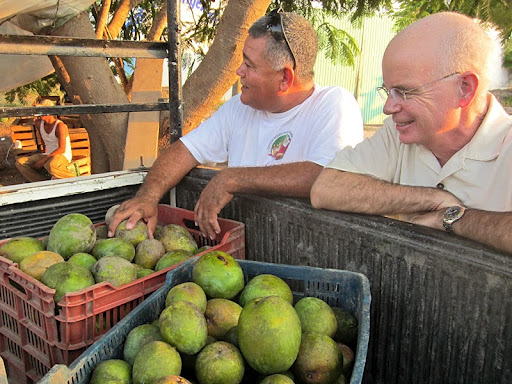
We had a FANTASTIC afternoon and evening learning about shrimping with a cast net/atarraya in the estuaries of Agua Verde, which is between Caimanero and El Rosario. We returned home with heartfelt smiles, new friends, 5 kilos of huge fresh shrimp (for which we paid about 7 bucks), a bunch of fresh crab (which our new fishermen friends gave us for free), and a bucketload of end-of-season mangoes ($4 for a crate full). ¡¡Viva Sinaloa y los Sinaloenses!!!!!!
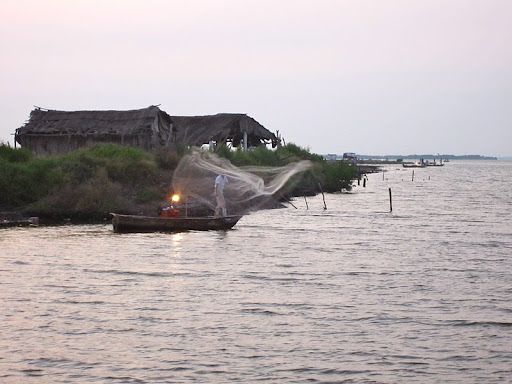
We set out late Saturday afternoon with our compadres, Jorge and Silvia, to attend the first annual “Festival de la Frasca.” While Jorge told me “frasca” is not a word, and that I surely must be trying to say “zafra” or “open season,” local people tell us it is a southern Sinaloan term meaning “to capture shrimp from the estuary.”
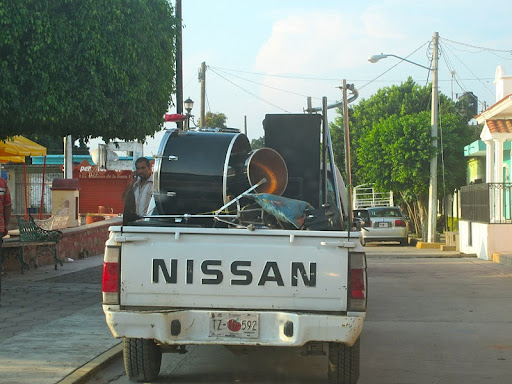
The Festival de la Frasca was supposed to be a food fest with live music. But as usual they were running late setting up, and before we could really get into the party we found much more exciting things calling us.

Just one month ago we had driven this very same road, but shrimp season is now open, and it was an even more wonderful place! I HIGHLY recommend you visit during shrimping season! While the season lasts 6 months, the first few weeks are supposedly the best, as the shrimp and the shrimpers are the most plentiful.

As we drove in we saw men with cast nets (atarrayas) everywhere.  Though mango season has finished, it is now the height of the shrimping season, and they have already planted tomatoes. After tomato season will come chile season, and so goes the year here.
Shrimp season is huge. We were told that opening day is like Carnaval—wall-to-wall people everywhere, with families fishing, picnicking and partying all night long. Family members come from all over the region back to Caimanero and Agua Verde to help with the shrimping, and to perform their obligations under the cooperativa(to work a minimum of so many hours and to capture a minimum of so many kilos). Women and children hang out with the fishermen, so it feels like life transfers from town to the estuary during this time.
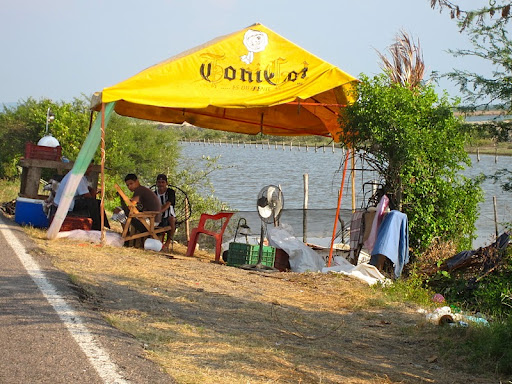
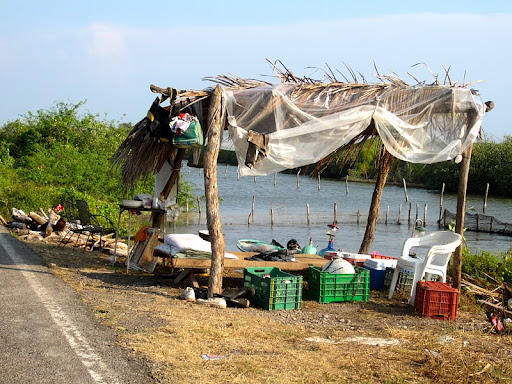
Beside the road that just two weeks ago looked so very different we saw little houses or shelters, many of them housing the shrimpers. A standard shelter like the one shown here has one or two lights powered by a propane tank, a plastic shelter for rain, chairs, a way to cook (usually a fire pit), a radio and a cell phone. As you can see, they sit just off the road. Can you imagine spending the night there with cars, trucks, and motorcycles coming by a few feet away from you all night?
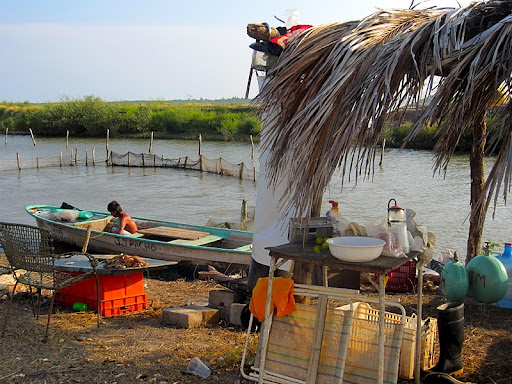
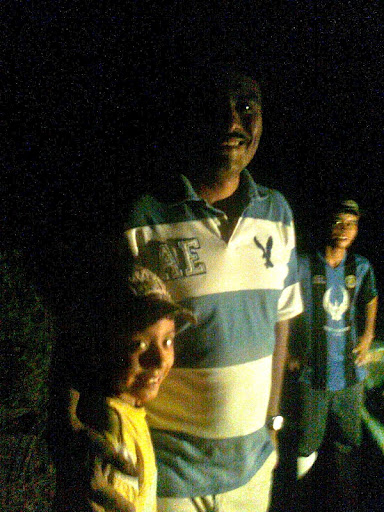
We greeted one of these guys, Rodolfo, at one of the stands, and he urged us to pull over and join him. So we did. The night crew, including Marco (who lives in Mazatlán but returns home for shrimp season), his 8 year old son and his 17 year old nephew, plus one other man, were just pulling up as we arrived.
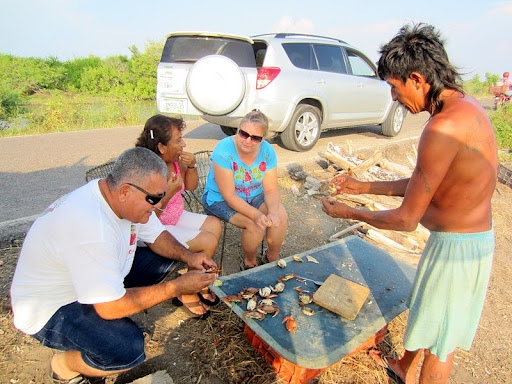
Rodolfo proceeded to feed us a whole mess of fresh crab and shrimp, beside the road, in the fresh breeze, looking out over the estuary. La vida dura. While I well know, from living in Japan, how to crack open a fresh crab, scrape out the lungs, and eat the juicy brain and meat, this fisherman really enjoyed teaching us, and my comadre, Silvia, really enjoyed learning.

Here we also ate shrimp crudo with salt and lime (my all-time favorite—huge prawns, still wiggling; oh yum!), but he also cooked some for Silvia in a pot of broth.

We stayed here about an hour, chatting, feasting and just generally relaxing. We bought our first few kilos of shrimp, as well as receiving a huge bagful of cooked crab.
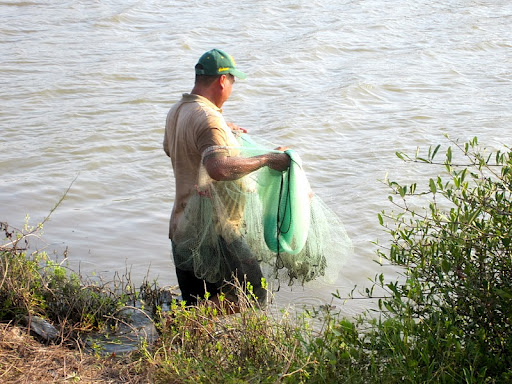
There were also many changueros, who we’ve heard about since arriving in Mazatlán, but this was the first time we met a few. They are estuary shrimpers who are not members of a cooperativa. They catch shrimp but legally are not supposed to be doing so. Many of the changueros used purina (shrimp chow) to get the shrimp up to the surface. None of the cooperativa fishermen we met used purina. They were very proud to explain to us that their shrimp were the purest.

Below is a video of one shrimper casting a net, and his wife helping him take out the shrimp and put them into a bucket.
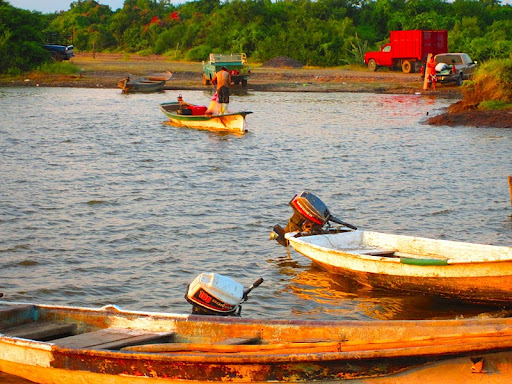
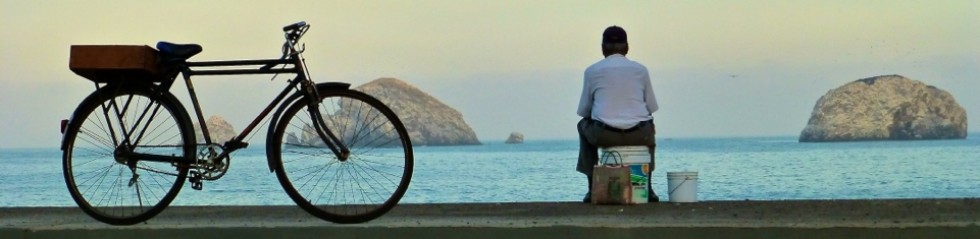
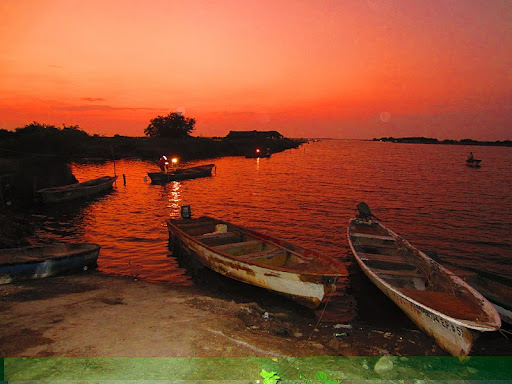
After getting back in the car, we made the rounds of several cooperativas. At the first one the view was spectacular.
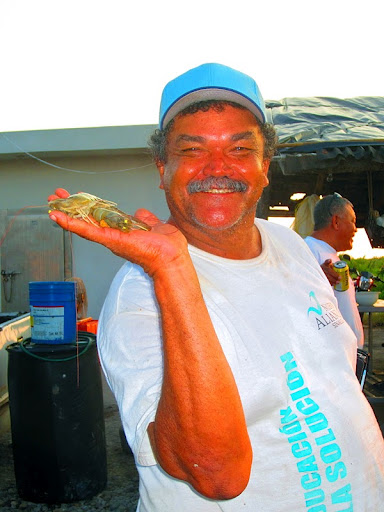
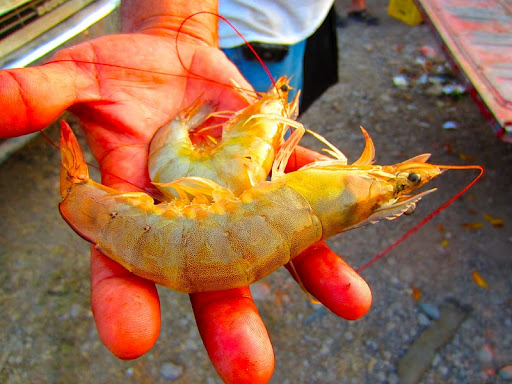
Rodrigo, a man we met there, sold us some more live shrimp. At left is his photo, and below a video of some of the shrimp wishing they could run away.

We had arrived here just in time for sunset. The sky and the water glowed. People were all so friendly, open and hospitable that it was amazing. Everyone was eager to talk, to explain this long Sinaloan shrimping tradition, and to share their catch of the day with us. To me this frasca tradition is soooo important; it’s Sinaloa’s history, and the if not some of the best shrimp in the world. And tons of it are harvested BY HAND here each year and shipped worldwide. I know such shrimping used to happen right here in Mazatlán; even next to Hotel Playa was an estuary (no wonder Zona Dorada floods).

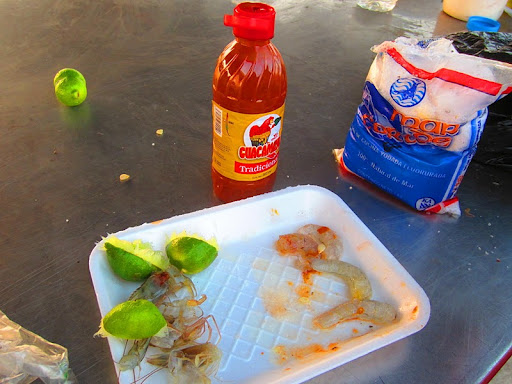
The fishermen brought out packets of salt, fresh limes and bottles of salsa, and urged us to eat from their catch to our hearts’ content. Alfresco dining overlooking the estuary with friendly, happy, relaxed, knowledgable people; it was a wonderful afternoon. Every boy we met knew how to cast a net. They seem to start as young as seven or eight.
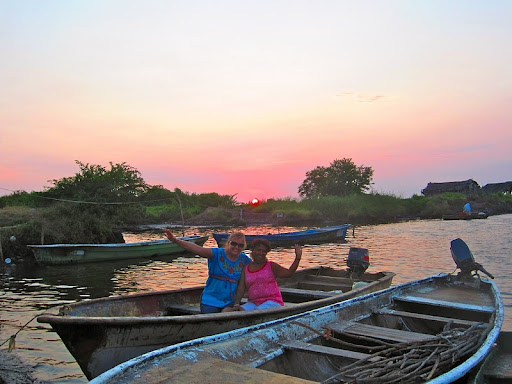


“Girls just wanna have fun…”

We also sat here for quite a long time, again feasting on raw shrimp (no cooked ones this time), and watching the guys cast their nets in the scenic little harbor.

The video below shows a guy casting his net from a panga, so you can see that as well as the earth-bound approach shown above.

The pangas or small fishing boats go out with two guys normally, one remero or rower, and one atarrayero or net caster. Most of the estuary is only hip- or waist-deep, so the remero carries a long stick or remo and basically pushes the panga along, similar to the movement of the gondolas in Venice.

Below is a short clip of the gentleman at left rowing.
There are various cooperativas to which the shrimpers belong. This drive out to one of them was really something — estuary on either side of the road, with loads of lit pangas all around.

Below is a video, so you can get a better feel for this road-with-water-on-both-sides drive.
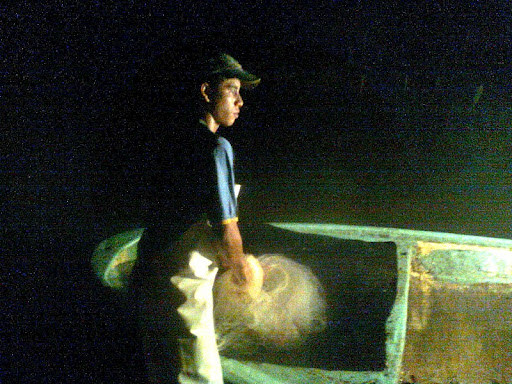
After visiting some very cool places and meeting lots of wonderful people, we ended up spending another couple of hours sitting with Marco and his family. It was so peaceful there, and so very pleasant. Excuse the poorer quality of the photos from here on. The batteries on our camera died, so the remaining photos are taken with our phone.

On the way out we stopped at one last cooperative, this one the largest we’d seen. Here they had a large building or warehouse, surrounded by dozens of pangasfishing. Families were sitting and standing everywhere, waiting for their husbands, fathers, boyfriends and brothers to come in with their catch.

A semi-truck full of ice was waiting nearby.

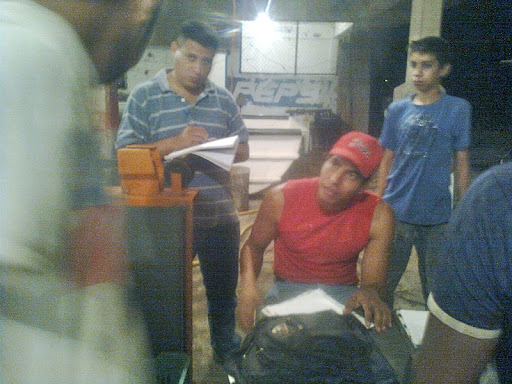
A group of men with a scale and ledgers was registering incoming shrimp.
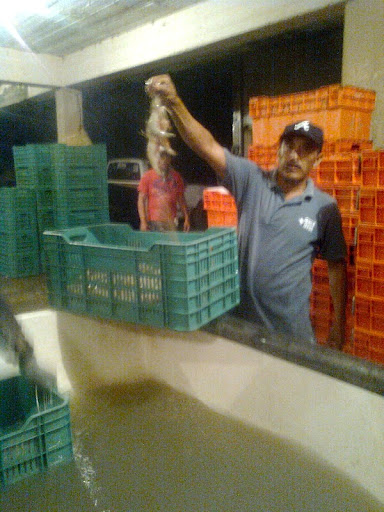
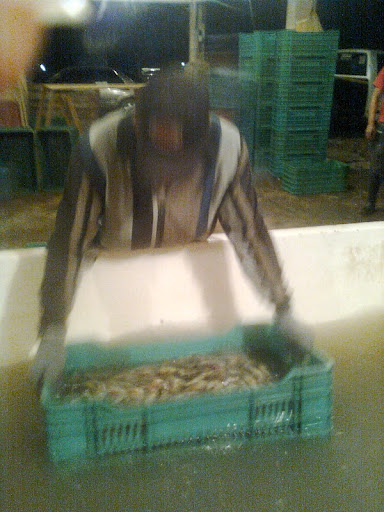
After dipping the bins full of shrimp into ice water, they placed the bins in the refrigerated truck where they are covered with ice and then taken to Mazatlán for sorting, packing and export.

It was at this last cooperative that we also saw our youngest atarrayero, this boy of about eight, at left.

We kept telling our friends that this was an otro mundo, or other world, that most guests in Mazatlán don’t know anything about or understand. We learned a lot about how the cooperativas function and about the life of a shrimper. We all got to eat live shrimp and enjoy some great company. The festival probably happened, but we know we had a lot more fun hanging out with our friends and meeting new ones. We already have plans to go back. We will definitely go opening night next year for the carnaval de cameron, and will head out some month just before the full moon when the really large shrimp are said to be much more plentiful and easier to catch. To be able to find Rodolfo and Marco’s shelter, we put their spot into our GPS and got their cell phone number. Stay tuned.
UPDATE:

Un Domingo Típico Mazatleco/Sunday Afternoon in Mazatlán

Mazatlán has so very many terrific aspects, but one of our absolute favorites is the music. Live music. Whether it be a single bohemio with guitar strolling past, a world-class symphony or opera in the Angela Peralta, a norteña on the beach, or a complete live band, we trust this enjoyable aspect of life here in our port will never fade!!

We are fortunate to have compadres y comadres we’ve known for over 30 years, and we love to enjoy a “quiet” Sunday afternoon of fresh fish, seafood and, of course, beers for the adults, together with them.  One recent Sunday the “boys” started outdoing each other (God bless machismo, a veces), and before the afternoon was over they had hired three separate bands to play for us for hours. Here is a taste.


This first clip above is an instrumental, by the house band that played first for us that Sunday. The name of the song is “Tecateando,” but as we live in the home of Grupo Modelo, we prefer to call it “Pacifiqueando.” Enjoy! You’ll see the signs around for zarandeado, fresh oysters… We have terrific seafood here. You’ll also get a taste of the gorgeous weather we enjoy.


The second clip, above, I post as a tribute to the lead singer. In this one he’s singing Chuy Lizárraga’s popular song, “La Peinada.”


This third clip is of our second band of the day, a smaller norteña group. You can see how difficult it is to relax here, lol…


And, as always, the best for last: El Tololoche Chicoteado! By now things have warmed up, food has been eaten, and beer has been imbibed. This third group had a drummer who took the bass player’s place to dance with the bass, as you’ll see. Once he finished, the bass player decided he wasn’t so elderly after all, and he could dance and jump with his bass as well as the drummer could. It made for a terrific culmination to the day.

When you come to Mazatlán to visit, we know you’ll LOVE our músicos. If you live here, please, please help support our local live music scene! I’ll finish this post with a photo of a cubeta from a typical Sunday afternoon here:

Names and Apellidos

Phone calls are rarely easy in a new language or culture. I remember calling a friend, Arnoldo, shortly after we’d moved here. The person who answered yelled out for “Lalo” to come to the phone! What’s up with that? “Lalo” is short for “Eduardo,” not “Arnoldo!” Had they misheard me? Was my pronunciation that bad? I didn’t want to speak with someone I didn’t know…

A few months later I received a call from a friend who told me she was “Bertalicia,” a rather long name with the emphasis on the “Alicia” ending. I couldn’t figure out who she was, even though she repeated herself several times. It was embarrassing. Eventually she had to explain to me who she was. Why? Because I knew her as “Bertha.”

Then, I’ve called a home to ask for someone, only to be asked “which one?” It is a very common practice to name daughters after their mothers, and sons after their fathers. So, they could be asking whether I want to speak to the parent or the child. But, at least in this part of México, it is also common for several (or all) children to share the same first name!!!! We know one family of girls named María Ana, María José, and María de la Luz, and María de Pilar. Through experiences like these I’ve come to learn that particularly “José” and “María” are more like placeholders or titles rather than names; the commonly used name would be the composite or, often, just the second name.

“María” and “José” are obviously very, very common names in Spanish. Want to complicate matters a bit more? A man can have the name “María,”as in “José María.” Likewise, a woman can have the name “José,” as in “María José.”

And, we all know that Mexicans LOVE apodos or nicknames! There are the “standard” versions for men and women, such as when Jesús become Chuy, Mercedes becomes Meche, or Francisco becomes Pancho or Paco. In the above case, Ms. María Jose might be called Pepa, Pepita, Josefa, or even José, so be careful about gendering! Likewise, “Lupe” or “Guadalupe” can be male or female. There are also the individual nicknames, most often referring to a physical feature (flaco, pelón, negro) or personal characteristic (loco).

The stereotype, of course, is that Spanish speakers all have llllloooooooonnnnngggg names. How many movies have we seen where, women particularly, spend several minutes rattling off their multiple names? But what I have found most surprising and confusing is that people are called differently by different people. What should I call people? Ok, my Dad was called “Charlie” by people who grew up with him, and “Chuck” by those who knew him as an adult. But names here are more complicated than that. We know one guy who told us his name was “Victor.” Most everyone else we know calls him “Lorenzo.” At work, however, he is called “Toby,” a nickname taken from a television show about a boys’ club. I hate to ask him what his family calls him.

Remember back in high school Spanish classes, when they taught us the “rules” around names in Spanish? Here’s what I remember learning way back then:

  • People have a first or given name (e.g., Ana or Juan).
  • Sometimes they also have a second name (e.g., María or Pedro). In this case, their given name is a composite: Ana María or Juan Pedro. They may be called by one or both names.
  • It is also rather frequent for people to use a confirmation name (e.g., Teresa or Antonio). These often are not used on a daily basis, but can form part of a person’s complete name.
  • These given names are followed by apellidos or family/surnames: their father’s family name first (e.g., Ana María Teresa Pérez, or Juan Pedro Antonio Lizárraga), followed
  • By their mother’s family name (e.g., Ana María Pérez Fernández, or Juan Pedro Antonio Lizárraga Castro).
  • When a woman marries (e.g., the two people named above), she maintains rather than changes her family name and, in some situations, adds “de” and the family name of her new spouse (spouse’s father’s name) (e.g., Ana María Pérez de Lizárraga or Ana María Pérez Fernández de Lizárraga).
  • Their children’s names would follow the same rules, so in the case above the children’s last names would be Lizárraga Pérez, with “Lizárraga” being the main apellido.

That’s all fine and good, but I’ve come to find out there are national, regional, ethnic, socio-economic and familial variations on naming, as well as LOADS of exceptions to these rules. I know one family, for example, where each son in the family fortunately uses only one given name, but they have THREE surnames: de Alba Rulfo de Jimenez. Huh? Two Moms? Children of divorce? What the heck??? No, I’ve come to find out that there are also composite last names! Such composite surnames may be connected by “de” or by a hyphen. Sometimes only one of these is used, though officially it should be both (or all). And we can all see what happens when someone with a composite surname marries another person with a composite surname! Bring on the funny movie clips!

And if you, like us, have “gringo” names or, worse yet, a spouse with ONLY ONE given name, Lord help you when people try to enter your name into a computerized form down here. Most programs seem to require a second surname, and many also request a second given name. Thus our son ends up having to use his middle name, which he very much dislikes.

As with English names (hyphenated family names, for example), there are modern-day variations on naming practices in Spanish. In Spain, for example, the traditional order of surnames can be reversed under current gender equity laws, so that children use the mother’s surname first, followed by the father’s. There also seem to increasingly be more women who do not use their husband’s names. Maybe they established themselves professionally before marriage, or they hold professional licenses in their maiden names.

One final confusion I’d note is that, in writing, people often abbreviate names, whether given names or surnames. Thus, “María” becomes “Ma” and “Agustín” become “Ag.” It might be worthwhile to familiarize yourself with a few of the more common abbreviations.

I eagerly look forward to your teaching me more, or correcting my errors!!!! Thanks!

Have fun!

Saludos,

Dianne, Diana, or Di

Street Vendors

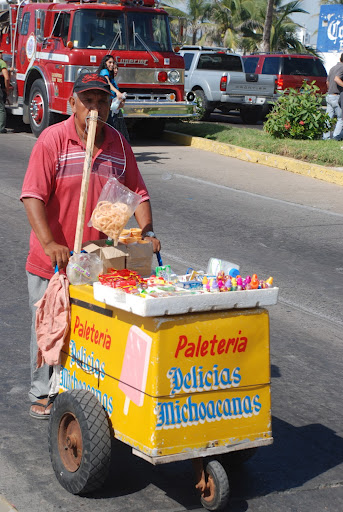
Part of what we love living here in Mazatlán is that you can buy almost anything you need so conveniently. “Ambulatory” street vendors walk, push carts, ride bicycles (many of them modified to carry their wares) or motorcyles around town, selling their wares. There are also many open-air stalls that make eating healthy (or not) quite convenient.

This blog post is just a collection of a few street vendors photos. Enjoy!

Ice cream vendor on Avenida del Mar

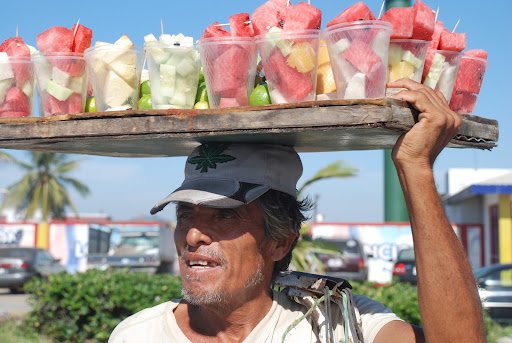
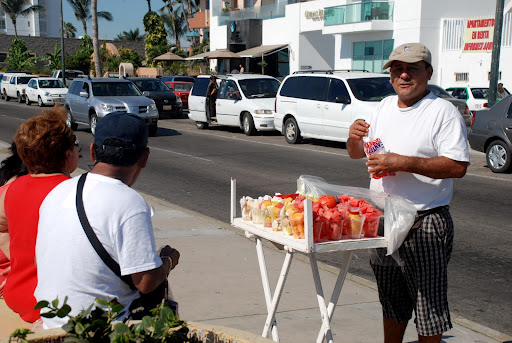
Our favorite fruit seller, who works our beach

And one of his competitors

Gelatinas, or jello molds

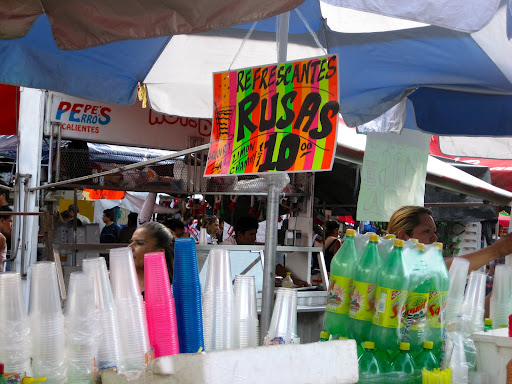
Various refreshing drinks, this photo taken in Guadalajara

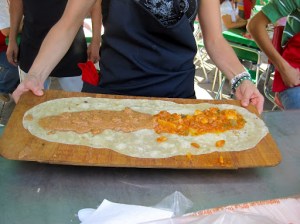
Giant burrito seller, again in Guadalajara

Vegetable seller: Nice to be able to buy healthy street food!

Another kind of fruit seller, not the ambulatory kind 🙂

Flower and plant vendor

Ceviche (fresh fish or shrimp with lime juice and some vegies) and Tostilocos (pack of tortilla chips covered with salsa and sometimes beans or cheese or meat)

Sugar cane and cane juice vendor, in a market


Broom and mop vendor


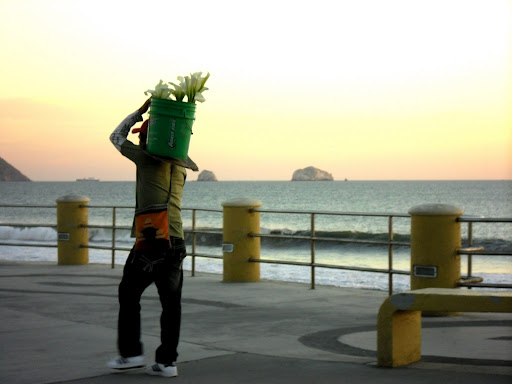
My favorite calla lily seller, at sunset on the malecón in front of our house

And this beach vendor came up to our house to measure my laptop and make me a custom-fitted computer bag out of beach trash (chip, candy and cookie wrappers)

Lotería as Modern Social Commentary


Most of you are familiar with the very popular Mexican game called Lotería. The Lotería images are iconic worldwide: esteemed by collectors, represented in art, and used in crafts projects. Recently a girlfriend of mine sent me images for a 21st century update of the Lotería cards that provide an insightfully scathing social commentary, packaged in this most innocuous of game wrappings.

The traditional El Pájaro, as shown at left, was a merry looking songbird. The updated version I received, at right, is dead on the beach, covered with oil.

There are quite a few themes that appear in the set of 27 (vs. the traditional 54) cards that I received. The top four themes in order of frequency on the cards are:

  1. Crime and Violence (7 of the 27 cards)
  2. Environmental Destruction (5 cards)
  3. Drugs, and Alcohol (5 cards)
  4. Breakdown of Social Values (2-4 cards, depending on how you categorize them)
Many Mexicans play Lotería with their families and friends, particularly when the children are joining in. The best part about Lotería is the caller, or cantor. S/he often tells riddles or jokes about the image, which is often the funnest aspect of the game.

A wonderful thing about Lotería is how adaptable it is. While the traditional images are known by everyone, you can find Lotería games customized to many specialized purposes. I love using games as learning tools, and I’ve often used Lotería or Bingo to teach vocabulary or review basic concepts. These new cards would lend themselves well to current events! I have no idea who created the new images in this post. If you know, please let me know! I can only imagine what fun a good cantor could have with these newly revised cards!

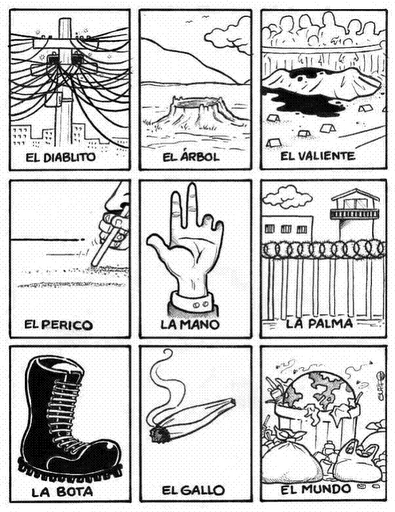
First let me show you a few of the new cards, next to their more traditional predecessors. The traditional version is colorful. The cartoonist (I assume) who drew these new cards used monochrome pen and ink.


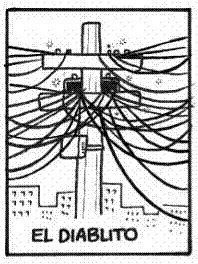
El Diablito, traditional at left and updated at the right. At first I thought it referred to the infrastructure realities we live with here: Will the phone work today? Will the rainstorm cause a power outage? Will we have internet? I have now learned that “diablito” refers to all those stolen electrical (and cable) hookups we see all around town.

La Calavera, traditionally the skull but updated to a young woman with an eating disorder. Definitely a serious issue in this style-conscious society.

A few of the traditional and updated cards urging us to be environmentally responsible include El Árbol, El Mundo, and El Sol. Terrific awareness raising, no?

Comparing a few traditional and updated cards from the theme of violence and crime includes El Valiente, La Mano, and La Sirena. Yes, a return to respect for others and for human life, please!

And finally, a couple of traditional and updated cards under the theme of the decay of social values include El Corazón (referencing the rampant poverty, homelessness and street corner begging in this beautiful country) and La Dama, sadly transformed into a table dancer (a different sort of “respect” or “empowerment” for women than the traditional card, for sure).

I post here the complete three sets of new cards that I received. In addition to the before-and-after photos above, noteworthy on this first page are La Palma (violence and crime),  El Perico and El Gallo, (drug use).

This second set includes another card about organized crime (Los Pinos, the Mexican “White House”). We also see the new themes of drugging our children in the name of health (La Muerte), and racism (El Negrito), which seems to me to exist in the traditional set as well.

In this third and final set of cards you see a card on immigration and the border “war” with Mexico’s northern neighbor (La Bandera), in addition to a few more related to crime and violence and a couple about alcohol and drugs.

All in all, a VERY strong and up-to-date social commentary, I would say.
 
How Lotería Is Played

You can buy Lotería sets very cheaply in almost any stationary or toy store. They make great gifts. Each player receives at least one tabla (card). Rather than five squares across, as in Bingo, Lotería cards have four images across and four down, for a total of 16 squares on each card. See the traditional Don Clemente images here.

As in Bingo, there is an announcer, in this case called the cantor (singer). The cantor has a deck of 54 cards, each with an image, a name and a number (I’ve never seen the numbers actually used). The images in the deck correspond to those on the tablas. The cantor randomly chooses a card from the deck and announces the drawing’s name or, oftentimes, a corresponding riddle (e.g., “The one who sang to St. Peter won’t sing to him again:” The Rooster) or joke to the players.

Players who have that image on their tabla use beans, bottle caps or other household items to mark the spot, trying to get four in a row: across, down, or diagonally. The first player to get four in a row wins, screaming “Lotería” or “Buena” to indicate their victory.

Well, someone, who I don’t know, has taken the time to update this classic game, making it more in tune with the 21st century.